
Sunil Devchand Ghudka Vs ITO (ITAT Rajkot)
Reassessment Cannot Stand Where the Section 151 Approval Is Neither Digitally Nor Manually Signed ITAT Rajkot
Unsigned Approval Invalidates Reassessment
The Rajkot Bench of the Income Tax Appellate Tribunal allowed the assessee’s appeal after finding that the approval under Section 151 of the Income-tax Act, 1961, on which the reassessment was based, bore neither a digital nor a manual signature. The Tribunal followed its coordinate bench decision in M/s Aditya Plastic, which held that reassessment founded on an unsigned approval could not stand. The appeal was thus decided on the validity of the statutory approval, and the Tribunal did not examine the merits of the disputed cash deposit.
Reassessment Concerned a ₹1.20 Lakh Cash Deposit
The Assessing Officer passed an order on 27 February 2024 under Section 147 read with Section 144B for Assessment Year 2019–20. The officer treated a cash deposit of ₹1,20,000 in the assessee’s bank account as unexplained money under Section 69A and applied the tax rate prescribed by Section 115BBE.
After the Commissioner of Income Tax (Appeals), National Faceless Appeal Centre, dismissed the first appeal, the assessee approached the Tribunal. He challenged the dismissal of his first appeal, the jurisdiction to issue the notice under Section 148 and make the reassessment, and the addition on merits. At the hearing, the argument that decided the case was that the document relied on as the specified authority’s approval had never been signed, either manually or digitally.
Tribunal Condones the 25-Day Delay
The appeal before the Tribunal was filed 25 days late. The assessee supported his request for condonation with an affidavit explaining the delay, while the Revenue opposed the request. On examining the affidavit, the Tribunal found mitigating circumstances sufficient to exercise its discretion in the assessee’s favour. It condoned the delay and proceeded to consider the jurisdictional objection.
Section 151 Approval Must Precede the Section 148 Notice
The assessee relied on M/s Aditya Plastic, ITA No. 185/Rjt/2024, AY 2013–14. In that case, the Rajkot Bench had examined an approval attributed to the Principal Commissioner of Income Tax that bore no signature and for which no Document Identification Number (DIN) had been generated. It quashed the reassessment on the ground that there was no valid approval under Section 151.
The coordinate bench had relied on the Allahabad High Court’s decision in Vikas Gupta v. Union of India, (2022) 142 taxmann.com 253 (Allahabad). There, the digital records showed that the prescribed authority had digitally signed the approval after issuance of the Section 148 notice. The High Court held that the Assessing Officer lacked jurisdiction when the notice was issued because the prescribed authority’s valid satisfaction had yet to be recorded. The later signature did not cure the defect in the notice.
The two cases illustrate different defects in the same statutory step. In Vikas Gupta, the signature established when the approval was granted, and that time was too late. In Sunil Devchand Ghudka, the approval placed before the Tribunal lacked both forms of signature. The Tribunal applied Aditya Plastic because the unsigned record could not establish valid sanction for initiating the reassessment.
Revenue Produced No Material to Displace the Precedent
The Tribunal examined and reproduced the Section 151 approval in its order. It found that the approval bore neither form of signature and that the Revenue had produced no material to distinguish the case from the coordinate bench ruling. It therefore followed Aditya Plastic and allowed the assessee’s appeal.
Although the Tribunal reproduced the earlier decision’s reference to a missing DIN, its finding in the present case centred on the absence of authentication by signature. The resulting relief flowed from the jurisdictional defect. The Tribunal made no separate finding on the source of the bank deposit or on the application of Section 115BBE to that deposit.
Author’s Comments
The decision underscores the importance of examining the approval itself when challenging a reassessment. A reference to sanction in the assessment record does not resolve whether the specified authority authenticated the approval. Where the approval is digital, the record may also show when the approval was authenticated. That timing can be decisive because the approval must exist when the Assessing Officer issues the notice.
The practical distinction is between a document purporting to record approval and evidence that the competent authority actually granted it before the notice. In this case, the Tribunal inspected the approval and found no manual or digital signature. In Vikas Gupta, the authenticated record supplied the answer through its timestamp. Read together, the decisions show why both authentication and chronology matter to a jurisdictional challenge under Section 151. Once the Tribunal accepted that challenge, the assessee obtained relief without having to establish the source of the ₹1.20 lakh cash deposit.
Cases Discussed
- M/s Aditya Plastic (ITAT Rajkot), ITA No. 185/Rjt/2024, AY 2013-14: Reassessment proceedings based on an approval under Section 151 lacking the signature of the Principal Commissioner of Income Tax were held invalid. Followed by the Tribunal.
- Vikas Gupta Vs Union of India (Allahabad High Court), (2022) 142 taxmann.com 253: A notice under Section 148 issued before the prescribed authority digitally authenticated its approval under Section 151 was held to be without jurisdiction. Relied upon in the coordinate bench decision.
FULL TEXT OF THE ORDER OF ITAT RAJKOT
Captioned appeal filed by the assessee, pertaining to assessment year (AY) 2019-20, is directed against the order under section-250 of the Income-tax Act, 1961 (hereinafter referred to as ‘the Act’) passed by the National Faceless Appeal Centre (NAC) Delhi/Commissioner of Income-tax (Appeals) [in short ‘NFAC/Ld.CIT(A)’], dated 07.04.026, which in turn arises out of an assessment order passed by the Assessing Officer u/s 147 read with section 144B of the Act, dated 27.02.2024.
2. The grounds of appeal raised by the assessee are as follows:
1. The learned Commissioner (Appeals), National Faceless Appeal Centre (NFAC), Delhi, erred in dismissing the appeal of the Appellant by failing to appreciate that the appellant was interested in pursuing the appeal.
2. The learned Commissioner (Appeals), National Faceless Appeal Centre (NFAC), Delhi erred in sustaining action of the Assessment Unit, Income Tax Department in issuing notice u/s 148 and passing of order u/s 147 of the Act, by failing to appreciate that the same are bad in law and without jurisdiction.
3. The learned Commissioner (Appeals), NFAC, Delhi erred in confirming the action of the Assessment Unit, Income Tax Department in making addition of Rs. 1,20,000/- u/s 69A of the Act by treating cash deposited in bank accounts as unexplained money and thereby levying tax at rates specified u/s 115BBE of the Act.
4. The appellant craves leave to add, amend, alter and withdraw any ground of appeal anytime up to the hearing of this appeal.
3. When the matter was called for hearing, the learned counsel for the assessee at the outset submitted that the appeal has been filed by the assessee belatedly. The learned counsel adverted my attention to the affidavit filed in this regard citing reason for condonation of delay and urged for a benign view and sought condonation of delay of 25 days in filling the appeal before the Tribunal. On the other hand, Ld. AR for the Revenue opposed the prayer of assessee for condonation of delay. A perusal of the affidavit gives me an impression of existence of mitigating circumstances to enable me to exercise my discretion in favour of the assessee. Accordingly, the delay is condoned.
4. When the appeal was called out for hearing, Ld. Counsel for the assessee invited my attention that the issue is squarely covered in favour of the assessee by the judgment of the Coordinate Bench of ITAT Rajkot, in the case of M/s Aditya Plastic, in ITA No.185/Rjt/2024, for AY 2013-14. In the assessee’s under consideration the approval under section 151 of the Act is neither signed digitally nor manually, therefore, reassessment proceedings initiated based on the defective approval under section 151 of the Act should be quashed.
5. On the other hand, Ld. DR for the revenue relied on the findings of the Assessing Officer.
6. I have heard, both the parties and perused the material available on record. I note that the approval given under section 151 of the Act, which is unsigned that is neither signed digitally nor manually, which is reproduced below:
GOVERNMENT OF INDIA
MINISTRY OF FINANCE
INCOME TAX DEPARTMENT
OFFICE OF THE PRINCIPAL COMMISSIONER OF INCOME TAX
PCIT, Jamnagar
Approval u/s 151 of the IT Act, 1961
| PAN | Assessment Year | Date | DIN |
|---|---|---|---|
| BPTPG2049L | 2019-20 | 21/03/2023 | ITBA/AST/S/118/2022-23/1051028792(1) |
—
| 1. | Name of the assessee | SUNIL DEVCHAND GHUDKA |
|---|---|---|
| 2. | Address and e-mail of the assessee | 136, DABASANG, DABASANG, LALPUR, JAMNAGAR |
| 3. | PAN | BPTPG2049L |
| 4. | Status | Individual |
| 5. | Circle/Ward/Range/CIT Charge | ITO WD 1(6), JNR / JCIT RANGE 1, JAMNAGAR / PCIT, Jamnagar |
| 6. | Assessment year | 2019-20 |
| 7. | The quantum of income which has escaped assessment | 600000 |
| 8. | Approval needed for | Order u/s 148A(d) required for issuance of notice u/s 148 |
| 9. | Time limit for current proceedings covered under | u/s 149(1)(a) – for 3 years |
| 10. | Limitation date for issuance of notice u/s 148 | 31/03/2023 |
| 11. | Whether the show cause notice u/s 148A(b) contains the details of the information, as per explanation-1 of Section 148. | Yes |
| 12. | (i) Enquiry conducted (if any), u/s 148A(a) | Yes / 15-FEB-23 |
| (ii) Whether the show cause notice u/s 148A(b) contains the details of results of enquiry conducted 148A(a) | Yes | |
| 13. | Date of issue of show cause notice to assessee u/s 148A(b) | 27-FEB-23 |
| 14. | Date by which assessee was required to submit reply to show cause notice u/s 148A(b) or the final extended date | 06-MAR-23 |
| 15. | Whether any reply received from assessee u/s 148A(b)? | No |
| 16. | Whether personal hearing requested by assessee | No |
| 17. | Whether the provision of Sec. 150(1) are applicable | No |
| 18. | Reasons for the belief that income has escaped assessment | Refer Order u/s 148A(d) for details |
| 19. | Recommendations of the Additional/Joint CIT | Remarks: With due application of mind, it is found on the examination of facts, that it is a fit case for issuing notice u/s 148 of the Act, 1961.
Name: OM PRAKASH CHAUDHARY Designation: JCIT RANGE 1, JAMNAGAR Date: 14/03/2023 |
| 20. | Recommendations of the CIT/PCIT (where CCIT/PCCIT is the specified authority) | Remarks: N/A
Name: N/A Designation: N/A Date: |
| 21. | Recommendations of the CCIT (where PCCIT is the specified authority) | Remarks: N/A
Name: N/A Designation: N/A Date: |
| 22. | Reasons for according approval/rejection by the specified authority to order u/s 148A(d) AND/OR issuance of notice under section 148 of the Income Tax Act, 1961? | Remarks: I have perused the content of draft order u/s. 148A(d) of IT Act submitted by the AO through Range head in this case. Looking to the information received and the opportunity given, the said draft order u/s. 148A(d) of the IT Act is found in order. I am satisfied that this is fit case to issue notice u/s. 148 of the IT Act. Therefore, undersigned being the competent authority as per section 151 of the IT Act, approval is accorded as per the provisions of section 148 of the IT Act.
Name: SANDEEP JAIN Designation: PCIT, Jamnagar Date: 21/03/2023 |
ANNEXURE
The assessee has not filed return of income for AY 2019-20. Further, as per the information available on Insight Portal under case type: RMS – Non-Filing of Return PAN Cases, it is noticed that assessee has entered into financial transactions during AY 2019-20 as per the details mentioned below:
| Information Description | Information Source | Account No. | Information Value (in Rs.) |
|---|---|---|---|
| Cash deposits in an account other than current account | BANK OF BARODA
(Filer PAN: AAACB1534F) |
11570100010567 | 1,20,000 |
| 11570100010567 | 1,20,000 | ||
| 11570100010567 | 1,20,000 | ||
| 11570100010567 | 1,20,000 | ||
| 11570100010567 | 1,20,000 |
7. Since, the above approval under section 151 of the Act, is neither signed digitally nor manually, therefore, issue is squarely covered by the Coordinate Bench of ITAT Rajkot, in the case of M/s Aditya Plastic, in ITA No.185/Rjt/2024, for AY 2013-14. The findings of the Coordinate Bench are as follows:
“8. We have heard both the parties, perused the material available on record. We note that the approval of the PCIT is without any signature of the Ld.PCIT and without generating any DIN number which is reproduced below:
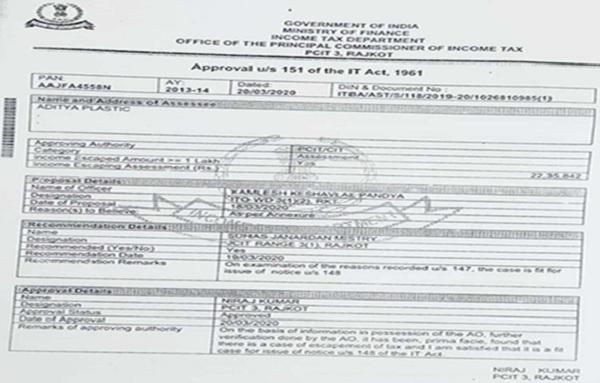
8.1. Therefore, the Ld.Cousel for the assessee has stated that the approval u/s.151 of the Act dated 30/03/2020 is not signed by the Ld.PCIT and, hence, it is not considered as a valid approval/satisfaction and, thus, the notice u/s.148 of the Act issued on the basis of said approval is bad in law and without jurisdiction. For that, reliance is placed on the judgement of Hon’ble High Court of Allahabad in the case of Vikas Gupta reported at (2022) 142 taxmann.com 253 (Allahabad HC). The relevant part of judgement is reproduced:
13. Thus, as per provision of section 151 of the Income-tax Act, 1961, an assessing officer gets jurisdiction to issue notice to an assessee under section 148 of the Act, 1961 after Principal Chief Commissioner or Chief Commissioner or Principal Commissioner or Commissioner of Income-tax is satisfied on the reason recorded by the assessing officer that it is a fit case for issuing such notice. The date and time of the approval granted digitally under section 151 of the Act and the date and time of the notice under section 148 of the Act, shows that the satisfaction was recorded by the PCTT digitally after the notice under section 148 was digitally signed.
29. In the present set of facts there was no valid satisfaction recorded by the by the Prescribed Authority under section 151 of the Act, 1961 when the Assessing Officer issued notice to the assessee under section 148 of the Act, 1961. At the time when the notice under section 148 of the Act, 1961 was issued by the Assessing Officer to the petitioner there was no valid satisfaction recorded by the Prescribed Authority ie. the Principal Chief Commissioner or Chief Commissioner or Principal Commissioner or Commissioner. Subsequent to issuance of the notice under section 148 of the Act, 1961 by the Assessing Officer, the satisfaction under section 151 was digitally signed by the Prescribed Authority. Therefore, the point of time when the Assessing Officer issued notices under section 148, he was having no jurisdiction to issue the impugned notices under section 148 of the Act, 1961. Consequently the impugned notices issued by the Assessing Officer under section 148 of the Act, 1961 were without jurisdiction. The questions no. (a) and (b) are answered accordingly.
8.2. Therefore, based on these facts and circumstances of the case, the assessment order framed by the AO needs to be quashed as there was no approval u/s.151 of the Act for initiating the re-assessment proceedings by the Ld.PCIT, therefore, on this count the assessment order framed by the AO should be quashed.”
8. As the issue is squarely covered in favour of the assessee by the decision of Coordinate Bench of ITAT Rajkot, in the case of M/s Aditya Plastic, in ITA No. 185/Rjt/2024, for AY 2013-14 (supra), and there is no change in facts and law and the revenue is unable to produce any material to controvert the aforesaid findings of the Division Bench (supra). I find no reason to interfere in the said order of the Division Bench (supra). Therefore, respectfully following the binding precedent of the Coordinate Bench (supra), I allow the appeal of the assessee.
9. In the result, the appeal of the assessee is allowed.
Order is pronounced in the open Court on 23/11/2026.



