Summary: Real Estate Investment Trusts (REITs) allow investors to participate in commercial property income through units they can acquire in a public issue or buy on a stock exchange through a Demat and trading account. Distributions and unit values can fluctuate. Form 77, which replaces Form 64B, gives unitholders the distribution breakdown and is due by 30 June following the relevant tax year. In the article’s illustration, a ₹1 lakh investment yields ₹8,000, comprising ₹3,000 in interest, ₹2,000 in capital repayment and ₹3,000 in dividend. At the assumed 30% slab rate, the interest attracts ₹900 in tax before surcharge and cess. The capital repayment, assumed to qualify for a cost adjustment, reduces the acquisition cost to ₹98,000, resulting in a ₹12,000 long-term capital gain on a sale at ₹1.10 lakh after two years. The article explains that the 12.5% rate applies to aggregate eligible long-term gains above ₹1.25 lakh, subject to statutory conditions. It also discusses the Ahmedabad ITAT’s decision to delete an addition of approximately ₹49.64 lakh for AY 2023–24 under the earlier law, and explains the separate amendment effective 1 April 2026 that exempts qualifying dividends regardless of the underlying SPV’s corporate tax election. Investors can use the distribution statement to reconcile tax credits, report each component in the appropriate return schedule and track adjustments to the acquisition cost.
Mr. Sharma has recently retired and wishes to invest a portion of his retirement corpus in an investment that generates regular income.
He is attracted to the idea of earning rental income from commercial property. However, purchasing an office space in a prime location requires a substantial investment. Finding tenants, collecting rent and maintaining the property are additional responsibilities.
What if Mr. Sharma could earn a share of the rental income generated by a large IT park or a shopping mall without actually purchasing or managing a property?
And all this without investing crores of rupees!
Sounds interesting?
This is where REITs (Real Estate Investment Trusts) come into the picture.
- What Exactly Are REITs?
- How and Where Can Mr. Sharma Invest?
- Through a Public Issue:
- Through the Stock Exchange:
- How Does His Investment Generate Income?
- Form 77 – Income Distribution Statement
- One Bank Credit – Different Tax Treatments!
- 1. Interest – ₹3,000
- 2. Repayment of Capital – ₹2,000
- 3. Dividend – ₹3,000
- ₹49.64 Lakh in Dividends – Why Did the Investor Receive an Income Tax Notice?
- Why Was the Exemption Disallowed?
- What Did the ITAT Decide?
- What Has Changed Under the Income-tax Act, 2025?
- What Should Investors Keep in Mind While Filing Their ITR?
- Conclusion
- Cases Discussed
What Exactly Are REITs?
Most of us are familiar with mutual funds, where money collected from several investors is pooled and professionally invested in shares, bonds and other financial instruments.
REITs work on a broadly similar concept of pooled investment. The key difference lies in the nature of the underlying assets.
| Investment Option | Where the Money Is Invested |
|---|---|
| Mutual Funds | Shares, bonds and other financial instruments |
| REITs | IT parks, office spaces, shopping malls and other real estate assets |
How and Where Can Mr. Sharma Invest?
Mr. Sharma finds the concept interesting, but a few practical questions arise in his mind.
Where can he find these investment opportunities? Does he have to wait for a new issue? Can he invest through his existing Demat account?
Investing in publicly traded REITs is broadly similar to buying shares on a stock exchange.
An individual can invest in two ways:
Through a Public Issue:
Just as companies raise funds through an Initial Public Offering (IPO), REITs may also raise funds through public issues of their units. Details of upcoming issues can be obtained from stock exchange websites, stockbroking platforms and financial news portals.
Through the Stock Exchange:
Investors need not wait for a new public issue. Units of publicly traded REITs can be purchased and sold through a stockbroker using a Demat and trading account, subject to applicable trading and eligibility requirements.
Information about available investment options, unit prices, past distributions and financial performance can be obtained from the NSE and BSE websites and the official websites of the respective Trusts.
Unlike a bank fixed deposit, however, neither the distributions nor the value of the investment is guaranteed. Before investing, Mr. Sharma should examine the underlying assets, financial performance, debt levels, past distributions and associated risks.
Some examples of REITs listed on Indian stock exchanges include Embassy Office Parks REIT, Mindspace Business Parks REIT and Nexus Select Trust. While the former two primarily invest in commercial office spaces and business parks, Nexus Select Trust predominantly invests in shopping malls and retail properties.
(The names mentioned above are purely for illustrative purposes and should not be construed as investment recommendations.)
Having understood where and how to invest, Mr. Sharma now wants to know how his investment will generate income.
How Does His Investment Generate Income?
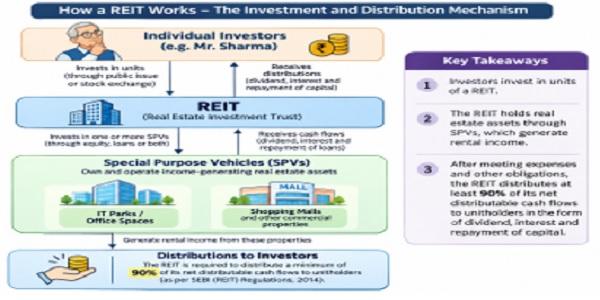
REITs primarily generate income through rentals from commercial properties.
These assets are often held through separate companies known as Special Purpose Vehicles (SPVs). For instance, a REIT may hold an IT park through one SPV and a shopping mall through another.
The Trust may invest in these companies through equity, loans or a combination of both. Consequently, the amounts flowing from these companies to the Trust may take different forms, such as dividends, interest and repayment of loans.
In accordance with the applicable SEBI regulations, a REIT is required to distribute at least 90% of its net distributable cash flows to unitholders.
The following flowchart illustrates this investment and distribution mechanism.
Mr. Sharma now understands how his investment generates income. But how will he identify the different components of the amount received in his bank account?
Form 77 – Income Distribution Statement
Mr. Sharma need not independently work out how much of the amount received represents dividend, interest or other components.
The REIT is required to furnish an Income Distribution Statement in Form 77 (erstwhile Form 64B), providing a detailed break-up of the amounts distributed to unitholders.
Form 77, prescribed under the provisions relating to Section 223 of the Income-tax Act, 2025, is generated based on Form 76 filed by the Trust and is required to be furnished to unitholders by 30 June following the relevant tax year.
This statement will help Mr. Sharma identify the taxable and exempt components of his receipts and report them correctly while filing his income tax return.
One Bank Credit – Different Tax Treatments!
Mr. Sharma has invested ₹1,00,000 in a REIT. During the year, he becomes entitled to distributions aggregating ₹8,000.
While he is happy with the receipts, he is curious about their tax implications.
The Income Distribution Statement received by Mr. Sharma shows the following break-up:
| Particulars | Amount |
|---|---|
| Interest | ₹3,000 |
| Repayment of Capital | ₹2,000 |
| Dividend | ₹3,000 |
| Total Distribution (before TDS, if applicable) | ₹8,000 |
Interestingly, each of these components may have a different tax treatment.
Let us understand them one by one.
1. Interest – ₹3,000
The interest component is taxable at his applicable slab rate under the head ‘Income from Other Sources’.
Assuming that Mr. Sharma falls within the 30% tax bracket, the income tax on this component would be ₹900, excluding applicable surcharge and cess.
TDS, wherever applicable, can be claimed as credit while filing his income tax return.
2. Repayment of Capital – ₹2,000
This is perhaps the most interesting component of the distribution.
Let us assume that the repayment of capital received by Mr. Sharma qualifies for adjustment against the cost of acquisition rather than immediate taxation.
Although Mr. Sharma is not required to pay income tax on this amount at the time of receipt in our illustration, it will have an impact on his capital gains when he subsequently sells his units.
Suppose Mr. Sharma sells his units after two years for ₹1,10,000. Assuming no further adjustments, his original cost of acquisition of ₹1,00,000 would stand reduced to ₹98,000.
His capital gain would be computed as follows:
Computation of Capital Gains on Sale of Units
| Particulars | Amount |
|---|---|
| Sale consideration | ₹1,10,000 |
| Original cost of acquisition | ₹1,00,000 |
| Less: Repayment of capital | ₹ 2,000 |
| Adjusted cost of acquisition | ₹98,000 |
| Capital Gain | ₹12,000 |
Mr. Sharma had expected his capital gain to be ₹10,000. However, for income tax purposes, it works out to ₹12,000!
| Particulars | STCG | LTCG |
|---|---|---|
| Holding period | 12 months or less | More than 12 months |
| Tax rate | 20% | 12.5% |
| Applicable threshold | — | Aggregate eligible LTCG exceeding ₹1.25 lakh |
| Income-tax Act, 2025 | Section 196 | Section 198 |
| Income-tax Act, 1961 | Section 111A | Section 112A |
The above rates are subject to applicable STT and other statutory conditions. Applicable surcharge and cess are additional.
Since Mr. Sharma has held the units for more than 12 months, the capital gain of ₹12,000 qualifies as long-term capital gain. Assuming his aggregate eligible long-term capital gains during the year do not exceed ₹1.25 lakh and the applicable statutory conditions are fulfilled,no income tax would be payable on this capital gain.
3. Dividend – ₹3,000
The dividend component of ₹3,000 qualifies for exemption in our illustration. Let us understand the statutory basis for this exemption through a recent judicial decision and a significant amendment to the law.
₹49.64 Lakh in Dividends – Why Did the Investor Receive an Income Tax Notice?
Interestingly, the exemption of dividend income received from REITs has been a subject matter of litigation. A recent decision of the Income Tax Appellate Tribunal (ITAT), Ahmedabad, in the case of Janki Darshanbhai Patel vs. DCIT (ITA No. 2223/Ahd/2025, AY 2023–24, decided on 26 October 2026), together with a significant amendment to the law, makes this aspect particularly relevant to present-day REIT investors.
An individual investor claimed exemption in respect of dividend income of approximately ₹49.64 lakh received from business trusts. However, the Assessing Officer disputed the exemption and taxed the amount under the head ‘Income from Other Sources’.
Why Was the Exemption Disallowed?
Under the provisions of the Income-tax Act, 1961, applicable to the relevant assessment year, the exemption of such dividend income depended on whether the underlying SPV had opted for the concessional corporate tax regime under Section 115BAA.
What Did the ITAT Decide?
The Tribunal observed that the underlying SPVs had not opted for the concessional corporate tax regime under Section 115BAA.
Applying the relevant pass-through taxation provisions, the Tribunal held that the dividend income retained its exempt character in the hands of the investor and accordingly directed deletion of the addition.
(Relevant provisions: Sections 10(23FD), 10(23FC), 115UA and 194LBA of the Income-tax Act, 1961.)
The case highlights how even substantial dividend income may legitimately qualify for exemption, provided the prescribed statutory conditions are fulfilled.
What Has Changed Under the Income-tax Act, 2025?
There is good news for Mr. Sharma and other REIT investors!
Under the erstwhile Income-tax Act, 1961, the exemption of dividend income received by REIT unitholders depended on whether the underlying SPV had opted for the concessional corporate tax regime under Section 115BAA.
However, a significant change has been introduced through the Taxation and Other Laws (Amendment) Act, 2026, with effect from 1 April 2026.
Let us understand the change through a simple comparison:
| Particulars | Income-tax Act, 1961 | Income-tax Act, 2025 (as amended) |
|---|---|---|
| SPV has not opted for the concessional corporate tax regime | Dividend exempt | Dividend exempt |
| SPV has opted for the concessional corporate tax regime | Dividend taxable | Dividend exempt |
| Relevant exemption provision | Section 10(23FD) | Schedule V, Table Sl. No. 5 |
| Concessional corporate tax regime for SPVs | Section 115BAA | Section 200 |
Thus, with effect from 1 April 2026, the exemption of qualifying dividend income in the hands of REIT unitholders is no longer dependent on the corporate tax regime opted for by the underlying SPV.
This provides greater certainty to individual investors regarding the tax treatment of their dividend receipts.
Coming back to Mr. Sharma’s investment, of the total distribution of ₹8,000, only ₹3,000 is taxable at the time of receipt in our illustration, resulting in an income tax liability of ₹900 at the assumed tax rate of 30%, excluding applicable surcharge and cess.
While the dividend of ₹3,000 qualifies for exemption under the amended provisions, the repayment of capital of ₹2,000 reduces the cost of acquisition of his units for future capital gains computation, subject to the applicable statutory conditions.
(Statutory reference: Section 5 of the Taxation and Other Laws (Amendment) Act, 2026, which omitted clause (b) of column D against Sl. No. 5 of the Table in Schedule V of the Income-tax Act, 2025.)
It is important to note that the ITAT decision discussed above relates to Assessment Year 2023–24, whereas the amended provisions apply with effect from 1 April 2026.
What Should Investors Keep in Mind While Filing Their ITR?
Mr. Sharma now realises that merely looking at the amount credited to his bank account is not sufficient for correctly computing his taxable income.
The following precautions may be useful for investors:
- Preserve the Income Distribution Statement (Form 77 or erstwhile Form 64B, as applicable) furnished by the REIT.
- Identify the different components of distributions and their respective tax treatment.
- Reconcile the distributions and TDS details with the Annual Information Statement (AIS) and Form 26AS.
- Report taxable and exempt income under the appropriate schedules of the income tax return.
- Maintain a record of capital repayments and corresponding adjustments to the cost of acquisition.
- Select the appropriate ITR form based on the nature of income and applicable eligibility conditions.
Conclusion
Mr. Sharma’s search for regular income has introduced him to an interesting investment avenue that enables individual investors to participate in large-scale commercial real estate projects without directly owning or managing such properties.
However, his investment journey also highlights an important lesson. Understanding the nature of an investment is as important as understanding its taxation.
After all, what matters is not merely how much an investment earns, but how much the investor ultimately gets to retain after tax!
Disclaimer: This article is for educational and informational purposes only and should not be construed as investment or tax advice. The tax implications may vary depending on individual circumstances and the applicable statutory provisions.
******
Cases Discussed
- Janki Darshanbhai Patel vs. DCIT — ITA No. 2223/Ahd/2025, AY 2023–24, decided on 26 October 2026 (ITAT Ahmedabad). The Tribunal directed deletion of the ₹49,64,279 addition after examining the character of the business-trust distributions and the tax regime of the underlying SPVs under the Income-tax Act, 1961.