Hespera Realty Pvt. Ltd. Vs DCIT (ITAT Delhi)
The issue under consideration is whether upward adjustment to book profit under section 115JB of the Act, by treating the loss on purchase and redemption of mutual funds as expenditure relatable to earning exempt income is justified in law?
ITAT states that, straight reading of the provisions denotes that the loss on purchase and redemption of mutual funds cannot be treated as an expenditure relatable to earning of dividend. The provisions relating to dividends stripping and allowability of consequent loss u/s 94(7) are different from the Clause (f) of Explanation 1 to the Section 115JB. Expense is something which comes out of pocket. A loss is something different as it is not a thing which is spent or disbursed. It is a thing which comes upon him ab extra. {CIT Vs SC Kothari (82 ITR 792) (SC)}. There is a clear distinction between a business expenditure and business loss. The former is an indicative of a volition but a loss comes to as ab extra without the role of the assessee. While expenditure is voluntarily, business loss is fortuitous [CIT Vs New India Assurance Co. Ltd. (71 ITR 761. (Bom.)]. Hence, the loss cannot be equated with expenditure. The provisions u/s 115JB doesn’t envisage enhancement of taxable profits by adding the loss incurred in redemption of mutual fund for the purpose of Section 115JB. Reliance is placed on the judgment of Hon’ble High Court of Gujarat in the case of CIT Vs JK Paper Ltd. 206 Taxmann 124 wherein it was held that the loss incurred by the on account of dividend stripping dealt under sub-Section 7 of Section 97 cannot be applied for the purpose of computing business profit in terms of Section 115JB. Based on the conjoint reading of the provisions of the Act and the judgments of the Hon’ble Apex Court, the appeal of the assessee on this ground is allowed.
FULL TEXT OF THE ITAT JUDGEMENT
The present appeal has been filed by the assessee against the order of ld. CIT (A)-4, New Delhi dated 20.01.2020.
2. Following grounds have been raised by the assessee:
“1. That the Commissioner of Income-tax (Appeals) [‘CIT(A)’] erred on facts and in law in confirming the action of the assessing officer in determining book profit under section 115JB of the Income Tax Act, 1961 (‘the Act’) at Rs.275,16,44,730 as against book loss of Rs.90,74,679 declared by the appellant.
2. That the CIT(A) erred on facts and in law in upholding the action of the assessing officer in making upward adjustment of Rs.247,52,73,951 to book profit in terms of clause (j) of Explanation 1 to section 115 JB of the Act.
2.1 That the CIT(A) erred in not holding that the assessing officer had exceeded his jurisdiction in making the aforesaid upward adjustment, contrary to the mandate of section 115JB of the Act, since the appellant had computed ‘book profit’ strictly in accordance with the books of account as mandated by the said section.
2.2 That the CIT(A) erred in not appreciating that the accounting treatment in the books of accounts, being strictly in accordance with the binding scheme of amalgamation as approved by the Hon’ble High Court, the provisions of the Companies Act and duly approved by the shareholders/ directors/ ROC was sacrosanct for the purpose of computing book profit under section 115JB of the Act.
2.3 That the CIT(A) erred on facts and in law in confirming the action of assessing officer in treating capital reserve created under the scheme of amalgamation on account of vesting of assets in the appellant by purchase method, to be in the nature of “revaluation reserve” referred to in clause (j) of Explanation 1 to section 115JB of the Act.
2.4 That the CIT(A) erred in upholding the false/ baseless allegations made by the assessing officer to conclude that the scheme of amalgamation approved by the Hon’ble High Court was a colorable device to evade tax.
2.5 That the CIT(A) failed to appreciate that the genuineness of the scheme of amalgamation duly approved by the High Court could not be questioned /tinkered with by the Revenue.
3. That the CIT(A) erred on facts and in law in confirming the action of the assessing officer in making upward adjustment of Rs.28,54,45,463 in terms of clause (f) of Explanation 1 to section 115JB of the Act on account of alleged expenditure relatable to earning of exempt income.
3. 2That the CIT(A) failed to appreciate that in the absence of any express provision in section 115JB of the Act for disallowance of short term capital loss on account of sale of mutual funds, the appellant was not required to add back the same to the declared profit as per Profit & Loss account, while computing ‘book profit’.
3.3 That the CIT(A) failed to appreciate that ‘loss’ arising on sale of units of mutual fund could not be regarded as ‘expenditure’ falling within the scope of clause (f) of Explanation 1 to section 115JB of the Act.
3.4. That the CIT(A) erred on facts and in law in not appreciating that the short term loss suffered by the appellant on account of sale of mutual funds, disallowed in terms of section 94(7), was, even otherwise, not exempt and consequently, clause (f) of Explanation 1 to section 115JB of the Act had no application at the very threshold.”
3. The brief background facts of the case are as under:
During the previous year relevant to assessment year 2015-16, pursuant to scheme of amalgamation duly approved by the Hon’ble High Court of Delhi vide order dated 08.05.2015, five companies viz., (i) Hespera Real Estate Private Limited, (ii) Hespera Infrastructure Private Limited, (Hi) Hespera Properties Private Limited, (iv) Hespera Realcon Private Limited and (v) Hespera Construction Private Limited (collectively in short ‘amalgamating companies’) amalgamated with the assessee company as under:
“Step 1: Wholly owned subsidiaries of the group merged into their respective parent companies
I – Merger of wholly owned subsidiaries into their respective parent companies as under:
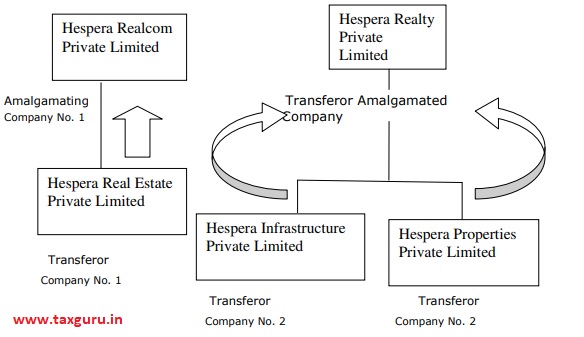
– M/s. Hespera Real Estate Pvt. Ltd. amalgamated with Hespera Realcon Pvt. Ltd.
– M/s. Hespera Infrastructure Pvt. Ltd. & M/s. Hespera Properties Pvt. Ltd. amalgamated with the assessee company.
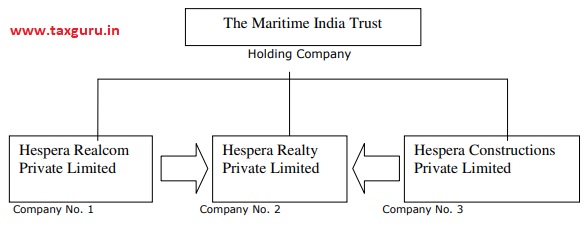
Step 2: Thereafter, M/s. Hespera Realcon Pvt. Ltd. and Hespera Constructions Pvt. Ltd amalgamated with the assessee-company.
The diagrammatic representation depicting the amalgamation of various companies with the assessee is as follows:
II — Merger of remaining companies
4. The salient features of the scheme of amalgamation were as follows:
a) In terms of the scheme, 01.08.2014 was the appointed date, as approved by the Hon’ble High Court;
b) Pursuant to the Scheme, all assets and properties of the five amalgamating companies, including various investments held, and all liabilities, stood transferred to and vested in the appellant with effect from the appointed date;
c) As per para 9 of the Scheme, all the assets and liabilities of the five amalgamating companies stood transferred to and vested in the appellant-company at their respective fair values (refer para 9.1).
5. Pursuant to the aforesaid scheme of amalgamation, various assets and investment(s) held by the five amalgamating companies, which inter-alia included 95,15,021 shares in M/s. Indiabulls Housing Finance Ltd. (hereinafter referred to as ‘Indiabulls’), stood transferred to and vested in the assessee company at its fair value on the appointed date, i.e., 01.08.2014, as part of the Scheme duly approved/sanctioned by the Hon’ble High Court of Delhi.
6. The amalgamation was recorded in the books of account, as per the assessee in accordance with purchase method of accounting, being one of the methods permitted by Accounting Standard-14 on “Accounting for Amalgamation” (AS-14) issued by the Institute of Chartered Accountants of India. Accordingly, difference between the fair value of assets acquired and the liabilities taken over, was recorded as “capital reserve” in the audited financial statements by the assessee.
7. As mandated by the scheme of amalgamation, in order to determine the fair value’ of various shares including shares in Indiabulls, the closing market price of shares on the National Stock Exchange (NSE) as on 31.07.2014 (i.e., the closing price of the shares on the day prior to the appointed date for the amalgamation) was considered. Taking into consideration the closing value of shares on NSE as on 31.07.2014, shares in Indiabulls were treated as having been transferred to and vested in the assessee pursuant to the scheme of amalgamation at their fair value determined at Rs.410.10 per share and was thus recorded as such in the books of the assessee.
8. In a nutshell, as per the mandate of the scheme of amalgamation as approved by the Hon’ble High Court, shares in Indiabulls were transferred by the amalgamating company(ies) to the assessee at their fair value, which was determined at Rs.410.10 per share being the closing price of the shares on the day prior to the effective date. Accordingly shares in Indiabulls were recorded in the books of the assessed company as received pursuant to transfer under the Scheme at Rs.410.10 per share.
9. During the relevant previous year; out of the aforesaid shares of Indiabulls, 95,15,021 shares were sold on a recognized stock exchange for total consideration of Rs.423,30,90,600, after payment of securities transaction tax (in short “STT”) thereon.
10. The gains/ loss arising on transfer of 95,15,021 shares in Indiabulls, both, while computing income under the normal provisions as well as while computing deemed income under section 115JB was computed by the assessee and shown as such in the return of income.
11. Thus, the assessee declared long-term capital gains of Rs.280,62,54,440 (being the difference between sale consideration of Rs.423,30,90,600 and original purchase cost of Rs.142,68,36,160 in the hands of the amalgamating companies) and claimed it as exempt from tax under section 10(38) of the Act since the shares were transferred on a recognized stock exchange and STT was paid thereon, thereby satisfying the conditions prescribed in the said section.
12. In the books of account, since shares were transferred to and stood vested in the assessee at their fair value pursuant to the Scheme, (which was determined at Rs.410.10 per share), the resultant gain of Rs.33,09,80,489, was credited as part of “Other income – profit on sale of equity shares” in the profit and loss account.
13. For the purpose of computing deemed income under section 115JB of the Act, net profit/ loss as per audited profit and loss account, which included the aforesaid gain on sale of equity shares was considered, and the specified upward/ downward adjustments, as prescribed in Explanation 1 thereto were made.
Order of the Assessing Officer:
14. The Assessing Officer has disregarded the aforesaid treatment adopted by the assessee and proceeded to make upward adjustment of Rs.247,52,73,951 to the book profit of the assessee, holding as under:
(a) The scheme of amalgamation was conceived and implemented by the assessee with the intent of evading payment of tax on ‘book profit’ and crucial facts were concealed before the Court with malafide intention;
(b) The assessee had, under the garb of amalgamation, deliberately adopted ‘Purchase method’ in order to artificially jack up the value of assets/investments with the intent of undermining its book profit for the purpose of section 115JB of the Act and the difference arising on account of revaluation should have been transferred to ‘revaluation reserve’ as against ‘capital reserve’.
(c) Since the amount transferred to ‘capital reserve’ actually qualified as ‘revaluation reserve’, upward adjustment to the book profit in terms of clause (j) of Explanation 1 to Section 115JB of the Act was warranted.
15. The Assessing Officer has further observed that there was no commercial purpose at all for applying purchase method because all the entities were actually owned up by a single entity i.e. ultimate parent entity namely, Maritime India Trust. The observation of the Hon’ble Delhi High Court that the “applicant companies have not placed on record the valuation report for determining the share exchange ratio as the proposed scheme of amalgamation is of closely held companies and as a result of the same, the share-holding of the ultimate parent entity (i.e. Maritime India Trust) does not get affected”, clearly shows that application of this method, was just for revaluing the assets in the disguise, without having any commercial purpose. As stated in preceding paragraphs it is very clear that when the High Court order approving the amalgamation scheme was passed on 08.05.2015 the majority investment by the group companies which was in the form of investment into the shares of IBHFL was already offloaded. It all the more shows that the entire amalgamation process was orchestrated has treated a mere sham to reduce the tax liability. It may be said that the Hon’ble Delhi High Court was kept in dark as the actual motive of amalgamation was never brought to the notice of the Hon’ble Court. Even while validating the genuine tax planning the Hon’ble Supreme Court in the case of Vodafone International Holdings has observed that it should be bonafide and the series of transactions in form also should have some commercial purpose. The assessee has failed to show any commercial purpose of amalgamation.
16. The AO held that the entire scheme of transaction was colourable device only, it is to note that the cost of acquisition of the said shares was only Rs. 142,68,36,160/- and post amalgamation (as the amalgamation was account by purchase method) the said book value was calculated at Rs. 390,21,10,112/-. The difference on account of market value and cost of acquisition of these shares was credited to the capital reserve account in the new entity along with fair market value of other assets re-valued (not sold during the year).
17. Having said so, the AO held that although, it is called as Capital Reserve, through the scheme of amalgamation presented, in effect and in essence it is only a Revaluation Reserve. For the purposes of book profit, the profit on sale of investment was recorded as sales consideration minus book value post-merger as is exactly the case in case of revaluation reserve. The book value effectively was a sum of cost of acquisition plus capital reserve (the same effectively as is in the case of Revaluation reserve). The profit on sale of investment was thus reduced to the extent of this capital reserve created post merger. Thus, AO concludes that in view of provision of clause (j) to Explanation 1 of section 115JB, the amount standing in revaluation reserve relating to revalued asset on the retirement or disposal of such asset, needs to be increased in computation of the book profit u/s 115JB. Therefore as the shares in question have been disposed of during the year, the amount relating to these re-valued assets have to be added. Thus, the AO added the amount relating to these shares being Rs. 247,52,73,952/- [Rs. 390,21,10,112 (after revaluation, applying purchase method) minus Rs. 142,68,36,160/- (actual cost to the book profit of the appellant)].
18. In this regard, AO placed reliance on the following judicial pronouncements:
(i) SREI Infrastructure Finance Ltd. vs. Income Tax Settlement Commission [2012] 20 taxrnann.com 476 (Delhi), wherein the jurisdictional Delhi High Court has held that –
“The Act i.e. Income-tax Act was enacted to tax the income or gains made by an assessee. The Companies Act 1956, on the other hand serves, and is intended to serve a different purpose and, therefore, when a scheme under section 391 to 394 of the Companies Act 1956 is sanctioned by the Court, it is treated as a binding statutory scheme because the scheme has to be implemented and enforced. This cannot, or is not, a ground to escape tax on transfer of a Capital Asset under and as per provisions of the Act.”
(ii) McDowell and Co. Ltd. v. CTO [1985] 154 ITR 148 wherein it has been held clearly that the taxpayer cannot be allowed to get away with any colourable device or artificial sham transaction. The Hon’ble Supreme Court, while applying the doctrine, had observed-
“Tax planning is legitimate provided it is within the frame work of law. Colourable devices cannot be part of tax planning, and it is wrong to encourage or entertain the belief that it is honourable to avoid payment of tax by resorting to dubious methods. It is the obligation of every citizen to pay the taxes honestly without resorting to subterfuges. “Therefore, it becomes an important function of the income tax authorities to look into the devices and natures of transactions used by the assessee, and decide upon the character and nature of such devices and transactions.”
(iii) A similar observation was made in the Supreme Court’s decision in the case of Workmen v. Associated Rubber Industry [1986] 157 ITR 77 wherein the Hon’ble Court had observed-
“It is true that in law the Associated Rubber Industry Ltd. and its subsidiary were two independent companies with separate legal existence and, therefore, the profits made by the subsidiary could not be treated as profits made by the parent. But in our view that was not an end of the matter. It is the duty of the court, in every case where ingenuity is expended to avoid taxing and welfare legislations, to get behind the smoke screen and discover the true state of affairs. The courts is not satisfied with form and leave alone the substance of the transaction.”
(iv) In the context of above, the AO fount it essential to refer to the case of Commissioner of Income-tax v. Durga Prasad More [1971] 082 ITR 0540-SC, wherein the Hon’ble Supreme Court had once again reiterated the vital role of ‘surrounding circumstances” while deciding on merits of documents submitted by the assessee. The Hon’ble Court has held as under:
“It is true that an apparent must be considered real until it is shown that there are reasons to believe that the apparent is not the real. In a case of the present kind a party who relies on a recital in a deed has to establish the truth of those recitals, otherwise it will be very easy to make self-serving statements in documents either executed or taken by a party and rely on those recitals. If all that an assessee who wants to evade tax is to have some recitals made in a document either executed by him or executed in his favour then the door will be leftwide open to evade tax. A little probing was sufficient in the present case to show that the apparent was not the real The taxing authorities were not required to put on blinkers while looking at the documents produced before them. They were entitled to look into the surrounding circumstances to find out the reality of the recitals made in those documents.”
(v) In the case of Sumati Dayal v. CIT [1995] 214 ITR 801, the Hon’ble Supreme Court observed the supreme importance of the test of human probabilities-
“This, in our opinion, is a superficial approach to the problem. The matter has to be considered in the light of human probabilities. We are, therefore, unable to agree with the view of the Chairman in his dissenting opinion. In our opinion, the majority opinion after considering the surrounding circumstances and applying the test of human probabilities has rightly concluded that the appellant’s claim about the amount being her winnings from races is not genuine.”
(vi) In the case of CIT v. Wipro Limited (Karnataka High Court)[2014] 50 taxmann.com 421 (Karnataka),while deciding a case of alleged sham transaction, the Hon’ble High Court has held as under:
“The question whether a transaction is sham or colorable and entered into with the sole intention of evading payment of tax is purely a question of fact. On appreciation of the material on record and thereafter keeping in mind the statutory provisions in particular, the charging section and the section under which the tax is exempted, the Court has to record the finding of fact. Unless the statutory provisions provide for exemption from payment of tax, the question of an assessee trying to take advantage of the said provision would not arise. Therefore, in each case, the question is, the way the assessee has avoided to pay tax relying on the statutory provisions is legitimate or not is to be considered by the Court. The Court has to bear in mind that it is wrong to encourage or entertain the belief that it is honourable to avoid the payment of tax by resorting to dubious methods. An obligation is cast on every citizen to pay the taxes without resorting to subterfuges. When the statute provides certain rights, which if properly applied would reduce the tax burden on the assessee or exempts him from the payment of tax, the assessee is entitled to the said benefit. However, if he is invoking the said provisions with the intention of evading payment of tax, then it would be a colorable device to avoid payment of tax, which cannot be entertained by the Court. It is in this context, Court has to find out whether the transaction is real or unreal and then record a finding whether it is a colorable device or sham transaction.”
Order of the ld. CIT (A):
19. The ld. CIT (A) mainly relied on the assessment order and also derived support from the fact that Sh. Saurabh Mittal has already relinquished his control in India Bulls Group and in the amalgamating companies have been held controlled by The Maritime India Trust. The relevant part of the order of the ld. CIT (A) is as under:
“It has been brought out by the AO in the assessment order that as on 9th July 2014, a statement was filed by India Bulls Housing Finance Ltd. (IBHFL) before the National Stock Exchange India Ltd.(NSE) regarding the restructuring of promoters’ inter-se roles in India Bulls Group Company. As per the said statement Sh. Saurabh Mittal shall have no control, management and supervision rights in India Bulls group companies on or before 31.12.2014. In this context, it is important to note that Sh. Saurabh Mittal before that, directly or indirectly wholly owned the five amalgamating companies and the assessee company before these were apparently transferred to a newly made private trust i.e. Maritime India Trust (for the benefit of his family members ). AO also finds that as per the statement filed before NSE, the said six companies were also declassified as promoters. The Hon’ble Delhi High Court in its interim order dated 22.12.2014 passed in CA (M) 173/2014 has observed that the applicant companies have not placed on record the valuation report for determining the share exchange ratio as the proposed scheme of amalgamation is of closely held companies and as a result of the same, the share-holding of the ultimate parent entity i.e. Maritime India Trust does not get affected. This thus means that the merger of the five companies into the assessee did not effectively impact the management, control and supervision of the said companies/the amalgamated company.
…It also emanates from the assessment order that as on the appointed date of merger i.e. 01.08.2014, the investment in shares of India Bulls Housing Finance Ltd. (IBHFL)of the merging companies was as under:-