Vedure Mahender Reddy Vs DCIT (ITAT Hyderabad)
Auto-Populated Email and Duplicate Appeals Do Not Establish Sufficient Cause: ITAT Refuses to Condone Delay
An Explanation Must Withstand Verification Against the Record
The Hyderabad Bench of the Income Tax Appellate Tribunal refused to condone a delay described in its order as more than one year and nine months, holding that the assessee had failed to establish sufficient cause for filing the appeal belatedly.
The assessee attributed the delay to lack of knowledge of the first appellate order, an email address automatically populated in Form No. 35, and confusion arising from duplicate appeals. However, the Tribunal found that these explanations were either inadequately supported or inconsistent with the documents produced.
The appeal was dismissed at the limitation stage, without adjudication of the underlying tax dispute on merits.
Assessee Claimed That the Appellate Order Was Never Received
The appeal challenged the order dated 25 June 2024 passed by the Addl./JCIT(A)-1, Jaipur, for Assessment Year 2017–18.
Seeking condonation, the assessee filed a petition supported by an affidavit. His authorised representative submitted that the assessee had never opted to receive notices or communications through email in Form No. 35 and consequently remained unaware of the appellate order.
It was explained that the email address appearing in the appeal form had been imported automatically from the assessee’s profile on the income-tax portal.
According to the assessee, he learnt about the disposal only in January 2026, when the Department enquired about the outstanding demand. He claimed to have taken steps thereafter to approach the Tribunal.
Form No. 35 Did Not Support Express Refusal of Email Service
The Tribunal examined the personal information section of Form No. 35.
It found that neither “Yes” nor “No” had been marked against the question concerning service of notices or communications through email. The form therefore did not support the categorical assertion that the assessee had expressly declined electronic communication.
Further, an email address had been furnished in the form. Merely stating that it was automatically populated did not explain why communications sent to that address could not have been accessed or monitored.
The Tribunal required an explanation for the failure to receive or monitor communications; the manner in which the email address entered the form was insufficient by itself.
Participation in Duplicate Appeals Weakened the Explanation
The authorised representative also submitted that counsel had inadvertently filed three additional appeals against the same assessment order.
The assessee continued receiving notices in those duplicate appeals and furnished submissions in response. It was argued that this participation created a bona fide belief that the appeal remained pending.
However, the Tribunal noticed that the same email address appeared in all the duplicate appeal forms. Documents showed that submissions had been furnished in duplicate proceedings on 29 November 2024 and 31 May 2025.
These records demonstrated participation in appellate proceedings during the relevant period. The assessee had not satisfactorily explained how he could respond in the duplicate appeals while remaining unaware of the disposal of the appeal under challenge.
The general assertion that the automatically populated email address left him unaware of communications therefore did not inspire confidence.
Oral Explanation Was Missing From the Affidavit
A further weakness concerned the contents of the affidavit.
The claimed belief that the original appeal remained pending because duplicate appeals were continuing had not been stated in the affidavit. That explanation was advanced for the first time through oral submissions before the Tribunal.
The existence of duplicate appeals did not, by itself, establish that the assessee held the asserted belief throughout the period of delay.
In the absence of a corresponding sworn statement or supporting material explaining the belief and its duration, the Tribunal regarded this explanation as an afterthought.
Liberal Approach Requires Sufficient Cause
The Tribunal relied on P.K. Ramachandran v. State of Kerala, (1997) 7 SCC 556, Basawaraj v. Special Land Acquisition Officer, (2013) 14 SCC 81, and Pathapati Subba Reddy v. Special Deputy Collector (LA), decided on 8 April 2024.
Drawing from these decisions, it explained that limitation serves the public interest in finality of litigation. A liberal approach towards condonation does not dispense with the requirement to establish sufficient cause.
The length of delay alone is not decisive, but the explanation must be credible and adequate. A statement that the delay was neither deliberate nor intentional cannot substitute for evidence explaining why the appeal could not be filed in time.
Finding the explanation unsatisfactory, the Tribunal rejected the condonation petition and dismissed the appeal.
Author’s Comments
The decision highlights the importance of consistency between the affidavit, oral submissions and the documentary record. A potentially relevant explanation loses force when it is omitted from the affidavit or contradicted by evidence of participation in connected proceedings.
Where duplicate appeals create confusion, the condonation application should explain the sequence of filings, communications received, actual knowledge of disposal and subsequent action, supported by available records.
The ruling should not be read as conclusively deciding the validity of every email communication where the consent field is blank. Its conclusion concerns the failure to establish sufficient cause on the particular record before the Tribunal. Equally, dismissal on limitation does not amount to a reasoned affirmation of the underlying assessment on merits.
Cases Discussed
- P.K. Ramachandran Vs. State of Kerala, (1997) 7 SCC 556 — strict application of limitation.
- Basawaraj & Anr. Vs. Special Land Acquisition Officer, (2013) 14 SCC 81 — sufficient cause and diligence.
- Pathapati Subba Reddy (Died) by LRs. Vs. Special Deputy Collector (LA), 08.04.2024 — principles of delay condonation.
FULL TEXT OF THE JUDGMENT/ORDER OF ITAT HYDERABAD
This appeal is filed by Shri Vedure Mahender Reddy (“the assessee”), feeling aggrieved by the order passed by the Learned Addl/JCIT(A)-1, Jaipur (“Ld. First Appellate Authority”) dated 25.06.2024 for the A.Y. 2017-18.
2. At the outset, it is noticed that there is a delay of more than one year and nine months in filing the present appeal. The assessee has filed a petition seeking condonation of the delay, along with an affidavit explaining the reasons for the belated filing of the appeal. The Learned Authorized Representative (“Ld. AR”) submitted that the assessee had never opted for service of notices or communications through email in Form No.35 and, therefore, had not received the notices or the order passed by the Ld. CIT(A). He further submitted that the email address appearing in Form No. 35 had been populated by default from the assessee’s profile on the e-filing portal. According to the Ld. AR, the assessee came to know about the order of the Ld. CIT(A) only in January 2026, when an enquiry was made by the Department regarding the outstanding tax demand. Immediately thereafter, the assessee took steps to file the present appeal before this Tribunal.
3. The Ld. AR further invited our attention to the copies of Form No. 35 dated 30.09.2021, 01.10.2021 and 13.10.2021, and the connected documents placed at page nos. 48 to 87 of the paper book. He submitted that the assessee’s counsel had inadvertently filed three additional appeals against the same assessment order. The assessee continued to receive notices in those duplicate appeals and also furnished submissions in response to some of those notices. Consequently, the assessee was under a bona fide belief that his appeal was still pending before the Ld. CIT(A). He submitted that the delay was neither deliberate nor intentional and prayed that the same be condoned and the appeal be admitted for adjudication on merits.
4. Per contra, the Learned Departmental Representative (“Ld. DR”) vehemently opposed the condonation of delay. He submitted that the assessee had failed to demonstrate sufficient cause for the substantial delay of more than one year and nine months and prayed that the appeal be dismissed as barred by limitation.
5. We have heard the rival submissions and perused the material available on record. We have examined the affidavit filed by the assessee in support of the petition for condonation of delay, which is to the following effect:
AFFIDAVIT
I, Vedure Mahender Reddy, S/o. Vedure Ranga Reddy, aged about 58 years, residing at VIDYANAGAR, HYDERABAD do hereby state as follows:
During the year 2016-17, I was holding a licence for running a Wine Shop at Mettuguda. This shop was run at METTUGUDA. All the affairs of the Wine Shop were looked after by our Manager, Sri Venkatesh Goud. Both I and the Manager, Venkatesh Goud, are not well educated and are not computer savvy. I am an under-graduate and the said Venkatesh Goud discontinued his studies after the 12th Class.
I filed the Return of Income for the Assessment Year 2017-18 with the help of a Chartered Accountant. When the assessment was taken up for scrutiny, I took the help of M/s. K. Prahlada Rao and Company for representing me in the scrutiny proceedings. Though the assessment was completed on 26.12.2019, we came to know about it only during the Covid period and the appeal was filed in October, 2021.
The Commissioner of Income Tax dismissed the appeal on account of the delay in filing the appeal, though we had explained that the delay was due to the lockdowns during the Covid period. However, this order was never served on me and I did not opt for service through email. The email “[email protected]” was imported into Form No. 35 by default from my profile tab in the e-filing portal. I did not know about the order of the Addl./JCIT (A)-1, Jaipur.
Only in January, 2026, when there was an enquiry about the tax demand from the Department, I brought it to the notice of M/s. K. Prahlada Rao and Company. They took out a copy of the order from the system on 9th January, 2026. I immediately took steps for filing an appeal against the order of the Joint Commissioner of Income Tax (Appeals). I therefore gave the date of service of the order as 9th January, 2026, as the order was downloaded on that date in the office of the Chartered Accountant.
Solemnly affirmed on 17/07/26 that what is stated above is true to the best of my knowledge and belief.
6. On perusal of the above, we find that in the affidavit, the assessee has stated that the order of the Ld. CIT(A) was never served upon him and that he had not opted for service of the order through email. He has further stated that the email address “[email protected]” was imported by default into Form No. 35 from the profile section of the e-filing portal and, therefore, he could not become aware of the order passed by the Ld. CIT(A). In this regard, we have examined the “personal information” section of Form No. 35 relating to the appeal in which the impugned order was passed, which is to the following effect:
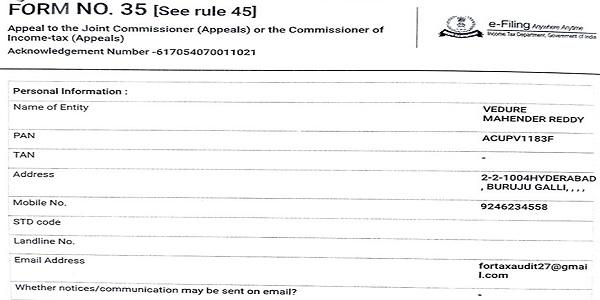
7. On perusal of the above, we find that the assessee has marked neither “Yes” nor “No” against the question whether notices or communications may be sent through email. Thus, the form does not substantiate the categorical assertion that the assessee had expressly declined service through email. Further, the assessee had furnished the aforesaid email address in the “personal information” section of Form No. 35. The explanation that the address was populated by default, without any further material explaining why communications sent to that address could not be accessed or monitored, does not sufficiently explain the prolonged delay. We have also examined the “personal information” sections of Form No. 35 relating to the duplicate appeals, placed at page nos. 48, 54 and 60 respectively of the paper book. For the sake of brevity, the “personal information” sections of Form No. 35 relating to the duplicate appeal, placed at page no. 48 only is reproduced as under:
8. On perusal of the above, we find that the same email address, namely, “[email protected]”, appears in all the three forms no.35 of the duplicate appeals. Further, the acknowledgement placed at page nos. 70 and 71 of the paper book show that the assessee furnished submission before the Ld. CIT(A) in a duplicate appeal on 31.05.2025. Similarly, the acknowledgement placed at page nos. 85 and 86 show that submission was again furnished in duplicate appeal on 29.11.2024. These documents demonstrate that the assessee was participating in the appellate proceedings during the relevant period. When the same email address was furnished in all the appeals and the assessee was responding to communications in the duplicate appeals, the general explanation that the email address had been populated by default and that communications through that address remained unknown to him does not inspire confidence. The assessee has not satisfactorily explained how he could respond in the duplicate appeals while remaining unaware of the disposal of the appeal giving rise to the present proceedings.
9. As regards the contention that the pendency of the duplicate appeals led the assessee to believe that the original appeal was also pending, we find that no such explanation has been stated in the affidavit filed before us. This reason was advanced before us by the Ld. AR for the first time through oral submissions. The existence of duplicate appeals and the filing of submissions therein do not, by themselves, establish that the assessee was under the asserted bona fide belief throughout the period of delay. In the absence of a corresponding statement in the affidavit or other supporting material explaining this belief and its duration, the explanation appears to be an afterthought and cannot be accepted as sufficient cause.
10. The power to condone delay is to be exercised where the appellant demonstrates sufficient cause for not filing the appeal within the prescribed period. Although the length of delay is not, by itself, decisive, the explanation must be credible and sufficient to account for the belated filing. A mere assertion that there was no deliberate intention to delay the appeal cannot substitute for such an explanation. Further, at this stage, it would be relevant to refer to the settled legal position governing condonation of delay. The Hon’ble Supreme Court in the case of P.K. Ramachandran Vs. State of Kerala [(1997) 7 SCC 556] at last para of the order has held as under:
“Law of limitation may harshly effect a particular party but it has to be applied with all its rigour when the statute so prescribe and the Courts have no power to extend the period of limitation on equitable grounds. The discretion exercised by the High Court was, thus, neither proper nor judicious. The order condoning the delay cannot be sustained. This appeal, therefore, succeeds and the impugned order is set aside. Consequently, the application for condonation of delay filed in the High Court would stand rejected and the Miscellaneous First Appeal shall stand dismissed as barred by time. No costs.”
11. On perusal of the above, it is evident that the Hon’ble Supreme Court has held that the law of limitation may operate harshly in a particular case, but it has to be applied with all its rigor when the statute so prescribes and Courts have no power to extend the period of limitation on equitable grounds in the absence of a satisfactory explanation. Accordingly, the Hon’ble Supreme Court has observed that while considering an application for condonation of delay, the Court must examine whether sufficient cause has been shown 10 and cannot condone delay merely on sympathetic considerations. Similarly, in Basawaraj & Anr. Vs. Special Land Acquisition Officer [(2013) 14 SCC 81], the Hon’ble Supreme Court at para no. 5 of the order has held as under: “15. The law on the issue can be summarized to the effect that where a case has been presented in the court beyond limitation, the applicant has to explain the court as to what was the “sufficient cause” which means an adequate and enough reason which prevented him to approach the court within limitation. In case a party is found to be negligent, or for want of bonafide on his part in the facts and circumstances of the case, or found to have not acted diligently or remained inactive, there cannot be a justified ground to condone the delay. No court could be justified in condoning such an inordinate delay by imposing any condition whatsoever. The application is to be decided only within the parameters laid down by this court in regard to the condonation of delay. In case there was no sufficient cause to prevent a litigant to approach the court on time condoning the delay without any justification, putting any condition whatsoever, amounts to passing an order in violation of the statutory provisions and it tantamount to showing utter disregard to the legislature.” 11. On perusal of the above, we find that the Hon’ble Supreme Court has categorically held that the expression “sufficient cause” means a cause beyond the control of the party invoking the aid of the Court. It was further held that where negligence, inaction or want of bona fides is attributable to the party seeking condonation, delay cannot be condoned as a matter of course. The Hon’ble Supreme Court further observed that the law of limitation is founded on public policy and Courts cannot extend limitation on equitable grounds where no sufficient cause is demonstrated.
12. The aforesaid view is further fortified by the decision of the Hon’ble Supreme Court in Pathapati Subba Reddy (Died) by LRs. Vs. Special Deputy Collector (LA), Civil Appeal arising out of SLP (C) No.31248 of 2018 dated 11 08.04.2024, wherein, at para nos. 13 to 26 of the order it is held as under :
“13. It is very elementary and well understood that courts should not adopt an injustice-oriented approach in dealing with the applications for condonation of the delay in filing appeals and rather follow a pragmatic line to advance substantial justice.
14. It may also be important to point out that though on one hand, Section 5 of the Limitation Act is to be construed liberally, but on the other hand, Section 3 of the Limitation Act, being a substantive law of mandatory nature has to be interpreted in a strict sense. In Bhag Mal alias Ram Bux 8|22 and Ors. vs. Munshi (Dead) by LRs. and Ors.1, it has been observed that different provisions of Limitation Act may require different construction, as for example, the court exercises its power in a given case liberally in condoning the delay in filing the appeal under Section 5 of the Limitation Act, however, the same may not be true while construing Section 3 of the Limitation Act. It, therefore, follows that though liberal interpretation has to be given in construing Section 5 of the Limitation Act but not in applying Section 3 of the Limitation Act, which has to be construed strictly.
15. It is in the light of the public policy upon which law of limitation is based, the object behind the law of limitation and the mandatory and the directory nature of Section 3 and Section 5 of the Limitation Act that we have to examine and strike a balance between Section 3 and Section 5 of the Limitation Act in the matters of condoning the delay.
16. Generally, the courts have adopted a very liberal approach in construing the phrase ‘sufficient cause’ used in Section 5 of the Limitation Act in order to condone the delay to enable the courts to do substantial justice and to apply law in a meaningful manner which subserves the ends of justice. In Collector, Land Acquisition, Anantnag and Ors. vs. Katiji and Ors.2, this Court in advocating the liberal approach in condoning the delay for ‘sufficient cause’ held that ordinarily a litigant does not stand to benefit by lodging an appeal late; it is not necessary to explain every day’s delay in filing the appeal; and since sometimes refusal to condone delay may result in throwing out a meritorious matter, it is necessary in the interest of justice that cause of substantial justice should be allowed to prevail upon technical considerations and if the delay is not deliberate, it ought to be condoned. Notwithstanding the above, howsoever, liberal approach is adopted in condoning the delay, existence of ‘sufficient cause’ for not filing the appeal in time, is a condition precedent for exercising the discretionary power to condone the 12 delay. The phrases ‘liberal approach’, ‘justice- oriented approach’ and cause for the advancement of ‘substantial justice’ cannot be employed to defeat the law of limitation so as to allow stale matters or as a matter of fact dead matters to be revived and re opened by taking aid of Section 5 of the Limitation Act.
17. It must always be borne in mind that while construing ‘sufficient cause’ in deciding application under Section 5 of the Act, that on the expiry of the period of limitation prescribed for filing an appeal, substantive right in favour of a decree-holder accrues and this right ought not to be lightly disturbed. The decree-holder treats the decree to be binding with the lapse of time and may proceed on such assumption creating new rights.
18. This Court as far back in 1962 in the case of Ramlal, Motilal And Chhotelal vs. Rewa Coalfields Ltd3 has emphasized that even after sufficient cause has been shown by a party for not filing an appeal within time, the said party is not entitled to the condonation of delay as excusing the delay is the discretionary jurisdiction vested with the court. The court, despite establishment of a ‘sufficient cause’ for various reasons, may refuse to condone the delay depending upon the bona fides of the party.
19. In Maqbul Ahmad and Ors. vs. Onkar Pratap Narain Singh and Ors.4, it had been held that the court cannot grant an exemption from limitation on equitable consideration or on the ground of hardship. The court has time and again repeated that when mandatory provision is not complied with and delay is not properly, satisfactorily and convincingly explained, it ought not to condone the delay on sympathetic grounds alone.
20. In this connection, a reference may be made to Brijesh Kumar and Ors. vs. State of Haryana and Ors.5 wherein while observing, as above, this Court further laid down that if some person has obtained a relief approaching the court just or immediately when the cause of action had arisen, other persons cannot take the benefit of the same approaching the court at a belated stage simply on the ground of parity, equity, sympathy and compassion.
21. In Lanka Venkateswarlu vs. State of Andhra Pradesh & Ors.6, where the High Court, despite unsatisfactory explanation for the delay of 3703 days, had allowed the applications for condonation of delay, this Court held that the High Court failed to exercise its discretion in a reasonable and objective manner. High Court should have exercised the discretion in a systematic and an informed manner. The liberal approach in considering sufficiency of cause for delay should not be allowed to override substantial law of limitation. The Court observed that the 13 concepts such as ‘liberal approach’, ‘justice-oriented approach’ and ‘substantial justice’ cannot be employed to jettison the substantial law of limitation.
22. It has also been settled vide State of Jharkhand & Ors. vs. Ashok Kumar Chokhani & Ors.7, that the merits of the (2011) 4 SCC 363 AIR 2009 SC 1927 13 | 2 2 case cannot be considered while dealing with the application for condonation of delay in filing the appeal.
23. In Basawaraj and Anr. vs. Special Land Acquisition Officer8, this Court held that the discretion to condone the delay has to be exercised judiciously based upon the facts and circumstances of each case. The expression ‘sufficient cause’ as occurring in Section 5 of the Limitation Act cannot be liberally interpreted if negligence, inaction or lack of bona fide is writ large. It was also observed that even though limitation may harshly affect rights of the parties but it has to be applied with all its rigour as prescribed under the statute as the courts have no choice but to apply the law as it stands and they have no power to condone the delay on equitable grounds.
24. It would be beneficial to quote paragraph 12 of the aforesaid decision which clinches the issue of the manner in which equilibrium has to be maintained between adopting liberal approach and in implementing the statute as it stands. Paragraph 12 reads as under:
“12. It is a settled legal proposition that law of limitation may harshly affect a particular party but it has to be applied with all its rigour when the statute so prescribes. The Court has no power to extend the period of limitation on equitable grounds. “A result flowing from a statutory provision is never an evil. A Court has no power to ignore that provision to relieve what it considers a distress resulting from its operation.” The statutory provision may cause hardship or inconvenience to a particular party but the court has no choice but to enforce it giving full effect to the same. The legal maxim dura lex sed lex which means “the law is hard but it is the law”, stands attracted in such a situation. It has consistently been held that, “inconvenience is not” a decisive factor to be considered while interpreting a statute.”
25. This Court in the same breath in the same very decision vide paragraph 15 went on to observe as under: “15. The law on the issue can be summarized to the effect that where a case has been presented in the court beyond limitation, the applicant has to explain the court as to what was the “sufficient cause” which means an adequate and enough reason which prevented him to approach the court within limitation. In case a party is found to be negligent, or for want of bona fide on 14 his part in the facts and circumstances of the case, or found to have not acted diligently or remained inactive, there cannot be a justified ground to condone the delay. No court could be justified in condoning such an inordinate delay by imposing any condition whatsoever. The application is to be decided only within the parameters laid down by this Court in regard to the condonation of delay. In case there was no sufficient cause to prevent a litigant to approach the court on time condoning the delay without any justification, putting any condition whatsoever, amounts to passing an order in violation of the statutory provisions and it tantamounts to showing utter disregard to the legislature.” (emphasis supplied)
26. On a harmonious consideration of the provisions of the law, as aforesaid, and the law laid down by this Court, it is evident that: (i) Law of limitation is based upon public policy that there should be an end to litigation by forfeiting the right to remedy rather than the right itself; (ii) A right or the remedy that has not been exercised or availed of for a long time must come to an end or cease to exist after a fixed period of time; (iii) The provisions of the Limitation Act have to be construed differently, such as Section 3 has to be construed in a strict sense whereas Section 5 has to be construed liberally; (iv) In order to advance substantial justice, though liberal approach, justice-oriented approach or cause of substantial justice may be kept in mind but the same cannot be used to defeat the substantial law of limitation contained in Section 3 of the Limitation Act; (v) Courts are empowered to exercise discretion to condone the delay if sufficient cause had been explained, but that exercise of power is discretionary in nature and may not be exercised even if sufficient cause is established for various factors such as, where there is inordinate delay, negligence and want of due diligence; vi) Merely some persons obtained relief in similar matter, it does not mean that others are also entitled to the same benefit if the court is not satisfied with the cause shown for the delay in filing the appeal; (vii) Merits of the case are not required to be considered in condoning the delay; and (viii) Delay condonation application has to be decided on the parameters laid down for condoning the delay and condoning the 15 delay for the reason that the conditions have been imposed, tantamounts to disregarding the statutory provision.”
13. On perusal of the above, it is evident that in the above decision, the Hon’ble Supreme Court comprehensively reviewed the law relating to condonation of delay and reiterated that the law of limitation is founded upon public policy and there must be finality to litigation. The Hon’ble Supreme Court observed that though the expression “sufficient cause” occurring in section 5 of the Limitation Act deserves liberal construction, such liberal approach cannot be stretched to defeat the substantive provisions of limitation. The Court further held that concepts such as “substantial justice”, “liberal approach” and “justice-oriented approach” cannot be employed to revive stale and dead claims. The Hon’ble Supreme Court further held that even where sufficient cause is shown, condonation of delay is not a matter of right and the power to condone delay remains discretionary. Negligence, inaction, lack of bona fides, absence of due diligence and inordinate delay are valid grounds for refusing condonation. The Hon’ble Supreme Court ultimately upheld the refusal to condone the delay and emphasized that Courts cannot extend limitation on equitable or sympathetic considerations alone.
14. Applying the aforesaid principles to the facts of the present case, we find that in the present case, the reasons stated in the affidavit, read with the documents placed on record and the submissions of the Ld. AR, do not satisfactorily explain the delay of more than one year and nine months. Therefore, respectfully following the principles laid down by the Hon’ble Supreme Court in the cases of P.K. Ramachandran (supra), Basawaraj (supra) and Pathapati Subba Reddy (Died) by LRs. (supra), we are of the considered view that the assessee has failed to establish “sufficient cause” for condonation of the inordinate delay of more than one year and nine months. Accordingly, the petitions for condonation of delay are rejected.
15. In the result, the appeal of the assessee is dismissed.
Order pronounced in the Open Court on 16th October, 2026.