Shamsunder Pritesh Malode Vs ACIT (ITAT Hyderabad)
The Income Tax Appellate Tribunal, Hyderabad, dismissed an assessee’s challenge to the initiation of penalty proceedings under section 270A, holding that the notice was not vague merely because it did not identify a particular clause of section 270A(9).
The Tribunal found that both the assessment order and penalty notice expressly communicated the charge of “under-reporting of income in consequence of misreporting of income”. Accordingly, the assessee was aware that misreporting, rather than under-reporting simpliciter, formed the basis of the proposed penalty.
The decision arose from a limited challenge to the validity of initiation. No other ground was pressed before the Tribunal.
Facts of the Case
The assessee, an individual, had not filed a return under section 139 for assessment year 2020-21.
Based on information available on record, the Assessing Officer noticed that the assessee had received salary income of ₹43,61,695 during the relevant year. Reassessment proceedings were consequently initiated under section 147.
The Assessing Officer passed an order under section 148A(d) on 12 March 2024 and issued a notice under section 148 on the same date.
In response, the assessee filed a return on 18 June 2024, declaring total income of ₹35,40,270. The assessment was completed under section 147 read with section 144B on 10 February 2025, accepting total income at that amount.
The Assessing Officer also issued a notice under section 274 read with section 270A, dated 10 February 2025.
Subsequently, through an order dated 26 August 2025, the officer levied a penalty of ₹18,19,128, treating the case as under-reporting in consequence of misreporting. The CIT(A), National Faceless Appeal Centre, Delhi, confirmed the penalty.
Additional Legal Ground Admitted
Before the Tribunal, the assessee raised additional legal grounds, including an objection that the penalty notice did not specify the exact clause of section 270A(9) sought to be invoked.
The Tribunal admitted the additional grounds under Rule 11 of the Income Tax (Appellate Tribunal) Rules, 1963, noting that they were legal in nature and arose from facts already on record. It referred to the Supreme Court’s decision in National Thermal Power Co. Ltd. v. CIT, 229 ITR 383.
At the hearing, however, the assessee pressed only the ground challenging initiation of penalty for failure to specify the particular misreporting clause.
Assessee’s Arguments
The assessee contended that merely recording the expression “under-reporting of income in consequence of misreporting” did not adequately identify the charge.
Its representative argued that neither the assessment order nor the penalty notice specified the particular clause of section 270A(9) covering the alleged conduct. The initiation was therefore said to be ambiguous and invalid.
Reliance was placed on the Delhi High Court’s decision in Schneider Electric South East Asia (HQ) Pte Ltd. v. ACIT, dated 28 March 2022, and decisions of coordinate Tribunal Benches.
Revenue’s Response
The Revenue argued that both documents expressly stated that proceedings concerned under-reporting resulting from misreporting.
According to the Department, the assessee was therefore informed of the basis of the proposed penalty. It submitted that Schneider Electric required clarity between under-reporting and misreporting, rather than compulsory citation of a particular subsection (9) clause in every notice.
The Revenue also relied on coordinate Bench decisions supporting its position.
Tribunal’s Reading of Schneider Electric
The Bench, comprising Judicial Member Ravish Sood and Accountant Member Madhusudan Sawdia, examined the Delhi High Court’s observations.
It noted that the notice considered in Schneider Electric had failed to communicate whether the proceedings concerned under-reporting or misreporting. The High Court had also referred to the absence of particulars explaining how section 270A(9) was attracted.
The Tribunal held that these observations had to be read in their factual context. They did not establish that omission of a specific clause alone invalidates initiation, even where the notice expressly communicates the misreporting charge.
Express Charge Distinguished the Present Case
The Tribunal examined the assessment order and notice dated 10 February 2025. Both stated that the assessee had under-reported income in consequence of misreporting.
Consequently, the assessee was not left to determine whether the proposed proceedings concerned ordinary under-reporting or under-reporting arising from misreporting.
On that basis, the Tribunal rejected the contention that the notice was vague merely because it omitted a particular clause of section 270A(9).
Conclusion
The Tribunal dismissed the additional ground challenging initiation. Since no other ground was pressed, the assessee’s appeal was dismissed, leaving the penalty undisturbed.
The ruling addresses the specific notice-validity objection argued before the Bench. It does not separately examine whether the underlying conduct satisfied every substantive requirement for misreporting, as those merits were not pressed for adjudication.
List of Cases Discussed / Relied Upon
1. Schneider Electric South East Asia (HQ) Pte Ltd. Vs ACIT (Delhi High Court), W.P.(C) No. 5111/2022, dated 28.03.2022: The principal judicial precedent examined by the Tribunal. The Delhi High Court had found the penalty proceedings defective where the notice failed to specify whether the charge concerned under-reporting or misreporting and did not explain how Section 270A(9) was attracted. The Hyderabad Tribunal distinguished that situation because the notice in the present case expressly communicated misreporting as the basis of the proposed penalty.
2. Divya Burman Vs AU (ITAT Delhi), ITA No. 8421/Del/2025: Relied upon by the assessee in support of the contention that failure to specify the particular charge under Section 270A(9) invalidated the penalty proceedings. The Tribunal considered the competing authorities but preferred to examine the Delhi High Court ruling directly.
3. Ghanta Srinivas Vs DCIT (ITAT Visakhapatnam), ITA Nos. 172 and 173/Viz/2026: Cited by the assessee in support of the challenge to the penalty notice. The Tribunal did not separately discuss the factual ratio of this decision.
4. N.A.M. Expressway Ltd. Vs DCIT (ITAT Hyderabad), ITA No. 2044/Hyd/2025: Relied upon by the Revenue to defend the validity of the penalty notice. The Tribunal recorded this reliance without separately reproducing the decision’s reasoning.
5. Megnaquest Technologies Ltd. Vs DCIT (ITAT Hyderabad), ITA Nos. 736 and 743/Hyd/2025: Cited by the Revenue in support of its position that the notice sufficiently disclosed the misreporting charge. The Tribunal did not separately analyse the decision’s facts.
6. National Thermal Power Co. Ltd. Vs CIT (Supreme Court), (1998) 229 ITR 383: Relied upon by the assessee for admission of additional legal grounds. The Tribunal admitted the grounds under Rule 11 of the Income Tax (Appellate Tribunal) Rules, 1963, since the objections were legal in nature and the relevant facts arose from the existing record.
FULL TEXT OF THE ORDER OF ITAT HYDERABAD
This appeal is filed by Shri Shamsunder Pritesh Malode (“the assessee”), feeling aggrieved by the order passed by the Learned Commissioner of Income Tax (Appeals), National Faceless Appeal Centre (NFAC) Delhi (“Ld. CIT(A)”) dated 30.01.2026 for the A.Y. 2020-21.
2. The assessee has raised the following grounds of appeal:
| Sl No. | Grounds of Appeal | Tax effect relating to each Ground of Appeal |
|---|---|---|
| 1. | The order of learned Commissioner of Income Tax (Appeals) is contrary to the facts and also the law applicable to the facts of the case. | — |
| 2. | The learned Commissioner of Income Tax (Appeals) is not justified in sustaining the penalty of Rs.18,19,128 levied by the assessing officer u/s 270A of the Act for underreporting in consequence of misreporting of income. | Rs.18,19,128/- |
| 3. | Any other ground that may be urged at the time of appeal hearing. | — |
| Total tax effect | Rs.18,19,128/- | |
3. The assessee has also raised the following additional grounds before us:
“1. The notice u/s 148 issued on 18.06.2024 by the JAO is invalid as the same is in contravention of S. 151 of the Act and consequently, the entire penalty proceedings are liable to be quashed as invalid.
2. The notice issued u/s 270A of the Act did not specify the exact limb of S. 270A(9) that was sought to be invoked and consequently the said notice suffers from ambiguity and is liable to be quashed”
4. The Learned Authorized Representative (“Ld. AR”) submitted that additional grounds so filed are admissible in view of judgment rendered by the Hon’ble Supreme Court in the case of National Thermal Power Co. Ltd. Vs. CIT (1998) 229 ITR 383 (SC). The Learned Departmental Representative (“Ld. DR”) also did not raise any objection for admission of the additional grounds. The prayer for admission of additional grounds noted above which are not in memorandum of appeal are being admitted for adjudication in terms of Rule 11 of the Income Tax (Appellate Tribunal) Rules, 1963 owing to the fact that objections raised in additional grounds are legal in nature for which relevant facts are stated to be emanating from the existing records.
5. Brief facts of the case are that the assessee is an individual who had not filed the return of income under section 139 of the Income-tax Act, 1961 (“the Act”) for the assessment year 2020-21. On the basis of information available on record, the Assessing Officer noticed that during the year under consideration, the assessee had received salary income of Rs. 43,61,695/-. Accordingly, the case of the assessee was reopened under section 147 of the Act. After passing the order under section 148A(d) of the Act on 12.03.2024, the Assessing Officer issued notice under section 148 of the Act on the same date. In response thereto, the assessee filed the return of income on 18.06.2024 declaring total income of Rs. 35,40,270/-. After considering the submissions of the assessee, the Assessing Officer passed the assessment order under section 147 read with section 144B of the Act dated 10.02.2025 determining the total income of the assessee at Rs. 35,40,270/-. Subsequently, the Assessing Officer initiated penalty proceedings under section 270A of the Act and issued notice under section 274 read with section 270A of the Act dated 10.02.2025. Thereafter, the Assessing Officer passed the penalty order under section 270A of the Act dated 26.08.2025, treating the case as under-reporting of income in consequence of misreporting of income and levied penalty of Rs. 18,19,128/-.
6. Aggrieved by the penalty order, the assessee preferred an appeal before the Ld. CIT(A). The Ld. CIT(A) confirmed the penalty levied by the Assessing Officer and dismissed the appeal of the assessee.
7. Aggrieved by the order of the Ld. CIT(A), the assessee is in appeal before us. At the outset, the Ld. AR submitted that the assessee is pressing only additional ground no. 2, which challenges the validity of initiation of penalty proceedings under section 270A of the Act. Inviting our attention to page no. 5 of the assessment order, the Ld. AR submitted that the Assessing Officer had merely recorded that penalty proceedings were being initiated for “under-reporting of income in consequence of misreporting of income”. He further referred to the notice dated 10.02.2025 issued under section 274 read with section 270A of the Act, placed at page no. 75 of the paper book, and submitted that the notice also did not identify the particular clause of section 270A(9) of the Act under which the alleged misreporting fell. According to the Ld. AR, in the absence of identification of the specific charge, the initiation of penalty proceedings was vague and invalid. In support of his contention, the Ld. AR relied on the decision of the Hon’ble Delhi High Court in the case of Schneider Electric South East Asia (HQ) Pte Ltd. Vs. ACIT, W.P.(C) No. 5111/2022, dated 28.03.2022. He also relied on the decisions of the coordinate Benches of the Tribunal in the case of Divya Burman Vs. AU, ITA No. 8421/Del/2025, and Ghanta Srinivas Vs. DCIT, ITA Nos. 172 and 173/Viz/2026. He prayed that the penalty levied pursuant to the notice be deleted.
8. The Ld. DR relied on the orders of the lower authorities and opposed the contention of the assessee. He submitted that both the assessment order and the penalty notice expressly stated that the proceedings were being initiated for under-reporting of income in consequence of misreporting thereof. The assessee was thus made aware that the proposed penalty was on the basis of misreporting. The Ld. DR contended that the Hon’ble Delhi High Court in Schneider Electric South East Asia (HQ) Pte Ltd. Vs. ACIT (Supra) had at para no. 6 of the order has categorically made it clear that the limb refers to mentioning of “under reporting” or “mis-reporting” of income. He submitted that the said decision did not require the Assessing Officer to mention the particular clause of section 270A(9) of the Act in every penalty notice. The Ld. DR also relied on the decisions of the coordinate Benches of the Hyderabad Tribunal in N.A.M. Expressway Ltd. Vs. DCIT, ITA No. 2044/Hyd/2025, and Megnaquest Technologies Ltd Vs. DCIT, ITA Nos. 736 & 743/Hyd/2025. He prayed that the additional ground and the appeal of the assessee be dismissed.
9. We have heard the rival submissions and perused the material available on record including the case laws relied upon. Since the Ld. AR has pressed only additional ground no. 2, the issue for our consideration is confined to the validity of initiation of penalty proceedings. In particular, we have to decide whether the proceedings are invalid because the assessment order and the notice dated 10.02.2025 did not mention a particular clause of section 270A(9) of the Act.
6. Both the parties have relied on decisions of coordinate Benches of the Tribunal, and the assessee has also relied on the decision of the Hon’ble Delhi High Court in Schneider Electric South East Asia (HQ) Pte Ltd. Vs. ACIT (supra). Although the Hon’ble Delhi High Court is not the jurisdictional High Court, its decision has greater persuasive value than the decisions of coordinate Benches of the Tribunal on the legal issue before us. We therefore consider it appropriate to seek guidance from the decision of the Hon’ble Delhi High Court. In this regard, we have gone through para nos. 6 and 7 of the of the Hon’ble Delhi High Court in Schneider Electric South East Asia (HQ) Pte Ltd. Vs. ACIT (supra), which is to the following effect:
“6. Having perused the impugned order dated 09th March, 2022, this Court is of the view that the Respondents’ action of denying the benefit of immunity on the ground that the penalty was initiated under Section 270A of the Act for misreporting of income is not only erroneous but also arbitrary and bereft of any reason as in the penalty notice the Respondents have failed to specify the limb – “underreporting” or “misreporting” of income, under which the penalty proceedings had been initiated.
7. This Court also finds that there is not even a whisper as to which limb of Section 270A of the Act is attracted and how the ingredient of sub-section (9) of Section 270A is satisfied. In the absence of such particulars, the mere reference to the word “misreporting” by the Respondents in the assessment order to deny immunity from imposition of penalty and prosecution makes the impugned order manifestly arbitrary.
10. On perusal of the above, we find that in para no. 6, the Hon’ble High Court noted that the penalty notice in that case failed to specify the limb under which the proceedings had been initiated, namely, whether the charge was “underreporting” or “misreporting” of income. Further, in para no. 7, the Hon’ble High Court observed that there was no indication as to which limb of section 270A of the Act was attracted and how the ingredients of section 270A(9) of the Act were satisfied. These observations must be read in the context of the notice and the issue before the Hon’ble High Court. The notice there did not communicate whether the assessee was being proceeded against for under-reporting or for misreporting. In our considered view, the said decision does not lay down that, even where a notice expressly communicates the charge of under-reporting in consequence of misreporting, its failure to cite the particular clause of section 270A(9) of the Act must, by itself, invalidate the initiation of proceedings. We have also gone through the relevant portion of page no. 5 of the assessment order dated 10.02.2025, which is to the following effect:
“Penalty is initiated u/s 270A of IT Act for under reporting of income in consequence of misreporting of income.”
11. On perusal of the above, we find that the Assessing Officer specifically recorded that penalty proceedings under section 270A of the Act were being initiated for “under-reporting of income in consequence of misreporting of income”. We have also perused the notice dated 10.02.2025 issued under section 274 read with section 270A of the Act, placed at page no. 75 of the paper book. Which is to the following effect:
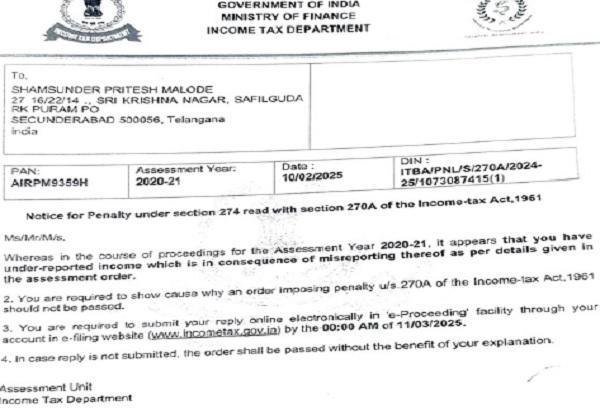
12. On perusal of the above, we find that in that notice also, the Assessing Officer stated that the assessee had under-reported income in consequence of misreporting thereof. Thus, both the assessment order and the penalty notice communicated that misreporting was the basis of the proposed penalty. The assessee was not left to ascertain whether the proceedings were for under-reporting simpliciter or for under-reporting in consequence of misreporting. Therefore, guided by the decision of the Hon’ble Delhi High Court in the case of Schneider Electric South East Asia (HQ) Pte Ltd. Vs. ACIT (supra) and having regard to the express charge recorded in the assessment order and the penalty notice, we are of the considered view that the notice in the present case cannot be treated as vague merely because it did not cite a particular clause of section 270A(9) of the Act. We therefore find no merit in the assessee’s challenge to the validity of initiation of penalty proceedings. Accordingly, additional ground no. 2 of the assessee is dismissed.
10. As the Ld. AR pressed only additional ground no. 2 and no other ground was pressed before us, the appeal of the assessee is dismissed.
13. In the result, the appeal of the assessee is dismissed.
Order pronounced in the Open Court on 16th October, 2026.