
Shri Ashok Khatri Vs M/s S3 Infra Reality Pvt Ltd (NAA)
From the documents placed on record and the DGAP’s report it is evident that the Respondent has sold 780 units out of 816 residential units, out of which for 29 units there was no consideration paid after introduction of GST, hence the profiteered amount has to be calculated only for 751 units which have been sold and consideration received. Out of these 751 home buyers the DGAP has admitted that for 100 buyers the entire profiteered amount has already been paid. Hence in respect of 651 units as has been shown in the table below the profiteered amount comes to Rs. 1,45,59,184 which includes an amount of Rs. 23,772 for the Applicant No. 1 and Rs. 1,45,35,412 for all the other 650 home buyers. It has also been verified by the DGAP that in the case of the above Applicant, the Respondent has already paid an amount of Rs. 12,492, out of the profiteered amount of Rs. 23,772 hence the balance amount of Rs. 11,280 is to be paid. In the case of the balance 650 buyers, an amount of Rs. 70,71,541 has already been paid and balance amount of Rs. 54,63,640 is required to be paid. With regard to the commercial units only 13 units out of 36 units have been sold and an amount of Rs. 3,01,690 has been profiteered. Thus a total amount of Rs. 3,01,690 has to be paid to all the buyers of these commercial units. Accordingly out of total profiteered amount of Rs. 1,48,60,874 an amount of Rs. 90,84,264 has already been passed on as is evident from Annexure 17 of the DGAP’s Report where intimations have been filed by the Respondent stating the details of the payments regarding ITC benefit paid to their buyers. The balance amount of Rs. 57,76,610 is to be passed on to the identified buyers.
It is evident from the above that the Respondent has denied benefit of ITC to the buyers of the flats being constructed by him under the above Policy in contravention of the provisions of Section 171 (1) of the CGST Act, 2017 and has thus realized more price from them than he was entitled to collect and has also compelled them to pay more GST than that they were required to pay by issuing incorrect tax invoices and hence he has committed an offence under section 122 (1) (i) of the CGST Act, 2017 and therefore, he is liable for imposition of penalty. Accordingly, a Show Cause Notice be issued to him directing him to explain why the penalty prescribed under Section 122 of the above Act read with rule 133 (3) (d) of the CGST Rules, 2017 should not be imposed on him.
FULL TEXT OF ORDER OF NATIONAL ANTI-PROFITEERING APPELLATE AUTHORITY
1. This Report dated 28.11.2018, has been received from the Applicant No. 2 i.e. the Director General of Anti-Profiteering (DGAP), under Rule 129 (6) of the Central Goods & Services Tax (CGST) Rules, 2017. The brief facts of the present case are that a complaint dated 04.04.2018 was filed before the Haryana State Screening Committee on Anti-Profiteering by the Applicant No. 1 alleging profiteering by the Respondent in respect of purchase of a flat in the Respondent’s project “Auric City Homes” situated in Village Bathola, Sector-82, Faridabad, Haryana-121007. The above Applicant had alleged that the Respondent had not passed on the benefit of Input Tax Credit (ITC) to him by way of commensurate reduction in the price after implementation of the GST w.e.f. 01.07.2017 and charged GST on full amount of instalments. This Complaint was further referred to the Standing Committee on Anti-profiteering by the Screening Committee vide minutes of its meeting dated 20.06.2018 under Rule 128 of the above Rules.
2. The above Complaint was examined by the Standing Committee on Anti-profiteering in its meeting held on 07.08.2018 & 08.08.2018 and its minutes were forward to the DGAP for detailed investigation under Rule 129 (1) of the CGST Rules, 2017.
3. The DGAP on receipt of the above minutes had called upon the Respondent to submit reply as to the whether the ITC benefit was passed on by him to his recipients and also asked him to suo-moto determine the quantum of benefit which was not passed on. The Respondent had submitted replies vide letters dated 20.09.2018, 10.10.2018, 16.10.2018, 01.11.2018, 12.11.2018, 13.11.2018, 14.11.2018, 15.11.2018, 19.11.2018, 22.11.2018 and 26.11.2018 stating that he was in the business of construction of flats under the Affordable Housing Scheme sanctioned under the Haryana Affordable Housing Policy, 2013 in Sector-82, Faridabad. The Respondent had also stated that after implementation of the GST w.e.f. 01.07.2017, the ITC on purchase of materials during July. 2017 and August, 2017 was negligible and he had raised the first demand without giving the benefit of ITC by changing GST @ 12% on 14.08.2017. He had further stated that he had raised the next demand on 14.02.2018 by levying GST @ 8% due to change in the rate of tax as per the Notification issued on 25.01.2018 and had -7‘ given the benefit of ITC provisionally and informed the buyers that the benefit of ITC would be passed on to them at the time of handing over possession of the flats. The Respondent also submitted that the Applicant No. 1 had filed the complaint on 04.04.2018 in which he had mentioned about the demand raised by the Respondent in the month of August, 2017, but he had failed to mention the demand which was raised in the month of March 2018 which included the benefit of ITC which was passed on to the Applicant. He has further submitted that he had given the benefit of ITC to his customers and also assured them that such benefit would be passed on at the time of possession.
4. The DGAP’s investigation report has covered the period from 01.07.2017 to 31.08.2018.
5. The Respondent had also submitted the following documents along with their replies:-
(a) Copies of GSTR-1 returns for July. 2017 to August, 2018.
(b) Copies of GSTR-3B returns for July, 2017 to August, 2018 along with copies of challans for depositing the GST in Cash.
(c) Copies of Tran-1 returns for transitional credit availed.
(d) Copies of VAT & ST-3 returns for April, 2016 to June, 2017.
(e) Copies of all demand letters and sale agreement/contract issued in the name of Shri Ashok Khatri.
(f) Tax rates- pre-GST and post-GST.
(g) Copy of Balance Sheet for FY 2016-17 & FY 2017-18.
(h) Copy of Electronic Credit Ledger for 01.07.2017 to 31.08.2018.
(i) CENVAT/Input Tax Credit register for April, 2016 to August. 2018.
(j) Details of taxable turnover and input tax credit for the project “Auric City Homes”.
(k) List of home buyers in the project “Auric city Homes” along with buyers of commercial shops.
(l) Copy of Project Report of RERA.
(m) Reconciliation of turnover reported in GSTR-3B with list of home buyers.
(n) Details of unsold flats and unsold commercial shops.
(o) Copies of contract and demand letters for new bookings made during the period August, 2018 to October, 2018 reflecting passing of 2% benefit of GST input credit to new allottees.
(p) Details of Customer wise benefit passed on.
6. The DGAP in his report has submitted that as per the documents submitted by the Respondent, the payment schedule for the purchase of a flat measuring 618.24 square feet at the basic sale price of Rs. 4,000/- per square feet and the details of amounts and taxes paid by the Applicant No. 1 to the Respondent were as has been given below in the Table:-
Table-`A’ (Amount in Rs.)
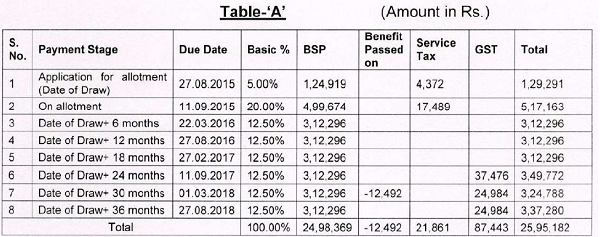
7. The DGAP has also submitted that unlike other cases in which allegation of not passing on the benefit of ITC is generally contested but in the present case the Respondent had suo-moto admitted that there has been benefit of ITC post GST and he had passed on such benefit to the above Applicant by reducing the demand raised in the month of February, 2018 by Rs. 12,492/- which was 1.23% of the amount collected post-GST. The Respondent had also assured that the final input tax credit benefit would be provided at the time of possession.
8. The DGAP in his Report has further submitted that prior to 01.07.2017, i.e., in the pre-GST era, the service of construction of affordable housing, provided by the Respondent, was exempted from the Service Tax under Notification No. 25/2012-ST dated 20.06.2012, as amended by Notification No. 9/2016-ST dated 01.03.2016 and hence the Respondent was not eligible to avail credit of Central Excise Duty paid on the inputs or Service Tax paid on the input services, however, the Respondent was eligible to avail CENVAT credit of Service Tax paid on input services for the commercial shops sold by him. He has also claimed that the Respondent was eligible to ITC on VAT paid on inputs but the CENVAT credit of Central Excise Duty paid on inputs was not available and post-GST, the Respondent was eligible to avail ITC of GST paid on inputs and input services including the tax paid by his sub-contractors. He has further claimed that from the data submitted by the Respondent duly verified from his returns filed during the pre-GST period (April, 2016 to June, 2017) and the post-GST period (July, 2017 to August, 2018), the details of the ITC availed and the taxable turnover during the above periods were as under:-
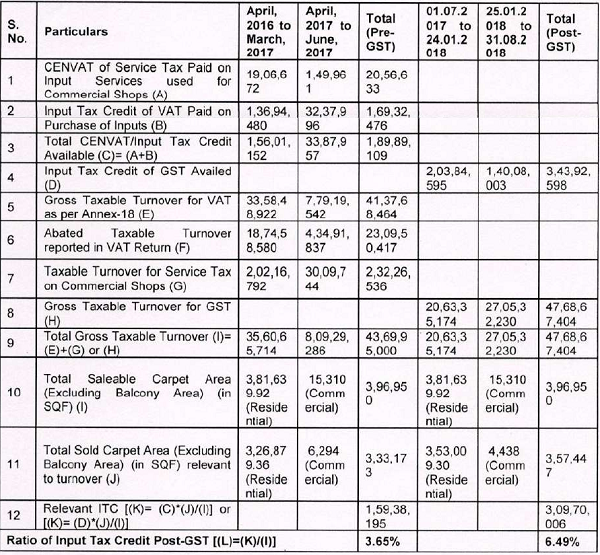
9. The DGAP has also contented that from the above Table, it was clear that the ITC as a percentage of the total turnover that was available to the Respondent during the pre-GST period from April, 2016 to June, 2017 was 3.65% and during the post-GST period w.e.f. July, 2017 to August, 2018, it was 6.49%. The Report has further claimed that this data duly confirmed that post-GST the Respondent had benefited from additional ITC to the extent of 2.84% [6.49% (-) 3.65%] of the taxable turnover. The DGAP has also noted that the Central Government, on the recommendation of the GST Council, had levied 18% GST, effective rate of which was 12% in view of 1 /3rdabatement on the value of land on construction service vide Notification No. 11/2017-Central Tax (Rate) dated 28.06.2017. He has further noted that the actual GST rate on construction service in respect of affordable and low-cost housing was further reduced from 12% to 8%, vide Notification No. 1/2018-Central Tax (Rate) dated 25.01.2018. In view of the change in the GST rate after 01.07.2017, the DGAP has examined the issue of profiteering in two parts, i.e., by comparing the applicable tax rate and input tax credit available for the pre-GST period from April, 2016 to June, 2017 when only VAT was payable @5.25% with (1) the post-GST period from July, 2017 to 24.01.2018 when the effective GST rate was 12% and (2) with the GST period from 25.01.2018 to 31.08.2018 when the effective GST rate was 8%. Accordingly, on the basis of the above Table, the comparative figures of ITC available during the pre-GST and the post-GST period and the profiteered amount have been tabulated by the DGAP as per the Table given below:-
Table C






Comments are closed.