AutoForm Sales GmbH Vs ADIT (International Taxation)-1 (ITAT Hyderabad)
Background of the Case
The Hyderabad Tribunal held that the specialised nature of software and selection of modules according to customer requirements do not, by themselves, establish transfer of copyright rights.
It also rejected treatment of the software receipts as fees for technical services because the Revenue had not identified any actual managerial, technical or consultancy service rendered for the disputed consideration.
The assessee, a company incorporated in Switzerland, operated within the distribution chain for AutoForm software used primarily in the automobile industry. The software supported product manufacturability, tool and material cost calculations, die-face design and virtual stamping.
For Assessment Year 2022–23, the assessee received ₹43,54,66,906 from AutoForm Engineering India Pvt. Ltd. towards software sale/distribution. It declared nil taxable income and claimed refund of the tax deducted at source.
Revenue Treats Entire Receipts as Royalty and FTS
The Assessing Officer considered the software specialised or customised and associated its supply with technical assistance and training.
On that basis, the entire receipts were characterised as royalty as well as fees for technical services. The Dispute Resolution Panel upheld the proposed treatment, followed by the final assessment order.
The assessee challenged this characterisation, relying on the distribution agreements, appointment letter, price lists, quotations, purchase orders and invoices.
Its central contention was that the transactions involved copyrighted software products, without transfer of rights in the underlying copyright.
Intellectual Property Remained with the Developer
The Tribunal examined the contractual framework and found that AutoForm Engineering GmbH developed the software and retained its intellectual property rights.
AutoForm India was appointed as a non-exclusive distributor. The assessee functioned as the foreign distribution/invoicing entity, raising invoices and receiving payments from AutoForm India.
The material did not establish that AutoForm India or the Indian end-users obtained rights to independently reproduce the software for commercial exploitation, modify or adapt it, create derivative works, or otherwise exercise rights comprised in its copyright.
The distinction between permission to use a software product and acquisition of copyright rights was therefore decisive.
Configuration Is Not Necessarily Customer-Specific Development
The Revenue relied on customers choosing different modules, features and functionalities to meet their business requirements.
However, the Tribunal found that customers selected from an existing software suite. The transaction documents identified particular modules and licences.
There was no material showing that a separate software product had been developed for a customer or that the underlying source code had been modified for that customer.
The Tribunal held that selection or configuration of existing modules does not, by itself, establish customer-specific development or a grant of copyright rights.
A sophisticated product does not become a copyright transfer merely because its modules are selected to suit a particular user.
Engineering Analysis Applied
The Tribunal relied on Engineering Analysis Centre of Excellence (P.) Ltd. v. CIT (2021) 432 ITR 471 (SC).
It noted the Supreme Court’s distinction between a non-exclusive licence permitting use of software and acquisition of rights retained by the copyright owner under Section 14 of the Copyright Act, 1957.
Restrictions governing software use do not, by themselves, transfer an interest in copyright.
Applying that distinction, the Tribunal found that the Revenue had not established the necessary transfer of rights to support its royalty characterisation.
Support Clauses Did Not Establish Actual Technical Services
The Tribunal separately examined the allegation of technical services.
The invoices concerned identified software modules and licences. AutoForm India’s financial statements recorded nil training income, and no separate invoice for customer-specific technical or training services was identified.
Importantly, the Tribunal clarified that absence of a separate invoice was not conclusive by itself.
The deeper defect was that neither the assessment order nor the DRP directions identified the particular service actually rendered by the assessee, its recipient, the person rendering it or identifiable consideration attributable to it.
A contractual clause contemplating training or support did not establish that such services had actually been rendered for the receipts under appeal.
Royalty and FTS Require Separate Factual Findings
The Tribunal criticised the characterisation of the same receipts as royalty and FTS without establishing the respective factual foundations.
Royalty required identification of the copyright rights granted. FTS required identification of the services rendered for consideration. Neither had been established.
Although the same distribution arrangement had been accepted as non-taxable in the preceding year, the Tribunal expressly based its decision on its independent examination of the current record.
It deleted the ₹43,54,66,906 addition for Assessment Year 2022–23 and directed deletion of the corresponding addition for Assessment Year 2023–24. Both appeals were allowed.
Author’s Comments
The ruling demonstrates that technical sophistication is not a substitute for examining contractual rights and actual transactions.
Module selection must be distinguished from modification of the underlying software, just as a support clause must be distinguished from evidence of services actually rendered.
Equally, the decision does not establish that every software-related payment or bundled service is non-taxable. Its strength lies in the documented distribution model and the Revenue’s failure to establish either copyright exploitation rights or identifiable technical services for the disputed receipts.
List of Cases Discussed / Relied Upon
1. Engineering Analysis Centre of Excellence (P.) Ltd. Vs CIT, (2021) 432 ITR 471 (Supreme Court): The Supreme Court distinguished the right to use copyrighted software from the acquisition of rights in the copyright itself. The Tribunal applied this distinction to conclude that the distribution and configuration of existing AutoForm software modules did not establish transfer of copyright rights. The linked TaxGuru article discusses the ruling and subsequent review proceedings.
FULL TEXT OF THE ORDER OF ITAT HYDERABAD
These two appeals are filed by M/s. AutoForm Sales GmbH (“the assessee”), feeling aggrieved by the separate assessment orders passed by the Assessing Officer under section 143(3) r.w.s. 144C(13) of the Income Tax Act, 1961 (“the Act”) for A.Ys. 2022-23 & 2023-24, dated 22.01.2025 and 22/01/2026 as per the directions of the Learned Dispute Resolution Panel-1 Bengaluru (“Ld. DRP”) dated 23.12.2024 and 29.12.2025 respectively. Since identical issues are raised by the assessee in both these appeals, for the sake of convenience, these two appeals were heard together and are being disposed of by this common and consolidated order.
ITA No.498/Hyd/2025 for the A.Y 2022-23:
2. The assessee has raised the following grounds of appeal:
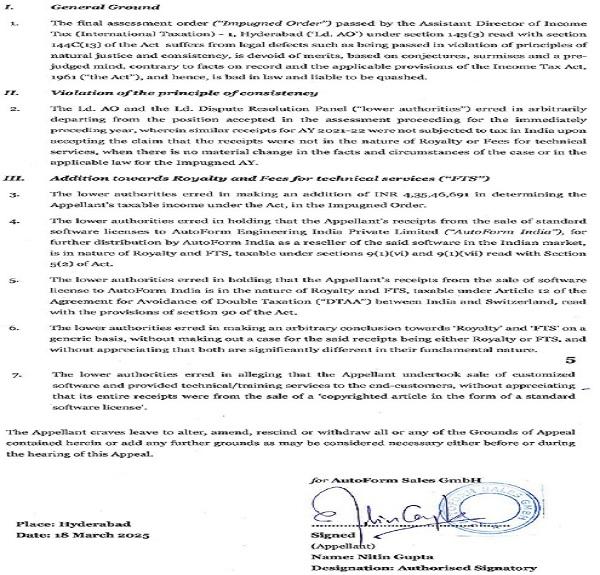
3. The brief facts of the case are that the assessee is a foreign company incorporated under the laws of Switzerland, engaged in providing software for product manufacturability, tool and material cost calculation, die-face design and virtual stamping, which is primarily used in the automobile industry. The assessee filed its return of income for A.Y. 2022-23 on 23.11.2022 declaring total income of Rs. Nil and claimed the entire TDS of Rs. 4,35,46,690/- as refund. The case of the assessee was selected for complete scrutiny under CASS and accordingly, notice under section 143(2) of the Act was issued by the Assessing Officer on 31.05.2023. During the assessment proceedings, the Assessing Officer observed that during the year under consideration, the assessee had received an amount of Rs. 43,54,66,906/- from AutoForm Engineering India Pvt. Ltd. (“AutoForm India”) towards sale/distribution of software products. The assessee claimed that the said receipts were not chargeable to tax in India. The Assessing Officer, however, was of the view that the software supplied in India was specialised/customised software and that technical/training services were also associated with the supply of such software. Accordingly, the Assessing Officer passed the draft assessment order under section 144C(1) of the Act dated 31.03.2024 treating the entire receipts of Rs. 43,54,66,906/- as royalty as well as fees for technical services (“FTS”) and proposing to assess the total income of the assessee at Rs. 43,54,66,906/-.
4. Aggrieved by the draft assessment order, the assessee raised objections before the Ld. DRP. However, the Ld. DRP, vide its directions under section 144C(5) of the Act dated 23.12.2024, upheld the action of the Assessing Officer. Pursuant to the directions of the Ld. DRP, the Assessing Officer passed the final assessment order under section 143(3) read with section 144C(13) of the Act dated 22.01.2025 assessing the total income of the assessee at Rs. 43,54,66,906/-.
5. Aggrieved by the final assessment order, the assessee is in appeal before us. At the outset, the Learned Authorized Representative (“Ld. AR”) submitted that the dispute essentially relates to the characterization of the receipts of Rs. 43,54,66,906/- from sale/distribution of AutoForm software as royalty and FTS. In this regard, the Ld. AR submitted that AutoForm Engineering GmbH (“AutoForm Engineering”) is involved in developing highly specialised software for optimizing sheet-metal products and sheet-metal forming processes and designing tools with complex geometries, hereinafter referred to as “AutoForm software”. AutoForm India is a private limited company incorporated in India and is engaged in the business of distribution of software owned/developed by AutoForm Engineering. AutoForm Engineering has entered into a Distribution Agreement with AutoForm India appointing it as a distributor of such software to end-users/third-party customers in India. The assessee has been appointed as the invoicing entity in the distribution chain and, accordingly, invoices in respect of the software supplied are raised by the assessee and payments are received by the assessee from AutoForm India. The Ld. AR, inviting our attention to the Distribution Agreement entered into between AutoForm Engineering and AutoForm Engineering India, placed at page nos. 27 to 51 of the paper book, submitted that AutoForm Engineering develops the software and exclusively owns the intellectual property rights therein, whereas AutoForm India has merely been appointed as a non-exclusive distributor of AutoForm software in India. Further, inviting our attention to the appointment letter issued by AutoForm Engineering in favour of the assessee, placed at page no. 52 of the paper book, the Ld. AR submitted that the assessee merely functions as the foreign distribution/invoicing entity. It was submitted that neither the assessee nor AutoForm India acquires ownership of, or any exploitation rights in, the copyright underlying the AutoForm software and the intellectual property rights continue to vest with AutoForm Engineering.
6. The Ld. AR further invited our attention to the AutoForm price list placed at page nos. 109 to 112 of the paper book; the sample quotation issued by AutoForm India to one of its customers placed at page nos. 113 to 116 of the paper book; the sample purchase order received by AutoForm India from one of its customers placed at page nos. 118 to 120 of the paper book; the tax invoice issued by AutoForm India to one of its customers placed at page nos. 121 to 123 of the paper book; and the corresponding invoice issued by the assessee to AutoForm India placed at page nos. 132 to 135 of the paper book. Referring to the aforesaid documents, the Ld. AR submitted that the AutoForm software supplied is a suite of pre-existing software products comprising various modules and functionalities. The customers merely select different combinations of modules, features and add-ons according to their business requirements. Such selection, according to the Ld. AR, merely amounts to configuration from the existing product suite and does not involve modification, redevelopment or customer-specific development of the underlying software. It was submitted that the license key merely activates the modules and license parameters purchased by a particular customer and does not alter the source code or result in creation of any customer-specific executable or source code.
7. The Ld. AR further submitted that neither AutoForm India nor the ultimate end-users acquire any right to reproduce, modify, adapt, reverse engineer, decompile or create derivative works from the software or to access its source code. They also do not acquire any right to commercially exploit the copyright underlying the software. Thus, according to the Ld. AR, what is supplied is merely a copyrighted software product and no right in the copyright itself is transferred. The Ld. AR placed heavy reliance on the decision of the Hon’ble Supreme Court in Engineering Analysis Centre of Excellence (P.) Ltd. Vs. CIT (2021) 432 ITR 471 (SC) and submitted that the issue is squarely covered by the said decision. It was submitted that the Hon’ble Supreme Court has specifically considered software distribution arrangements involving foreign software suppliers, foreign distributors, Indian distributors and Indian end-users and has held that where no right in the underlying copyright is transferred, consideration received towards sale/distribution of software does not constitute royalty.
8. With regard to the treatment of the receipts as FTS, the Ld. AR invited our attention to the details of the amount received on account of sale of services forming part of the audited financial statements of AutoForm India at note no. 2.13, placed at page no. 184 of the paper book. The Ld. AR submitted that the said financial statements show Nil training income, which, according to him, further substantiates the contention that no customer-specific technical or training services were rendered by the assessee either to AutoForm India or to the ultimate end-users. It was submitted that the clauses relating to support, maintenance or training contained in the Distribution Agreement merely contemplate general support or product familiarization incidental to the software distribution arrangement. No separate service agreement or statement of work existed, no separate invoice for technical or training services was raised and no separate consideration was received by the assessee for any such services.
9. The Ld. AR further submitted that the Assessing Officer as well as the Ld. DRP have treated the entire receipts simultaneously as royalty and FTS without identifying either the particular right in copyright which was allegedly transferred or the particular managerial, technical or consultancy service which was allegedly rendered by the assessee. It was submitted that royalty and FTS are distinct categories of services and the conditions prescribed for each category are required to be independently satisfied.
10. The Ld. AR also drew our attention to the assessment order of the assessee for the A.Y. 2021-22 placed at page nos. 231 to 233 of the paper book and submitted that in the immediately preceding A.Y. 2021-22, receipts arising from the same software distribution arrangement had been accepted as not taxable in India by the Revenue after considering the decision of the Hon’ble Supreme Court in Engineering Analysis Centre of Excellence (P.) Ltd. (supra). It was submitted that there has been no change in the software products, contractual framework, distribution model or other material facts during the assessment year under consideration. Accordingly, the Ld. AR prayed that the addition made by the Assessing Officer by treating the impugned receipts as royalty and/or FTS be deleted.
11. Per contra, the Learned Departmental Representative (“Ld. DR”) relied upon the orders of the lower authorities. The Ld. DR submitted that the software supplied by the assessee is highly specialized software intended for the automobile industry and that different modules, features and functionalities are selected and configured according to the requirements of individual customers. Therefore, according to the Ld. DR, the transaction cannot be regarded as a simple sale of software. The Ld. DR further submitted that the Distribution Agreement contains provisions relating to technical support, training and other assistance connected with the software supplied in India. Accordingly, the Ld. DR supported the action of the Assessing Officer in treating the receipts as royalty and FTS under the provisions of the Act and prayed that the grounds raised by the assessee be dismissed.
12. We have heard the rival submissions and perused the material available on record, including the case law relied upon by the parties. The issue before us is whether the receipts of the assessee from the sale/distribution of AutoForm software products to AutoForm India are liable to be taxed in India as royalty and/or FTS. The principal contention of the Revenue is that the software is highly specialized for the automobile industry, that different modules and functionalities are selected and configured according to the requirements of individual customers, and that training, technical support and other assistance are provided in connection with its use. According to the Revenue, these features show that the transaction involves a grant of rights in the copyright underlying the software. We have examined the relevant portions of the Distribution Agreement placed at page nos. 27 to 51 of the paper book, to which our attention was invited by the Ld. AR. The agreement shows that AutoForm Engineering is the developer of the AutoForm software and retains the intellectual property rights therein, whereas AutoForm India has been appointed as a non-exclusive distributor in India. We have also examined the appointment letter placed at page no. 52 of the paper book, relied upon by the Ld. AR to explain the assessee’s role as the foreign distribution/invoicing entity. Further, we have examined the AutoForm price list placed at page nos. 111 and 112, sample quotation placed at page nos. 113 to 116, sample purchase order placed at page nos. 118 to 120, customer invoice placed at page nos. 121 to 123 and corresponding invoice raised by the assessee on AutoForm India placed at page nos. 132 to 135 of the paper book. On a conjoint reading of these documents, we find that customers select the required modules and functionalities from the existing AutoForm software suite and that invoices are raised in respect of the identified software modules/licenses. The material before us does not show that a separate software product was developed for any customer or that the source code of the existing software was modified for a particular customer. Selection or configuration of different combinations of existing modules does not, by itself, establish customer-specific development of the underlying software or a grant of rights in its copyright. In this regard, we have also carefully gone through the para no. 97 of the order of the Hon’ble Supreme Court in Engineering Analysis Centre of Excellence (P.) Ltd. Vs. CIT (Supra), which is to the following effect:
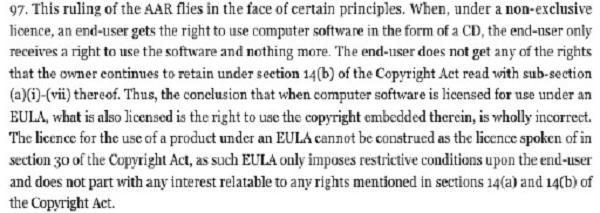
13. On perusal of the above, we find that the Hon’ble Supreme Court has explained that an end-user who receives a non-exclusive licence to use computer software obtains the right to use the software, but does not thereby acquire any of the rights retained by the copyright owner under section 14 of the Copyright Act, 1957. The restrictions imposed upon the end-user under a licence for use of the software do not, by themselves, amount to a grant of an interest in the copyright. Applying the distinction explained by the Hon’ble Supreme Court to the Revenue’s contention in the present case, we find that the Revenue has failed to brought before us any materials to substantiate that AutoForm India or the ultimate Indian end-users are granted any right to reproduce the software for independent commercial exploitation, modify or adapt it, create derivative works, or otherwise exercise a right comprised in the copyright. The intellectual property rights continue to vest with AutoForm Engineering. The specialized nature of the software and the selection or configuration of existing modules to suit different customers do not establish a transfer of rights in the copyright underlying the software.
14. We now turn to the Revenue’s contention regarding training, technical support and other assistance connected with the software. We have examined the audited financial statements of AutoForm India, particularly note no. 2.13 placed at page no. 184 of the paper book, to which our attention was specifically invited by the Ld. AR. The assessee relies upon that note to show that no training income was recorded. We have also considered the invoices and other transaction documents referred to above. The invoices placed before us pertain to identified software modules/licenses. No separate invoice for customer-specific training or technical services has been brought to our notice. While the absence of a separate invoice is not, by itself, decisive, neither the assessment order nor the directions of the Ld. DRP identify any particular training, managerial, technical or consultancy service actually rendered by the assessee to AutoForm India or to an ultimate Indian customer in consideration for the impugned receipts. The Revenue has not identified the recipient of any such service, the person through whom it was rendered, or any identifiable consideration attributable thereto. More particularly, the Revenue has not explained how the alleged training, technical support or other assistance conferred upon AutoForm India or any end-user a right in the copyright underlying the software. Assistance in learning to operate software, even if rendered, does not by itself confer a right to reproduce, modify, adapt or commercially exploit the software as a copyright holder. A provision in the Distribution Agreement contemplating training or support also does not establish that such a service was actually rendered by the assessee for the consideration under appeal, much less that its rendition resulted in a transfer of rights in copyright. Thus, the factual link on which the Revenue’s contention rests has not been established.
15. We further find that the lower authorities have characterized the same receipts as royalty and FTS without identifying the rights in copyright said to have been granted or the services said to have been rendered by the assessee for those receipts. The two characterizations require separate findings on their respective factual foundations. On the material before us, the Revenue has established neither a grant of rights in the copyright underlying the software nor the rendition of managerial, technical or consultancy services by the assessee for the impugned consideration.
16. We also note the assessee’s submission that receipts arising from the same software distribution arrangement were accepted as not taxable in India in the immediately preceding A.Y. 2021-22. The Revenue has not pointed out any material change in the relevant contractual terms or distribution model during the year under consideration. We have, however, reached our findings independently on the basis of the agreements, transaction documents, audited financial statements and other material placed before us.
17. In view of the foregoing discussion and considering the totality of the facts and circumstances of the case, we find that the Revenue has failed to establish its contention that the sale/distribution of the software, including the selection or configuration of its existing modules and the alleged provision of training or assistance, resulted in the grant of rights in the copyright underlying the software. The Revenue has also failed to establish that the impugned receipts, or any identifiable part thereof, represent consideration for managerial, technical or consultancy services rendered by the assessee. Accordingly, the addition of Rs. 43,54,66,906/- made by treating the receipts from the sale/distribution of AutoForm software products as royalty and/or FTS cannot be sustained. Accordingly, We direct the Assessing Officer to delete the said addition.
18. In the result, the appeal of the assessee in ITA No.498/Hyd/2025 is allowed.
ITA No.486/Hyd/2026 for A.Y. 2023-24:
19. The facts and issues involved in the present appeal are identical to the issue involved in the appeal of the assessee in ITA No.498/Hyd/2025 for the A.Y. 2022-23. The parties have not brought to our notice any material difference in the relevant agreements, distribution arrangement, nature of software or nature of transactions for A.Y. 2023-24. Therefore, our findings and conclusions recorded hereinabove for A.Y. 2022-23 shall apply mutatis mutandis to A.Y. 2023-24. Accordingly, the Assessing Officer is directed to delete the corresponding addition made by treating the software receipts as royalty and/or FTS for A.Y. 2023-24 also.
20. In the result, the appeal of the assessee in ITA No.486/Hyd/2026 for the A.Y. 2023-24 is also allowed.
21. To sum up, both the appeals of the assessee are allowed.
Order pronounced in the Open Court on 16th October, 2026.