Subros Ltd. Vs Assessment Unit (ITAT Delhi)
Under-reporting Too Needs a Specific Charge: A Vague Notice Cannot Sustain Penalty
Background: Disallowances Followed by Penalties
For AY 2015-16, the assessee declared a loss under the normal provisions and paid tax on its book profits. Following the quantum proceedings, the disallowances of CSR expenditure of ₹57,32,516 and delayed employees’ PF contribution of ₹4,715 remained. The AO imposed a penalty of ₹19,85,542 under section 271(1)(c) for furnishing inaccurate particulars of income.
For AY 2016-17, a penalty of ₹6,03,880 under section 271(1)(c) was imposed in connection with delayed employees’ PF contribution and an adjustment relating to delayed payment of TDS.
For AY 2017-18, the dispute concerned an excess weighted deduction of ₹83,11,838 under section 35(2AB) arising from the difference between the deduction claimed and the expenditure subsequently approved by DSIR. The AO imposed penalty under section 270A for under-reporting of income. The CIT(A) upheld the penalties, leading to the present appeals.
Section 271(1)(c): The Notice Must Specify the Charge
For AY 2015-16, the assessee pointed out that neither the initial penalty notice nor the subsequent show-cause notice specified whether the charge was concealment of income or furnishing inaccurate particulars of income.
The Revenue argued that the assessment order recorded satisfaction for furnishing inaccurate particulars and that the penalty was ultimately imposed on that basis. Accordingly, failure to strike out the irrelevant limb in the notice should not invalidate the penalty.
The Tribunal rejected this contention. It held that the two limbs carry different meanings and that the assessee must know the precise allegation to respond effectively. A standard notice retaining both alternatives reflected non-application of mind.
Relying on CIT v. Manjunatha Cotton & Ginning Factory, 359 ITR 565 (Karnataka), SSA’s Emerald Meadows, and the observations in Dilip N. Shroff v. JCIT, 291 ITR 519 (SC), the Tribunal deleted the penalty.
A Debatable Deduction Does Not Automatically Invite Penalty
For AY 2016-17, the Tribunal noted that deductibility of employees’ PF contribution deposited beyond the statutory due date, but before the return-filing due date, had attracted conflicting judicial views.
Although the issue was subsequently settled by the Supreme Court in Checkmate Services Ltd. v. CIT, 448 ITR 518, the assessee’s claim related to a period when favourable decisions existed. The expenditure was genuine, and the AO had not established that inaccurate particulars were furnished.
Regarding the ₹39,725 book-profit adjustment, the Tribunal noted that the assessee had already added the amount under the normal provisions. Applying CIT v. Reliance Petroproducts Pvt. Ltd., 322 ITR 158 (SC), it reiterated that rejection of a claim does not, by itself, justify penalty. The penalty for this year was also deleted.
Section 270A: Specificity Is Required for Under-reporting Also
For AY 2017-18, the assessee had claimed weighted deduction for its in-house research expenditure. DSIR issued its approval on 9 July 2018, after the return had been filed, approving a lower amount and resulting in the disputed excess deduction.
The Tribunal found that the relevant particulars had been disclosed and that the subsequent approval could not have guided the original return. Following Akums Drugs & Pharmaceuticals Ltd. v. DCIT, (2025) 175 taxmann.com 135 (Delhi ITAT), it held that the disallowance did not automatically warrant penalty.
The Tribunal then considered the independent objection concerning the charge. Section 270A(2) specifies seven circumstances, in clauses (a) to (g), constituting under-reporting. The AO had failed to identify and communicate the applicable circumstance through the assessment order or notice. The penalty order also failed to explain the circumstance triggering the levy.
The Tribunal held that this omission obstructed the assessee’s ability to contest the allegation and violated natural justice. Drawing support from Schneider Electric South East Asia (HQ) Pte. Ltd. v. ACIT, 443 ITR 186 (Delhi), it quashed the penalty. All three appeals were allowed.
Author’s Comments
The significance of this decision extends beyond defective notices for misreporting. The Tribunal expressly applied the requirement of a specific charge to under-reporting under section 270A(2). Paragraphs 30 to 34 therefore provide direct support for challenging a levy where the AO merely uses the expression “under-reporting” without identifying the statutory circumstance and explaining its application.
However, the decision should be applied with precision. Schneider Electric concerned misreporting and denial of immunity; the express extension to clauses (a) to (g) of section 270A(2) is the Tribunal’s reasoning in Subros. Further, the defect here involved absence of identification and communication across the relevant proceedings. It is therefore stronger than an objection based solely on omission of a clause number where the charge is otherwise clearly explained.
On merits, section 270A(6)(a), covering a bona fide explanation supported by disclosure of material facts, provides a useful statutory foundation. A taxpayer should substantiate that protection alongside the notice objection. A sustained disallowance establishes the assessment consequence; it does not dispense with the separate requirements for penalty.
Cases Discussed
1. Akums Drugs & Pharmaceuticals Ltd. v. DCIT — (2025) 175 taxmann.com 135 (ITAT Delhi). Followed in AY 2017-18 for holding that a bona fide weighted deduction claim under Section 35(2AB), based on disclosed particulars and subsequently restricted by DSIR approval, does not automatically justify penalty under Section 270A.
2. Checkmate Services Ltd. v. CIT — Supreme Court, (2022) 448 ITR 518. Distinguished in the penalty context; although delayed employees’ contributions were held inadmissible under Section 36(1)(va), the existence of earlier conflicting judicial views was considered relevant to the assessee’s bona fide claim.
3. Schneider Electric South East Asia (HQ) Pte. Ltd. v. ACIT — Delhi High Court, (2022) 443 ITR 186, decided on 28 March 2022. Relied upon for the requirement to specify the charge under Section 270A. The Delhi ITAT extended its reasoning to identification of the applicable circumstance under Section 270A(2).
4. CIT v. Reliance Petroproducts (P.) Ltd. — Supreme Court, (2010) 322 ITR 158. Relied upon for the proposition that mere rejection of a deduction or expenditure claim, without incorrect particulars, does not automatically attract penalty.
5. Dilip N. Shroff v. JCIT — Supreme Court, (2007) 291 ITR 519. Relied upon regarding uncertainty in stereotyped penalty notices and non-application of mind where the applicable charge is not identified.
6. CIT v. SSA’s Emerald Meadows — Supreme Court, (2016) 73 taxmann.com 248 (SC), arising from the Karnataka High Court decision. Relied upon for the invalidity of a notice that does not identify whether penalty concerns concealment or furnishing inaccurate particulars.
7. CIT v. Manjunatha Cotton & Ginning Factory — Karnataka High Court, (2013) 359 ITR 565. Relied upon for the requirement that the statutory penalty notice should specifically communicate the applicable limb under Section 271(1)(c).
8. Hindustan Steel Ltd. v. State of Orissa — Supreme Court, (1972) 83 ITR 26. Relied upon for the principle that penalty is not automatically warranted merely because it is legally permissible, particularly where a breach is technical or arises from bona fide belief.
9. Union of India v. Dharmendra Textile Processors — Supreme Court, (2008) 306 ITR 277. Discussed through the Reliance Petroproducts decision regarding the role of mens rea under Section 271(1)(c) and the continuing relevance of the distinction between concealment and inaccurate particulars.
FULL TEXT OF THE ORIGINAL ORDER OF ITAT DELHI
The captioned appeals are filed by the assessee against the separate orders, all dated 18.09.2025 by Ld. Commissioner of Income Tax (A), National Faceless Appeal Centre (“NFAC”), Delhi [“Ld. CIT(A)”] passed u/s 250 of the Income Tax Act, 1961 [“the Act”] arising from the different penalty order dated 31.03.2025 passed u/s 271(1)(c); penalty order dated 17.03.2025 passed u/s 271(1)(c); and penalty order dated 21.03.2025 passed u/s 270A of the Act pertaining to Assessment Year 2015-16 to 2017-18 respectively.
2. The issues involved in all three captioned appeals are common, therefore, they were heard together and accordingly, adjudicated by a common order.
3. First we take the appeal of the assessee in ITA No.7325/Del/2025 for Assessment Year 2015-16.
ITA No.7325/Del/2025 [Assessment Year 2015-16]
4. Brief facts of the case are that the assessee has filed its return of income on 30.11.2015, declaring loss at INR 35,78,80,223/-. The return was revised on 30.03.2017 reducing the loss at INR 35,61,69,137/-. The book profit was disclosed at INR 20,14,60,260/- and paid the taxes thereon. The assessment was completed at a loss of INR 34,71,93,906/- and the book profit was assessed at INR 21,04,30,770/-.
5. Against the said order, assessee preferred an appeal before Ld. CIT(A) and matter travelled upto the Tribunal and addition of INR 32,38,000/- made on account of M2M loss stood deleted by the coordinate bench of Tribunal however, disallowance made towards late payment of employees contribution towards of PF of INR 4,715/- was confirmed and no appeal was preferred by the assessee on the disallowance made of CSR expenses of INR 57,32,516/-. Thereafter, the AO proceeded with pending penalty proceedings and imposed the penalty u/s 271(1)(c) of the Act of INR 19,85,542/- on the disallowance made of CSR expenses and late payment of employee’s contribution to PF by holding that assessee has furnished inaccurate particulars of its income. Thereafter, in first appeal, Ld. CIT(A) has dismissed the appeal of the assessee.
6. Aggrieved by the said order, assessee is in appeal before the Tribunal by taking various Grounds of appeal as mentioned in the appeal memo. Since all the grounds of appeal are with respect to levy of penalty u/s 271(1)(c) of the Act, therefore, the same are taken together for consideration.
7. Before us, Ld. AR for the assessee submits that while initiating penalty proceedings u/s 271(1)(c) of the Act, a notice was issued to the assessee on 28.12.2017. Thereafter, a show cause notice was issued on 13.10.2021. Ld. AR submits that from the perusal of both the notices (reproduced below), it could be seen that in both the notices, charge for which the penalty proceedings were initiated was not specified as to the assessee has concealed the income or for furnished inaccurate particulars of income. He thus, by following the order of Hon’ble Karnataka High Court in the case of CIT vs. Manjunatha Cotton & Ginning Factory reported in (2013) 359 ITR 565 requested for the deletion of the penalty being initiating without specifying the limb on which the penalty proceedings were initiated. For ready-reference, both the notices issued by the AO, are reproduced as under:-
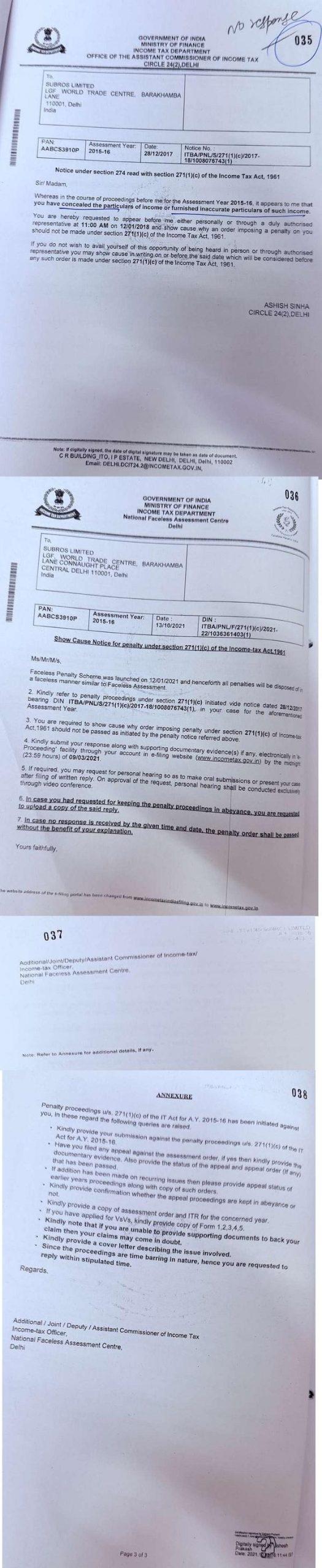
8. On the other hand, Ld. CIT DR for the Revenue vehemently supported the orders of the lower authorities and submitted that the AO has recorded the satisfaction in the assessment order that assessee has furnished inaccurate particulars of income and penalty was also levied for furnishing inaccurate particulars of income, therefore, the order of levy of penalty deserves to be upheld and merely for not struck off the limb in the penalty notice, such order should not be cancelled.
9. We have heard the rival submissions and perused the materials available on record. From the perusal of the notice issued for initiation of the penalty proceedings, we find that AO has not specified the limb for which the satisfaction was recorded of initiation of penalty proceedings u/s 271(1)(c) of the Act as the word ‘OR’ was not strike off in the notice. Even in the show cause notice issued before the levy of penalty, as reproduced above, the OA never asked the assessee to explain on what limb, explanation form the assessee was sought.
10. As per Section 271(1)(c) of the Act, the AO should record his satisfaction that the assessee has either concealed the income or furnished inaccurate particulars of his income. From the perusal of both the notices issued u/s.274(1) r.w.s.271(1)(c) of the Act as reproduced above, it could be seen that AO has not specifically pointed out as to whether the assessee has concealed the particulars of income or furnished the inaccurate particulars of income. Therefore, the penalty proceedings initiated without recording the satisfaction is liable to be quashed. The Hon’ble Apex Court in case of M/s. SSA’s Emerald Meadows, (2016) 73 taxmann.com 248 (SC) dismissed the Special Leave Petition filed by the Revenue against the judgment rendered by Hon’ble High Court of Karnataka whereby identical issue was decided in favour of the assessee. Operative part of the judgment in case of M/s. SSA’s Emerald Meadows (supra) as decided by Hon’ble High Court of Karnataka is reproduced below:-
“2. This appeal has been filed raising the following substantial questions of law:
(1) Whether, omission if assessing officer to explicitly mention that penalty proceedings are being initiated for furnishing of inaccurate particulars or that for concealment of income makes the penalty order liable for cancellation even when it has been proved beyond reasonable doubt that the assessee had concealed income in the facts and circumstances of the case?
(2) Whether, on the facts and in the circumstances of the case, the Tribunal was justified in law in. holding that the penalty notice under Section 274 r.w.s. 271(1)(c) is had in law and. invalid in spite the amendment of Section 271(1 B) with retrospective effect and by virtue of the amendment, the assessing officer has initiated the penalty by properly recording the satisfaction for the same?
(3) Whether on the facts and in the circumstances of the case, the Tribunal was justified in deciding the appeals against the Revenue on the basis of notice issued, under Section 274 without taking into consideration the assessment order when the assessing officer has specified that the assessee has concealed particulars of income?
3. The Tribunal has allowed the appeal filed by the assessee holding the notice issued by the Assessing Officer under Section 274 read with Section 271(1)(c) of the Income Tax Act, 1961 (for short ‘the Act’) to be bad in law as it did not specify which limb of Section 271(1)(c) of the Act, the penalty proceedings had been initiated i.e, whether for concealment of particulars of income or furnishing of inaccurate particulars of income. The Tribunal, while allowing the appeal of the assessee, has relied on the derision of the Division Bench of this Court rendered in the case of COMMISSIONER or INCOME TAX -VS- MANJUNATHA COTTON AND GINNING FACTORY (2013) 359 ITR 565.
4. In our view, since the matter is covered by judgment of the Division Bench of this Court, we are of the opinion, no substantial question of law arises in this appeal for determination by this Court, the appeal is accordingly dismissed.”
11. As observed above, the Assessing Officer initiated the penalty proceedings by issuing the notice u/s 274/271(1)(c) of the Act without specifying whether the assessee has “concealed the income” or the assessee has furnished “inaccurate particulars of income”, so as to provide adequate opportunity to the assessee to explain the show cause notice. Rather notices in this case have been issued in a stereotyped manner without applying any mind which is bad in law, hence is not a valid notice sufficient to impose penalty u/s 271(1)(c) of the Act.
12. The penalty provisions of section 271(1)(c) of the Act are attracted where the assessee has concealed the particulars of income or furnished inaccurate particulars of such income. It is also a well-accepted proposition that the aforesaid two limbs of section 271(1)(c) of the Act carry different meanings. Therefore, it was imperative for the Assessing Officer to strike- off the irrelevant limb so as to make the assessee aware as to what is the charge made against him so that he can respond accordingly. The Hon’ble Karnataka High Court in the case of CIT Vs. Manjunatha Cotton & Ginning Factory reported in (2013) 359 ITR 565 observed that for the levy of penalty u/s 271(1)(c) it has to be made clear as to under which limb it is being levied. As per Hon’ble High Court, where the Assessing Officer proposed to invoke first limb being concealment, then the notice has to be appropriately marked. The Hon’ble High Court held that the standard proforma of notice under section 274 of the Act without striking of the irrelevant clauses would lead to an inference of non-application of mind by the Assessing Officer. The Hon’ble Supreme Court in the case of Dilip N. Shroff vs. JCIT, 291 ITR 519(SC) has also noticed that where the Assessing Officer issues notice under section 274 of the Act in the standard proforma and the inappropriate words are not deleted, the same would postulate that the Assessing Officer was not sure as to whether he was to proceed on the basis that the assessee had concealed the particulars of his income or furnished inaccurate particulars of income. According to the Hon’ble Supreme Court, in such a situation, levy of penalty suffers from non-application of mind. In the background of the aforesaid legal position and having regard to the manner in which the Assessing Officer has issued notices under section 274 r.w.s. 271(1)(c) of the Act without striking off the irrelevant words, as reproduced above, the penalty proceedings show the non-application of mind by the Assessing Officer and is, thus, unsustainable.
13. In view of the facts and circumstances of the case, particularly looking to the fact that the AO has failed to record the satisfaction about any limb at the time of initiation of penalty proceedings u/s 271(1)(c) of the Act, therefore, the penalty levied u/s.271(1)(c) of the Act is hereby, deleted. Accordingly, all the Grounds of appeal raised by the assessee are allowed.
14. In the result, appeal of the assessee is allowed.
ITA No.7326/Del/2025 [Assessment Year 2016-17]
15. Brief facts of the case are that the assessee has filed the return of income on 17.10.2016, declaring total loss at INR 6,52,87,904/-. The return was revised on 31.03.2017 reducing total loss declared at INR 6,47,26,563/-. The book profit was declared at INR 26,64,22,494/- and paid the taxes thereon. The assessment was completed at a loss of INR 5,65,85,156/-and the book profit was assessed at INR 27,73,86,916/-.
16. Against the said order, assessee preferred appeal before Ld. CIT(A) and matter travelled upto the Tribunal where the coordinate bench has deleted the addition made of INR 62,33,072/- on account of M2M loss. However, the disallowance made of late payment of employee’s contribution to PF of INR 19,08,336/- was added back and no appeal was preferred by the assessee on the additions made on account of CSR expenses of 46,91,656/- to the book profit. Further, AO disallowed the TDS of earlier years deposited in the year and added to the book profits. Thereafter, the AO proceeded with pending penalty proceedings initiated u/s 271(1)(c) of the Act and levied the penalty of INR 6,03,880/- for late payment of employee’s contribution of PF and for disallowance of delayed payment of TDS. In first appeal, Ld. CIT(A) has dismissed the appeal of the assessee.
17. Aggrieved by the said order, the assessee is in appeal before the Tribunal by taking various Grounds of appeal mentioned in the appeal memo. Since all the grounds of appeal are with respect to levy of penalty u/s 271(1)(c) of the Act thus they are taken together for consideration.
18. Heard the parties at length and perused the material available on records. As regards to disallowance under Section 36(1)(va) for delay in depositing employees Provident Fund, the same cannot be sustained as the issue at the time of assessment proceedings was concluded was a debatable issue and certain decisions of Hon’ble High Courts were in favour of the assessee. Therefore, this cannot be treated as concealment of income or furnishing of inaccurate particulars of income. Penalty under section 271(1)(c) is levied in the case of either concealment of income or in the case of providing inaccurate particulars of income. As per the assessment order, learned A.O. initiated penalty, in respect of the said disallowance, on the ground of providing inaccurate particulars of income. From the perusal of the penalty order it is clear that learned A.O. failed to substantiate his ground that appellant had provided inaccurate particulars of income. Sole ground for levying penalty is that appellate authorities have sustained the disallowance under s. 36(1)(va) made in the assessment order. Further, fact remains that addition by way of disallowance has been made due to delay in deposit of employee’s contribution to Provident Fund. Expenditure claimed by the appellant is otherwise genuine. Hence, penalty under s. 271(1)(c) is not sustainable as per settled legal propositions. Whether, delay in deposit of employees contribution to PF and ESI are allowable or not, when same is delayed but deposited before due date of return u/s. 139(1), is a controversial issue and certain courts and tribunals have opined in favour of the assessee holding that if payment is made before due date of return of income under s. 139(1) same is allowable as per the provisions of section 43B of the Act. This issue is now finally settled by the hon’ble Supreme court int eh case of Checkmate Services Ltd. Vs. CIT reported in 448 ITR 518 (SC). Prior to that due to divergent views of different courts and tribunals of the country, on the issue, Finance Act, 2021 clarified the position of law by inserting explanation 2 to section 36(1)(va) clarifying the position of law that provisions of section 43B shall not apply and shall be deemed never to have been applied for the purpose of determining the ‘due date’ under said clause. As observed above, there are series of decisions of different High Courts holding that payment of employees contribution in regard to PF & ESI if made before the due date of filing return of income under section 139(1) of the Act, same is allowable as deduction as per the provisions of section 43B of the Act.
19. Likewise the amount of INR 39,725/- was though added to the total income under normal provisions of Act however, it was not included in the book profit which was added by the AO and assessee has not challenged the same. This clearly shows that there was no Mens rea of the assessee not to add this amount in the book profit and therefore, it could not be said that it was a wilful attempt made by the assessee to evade any tax. Further assessee is entitled to MAT credit of the tax paid on book profits in subsequent years and thus there was no loss to assessee by not adding this meagre amount to the book profits. In this regard, we place reliance to the Hon’ble Apex Court decision in the case of CIT vs. Reliance Petro Products Ltd. reported in 322 ITR 158 (SC). In this case vide order dated 17.3.2010, the Hon’ble Apex Court held that the law laid down in the case of Dilip Sheroff reported in 291 ITR 519 (SC) as to the meaning of word ‘concealment’ and ‘inaccurate’ continues to be a good law because what was overruled in the Dharmender Textile case was only that part in Dilip Sheroff (supra) where it was held that Mens rea was an essential requirement of penalty u/s 271(1)(c). The Hon’ble Apex Court also observed that if the contention of the revenue is accepted then in case of every return where the claim is not accepted by the AO for any reason, the assessee will invite the penalty u/s 271(1)(c). This is clearly not the intendment of legislature.
20. In this regard we also place reliance from the Apex Court decision rendered by a larger Bench comprising of three of their Lordships in the case of Hindustan Steel vs. State of Orissa reported in 83 ITR 26 (SC) wherein it was held as under:
“An order imposing penalty for failure to carry out a statutory obligation is the result of a quasi-criminal proceedings, and penalty will not ordinarily be imposed unless the party obliged either acted deliberately in defiance of law or was guilty of conduct contumacious or dishonest, or acted in conscious disregard of its obligation. Penalty will not also be imposed merely because it is lawful to do so. Whether penalty should be imposed for failure to perform a statutory obligation is a matter of discretion of the authority to be exercised judicially and on a consideration of all the relevant circumstances. Even if a minimum penalty is prescribed, the authority competent to impose the penalty will be justified in refusing to impose penalty, when there is a technical or venial breach of the provisions of the Act, or where the breach flows from a bonafide belief that the offender is not liable to act in the manner prescribed by the statute.”
21. In the background of the aforesaid discussion and precedents, we set aside the orders of the authorities below and delete the levy of penalty.
22. In the result, appeal filed by the Assessee stands allowed.
ITA No.7327/Del/2025 [Assessment Year 2017-18]
23. Brief facts of the case are that the assessee has filed its return of income on 30.11.2017, declaring loss at INR 23,96,96,021/-. The book profit was disclosed at INR 9,55,44,679/- and paid the taxes thereon. The assessment was completed at a loss of INR 22,79,04,937/-and the book profit was assessed at INR 10,34,38,452/-.
24. Against the said order, assessee preferred an appeal before Ld. CIT(A) and matter traveled upto the Tribunal where the coordinate bench has deleted the additions made of INR 34,79,246/- towards M2M loss; addition of INR 21.00 Lakhs made u/s 68 of the Act and addition of INR 44,14,527 towards CSR expenses into book profit. However, the disallowance excess claim of weighted expenditure u/s 35(2AB) of INR 83,11,838/- on the basis of certificate issued by Department of Scientific and Industrial Research (“DSIR”) was not challenged.
25. Before us, ld.AR submits that all the details with respect to the deduction claimed u/s 35(2AB) were filed and the approval was granted by DSIR however, the said approval was granted after the due date of filing of return and the assessee has claimed the deduction u/s 35(2AB) as per the claim made before DSIR. Since the approval was granted by DSIR on 09.07.2018, i.e. much after the filing of return of income for the impugned year, same has resulted into claim of excess deduction by the assessee. Ld. AR thus submits that the claim of excess deduction was not malafide and was beyond the control of the assessee and thus the assessee not under reported its income and, therefore, no penalty is to be levied us/ 270A. in this regard reliance is placed on the decision of Co-ordinate Bench of Delhi Tribunal in the case of Akums Drugs and Pharmaceuticals Ltd. vs DCIT reported in (2025) 175 taxxmann.com 135 (ITAT Delhi).
26. Ld. AR further submits that neither in the assessment order nor in the penalty order, the AO has specified as to under which clause of sub-section (2) of section 270A of the Act, the penalty proceedings were initiated. He thus prayed that the penalty so levied u/s 270A of eh Act be deleted.
27. On the other hand, Ld. Sr. DR vehemently supported the orders of the lower authorities and submits that claim of excess deduction u/s 35(2AB) is not permissible and the approving authority i.e. DSIR has not approved the total expenditure claimed therefore, the AO has rightly levied the penalty u/s 270A of the Act for under-reporting of income which deserves to be uphold. He prayed accordingly.
28. Heard the parties and perused the material available on record. It is observed that assessee has filed it return of income on 30.10.2017 wherein the deduction for the expenditure incurred on in-house R&D facility of INR 20.89 crores was claimed as weighted deduction u/s 35(2AB) at INR 41,79,11,838/-. The assessee has also applied for the approval of such R&D facility from the prescribed authority i.e. DSIR who has granted the approval for the expenditure to the extent of INR 20,48,01,000/- thus, the excess claim of weighted deduction u/s 35(2AB) of INR 83,11,838/- was disallowed by the AO. It is observed that DSIR has grated the approval in terms of the letter dated 09.07.2018 whereas the return of income was filed on 31.10.2017 thus, there was no occasion with the assessee for making claim of deduction as per the approval granted by the DSIR which was not available when the return was filed. Therefore, there was not malafide intention of the assessee of making excess claim of u/s 35(2AB) of the Act. Further it is not the case of the Revenue that assessee has not filed the particulars of deduction claimed and there was no any malafide intention of the assessee in claiming excess deduction. The Co-ordinate Bench of the Delhi Tribunal under identical circumstances in the case of Akums Drugs & Pharmaceuticals Ltd. vs DCIT (supra) has deleted the penalty levied by making following observations:
6. “We have heard both parties at length and have perused the material available on the record. We have considered the rival submissions and the material available on record. It is admitted fact that assessee disclosed all the particulars of the above disallowances in its ITR. The AO made the disallowance on the basis of Form 3CL. No disallowance of the above expenditure had been made due to non-genuineness or otherwise out of expenditure claimed in the books of accounts in this regard. It would, therefore, show that the assessee has disclosed all the relevant facts and materials in its ITR as well as before the authorities below on merit. Itis not a case of the AO that the assessee has made false claim or suppressed the facts relating to the above claims of the expenditure. Since the assessee has disclosed all the facts before the authorities below, the disallowances under section 35(2AB) of the Act would not par-se lead to an inference that the assessee has under reported its income. On the disallowance under section 35(2AB) of the Act, imposition of penalty is not automatic. The Hon’ble Supreme Court in the case of CIT v. Reliance Petroproducts (P.) Ltd. [2010] 189Taxman 322/322 ITR 158 (SC) held that “A glance at the provisions of section 271(1)(c) of the Act, suggest that in order to be covered by it, there has to be concealment of particulars of the income of the assessee. For penalty purposes, we do not see much difference in interpretation under section 270A and section 271(1)(c) of the Act. Further, the AO has not established a case that the assessee has furnished inaccurate particulars of its income.
7. Where no information given in the ITR is found to be incorrect or inaccurate, the assessee cannot be held guilty of under reported income. In order to expose the assessee to penalty, unless the case is strictly covered by the provision, the penalty provision cannot be invoked. By no stretch of imagination can making an incorrect claim tantamount to furnishing inaccurate particulars. There can be no dispute that everything would depend upon the ITR filed by the assessee, because that is the only document where the assessee can furnish the particulars of his income. To attract penalty, the details mentioned in the ITR, based on the material available to the assessee till then, must be demonstrated to be incorrect or erroneous or false. Here, there is no finding that any details mentioned in the ITR is found incorrect or erroneous or false; therefore, the penalty is not leviable for under reporting of income under section 270A of the Act. A mere making of a claim based on the books of accounts, which is not sustainable in law, by itself, will not amount to under reporting of income by the assessee. Here, there is reasonable caused for claiming deduction, based on the books of accounts, under section 35(2AB) of the Act particularly when the Form 3CL was issued by the DSIR after 7 months from the date of filing of the ITR.
8. In view of the above, we are of the considered view that it is not a fit case for levy of penalty. We accordingly, set aside the impugned order and delete the penalty. Accordingly, the assessee gets consequential relief.”
29. Now coming to the other argument of the assessee that the AO has not specified under which clause of sub-section (2) of section 270A, the charge of under reporting of income is framed against the assessee. Before going further, we first refer the provisions of section 270A of the Act herein below:
“270A. Penalty for under-reporting and misreporting of income.
(1) The Assessing Officer or the Commissioner (Appeals) or the Principal Commissioner or Commissioner may, during the course of any proceedings under this Act, direct that any person who has under-reported his income shall be liable to pay a penalty in addition to tax, if any, on the under-reported income.
(2) A person shall be considered to have under-reported his income, if—
(a) the income assessed is greater than the income determined in the return processed under clause (a) of sub-section (1) of section 143;
(b) the income assessed is greater than the maximum amount not chargeable to tax, where no return of income has been furnished or where return has been furnished for the first time under section 148;
(c) the income reassessed is greater than the income assessed or reassessed immediately before such reassessment;
(d) the amount of deemed total income assessed or reassessed as per the provisions of section 115JB or section 115JC, as the case may be, is greater than the deemed total income determined in the return processed under clause (a) of sub-section (1) of section 143;
(e) the amount of deemed total income assessed as per the provisions of section 115JB or section 115JC is greater than the maximum amount not chargeable to tax, where no return of income has been furnished or where return has been furnished for the first time under section 148;
(f) the amount of deemed total income reassessed as per the provisions of section 115JB or section 115JC, as the case may be, is greater than the deemed total income assessed or reassessed immediately before such reassessment;
(g) the income assessed or reassessed has the effect of reducing the loss or converting such loss into income.
(3) The amount of under-reported income shall be,—
(i) in a case where income has been assessed for the first time,—
(a) if return has been furnished, the difference between the amount of income assessed and the amount of income determined under clause (a) of sub-section (1) of section 143;
(b) in a case where no return of income has been furnished or where return has been furnished for the first time under section 148,—
(A) the amount of income assessed, in the case of a company, firm or local authority; and
(B) the difference between the amount of income assessed and the maximum amount not chargeable to tax, in a case not covered in item (A);
(ii) in any other case, the difference between the amount of income reassessed or recomputed and the amount of income assessed, reassessed or recomputed in a preceding order:
Provided that where under-reported income arises out of determination of deemed total income in accordance with the provisions of section 115JB or section 115JC, the amount of total under-reported income shall be determined in accordance with the following formula—
(A — B) + (C — D)
where,
A = the total income assessed as per the provisions other than the provisions contained in section 115JB or section 115JC (herein called general provisions);
B = the total income that would have been chargeable had the total income assessed as per the general provisions been reduced by the amount of under-reported income;
C = the total income assessed as per the provisions contained in section 115JB or section 115JC;
D = the amount of total income that would have been chargeable had the total income assessed as per the provisions contained in section 115JB or section 115JC been reduced by the amount of under-reported income:
Provided further that where the amount of under-reported income on any issue is considered both under the provisions contained in section 115JB or section 115JC and under general provisions, such amount shall not be reduced from total income assessed while determining the amount under item D.
Explanation.—For the purposes of this section,—
(a) “preceding order” means an order immediately preceding the order during the course of which the penalty under sub-section (1) has been initiated;
(b) in a case where an assessment or reassessment has the effect of reducing the loss declared in the return or converting that loss into income, the amount of under-reported income shall be the difference between the loss claimed and the income or loss, as the case may be, assessed or reassessed.
(4) Subject to the provisions of sub-section (6), where the source of any receipt, deposit or investment in any assessment year is claimed to be an amount added to income or deducted while computing loss, as the case may be, in the assessment of such person in any year prior to the assessment year in which such receipt, deposit or investment appears (hereinafter referred to as “preceding year”) and no penalty was levied for such preceding year, then, the under-reported income shall include such amount as is sufficient to cover such receipt, deposit or investment.
(5) The amount referred to in sub-section (4) shall be deemed to be amount of income underreported for the preceding year in the following order—
(a) the preceding year immediately before the year in which the receipt, deposit or investment appears, being the first preceding year; and
(b) where the amount added or deducted in the first preceding year is not sufficient to cover the receipt, deposit or investment, the year immediately preceding the first preceding year and so on.
(6) The under-reported income, for the purposes of this section, shall not include the following, namely:—
(a) the amount of income in respect of which the assessee offers an explanation and the Assessing Officer or the Commissioner (Appeals) or the Commissioner or the Principal Commissioner, as the case may be, is satisfied that the explanation is bona fide and the assessee has disclosed all the material facts to substantiate the explanation offered;
(b) the amount of under-reported income determined on the basis of an estimate, if the accounts are correct and complete to the satisfaction of the Assessing Officer or the Commissioner (Appeals) or the Commissioner or the Principal Commissioner, as the case may be, but the method employed is such that the income cannot properly be deduced therefrom;
(c) the amount of under-reported income determined on the basis of an estimate, if the assessee has, on his own, estimated a lower amount of addition or disallowance on the same issue, has included such amount in the computation of his income and has disclosed all the facts material to the addition or disallowance;
(d) the amount of under-reported income represented by any addition made in conformity with the arm’s length price determined by the Transfer Pricing Officer, where the assessee had maintained information and documents as prescribed under section 92D, declared the international transaction under Chapter X, and, disclosed all the material facts relating to the transaction; and
(e) the amount of undisclosed income referred to in section 271AAB.
(7) The penalty referred to in sub-section (1) shall be a sum equal to fifty per cent of the amount of tax payable on under-reported income.
(8) Notwithstanding anything contained in sub-section (6) or sub-section (7), where underreported income is in consequence of any misreporting thereof by any person, the penalty referred to in sub-section (1) shall be equal to two hundred per cent of the amount of tax payable on under-reported income.
(9) The cases of misreporting of income referred to in sub-section (8) shall be the following, namely:—
(a) misrepresentation or suppression of facts;
(b) failure to record investments in the books of account;
(c) claim of expenditure not substantiated by any evidence;
(d) recording of any false entry in the books of account;
(e) failure to record any receipt in books of account having a bearing on total income; and
(f) failure to report any international transaction or any transaction deemed to be an international transaction or any specified domestic transaction, to which the provisions of Chapter X apply.
(10) The tax payable in respect of the under-reported income shall be—
(a) where no return of income has been furnished or where return has been furnished for the first time under section 148 and the income has been assessed for the first time, the amount of tax calculated on the under-reported income as increased by the maximum amount not chargeable to tax as if it were the total income;
(b) where the total income determined under clause (a) of sub-section (1) of section 143 or assessed, reassessed or recomputed in a preceding order is a loss, the amount of tax calculated on the under-reported income as if it were the total income;
(c) in any other case, determined in accordance with the formula—
(XY) where,
X = the amount of tax calculated on the under-reported income as increased by the total income determined under clause (a) of sub-section (1) of section 143 or total income assessed, reassessed or recomputed in a preceding order as if it were the total income; and
Y = the amount of tax calculated on the total income determined under clause (a) of sub-section (1) of section 143 or total income assessed, reassessed or recomputed in a preceding order.
(11) No addition or disallowance of an amount shall form the basis for imposition of penalty, if such addition or disallowance has formed the basis of imposition of penalty in the case of the person for the same or any other assessment year.
(12) The penalty referred to in sub-section (1) shall be imposed, by an order in writing, by the Assessing Officer, the Commissioner (Appeals), the Commissioner or the Principal Commissioner, as the case may be.”
30. From the above, it is clear that for “under reporting of income”, the AO should satisfy the conditions defined in sub clause (a) to (g) of sub section (2) of section 270A of the Act. For “under reporting of income in consequence to misreporting of income” the conditions specify in clause (a) to (f) of sub section (9) of section 270A should be satisfied. In the instant case, it is observed that, the Ld. AO after having clearly analysed facts and circumstances of the case has dejectedly failed to identify or determined and then communicate either through assessment order or through notice, the specific circumstance or incidence i.e. specific clause (a) to clause (g) of s/s (2) of section 270A within which the case of the appellant falls so has to hold income as “under-reported” to trigger said penal provision.
31. Thus, non-identification or determination vis-a-vis communication of specific clause lineally from sub-section (2) of section 270A of the Act would drastically obstruct an assessee from enforcing his right to dismantle the charge alleged against him, thus resulting into violation of principle of natural justice.
32. In the light of afore mentioned reasoning and discussion, we observed that, the notice initiating the penal proceedings is silent on the circumstance or incidence triggering the very initiation in this case. Further the order of penalty did neither mention the circumstance or incidence nor make a mention of alleged action in reaching the final imposition.
33. The Hon’ble Delhi High Court in the case of Schneider Electric South East Asia (HQ) Pte Ltd Vs. ACIT reported in (2022)443 ITR 186 (Delhi) has dealt the issue of satisfaction recorded at the time of levying the penalty u/s.270A of the Act, wherein, the Hon’ble Court has held as follows:
“6. Having perused the impugned order dated 09 March, 2022 to contend that the Petitioner is not entitled to the benefit of immunity under Section 270A of the Act for misreporting of income is not only erroneous but also arbitrary and bereft of any reason as in the penalty notice the Respondents have failed to specify the limb – “underreporting” or “misreporting” of income, under which the penalty proceedings had been initiated.
7. This Court also finds that there is not even a whisper as to which limb of Section 270A of the Act is attracted and how the ingredient of sub-section (9) of Section 270A is satisfied. In the absence of such particulars, the mere reference to the word “misreporting” by the Respondents in the assessment order to deny immunity from imposition of penalty and prosecution makes the impugned order manifestly arbitrary.
8. This Court is of the opinion that the entire edifice of the assessment order framed by Respondent No.1 was actually voluntary computation of income filed by the Petitioner to buy peace and avoid litigation, which fact has been duly noted and accepted in the assessment order as well and consequently, there is no question of any misreporting.”
34. Thus, by respectfully following the judgement of Hon’ble jurisdictional High Court in the case of Schneider Electric South East Asia (HQ) Pte Ltd (supra), we are of the considered view that failure on the part of AO to identify and communicate the specific circumstance or incidence from clause (a) to (g) of sub-section (2) of section 270A which was determinant before imposing the impugned penalty has rendered the entire proceedings invalid and thus untenable in the eyes of law. Moreover, as discussed above, the assessee has not filed any inaccurate particulars as has been held by the coordinate Delhi bench of Tribunal where under identical circumstances, penalty levied on the incorrect claim of deduction u/s 34(2AB) of the Act was deleted in the case of Akums Drugs & Pharmaceuticals Ltd. vs DCIT (supra).
35. In view of above, the penalty imposed u/s 270A of the Act being bad in law deserves to be quashed, ergo we order accordingly. All the grounds of appeal raised by the assessee are thus, allowed.
36. In the result, appeal of the assessee is allowed.
37. In the final result, appeal of the assessee in ITA Nos.7325 to 7327/Del/2025 for Assessment Years 2015-16 to 2017-18 respectively, are allowed.
Order pronounced in the open Court on 17.06.2026.