
Sajindra Singh Vs ITO (ITAT Patna)
Summary: The ITAT Patna set aside the CIT(A), NFAC order dated 27 January 2026 and restored Sajindra Singh’s appeal for fresh consideration of a long-term capital-gains assessment of ₹68,98,500 for AY 2011-12. The dispute arose from a Joint Development Agreement dated 11 February 2011 with M/s. Om Sai Builders & Developers. The assessee maintained that the land belonged to his son, Shri Chandra Prakash, and that he had signed the agreement solely as a constituted attorney. The Tribunal considered factual verification necessary and allowed the appeal for statistical purposes.
Based on information received from the Registrar of Properties, Patna district, the Assessing Officer initiated reassessment proceedings on the ground that capital gains arising from the development agreement had not been disclosed. Treating the transaction as a transfer under section 2(47)(v), read with section 53A of the Transfer of Property Act, the officer completed the assessment on 21 December 2018 under section 144 read with section 147. The CIT(A) upheld the assessment because the assessee had failed to substantiate his assertion that he was merely an agent.
The assessee challenged the reopening, the ex parte assessment, the existence and timing of a transfer, and the computation of consideration. His grounds also disputed Section 50C, interest under sections 234A and 234B of ₹12,64,771 and ₹13,21,615 respectively, and the disputed demand including interest of ₹40,07,477. He argued that capital gains could not be assessed in his hands because he neither owned the land nor beneficially received the constructed share.
To support that position, he produced the registered sale deed dated 28 May 1992 in favour of Chandra Prakash, the registered power of attorney dated 22 January 2011, and the development agreement. He relied on its description of him as Chandra Prakash’s constituted attorney and on clauses identifying the landowner and allocating ownership of the completed project between the developer and landowner. He maintained that documents had been submitted to the Assessing Officer through a letter dated 6 December 2018 and to the appellate authority through submissions dated 22 January 2021. He also sought refund, with interest, of ₹8,01,500 stated to have been deposited.
The assessee cited Suraj Lamp and Industries Private Limited vs. State of Haryana & Anr. and State of Rajasthan v. Basant Nahata to support the distinction between ownership and an attorney’s representative authority. He disputed the applicability of ITO v. N.S. Nagaraj, relied upon below, contending that it involved landowners dealing with a developer rather than an attorney acting for a separate owner.
In its written submissions, the Revenue stated that gains from the transaction should be assessed in the hands of the real landowner rather than a power-of-attorney holder. It relied on Suraj Lamp for the proposition that a power of attorney creates an agency and does not transfer title. On timing, it cited N.A. Haris v. Additional CIT and submitted that chargeability should be determined with reference to the handing over of constructed flats or built-up area. To protect the Revenue’s interests, it requested a direction for assessment of the actual landowner in accordance with law.
The Tribunal observed that the sale deed and power of attorney produced before it supported the claim that the assessee acted as Chandra Prakash’s agent. It stated that Sajindra Singh was not the real owner and that Chandra Prakash was the landowner, unless he was a benamidar. Nevertheless, the Tribunal recorded that documentary evidence had not been produced before the lower authorities and that factual verification remained necessary. It directed the CIT(A) to consider the assessee’s submissions and documents, examine the Revenue’s written submissions, and pass a fresh order. The addition was thus remitted for reconsideration; the Tribunal did not finally determine the taxable year, direct an assessment against Chandra Prakash, or order the requested refund.
Cases Discussed
- Suraj Lamp and Industries Private Limited vs. State of Haryana & Anr., (2012) 1 SCC 656; also cited as (2012) 340 ITR 1 (SC), judgment dated 11.10.2011 (Supreme Court) — Cited by the assessee and Revenue on the agency created by a power of attorney and its inability to transfer ownership to the attorney. The Tribunal remanded for factual verification.
- State of Rajasthan v. Basant Nahata, (2005) 12 SCC 77 (Supreme Court) — Cited in the assessee’s submissions on the attorney’s fiduciary role and authority to act for the principal; no separate final ruling on its application was recorded.
- ITO v. N.S. Nagaraj, (2014) 52 taxmann.com 511 (ITAT Bangalore) — Identified by the assessee as a precedent relied upon by the CIT(A); the assessee sought to distinguish it because he claimed to be an attorney rather than a landowner.
- N.A. Haris v. Additional CIT, ITA No. 988/Bang/2018, order dated 15.02.2021 (ITAT Bangalore) — Cited by the Revenue regarding performance of development obligations, possession and the year of chargeability. These were Revenue submissions; the Tribunal restored the matter without finally deciding that issue.
FULL TEXT OF THE JUDGMENT/ORDER OF ITAT PATNA
The present appeal has been preferred by the assessee against the order of the CIT(A) of the National Faceless Appeal Centre (NFAC) dated 27.01.2026 of the Income Tax Department [hereinafter referred to as ‘CIT(A)’] u/s 144 of the Income Tax Act, 1961.
2. The brief facts of the case of the assessee is that as per the information received from Registrar office of Properties, Patna district, it is noticeable that appellant has entered into a Joint Development Agreement dated 11.02.2011 with M/s. Om Sai Builders &Developers during the AY 2011-12 and has accordingly has not admitted applicable capital gain as pertains to the such development agreement as analyzed by AO in the assessment order resulting in escapement of income with consequent initiation of re-assessment proceedings. Accordingly, during the assessment proceedings AO has sought for appellant substantiations of joint development agreement (JDA) dated 11.2.2011 as entered by appellant along with other party Shri. Vireshwar Prasad with the developer M/s. Om Sai builders and developers with all its supporting proofs duly reconciling the applicable provisions 2(47)(v), 45 and 48 of IT Act. Apparently appellant is non-responsive to explain such attraction of transfer of property as applicable u/s. 2(47) of IT Act as pertains to the JDA for its consequent computation of applicable LTCG and in the absence of the same AO arrived at such applicable LTCG as computed in the assessment order and thereby concluded assessment order dated 21 12.2018.
Aggrieved by the said order, assessee preferred appeal before the CIT(A) wherein appeal of the assessee has been dismissed by holding that assessee has failed to adduce any supporting provisions/evidences as needed to advance the grounds of appeal to hold appellant as a mere agent to the JDA as claimed.
3. Being aggrieved by and dissatisfied assessee preferred appeal before us by taking following grounds:-
Grounds of Appeal
| 1. | The learned CIT(A), NFAC has erred in law and on facts in confirming the assessment order passed by the Assessing Officer u/s 144 r.w.s. 147 of the Income Tax Act, which is bad in law and liable to be quashed. 2. The learned CIT (A), NFAC has erred in confirming the reopening of assessment u/s 147/148 without properly appreciating that the conditions required for assumption of jurisdiction under section 147 were not satisfied. 1 3 The learned CIT (A), NFAC has erred in upholding the action of the Assessing Officer in completing the assessment ex-parte under section 144 without providing adequate opportunity to the appellant and thereby violating the principles of natural justice. 4. The learned CIT (A), NFAC has erred in holding that the Joint Development Agreement dated 11.02.2011 resulted in transfer of capital asset within the meaning of section 2(47)(v) read with section 53A of the Transfer of Property Act. |
| 2. | The learned CIT (A), NFAC has failed to appreciate that no effective transfer of property had taken place during the relevant previous year, and therefore no capital gain could arise in A.Y. 2011-12. 6. The learned CIT (A), NFAC has erred in confirming the computation of Long Term Capital Gain made by the Assessing Officer based on estimated consideration, which is arbitrary, without proper basis and contrary to the provisions of the Income Tax Act. 7. The learned CIT (A), NFAC has failed to appreciate that the appellant had acted only as a Power of Attorney holder/agent and was not the real owner of the land, and therefore the provisions relating to capital gains were not applicable to the appellant. 8. The learned CIT (A), NFAC has erred in ignoring the submissions and documents filed by the appellant and in passing the order without proper examination of facts and evidence on record. |
| 3. | The learned CIT(A), NFAC has erred in upholding the Invocation of Section 50C of the IT. Act and determining the LTCG of Rs. 68,98,500/-. 10. For that the Ld. CIT (A), NFAC has failed to consider that the capital gain pursuant to development agreement will arise in the year in which the possession of constructed portion is handed over by the developer and not in the year of execution of development agreement. 11. For that the Ld. CIT (A), NFAC has failed to consider that there will be no capital gain in the hands of the appellant on the date of entering upon the Development Agreement. 12. For that the Ld. CIT (A), NFAC has failed to consider that the liability of capital gain in case of Development Agreement will arise in the year of exchange of the constructed portion falling to the share of the landlord and not as on the date of entering into the Development Agreement. |
| 4. | For that the Ld. CIT(A), NFAC has erred in relying on the order of the Honble Bangalore Bench of ITAT in the case of N S Nagraj reported in (2014) 52 Taxmann.com 511 while confirming the addition. 14. For that the Ld. CIT (A) NFAC has erred in affirming charging of interest u/s 234A, and 234B amounting to Rs. 12,64,771/- and Rs. 13, 21,615/- which is bad in fact and law of the case. 15. For that the appellant may not be treated as assessee in default in respect of the disputed demand including interest amounting to Rs.40,07,477/-. 16. For that the whole order is bad in fact and law of the case and is fit to be annulled/modified. 17. For that other grounds, if any, shall be urged at the time of hearing of the appeal. |
3.1. The Assessee by filing copy of date of absolute sale executed in favour of Shri Chandra Prakash, copy of power of attorney executed by Chandra Prakash in favour of assessee Shri Sajindra Singh has submitted that Shri Sajindra Singh (Assessee) has been constituted as attorney of Shri Chandra Prakash and assessee is not the land owner, rather the land remains to Shri Chandra Prakash. The assessee has brought the Joint Development Agreement in support of his contention that in the present facts Section 53 of the TP Act is not applicable to the assessee being constituted attorney so the provisions of Section 2(47)(v), 45 and 48 of I.T. Act on long term capital gains are not applicable to the assessee as the assessee is not the land owner but constituted attorney through power of attorney holder. The Ld AR submits that since the assessee is not a land owner but constituted attorney of land owner, the application of long term capital gain tax on the appellant for the assessment year 2011-12 was a gross mistake committed by the Learned Assessing Officer. Assessee has filed written submission which is as follows:-
That Appeal to the Commissioner of Income Tax National Faceless Appeal Centre (NFAC), Delhivide order dated 27.01.2026 held as under
“the appellant appeal is dismissed as not maintainable as per facts available on record on merits as appellant is failed to adduce any such supporting proofs/ evidences as needed to advance the grounds of appeal to hold appellant as a mere agent to the JDA as claimed not to attract provisions u/s. 2(47) of LT Act without such substantiations contrary to the findings of AO in the assessment order. Accordingly, appellant appeal is maintainable as per law.
2. That a copy of the Deed of Absolute Sale to Shri Chandra Prakash Plot No. 3 (three) a part of Survey Plot No. 727 measuring 4 katha 1 dhur 2 dhurki from RupaspurSahkariGrih Nirma Samiti Ltd., Patna by Honorary Secretary Shri Hardeshwar Prasad son of Late Shri Akhileshwar Prasad through a Registered Deed of Absolute Salee on 28th May, 1992 is attached at Annexure-L
3. That a copy of Summary of Endorsement(Power of Attorney)(POA) executed to assessee/ appellant Shri Sajindra Singhon 22.01.2011 by the land ownerShri Chandra Prakash,vide registered Deed No. 314 in Book No. 4, Volume No. 5 on pages from 143 to 148 and preserved in total 6 pages in C.D. No. 1 of Year 2011 is attached at Annexure II. In this regard, it is requested to refer to Page 3 of the Summary of Endorsement/POA. The same is reproduced for ready reference:
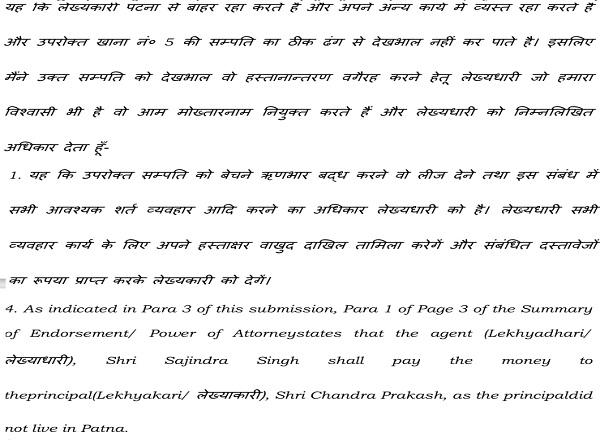
2. Subsequently, Shri Sajindra Singh, constituted attorney/an, agent on the behalf of the principal, Shri Chandra Prakash and another party entered into a “Development Agreement with the developer M/s. Om Sai builders and developers on 11.02.2011 The assessing officer (OA) referred to this agreement as “Joint Development Agreement” (JDA). The preface of the Development Agreement mentions as under:
DEVELOPMENTAGREEMENT
This development agreement executed and entered into this 11th day of February, 2011.
BETWEEN
(1) Sri Sajindra Singh son of Late Banke Bihari Singh, resident of East of N.S.C. Sheil hpura, PO-B. V.College, P.S.-
Shastri Nagar, Dist.- Pama as constituted attorney Sri Chandra Prakash son of Sri Sajındra Singh, resident of East of N.S.C. Sheikhpura, PO-B.V College, PS-Shastri Nagar, Distt.-Pana constituted vide Power No 314/2011 on 22.01.2011, which is Registered in the Office of the District Registration Office Patna in Book no. iv, volume no. 5, C.D.-1/2011, pages 143 to 148.
(ii) xxxxxx (other party)
AND
M/s Om Sai Builders & Developers, having its registered office at In the House of Sri Nawal Kishore Prasad Chourasia,
6. That the Development Agreement (“DA”) dated 11.02.2011 had been entered into by the assessee/ appellant and other party with M/s. Om Sai Builders & Developers. That Shri Sajindra Singh, son of Late Shri Banke Bihari Singh, resident of East of N.SC, Sheikhpura, P.O. B.V. College, P.S. Shastri Nagar, District Patna as constituted attorney ofShri Chandra Prakash, son of Shri Sajindra Singh, resident of East of N.S.C, Sheikhpura, P.O. B.V. College, P.S Shastri Nagar, District constitutedvide Power No. 314/2011 on 22.01.2011, is Registered in the Office of the District Registration Office, Patna in Book No. iv, volume no. 5, C.D.-1/2011, pages 143 to 148.A copy of the Development Agreement is attached at Annexure-III.
7. That the Hon’ble Supreme Court in Suraj Lamp and Industries Private Limited vs. State of Haryana & Anr. (2012) 1 SCC 656 held in paragraphs 20 and 21 as under:
“20. A power of attorney is not an instrument of transfer in regard to any right, title or interest in an immovable property. The power of attorney is creation of an agency whereby the grantor authorises the grantee to do the acts specified therein, on behalf of grantor, which when executed will be binding on the grantor as if done by him (see Section 1-A and Section 2 of the Powers of Attorney Act, 1882). It is revocable or terminable at any time unless it is made irrevocable in a manner known to law. Even an irrevocable attorney does not have the effect of transferring title to the grantee.
8. Further, in the matter of State of Rajasthan v. Basant Nahata, (2005) 12 SCC 77, the Hon’ble Supreme Court held:
“13. A grant of power of attorney is essentially governed by Chapter X of the Contract Act. By reason of a deed of power of attorney, an agent is formally appointed to act for the principal in one transaction or a series of transactions or to manage the affairs of the principal generally conferring necessary authority upon another person. A deed of power of attorney is executed by the principal in favour of the agent. The agent derives a right to use his name and all acts, deeds and things done by him and subject tomthe limitations contained in the said deed, the same shall be read as if done by the donor. A power of attorney is, as is well known, a document of convenience
52. Execution of a power of attorney in terms of the provisions of the Contract Act as also the Powers of Attorney Act is valid. A power of attorney, we have noticed hereinbefore, is executed by the donor so as to enable the donee to act on his behalf Except in cases where power of attorney is coupled with interest, it is revocable. The donee in exercise of his power under such power of attorney only acts in place of the donor subject of course to the powers granted to him by reason thereof He cannot use the power of attorney for his own benefit. He acts in a fiduciary capacity. Any act of infidelity or breach of trust is a matter between the donor and the done.
An attorney-holder may however execute a deed of conveyance in exercise of the power granted under the power of attorney and convey title on behalf of the grantor.”
9. That in view of the above judgements of Hon’ble Supreme Court, the assess/ appellant is an agent of the principal and not the land owner since the land owner executed Summary of Endorsement/ Power of Attorney in favour of the assessee/ appellant..
10. That the Development Agreement signed by the assessee/ appellant as constituted attorney of the land owner with the land developer, the land owner remains Shri Chandra Prakash in terms of the Para A(ii) and (iv) of the Development Agreement. The same is reproduced as under:
“A (ii) That the owners have not created any encumbrances on the said property or any part thereof by way of sale, mortgage,exchange, lease, trust, assessment, rights, gifts, liens, leave land license permission, rent, possession, charges inheritance or any other encumbrances whatsoever.
(A)(iii) xxxxxx
(A)(iv) That there are no attachments, either before or after judgement and there are no claims, demands, suits, decrees, injunctions, orders, notice, petitions, or adjudication orders affecting the said property or any part thereof”
11. That Section 53 of the Transfer of Property Act is not applicable to the assessee appellant being constituted attorney as explained above. Therefore, it is humbly submitted that the provisions of sections 2 (47)(v),45 and 48 of the Income Tax Act on long term capital gain are not applicable to the appellant as the appellant is not the land owner but constituted attorney through the “Summary of Endorsement/ Power of Attorney”. The same has been clearly written at Page 4 of the Development Agreement signed by the appellant and other party with M/s Om Sai Builders & Developers on 11.02.2011. The same is reproduced for ready reference:
“Whereas as the property of Schedule No. 1 fully described at the foot of this deed. Land ownerChandra Prakash purchased the land measuring 4 katha 1 dhurs 2 dhurki from Rupaspur SahkariGrih Nirma Samiti Ltd., Patna through Honorary Secretary Shri Hardeshwar Prasad son of Late Shri Akhileshwar Prasad through a Registered Deed of Absolute Sale bearing No. 3802/1992 xxxxxxxxxxxxxxxxxxAND WHEREAS, the said land owner expressed his desire to develop the landed property and to construct multi-storied building.xxxxxxxxxxxxx.”
12. That the statutory provision under the Transfer of Property Act and the Income Tax Actdo not pertain to the assessee/ appellant on the ground that the appellant is not the land owner and hence not the owner of the respective shares. The same is specifically written at Para 22 of the Development Agreement and is reproduced as under: “(22) That after the completion of the construction of the building project developer/ promoter/ land owner shall be absolute owners of their respective shares and they will be entitled to sell/ transfer as per Provisions of Bihar Apartment Ownership Act, 2006 u/s 5 (1) & 5 (2) and others.
13. That the notice to the assessee/ appellant is bad in law so, the notice is void abinitioand therefore needed to be cancelled. This was submitted vide letter dated 06.12.2018. Vide this letter, a copy of the Development Agreement and Deed of Absolute sale was also attached. A copy of letter dated 06.12.2018 is attached at Annexure-IV.
14. That vide submission dated 22.01.2021 before the Commissioner of Income Tax Appeal, the assessee/ appellant submitted that the land owner was Chandra Prakash and not the assessee/ appellant. A copy of submission dated 22.01. 2021 is attached at Annexure – V
15. That the appellant being not a land owner but constituted attorney of the land owner, the application of long term capital gain tax on the appellant for the AY 2011-12 was a gross mistake committed by the learned Assessing Officer Further, the documents Sale Deed, Summary of Endorsements and Development Agreement submitted with the Appeal to the Commissioner of Income Tax-Faceless Appeal, Delhi – it is amply clear that the appellant is not the land owner of the property. Therefore, the order dated 27.01.2026 is bad in law and therefore needs to be reviewed.
16. That the assessee/ appellant had already deposited Rs. Eight Lakh One Thousand Five Hundred (8,01,500/-) through Challan No. 00005 dated 28.12.2019. A copy of receipt of Challan is attached at Annexure – VI. Para-wise replies to the Order u/s 250 of Income Tax Act, 1961 dated 27.01.2026 Reply to Para 1 (Page 1 of 27):
That the content of this para need no reply.
Reply to Para 2 (Page 2 of 27):
That the assessee/ appellant along with the other party entered into Development Agreement (“DA”) dated 11.02.2011 with M/s. Om Sai Builders & Developers is a matter of fact. However, it is humbly submitted that the assessee/ appellant had entered into Development Agreement with the land developer as constituted attorney of the land owner Shri Chandra Prakash vide Summary of Endorsementdated22.01.2011. Therefore, issue of capital gain tax does not arise as the assessee/ appellant is not land owner but an agent of the land owner.
It is humbly submitted that that the appellant was not non-responsive to explain attraction of transfer of property as applicable under u/s 2 (47) of the IT. Act. The assessee/ applicant vide letter dated 06.12.2018 submitted a copy of the Development Agreement and Sale Deed to the learned Assessing Officer (OA) explaining that he was not the land owner. Further the DevelopmentAgreement clearly mentions that the assessee/ appellant is a constituted attorney of the land owner as submitted at Para 5 of this submission.
Reply to Para 3 (Page 2 of 27):
It is humbly submitted that thecontent of this para is denied as the assessee/appellant entered into the Development agreement as constituted Attorney of the land owner and therefore, the issue of capital gain does not arise. Therefore, the notice issued u/s 148 of the Income Tax Act is void abinitio.
Reply to Para 2 (Page 3 of 27):
It is humbly submitted that the content of the para is denied as the appellant is not the land owner as per the “Summary of Endorsement” but a constituted attorney of the land owner.
It is also submitted that Section 53 of the Transfer of Property Act is not applicable to the appellant being an agent as explained above. Therefore, it is humbly submitted that the provisions of sections 2 (47)(v),45 and 48 of the Income Tax Act on capital gain are not applicable to the appellant as the appellant is not the owner of the land but the agent through the “Summary of Endorsement. The same has been clearly written at Page 4 of the Development Agreement signed by the appellant and other party with M/s Om Sai Builders & Developers on 11.02.2011. The same is reproduced for readyreference:
“Whereas as the property of Schedule No. 1 fully described at the foot of this deed. Land ownerChandra Prakashpurchased the land measuring 4 katha 1 dhurs 2 dhurki from Rupaspur SahkariGrih Nirma Samiti Ltd., Patna through Honorary Secretary Shri Hardeshwar Prasad son of Late Shri Akhileshwar Prasad through a Registered Deed of Absolute Sale bearing No. 3802/1992xxxxxxxxxxxxxxxxxxxxxxxxx
AND WHEREAS, the said land owner expressed his desire to devlop the landed property and to construct multi-storied building xxxxxxxxxxxx
Reply to Para 4 (Page 3 of 27):
It is humbly submitted that the content of this para pertains to the Development Agreement and thesame does not pertain to the appellanton the ground that the appellant is an agent as brought out above.
Reply to Para 5 (Page 5 of 27):
It is humbly submitted that the content of this para pertains to the statutory provision under the Transfer of Property Act and the Income Tax Act. The same does not pertain to the appellant on the ground that the appellant is not the land owner and hence not the owner of the respective shares. The same is specifically written at Para 22 of the Development Agreementand is reproduced as under:
“(22) That after the completion of the construction of the building project developer/ promoter/ land owner shall be absolute owners of their respective shares and they will be entitled to sell/ transfer as per Provisions of Bihar Apartment Ownership Act, 2006 u/s 5 (1) & 5 (2) and others.
Reply to Para 6 (Page 6 of 27):
It is humbly submitted that the content of this para pertains to the statutory provision under the Transfer of Property Act and the judgement of the Hon’ble Supreme Court regarding Section 53 A of the Transfer of Property Act. The same does not pertain to the appellant on the ground that the appellant is not the land owner Further, as per the submission made under reply to Para 5 above, the he appellant cannot transfer the land/ property as he is not the owner but only an agent.
Reply to Para 7 (Page 7 of 27):
It is humbly submitted that the content of this para pertains to the agreement executed under the Indian Registration Act. In this regard, it is humbly submitted that the Development Agreement has been duly registered. Hence, need no reply.
Reply to Para 8& 9 (Page 7 of 27):
It is humbly submitted that the assessee/ appellant Shri Sajindra Singh is not escaping the capital gain due to the Development Agreement u/s 147/ 148 of the Income Tax Act, 1961 for the AY 2011-12, as the assessee/ appellant cannot transfer the land to the land developer as the appellant is not the land owner but executed the Development Agreementwith the land developer as constituted attorneyof the land owner. It is humbly submitted that the appellant cannot transfer property therefore, no transfer of property took place under this Development Agreement between the appellant and the land developer. Therefore, the notice u/s 148 issued to the assessee on 29.03.2018 is void abinitio.
Reply to Para 10 (Page 8 of 27):
It is humbly submitted that the content of this para does not pertain to the assessee/appellant as the appellant cannot transfer the land to the land developer as he is not the land owner but executed the Development Agreement as constituted attorneyof the land owner. It is further humbly submitted that the developer, M/s. Om Sai Builders & Developers after developing the property shall transfer the constructed share to the land owner and cannot transfer to the assessee/ appellant, hence the question of capital gain does not arise out of the signing of the Development Agreement. The same has been clearly written atPage 4 of the Development Agreement signed by the appellant and other party with M/s Om Sai Builders & Developers on 11.02.2011. The same is reproduced for ready reference:
4 “Whereas as the property of Schedule No. 1 fully described at the foot of this deed. Land ownerChandra Prakash purchased the land measuring katha 1 dhurs 2 dhurki from Rupaspur SahkariGrih Nirma Samiti Ltd. Patna through Honorary Secretary Shri Hardeshwar Prasad son of Late Shri Akhileshwar Prasad through a Registered Deed of Absolute Sale bearing No. 3802/1992
AND WHEREAS, the said land owner expressed his desire to develop the landed property and to construct multi-storied building xxxxxxxxxxxxx
Further, it has been specifically written at Para 22 of the Development Agreement and is reproduced as under:
“(22) That after the completion of the construction of the building project developer/ promoter/ land owner shall be absolute owners of their respective shares and they will be entitled to sell transfer as per Provisions of Bihar Apartment Ownership Act, 2006 u/s 5 (1) & 5 (2) and others.”
It is humbly submitted that the appellant cannot transfer property therefore, no transfer of property took place under this Development Agreement between the appellant and the land developer. Therefore, the notice u/s 148 issued to the assessee on 29.03.2018 is void abinitio.
Reply to Para 11 (Page 10 of 27):
It is humbly submitted that the content of this para does not pertain to the assessee/ appellant as the appellant cannot relinquish the right of land to theand developer, M/s. Om Sai Builders & Developers through the Development Agreement as the assessee/ appellant is constituted attorneyof the land ownerand not the land owner. Therefore, the case of assessee does not attract the provisions of section 2 (47) (ii) as he cannot relinquish the rights in the land transferred to the developer being a constituted attorney of the land owner, hence the appellant is not covered under section 53 (A) of Transfer of Property Act.
Reply to Para 12& 13 (Page 10 of 27):
It is humbly submitted that the content of this para is denied on the ground that no capital gain is arising under the provisions of section 45 and 48 to the assessee/ appellant, as after the completion of the construction of the building project developer/ promoter/ land owner shall be absolute owners of their respective shares and the appellant shall not receive any constructed area by the developer, as per Para 22 of the Development Agreement, as appellant being the constituted attorney of the land owner.
Reply to Para 14 (Page 10 of 27):
It is humbly submitted that the content of this para is denied on the ground that the provisions under section 53 A of the Transfer of Property Act is not applicable to the assessee/ appellant not being owner of the land.
Reply to Para 15 (Page 10 of 27):
It is humbly submitted that the content of this para is the details of the computation of the total cost of consideration for the transfer 50% land to the land developer. The same is not applicable to the assessee/ applicant as the appellant is mere constituent attorney of the land owner.
In is humbly submitted that the content of this para pertains to the Order in the matter of ITO, Bangalore v. Sri. N.S. Nagaraj, Bangalore. It is humbly submitted that in this example, the power of attorney was executed between the landowners (two brothers) with the land developer. Therefore, the aforesaid Order does not relate to the Assesee/ Appellant, becausethe appellant is a constituent attorney of the land owner under the Development Agreement. Therefore, the Order quoted by way of example is not relevant to the instant case.
Reply to Para 17 (Page 13 of 27):
It is humbly submitted that the content of this para is the details of the computation of capital gain arising to the land owner. As the appellant is not the land owner, therefore, the same does not pertain to the appellant.
It is humbly submitted that being the constituent attorney, there is no capital gain into the appellant and therefore, the issue of concealing of income by the appellant does not arise. Therefore, the satisfaction expressed by the learned Assessing Officer is not as per law. In view of this, it is humbly submitted that the penalty notice u/s 274 r.w.s. 271 (1)(c) of the Income Tax Act, 1961 becomes infructuous
Reply to Para 3 (Page 13 of 27):
It is humbly submitted that the content of this para is a matter of fact and hence the appellant was left with no option except to file the appeal before the CITA-NFAC
Reply to Para 4:
That the appellant through various submissions brought forth the fact that the appellant was only a constituent attorney of the land owner and as an agent of the land owner executed the Development Agreement with the land developer This relationship of the assessee/ appellant is clearly visible from the documents Deed of Absolute Sale, Summary of Endorsement (Power of Attorney) and Development Agreement. Therefore, the statement made in this para by the Hon’ble CITA that “the appellant submissions as filed earlier are considered as per law is not correct. In view of this, it is humbly submitted that the Order dated 27.01.2026 needs to be reviewed as per law and facts of the case based on the documents – Deed of Absolute Sale, Summary of Endorsement (Power of Attorney) and Development Agreement.
Reply to Para 5 (a) (Page 14 of 27):
That the content of this para need no reply.
Reply to Para 5 (b) (Page 14 of 27):
That the content of this para is denied due to the fact that the appellant submitted all the documents- Deed of Absolute Sale, Summary of Endorsement (Power of Attorney) and Development Agreement, to show that the appellant was not the land owner but an agent of the land owner. It humbly submitted that the appellant was not non-responsive to explain applicability of transfer of property u/s 2 (47) of the Income Tax Act. It is also humbly submitted that the AO failed to appreciate the submissions made by the appellant. Therefore, the concluded assessment order dated 21.12.2018 is not as per law.
Replies to the true extract of the relevant assessment order u/s 144 r. w.s. 147 of Income Tax Act is as follows:
That the content of this para is denied on the ground that there is no capital gain to the assessee/ appellant after executing the Development Agreement (DA) as an agent of the land owner with the land developer The assesee duly replied to the notice dated 29.03.2018 issued u/s 148 vide his letter dated 06.12.2018 gating the he was not the land owner along with the documents, namely, the Development Agreement and Sale Deed.
That there was no ownership of 50% of the developed area to the assessee. Further, there was no transfer of property between the assessee and the land developer as the appellant was an agent of the land owner. It has been wrongly assessed by the AO that the assessee/ appellant would receive 50% of the developed area, as the assessee/ appellant is an agent only. Therefore, there is capital gain to the assessee/ appellant being agent of the land owner.
That Section 2, 45 and 53 A of the Income Tax Act is statutory provisions applicable to the land owners but not the agent, which is the instant case of the assessee/ appellant.
The order dated 27.01 2026 states that “the appellant appeal is dismissed as not maintainable as per facts available on record on merits as appellant is failed to adduce any such supporting proofs/ evidences as needed to advance the grounds of appeal to hold appellant as a mere agent to the JDA as claimed not to attract provisions us. 2(47) of I.T Act without such substantiations contrary to the findings of AO in the assessment order. Accordingly, appellant appeal is dismissed as not maintainable as per law.”
In view of the aforesaid conclusion by the Commissioner of Income Tax (Appeal), it humbly submitted that there is an error apparent on the face of the order due to the fact that the appellant is not the owner of the land as, as per the Registered Deed of Absolute Salee on 28th May, 1992, “Summary of Endorsement (Power of Attorney)” wherein, Chandra Prakash, signed as Principal with the Agent, Sajindra Singh on 22.01.2011 for carrying out activities as enshrined in the Summary of Endorsement and that the transfer the money thus received to be given to the owner of the land, establishing the fact that hat appellant was a mere agent of the land owner. The Development Agreement dated 11.02.2012 between the appellant and the land developer also establishes the fact that the land owner is not the appellant. The relevant portion of the Development Agreement dated 11.02.2012 is reproduced under:
Whereas as the property of Schedule No. 1 fully described at the foot of this deed. Land owner Chandra Prakash purchased the land measuring 4 katha 1 dhurs 2 dhurki from RupaspurSahkariGrih Nirma Samiti Ltd., Patna through Honorary Secretary Shri Hardeshwar Prasad son of Late Shri Akhileshwar Prasad through a Registered Deed of Absolute Sale bearing No. 3802/1992 xxxxxxxx
AND WHEREAS, the said land owner expressed his desire to devlop the landed property and to construct multi-storied building xxxxxxxxxxxxx
Further, Para 22 of the Development Agreement dated 11.02.2012 is reproduced as under
“(22) That after the completion of the construction of the building project developer/ promoter/ land owner shall be absolute owners of their respective shares and they will be entitled to sell transfer as per Provisions of Bihar Apartment Ownership Act, 2006 w/s 5 (1) & 5 (2) and others.
In view of the submissions, it is humbly submitted to set aside the Order u/s 250 of Income Tax Act, 1961 dated 27.01.2026. it also humbly submitted to refund Rs Eight Lakh One Thousand Five Hundred (8,01500/-) deposited on 28.02.2019 along with interest and pass the relief as admissible under the law to the appellant.
It is, therefore, respectfully prayed that the Hon’ble Appellate Tribunal may please to provide the relief which has been derived arbitrarily on account of misleading computation of capital gain tax which is not applicable to the appellant being the constituted attorney of the land owner and be graciously pleased to delete the demand along with interest in full as submitted above and refund the tax amount already deposited along with the interest.
That any other relief as your honour may deem fit may proper be allowed. And for the assessee shall ever pray
44. Contrary to that Ld. DR has also filed written submission which are as follows:-
1.1 The captioned appeal arises out of the order dated 27.01.2026 passed by the learned Commissioner of Income Tax (Appeals), NFAC, Delhi, confirming the assessment order dated 21.12.2018 passed under section 144 read with section 147 of the Income-tax Act, 1961. for Assessment Year 2011-12, whereby Long Term Capital Gain of Rs. 68,98,500/- was computed and brought to tax in the hands of the Appellant on account of a Land Development Agreement dated 11.02.2011 entered into with M/s Om Sai Builders & Developers.
1.2 The Assessing Officer treated the said Development Agreement as resulting in “transfer” of a capital asset within the meaning of section 2(47)(v) of the Income-tax Act, 1961, read with section 53A of the Transfer of Property Act, 1882, and computed the Long Term Capital Gain accordingly in the year of execution of the said Agreement, i.e., Assessment Year 2011-12.
1.3 During the course of hearing before this Hon’ble Tribunal, it has emerged that the Appellant, Sajindra Singh, has represented himself to be a Power of Attorney holder/constituted attorney acting on behalf of the real and beneficial owner of the land, namely his son, who is stated to be the actual landowner under the Development Agreement dated 11.02.2011 Since the name of the said landowner does not appear as a party before this Hon’ble Tribunal in the present proceedings, this Hon’ble Tribunal has directed the Department to place its submission
2. SUBMISSION NO. 1-Long-Term Capital Gain (LTCG) WILL BE COMPUTED IN THE YEAR IN WHICH POSSESSION OF THE FLATS ARE HANDED OVER
1 It is respectfully submitted that, as a matter of law, the liability to Long Term Capital Gains arising out of a Joint/Land Development Agreement, where the consideration flowing to the landowner is in the form of constructed area/built-up space rather than cash, arises in the year in which possession of the constructed flats/built-up area is actually handed over to the landowner by the developer, and not necessarily in the year of mere execution of the Development Agreement, particularly in cases where construction had not commenced, or was not complete, in the year of execution. The rationale is that till the constructed area is actually handed over, the landowner does not receive any ascertainable consideration in his hands, and the “transfer” for the purposes of section 45 read with section 48 of the Act fructifies only when the reciprocal obligation of the developer, namely construction and handing over of possession, stands discharged.
2.2 In this regard, reliance is respectfully placed on the order of the Income Tax Appellate Tribunal, Bangalore Bench, in N.A. Haris v. Additional CIT, ITA No. 988/Bang/2018, order dated 15.02.2021, wherein the Co-ordinate Bench, while examining an identical Joint Development Agreement structure, held that mere permission to enter upon the property for development, without delivery of possession within the meaning of section 53A of the Transfer of Property Act, does not result in transfer, and that the transferee must have “performed or be willing to perform” its obligations under the agreement for section 2(47)(v) to be attracted, the year of taxability was accordingly held to be the year in which the developer’s obligations were substantially performed and the constructed area was actually received by the assessee, and not the earlier year of execution of the agreement.
2.3 Further, reference is respectfully invited to Ground No. 12 of the Grounds of Appeal raised by the Appellant before this Hon’ble Tribunal, which reads as under
“For that the Ld. CIT (A), NFAC has failed to consider that the liability of capital gain in case of Development Agreement will arise in the year of exchange of the constructed portion falling to the share of the landlord and not as on the date of entering into the Development Agreement.”
2.4 It is submitted that the said Ground No. 12, on its own showing, proceeds on the footing that the liability to capital gains arises only in the year in which the constructed portion falling to the share of the landlord is exchanged with, ie, handed over to, the landlord, and not on the date of entering into the Development Agreement. This position, as urged by the Appellant himself in Ground No. 12, is consistent with, and lends further support to, the submission made hereinabove at Submission No. 1 that the Long Term Capital Gain is exigible to tax in the year in which possession of the constructed flats/built-up area is handed over to the landowner, and not in the year of execution of the Development Agreement.
2.5 It is accordingly submitted that the year of chargeability of the impugned Long Term Capital Gain be determined with reference to the year in which possession of the constructed flats/built-up area is actually handed over to the landowner, in accordance with the principle laid down in the above decision.
3. SUBMISSION NO. 2- ASSESSMENT TO BE MADE IN THE HANDS OF THE LANDOWNER AND NOT THE POWER OF ATTORNEY HOLDER
3.1 It is submitted that the capital asset, namely the land which was the subject matter of the Development Agreement dated 11.02.2011, is owned by, and vests in, the real and beneficial landowner, and that any income, gain, or consideration arising from the transfer or development of the said asset is taxable only in the hands of the true owner thereof. A Power of Attorney holder, who executes documents and performs acts on behalf of, and for the benefit of, the principal’lowner, acts purely in a fiduciary and representative “capacity, and does not thereby acquire ownership of the asset, nor does he receive the consideration arising from its transfer beneficially in his own right. It would therefore not be in consonance with the settled position of law to fasten the liability to capital gains tas upon a Power of Attorney holder/constinated attorney, where the real owner of the asset is identifiable and is a person other than the attorney holder.
3.2 Reliance in this regard is respectfully placed on the judgment of the Hon’ble Supreme Court in Suraj Lamp & Industries (P) Lad. Tr. Director v. State of Haryana & Anr., (2012) 340 ITR 1 (SC), judgment dated 11.10.2011, wherein it has been authoritatively held that a power of attorney is not an instrument of transfer in regard to any right, title, or interest in an immovable property, and is merely the creation of an agency whereby the grantor authorises the grantee/donee to act on his behalf, such acts, when done, binding the grantor as if done by him; it was further held that the donee acts in a fiduciary capacity and “cannot use the power of attorney for his own benefit,” and that even an irrevocable power of attorney does not have the effect of transferring title to the grantee.
3.3 The Hon’ble Supreme Court further clarified, at paragraph 19 of the said judgment, that bona fide development agreements coupled with powers of attorney executed in favour of developers for the limited purpose of development continue to be governed by their own terms; ownership of the asset, and the consequent tax incidence, however, remains that of the principal/landowner and not of the attorney holder. It is accordingly submitted that, applying the ratio of the above judgment, the Long Term Capital Gain arising from the transaction in question be computed and assessed in the hands of the real landowner, and not in the hands of the Power of Attorney holder/constituted attorney
4. SUBMISSION NO. 3- A SUITABLE DIRECTION MAY KINDLY BE PASSED THAT LAND OWNER MAY BE ASSESSED FOR THE LTCG ON EXECUTION OF JOINT DEVELOPMENT AGREEMENT WITH THE DEVELOPER
4.1 In light of the submissions made hereinabove, and in order to protect the interest of the Revenue, it is respectfully prayed that a suitable direction be issued by this Hon’ble Tribunal directing that the real and beneficial landowner, that is Sri Chandra Prakash being the person who has entered into the Development Agreement dated 11.02.2011 with M/s Om Sai Builders & Developers through the Power of Attorney holder, be identified and assessed to tax for the Long Term Capital Gains arising from the said Development Agreement, in accordance with law. It is submitted that such a direction would be necessary to ensure that the correct and real owner of the capital asset is brought within the tax net in respect of the impugned transaction, consistent with the legal position set out in Submission No. 2 above.
5. PRAYER
In view of the foregoing submissions, it is most respectfully prayed that this Hon’ble Tribunal may be pleased to:
1. Hold that the year of chargeability of the impugned Long Term Capital Gain be reckoned with reference to the year in which possession of the constructed flats/built-up area is handed over to the landowner;
2. Direct that the assessment of the said Long Term Capital Gain be made in the hands of the real landowner, and not in the hands of the Power of Attorney holder; and
3. Issue a suitable direction that the landowner be identified and assessed for the Long Term Capital Gain arising on execution of the Joint Development Agreement dated 11.02.2011 with the developer, in accordance with law.
Any other order(s) as this Hon’ble Tribunal may deem fit and proper in the facts and circumstances of the case may also kindly be passed.
5. Upon hearing the submission of the counsel of the respective parties and on perusal of the impugned order, we find that Assessing Officers assess the Long Term Capital Gain tax when assessee has failed to produce documentary evidences. The CIT(A) has also passed an order by holding that the assessee is failed to adduce any such supporting proof/evidences as needed to advance the grounds of appeal to hold assessee as mere agent to the JDA as claimed, not to attract provisions u/s 2(47) of the Act. Before us the Assessee has filed the copy of the sale deed and the power of attorney that goes to establish that assessee mere an agent of owner Shri Chandra Prakash. The submission of the assessee is that assessee is an agent of works on behalf of the Shri Chandra Prakash and another party entered into the development agreement with the developer M/s. Om Sai Builders & Developers agreement dated 11.02.2011. It is a fact that Sri Sajindra Singh is not the real owner and the land owner is Shri Chandra Prakash unless he is benamidar. It is pertinent to mention here that it is a case where factual verification is required as revenue has also filed written submission. It is also a fact that the assessee has failed to produce documentary evidences before the lower authorities. Keeping in view the entire facts as discussed above we are inclined to restore the appeal of the assessee before the CIT(A) with direction to consider the submission of the assessee, perused the documents filed by the assessee, perused the written submission of the revenue and to pass an order a fresh. Accordingly, the order passed by the CIT(A) is hereby set aside and the appeal be remitted back to the file of the CIT(A) for fresh consideration.
In the result, the appeal is allowed for statistical purpose.
Kolkata, the 25th August, 2026.






