Vinutha Prahlad Vs MJR Builders Pvt. Ltd. (NAA)
Authority finds that in the present ease, the Respondent has raised invoice to his home buyers which included the consolidated demand of the land and the construction services. No separate demand for the land in the invoice has been issued by the Respondent to his home buyers. The Authority finds that. if the Respondent would have issued separate invoice demanding the cost of land, the amount of GST charged would have been 18% and not 12%. The Authority finds that, had the Respondent excluded the land value from the demand raised to his buyers, the value of land would have been excluded from the perview of profiteering. Therefore, the Authority finds that the facts of the cases relied upon by the Respondent are different from the present case. Hence, the Authority finds that this contention of the Respondent regarding exclusion of land value being untenable cannot be accepted.
Hence, as per our findings above, the Authority rinds no reason to differ from the above detailed computation of profiteering in the DGAP’s Report or the methodology adopted. Hence, the Authority holds that, the EEC as a percentage of the turnover that was available to the Respondent during the pre-GST period (April-2016 to June-2017) was 3.71% and during the post-GST period (July-2017 to September-2019), it was 8.76%. This confirms that, post-GST, the Respondent has been benefited from additional ITC to the tune of 5.05% (8.76%-3.71%) of his turnover and the same was required to be passed on to the customers/flat buyers/recipients. The DGAP has calculated the amount of ITC benefit to be passed on to all the customers/ flat buyers/ recipients as Rs. 1,07.67.330/- for the project ‘MJR Clique Hydra’ which was availed by the Respondent the details of which are mentioned in Table- C supra.
For the masons mentioned above, the Authority determines the profiteered amount for the period from 01.07.2017 to 30.09.2019, in the instant case. as Rs. 1,07,67,330/- for the project ‘MJR Clique Hydra’. This profiteered amount of Rs. 1,07,67,330/- includes GST on the base profiteered amount of Rs. 96,13.687/-. The homebuyer/customer /recipient and unit No. wise break-up of this amount as given in Annexure-13 of the DGAP Report is accepted. This amount is inclusive of Rs. 1,03,453/- (including GST on the base amount of Rs. 92,369/-) which is the profiteered amount in respect of the Applicant No. 1. mentioned at serial No. 108 of Annexure-13 of the said Report.
For the reasons mentioned above, the Authority determines the profiteered amount for the period from 01.07.2017 to 30.09.2019. in the instant case, as Rs. 1,07.67,330/- for the project ‘MJR Clique Hydra’. This profiteered amount of Rs. 1.07.67.330/- includes GST on the base profiteered amount of Rs. 96,13,687/-.
This Authority under Rule 133 (3) (a) of the CGST Rules, 2017 orders that the Respondent shall reduce the prices to be realized from the buyers of the customers/flat buyers/recipients commensurate with the benefit of’ ITC received by him as has been detailed above.
The Respondent is also liable to pay interest to all customers/ flat buyers/ recipients. as prescribed and applicable on the entire amount profiteered. i.e. Rs. 1.07.67,330/- for the project ‘MJR Clique Hydra’. Hence the Respondent is directed to also pass on interest @18% to the customers/ flat buyers/ recipients on the entire amount profiteered, starting from the date from which the above amount was profiteered till the date of passing on payment of the profiteered amount, as per the provisions of Rule 133 (3) (b) of the CGST Rules 2017.
FULL TEXT OF ORDER OF NATIONAL ANTI-PROFITEERING AUTHORITY
1. The Report dated 01.06.2020, has been received on 02.06.2020 from Applicant No. 2 i.e. the Director General of Anti-Profiteering (DGAP) after a detailed investigation under Rule 129 (6) of the Central Goods & Service Tax (CGST) Rules, 2017.
2. The brief facts of the case and findings of investigation conducted by the DGAP arc as under:-
i. An application was received on 09.10.2019 from the Standing Committee on Anti-profiteering under Rule 129 of the CGST Rules. 2017 to conduct a detailed investigation in respect of an application dated 25.07.2019, tiled by the Applicant No. 1 under Rule 128 of the Rules, alleging profiteering in respect of construction service supplied by the Respondent. The Applicant No. 1 had submitted that she had booked a Flat No. C-701 in the Respondent’s project “MJR Clique Hydra”, Electronic City Phase-I. Bengaluru and had alleged that the Respondent had not passed on the benefit of Input Tax Credit (ITC) to her by way of commensurate reduction in price. The DGAP has intimated that the Applicant No. I had lodged the complaint with the Karnataka State Screening Committee. Thereafter. the above reference was examined by the Standing Committee on Anti-profiteering, in its meeting held on 13.09.2019 whereby it decided to forward the same to the DGAP to conduct a detailed investigation in the matter.
ii. The Applicant No. I had submitted the following documents along with her application:-
(a) Scanned copy of proof of Identity.
(b) Sale Agreement.
(c) Construction Agreement.
(d) Break up of cost as given by the Respondent.
(e) Demand notes from level foundation to 14th floor, internal plastering and final notes on possession.
(f) Payment Schedule given at the time of booking (pre-GST).
(g) Payment schedule with the comparison for pre and post GST.
(h) copy of Anti Profiteering Application Form (APA F-1).
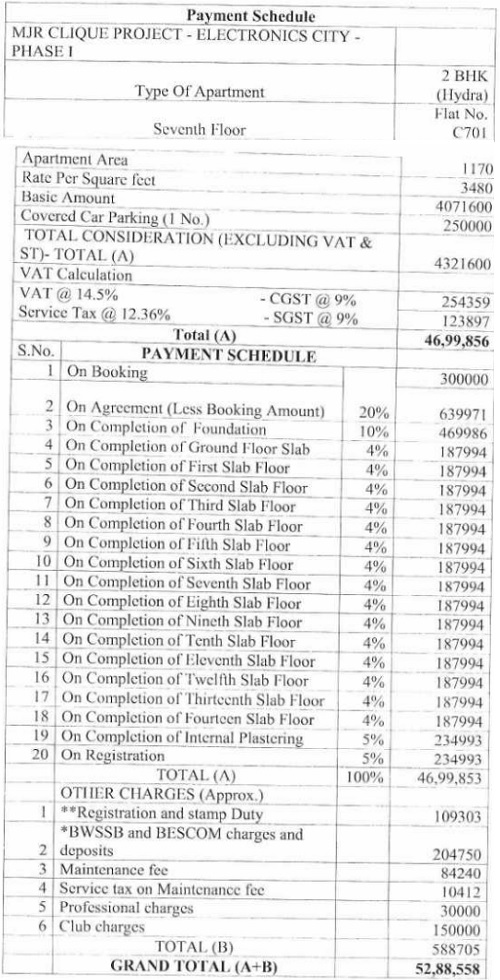
iii. The Applicant No. 1 had booked Flat No. C-701 in the Respondent’s project “MJR Clique Hydra”, on 09.06.2014. i.e. in the pre-GST era in terms of the Sale Agreement agreed upon. The DGAP, on going through the Payment Scheduled (mentioned in Table-A given below), has observed that the Applicant No. I was to pay the consideration in 20 instalments each linked with different stages.
iv. The Respondent had demanded 95% of the amount payable before the introduction of GST and remaining 5% amount payable was towards registration which was demanded during August, 2018. The Applicant No. I had submitted that prior to GST, she had already paid 10 instalments and stopped the payments from 11th instalment (seventh floor slab) as the construction after seventh floor had not progressed. However, the Applicant No. 1 started making payment after 19 instalments (Internal Plastering) and made payment of an amount of Rs. 17,41,620/- from July, 2017 to August, 2018 which was approximately 32% of the total amount payable.
v. On scrutiny of the above application of the Applicant No. 1, the DGAP issued a Notice under Rule 129 of the CGST Rules, 2017 on 23.10.2019, calling upon the Respondent to reply as to whether he admitted that the benefit of ITC had not been passed on to the Applicant No. 1 by way of commensurate reduction in price and if so, to suo moto determine the quantum thereof and indicate the same in his reply to the Notice as well as furnish all supporting documents. The DGAP further afforded an opportunity to the Respondent to inspect the non-confidential evidences/information submitted by the Applicant No. 1 during the period 30.10.2019 to 31.10.2019 which was not availed by the Respondent. The DGAP has stated that the time limit to complete the investigation was extended up to 07.07.2020 from 08.04.2020 by this Authority, in terms of Rule 129 (6) of the CGST Rules, 2017. The DGAP has also informed that the period covered by the current investigation was from 01.07.2017 to 30.09.2019.
vi. The Respondent. in response to the above Notice dated 23.10.2019 and subsequent reminders dated 06.11.2019, 22.11.2019, 15.01.2020, 13.02.2020 and 08.05.2020, had submitted the following documents/information vide his letters/e-mails dated 02.12.2019, 05.12.2019, 16.01.2020, 14.02.2019, 26.02.2019, 16.05.2020 and 23.05.2020:-
(a) Copies of GSTR-1 returns for the period July, 2017 to September, 2019.
(b) Copies of GSTR-313 returns for the period July, 2017 to September, 2019.
(c) Copies of Tran-1 filed.
(d) Electronic Credit Ledger for the period July, 2017 to September, 2019.
(e) Copies of VAT& ST-3 returns for the period April, 2016 to June, 2017.
(f) Copies of all demand letters, sale agreement/contract issued in the name of the Applicants.
(g) Details of applicable tax rates, pre-GST and post-GST.
(h) Copy of Balance Sheet and Cost Audit Report for F.Y. 2016-17, and 2017-18.
(i) Details of VAT, Service Tax, ITC of VAT. Cenvat Credit for the period April, 2016 to June, 2017, Output GST and ITC for the period July, 2017 to June. 2019 for the Project “MJR Clique Hydra”.
(j) Cenvat/Input Tax Credit Ledger for the F.Y. 2016-17, 2017-18 and 2018-19 reconciled with VAT. ST-3 and GSTR-3B returns.
(k) List of home-buyers for the above Project.
(L) Project details submitted to RERA.
(m) Copy of Completion Certificate (CC) dated 17.12.2018 of the project “MJR Clique Hydra”
The DGAP has also informed that the Respondent has not claimed confidentiality of any of the details/information furnished by him, in terms of Rule 130 of the CGST Rules, 2017. Similarly, the Applicant No. 1 was also afforded an opportunity to inspect the non-confidential documents/reply furnished by the Respondent on 28.05.2020 to 29.05.2020 which the Applicant No. 1 did not avail of.
vii. The DGAP has examined the above application, the replies of the Respondent and the documents/evidence on record. The main issues for determination were whether there was the benefit of reduction in the rate of tax or ITC on the supply of construction service after the implementation of GST w.e.f. 01.07.2017 and if so, whether such benefit had been passed on by the Respondent to his recipients by way of commensurate reduction in prices, in terms of Section 171 of the CGST Act, 2017.
viii. The details of Payment Schedule of Flat No. C-701 of the project “MJR Clique Hydra” as per the copy of Sale Agreement in Table- ‘A’ given below:-
Table-`A’ (Amount in Rs.)
ix. Para 5 of Schedule-111 of the COST Act, 2017 (Activities or Transactions which should be treated neither as a supply of goods nor a supply of services) reads as “Sale of land and, subject to clause (b) of paragraph 5 of Schedule II. sale of building”. Further, clause (b) of Paragraph 5 of Schedule II of the CGST Act. 2017 read as “(b) construction of a complex, building, civil structure or a part thereof, including a complex or building intended for sale to a buyer, wholly or partly, except where the entire consideration has been received after issuance of the completion certificate, where required, by the competent authority or after its first occupation. whichever was earlier’. Thus, the ITC pertaining to the residential units which were under construction but not sold was provisional ITC which might be required to be reversed by the Respondent, if such units remained unsold at the time of issue of the Completion Certificate (CC), in terms of Section 17(2) & Section 17(3) of the CGST Act, 2017. Therefore, the ITC pertaining to the unsold units might not fall within the ambit of this investigation. and the Respondent was required to recalibrate the selling prices of such units to be sold to the prospective buyers by considering the proportionate benefit of additional ITC available to him post-GST.
x. The present case pertained to supply of construction service and the investigation was limited to one project i.e. “MJR Clique Hydra” only, in which the Applicant No. 1 had booked his Unit No. C-701. However, the Respondent vide his submission dated 03.12.2019 has submitted that he had executed other three projects namely MJR Platina, MJR Pearl and MJR Clique Hercules and all these projects were executed in l3angalore only.
xi. Prior to 01.07.2017, i.e., before GST was introduced, the Respondent was eligible to avail CENVAT credit of Service Tax paid on the input services. I However, CENVAT credit of Central Excise Duty paid on the inputs was not admissible as per the CENVAT Credit Rules. 2004. which was in force at the material time. Further, on going through the VAT Returns submitted by the Respondent he was paying VAT under Karnataka VAT under normal scheme and was eligible to avail ITC of VAT paid on the inputs purchased by him. The Respondent had submitted VAT Returns and the breakup of the purchases made for the above project to justify the credit of VAT for the above project and details of VAT turnover for the project were provided.
xii. The DGAP has further mentioned that prior to 01.07,2017. deduction from turnover of the payments made to the registered contractors and sub-contractors (from the taxable turnover under VAT) on which VAT (a) 4% was being levied. Further, post-GST, the Respondent could avail the ITC of GST paid on all the inputs and input services including the subcontracts. The DGAP has also observed from the information submitted by the Respondent for the period April, 2016 to September. 2019, the details of the input tax credits availed by him, his total turnovers from the project “MJR Clique Hydra”, the ratios of ITCs to the turnovers during the pre-GST (April, 2016 to June, 2017) and post-UST (July, 2017 to September, 2019) periods, have been furnished in Table-‘B’ given below:-
Table ‘B’
(Amount in Rs.)
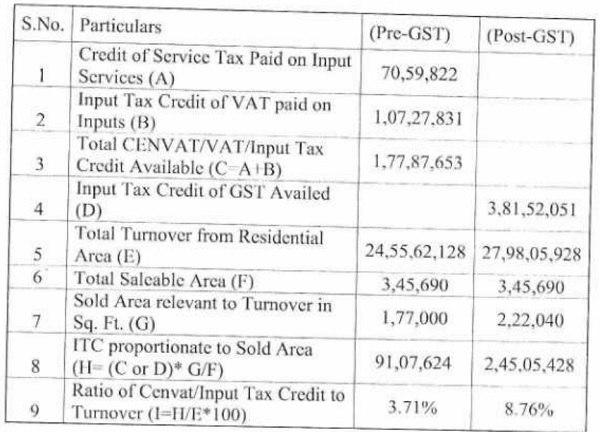
xiii. The DGAP has claimed from the above Table- ‘8’ that the input tax credit as a percentage of the turnover that was available to the Respondent during the pre-GST period (April, 2016 to June. 2017) was 3.71% and during the post-GST period (July, 2017 to September, 2019), it was 8.76% which clearly confirmed that post-GST, the Respondent had benefited from additional ITC to the tune of 5.05% [8.76% (-) 3.71%] of the turnover.
xiv. The Central Government, on the recommendation of the GST Council, had levied 18% GST (effective rate was 12% in view of 1/3rd abatement on land value) on construction service, vide Notification No. 11/2017-Central Tax (Rate) dated 28.06.2017. Accordingly, the profiteering had been examined by comparing the applicable tax rate and ITC available for the pre-GST period (April, 2016 to June, 2017) when Service Tax @; 5.8% or 6% and VAT (n) 10.15% were payable (total tax rate of 15.95% or 16.15% of the construction value) with the post-GST period (July, 2017 to September, 2019) when the GST rate was 12% on construction service. The DGAP on the basis of the figures contained in Table- ‘B’ above, the comparative figures of the ratio of ITCs availed/available to the turnover in the pre and post GST periods, has tabulated the recalibrated base price and the excess collection (profiteering) during the post-GST period, in Table-‘C’ given below:-
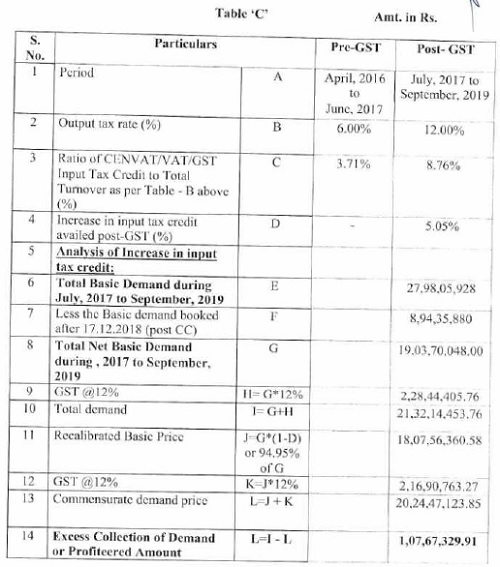
xv. The DGAP has claimed from Table-‘C’ above that the additional input tax credit of 5.05% of the turnover should have resulted in commensurate reduction in the basic prices as well as cum-tax prices. Therefore, in terms of Section 171 of the CGST Act, 2017. the benefit of additional ITC should have been passed on by the Respondent to the recipients. In other words, by not reducing the pre-GST basic prices by 5.05% on account of additional benefit of ITC and charging GST @ 12% on the pre-GST basic prices, the Respondent has contravened the provisions of Section 171 of the CGST Act. 2017.
xvi. On the basis of the aforesaid CENVAT/ITC availability in the pre and post-GST periods and the demands raised by the Respondent on the Applicant No. 1 and other home buyers towards the value of construction on which GST liability @ 12% was discharged by the Respondent during the period 01.07.2017 to 30.09.2019, the amount of benefit of ITC not passed on to the recipients or in other words, the profiteered amount came to Rs. 1,07,67,330/- which included GST on the base profiteered amount of Its. 96,13,687/-. The home buyer and unit No. wise break-up of this amount was given in Annexure-13 of the Report. This amount was inclusive of Rs. 1,03.453/- (including GST on the base amount of Its. 92,369/-) which was the profiteered amount in respect of the Applicant No. 1, mentioned at serial No. 108 of Annexurc-13 of the Report.
xvii. The above computation of profiteering was with respect to 169 units (excluding 21 buyers who booked their units after 17.12.2018 post Completion Certificate) out of a total of 190 units as mentioned in the home-buyers’ list. Whereas the Respondent had booked total 202 units as per the data submitted to the DGAP, in the pre-GST period, demands were raised from only 151 buyers who had booked the units, and the net total of demands raised from such units only had been taken into consideration. Similarly, in the post-GST period, demands were raised from 169 buyers who had booked the units before 17.12.2018 (pre Completion Certificate), and the net total of demands raised from such units only had been taken into consideration. If the ITC in respect of those units from whom no demands had been raised in the concerned period was considered for calculation of profiteering in respect of units where demands had been raised in the relevant period, the ITC as a percentage of turnover would be distorted and erroneous. Therefore. the benefit of ITC in respect of those 12 (202-190) units would be calculated when the demands would be raised from such units by taking into account the proportionate ITC in respect of such units.
i. e. 151 Units booked pre GST (A) 151 Units booked post OST(13) 202; Of (A), demands not raised on 12 between 1.07.2017 to 30.09.2019 Of (B), 21 Units booked after 17.12.2018 (after CC)
Hence, (151-12)+(51-21)=169 Units demands considered)
3. Consequently, the DGAP has concluded that post-GST, the benefit of additional ITC of 5.05% of the turnover had accrued to the Respondent for the project “MJR Clique Hydra”. This benefit was required to be passed on to the recipients but this was not done. Therefore, Section 171 of the CGS’Is Act, 2017 has been contravened by the Respondent, inasmuch as the additional benefit of ITC ® 5.05% of the base prices received by the Respondent during the period 01.07.2017 to 30.09.2019, has not been passed on by the Respondent to 190 recipient including the Applicant No. 1. These recipients were identifiable as per the documents provided by the Respondent, giving the names and addresses along with Unit Nos. allotted to such recipients. Therefore, the total additional amount of Rs. 1,07, 67,330 I-(Rupees One Crore Seven Lakh Sixty Seven Thousand Three Hundred and Thirty only) was required to be returned to the Applicant No. I and such eligible recipients. The DGAP has also stated that the Respondent has supplied construction services in the State of Karnataka only. The DGAP has further reported that, the present investigation covered the period from 01.07.2017 to 30.09.2019 and profiteering, if any, for the period post September. 2019, had not been examined as the exact quantum of rrc that would be available to the Respondent in future could not be determined at this stage. when the construction of the project was yet to be completed.
4. The above Report was considered by this Authority in its meeting held on 04.06.2020 and it was decided that the Applicants and the Respondent be asked to file their submissions before this Authority by 19.06.2020. A Notice dated 04.06.2020 was also issued to the above Respondent asking him to explain why the Report dated 01.06.2020 furnished by the DGAP should not be accepted and his liability for violating the provisions of Section 171 of the above Act should not be fixed. Thereafter, hearing via videoconferencing was held on 05.02.2021 wherein Sh. Rajesh Kumar T. R., Chartered Accountant represented the Respondent. However, before the Order could be passed, one of the Technical Members of the Authority who had heard the matter was transferred out and thereafter the Chairman of the Authority had also left the Authority. Since, the quorum of the Authority of minimum three Members, as provided under Rule 134 was not available till 23.02.2022, the matter could not be decided. With the joining of two new Technical Members in February 2022. the quorum of the Authority was restored from 23.02.2022 and the personal hearing in the matter was accorded to the Respondent and Applicant No. 1 on 27.04.2022 via video-conferencing. Sh. S. Rajesh Kumar T. R. and Sh. G. Pattabhi, Chartered Accountants. appeared on behalf of the Respondent. Ms. Vinutha Prahlad, the Applicant No. I did not appear. Sh. Raminder Singh, Assistant Commissioner appeared on behalf of DGAP. During the course of proceedings, the Respondent has relied upon his submissions dated 21.08.2020, 13.11.2020 and 04.05.2022 wherein he has inter-alia stated that:-
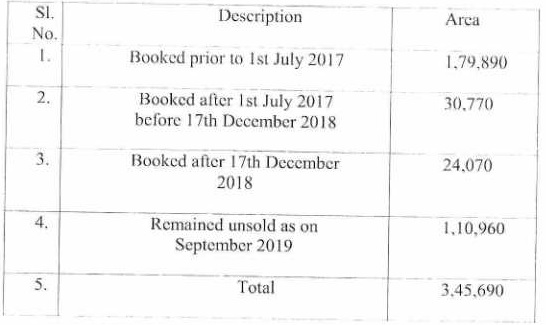
i. He was undertaking construction of apartments in “MJR Clique Hydra”. Project Electronic City Phase-I, Bengaluru. The construction of the above project had started during the Financial Year 2013-14 and completion certificate was obtained on 17.12.2018. The total area of construction was 3,45,690 Sq. Ft. which could be segregated as follows:-
ii. The VAT Input Tax Credit and CENVAT Credit for the period 2016-17 and April 2017 to June 2017 was Rs. 1,77,87,653/-.
iii. The amount of Input Tax Credit of GST availed during the period post GST was Rs. 3,81,52,051/-. This credit included Rs. 35,26.800/- of ITC relating to unregistered supplies paid under RCM which was not liable to be paid pre-GST.
iv. As far as the benefit of input tax credit was concerned, the basic prices post-GST got increased and were not decreased after introduction of GST and therefore no additional benefit accrued to him. Further since most of his purchases were from dealers and not manufacturers. there was no credit which he had foregone pre-GST but subsequently got benefit of the same. Instead there was increase in the GST rates on the inputs and input services for which he had paid extra. The additional credit of GST in quantum availed by him was additionally paid by him either due to increase in tax rate, or increase in cost of goods and services. Thereby, the Respondent has stated that no additional benefit accrued to him. Accordingly no benefit was passed on.
v. The matter relating to constitutional validity of the provisions of Section 171 and Rules made thereunder was pending before Hon’ble Delhi High Court. The Respondent has requested that the matter be kept in abeyance till the issue of constitutional validity was decided.
vi. The application filed by the Applicant No. 1 was not proper and the Respondent did not accept the fact of any profiteering. Thereby he has requested to dispose of the application as having no merits.
vii. The Respondents has objected to the methodology adopted by the DGAP in computing the benefit of input tax credit as it was not in accordance with the provisions of Section 171 of COST Act, 2017. The Respondent has submitted that Section 171, did not define what was the meaning of the term benefit of Input Tax Credits and in what circumstances and how to compute the same. In the absence of such prescription in law adoption of certain method without establishing the correctness of it thorough authority or guidelines by Parliament or Government was not legal and proper. it was well settled principles in law that if the valuation /quantification was not clear the levy itself failed. In this regard, the Respondent has placed reliance on the decisions of Hon’ble Supreme Court in the following cases:-
a. CIT vs. B.C. Srinivasa Setty- (1981) 2 SCC 460:
b. Commissioner of C. lix. & Cus., Kerala vs. Larsen & Toubro Ltd. 2015 (039) STR 0913 S.C.
viii. In the absence of any prescribed methodology prescribed by law, adoption of any particular method without explaining the theory and purpose beyond it and also explaining legal validity or such methodology would be arbitrary and was not legally correct.
ix. The provisions of Section 171 mandated to reduce the price if there was reduction in output tax on one hand and also if there was benefit of input tax credit accruing to the supplier. In this regard, the Respondent has submitted that the term ‘benefit’ was employed in the statute with a purpose of any extra benefit without paying extra for it. He has further argued that, the benefit has to be understood in the context of profiteering. The meaning of the term ‘profiteering’ was explained in different dictionaries as follows:-
Want to Read the Complete Judgment?
You have read the free case summary. Unlock the full judgment, the detailed judicial reasoning and the downloadable PDF, along with every other premium judgment on TaxGuru.
Already subscribed? Log in
One subscription covers the entire premium judgment library, not just this case.