MKY Enterprises Pvt. Ltd. Vs Commissioner of Central Excise & CGST (CESTAT Allahabad)
CESTAT Allahabad allowed a batch of appeals filed by MKY Enterprises Pvt. Ltd. concerning enhancement of the assessable value of imported fabrics. The principal issue was whether the Commissioner (Appeals) was justified in rejecting the appeals merely because the importer had given written letters accepting the enhanced value at the time of clearance. The appellant, a regular importer of fabrics from China, had imported 80 consignments between 01.07.2019 and 18.09.2019 at ICD, Dadri. According to the appellant, the goods had been correctly self-assessed on the basis of invoice values, but no Out of Charge Orders were issued. To avoid continued detention and delay, it repeatedly requested provisional clearance on payment of duty on the enhanced value under protest. The appellant alleged that those requests were ignored and that it was ultimately compelled to furnish consent letters accepting the valuation proposed by Customs.
The importer contended that Customs could not discard the declared transaction value without complying with Section 14 of the Customs Act, 1962 and the Customs Valuation Rules, 2007. The acceptance letters themselves did not disclose the contemporaneous import data said to justify the enhancement. The appellant further argued that valuation under the Rules required examination of relevant comparability parameters and could not be sustained merely by asserting that contemporaneous imports existed. Despite subsequent requests, no speaking order was passed. The Commissioner (Appeals) nevertheless upheld the reassessment on the ground that, once the importer had accepted the enhanced value in writing, Section 17(5) did not require a speaking order.
A central precedent was Century Metal Recycling Pvt. Ltd. Vs Union of India, 2019 (367) E.L.T. 3 (SC). The appellant relied on the Supreme Court’s ruling that Rule 12(2) requires the proper officer, when required, to communicate in writing the grounds giving rise to doubt about the truth or accuracy of the declared value. Formation of reasonable doubt, its foundation in relevant facts and figures and communication of the reasons constitute safeguards in the statutory valuation mechanism. The appellant pointed out that the Bills of Entry in the present matter were subsequent to 17.05.2019 and therefore the prospective requirement identified in Century Metal Recycling was applicable.
The Tribunal examined the correspondence placed on record and found that the case was not one of a simple, unconditional acceptance of enhanced value. The importer had written letters requesting clearance either provisionally or finally on payment of duty on the enhanced assessable value under protest. Those communications had not been taken into account by the Commissioner (Appeals). The Tribunal also noted communications indicating the allegedly involuntary or coerced character of the acceptance and the appellant’s requests for speaking orders, which were never issued.
Applying Century Metal Recycling Pvt. Ltd., CESTAT held that the Commissioner (Appeals) had not considered the Supreme Court ruling in its entirety. Rule 12(2) requires the proper officer to intimate in writing the grounds for doubting the truth or accuracy of the declared value. That requirement cannot be ignored or waived. Only after formation and communication of reasonable doubt can the proper officer proceed under the subsequent valuation rules after rejecting the transaction value. Since the Bills of Entry in the present case were dated between 17.05.2019 and 18.09.2019, the Tribunal held that the proper officer was required to communicate in writing the reasons for rejecting the declared transaction value.
The Tribunal further found that, although the acceptance letters purported to state that the grounds of rejection and contemporaneous import data had been shown to the appellant, the letters did not actually identify the alleged comparable import data. Considering the other contemporaneous communications made by the importer, the Tribunal found a significant evidentiary gap in the Revenue’s case and held that the contents of the acceptance letters could not simply be taken at face value.
CESTAT then relied substantially on Niraj Silk Mills Vs Commissioner of Customs (ICD), Patparganj, CUSAA 26/2022, decided by the Delhi High Court on 27.11.2024. The Delhi High Court had considered whether an importer who waived issuance of a show cause notice or speaking order under Section 17 could nevertheless challenge the enhanced valuation. It held that the concession contemplated by Section 17(5) is confined to relieving the proper officer of the obligation to issue a speaking order where reassessment is accepted in writing. Such acceptance cannot be construed as taking away the importer’s statutory right to challenge the proper officer’s decision in accordance with law.
The Delhi High Court had also addressed valuation based solely on NIDB data. It held that an enhancement based merely on NIDB data, without independent and cogent evidence or adequate justification, would not satisfy the governing valuation requirements. Departure from the declared transaction value must be founded upon tangible and justiciable material. The High Court consequently answered the question framed before it in favour of the importers.
The Revenue relied on the Allahabad High Court ruling in M/s S. S. Overseas & Ors. and the subsequent dismissal of the SLP by the Supreme Court. The appellant distinguished that case on the ground that it concerned provisional assessment and non-finalisation of Bills of Entry. It further relied upon Kunhayammed & Ors. Vs State of Kerala & Anr., (2000) 6 SCC 359 for its submission concerning the effect of dismissal of a special leave petition and the doctrine of merger.
Ultimately, CESTAT held that the controversy was squarely covered by the Delhi High Court judgment in Niraj Silk Mills. The impugned Orders-in-Appeal were therefore unsustainable. They were set aside and all the appeals were allowed with consequential relief, if any, in accordance with law. The order was pronounced in open court on 25.06.2025.
Cases Discussed
- Century Metal Recycling Pvt. Ltd. Vs Union of India, 2019 (367) E.L.T. 3 (Supreme Court) — Relied upon for the mandatory nature of Rule 12(2) of the Customs Valuation Rules, 2007. The proper officer must form reasonable doubt regarding the declared value and, when required, communicate the grounds in writing before rejecting transaction value and proceeding under the subsequent valuation rules.
- Niraj Silk Mills Vs Commissioner of Customs (ICD), Patparganj, CUSAA 26/2022 (Delhi High Court), decided on 27.11.2024 — Followed as directly governing the controversy. Written acceptance of reassessment may dispense with the speaking order contemplated by Section 17(5), but does not extinguish the importer’s statutory right to challenge the reassessment. The judgment also held that NIDB data alone cannot justify enhancement without independent and cogent material.
- M/s Century Metal Recycling Ltd. Vs Commissioner of Customs, Faridabad, Customs Appeal No. 61303 of 2019, Final Order Nos. 60266-60349/2025 dated 27.02.2025 (CESTAT Chandigarh) — Cited by the appellant in support of its challenge to the enhancement of declared customs value.
- Commissioner of Customs, Patparganj Vs M/s Artex Textile Private Limited, Customs Appeal Nos. 51414, 52809 and 52810 to 52864 of 2019, Final Order Nos. 50769-50825/2020 (CESTAT New Delhi) — Cited by the appellant in support of its valuation challenge.
- M/s S. S. Overseas & Ors., Writ Tax No. 881/2022 (Allahabad High Court) — Relied upon by the Revenue for the proposition that written acceptance of enhanced value dispensed with the need for a speaking order under Section 17(5). The appellant distinguished the case as involving provisional assessment and non-finalisation of Bills of Entry.
- Kunhayammed & Ors. Vs State of Kerala & Anr., (2000) 6 SCC 359 (Supreme Court) — Relied upon by the appellant on the effect of dismissal of an SLP and the doctrine of merger.
FULL TEXT OF THE CESTAT ALLAHABAD ORDER
All above Appeals are taken up together as the issue involved is primarily as to whether the Appeals filed by the Appellant were correctly rejected by the Commissioner (Appeals) holding that the Appellant accepted the enhancement of value in writing at the time of clearance of the consignments in question?
2. The Ld. Advocate appearing for the Appellant contended that the Appellant is a regular Importer of different kind of Fabrics and have imported 80 consignments of fabrics from China during the period 01.07.2019 to 18.09.2019 at ICD, Dadri against negotiated price. It has further been contended that the Appellant had self-assessed the duty correctly as per the respective Invoices. However, no „Out of Charge Orders‟ were passed. The Appellant made written requests to the Proper Officer to clear the consignments provisionally paying duty on the enhanced value under protest in Order to avoid delay in clearance of consignments. According to the Appellant, no cognizance was taken by the Proper Officer despite several written requests made for clearance of consignment on enhanced value for which duty was paid under protest. Finally, the Appellant was coerced to submit letters of consent agreeing to assessment/valuation by the Customs Authorities. The Appellant further contended that the Customs Authorities without observing the mandate of Section 14 of the Customs Act, 1962, discarded the declared transaction value and enhanced the value on the basis of the consent letter.
3. The Ld. Advocate submitted that since the acceptance letters were not voluntary, the Appellant wrote several letters requesting the Ld. Assessing Officer to issue Speaking Order. However, no speaking Order was passed. Hence, the Appellant filed respective Appeals before the Commissioner (Appeals) against the assessment made in the respective Bills of Entry. The Appellate Authority sought comments from the Department on the Appeals filed by the Appellant wherein the Department contended that the re-assessment has been done under Section 17(4) of the Customs Act, 1962 on the basis of written consent, therefore, no speaking Order was passed. All the Appeals were rejected merely on the ground that since the Appellant has accepted the enhancement of value in writing there was no requirement of issuance of speaking Order under Section 17(5) of the Customs Act, 1962 and therefore the assessable value determined by the Adjudicating Authority on reassessment of imported goods in the Bills of Entry and accepted by the Appellant in writing was legal and binding on the Appellant.
4. The Ld. Advocate has drawn our attention to the letter of acceptance which has been reproduced in the Order-in-Appeal and has submitted that the said letter of acceptance does not provide any evidence of contemporaneous import price of the goods of and merely mentions that the declared value is liable to be rejected and re-determined on the basis of the data of contemporaneous import. The Ld. Advocate further submitted that merely mentioning that the declared value is liable to be rejected and the same is liable to be assessed at a particular price does not meet the requirements of Customs Valuations 1 Rules, 2007, as even for applying Rule 5 of CVR, 2007 several parameters like quantity in comparable commercial transactions, GSM, quality of goods, time of placement of Order for import etc. has to be fulfilled.
5. The Ld. Advocate referring to the judgement of the Hon‟ble Supreme Court in the case of Century Metal Recycling Pvt. Ltd. vs. UOI reported in 2019 (367) E.L.T. 3 (SC) submitted that the mandate of sub Rule (2) of Rule 12 cannot be ignored or waived. Formation of opinion regarding reasonable doubt as to the truth or accuracy of the valuation and communication of the said ground to the importer is mandatory. The Hon‟ble Supreme Court has deprecated the practice of bypassing and circumventing the statutory mandate as un-acceptable. The Hon‟ble Supreme Court has held that the formation of belief and recording of reasons as to a reasonable doubt about the truth or accuracy of the declaration is required to be substantiated by “facts and figures” on existence of positive belief. The communication of the reasons is the only way and manner in which the Proper Officer in terms of Rule 12 can proceed to make assessment under Rule 4 to 9 after rejecting the transaction value as declared. The above requirement has been made mandatory by the Hon‟ble Supreme Court by invoking the doctrine of prospective application. The Ld. Advocate submitted that in the present case, all bills of entry are dated post 17.05.2019 and therefore, the proper officer was duty bound to communicate the reasons for rejection of the transaction value in writing as mandated by the Hon‟ble Supreme Court.
6. The Ld. Advocate also submitted that similar letters of acceptance were submitted by the importers in the case of Hanuman Prasad & ors. and in the Appeals filed by them, the LD. Commissioner (Appeal) set aside the enhancement of value merely on the basis of letter of acceptance. The Department filed Appeals against the Orders of the Ld. Commissioner (Appeal) wherein the Hon‟ble CESTAT allowed the Appeals holding that once letter of acceptance has been submitted, the importers cannot question the assessment later on. The said importer filed Appeals before the Hon‟ble High Court of Delhi titled as Niraj Silk Mills vs. Commissioner of Customs & Ors. – CUSAA 26/2022. The Hon‟ble High Court of Delhi after analyzing the provisions of law and judgments allowed the Appeals. The present Appeals are squarely covered by the judgment of the Hon‟ble High Court.
7. The Ld. Advocate further submitted that the mandate of Rule 12(2) of CVR, 2007 to intimate the importer in writing the grounds for doubting the truth of accuracy of the declared value cannot be undermined. The Hon‟ble Supreme Court in the case of Century Metal Recycling Pvt. Ltd.(supra) has held that the said mandate of sub Rule (2) of Rule 12 cannot be ignored or waived. Formation of opinion regarding reasonable doubt as to the truth or accuracy of the valuation and communication of the said ground to the importer is mandatory. The Supreme Court has deprecated the act of bypassing and circumventing the statutory mandate as un-acceptable and therefore, the proper officer was duty bound to communicate the reasons for rejection of the transaction value in writing as mandated by the Hon‟ble Supreme Court.
8. The Ld. Advocate has further drawn our attention to several letters written to the proper officer requesting for clearance of the consignment either provisionally or finally on payment of enhanced value in Order to avoid delay in clearance of goods. However, no cognizance was taken by the proper officer to such request.
9. The Ld. Advocate also relied on the following judgements:-
I. M/s Century Metal Recycling Ltd. Vs. Commissioner of Customs, Faridabad. Customs Appeal No.61303 of 2019 decided vide Final Order No.60266-60349/2025 dated 27.02.2025 by CESTAT Bench at Chandigarh.
II. Commissioner of Customs, Patparganj Vs. M/s Artex Textile Private Limited-Customs Appeal Nos.51414,52809 and 52810 to 52864 of 2019 decided vide Final Order No.50769-50825/2020 dated 14.09.2020 2025 by CESTAT Bench at New Delhi.
10. The Ld. Departmental Authorized Representative reiterated the findings of the Commissioner (Appeals) and has drawn our attention to the acceptance letter submitted by the Appellant agreeing to enhancement of the declared value made in writing. The Ld. Departmental Authorized Representative submitted that the Appellant had accepted the enhancement of value in writing stating that they have gone through the details narrated by the concerned Officer including the grounds of rejection of declared value and understood the details of contemporaneous import of similar/identical goods and that they fully agree with the enhancement of value and that they do not want show cause 2 notice or speaking Order. Based on the said letter of acceptance, the Appellate Authority came to the conclusion that the reassessment of the Appellants import consignments were done by the Assessing Officers only after disclosing all the ingredients of reassessment to the Appellant and after acceptance in writing and hence no speaking Order was required to be passed under Section 17(5) of the Customs Act, 1962. The Ld. Departmental Authorized Representative relied on the judgment of the Hon‟ble High Court of Allahabad in the case of M/s S. S. Overseas & Ors. being Writ Tax No.881/2022 and submitted that the Hon‟ble High Court has held that once 2 SCN acceptance of enhancement of value by the importer is made in writing there is no requirement of issuance of Speaking Order under Section 17(5) of the Customs Act, 1962. The Ld. Departmental Authorized Representative further submitted that this judgment of the Hon‟ble High Court has also been upheld by the Hon‟ble Supreme Court being SLP (Civil) No.38571/2023 titled as M/s S. S. Overseas vs. Union of India & Anr. Hence according to the Departmental Authorized Representative, there is no infirmity in the Order passed by the Ld. Commissioner (Appeals).
11. The Ld. Advocate for the Appellant, in rejoinder, submitted that the issues in M/s S. S. Overseas & Ors. were entirely different in as much as it was the case of provisional assessment and non-issuance of finalized the Bills of Entry. In any case, the Order of the Hon‟ble Supreme Court was merely dismissal of the SLP which does not operate as merger with the Order of the High Court. In this regard, the Ld. Advocate relied upon the judgment of Hon‟ble Supreme Court in the case of Kunhayammed & Ors. Vs. State of Kerala & Anr. (2000) 6 Supreme Court Cases 359.
12. We have heard the Ld. Advocate for the Appellant and the Ld. Departmental Authorized Representative appearing for the Revenue and have gone through the records.
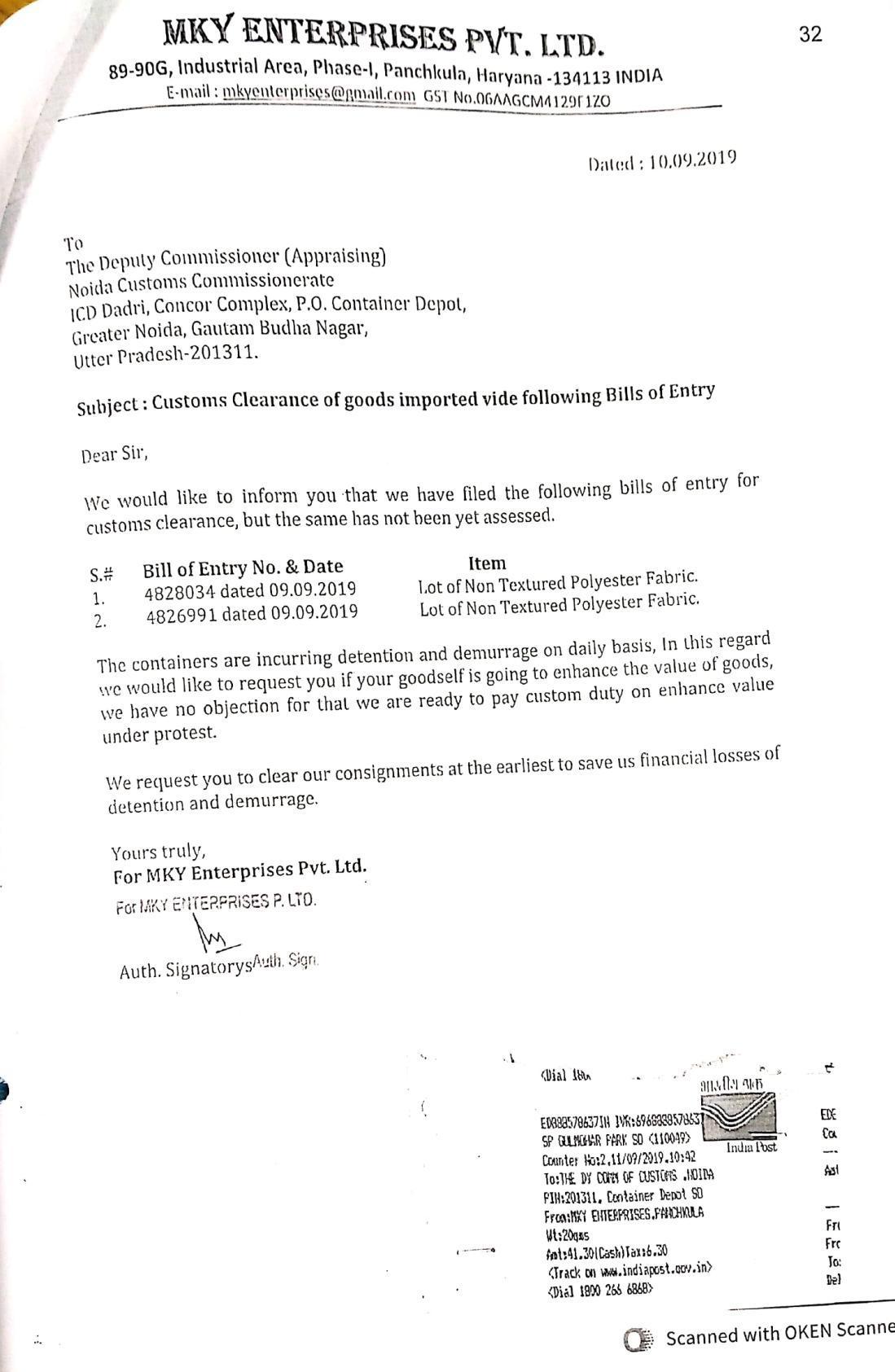
13. For sake of records and appreciation of facts in its proper perspective, it would be obligatory for us, by way of sample, to place on record such “Acceptance Letter”, written by the appellant from time to time in respect of each of the concerned imports. Thus:
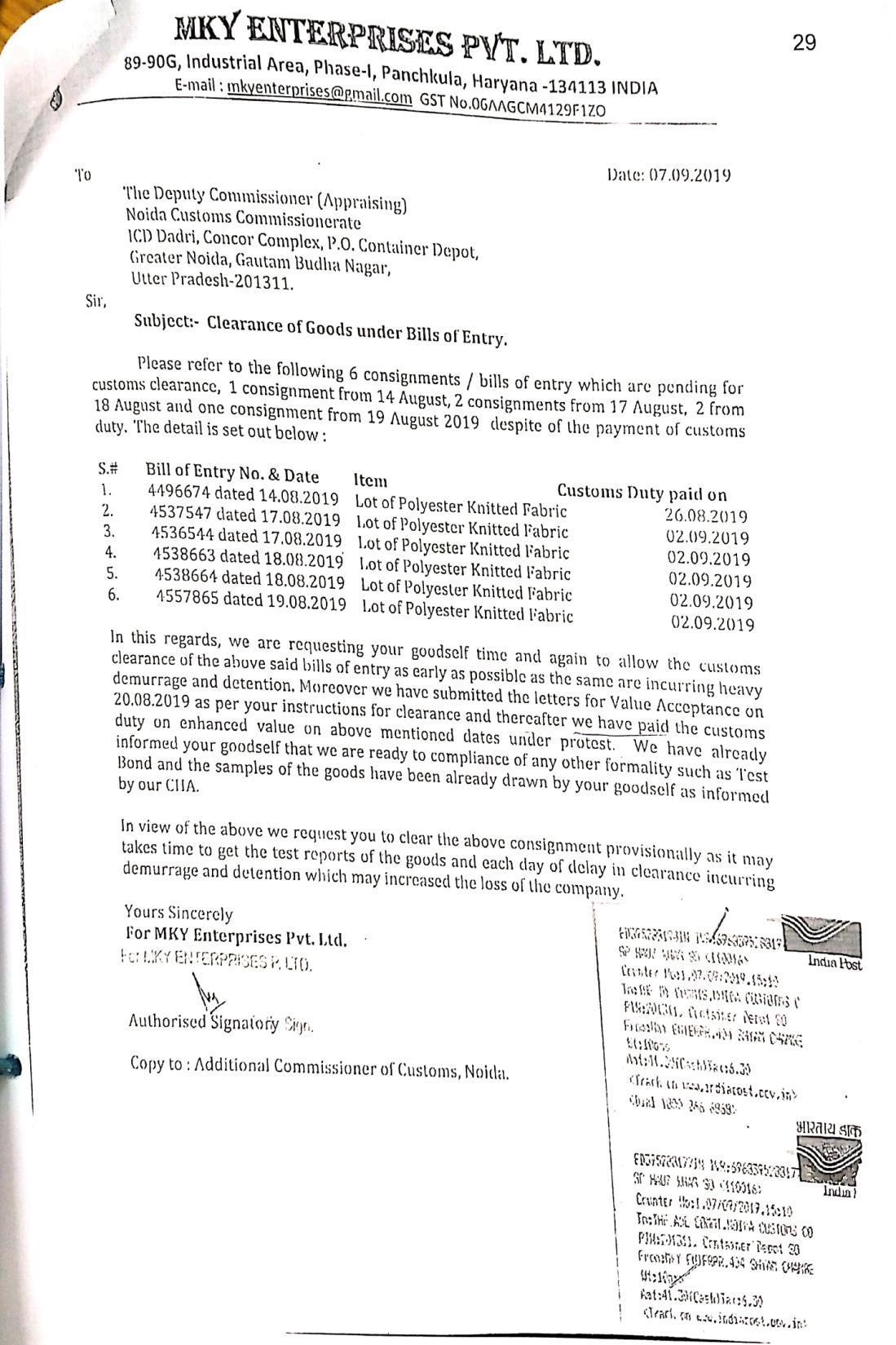
 Further, a communication as below would show that the involuntary or rather coerced nature of such “acceptance” by the appellant. :
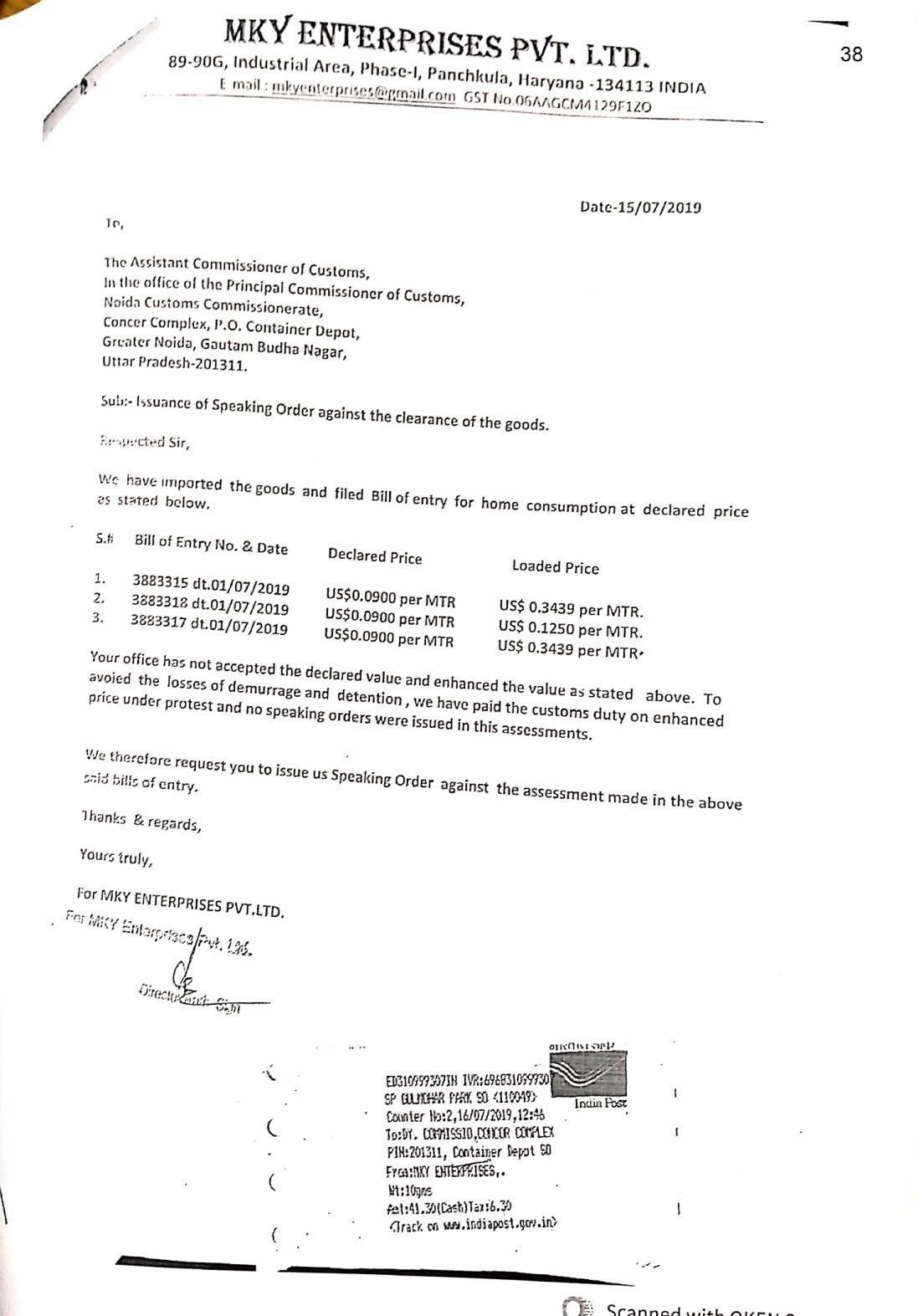
14. Yet another communication as scanned below would evidently show that the appellant did solicit the speaking orders from the authori ties that were never issued by the department and on the contrary the authorities below have come up with certain fanciful case of their not being required to be so issued:
15. We have examined the impugned Order-in-Appeal vide which the Appeals filed by the Appellant were rejected holding that the Appellant has accepted the enhancement of value in writing and therefore there was no question of issuance of Speaking Order under Section 17(5) of the Customs Act, 1962. From the impugned Order-in-Appeal, it is further revealed that the Appellate Authority sought parawise comments from the Department and in response, the Department filed parawise comments and the acceptance letters regarding enhancement of assessable value by the Appellant. However, we find that none of the letters written by the Appellant seeking clearance of the consignments either provisionally or finally on payment of duty on enhanced assessable value under protest have been referred too. We have seen the letters written by the Appellant requesting the clearance of consignments either provisionally or finally on payment of duty on enhanced value under protest and also placed some of them on record, which clearly prove that this indeed was not the case of acceptance of enhancement of value simplicitor.
16. We find that the Order of the Commissioner (Appeals) merely proceeded on the ground that the Appellant had accepted the enhancement of value under Section 17(5) of the Customs Act, 1962 and therefore, there was no requirement of issuance of Speaking Order. The Commissioner (Appeals) referred to the judgment of Century Metal Recycling (supra) for rejecting the Appeal, more specifically relying on Para 26 to hold that there was no general or omnibus direction passed by the Hon‟ble Supreme Court to the effect that the transaction value declared in the bills of entry should invariably be accepted in all cases. However, it is seen that the Commissioner (Appeals) has failed to take into account the ratio of the judgment in entirety. The issue as to whether assessable value can be rejected without following the mandate of Section 14 of the Customs Act, 1962 read with Rule 12 of CVR, 2007 and the declared transactional value be re-determined following sequentially from Rule 4 to 5 of CVR, 2007, is no more res-integra as the Hon‟ble Supreme Court in the case of Century Metal Recycling Pvt. Ltd. vs. UOI reported in 2019 (367) E.L.T. 3 (SC) has held that the mandate of Rule 12(2) of CVR, 2007 to intimate the importer in writing the ground of doubting the truth of accuracy of the declared value cannot be ignored or waived. The Hon‟ble Supreme Court has held as under:- “
20. ……………….. As per sub-rule (2) of Rule 12, the proper officer when required must intimate to the importer in writing the grounds for doubting the truth or accuracy of the value declared. The said mandate of sub-rule (2) of Rule 12 cannot be ignored or waived. Formation of opinion regarding reasonable doubt as to the truth or accuracy of the valuation and communication of the said grounds to the importer is mandatory, subterfuge to by-pass and circumvent the statutory mandate is unacceptable. Formation of belief and recording of reasons as to reasonable doubt and communication of the reasons when required is the only way and manner in which the proper officer in terms of Rule 12 can proceed to make assessment under Rules 4 to 9 after rejecting the transaction value as declared.
21. The mandate to record reasons at the second stage of enquiry is not expressly stipulated, albeit it has been read by us by implication in Rule 12. Being conscious that this mandate if applied to past cases would possibly lead to complications and difficulties, we would invoke the doctrine of prospective application with the direction that the past cases will be decided on a case to case basis, depending upon the factual matrix and considerations like whether the importer has asked for „certain reasons‟, whether the reasons were not communicated, whether „certain reasons‟ can be deciphered from the assessment/valuation Order, whether mis-description or false declaration was apparent, etc.”
17. We notice that in the present case, all bills of entry are dated 17.05.2019 to 18.09.2019 and therefore, the Proper Officer was duty bound to communicate the reasons for rejection of the transaction value in writing as mandated by the Hon‟ble Supreme Court. We find that in the Century Metal Recycling Pvt. Ltd. (supra) facts were similar to the present case in as much as in that case too repeated requests for provisional assessment by the importer were ignored and the importer was forced to submit letter of acceptance. We further find that although the letter of acceptance states that the ground for rejection of the declared value has been narrated to the Appellant and that details of contemporaneous import of similar and identical goods have been shown to them and on the basis of which, the Appellant accepted that their value were significantly lower than the value at which identical/similar goods imported at or about the same time in comparable commercial transactions were assessed at other ports of the country, however, no such details of alleged contemporaneous import data have been mentioned, therein. Given the language as noted in some of the letters as written by the appellant and placed above, there is a wide gap which has not been bridged by the Revenue, in the matter. The contents of this communication cannot therefore be taken on its face value.
18. We further find that the issue (1) as to whether the Department can enhance the value relying on NIDB and on the basis of the acceptance letter and (2) once there is acceptance letters, the importer cannot contest the same, have also come up for consideration before the Hon‟ble High Court of Delhi in the case of Niraj Silk Mills vs. Commissioner of Customs (ICD) Patparganj passed in CUSAA 26/2022 and the Hon‟ble High Court vide its judgment dated 27.11.2024 has held that the right to question the correctness of the decision of the proper officer, be it with respect to the formation of opinion or even on merits, is one which is protected by statute. The Hon‟ble High Court formulated the question of law as under:-
“Whether the Tribunal misdirected itself in holding that the appellants in the above-mentioned matter could not question the enhancement made concerning the valuation of the imported goods, once the appellants had given up their right to seek issuance of a show cause notice and/or speaking Order under Section 17 of the Customs Act, 1962?”
The Hon‟ble High Court vide its judgment, thus held as under:- “83. That then takes us to the concession which the importer could tender and which would require us to identify the subject in respect of which that concession may be made. When we examine this aspect on the anvil of Section 17(5), it becomes apparent that the statute speaks of the concession being with reference to the reassessment made under Section 17(4). It thus proceeds to provide that in a case where the importer confirms his acceptance of the reassessment in writing, the proper officer would stand relieved of the obligation of passing a speaking Order in respect of such reassessment. In all other cases and where the reassessment is not acceded to, the proper officer is obliged to pass a speaking Order. Thus, the waiver or concession is at best confined to the speaking Order which the proper officer is obliged to frame in affirmation of the provisional opinion that it may have formed under Section 17(4).
84. We find ourselves unable to construe Rule 12(2) as contemplating any concession or waiver at least in explicit terms. All that Rule 12(2) stipulates is that the proper officer would intimate to the importer the grounds for doubting the declared value at its request. It is in the aforesaid context that we would thus have to adjudge whether the CESTAT was correct in holding that the exchange of communications amounted to a waiver or abandonment not just of the right to question and assail the reassessment but to impugn it in further proceedings in accordance with the procedure prescribed under the Act.
85. In our considered opinion, the perceived concession made in respect of the opinion harboured by the proper officer cannot possibly be interpreted or construed as detracting from or depriving the importer of the right to question the decision of the proper officer in accordance with law. The right to question the correctness of the decision of the proper officer, be it with respect to the formation of opinion or even on merits, is one which is protected by statute. The question, which as a sequitur, arises is whether that right itself can be said to have been abandoned.”
19. The Ld. Advocate has further drawn our attention to the finding of the Hon‟ble High Court on the issue as to whether the declared value can be rejected merely on the basis of NIDB data. The Hon‟ble High Court has held as under:-
“104. It becomes apparent from a reading of these decisions collectively that the Tribunal has consistently found that a valuation addition based solely on NIDB data would wholly unwarranted and that any such reassessment would have to be shored by independent and cogent evidence. The legal position so articulated would ensure fairness and transparency in the determination of import values. The body of precedent noticed above have in unison held that mere reliance on external data without corroborative evidence or clear justification would fail to meet the tests and principles underlying the provisions enshrined in the 1988 Rules and 2007 Rules. They correctly lay emphasis on the imperatives of a reasoned approach to customs valuation and a deviation from declared values being founded on tangible and justiciable material. A reassessment or rejection of declared value would thus have to necessarily be established as being compliant with the aforenoted requirements of pre- eminence. Relieving the respondents of this obligation would clearly lead to pernicious consequences.”
“105. Accordingly, and for all the aforesaid reasons, we would answer the question framed in the affirmative and in favour of the importers. The Appeals are consequently allowed and the impugned Orders of the CESTAT set aside. The Order of the Commissioner (Appeals) shall in consequence stand restored……”
20. Having considered the rival contentions and after analyzing the relied upon judgments, we find that the issue involved in the present Appeals is squarely covered by the judgement of Hon‟ble High Court of Delhi in the case of Niraj Silk Mills (supra) and therefore, the impugned Orders-in-Appeal are not sustainable in law. Accordingly, we set aside the same and allow all the Appeals, with consequential relief if any, as per law.
(Order pronounced in open court on – 25.06.2025)