
Summary: Captain Smit Machchhar, an Indian pilot flying for flydubai, emerged as one of the central figures in a dramatic aviation emergency aboard flight FZ1073 from Dubai to Tel Aviv on 30 September 2026. Flydubai officially confirmed that an incident occurred during the flight, control of the aircraft was regained through the actions of its crew and the aircraft was diverted and landed safely at Tabuk Airport in Saudi Arabia. Reuters, citing passengers and Israeli officials, reported that Machchhar was attacked and stabbed by the co-pilot during a violent cockpit confrontation. Despite being injured, the captain reportedly managed to facilitate access to the cockpit, following which crew members and passengers intervened. Other qualified flydubai pilots travelling on board subsequently helped bring the aircraft safely to the ground. All passengers were reported safe. The incident has focused attention not only on Captain Machchhar’s actions but also on cockpit security, crew resource management, aviation emergency preparedness and the importance of trained personnel being able to respond when an extraordinary situation develops in flight. TaxGuru has separately explained the Flydubai FZ1073 incident and aviation terms including Squawk 7500 and 7700.
- What Happened on Flydubai Flight FZ1073?
- Captain Smit Machchhar Attacked in Cockpit: What Has Been Reported
- Who is Captain Smit Machchhar?
- From SpiceJet to flydubai
- How Disaster Was Averted
- Why Opening the Cockpit Became Critical
- Passengers and Crew Played a Critical Role
- All Passengers Safe
- Captain Machchhar's Aviation Experience
- Investigation Will Determine the Full Story
- Aviation-Security Questions Raised by FZ1073
- Should Captain Smit Machchhar Be Considered for the Ashoka Chakra?
- An Indian Pilot at the Centre of an Extraordinary Aviation Emergency
What Happened on Flydubai Flight FZ1073?
Flydubai flight FZ1073 was operating from Dubai International Airport to Ben Gurion International Airport in Tel Aviv on 30 September 2026 when a serious incident occurred during the journey.
Flydubai’s initial official statement was deliberately cautious. The airline confirmed that FZ1073 had experienced an incident while en route, had subsequently landed safely at Tabuk Airport in Saudi Arabia, and that all passengers were safe and accounted for.
In a subsequent update, flydubai confirmed that there had been a conflict on the flight deck. The airline said that the aircraft was successfully brought back under control through the actions of its crew and was diverted to Tabuk, where it landed safely.
The airline said replacement aircraft were dispatched to Tabuk for the passengers and crew.
The incident also resulted in the aircraft transmitting emergency signals that attracted international attention. TaxGuru has explained separately what Squawk 7500, Squawk 7700, unlawful interference, flight deck, transponder and diversion mean in the context of FZ1073.
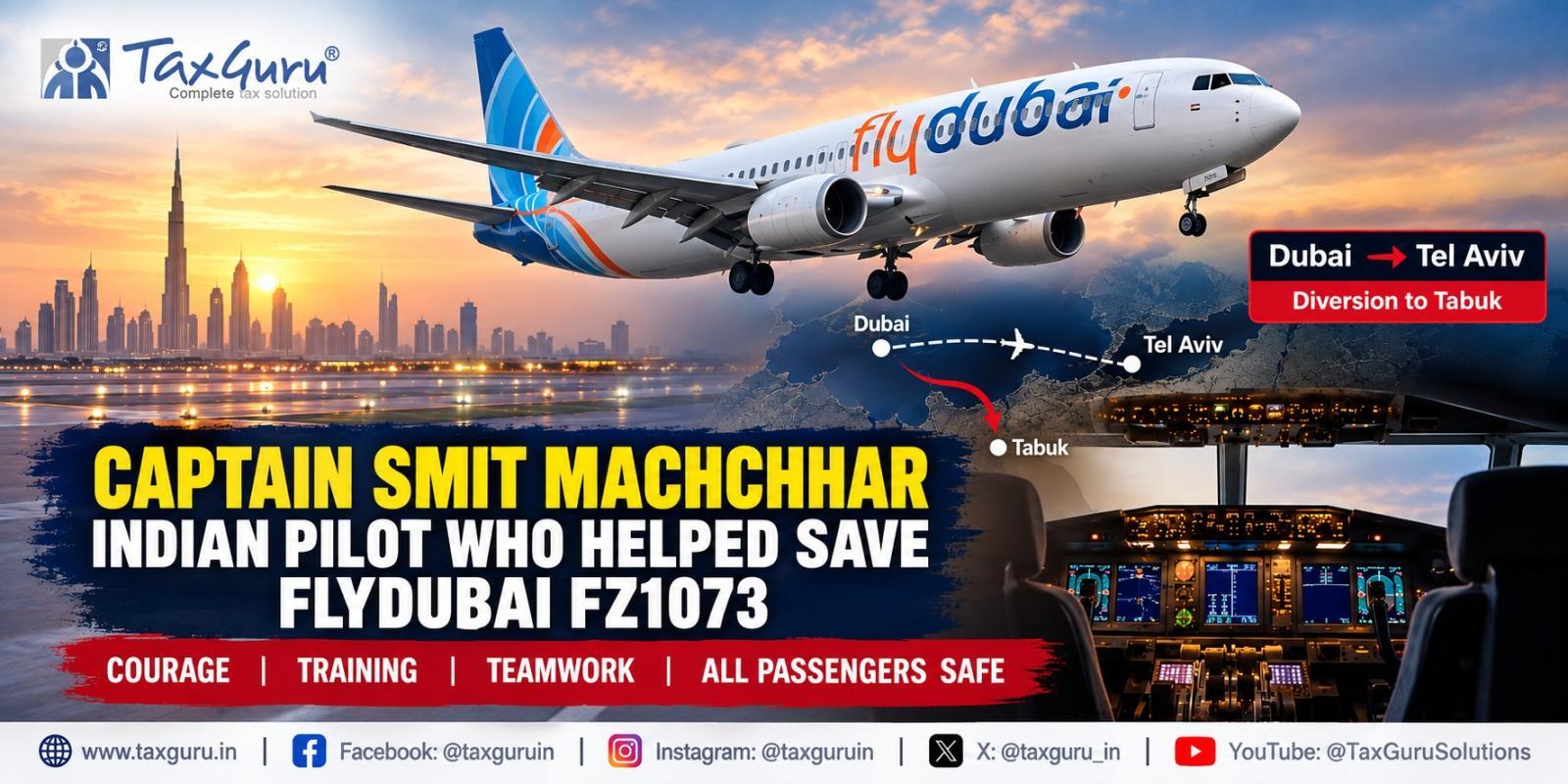
Captain Smit Machchhar Attacked in Cockpit: What Has Been Reported
The circumstances surrounding the cockpit conflict are considerably more serious than flydubai’s initial statement disclosed.
Reuters reported, based on passenger accounts and Israeli officials, that the co-pilot attacked and stabbed the captain and allegedly attempted to take control of the aircraft.
The aircraft underwent a dramatic loss of altitude during the incident. Reports based on flight-tracking information indicate that the aircraft descended rapidly before control was restored.
Reuters reported that despite being seriously wounded, the captain was able to unlock or facilitate access to the cockpit, enabling intervention by passengers and crew.
The precise sequence of events, the attacker’s motive and several other details remain matters for investigation. Flydubai itself has cautioned against speculation while the relevant authorities investigate the incident.
The distinction is important because an aviation security incident or transmission of the code associated with unlawful interference does not by itself conclusively establish that an aircraft was legally “hijacked”. India, for example, separately defines and deals with hijacking under the Anti-Hijacking Act, 2016.
Who is Captain Smit Machchhar?
Captain Smit Machchhar is an Indian commercial pilot currently associated with flydubai.
According to reporting by NDTV based partly on his professional profile and an earlier podcast appearance, Machchhar has more than 13 years of commercial flying experience on the Boeing 737 family and more than 9,750 flying hours.
His path into aviation was not originally planned.
Machchhar has said that flying was not a childhood ambition. He initially pursued textile engineering in the context of his family’s textile business. He subsequently undertook management studies, and exposure to aviation during this period reportedly prompted him to consider flying professionally.
He was around 19 when he decided to pursue aviation and subsequently underwent pilot training in New Zealand.
Commercial pilot training and licensing are highly regulated activities. In India, the Directorate General of Civil Aviation regulates pilot licensing and recognised aviation training. TaxGuru has previously examined the regulatory framework surrounding aviation training for Commercial Pilot Licence qualifications and the role of DGCA.
From SpiceJet to flydubai
Before joining flydubai, Machchhar had a long association with SpiceJet in India.
According to his publicly reported professional history, he joined SpiceJet in 2011 and held positions including Senior Commander and Line Training Captain.
That experience is particularly significant because a Line Training Captain does considerably more than operate an aircraft. Such pilots are entrusted with training and evaluating other pilots during operational flying.
Machchhar reportedly left SpiceJet in 2022 and joined flydubai as a Direct Entry Captain.
His professional profile currently identifies him as a captain with flydubai.
India’s aviation regulatory structure includes the Directorate General of Civil Aviation (DGCA) for safety oversight and regulatory functions and the Bureau of Civil Aviation Security (BCAS) for civil aviation security. Their statutory framework was strengthened through the Aircraft (Amendment) Act, 2020.
How Disaster Was Averted
The available reporting indicates that the safe outcome was not attributable to one person alone. It resulted from several critical actions occurring during an exceptionally dangerous situation.
Captain Machchhar’s reported actions despite suffering injuries were crucial. Crew members and passengers subsequently intervened in the cockpit situation.
Another important factor was the presence of additional qualified flydubai pilots aboard the aircraft.
Reuters reported that other pilots travelling on the flight were able to assist in regaining operational control and ultimately bringing the aircraft safely to Tabuk.
The episode therefore demonstrates several layers of aviation safety working under extraordinary circumstances: an injured captain continuing to respond, intervention by crew and passengers, availability of other trained pilots, diversion to a suitable airport and emergency coordination on the ground.
Why Opening the Cockpit Became Critical
Modern commercial aircraft cockpit doors are deliberately designed to resist unauthorised entry. This security architecture became substantially more stringent following the September 11 attacks.
Ordinarily, preventing passengers or attackers from gaining cockpit access is essential to aviation security.
FZ1073 presented the opposite problem.
According to the reported sequence, the threat was already inside the cockpit. Access from outside therefore became essential to permit others to intervene.
The unusual circumstances are particularly significant when compared with conventional cockpit-security rules. India’s Aircraft (Security) Rules, 2023 contain specific requirements governing protection and access control of cockpit doors and the flight-crew compartment.
Rule 37 requires an aircraft operator, among other things, to ensure that cockpit doors remain locked during all phases of flight unless they need to be opened for operational reasons. It also requires a communication system between flight crew and cabin crew and places responsibility for cockpit access control on the pilot-in-command.
The FZ1073 incident therefore illustrates one of the difficult issues aviation-security authorities may examine: security systems designed to prevent cockpit intrusion must also operate effectively in the extremely rare situation where the danger originates from a person already authorised to be inside the flight deck.
Passengers and Crew Played a Critical Role
The passengers and other crew members who intervened also played an important role in the outcome.
Reuters reported accounts of passengers becoming aware that something was seriously wrong, followed by intervention as events unfolded.
Video footage from inside the aircraft, verified by Reuters, showed the aftermath of the violent confrontation.
Israeli officials publicly praised the intervention of those aboard the aircraft.
The precise individual roles of everyone involved will become clearer only after aviation and law-enforcement authorities complete their investigations.
All Passengers Safe
The most important confirmed fact is the outcome.
Flydubai stated that the aircraft landed safely at Tabuk Airport and that all passengers were safe and accounted for.
The airline subsequently arranged replacement aircraft to assist passengers and crew.
That outcome is remarkable given the reported violence in the cockpit and the aircraft’s sudden altitude change.
Captain Machchhar’s Aviation Experience
Machchhar’s reported career history provides important context to his response during the emergency.
More than 9,750 hours of flying represents extensive operational exposure. His previous role as a Line Training Captain also indicates experience not merely in aircraft operation but in managing cockpit procedures, training and abnormal operational situations.
Commercial aviation training repeatedly exposes pilots to simulated emergencies precisely because real emergencies leave very little time for deliberation.
Indian aviation law also imposes detailed competency, licensing and aircraft-rating requirements on pilots. TaxGuru’s coverage of commercial pilot training, DGCA licensing and aircraft type-rating requirements provides additional background on how pilot qualifications are regulated in India.
Investigators will ultimately determine the precise sequence of technical and human actions aboard FZ1073. Nevertheless, the currently reported account indicates that experience and emergency response were important to the eventual safe outcome.
Investigation Will Determine the Full Story
Some early media reports differ on details such as the precise passenger count, the aircraft’s altitude changes and portions of the cockpit sequence.
Those differences matter.
Flydubai’s official statements confirm the flight-deck conflict, restoration of control by its crew, diversion to Tabuk and the safety of passengers and crew. More specific allegations concerning the co-pilot’s actions have been reported by Reuters and other media based on Israeli officials, passengers and other sources.
Until the relevant aviation and law-enforcement authorities complete their investigations, those distinctions should be maintained.
Investigators are likely to examine the cockpit voice recorder, flight data recorder, crew history, security procedures, aircraft movements, passenger and crew testimony, medical evidence and the circumstances leading to the confrontation.
In the Indian regulatory framework, investigation of aircraft accidents and incidents is institutionally separated from other aviation functions. The Aircraft (Amendment) Act, 2020 provides for the Aircraft Accidents Investigation Bureau, while separately recognising the DGCA and BCAS and their respective regulatory functions.
Aviation-Security Questions Raised by FZ1073
The incident raises broader questions extending beyond one flight.
Commercial aviation security traditionally concentrates heavily on external threats: passengers carrying prohibited objects, unauthorised cockpit access, airport security breaches and potential hijacking.
An alleged threat originating within the cockpit presents a fundamentally different risk.
The concept of “unlawful interference” is broader than conventional hijacking. As explained in TaxGuru’s detailed explainer on the FZ1073 incident, India’s Aircraft (Security) Rules cover several acts or attempted acts capable of jeopardising civil aviation safety.
The Aircraft (Security) Rules, 2023 address matters including security screening, aircraft security, cockpit protection, access control, security programmes and measures against acts of unlawful interference.
India also has a specialised criminal-law framework under the Anti-Hijacking Act, 2016 for unlawful seizure or exercise of control of aircraft.
The FZ1073 investigation may therefore have implications for crew screening, cockpit access protocols, procedures when one flight-deck crew member becomes incapacitated or hostile, psychological and behavioural monitoring, and protocols governing intervention by cabin crew.
It would, however, be premature to conclude that any particular regulatory failure caused this incident before investigators establish the facts.
Should Captain Smit Machchhar Be Considered for the Ashoka Chakra?
The extraordinary circumstances surrounding flight FZ1073 also raise a question of national recognition: if the investigation confirms the currently reported account of Captain Smit Machchhar’s actions, should he be considered for the Ashoka Chakra?
The Ashoka Chakra is India’s highest peacetime gallantry award. Importantly, eligibility is not confined to members of the Armed Forces. According to the Ministry of Defence guidelines, the award may be conferred for the “most conspicuous bravery” or an act of daring, pre-eminent valour or self-sacrifice otherwise than in the face of the enemy. The eligible categories expressly include civilian citizens of either sex in all walks of life.
Captain Machchhar is therefore not excluded from consideration merely because he is a civilian commercial pilot.
There is also a significant precedent from Indian civil aviation. Flight Captain Damodar Kashinath Jatar of Air India was the first civilian recipient of the Ashoka Chakra. On 11 April 1955, while piloting Air India’s Kashmir Princess, an explosion and subsequent fire created a catastrophic emergency over the South China Sea. With no landing ground nearby, Captain Jatar decided to ditch the aircraft in the sea, organised the emergency procedure and continued commanding the aircraft. Three persons survived, while Captain Jatar lost his life. He was awarded the Ashoka Chakra posthumously for his exemplary courage and self-sacrifice.
An even more familiar aviation precedent is Neerja Bhanot, the Pan Am flight purser who displayed extraordinary courage during the hijacking of Pan Am Flight 73 at Karachi on 5 September 1986. She helped passengers escape after the hijackers opened fire and was fatally wounded while shielding children. She was subsequently honoured with the Ashoka Chakra posthumously.
These precedents do not by themselves establish that Captain Machchhar should receive the award. Each gallantry award is determined on its own facts and through the prescribed governmental process. They do, however, establish two important points: civilian aviation personnel are eligible for the Ashoka Chakra, and extraordinary courage displayed in protecting lives aboard a civilian aircraft has previously resulted in India’s highest peacetime gallantry recognition.
In Captain Machchhar’s case, Reuters and other reports have stated that despite being seriously injured during the cockpit confrontation, he continued acting in circumstances that ultimately enabled intervention and restoration of control of the aircraft. The flight subsequently landed safely at Tabuk and the passengers survived the emergency.
If the official investigation substantiates the reported sequence of events and establishes that Captain Machchhar, despite suffering serious injuries, demonstrated conspicuous bravery or pre-eminent valour that materially contributed to saving the aircraft and the lives aboard it, his actions would merit consideration by the competent authorities for appropriate national gallantry recognition, including the Ashoka Chakra.
Such consideration should ultimately rest on the verified findings of the investigation rather than on early media reports. But the precedents of Captain D. K. Jatar and Neerja Bhanot demonstrate that extraordinary courage in civilian aviation has an established and distinguished place in the history of the Ashoka Chakra.
An Indian Pilot at the Centre of an Extraordinary Aviation Emergency
For India, the episode has attracted particular attention because Captain Smit Machchhar built a substantial part of his aviation career in the country before moving to flydubai.
From training abroad to more than a decade of commercial flying, including senior training responsibilities in India, his career ultimately placed him in circumstances no commercial pilot expects to encounter.
What is presently established is that flight FZ1073 experienced a serious flight-deck conflict, control of the aircraft was restored, the aircraft was diverted to Saudi Arabia and its passengers survived the ordeal.
The episode should also be viewed against the wider legal architecture governing aviation security. India’s Aircraft (Security) Rules, 2023 provide the preventive civil aviation security framework, while the Anti-Hijacking Act, 2016 deals specifically with hijacking and unlawful control of aircraft.
As investigations continue, the complete account of what happened inside the cockpit will emerge.
For now, Captain Smit Machchhar’s reported actions—together with those of the other pilots, cabin crew and passengers who intervened—form the central story of how an exceptionally dangerous mid-air emergency ended with the aircraft safely on the ground and its passengers alive.







