In re Pinaka Aerospace Solutions Pvt. Ltd. (CAAR Mumbai)
Summary: The Customs Authority for Advance Rulings, Mumbai considered whether three key components proposed to be imported by Pinaka Aerospace Solutions Pvt. Ltd.—MILDS F SUOF Lens V2, Front End (M2FE) V2.11 and MILDS F SUII Coupled V2.5 series—were eligible for exemption from customs duty under Sl. No. 60 of Table II to Notification No. 45/2025-Customs dated 24.10.2025. The components were to be imported from HENSOLDT, Germany and assembled in India into the MILDS AN/AAR-60 Block 2 Missile Warning System for installation on MI-17 V5 and MLH helicopters operated by the Indian Air Force. The Authority noted that Sl. No. 60 applies to goods falling under “Any Chapter” and covers parts, sub-assemblies, spares, accessories, tools and other specified goods for defence equipment including aircraft. Consequently, eligibility was principally dependent upon the functional character and intended end-use of the imported goods rather than their individual tariff classifications.
The Authority found that the three imported components were prefabricated units manufactured separately but engineered to be combined into the MILDS Block 2 Missile Warning System, which in turn forms part of the aircraft’s electronic-warfare suite. They therefore answered the description of “sub-assemblies … for goods like … aircrafts”. It further held that, even if their characterisation as sub-assemblies were doubted, they qualified as accessories because the missile-warning system materially enhanced the effectiveness of the military aircraft by detecting incoming missile threats and facilitating countermeasures. The Authority relied on the principle relating to accessories discussed in Annapurna Carbon Industries Co. v. State of Andhra Pradesh, (1976) 2 SCC 273. Since aircraft were expressly specified in the exemption entry and helicopters fell within the description of aircraft, the Authority found it unnecessary to invoke the residuary expression “etc.” or the ejusdem generis principle discussed in Siddeshwari Cotton Mills (P.) Ltd. v. Union of India & Anr.
The End-Use Certificate dated 16.06.2026 issued by Air Headquarters, New Delhi established the specific defence nexus by recording that the imported components would be used to manufacture MILDS AN/AAR-60 Block 2 sensors forming part of the Electronic Warfare Suite for Indian Air Force helicopters. However, CAAR clarified that this End-Use Certificate could not substitute the specific certificate mandated by Condition No. 17. That condition requires certification by an officer not below the rank of Joint Secretary to the Government of India in the Ministry of Defence regarding the quantity, description and technical specifications of the imported goods, their intended exclusive use by the Defence Forces and recommendation of the exemption. The prescribed certificate must be furnished to the jurisdictional Customs officer at the time of import.
CAAR accordingly ruled that MILDS F SUOF Lens, Front End (M2FE) and MILDS F SUII Coupled units, being components/sub-assemblies destined for assembly into the MILDS Block 2 Missile Warning System and, through that system, for fitment as accessories to military aircraft, were covered by the relevant description and eligible for exemption under Sl. No. 60 of Table II to Notification No. 45/2025-Customs. The benefit remains subject to fulfilment of Condition No. 17 and verification by the jurisdictional Customs authorities at import. The ruling did not determine tariff classification of the individual components, which remains for determination by the proper officer at assessment. The Authority also noted that the exemption entry ceases to have effect on or after 01.07.2029 and its continuing applicability must therefore be verified for each import.
Cases Discussed
1. Annapurna Carbon Industries Co. v. State of Andhra Pradesh, (1976) 2 SCC 273 (Supreme Court) — Referred to for the meaning of “accessory” and the principle that an accessory may add to the convenience or effectiveness of the principal product. Applying the predominant-use approach, CAAR held that the subject goods could qualify as accessories for military aircraft.
2. Siddeshwari Cotton Mills (P.) Ltd. v. Union of India & Anr., AIR 1989 SC 1019; (1989) 2 SCC 458 (Supreme Court) — Relied upon by the applicant for the principle of ejusdem generis. CAAR ultimately found it unnecessary to invoke that principle because “aircrafts” were expressly covered by Sl. No. 60 and the relevant end-use products were military helicopters.
FULL TEXT OF THE ORDER OF CUSTOMS AUTHORITY OF ADVANCE RULING, MUMBAI
M/s Pinaka Aerospace Solutions Pvt. Ltd. (having IEC No. 0707004497), having its registered office at Plot-16, KIADB Hi Tech Defense and Aerospace Park, Mahadevakodigehalli Village, Bangalore North, Bangalore — 562 149 and hereinafter referred to as ‘the applicant’) filed an application (CAAR-1) for advance ruling before the Customs Authority for Advance Rulings, Mumbai (`CAAR’, in short). The said application was received in the Secretariat of the CAAR, Mumbai on 17.02.2026 along with enclosures, in terms of Section 281-1(1) of Customs Act, 1962 (hereinafter referred to as ‘the Act’). The applicant, describing itself as a provider of avionics, electronic-warfare and communication systems, is seeking an advance ruling on the following question in respect of goods proposed to be imported:
“Whether the goods proposed to be imported by the applicant are eligiblelbr the duty exemption provided at SI. No. 60 of Table 11 of. the Notification No. 45/2025-Customs dated 24.10.2025.”
2. The applicant, M/s. Pinaka Aerospace Solutions Pvt. Ltd., vide its application dated 09.02.2026, received in this office on 17.02.2026 and additional submission received in this office on 04.08.2026, has submitted as follows:
2.1 The applicant is a services and solutions provider in the field of avionics, electronic-warfare and communication systems established in 2007. The applicant proposes to be imported goods namely “Key Components of MILDS Block 2” from HENSOLDT, Germany and to carry out the sub-assembly and final assembly, at its facility at Bengaluru, of the IIENSOLDT MILDS AN/AAR-60 Block 2 Missile Warning System (“MILDS Block 2 Missile Warning System”).
2.2 WILDS 13lock 2 Missile Warning System’ is described as a UV-based Missile Warning System developed by 1-IINSOLDT, a German aerospace and defence electronics company. It is stated to be a passive. true-imaging sensor system optimise to detect the radiation signature in the UV solar-blind spectral band emitted by the exhaust plume of a hostile missile during its approach. The system is designed to detect incoming missile threats and indicate their direction of arrival, thereby providing maximum warning time.
2.3 The applicant submits that passive, Infrared-Red Surface to Air Missiles (IR SAMs) (IR SAMs) pose an increasing threat to tactical aircraft and their crews. A significant number of aircraft lost in current and recent conflicts have been brought down by ground-based Infrared-Red Surface to Air Missiles (IR SAMs) (IR SAMs). WILDS Block 2′ has been developed to address this threat by providing rapid and reliable detection and declaration of incoming missile threats, while virtually eliminating false alarms. The system operates in conjunction with crew-alert mechanisms and the automatic release of countermeasures to decoy the incoming missile, thereby facilitating mission completion and the safe return of the crew and aircraft.
2.4 It is further submitted that ‘MIMS Block 2’ can be installed on a wide range of rotary-wing and fixed-wing platforms, including helicopters and aircraft such as the NI1-90, Tiger, U1-160, CI I-47, C-130 and P-3.
2.5 The applicant has submitted the photographs of the products i) MILDS F SUOF Lens V2 (Front-end Sensor Unit Optics) ii) Front End (M2FE) V2.11 and iii) MILDS F SUII Coupled V2.5 series, which are reproduced below:
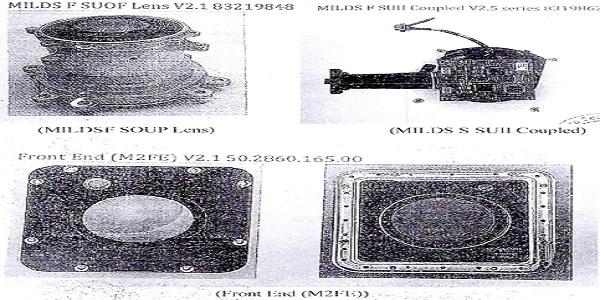
2.5.1 The applicant proposes to import the key components ,the (erred to as the -subject goods-) of as the Block 2 lot- assembly into the complete Product and to supply the finished product.’ i.e. MILDS 1310 k 2′. exclusively to the Defence India. The three key components (subject goods) proposed to be imported are set out below:
| SI. No. | Part name | HSN Code | Part Description | Final product where it is used |
|---|---|---|---|---|
| 1. | MlLl)S 1′ SIMI’ Lens V2 (Front-end Sensor Unit Optics) | 9031 90 00 | A high-precision passive imaging lens optimise for the UV solar- blind band, providing the wide- angle true-imaging field of view for 360° coverage; detects the UV signature of a missile exhaust plume, computes direction of arrival, and triggers automatic countermeasures. |
MILDS Block 2 |
| 2. | Front End (M2FE) V2.1I | 7610 90 90 | The “font end” is the optical and detector assembly that is “brain” inside each individual sensor head, performing real-time high speed data processing to detect and classify the UV signatures of incoming missiles. It detects small arms or RPGs and triggers automatic countermeasures (flares/DIRCM) within millisecond. |
MILI)S Block 2
– |
| 3. | MUDS F SUII Coupled V2.5 series | 8543 90 00 | The primary digital bridge between the individual Front End (M2FE) sensor modules and the aircraft’s Mission Management System / Countermeasure Signal Processor. The terms “Coupled” refers to its ability to synchronize data streams from multiple sensor heads (usually 4 to 6) to provide a unified. 360° spherical protection picture without data lag. |
MILDS Block 2 |
2.6 The applicant further submits that the licensor, HENSOLDT, will not transfer the production process or technology relating to the key components. The said components will be supplied in fully finished form and accompanied by a Certificate of Conformity (CoC). The applicant further states that, pursuant to the Statement of Work (Sow), it will establish a subassembly and final-assembly production line for WILDS Block 2′ at its production and manufacturing facility. Thereafter, the applicant will undertake the assembly p1 the complete ‘MUDS Block 2’ system and supply the finished product exclusively to the Defence Forces of India.
2.7 In view of the foregoing, the applicant submits that the subject goods are eligible fbr the duty exemption under Si. No. 60 of ‘fable II to Notification No. 45/2025-Customs dated 24.10.2025 and has, accordingly, sought an advance ruling under Section 28I1(2)(b) of the Customs Act, 1962.
3. Applicant’s interpretation of law and facts:
3.1 On the issue of maintainability, the applicant submits that the present application is maintainable and that an advance ruling is sought as per clause (b) of sub-section (2) of Section 281-1 of the Customs Act, 1962, on the question as to whether the goods proposed to be imported by the applicant are eligible for exemption from customs duty under SI. No. 60 of Table II to Notification No. 45/2025-Customs dated 24.10.2025 issued under sub-section (I) of Section 25 of the Customs Act, 1962 (hereinafter referred to as the –Customs Act”).
3.2 The applicant submits that, to the best of its knowledge, the question of applicability of’ the said notification has neither been raised before nor is pending before, nor has it been decided by, any officer of Customs, the Appellate Tribunal or any Court in respect of the applicant.
3.3 Relying on the definition of “advance ruling under Section 28E oldie Customs Act, i.e., an Advance Ruling as per clause (b) of sub-section (2) of Section 2811 of the Customs Act, 1962 on applicability of a notification issued under sub-section (1) of Section 25 of the Customs Act in relation to goods proposed to be imported prior to their importation or exportation, the applicant submits that the Present application is maintainable, as the subject goods are yet to be imported and the prescribed fee has been duly paid by way of demand draft.
3.4 On merits, the applicant relies on Sl. No. 60 of Table II of Notification No. 45/2025-Customs dated 24.10.2025 (G.S.R. 781(E), with effect from 01.11.2025), issued under Section 25(1) of the Act and Section 3(12) of the Customs Tariff Act, 1975.
| Sl. No. | Chapter or Heading or Sub-heading or tariff item | Description of goods | Standard rate | Integrated Goods and Services Tax | Condition No. |
|---|---|---|---|---|---|
| 60. | Any Chapter | Parts, sub-assemblies, spares, accessories, tools, testing equipment, literature for goods like artillery weapons, rifles, aircrafts, etc. except for 12.7mm SRCG. I S5mm,45 Cal. Dhanush, 1–70 Gun, RI. Mk-m, 630 Naval Guns, Light Machine Gun. WAG Gun: Provided nothing contained in is no. shall have effect or after the 1st July,2029 | Nil | Nil | 17 |
The relevant Condition No. 17 of the Annexure to Table II reads:
17″. If imported into India by the Ministry of Defence, or the Defence forces, or the Defence Public Sector Units, or other Public Sector Units, or any other entity, for the Defence forces, subject to the following conditions, namely:-
(i) an officer not below the rank of Joint Secretary to the Government of India in the Ministry of Defence certifies,
(a) the quantity,. description and technical specifications of the imported goods and
(b) that the said goods are intended for the purpose of and use by the defence forces only and recommends the grant of exemption to the imported goods;
(ii) the importer shall, at the time Of import, furnish the said certificate to the Deputy Commissioner (#. Customs or the Assistant Commissioner of Customs, as the case may be.
3.5 The applicant submits that, where the goods conform to the description specified in column (3) contains “Parts, sub-assemblies, spares, accessories, tools, testing equipment, literature for goods like artillery weapons, rifles, aircrafts, etc. except for 12.7mm SRCG, 155mm/45 Cal, Dhanush, L-70 Gun, 84mm RL Mk-III, AK-630 Naval Guns, Light Machine Gun, MAG Gun” of the said Notification, their import is eligible for exemption from the customs duty and integrated tax specified in columns (4) and (5), respectively. Accordingly, the applicant contends that sub-assemblies and accessories of aircraft are covered by the relevant entry, subject to fulfilment of Condition No. 17 of Table II to the said Notification.
3.6 The applicant submits that the three imported. items, once assembled in India, form the complete 1\411,DS Block 2 which is installed onto the aircraft, and that the components are therefore “sub-assemblies” of the aircraft. being prefabricated units engineered not as standalone items but for seamless incorporation into the aircraft’s defence architecture. Reliance is placed on the following:
- Collins Dictionary – “subassembly”: a number of machine components integrated into a unit forming part of a larger assembly.
- Merriam-Webster – “subassembly”: an assembled unit designed to be incorporated with other units in a. Finished product.
- McGraw-Hill Dictionary of Engineering – “subassembly”: [MEM] “live or more components combined into a unit ,for convenience in assembling or servicing equipment,. an intermediate frequency strip for a receiver is an example.
- [ENG] A structural unit, which, though manufactured separately, was designed for incorporation with other parts in the final assembly of a finished product.
3.7 The applicant submits that the three imported items, namely, the Front-End Sensor Unit/Optics Lens, Front End (M2FE) and MILDS F Still Coupled, when assembled in India, constitute the complete `MILDS Block 2′ system, which is subsequently installed on an aircraft. Accordingly, the applicant contends that the subject goods constitute sub-assemblies of the aircraft.
3.8 The applicant further submits that the subject goods are prefabricated units designed to be integrated with other components to form a functional subsystem essential for missile detection and aircraft protection. In support of this contention, the applicant relics upon the definition of “subassembly” in the McGraw-Hill Dictionary of Engineering, which describes a subassembly as a “structural unit, which, though manufactured separately, was designed for incorporation with other parts in the final assembly of a finished product.” The applicant submits that, in the present case, the subject goods are not standalone items but are specifically engineered for integration into the aircraft’s missile-warning and &fence system.
3.9 ‘ Without prejudice to the above contention, the applicant submits that, even ilthe subject goods are not considered essential components or sub-assemblies of the aircraft, they would nevertheless qualify as “accessories” to the aircraft.
3.10 In Black’s Law Dictionary (5th Edition) ‘accessory’ is defined as, “anything which is joined to another thing as an ornament or to render ii snore perfect, or which accompanies it. or is connected with it as an incident; or as subordinate to it, or which belongs 10 or with it, adjunct or accompaniment. A thing to subordinate importance. Aiding or contributing in secondary way of assisting in or contributing to as a subordinate.”
Similarly, Oxford Dictionary defines “accessory” as: “an extra piece of equipment that useful but not essential or that can he added to something else as a decoration.”
Cambridge Dictionary defines “accessory” as; “something added to a machine or 10 clothing that has a uselitl Or decorative purpose”.
Ramahatha Aiyar (8th citron) notes that the term ‘accessories’ is used to describe goods which May have been manufactured for use as an aid or addition.
3.10.1 In Annapurna Carbon Industries Co. v. State of Andhra Pradesh, 1976 (2) SCC 273, the 1.1on.ble Supreme Court deliberated on the meaning of “accessories”. The relevant extract is as below –
“10. We find that the term .`accessories’ is used in the schedule to describe goods . which may have been manufactured for use as an aid or addition. A sense in which the word accessory is used is given in Webster’s Third New International Dictionary as follows: ‘An object or device that is not essential in itself but that adds to the beauty, convenience, or effectiveness of something else.’ Other meanings given there are: ‘supplementary or secondary to something of greater or primary importance’. `additional’, “any of several mechanical*, devices that assist in operating or controlling the tone resources of an organ”.
From the above definitions it can be understood that the subject goods which arc attached in addition to the essential parts of the aircraft and assists the aircraft in its defence by detecting incoming missile threats, will also qualify as an “accessory” to the aircraft. The goods aid the aircraft in a secondary yet critical manner, aligning with Black’s Law Dictionary’s description of an accessory as something “aiding . or contributing in a secondary way or assisting in or contributing to as a subordinate.”
3.10.2 In the Supreme Court’s decision in Annapurna Carbon Industries (supra), accessories were held to include items that add to the convenience or effectiveness of the primary product. Applying this, the subject goods enhance the aircraft’s defensive capabilities against missile threats, making them indispensable accessories in modern aerial warfare scenarios. They are not core structural elements like engines or fuselages but supplementary systems that improve overall performance
3.10.3 It is also to be noted that the tools, accessories, parts etc. of an aircraft arc all included in this entry. Further,.the description is a very broad and inclusive one which can encompass most of the goods related to defence purposes with only seven specific exceptions listed. This broad nature can be inferred by the usage of the term “etc.” in the description and the inclusion of “Any Chapter” in this entry.
3.11 Thc Supreme Court’s decision in Siddeshwari Cotton Mills (P,) Ltd vs Union Of India & Anr (1989 AIR 1019, 1989 (2) SCC 458) explains the principle of “ejusdem genres” as follows;
7. The expression ejusdem generis, ‘of the same kind or nature’– signifies a principle of construction whereby words in a statute which are otherwise wide but are associated in the test with more limited words are, by implication, given a restricted operation and are limited to matters of the same class or genus as preceding. If a list or string or family of genus-describing terms are .followed by wider or residuary or sweeping-up words, then the verbal context and the linguistic implications of the preceding words’ limit the scope of such words.
3.12 Applying this principle to entry in SI No. 60 of the notification, the items specifically listed in the description like artillery weapons, rifles, aircrafts etc. shows that this entry also applies to Missiles Warning System which is in the similar nature.
3.13 The listed items form a genus of defence equipment used in military operations. Missile warning systems share this genus, as they are specialized defence tools integral to aircraft protection, similar to how rifles or artillery serve protective or of Tensive roles in ground operations.
3.14 The term “etc.” extends the entry to analogous items within the same category of military hardware. Missile warning systems, like the MILDS Block 2, are not standalone consumer goods but are purpose-built for defence applications. Since the notification explicitly excludes only seven items, the broad inclusion via “etc.” and “Any Chapter” indicates an intent to cover a wide array of defence related goods, including advanced sensor-based systems for aircraft.
3.15 Therefore, in every angle of viewing, the subject goods clearly fall under the broad description at he entry in SI No. 60 of the Notification.
3.16 Further, the eligibility of this exempted duty is subject to the fulfilment of the conditions
given in the column (6) of the said notification. In the instant case, the necessary condition is the condition no. 17, which is reproduced below;
ANNEXURE TO TABLE
| Condition No. | Condition |
|---|---|
| 17. | If imported into India by the Ministry of Defence, or the Defence forces, or the Defence Public Sector Units, or other Public Sector Units, or any other entity, for the Defence forces, subject to the following conditions, namely:-
(i) an officer not below the rank of Joint Secretary to the Government of India in the Ministry of Defence certifies. (a) the quantity, description and technical specifications of the imported goods; and (b) that the said goods are intended for the purpose of and use by the defence forces only and recommends the grant of exemption to the imported goods: (ii) the importer shall, at the time of import, furnish the said certificate to the Deputy Commissioner of Customs or the Assistant Commissioned .of Customs, as the case may be. |
In view of the above table, the condition has mentioned that the goods are eligible for exempted duty if imported into India by any entity for use by defence forces. It is submitted that the usage of the term “any other entity” shows that imports by the private entities like the Applicant arc also eligible for benefit under this notification, if they fulfil the other conditions.
The availability of exemption is further subjected to the certification of officer in the prescribed rank regarding the quantity, description, technical specifications of the imported goods, and that the said goods arc intended for the purpose of and use by the defence forces only and recommends the grant of exemption to the imported goods.
4. Additional submissions by the applicant
4.1 Pursuant to the direction of this Authority at the hearing, the applicant placed on record documents said to establish its capacity to manufacture defence-related equipment in India: a Registration Certificate of the Directorate General of Aeronautical Quality Assurance (DGAQA), Ministry of Defence, for “Design, Development & Production and MRO” of specified defence aviation stores (valid to 31.12.2028); vendor-renewal letters of 9 Base Repair Depot (Punt) and 12 Base Repair Depot (Delhi) of the Indian Air Force; a vendor registration of I I Hindustan Aeronautics Limited (Avionics Division, Korwa) under the OEM/Licensor category; ISO/IEC 20000-1:2018 certificate; and a certificate of membership of the Society of Indian Defence Manufacturers (SIDM).
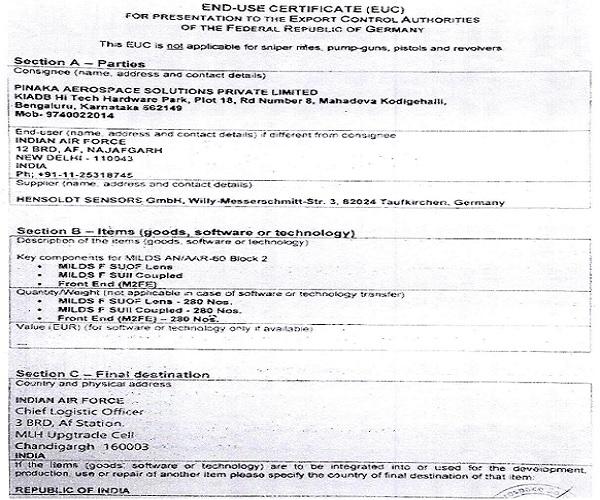
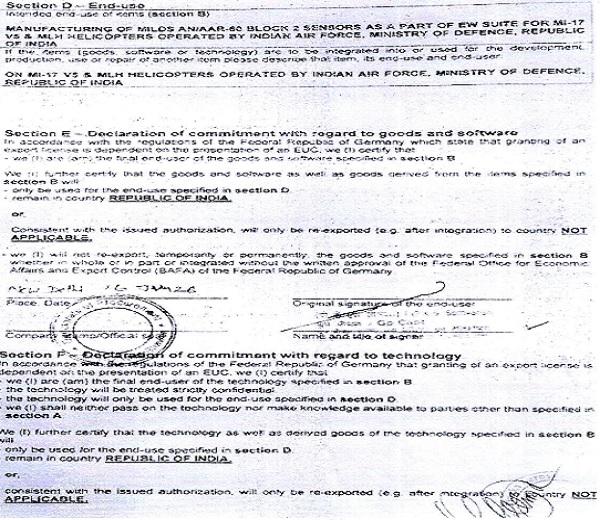
4.2 By its additional written submission, the applicant reiterated the components and their proposed import. and submitted that the three items. once assembled in India, form the complete ‘MUDS Block 2 Missile Warning System’ which will be installed directly onto the MI-17 V5 and MH helicopters operated by the Indian Air Force. To establish the nexus between the imported components and the final aircraft, the applicant placed on record an End-Use Certificate issued by the Indian Air Force on 16.06.2026 for presentation to the export-control authorities of the Federal Republic of Germany, certifying that the imported key components will be used for the manufacture of MILDS AN/AAR-60 Block 2 sensors forming part of the Electronic Warfare (EW) suite for the MI-17 V5 and MLH helicopters of the Indian Air Force, Ministry of Defence, as reproduced below:
–
–
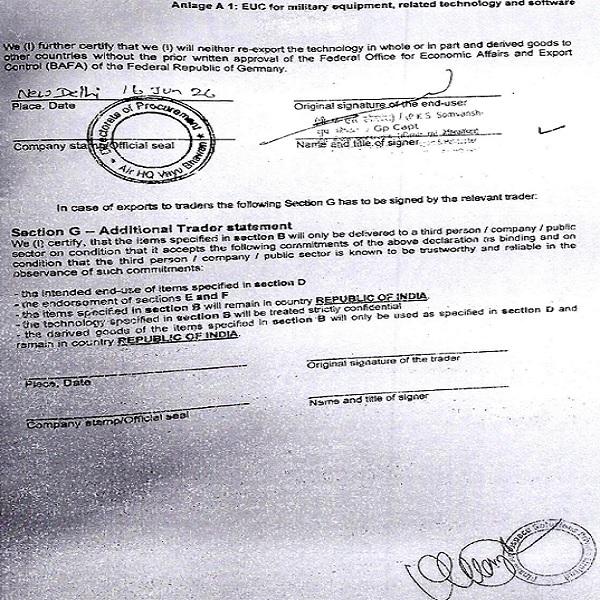
subject to the production of the certificate prescribed under Condition No. 17 of the said Notification before–the proper officer at the time of importation.
4.3 it is submitted that. the Applicant import the key components and assemble MIMS Block 2 to supply it exclusively for the purpose of and use by defence forces. The Applicant has the necessary documents including contracts evidencing the above fact ‘which will be presented to the prescribed officer.
Accordingly, the subject goods arc eligible for the benefit of the exemption from customs duty prescribed under SI. No. 60 of Table II to Notification No. 45/2025-Customs dated 24.10.2025, subject to fulfilment of the conditions stipulated therein. In particular, the applicant shall be required to produce, at the time of importation, the certificate prescribed under Condition No. 17 of the said Notification before the proper officer. Port of Import and comments from the jurisdictional Commissionerate
5.1 The applicant, in Form CAAR-1, has indicated that the subject goods arc proposed to be import6d within the jurisdiction of the Office oldie Commissioner of Customs, Bengaluru, C.R. Building, 13engaluru — 560 001. Accordingly, the application, along with the covering letter and –relevant documents, was forwarded to the jurisdictional Commissionerate on 19.02.2026, requesting their comments and views on the issues raised in the said application..
5.2 In view of the foregoing facts and circumstances of the matter, the jurisdictional Commissionerate, i.e. Bengaluru City Customs Commissionerate, vide its letter dated 05.03.2026, has examined the matter and furnished its detailed comments/views thereon. The comments furnished by. the jurisdictional .Commissionerate, which are relevant for consideration of the issue under examination are. reproduced below for ready reference:
(1) Eligibility of the applicant under Section 28E(c): The applicant fulfils the eligibility criteria prescribed under Section 28E(c)(i) of the Customs Act, 1962, which requires the applicant to be an importer or exporter holding .a valid Importer Exporter Code (IEC). In the present case, the applicant is in possession of a valid Importer Exporter Code (1EC) bearing No. 0707004497. Accordingly. the applicant satisfies the statutory requirement prescribed under the aforesaid provision and is eligible to seek an Advance Ruling under the Customs Act. 1962.
(ii) Nature of proposed activity and eligibility for exemption from duty in terms of Sl. No.60 of Table 11 of the Notification No. 45/2025-Customs dated 24.10.2025: The applicant seeks an Advance Ruling as to whether the subject goods are eligible for the benefit of exemption from customs duty under SI. No. 60 of Table II to Notification No. 45/2025-Customs dated 24.10.2025. In this regard, SI. No. 60 of the said Notification specifically covers the import of parts, sub-assemblies, spares, accessories, tools, testing equipment and literature intended for specified defence-related goods, including artillery weapons, rifles, aircraft, and other goods enumerated therein. To avail of this benefit, the import must strictly satisfy Conditions No.17 of Table II of the said notification, which stipulates:
| Condition No. | Condition |
|---|---|
| 17. | If imported into India by the Ministry of Defence, or the Defence forces, or the Defence Public Sector Units, or other Public Sector Units, or any other entity, for the Defence forces, subject to the following conditions, namely:-
(i) an officer not below the rank of Joint Secretary to the Government of India in the Ministry of Defence certifies. (a) the quantity, description and technical specifications of the imported goods; and (b) that the said goods are intended for the purpose of and use by the defence forces only and recommends the grant of exemption to the imported goods: (ii) the importer shall, at the time of import, furnish the said certificate to the Deputy Commissioner of Customs or the Assistant Commissioned .of Customs, as the case may be. |
In view of the above, the Authority may examine and verify whether the technical specifications and characteristics of the subject goods proposed to be imported conform to the categories of goods specified under Si. No. 60 of Table I I to the said Notification. The Authority may also verify whether the applicant fulfils the documentary requirements prescribed under Condition No.17 of the said Notification, including production of the requisite certificate before the proper officer at the time of importation, as stipulated therein.
Verification under Proviso 1 to Section 281(2) of the Customs Act: As per the records available with the jurisdictional Comm issionerate. there are no pending proceedings or cases in respect of the-question raised in the present application involving the applicant before any Officer of Customs, the Appellate Tribunal. or any Court of Law. It has further been stated that the issue raised in the present application has neither been previously decided nor is presently pending adjudication before the Appellate Tribunal or any Court of Law in the applicant’s own case.
6. DETAILS OF PERSONAL HEARING:
6.1 A personal hearing was held on 06.08.2026, wherein the authorised representative appeared on behalf of the applicant and reiterated the submissions made in the application and the additional written submissions. During the personal hearing, the Authority sought documents evidencing the, applicant’s eligibility to manufacture defence-related equipment in India. The applicant subsequently furnished the said documents, which have been duly taken on record and are discussed herein above.
6.2 Nobody appeared on behalf of the Department for personal hearing.
7. DISCUSSION AND FINDINGS:
7.1 I have carefully considered the application filed by the Applicant, the applicant’s grounds made in the application, the written-and oral submissions advanced during the personal hearing, the additional submissions and statement of the facts viz. technical literature, product images placed on record. the End-Use Certificate (UV) issued by India Air Force, HQ, New Delhi, the capability documents and the comments of the jurisdictional Commissionerate. I have also examined the relevant provisions of the Customs Act, 1962, the First Schedule to the Customs Tariff Act, 1975, the General Rules for the Interpretations of the Import Tari (GR1), the 1ISN Explanatory Notes and the judicial precedents relied upon by the Applicant.
7.2 In order to maintain an application before the Authority for Advance Rulings,-the Applicant is required to satisfy the conditions and fulfil the requirements prescribed under the Customs Act, 1962 (hereinafter referred to as the “Customs Act”).
7.3 Clause (b) of Section 28E ofthe Customs Act, 1962 defines the term -.advance rulin2. as follows:
“(b,) “advance ruling” means a written decision on any of the questions referred to in section 2811 raised by the applicant in his application in respect of any goods prior to its importation or exportation; “
… [Emphasis Supplied]
Further. the provisions governing advance rulings are contained in Chapter V13 of the Customs Act. In this regard. clause (c) of Section 28E of the Customs Act defines the term “Applicant– as follows:
“…In this chapter unless the context otherwise requires,
(c) “applicant” means any person, –
(i) holding a-valid Importer-exporter Code Number granted under section 7 of the Foreign Trade (Development and Regulation) Act, 1992 (22 of 1992); or
(ii) exporting any goods to India; or
(iii)With a justifiable cause to the satisfaction of the Authority, who makes an application for advance ruling under section 2811.
… [Emphasis Supplied]
In view of the foregoing. it is observed that the Applicant has been duly granted a valid Importer-Exporter Code (IEC) having 0707004497 under Section 7 of the Foreign Trade (Development and Regulation) Act, 1992. Accordingly. the Applicant is duly recognised as an importer under the applicable provisions of the foreign trade and customs laws and therefore, fulfils the requisite eligibility criteria to seek an Advance Ruling in respect of the proposed import transactions and the goods intended to be imported into India.
7.4 Sub-section (1) of Section 25 of the Customs Act, 1962, is reproduced ..below:
“(2) If the Central Government is satisfied that it is necessary in the public interest so to do, it may, by notification in the Official Gazette, exempt generally either absolutely or subject to such conditions (to be fulfilled before or after clearance) as may be specified in the notification goods of any specified description from the whole or any part of duty of customs leviable thereon.”
The applicant seeks an Advance Ruling as to whether the goods proposed to be imported are eligible for the benefit of exemption from duty under Notification No.45/2025-Customs dated 24.10.2025. In this regard, sub-section (1) of Section 25 of the Customs Act, 1962 empowers the Central Government, in the public interest, to exempt, by notification, goods of the specified description from the whole or any part of the customs duty leviable thereon, subject to such conditions as may he specified therein.
7.5 At the outset, it is observed that the applicant seeks an advance ruling as to whether the goods proposed to be imported, namely, (i) M11DS F bens (ii) Front End (1\4211;) and (iii) MUMS F Still Coupled are eligible for the benefit of exemption from duty tinder Notification No.45/2025-Customs dated 24.10.2025, subject to fulfilment of Conditions prescribed therein.
I find that the questions raised by the applicant for advance ruling are covered under clause (b) of sub-section 2 of Section 2811 of the Customs Act, 1962, as they relate to the applicability of a duty exemption notification, as reproduced below:
“(b) Applicability of a notification issued under sub-section (1) of section 25, having a earing on the rate of duty”
..: ‘Emphasis Supplied’
In terms of Section 28I1(2)(b) of the Customs Act, 1962, the applicant is entitled to seek an Advance Ruling in respect of the applicability of any notification issued under sub-section (1) of Section 25 of the said Act. Accordingly, the question raised by the applicant regarding the applicability of Notification No. 45/2025-Customs dated 24.10.2025 for exemption of duty to the goods proposed to be imported falls within the scope of matters in respect of which an Advance Ruling may be sought under the aforesaid provision.
7.6 For the purpose of determining the scope and applicability of the aforesaid provision, the relevant provisions of Section 28-1 of the Customs Act, 1962 are reproduced below:
“28-I. Procedure on receipt of application. –
(1) On receipt of an application, the Authority shall cause d copy thereof to he for wanted to the /Principal commissioner of Customs or Commissioner of’ Customs and, if call -upon him 10 furnish the relevant records:
PROVIDED –that Wither any records have been called Pr by the Authority in any case, such– records• shall; as soon as possible, be returned to the Principal Commissioner of Customs or Commissioner of CUSTOMV.
(2) The Authority’ may, after examining the application and the records called fir, by order, either allow or reject the application: PROVIDED that the Authority shall not allow the application where the question raised in the application is, —
(a) already pending in- the applicant S case before any officer of customs, the Appellate Tribunal, or any Court;
(b) the same as in a matter already decided by the Appellate Tribunal or any Court:
PROVIDED FURTHER that no application shall be rejected under this subsection unless an opportunity has been given to the applicant of being heard.
PROVIDED ALSO that where the application is rejected, reasons for such rejection shall be given in the onled”
On examination of the records and submissions available on record, it is observed that the present application is not hit by any of the restrictions or exclusions prescribed under Section 28-1 of the Customs Act, 1962. In particular, the question raised in the present application is neither pending in the applicant’s case before any officer of Customs, the Appellate Tribunal or any Court, nor is it the same question as has already been decided by the Appellate Tribunal or any Court in the applicant’s case. Accordingly, the present application is not barred by the provisions of Section 28-1 of the Customs Act, 1962 and is, therefore, liable to be admitted for consideration on merits.
7.7 It is also observed that the subject goods are yet to be imported and that the prescribed fee in respect of the application has been duly paid. Accordingly, the application satisfies the requisite procedural requirements and is maintainable under the provisions of the Customs Act, 1962. The application is, therefore, taken up consideration and decision on merits.
7.8 ‘Mc applicant furnishes the following product-wise description Of the subject goods, characterising the essential function of each:
(i) MUDS F SUOF Lens
(ii) Front End (M2FE)
(iii) MILDS F SUIT Coupled
(A) MILDS F SUOF Lens: A high-precision passive imaging lens specifically optimized for the UV solar-blind spectral band and designed to provide a wide-angle, true-imaging field of view covering 3600 around the platform. It enables the detection and imaging of the ultraviolet signature generated by the exhaust plume of an incoming missile, facilitates accurate determination of the missile’s direction of arrival. and provides the necessary optical input for timely detection, tracking and initiation of appropriate automatic countermeasures. The lens forms an integral part of the sensor system and enables continuous situational awareness against incoming missile threats.
(B) Front End (M2FE): The Front End (M2FE) is an integrated optical and detector assembly forming the core ()leach individual sensor head. It receives and processes ultraviolet (UV) signals in real time and performs high-speed data processing to detect, identify and classify the UV signatures associated with incoming missile threats. The system enables rapid detection w–tel assessment of such threats and, upon identification, provides the necessary inputs for the timely initiation of automatic countermeasures, including flares and Directed Infrared Countermeasures (I)IRCM), within milliseconds. It therefore constitutes a critical component of the sensor head for providing rapid threat detection and response.
(C) MILDS F SUII Coupled: The MILDS F SUII Coupled serves as the primary digital interface between the individual Front End (M2FE) sensor modules and the aircraft’s Mission Management System/Countermeasure Signal Processor. The “Coupled” configuration enables synchronisation and integration of data streams from multiple sensor heads, typically four to six; to generate a unified and continuous 3600 spherical protection picture. This .facilitates seamless and real-time transfer of threat information without significant data latency. thereby enabling timely detection, assessment and response to incoming threats.
7.8.1 After assembly, these three keys are used for the assembly Of the MDS Block 2 Missile Warning System, a CJIV-based Missile warning system designed for installation on as vide range of helicopters and aircraft. The system is a passive, true-imaging sensor optimized to detect the radiation signature of the exhaust plume of an approaching hostile missile in the UV solar-blind spectral band. It –designed to detect incoming Missile threats and indicate their direction of arrival, thereby providing maximum warning time to the host platform.
7.8.2 Passive, Infrared-Red Surface to Air’ Missiles (IR SAMs) pose an increasing threat to tactical aircraft and their crews. It is-further submitted that a significant number of aircraft lost in current and recent conflicts have been brought’ down by ground-based infrared-guided Infrared-Red Surface to Air Missiles (IR SAMs) (IR SAMs). ‘MIMS Block 2 Missile Warning System’ has been developed to address this threat by proVidi4 rapid and reliable detection. and declaration of incoming missile threats, while virtually chin Mating ‘Take alarms. The system operates in conjunction with crew-alert .mechanisms and the automatic release of countermeasures to &Coy the incoming missile thereby facilitating mission’ completion and the safe return of the crew ‘and aircraft.
7.8.3 The key components, namely (i) MILDS SUM’ Lens, (ii) Front End (M2FE), and (iii) MILDS F SUIT Coupled, are intended to be assembled into the complete system and supplied as the finished product, i.e., the ‘MILDS Block 2 Missile Warning System. The said system is designed for installation on a wide range of rotary-wing and fixed-wing platforms, including military helicopters and aircraft for defence purpose.
7.9 On merits, the applicant relies on SI. No. 60 of Table II of Notification No. 45/2025- Customs dated 24.10.2025 (G.S.R. 781(1), with effect from 01.11.2025), issued under Section 25(1) attic Act and Section 3(12) of the Customs Tariff Act, 1975, which reads:
| Sl. No. | Chapter or Heading or Sub-heading or tariff item | Description of goods | Standard rate | Integrated Goods and Services Tax | Condition No. |
|---|---|---|---|---|---|
| 60. | Any Chapter | Parts, sub-assemblies, spares, accessories, tools, testing equipment, literature for goods like artillery weapons, rifles, aircrafts, etc. except for 12.7mm SRCG, 155mm/45 Cal. Dhanush, L-70 Gun, 84mm RL Mk-III, AK-630 Naval Guns, Light Machine Gun, MAG Gun: Provided that nothing contained in this S. No. shall have effect on or after the 1st July, 2029. | Nil | Nil | 17 |
7.9.1 Further, the eligibility of this exempted duty is subject to the fulfillment of the conditions given in the column (6). In the instant case, the necessary condition is the condition no. 17, which is reproduced below;
| Condition No. | Condition |
|---|---|
| 17. | If imported into India by the Ministry of Defence, or the Defence forces, or the Defence Public Sector Units, or other Public Sector Units, or any other entity, for the Defence forces, subject to the following conditions, namely:-
(i) an officer not below the rank of Joint Secretary to the Government of India in the Ministry of Defence certifies, (a) the quantity, description and technical specifications of the imported goods; and (b) that the said goods are intended for the purpose of and use by the defence forces only and recommends the grant of exemption to the imported goods; the importer shall, at the time of import, furnish the said certificate to the Deputy Commissioner of Customs or the Assistant Commissioner of Customs, as the case may be. |
7.9.2 It is pertinent to mention that the import goods confirm to the description specified in Column (3) of the relevant entry of the said Notification, namely, “Parts, sub-assemblies, spares, accessories, tools, testing equipment, literature for goods like artillery weapons, rifles, aircrafts, etc., except for 12.7mm SRCG, 155mm/45 Cal. Dhanush, L-70 Gun, 84mm RI, Mk-III, AK-630 Naval Guns, Light Machine Gun, MAG Gun”, such goods are eligible for exemption from the customs duty and integrated tax specified in Columns (4) and (5), respectively, subject to fulfilment of the conditions prescribed under Condition No. 17 of Table II to the said Notification.
Also, the exemption is contingent upon the imported goods falling within the scope of the specified description and satisfying the prescribed condition relating to their intended use and the requisite certification under Condition No. 17.
7.9.3 At the outset, it is necessary to examine the manner in which the relevant entry is structured, as such construction substantially determines the scope and applicability of’ the exemption. Column (2) of the relevant entry specifies “Any Chapter”. The entry, therefore, is not a tariff classification specific entry confined to any particular heading or Chapter of the First Schedule to the Customs Tariff Act, 1975. Rather, it is functional and end-use based entry which extends duty exemption to a specified class of goods, namely, “parts, sub-assemblies, spares, accessories, tools, testing equipment, literature when such goods are intended for use with the specified end-products, including “artillery Weapons, rifles, aircrafts. etc.”, subject to. the exclusions expressly stipulated therein, namely, 12.7mm SRCG, 155mm/45 Cal. Dhanush, L-70 Gun, 84mm RL Mk-III, AK-630 Naval Guns, Light Machine Gun and MAG Gun.
7.9.4 Two important consequences fallow from the above construction. First, the eligibility for exemption is not dependent upon the tariff classification of the individual imported component under any particular Chapter or heading of the First Schedule to the Customs Tariff Act, 1975. Where the imported good satisfy the functional description specified in the entry and arc intended for use in or in relation to a qualifying end product, their classification under any particular Chapter, by itself would not determine their eligibility for the duty exemption.
Second, the expression “Any Chapter” does not, by itself, confer an unrestricted exemption upon every component merely because it is described as a part, sub-assembly, spare, accessory, tool or testing ‘equipment. The ‘imported goods must have a substantive and demonstrable nexus with one of the qualifying end-use products specified in the entry. This requirement is further reinforced by Condition No. 17 of Table II to the said Notification, which prescribes the requisite certification in respect of the goods and their intended defence end-Use purpose. Thus, eligibility must be established not merely by the description ‘or nomenclature of the imported goods, but by demonstrating that they are intended for use with a qualifying defence end-end product and that the prescribed documentary requirements under Condition. No. 17 have been duly fulfilled.
7.9.5 The components have been declared under headings as disparate as 9031 (measuring/checking instruments), 7610 (Aluminium structures) and 8543 (electrical machines having individual functions). Because the claim under SI. No. 60 spans “Any Chapter” and turns on functorial and end-use product rather than heading the appropriate classification of each item is a matter for assessment at the time of import and does not, by itself, determine entitlement to the exemption.
7.10 The applicant relied on Siddeshwari Cotton Hills (P) Ltd. v. Union of India & Anr., 1989:AIR 1019; 1989 (2) SCC 4_S8. to contend that a missile-warning system falls within the scope of the entry by virtue of the residuary expression “etc.” Two points arc material. First, the expression goods like … aircrafts, etc.” identifies the end-use products for which the parts,. subassemblies and accessories arc imported; it does not describe the imported goods themselves. Second, in- the present case, the relevant end-use product is the aircraft, and not the missile-warning system. Since “aircrafts” is expressly specified in the entry, there is no basis for invoking the residuary expression “etc.” to bring the missile-warning system within its scope.
7.11 The components of the three items, namely, (i) MILDS F SUOF Lens, (ii) MILDS F SUII Coupled, and (iii) Front End (M2FE), arc assembled in India to form the complete “MILDS Block 2 Missile Warning System”, which is thereafter installed directly on the. MI-17 VS and M1,H. helicopters operated by the Indian Air Force under Ministry of Defence. To establish the nexus between the imported components and the final aircraft. the applicant placed .on record an End-Use Certificate (EUC) issued by the Indian Air Force Headquarters. New Delhi,- dated 16.06.2026, fbr presentation to .the export-control authorities of the Federal Republic . of Germany. The certificate expressly certifies that the. imported key components will be used in the manufacture of MELDS AN/AAR-60 Block 2 Missile Warning Sensors, which form part of the Electronic Warfare (EW) suite installed on the M1-17 V5 and MU-I helicopters of the Indian Air Force, Ministry of Defence.
7.12. The End-Use Certificate (EUC) dated 16.06.2026, issued by Air HQ, New Delhi. establishes that the final products for which the imported components are intended are the MI-17 V5 and MLI I helicopters operated by the Indian Air Force. Heading 8802 of the First Schedule is expressly titled “Other aircraft (for example, helicopters, aero planes)…”, thereby placing helicopters within the description of “aircraft”. Since the relevant end-use products are expressly covered by the entry, it is unnecessary to construe the residuary expression “etc.” or to invoke the principle of ejusdem generic, and 1 therefore refrain from doing so. The only question that genuinely arises is whether the three imported components constitute “parts, sub-assemblies … tor’ accessories … for” such aircraft.
7.13 The entry employs the expressions -parts”, “sub-assemblies” and “accessories” in the disjunctive. The use of these expressions in the alternative makes it clear that thc -imported goods – need not simultaneously satisfy all three descriptions. It is sufficient if the Subject goods properly fall within any one of these categories and arc. in the relevant sense, “for” the aircraft covered by the entry. Accordingly, the question is not whether the goods can be characterised as each of a part, sub-assembly and accessory, but whether they answer to at least one of these descriptions. On a consideration of the material placed on record, and for the reasons set out below, I am satisfied that the subject goods meet this requirement.
7.13.1 On the applicant’s own technical description, the three components are prefabricated units an imaging-optics lens, a sensor front-end, and an interlace/coupling unit – manufactured separately but engineered to be combined into the LDS Block 2 Missile Warning Systems’. That accords with the ordinary engineering meaning of a “subassembly” as a unit “which, though manufactured separately, was designed for incorporation with other parts in the final assembly of a finished product.” The finished product into which they are incorporated — the `MI LDS Block 2 Missile Warning Systems’ — is in turn fitted to the aircraft as an element of its electronic-warfare suite. The components are therefore sub-assemblies destined, through the WILDS Block ‘2 Missile Warning Systems’, for the aircraft and answer the description of “sub-assemblies … for goods like … aircrafts”.
7.13.2 Even if the sub-assembly characterisation were doubted, the subject goods fit the description of an “accessory”. In Annapurna Carbon Industries Co. v. State of Andhra Pradesh,’ 1976 (2) SCC 273, the Supreme Court adopted the meaning-of an accessory as something that “adds to the … convenience, or effectiveness of something else” and decided the category by reference to the main or predominant use of the goods. Here the subject goods have no use whatever except in the ‘WAS Blocks 2 Missile Warning System’, and the MUDS Block 2 has no use except when fitted to a military aircraft, where it materially adds to the aircraft’s effectiveness by detecting incoming missile threats and Cueing countermeasures. The predominant-rise test is thus* satisfied and the goods qualify as accessories for the aircraft.
7.14 The entry, While covering parts, sub.-assemblies and accessories for the specified aircraft, expressly excludes site goods when they are intended for seven `Particular items, namely, the 12.7mm SRCG. /.45 Cal: Dhanesh, L-70 .Gun, 84mm RL Mk-111, AK-630 Naval Guns;
Light Machine Gun and MAO Gun. The exclusion is therefore confined to parts, Sub-asseffiblies or accessories ‘for those, specifically enumerated’ items. The . subject goods; however, are components of an airborne UV missile-warning Sensor system intended for installation on MI: 17 V5 and ML1-1 helicopters and have no connection with any of the seven excluded items. Thuy cannot, therefore, be ‘regime as parts. stib-assemblies Or-accessories of zany of’-the excluded seven items. The exclusions ‘consequently have. no application to ‘the- ‘subject goods and do not operate against the applicant.
7.15 Condition 17 extends the benefit to imports made by.”… any other. .entity the Defence frees”. The deliberate breadth of this language leaves no doubt that a private entity,. such as the applicant,* is not excluded ‘from availing the exemption in respect of such imports. The essential requirement is that the goods are imported “for the Defence Forces only” and that the certification and other requirements stipulated in Condition No. 17 of Table II to the said duty exemption notification arc duly satisfied. The appli6ant’s stated exclusive-supply arrangement, together with its credentials as a defence vendor—including its registration with Directorate General of Aeronautical Quality Assurance (DGAQA), vendor registrations with the India Air Force (1AF) Base Repair Depot and Hindustan Aeronautics Limited (HAL), and membership of Society of Indian Defence Manufacturers (SIDM) is consistent with, and lends support to, the stated end- use for the Defence forces only.
7.16 The End-Use Certificate (EUC) dated 16.06.2026 submitted by the applicant, is reproduced-below:
–
–
Upon perusal of. the aforesaid End-Use Certificate (EUC) in respect of the goods proposed to be imported, it is observed that the key components of M1LDS AN/AAR-60 13lock 2, namely, (i)MILDS F SLAW Lens, (ii) MILDS.12 SUIT Coupled, and (iii) Front End (M2FE), are intended to be used for the manufacture of “MILDS AN/AAR-60 Block 2 Sensors as a part of the EW Suite for MI-17 VS and MLH Helicopters operated by the Indian Air Force, Ministry of Defence. Government of India..” The. End-Use Certificate (EUC) is conclusively establishes the defence nexus and intended end-use of the goods. The End-Use Certificate establishes that the imported goods are intended exclusively for use in MI-17 V5 and MH copters operated by the Defence Forces under the Ministry of Defence, Government or India.
The contents of the End-Use Certificate (EUC) clearly indicate that the imported components are not intended for general commercial or civilian application, but are specifically required for incorporation into the MILDS AN/AAR-60 Block 2 Sensors, which form part of the Electronic Warfare (EW) Suite fitted on MI-17 VS and MLH Helicopters operated by the Indian Air Force. The certificate, therefore, establishes a direct and specific nexus between the goods proposed to be imported and their intended defence application. It also identifies the ultimate end-use product into which the imported components are proposed to be incorporated, as well as the specific defence platform, namely, M1-17 V5 and M1,11 Helicopters, on which the resultant LW system is intended to be deployed.
The EUC further demonstrates that the intended recipient and user of thc resultant system is the Indian Air Force under the Ministry of Defence, Government of India. Thus, the nature of the goods, their proposed incorporation into the MINDS AN/AAR-60 Block 2 Sensors, the application of the said sensors as part of an EW Suite and their intended deployment on MI-17 V5 and M1,1-111elicopters operated by the Indian Air Force, taken together, establish the specific defence nexus and intended end-use of the imported goods.
Accordingly, the MC constitutes substantive documentary evidence regarding the intended purpose and end-use of the goods and supports the conclusion that the imported components are– specifically intended for a defence application and are connected with the requirements of the Defence Forces under the Ministry of Defence, Government of India.
However, the said End-Use Certificate (EUC) does not satisfy this requirement for exemption of Customs duty and overlooks the express requirement that the exemption from the applicable of Customs duty is available only “subject to” Condition NO: 17 of the said exemption notification, which requires a certificate issued by an officer not below the rank of Joint Secretary to the Government of India in the Ministry of Defence. The condition requires production, at the time of importation, of a certificate issued by an officer not below the rank of Joint Secretary in’ the Ministry Of Defence, certifying the quantity, description and technical specification’s of the good’s, their exclusive use for defence purposes, ‘and *recommending grant of the duty exemption, confirm that the goods are intended for the specified purpose. and for use exclusively by the Defence Forces and recommend the grant exemption in respect of the imported goods. The requisite certificate must have been required to be produced before the Deputy Commissioner of Customs or the Assistant Commissioner of Customs, as the case may be, at the time importation; for importation of the said goods and in’ order to avail the benefit of exemption. The EUC is, therefore, relevant and persuasive evidence of the defence nexus and the identity of the intended end-use product, but it cannot substitute the certificate mandated by Condition No. 17′. Accordingly, fulfilment of Condition No. 17 in. respect of any particular Consignment must’ be Verified by the Deputy Commissioner or Customs or the. Assistant Commissioner of Cisterns, as the case may be, upon. production of the requisite certificate at the time of AM potation. This Authority is concerned with’ the applicability of the notification-10 goods ‘of the description under consideration: the actual availment of the’ duty exemption in respect of any consignment remains subject to fulfilment of Condition No.17′ of the said notification, including production of prescribed certificate at the time of importation.
7.19 The entry contains a proviso stipulating that ‘it shall cease to have effect on or alter 01.07.2029. The benefit of’ the entry can. the be claimed only in respect of imports made while the entry remains in force and subject to any ‘amendment to the notification in the intervening period. The applicant should accordingly verify, at the time of each import, that the entry continues to be in force and remains applicable to the goods in question.
In view of the foregoing, it is clarified that the present ruling is confined solely to determining the eligibility of the subject goods for the benefit of duty exemption under Sl. No. 60 of Table II to Notification No. 45/2025-Customs dated 24.10.2025, subject to fulfilment of the applicable conditions and procedural requirements prescribed under Condition No. 17 of the Annexure to the said Table. The ruling is based on the facts, documents, End-Use Certificate (EUC) and submissions placed on record. It does not determine the tariff classification of the subject goods, which remains to be determined by the proper officer at the time of assessment in accordance with law.– The jurisdictional Customs authorities shall, however, be at liberty to undertake such examination, sampling and verification of the imported goods from Ministry of Defence as may be deemed necessary at the time of importation, including verification with reference to the relevant technical literature, catalogues, model numbers, End-Use Certificate (EOU) and Country of Origin (COA) Certificate to ascertain compliance with the applicable Acts, laws and regulations.
In view of the foregoing discussion, findings, and the legal provisions discussed hereinabove, I rule as under:
The goods proposed to be imported by the applicant, namely i) MILDS F SUOF Lens, ii) Front End (M2FE) and iii) MILDS F SUII Coupled units, being components/sub-assemblies destined for assembly into the MILDS Block 2 Missile Warning System and through it, for fitment as accessories to military aircraft (the MI-17 V5 and MLH Helicopters of the Indian Air Force) — are covered by the description of “component/sub-assemblies for aircrafts” and the said goods are accordingly eligible for exemption from duty in terms of Sl. No. 60 of Table II of Notification No. 45/2025-Customs dated 24.10.2025, subject to fulfilment of the applicable conditions and procedural requirements prescribed under Condition No. 17 and verification by the jurisdictional Customs authorities at the time of importation.
10.I rule accordingly.