Summary: PIB Fact Check has debunked a purported Gazette of India notification claiming that every Saturday has been declared a public holiday for Public Sector Banks, including the State Bank of India. PIB clarified that no such notification has been issued by the Ministry of Finance. The existing statutory position continues: under the Central Government’s notification dated 20 August 2015 issued under Section 25 of the Negotiable Instruments Act, 1881, the second and fourth Saturdays of every month are public holidays for banks in India. Other Saturdays ordinarily remain working Saturdays unless separately covered by another applicable holiday. The fake document, dated 30 September 2026, closely imitates the format of an official Gazette notification and falsely purports to exercise powers under Section 25 of the Negotiable Instruments Act. The clarification is particularly relevant amid continuing discussion over a five-day banking week. A proposal or demand for a five-day week does not itself alter the legally notified bank holiday schedule. Bank customers, businesses and professionals should verify purported Government notifications from official sources before relying on or forwarding them.
- PIB Fact Check: Viral Bank Holiday Gazette Is Fake
- What Does the Fake Notification Claim?
- What Is the Existing Rule for Saturday Bank Holidays?
- RBI Had Implemented the Second and Fourth Saturday Holiday Rule
- RBI Has Previously Debunked Similar Five-Day Banking Week Claims
- Five-Day Banking Week Proposal Is Different From an Effective Notification
- Why the Fake Gazette Can Be Misleading
- Practical Impact for Bank Customers and Businesses
- How to Check Whether a Government Notification Is Genuine
- Existing Second and Fourth Saturday Rule Continues
PIB Fact Check: Viral Bank Holiday Gazette Is Fake
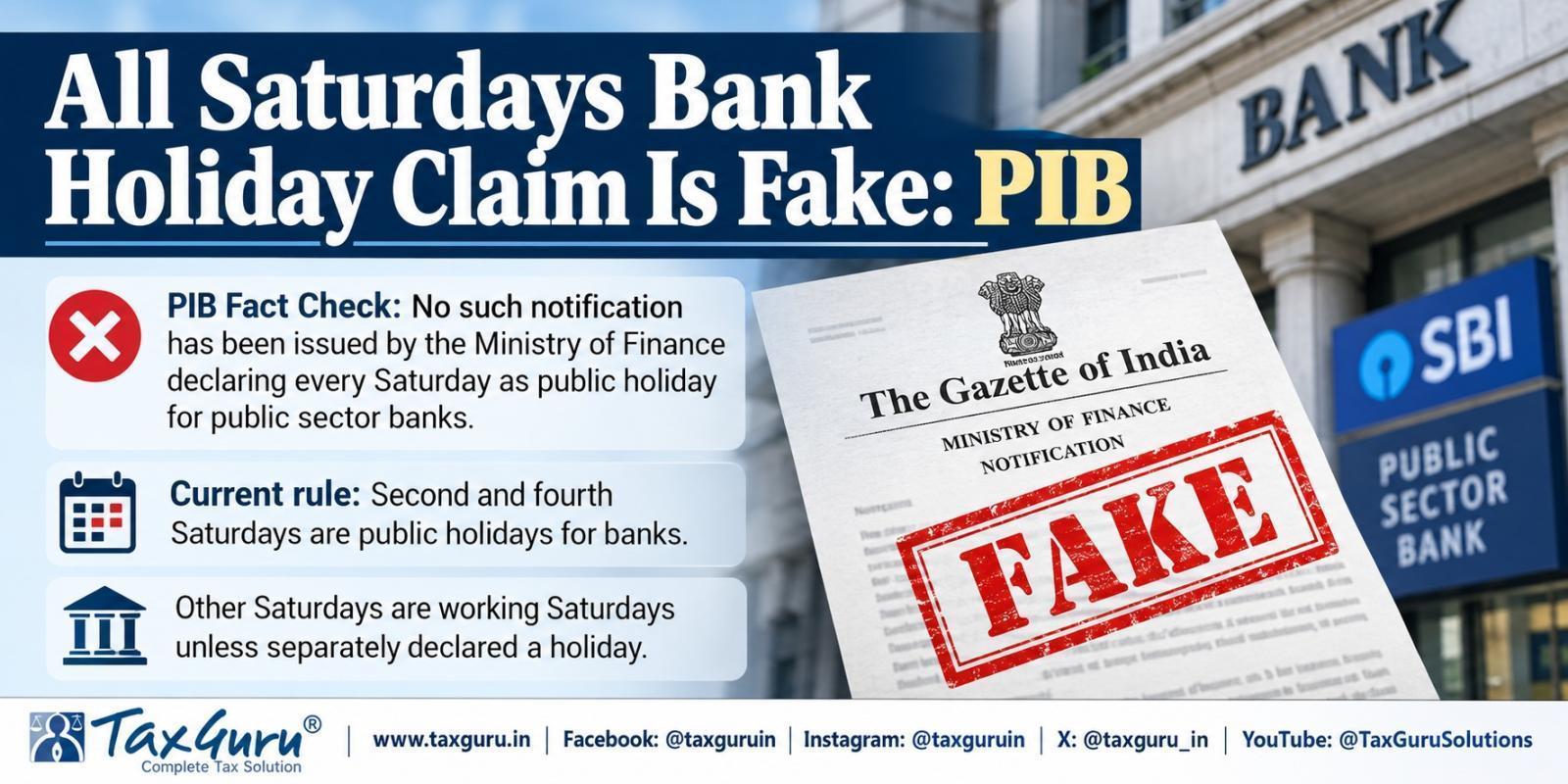
A purported Gazette of India notification claiming that every Saturday has been declared a public holiday for Public Sector Banks, including the State Bank of India (SBI), is fake.
PIB Fact Check has clarified that no such notification has been issued by the Ministry of Finance declaring every Saturday a public holiday for Public Sector Banks.
The clarification is important because the document circulating through social media and messaging platforms has been designed to resemble an official Gazette of India notification. It carries references to the Ministry of Finance and Department of Financial Services and purports to invoke the Negotiable Instruments Act, 1881.
However, the purported notification should not be treated as an authentic Government notification or legal authority.
What Does the Fake Notification Claim?
The document circulating online purports to be a Gazette of India notification dated 30 September 2026 issued by the Ministry of Finance, Department of Financial Services.
It claims that the Central Government, exercising powers under Section 25 of the Negotiable Instruments Act, 1881, has declared every Saturday a public holiday for all Public Sector Banks, including SBI, with immediate effect.
PIB Fact Check has categorically rejected this claim.
According to PIB Fact Check:
No such notification has been issued by the Ministry of Finance declaring every Saturday as public holiday for public sector banks.
Consequently, bank customers should not alter their banking plans on the basis of the viral document.
What Is the Existing Rule for Saturday Bank Holidays?
The existing statutory arrangement regarding Saturday bank holidays dates back to 2015.
The Central Government issued Notification S.O. 2285(E) dated 20 August 2015 declaring the second and fourth Saturdays as bank holidays.
The notification was issued by the Ministry of Finance, Department of Financial Services, in exercise of powers conferred by Section 25 of the Negotiable Instruments Act, 1881.
The notification provides that:
The Central Government hereby declares the second and the fourth Saturday of every month as public holiday for banks in India, whether or not such banks are included in the Second Schedule to the Reserve Bank of India Act, 1934, with effect from 1 September 2015.
Accordingly, the general position is:
| Saturday | General Banking Status |
|---|---|
| First Saturday | Working Saturday, subject to any separately applicable holiday |
| Second Saturday | Public holiday for banks |
| Third Saturday | Working Saturday, subject to any separately applicable holiday |
| Fourth Saturday | Public holiday for banks |
| Fifth Saturday | Working Saturday, subject to any separately applicable holiday |
RBI Had Implemented the Second and Fourth Saturday Holiday Rule
Following the Government’s 20 August 2015 notification, the Reserve Bank of India announced corresponding operational changes.
As explained in the RBI announcement on bank holidays on second and fourth Saturdays, all scheduled and non-scheduled banks were to observe public holidays on the second and fourth Saturdays with effect from 1 September 2015.
The RBI communication also expressly referred to Saturdays other than the second and fourth Saturdays as “working Saturdays”.
Therefore, the existing legal framework itself distinguishes between second/fourth Saturday holidays and other working Saturdays.
RBI Has Previously Debunked Similar Five-Day Banking Week Claims
Claims about all Saturdays becoming bank holidays are not entirely new.
In April 2019, reports had circulated suggesting that commercial banks would move to a five-day week pursuant to RBI instructions.
RBI expressly rejected those reports.
The RBI clarification on the alleged five-day week for commercial banks stated that reports claiming commercial banks would have a five-day week in terms of RBI instructions were not factually correct and that RBI had issued no such directions.
That earlier clarification illustrates an important distinction: discussions or demands concerning a five-day banking week cannot be treated as an operative change in bank holidays unless the necessary Government or regulatory action is actually taken.
Five-Day Banking Week Proposal Is Different From an Effective Notification
The viral claim must also be distinguished from discussions surrounding a five-day banking week.
There may be proposals, representations or negotiations concerning whether banks should operate only from Monday to Friday. However, such developments do not by themselves amend the existing bank holiday framework.
For every Saturday to become a public holiday under the statutory mechanism referred to in the viral document, the appropriate Government action would have to be validly taken and officially notified.
The purported Gazette dated 30 September 2026 circulating on social media is not such a valid notification, according to PIB Fact Check.
Why the Fake Gazette Can Be Misleading
The incident demonstrates the risks associated with relying upon screenshots or forwarded copies of purported Government notifications.
A fabricated document can appear credible because it may reproduce:
- the State Emblem;
- the Gazette of India heading;
- the name of a Government Ministry or Department;
- a purported statutory provision;
- a notification number;
- an official-looking date and signature; and
- the formatting generally associated with Government publications.
None of these visual features, by themselves, establish that a document is genuine.
The underlying notification should therefore be verified against authoritative Government or regulatory sources.
Practical Impact for Bank Customers and Businesses
Businesses, taxpayers, Chartered Accountants, finance teams and other bank customers should not assume that banks will remain closed on every Saturday merely because of the viral Gazette image.
This can be particularly important where a transaction involves:
- branch-based banking;
- Government receipts or payments;
- submission of physical banking documents;
- cheque-related activities;
- loan or banking documentation;
- statutory payments; or
- other transactions dependent upon branch working hours.
Special arrangements can also occasionally be prescribed for Government business. For example, RBI has in the past directed agency bank branches handling Government receipts and payments to remain open on otherwise notified holidays. TaxGuru has reported such directions, including the RBI direction concerning agency banks on 31 March 2026.
Accordingly, the banking status of a particular date should be checked from an authoritative source where a time-sensitive transaction is involved.
How to Check Whether a Government Notification Is Genuine
Before relying on a Government notification circulated through WhatsApp, social media or email, users should verify:
- whether the notification appears on the relevant Ministry or Department’s official website;
- whether the Gazette notification is traceable through the official Gazette publication system;
- whether the notification number, date and statutory authority correspond with official records;
- whether RBI or another relevant regulator has issued a consequential circular or clarification, where applicable; and
- whether PIB Fact Check has issued a clarification regarding a suspicious Central Government document.
The existence of a professional-looking PDF or screenshot should never substitute for verification from the original source.
Existing Second and Fourth Saturday Rule Continues
As matters presently stand, the viral claim that every Saturday has been declared a public holiday for Public Sector Banks is false.
PIB Fact Check has confirmed that the Ministry of Finance has issued no such notification.
The operative statutory arrangement continues to be based on the Central Government’s notification dated 20 August 2015, under which the second and fourth Saturdays of every month are public holidays for banks.
Other Saturdays ordinarily continue as working Saturdays unless the relevant date is independently covered by another notified holiday or special direction.
Therefore, the purported Gazette notification dated 30 September 2026 declaring all Saturdays as public holidays for Public Sector Banks should not be relied upon or circulated as an authentic Government notification.