In re Britannia Industries Ltd. (CCPA Delhi)
The Central Consumer Protection Authority (CCPA), Delhi, in In re Britannia Industries Ltd., imposed a penalty of ₹1 lakh on Britannia Industries Limited for misleading advertisements promoting its bread as “100% Whole Wheat Bread”, despite the finished product containing approximately 62% whole wheat flour. The Authority initiated suo motu proceedings under the Consumer Protection Act, 2019, after identifying discrepancies between the prominent advertising claims and the product’s declared composition. During the investigation, the Director General (Investigation) reported that the product contained 62.5% whole wheat flour. Britannia defended its advertisements by contending that the expression “100%” referred exclusively to the flour component, which consisted entirely of whole wheat flour without refined wheat flour (maida), rather than the overall composition of the bread. The company also relied upon the qualification “Made From 100% Whole Wheat Flour. On Flour Basis” appearing on the packaging and maintained that its product complied with the applicable food safety regulations. However, the CCPA observed that the prominent claim could lead ordinary consumers to believe that the entire product consisted of whole wheat, whereas the ingredient declaration disclosed otherwise.
The Authority examined the advertisements under Sections 2(28), 2(47) and 21 of the Consumer Protection Act, 2019, the Food Safety and Standards (Advertising and Claims) Regulations, 2018, and the Guidelines for Prevention of Misleading Advertisements and Endorsements for Misleading Advertisements, 2022. It held that the claims “100% Whole Wheat Bread” and “0% Maida”, when presented together, created a misleading impression regarding the product’s composition and nutritional characteristics. The CCPA rejected Britannia’s argument that a smaller-font disclaimer could adequately explain the prominent “100%” representation, observing that an ordinary consumer might not notice or understand the qualification printed in substantially smaller letters. The Authority also examined promotional statements suggesting that the bread paired well with a healthy diet and representations implying nutritional equivalence with traditional wheat roti. It emphasised that advertisements must be evaluated according to the overall impression conveyed to an average consumer rather than the manufacturer’s subjective interpretation. Although the investigation acknowledged that the product satisfied the prescribed whole-wheat compositional requirement when calculated on a flour basis, the CCPA concluded that such compliance did not justify the absolute claim “100% Whole Wheat Bread” in the manner presented to consumers.
Accordingly, the CCPA directed Britannia Industries Limited to immediately discontinue the misleading advertisements across print, electronic and social media, imposed a penalty of ₹1,00,000, and required the company to submit a compliance report within 15 days from the date of the order. Of the six advertising claims initially examined, three were dropped from further consideration, while the remaining three involving the expression “100%” were subjected to substantive scrutiny. The Authority concluded that the misleading representations amounted to unfair trade practices and violated consumers’ right to accurate information about the composition and characteristics of goods. The order reinforces that prominent advertising claims must be truthful, properly substantiated and consistent with the actual characteristics of the product, and that small-print disclaimers cannot automatically neutralise misleading representations made on product packaging or promotional materials.
FULL TEXT OF THE ORDER OF CENTRAL CONSUMER PROTECTION AUTHORITY
1. The Central Consumer Protection Authority (hereinafter referred to as CCPA) has been established under section 10 of the Consumer Protection Act 2019 to regulate matters relating to violation of rights of consumer, unfair trade practices, false and misleading advertisement which are prejudicial to the interest of public and consumers and to promote, protect and enforce the rights of consumer as a class.
2. The CCPA, in exercise of its statutory mandate under Section 18(1) of the Consumer Protection Act, 2019 (hereinafter referred to as Act), is entrusted with the function of preventing unfair trade practices and ensuring that no false or misleading advertisement is made in respect of any goods or services, and further to ensure that no advertisement of goods or services is issued in contravention of the provisions of the said Act or the rules and regulations framed thereunder.
3. In furtherance of the aforesaid mandate, CCPA has taken suo-moto cognizance against Britannia Industries Ltd. (hereinafter referred to as the “Opposite Party”) which had published advertisements (hereinafter referred to as the impugned advertisement) with the claim “100% Whole Bread”. However, through the product packaging, it was observed that the wheat content of the product was declared 62%.
4. The CCPA took cognizance of the matter in exercise of its statutory powers and initiated a preliminary inquiry which indicated that the Opposite Party had made various claims in respect of its products marketed under the title “100% Whole Wheat Bread”. The findings of the Preliminary Inquiry Report are:
i. “100% Whole Wheat Bread”
ii. “Bahar se New Andhar se Improved”
iii. “Made with Goodness of Wheat”
iv. “Britannia’s Atta based breads have always been your grocery list favourite for decades”. “Made with ingredients like wheat flour (Atta), multi-seeds, rolled oats, etc., enriched with B-vitamins and baked to perfection, these delicious bread slices are the ideal choice for your yummy breakfast”.
v. “Britannia 100% Whole Wheat Bread pairs perfectly well with a healthy diet”.
vi. “Milled from 100% whole wheat grains, this Atta based bread is the perfect blend of wheat flour (Atta) and wheat bran. No added Maida and low in saturated fat, this Atta bread is a good source of fiber. “Britannia 100% Whole Wheat Bread pairs perfectly well with a healthy diet”.
4.1. Additionally, the Opposite Party has advertised its product as “Britannia 100% Whole Wheat Bread,” through its official website, various social media platforms, and on the packaging of its products, as given below:
| Name of Platform | Title of the Page and Link |
|---|---|
| Britannia Industries Ltd. Official Website | https://www.britannia.co.in/product/wheat-flour- breads |
| YouTube Channel – (Britannia Industries) | Video 1- Britannia Whole Wheat Bread https://youtu.be/Nq0- AcVxccO?si=Hh3Y1sFrnJK8M3qN Video 2- Britannia Bread TVC 1 https://youtu.be/11mM2- KLntc?si=qGU3hei4G1bqmJd7 |
| Britannia Breads – ttps://www.facebook.com/people/Britannia-
Breads/100057127193644/ |
|
| Britanniasnacksinc — https://www.instaqram.com/reel/DDHcNA3BMQC /?utm source=iq web copy link&iqsh=MzRIOD BiNWFIZA |
4.2. The objective of the Consumer Protection Act, 2019, is to provide for protection of the interests of consumers.
Accordingly Section 28 of the Consumer Protection Act, 2019 stipulates that “misleading advertisement” in relation to any product or service, means an advertisement, which —
i. falsely describes such product or service; or
ii. gives a false guarantee to, or is likely to mislead the consumers as to the nature, substance, quantity or quality of such product or service; or
iii. conveys an express or implied representation which, if made by the manufacturer or seller or service provider thereof, would constitute an unfair trade practice…….
Section 2(47) defines “unfair trade practice” means a trade practice which, for the purpose of promoting the sale, use or supply of any goods or for the provision of any service, adopts any unfair method or unfair or deceptive practice including any of the following practices, namely:
(i) making any statement, whether orally or in writing or by visible representation including by means of electronic record, which-
(a) falsely represents that the goods are of a particular standard, quality, quantity, grade, composition, style or model;
(d) represents that the goods or services have sponsorship, approval, performance, characteristics, accessories, uses or benefits which such goods or services do not have;
(f) makes a false or misleading representation concerning the need for, or the usefulness of, any goods or services.
4.3. The Regulation 2.6 “Labelling of various types of bread” under the Food Safety and Standards (Labelling and Display) Second Amendment Regulations, 2022 expressly stipulates that:
The nomenclature of various breads mentioned in column (2) shall comply with requirements mentioned in columns (3) and (4) of the table below: The relevant clause is highlighted below:
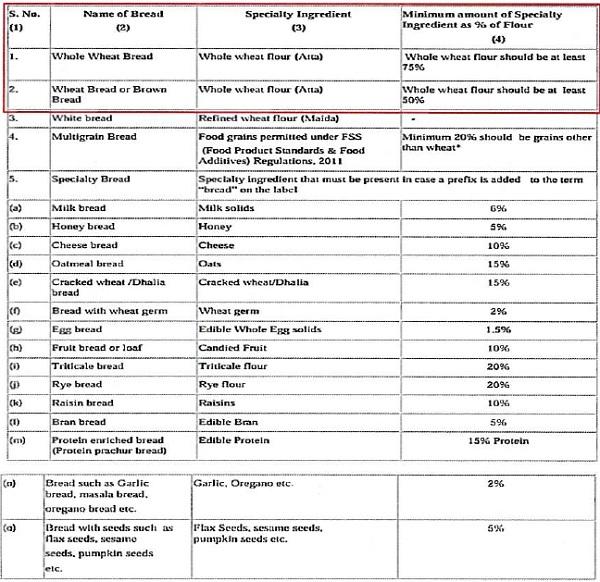
4.4. From the above Preliminary Inquiry Report it was observed that the discrepancy between the claims made in the advertisement i.e. “100% Whole Bread” and the product composition declared only 62% wheat content on the packaging. Whereas, as per the aforesaid Regulation the wheat content to use the nomenclature “Whole Wheat” should not be below 75%. Thus, the impugned advertisement appeared to be misleading consumers and influencing their purchasing decisions to believe that the product comprised 100% Wheat-based Bread, whereas the disclosed composition indicated otherwise.
5. Accordingly, Notice dated 13.01.2025 was issued to the Opposite Party to submit response along with documents on the above issues within 15 days besides as to why an investigation against them may not be initiated and an order under Section 21 of the Consumer Protection Act 2019 may not be passed.
6. In response to the above Notice, the Opposite Party vide letter dated 28.01.2025 submitted that:
6.1. All labelling and advertising of our products are done with the utmost sincerity, abiding to all the applicable requirements as per the Food Safety and Standards (Labelling & Display) Regulation, 2020 & Food Safety and Standards (Advertising & Claims) Regulation, 2018.
6.2. The claim “Bahar se New Andhar se Improved” had been used in an advertisement around 8 years back through its official YouTube channel. In this regard, the contended that the erstwhile advertisement titled “Britannia Bread TVC 1”, available at https://youtu.be/11mM2KLntc?si=oGU3hei4G1bornJd7 had been removed and which is no longer relevant.
6.3. The “Britannia 100% Whole Wheat Bread” contains Wheat Flour (Atta) (62%), Water, Yeast, Wheat Bran and other permitted ingredients & additives in descending order as per the Clause 5 (2) of FSS (Labelling & Display) Regulation, 2020. The ‘Goodness of Wheat’ is claimed because wheat flour is the major ingredient. The product is having flour of wheat origin only and no other flour is being used. Hence, the product in question is in compliance with the clause 4 (1) of Food Safety & Standards (Advertising & Claims) Regulation, 2018.
6.4. The claim, “Britannia’s Atta based breads have always been your grocery list favourite for decades. Made with ingredients like wheat flour (atta), multi-seeds, rolled oats, etc., enriched with B-vitamins and baked to perfection, these delicious bread slices are ideal choice for your yummy breakfast,” was published on the official website of Opposite Party merely as an introductory statement of the range of Britannia’s Atta-based breads and was not intended to refer exclusively to the product marketed as “Britannia 100% Whole Wheat Bread”. It was further contended that the said statement merely presented the products in the aforesaid range as a suitable breakfast option and neither misled consumers nor encouraged excessive consumption of the product. On the basis of the foregoing submissions, the Opposite Party emphasized that its product, “Britannia 100% Whole Wheat Bread”, did not contravene the provisions of Regulation 4(1), 4(2) and 4(3) of the Food Safety and Standards (Advertising and Claims) Regulations, 2018.
6.5. The claim, “Britannia 100% Whole Wheat Bread pairs perfectly well with a healthy diet,” suggest that the product can be paired well with a healthy diet. It was contended that the said statement neither misleads consumers nor expressly or impliedly encourages or suggests excessive consumption of the product. On the foregoing basis, the Opposite Party asserted that the claim in question does not contravene the provisions of Regulations 4(1), 4(2), 4(3), 4(10), 4(11) and 4(13) of the Food Safety and Standards (Advertising and Claims) Regulations, 2018.
6.6. The claim “100% Whole Wheat Bread” highlights the fact that the product is made exclusively from whole wheat flour (atta), without the use of any other variety of flour, including maida. It was further contended that the product contains saturated fat at 0.6 g per 100 g, as declared in the nutritional information table on the product label, which, according to the Opposite Party, contributes less than 10% of the total energy content of the finished product. On this basis, the Opposite Party asserted that the product is in compliance with Schedule I, clause 4, of the Food Safety and Standards (Advertising and Claims) Regulations, 2018, in respect of the claim “Low” in saturated fat. The product contains dietary fibre at 4.4 g per 100 g, as declared in the nutritional information table on the product label, and accordingly claimed compliance with the requirements prescribed under Schedule I, clause 14, of the aforesaid Regulations for making a “Source of Dietary Fibre” claim.
6.7. The Ingredients List of ‘Britannia 100% Whole Wheat Bread’ has 100% of Wheat Flour (Atta) on percentage of flour basis. Hence, the product fulfils the criteria of ‘minimum amount of specialty ingredient as % of flour’ for the nomenclature of ‘Whole Wheat Bread’ mentioned in Clause 2.6 (1) of Schedule- II of Food Safety and Standards (Labelling & Display) Regulation, 2020. The Ingredients List on the label consists of Wheat Flour (Atta) (62%), Water, Yeast, Wheat Bran and other permitted ingredients & additives. Inter-alai, a qualifier ‘#’ is connecting ‘100% Whole Wheat’ to the statement in the same panel of vision which is ‘Made From 100% Whole Wheat Flour. On Flour Basis’.
7. The reply submitted by the Opposite Party was examined by the CCPA and it was noted that:
7.1. Firstly, the Opposite Party agreed that “100% Whole Wheat Bread” consisted of only 62% Wheat Flour (Atta). Yet, it claimed “100% Whole Wheat Bread”. Thus, it appeared to be blatantly, deceiving consumers under the garb of “100% Whole Wheat Bread”.
7.2. Secondly, the argument that “Britannia 100% Whole Wheat Bread pairs perfectly well with a healthy diet” the claim is to be assessed in its entirety and in the context of the product’s actual characteristics, composition, and nutritional profile. Further, the claim gives an assertion that said product is substitute of the natural or traditional food which is not the case, thereby indicates the adoption of misleading advertisement for the sale of goods.
7.3. Thirdly, the nature of an advertisement was required to be assessed with reference to its actual claim, the overall impression conveyed to an ordinary consumer, the characteristics and composition of the product, and the applicable statutory standards which mandates minimum 75% Whole Wheat content to use the nomenclature “Whole Wheat Bread”. Accordingly, the Opposite Party’s assertion of due compliance does not preclude the CCPA from independently examining whether the claim in question are accurate, substantiated, and not misleading within the meaning of the Consumer Protection Act, 2019.
8. In light of the above, CCPA was satisfied that there exists a prima facie case. It may be mentioned that under section 19(1) of the Act:
“CCPA may after receiving any information or complaint or directions from the Central Government or of its own motion, conduct or cause to be conducted a preliminary inquiry as to whether there exists a prima facie case of violation of consumer rights, or any unfair trade practice or any false ormisleading advertisement, , by any person, which is prejudicial to the public interest or to the interest of consumers and if it is satisfied that there exists a prima fade case, it shall cause investigation to be made by the Director General or by the District Collector”.
Thus, consequent to the satisfaction, vide letter dated 07.02.2025 CCPA forwarded the matter to DG (Investigation) CCPA.
9. After detailed investigation, the Investigation report dated 07.09.2026 was received from DG (Investigation) CCPA wherein the following were submitted:
9.1. It was observed that the company markets its product under the name “Britannia 100% Whole Wheat Bread”which conveys an impression to an ordinary consumer that the product is entirely made from whole wheat flour. However, upon examination of the ingredient declaration appearing on the product packaging, it was observed that whole wheat flour constitutes only 62.5% of the product.
9.2. During the investigation, comments were sought from Food Safety and Standards Authority of India (FSSAI) in respect of the aforesaid claims. FSSAI, upon examination of the matter, made, inter alia, the following observations:
i. The products are labelled and marketed with the claim “100% Whole wheat Bread’, which is misleading, ambiguous and prone to misinterpretation.
ii. The use of the term “100%” in relation to food products is not permissible under the provisions of the Food Safety and Standards (Advertising and Claims) Regulations, 2018.
iii. Subsequently, FSSAI issued an Advisory dated 28.05.2025 advising Food Business Operators (FBOs) to discontinue the use of the term “100%” on food product labels, packaging and promotional materials.
iv. Accordingly, the aforesaid claim is not in compliance with the applicable regulatory provisions and the said Advisory.
v. The use of the term “100%” “in isolation or conjunction with descriptors” which is not defined or referenced in any regulation, is likely to convey a false sense of absolute purity or superiority, potentially leading consumers to believe that competing products in the market do not comply with prescribed standards.
vi. Accordingly, FSSAI opined that the said term is in contravention of FSS Act, 2006 and FSS (Advertising and Claims) Regulations, 2018 made thereunder.
vii. On a flour basis, the product contains 100% whole wheat flour and satisfies the minimum compositional requirement of more than 75% whole wheat flour for the nomenclature “Whole Wheat Bread.”
viii. An Improvement Notice was served on the FBO on 30.07.2026, instructing the prompt removal of misleading descriptions such as “100% Atta® and “100% Whole Wheat” across all product packaging, advertisements, website content, and promotional channels.
ix. In response, the FBO confirmed that measures to remove the claim “100%” had been initiated. Additionally, the FBO requested a 30- day extension (until 14 September 2026) to submit a complete compliance reply along with necessary documentation002Ed
9.3. From the observations and comments furnished by FSSAI, it is evident that the use of the claim “100% Whole Wheat” is misleading and ambiguous and is liable to result in misinterpretation by consumers. The fact that the product satisfy the applicable compositional requirement on a flour basis does not, by itself, validate the use of the expression “100%” in the manner in which it has been displayed and communicated to consumers.
9.4. It was further observed that, despite the FSSAI Advisory dated 28.05.2025 and the Show Cause Notice, the company continued to display the claim “100% Whole Wheat” on its official website and other promotional channels. Thus, even after the regulatory position had been specifically brought to the company’s notice, the aforesaid claim continued to remain accessible to consumers. The continued use of the term “100%” creates a misleading impression regarding the composition and nutritional attributes of the product and influence the purchasing decision of the consumers.
9.5. It is pertinent to note that established brands such as Britannia enjoy substantial consumer recognition and goodwill, and consumers reasonably rely upon representations made on the product packaging. An ordinary consumer sceing the prominent claim “100% Whole Wheat” may not necessarily examine the detailed ingredient declaration, wherein the whole wheat flour content is stated to be only 62.5%. The company’s reliance on the qualifier “#” accompanying the “100% Whole Wheat” claim does not adequately address this concern, as the corresponding qualification “Made From 100% Whole Wheat Flour. On Flour Basis” is displayed in substantially much smaller font. A much small-fondisclaimeror qualifier cannot, by itself, cure a prominent claim which is otherwise capable of misleading the consumer.
9.6. It is acknowledged that the company has initiated steps at certain places to change the nomenclature from “100% Whole Wheat Bread” to “Zero Maida Whole Wheat Bread”, which is a positive step towards prospective compliance. However, such partial changes cannot absolve the company of liability for the period during which the misleading claim continued to be used. Further, until the term “100%” is completely removed from all product packaging, websites and promotional material, the regulatory concern remains unaddressed.
9.7. It was also observed that the product carries other claims such as “Rich in Proteins’, “High Fibre Bread’, “Goodness of Prebiotics” and “Multigrain Bread”. When considered collectively with the prominent “100% Whole Wheat”claim, these representations create an overall impression that the product is healthier or nutritionally superior to competing products. Further, the simultaneous use of “100% Whole Wheat” and “Multigrain Bread” creates ambiguity regarding the overall composition and nature of the product. The claims therefore require assessment from the perspective of the overall impression conveyed to an ordinary consumer and not in isolation.
9.8. Britannia Industries Limited is in violation of Section 2(28) of the Consumer Protection Act, 2019, as it has represented the product as “100% Whole Wheat Bread” despite the product containing only 62.5% whole wheat flour. The said representation misleads the consumers regarding the composition of the product and influences the purchasing decision of the consumers.
9.9. The aforesaid conduct also constitutes an unfair trade practice under Section 2(47) of the Consumer Protection Act, 2019, as the company has adopted a representation which deceives and misleads consumers with respect to the composition and characteristics of the product. The prominent use of the expression “100%”, coupled with the limited prominence of the qualifying disclosure, reinforces consumer deception.
9.10. Additionally, the conduct of the company is in infringement of the consumer rights recognized under Section 2(9) of the Consumer Protection Act, 2019, particularly the right to be informed regarding the quality, quantity, purity, standard and other characteristics of goods. By prominently displaying “100% Whole Wheat”, the company has failed to provide consumers with clear and unambiguous information necessary for making an informed purchasing decision.
9.11. The aforesaid claim is in violation of Regulation 4(1) of the Food Safety and Standards (Advertising and Claims) Regulations, 2018, which requires claims relating to food products to be truthful, unambiguous and not misleading. The use of the expression “100%”, in the manner in which it has been represented to consumers, is inconsistent with the overall composition of the product and is therefore liable to mislead consumers.
9.12. The company’s use of the claim “100% Whole Wheat” is further in contravention of Clauses 4(1) and 12(d) of the Guidelines for Prevention of Misleading Advertisements and Endorsements for Misleading Advertisements, 2022, as the claims regarding the product’s composition misleads the consumer. The advertisement is accordingly non-compliant with the aforesaid Guidelines.
9.13. Henceforth, a case relating to the violation of consumer rights and misleading advertisement under the Consumer Protection Act, 2019 is established.
10. In view of the findings in the DG (Investigation) Report, the CCPA vide letter dated 15.09.2026 shared the investigation report with the Opposite Party to furnish their comments, if any. However, no comments were received. Thereafter, a hearing was scheduled on 29.09.2026 which was postponed and subsequently scheduled on 12.102.2026.
11. During the hearing held on 12.10.2026, Shri Sandeep Kumar, Shri Mohd Mohsin Beg, Shri Tahir Nizam, and Shri S Siddharth Jain, appeared on behalf of the Opposite Party and submitted the following:
11.1. That the expression “100%” is intended to convey that the wheat content of the product is unadulterated and that the product does not contain refined wheat flour (maida), unlike other products available in the market.
11.2. The product contains 62% whole wheat, while the remaining 38% comprises other ingredients, including rice bran and other constituents. The claim of “100%”, as made by the Opposite Party, is required to be examined with reference to the applicable minimum whole-wheat content threshold of 75% and the basis on which the said percentage is calculated from 75% of Wheat content criteria.
11.3. The Opposite Party’s interpretation is that the claim of “100%” would be justified if the entire wheat component within the prescribed 75% threshold comprised whole wheat, notwithstanding the presence of other ingredients in the finished product. The acceptability of such an interpretation, must be determined in light of the composition of 75% of wheat content, rather than solely on the basis of the method of calculation wheat in the total composition.
11.4. The claim of “100%” can, at best, be assessed with reference to the proportion of whole wheat within the relevant 75% compositional threshold prescribed by the FSSAI. For the avoidance of doubt, if the entire 75% component consist exclusively of whole wheat, the Opposite Party is entitled to contend that its claim of “100%” is justified within that specifically defined component.
11.5. The Advisory dated 28.05.2025 issued by FSSAI advising Food Business Operators (FBOs) to discontinue the use of the term “100%” on food product labels, packaging and promotional materials, by is very nature is Advisory and which does not mandates the adherence.
12. The CCPA, after consideration of the submissions (oral and written) made by the Opposite Party as well as findings recorded in the investigation report observed that:
12.1. During the course of the hearing, the CCPA displayed the Gazette Notification contained Regulation 2.6, titled “Labelling of Various Types of Bread,” under the Food Safety and Standards (Labelling and Display) Second Amendment Regulations, 2022. The said Regulation provision mandates that, for a bread product to be displayed as “Whole Wheat Bread,” the special ingredient, namely whole wheat flour, must constitute at least 75% of the prescribed composition. Accordingly, the use of the nomenclature ‘Whole Wheat Bread” is expressly subject to, and conditional upon, strict compliance with the aforesaid mandatory compositional threshold.
12.2. In the present matter the product admittedly contains only 62% whole wheat, while the remaining 38% comprises other ingredients, including rice bran and other constituents. In these circumstances, the Opposite Party’s claim with a prefix of “100%” is prima facie misleading, insofar as it conveys the impression that the product comprises “100% whole wheat”, whereas the disclosed composition demonstrates otherwise. Additionally, where the product contains only 62% whole wheat in its overall composition, the Opposite Party cannot legitimately extend such a limited or component-specific claim to the product as a whole without clear, adequate, and unambiguous disclosure of the basis of calculation.
12.3. The CCPA noted that the prominent depiction of the claim “100% Whole Wheat Bread”, despite the admitted position that the product contains only 62% Whole Wheat, even though the aforesaid Regulation stipulates for minimum ingredient of 75% of Whole wheat flour to claim the name as “Whole Wheat Bread”.
12.4. That there is no provision of making a claim for using the prefix “100%” before the term Whole Wheat” under the Food Safety and Standards (Advertising and Claims) Regulations, 2018. Additionally, falsely claiming the product as “100% Whole Wheat” is therefore misleading under the Consumer Protection Act, 2019..
12.5. It was observed that the expression “100% Whole Wheat Bread” carries a clear connotation for consumers that the product is entirely composed of Atta, without any additional ingredients or composition.
12.6. On being queried by the CCPA with regard to the purpose of the claims “100% Whole Wheat Bread” and the additional description “No Maida”, the Opposite Party reiterated that the same was intended to convey a sense of wholesomeness associated with “100% whole wheat bread” and was calculated based on 75% of the prescribed criteria.
12.7. The CCPA further noted that, if the reasoning submitted by the Opposite Party were to be accepted, it would lead to untenable consequences, for instance, even in a situation where a product contains a minimal proportion of Atta, say 5%, and no maida, it could still be labelled as “100% Atta Bread,” which would be misleading.
It is imperative to note that the Opposite Party had through multiple advertising claims, prominently employed the numerical expression “100%” as a central element of its promotional strategy wherein “Whole Wheat” has been referred. The use of such a precise and absolute numerical qualifier is neither incidental nor innocuous, rather, it is calculated to convey to consumers a clear and unequivocal impression and absence of any dilution or admixture.
13. It is imperative to mention that statutory provisions mandate diligence to be carried out for offering sale of goods and services and violating the same, amounts to misleading advertisement and unfair trade practice. In the present matter CCPA finds the following:
| Name of Platform | Title of the Page and Link | Date of Publishing and View Counts |
|---|---|---|
| Britannia Industries Ltd. Official Website (Annexure: A) | https://www.britannia.co.in/pro duct/wheat-flour-breads | Not Available |
| YouTube Channel – (Britannia Industries) (Annexure: B) | Video 1- Britannia Whole Wheat Bread https://youtu.be/Nq0- AcVxccO?si=Hh3Y1sFrnJK8M3 gt\1 Video 2- Britannia Bread TVC 1 https://youtu.be/11mM2- KLntc?si=gGU3hei4G1bqmJd7 | 03.01.2025 having
3891 views |
| 03.01.2025 having 42,201 views | ||
| Facebook
(Annexure: C) |
Britannia Breads – https://www.facebook.com/peo ple/Britannia- Breads/100057127193644/ | 28 K Followers |
| lnstagram
(Annexure: D) |
Britanniasnacksinc — https://www.instaqram.com/ree I/DDHcNA3BMQC/?utm sourc e=iq web copy link&iqsh=Mz RIODBiNWFIZA | 27 likes |
13.1. The CCPA found that, out of the 6 claims taken cognizance of in the present proceedings as stated in para 4 of this Order, the 3 claims do not require further consideration and are, accordingly, dropped. However, the remaining 3 below mentioned claims, each of which employs the prefix “100%” requires substantive analysis as to their substantiation under the applicable Consumer Protection Act, 2019 and Guidelines made thereunder.
i. “100% Whole Bread”
ii. “Britannia 100% Whole Wheat Bread pairs perfectly well with a healthy diet”.
iii. “Milled from 100% whole wheat grains, this Atta based bread is the perfect blend of wheat flour (Atta) and wheat bran. No added Maida and low in saturated fat, this Atta bread is a good source of fiber. “Britannia 100% Whole Wheat Bread pairs perfectly well with a healthy diet
13.2. The reliance placed on Regulation 2.6 of the Food Safety and Standards (Labelling and Display) Regulations, 2020 is misinterpreted by the Opposite Party. The absence of an explicit stipulation requiring “100%” wheat flour for “Whole Wheat Bread” does not imply that exaggerated or absolute claims are permissible. Thus, the use of superlative or absolute qualifiers mislead consumers.
13.3. In common parlance as well as under regulatory scrutiny, the expression “100%” conveys totality of composition and not selective exclusivity of a single category of ingredient. The test is not the subjective intent of the manufacturer, but the objective understanding of an average consumer of ordinary prudence, who would reasonably construe “100% Whole Wheat Bread” to mean that the product is entirely composed of Wheat.
13.4. Further, the submission of the Opposite Party that the labelling and advertising of its products was undertaken with due diligence and in compliance with the applicable provisions of the FSS (Labelling and Display) Regulations, 2020, and the FSS (Advertising and Claims) Regulations, 2018, is noted. However, it was found that where the applicable standard prescribes a minimum threshold for whole wheat content of 75% to use nomenclature of product as “Whole Wheat Bread” and not with prefix of “100%” Whole Wheat Bread”. A mere assertion of adherence to the applicable labelling regulations, without the specific claim satisfies the prescribed compositional standard in itself, constitutes misleading advertisement.
13.5. The submission of the Opposite Party that the product “Britannia 100% Whole Wheat Bread” contains wheat flour (atta) constituting 62% of the finished product, along with water, yeast, wheat bran and other permitted ingredients and additives, and that wheat flour is the principal ingredient, thereby justifying the claim “Goodness of Wheat”, does not, by itself, conclusively establish substantiation of the claim under examination. In particular, the claim “Goodness of Wheat”and the product nomenclature “100% Whole Wheat Bread” constitute distinct representations and cannot be treated as interchangeable. While the former may convey the prominence of wheat as an ingredient, the latter may reasonably be understood as an unequivocal claim concerning the whole-wheat character and composition of the finished product.
13.6. It is extremely difficult for an ordinary consumer of average intelligence, possessing no specialized knowledge and relying upon ordinary visual perception, to distinguish the material discrepancy between the prominent representation of “100%” displayed on the front of the packaging and the declaration of “62%” contained in the list of ingredients printed on the reverse of packaging. The Opposite Party has further aggravated this disparity through the use of differing font sizes, relative prominence, placement and manner of presentation, thereby rendering the qualification or limitation contained in the ingredient declaration virtually imperceptible to the naked eye of an ordinary consumer.
13.7. The impugned packaging, when viewed as a whole and from the standpoint of an ordinary consumer, is calculated to create a misleading impression as to the actual composition of the product. The disclosure of the material qualification in a much smaller font size on the reverse side cannot, cure, neutralize or override the misleading and unequivocal representation prominently made on the front. Such a mode of presentation undermines the consumer’s ability to make an informed purchasing decision and constitutes an unfair and deceptive mode of representation on the part of the Opposite Party.
13.8. In relation to the claim “Britannia 100% Whole Wheat Bread pairs perfectly well with a healthy diet”, the CCPA observes that the expression “pairs perfectly well”, when read in conjunction with the reference to a “healthy diet” and the product nomenclature “Britannia 100% Whole Wheat Bread”, conveys with strong force I and weightage an implied representation regarding the product’s dietary suitability or health-related attributes. The fact that the claim of “100%” is couched in general or promotional language does not, in itself, exclude it from scrutiny to determine whether it is accurate, adequately substantiated and consistent with the applicable Regulations and such representations portrays to make misleading representation concerning the need for, or the usefulness of impugned product and as a substitute to the natural food. Thus, constitutes unfair trade practice under Section 2(47) of the Consumer Protection Act, 2019.
13.9. The impugned products sold under its brand name “Britannia” and is accessible throughout multiple quick commerce platforms having far outreach. Therefore, the adoption and use of the claim on the impugned products is prima facie dishonest, deliberate, malafide and solely motivated to take advantage of the goodwill and reputation attached to the said product of the Opposite Party and to create confusion in the minds of unwary consumers.
13.10. The CCPA further observes that the presence of the qualifying statement “Made From 100% Whole Wheat Flour on Flour Basis” which is linked to the expression “100% Whole Wheat” by means of the symbol “#” appearing on the product packaging in a much smaller font size barely visible to a normally-sighted consumer (the same is evident from Annexure: E) and does not automatically cure a potentially misleading principal claim. Its adequacy must be assessed in light of its prominence, legibility, proximity to the principal claim, and the extent to which it effectively clarifies the meaning of the expression “100% Whole Wheat” for an ordinary consumer.
13.11. In view of the foregoing, it is evident that the use of the expression “100% Whole Wheat” is misleading, factually incorrect, and violative of the principles governing fair advertisement. The explanations furnished by the Opposite Party fail to dispel the inherent ambiguity and deceptive potential of the claim, and therefore rejected.
13.12. The use of the qualifier “100%” is absolute, unequivocal, and admits of no dilution or interpretative flexibility. The plea that the expression “100% Whole Wheat” is intended merely to signify that wheat flour is the “sole grain source” is misconceived and legally unsustainable as it falsely describes the product falls under the purview of Section 2(28) of the Consumer Protection Act, 2019.
14. The CCPA, after consideration of the submissions (oral and written) made by the Opposite Party as well as the findings recorded in the investigation report noted that —
14.1. Section 2(1) of the Consumer protection Act, 2019 defines:
(1) “advertisement” means any audio or visual publicity, representation, endorsement or pronouncement made by means of light, sound, smoke, gas, print, electronic media, internet or website and includes any notice, circular, label, wrapper, invoice or such other documents.
14.2. Section- 2(28) of the Consumer protection Act, 2019 defines “misleading advertisement” in relation to any product or service to mean an advertisement:
i. falsely describes such product or service; or
ii. gives a false guarantee to, or is likely to mislead the consumers as to the nature, substance, quantity or quality of such product or service; or
iii. conveys an express or implied representation which, if made by the manufacturer or seller….thereof, would constitute an unfair trade practice; or
14.3. Section 2 (47) of the Act defines ‘unfair trade practice’ as to the practice when for the objective of promoting the use or supply of any service, any person, adopts unfair or deceptive practice inter-alia any statement, whether orally or in writing or by visible representation including by means of electronic record which falsely represents that the goods are of a particular standard, quality, quantity, grade, composition, style or model [(Section 2(47) (b)] or represents that the goods or services have sponsorship, approval, performance, characteristics, accessories, uses or benefits which such goods or services do not have [(Section 2(47) (d)].
14.4. Inter alia, the Guidelines for Prevention of Misleading Advertisement and Endorsement of misleading advertisement, , 2022 stipulates that an advertisement shall not contain statements or visual presentations which directly, or by implication, or by omission, or by ambiguity, or by exaggeration are likely to mislead consumers about the product advertised, or the advertiser, or about any other product or advertiser.
14.5. Further, Clause 11 (2) of the aforesaid Guidelines stipulates that a disclaimerin advertisement shall fulfil the following requirements, namely
(b) the font used in a disclaimershall be the same as that used in the claim,
(e) a disclaimer shall be so clear, prominent and legible as to make it clearly visible to a normally-sighted person reading the marketing communication once, from a reasonable distance and at a reasonable speed.
15. From a bare reading of the above provisions of the Act, it is clear that any advertisement should:
15.1. contain truthful & honest representation of facts and shall not falsely describe products,
15.2. An advertisement and disclaimer shall be considered to be valid and not misleading, if it does not mislead consumers by exaggerating the accuracy, scientific validity or practical usefulness or capability or performance or service of the goods or product
15.3. The underlying object of consumer protection legislation is to empower consumers by ensuring access to complete, accurate, and transparent information, thereby enabling them to make informed choices. In furtherance of this objective, with the enactment of the Consumer Protection Act, 2019, the traditional doctrine of caveat emptor has undergone a marked transformation, giving rise to the principle of caveat venditor.
15.4. Additionally, as per the Opposite Party’s Sustainability Report for 2025-2026, which is available in the public domain, its operational portfolio comprises 20 owned factories in India, 9 owned depots, 6 regional offices located in Delhi, Kolkata, Chennai, Mumbai and Bengaluru (including two offices in Bengaluru), over 500 suppliers, over 400 distributors, and a retail network spanning approximately 26 lakh retail outlets. These figures reflects the extensive scale of the Opposite Party’s operational infrastructure, distribution network and market presence across India.
16. For the foregoing reasons, CCPA is of the considered view that the submissions made by the Opposite Party fail to rebut the findings of DG (Investigation) Report, along with its inadequate substantiation for the claims. Accordingly, the Authority finds no merit in the Opposite Party’s contentions and upholds the observations and concerns recorded in the DG (Investigation) Report. Considering the claims made by the Opposite Party and the analysis and findings in the aforementioned paras, CCPA is of the opinion that it is also necessary to levy a penalty.
17. The CCPA is empowered under Section- 21 of the Consumer Protection Act, 2019 to issue directions to the advertiser of false or misleading advertisement to discontinue or modify the advertisement and if necessary, it may, by order, impose a penalty which may extend to ten lakh rupees and for every subsequent contravention may extend to fifty lakh rupees. Further, Section 21 (7) of the above Act prescribes that following may be regarded while determining the penalty against false or misleading advertisement:-
a. the population and the area impacted or affected by such offence,
b. the frequency and duration of such offence,
c. the vulnerability of the class of persons likely to be adversely affected by such offence.
d. the gross revenue from the sales effected by virtue of such offence.
e. While the Food Safety and Standards (Labelling and Display) Regulations, 2020
permit a product containing the prescribed minimum threshold of whole wheat flour to be labelled as “Whole Wheat Bread”, the regulatory framework does not permit the representation of such product as “100% Whole Wheat Bread”where the product admittedly contains only 62% Whole Wheat along with other ingredients. Such claims falsely represents the product and gives a false guarantee to mislead the consumers as to the nature, substance, quantity or quality of such product which violates the provisions of theConsumer Protection Act, 2019.
18.1. The CCPA is of the considered view that the claim of “100% Whole Wheat Bread’, when read in conjunction with the accompanying claim “0% Maida”, unequivocally conveys to an average consumer that the impugned product is composed entirely of whole wheat flour, thereby creating an unambiguous, categorical and misleading impression as to its actual composition, quality and characteristics. However, the actual whole wheat content of the impugned product is only 62%, which falls below the prescribed threshold even for the use of the nomenclature “Whole Wheat”, let alone the emphatic and absolute representation “100% Whole Wheat”.
18.2. The Opposite Party has, therefore, not merely overstated the proportion of whole wheat in the impugned product but has also employed a product nomenclature that is, on the stated facts, inconsistent with the prescribed compositional requirement. The impugned representation is consequently misleading on two distinct and independent counts: firstly, by falsely representing the product as containing 100% whole wheat when its actual whole wheat content is only 62%; and secondly, by employing the nomenclature “Whole Wheat” itself despite the product allegedly failing to satisfy the prescribed threshold for its use.
18.3. The additional claim “0% Maida” does not cure or mitigate these misrepresentations; rather, when read alongside the claim “100% Whole Wheat Bread”, it reinforces the overall misleading impression that the product consists entirely of whole wheat flour. The cumulative effect of these representations is to convey a materially false impression to consumers and to undermine their ability to make an informed purchasing decision, thereby attracting scrutiny under the applicable consumer protection and food-labelling laws.
18.4. The claim “Britannia 100% Whole Wheat Bread pairs perfectly well with a healthy diet”, when considered in its entirety and in the context of the accompanying representation on the packaging that the dietary fibre obtained from 3 slices of bread is equivalent to that obtained from 1 roti, conveys a strong and unequivocal implied representation regarding the product’s nutritional attributes, dietary suitability, and purported equivalence to a traditionally prepared wheat roti. The juxtaposition of these representations is calculated, or is at the very least reasonably create an impression in the mind of an ordinary consumer that the product constitutes a nutritionally appropriate substitute for a naturally prepared wheat roti without any material distinction in the relevant nutritional characteristics.
18.5. The explanation submitted by the Opposite Party, that the impugned claims were intended merely to communicate wholesomeness, is untenable and cannot justify a representation that has the tendency to deceive consumers. Acceptance of such reasoning would lead to absurd and impermissible consequences, enabling products with only a marginal proportion to say 5% of atta and no maida to be marketed as “100% Atta Bread”.
18.6. Accordingly, the CCPA concludes that the impugned claims constitute misleading advertisement and unfair trade practice within the meaning of the Consumer Protection Act, 2019 and with affects consumers as a class.
19. In view of the above, the CCPA hereby issues the following directions to the Opposite party:
i. To discontinue the false and misleading advertisement with immediate effect from all print / electronic media including social media.
ii. The opposite shall pay a penalty of 1,00,000/- for indulging in misleading advertisement and unfair trade practice.
iii. The Opposite Party shall submit a compliance report to CCPA on the above directions within 15 days from the date of this Order.
20. The above order and directions are passed in exercise of the powers conferred upon CCPA under section 10, 18, 20, 21 of the Consumer Protection Act 2019.