Bhojraj Srinivas Vs Bhojraj Divya (Telangana High Court)
Summary: The Telangana High Court, in Bhojraj Srinivas Vs Bhojraj Divya, examined whether an ordinary Civil Court could entertain a suit concerning ownership interests in immovable properties claimed by a husband against his wife when a Family Court had already been established for the relevant territorial area. The Division Bench comprising Justice P. Naveen Rao and Justice Nagesh Bheemapaka considered the scope of Sections 7 and 8 of the Family Courts Act, 1984, together with the distinction between returning a plaint under Order VII Rule 10 of the Code of Civil Procedure, 1908 (CPC)” target=”_blank” rel=”noopener”>Order VII Rule 10 of the Code of Civil Procedure, 1908 (CPC), and rejecting a plaint under Order VII Rule 11(d) CPC” target=”_blank” rel=”noopener”>Order VII Rule 11(d) CPC. The appeal challenged the order dated 11 October 2022 passed by the I Additional Chief Judge, City Civil Court, Secunderabad, rejecting the husband’s plaint for want of jurisdiction.
The appellant, a dentist by profession, stated that he married the respondent in 2007. According to him, the parties jointly invested in two immovable properties, although the properties were registered in the respondent’s name. Schedule A concerned a residential property at Gunrock, Trimulgherry, Secunderabad, purchased under a sale deed dated 2 September 2015 for ₹37,66,650. The appellant claimed that he subsequently contributed ₹1,73,47,484 towards construction of a house on that property. Schedule B concerned commercial office space in the White House building at Begumpet, Hyderabad, allegedly purchased for ₹1,04,95,700. Claiming that the respondent had asserted exclusive ownership of both properties, the appellant instituted O.S. No. 7 of 2022 seeking declarations that he was their beneficial owner and entitled to 70% of Schedule A and 52% of Schedule B.
The respondent filed I.A. No. 1093 of 2022 under Order VII Rule 11(d) read with Section 151 CPC, contending that the dispute was between spouses concerning their property and therefore fell within the exclusive jurisdiction of the Family Court. The appellant argued that his suit concerned co-ownership arising from financial contributions and alleged registration of the properties in the respondent’s name without his knowledge. Alternatively, he submitted that even if the Civil Court lacked jurisdiction, it should return the plaint for presentation before the Family Court rather than reject it. He expressed concern that rejection might expose a subsequently instituted suit to objections based on limitation.
The High Court examined Section 7(1), Explanation (c), of the Family Courts Act, 1984, which covers suits and proceedings between parties to a marriage concerning the property of either or both spouses. It also considered Section 8, which excludes the jurisdiction of District Courts and subordinate Civil Courts over matters assigned to Family Courts. The Bench held that these provisions clearly conferred exclusive jurisdiction upon the Family Court over the appellant’s claims. The fact that the appellant described himself as a co-owner and alleged financial contributions did not alter the essential nature of the dispute, which concerned property claimed by the parties to a marriage. Since the Family Court was already functioning in Hyderabad when the suit was instituted, the ordinary Civil Court lacked jurisdiction from the outset.
On the question of the appropriate procedural order, the High Court distinguished the return of a plaint under Order VII Rule 10 CPC from rejection under Order VII Rule 11(d) CPC. Referring to the Supreme Court’s decisions in Raizada Topandas Vs Gorakhram Gokalchand and Amar Chand Inani Vs Union of India, together with the Allahabad High Court’s larger Bench decision in Ananti Vs Channu, the Court examined the consequences of instituting proceedings before a court inherently lacking jurisdiction. It concluded that the Civil Court could not return the plaint with liberty to represent the suit before the Family Court in the circumstances of this case. The appropriate consequence was rejection of the plaint for want of jurisdiction.
Accordingly, the Telangana High Court held that the trial court had committed no error in allowing the application under Order VII Rule 11(d) CPC and rejecting the plaint. The City Civil Court Appeal No. 120 of 2022 was dismissed, with pending miscellaneous applications closed. The decision establishes that property disputes between spouses falling within Section 7 of the Family Courts Act must be instituted before the competent Family Court and cannot be entertained by an ordinary Civil Court merely because the relief is framed as a declaration of beneficial ownership or co-ownership.
FULL TEXT OF THE JUDGMENT/ORDER OF TELANGANA HIGH COURT
1. Heard learned counsel Sri M. Naga Deepak for the appellant and the learned counsel Sri T.S. Praveen Kumar for the respondent.
2. Plaintiff filed O.S.No.7 of 2022 in the Court of I Additional Chief Judge, City Civil Court at Secunderabad. Plaintiff claims to be a Dentist by profession. He married the defendant in the year 2007. According to the plaintiff, property bearing plot No.140 in Sy.Nos.74, 100/1, 100/2, 100/3, 102 and 103 admeasuring 251.11 square yards situated at Durgamatha House Building Co-operative Society Limited at Gunrock, Trimulgherry village, Secunderabad Cantonment, described as schedule ‘A’ property, was purchased by the defendant vide Sale Deed dated 02.09.2015. Defendant paid total sale consideration of ₹37,66,650/-. In pursuance of the collective decision to build a house, plaintiff applied to Secunderabad Cantonment Board for permission to construct a house. The Cantonment Board has granted building permission on 20.11.2017. He paid the amount required for building permission and entire costs for construction of the building. In all, he has contributed ₹1,73,47,484/- for construction of building on suit schedule ‘A’ property. Plaintiff is living in the said property. It is further case that plaintiff and defendant decided to invest in a commercial property. Consequent to the said decision, they have identified the office space bearing no.918, having Municipal No.6-3-1192/1/1/1/9 in Block III, admeasuring 1340.41 square feet including two Car parkings and jointly purchased for a total sale consideration of ₹1,04,95,700/-. It is schedule ‘B’ property.
3. According to the plaintiff, even though there were joint purchases made by the plaintiff and defendant, without informing the plaintiff the defendant registered the said properties in her name. According to the plaintiff, in the year 2021, defendant suddenly left the house along with two children and has not responded for a long time. According to the plaintiff, defendant started claiming right over the schedule ‘A’ and ‘B’ properties and threatening the plaintiff to vacate the schedule ‘A’ property. In those circumstances, plaintiff prayed to pass decree in his favour declaring that plaintiff is a beneficial owner of the schedule ‘A’ property and consequently declare that the plaintiff is the true and rightful owner of 70% of the share of the schedule ‘A’ property; and to declare that he is a beneficial owner of schedule ‘B’ property and consequently declare that the plaintiff is true and rightful owner of 52% of the share in the schedule ‘B’ property.
4. In the said suit, defendant filed I.A.No.1093 of 2022 under Order VII Rule 11(D) read with Section 151 of Code of Civil Procedure, 1908 (CPC) praying to reject the plaint on the ground of jurisdiction. According to the petitioner/defendant, dispute raised in the suit is a family dispute and there are Family Courts specially constituted under the Family Courts Act, 1984 (for short, ‘Act, 1984’) and the suit has to be instituted only in the Family Court, not before the regular Civil Court. In support of the said plea, reliance is placed on Sections 7 and 8 of the Act, 1984.
5. Respondent/Plaintiff opposed the said prayer by contending that suit is maintainable before the Civil Court. Alternative submission made was even assuming that dispute raised in the suit is a family dispute and that the Family Court alone has jurisdiction to deal with the dispute raised by the plaintiff, the plaint can be returned with liberty to the plaintiff to represent the suit before the Family Court.
6. Holding that in the matters between the plaintiff and defendant, Section 7 of the Act, 1984 vests jurisdiction in the Family Court and as per Section 8 of the Act, 1984, the jurisdiction of the Civil Court is excluded, the suit filed by the plaintiff is barred by law and accordingly, rejected the plaint.
7. We have heard learned senior learned counsel for the plaintiff and the learned counsel for the respondent.
8. According to the learned senior counsel for plaintiff, suit before the Civil Court was maintainable as Plaintiff was only pleading that he is a joint owner of the suit schedule ‘A’ and ‘B’ properties as he and defendant together invested in the said properties, whereas by playing fraud, defendant got those two properties registered on her name and as co-owner petitioner is only claiming his share in the suit schedule ‘A’ and ‘B’ properties. Therefore, according to the learned counsel the suit is maintainable before the Civil Court.
9. Learned counsel also made alternative plea that even assuming that Sections 7 and 8 of the Act, 1984 are attracted and the suit is not maintainable before the Civil Court, the Civil Court grossly erred in rejecting the plaint instead of returning the plaint with liberty to the plaintiff to present the plaint before the Family Court. On account of rejection of plaint, grave prejudice is caused to the plaintiff. If plaintiff presented the suit before the Family Court, there is every likelihood of defendant raising a plea of maintainability of the suit on the ground of limitation and in such an event, grave prejudice would be caused to the plaintiff in asserting his right over the suit schedule properties.
10. Learned counsel for the plaintiff relied on following decisions:
i) Governing Council of Kayastha Pathshala, Prayag and others vs. Ram Chandra Srivastava and others1;
ii) Judgment of High Court of Bombay in Chandra Prem Shah and others vs. K. Raheja Universal Pvt. Ltd., and another [Appeal from Order No.415 of 2014 with Civil Application No.469 of 2014 in Appeal from Order No.415 of 2014].
11. Per contra, according to the learned counsel for defendant, even before the suit was instituted, the Family Court was established in Hyderabad and in view of the provisions of the Act, 1984, suit which concerns dispute on property between the husband and wife has to be instituted only in the Family Court. Knowing fully well the statutory mandate, the plaintiff instituted the suit before the wrong Court and as suit is not maintainable in law before the Civil Court, the trial Court rightly rejected the plaint. According to the learned counsel, the trial Court has not committed any illegality or irregularity in rejecting the plaint. As by the time the suit was instituted the Civil Court has no jurisdiction, question of returning the plaint to enable the plaintiff to present the suit before the Family Court does not arise.
12. Learned counsel for the defendant placed reliance on the following decisions:
i) Creations A Partnership Firm vs. Twenty Four Assured Aircon Pvt. Ltd.2; and
ii) Amar Chand Inani vs. The Union of India (UOI)3.
13. The following issue arises for consideration:
(1) Whether the trial Court committed error in rejecting the plaint?
(2) To what relief?
ISSUE NO.1
14. [The source text on this page is not sufficiently legible to reproduce verbatim without verification.]
15. The matter referred to in the explanation appended to Section 7(1)(b) of the Family Courts Act, 1984 concerns suits or proceedings between parties to a marriage with respect to the property of either or both of them. Section 8 deals with the exclusion of jurisdiction of other Courts and pending proceedings.
16. A cumulative reading of these two provisions make it clear that from the date of constitution of the Family Court covering an area, any dispute between husband and wife concerning property owned by them or by any one of them, the Family Court alone shall have jurisdiction to decide and District Court or Subordinate Civil Court cannot entertain such suits/decide pending suits.
17. Having regard to the statutory mandate, looking at the pleadings in the plaint and the prayer sought, it is clear that according to the plaintiff, the suit schedules ‘A’ and ‘B’ properties are joint properties of plaintiff and defendant and the plaintiff is entitled to his share in those two properties, whereas defendant is claiming those two properties as belonging to her exclusively. Thus, there is a dispute between plaintiff and defendant on suit schedule ‘A’ and ‘B’ properties. In accordance with the explanation (c) appended to Section 7(1)(b), the Family Court alone has jurisdiction to entertain the suit and adjudicate the dispute and the District Court in Hyderabad District was ousted of the jurisdiction to entertain the suit filed by the plaintiff. There is no ambiguity in the statutory provisions requiring interpretation in any other manner. Therefore, the plaintiff erred in instituting the suit before the Civil Court when Family Court was already established in Hyderabad district.
18. The next question that arises for consideration is whether the trial Court erred in rejecting the plaint instead of returning the plaint to enable the plaintiff to present the suit before the Family Court.
19. Order VII Rules 10 and 11 of CPC require consideration.
20. Order VII Rule 10(1) envisages return of plaint at any stage of the suit to be presented to the Court in which suit should have been instituted. Order VII Rule 11(d) of CPC envisages rejection of plaint when the suit appears from the statement in the plaint to be barred by any law.
21. In Raizada Topandas and another vs. Gorakhram Gokalchand9, the issue arose under Section 28 of the Bombay Rents, Hotel and Lodging House Rates Control Act, 1947. The issue considered by the Hon’ble Supreme Court was on whether based on counter pleadings of defendant the jurisdiction of a Court has to be decided. It is useful to extract the question posed for consideration and the decision. It reads as under:

22. It is thus, apparent that the issue considered by the Hon’ble Supreme Court is not on the same point on which the decision is made by trial Court in this case. On the contrary, Hon’ble Supreme Court upheld the larger Bench decision of Allahabad High Court in Ananti v. Channu and others10, which concerns the issue on hand.
23. In Ananti (supra), Larger Bench of the Allahabad High Court held as under:
“The plaintiff chooses his forum and files his suit. If he establishes the correctness of his facts he will get his relief from the forum chosen. If … he frames his suit in a manner not warranted by the facts, and goes for his relief to a court which cannot grant him relief on the true facts, he will have his suit dismissed. Then there will be no question of returning the plaint for presentation to the proper court, for the plaint, as framed, would not justify the other kind of court to grant him the relief … If it is found, on a trial on the merits so far as this issue of jurisdiction goes, that the facts alleged by the plaintiff are not true and the facts alleged by the defendants are true, and that the case is not cognisable by the court, there will be two kinds of orders to be passed. If the jurisdiction is only one relating to territorial limits or pecuniary limits, the plaint will be ordered to be returned for presentation to the proper court. If, on the other hand, it is found that, having regard to the nature of the suit, it is not cognizable by the class of court to which the court belongs, the plaintiff’s suit will have to be dismissed in its entirety.”
(emphasis supplied)
24. In Amar Chand Inani (supra), the main question considered by Hon’ble Supreme Court was whether the suit was filed within time. The facts are noted in paragraphs 4 and 5 of the judgment. They read as under:
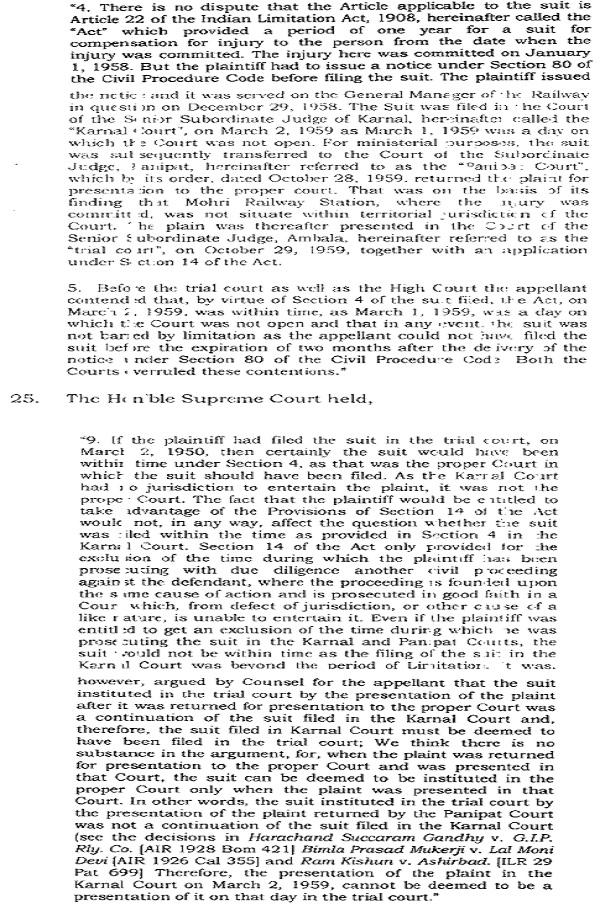
26. By the time the suit was filed by the plaintiff, the District Courts in Hyderabad District did not have the jurisdiction to entertain the dispute concerning the suit schedules ‘A’ and ‘B’ properties claimed to have been belonging to both the parties and only Family Court has jurisdiction. It is a case of inherent lack of jurisdiction for the District Court to entertain the suit. In such a case, the Court, which does not have jurisdiction to entertain the suit, cannot return the plaint granting liberty to the plaintiff to represent the suit before the Family Court, but has to dismiss the suit for want of jurisdiction.
27. Having regard to the mandate of law, we do not see any error committed by the trial Court in rejecting the plaint allowing the application filed under Order VII Rule 11(D) of CPC. The Appeal fails. It is accordingly dismissed. Pending miscellaneous applications if any shall stand closed.
Notes:
1 MANU/UP/0035/1992 — Governing Council of Kayastha Pathshala, Prayag and Others Vs Ram Chandra Srivastava and Others.
2 MANU/AP/125/2014 — Creations, A Partnership Firm Vs Twenty Four Assured Aircon Pvt. Ltd.
3 (1973) 1 SCC 115 — Amar Chand Inani Vs Union of India.
4 8.7. Jurisdiction.—(1) Subject to the other provisions of this Act, a Family Court shall—
(a) have and exercise all the jurisdiction exercisable by any district court or any subordinate civil court under any law for the time being in force in respect of suits and proceedings of the nature referred to in the Explanation; and
(b) be deemed, for the purposes of exercising such jurisdiction under such law, to be a district court or, as the case may be, such subordinate civil court for the area to which the jurisdiction of the Family Court extends.
Explanation.—The suits and proceedings referred to in this sub-section are suits and proceedings of the following nature, namely:—
(a) a suit or proceeding between the parties to a marriage for a decree of nullity of marriage (declaring the marriage to be null and void or, as the case may be, annulling the marriage) or restitution of conjugal rights or judicial separation or dissolution of marriage;
(b) a suit or proceeding for a declaration as to the validity of a marriage or as to the matrimonial status of any person;
(c) a suit or proceeding between the parties to a marriage with respect to the property of the parties or of either of them;
(d) a suit or proceeding for an order or injunction in circumstances arising out of a marital relationship;
(e) a suit or proceeding for a declaration as to the legitimacy of any person;
(f) a suit or proceeding for maintenance;
(g) a suit or proceeding in relation to the guardianship of the person or the custody of, or access to, any minor.
(2) Subject to the other provisions of this Act, a Family Court shall also have and exercise—
(a) the jurisdiction exercisable by a Magistrate of the first class under Chapter IX (relating to order for maintenance of wife, children and parents) of the Code of Criminal Procedure, 1973 (2 of 1974); and
(b) such other jurisdiction as may be conferred on it by any other enactment.
5 S.8. Exclusion of jurisdiction and pending proceedings.—Where a Family Court has been established for any area,—
(a) no district court or any subordinate civil court referred to in sub-section (1) of section 7 shall, in relation to such area, have or exercise any jurisdiction in respect of any suit or proceeding of the nature referred to in the Explanation to that sub-section;
(b) no magistrate shall, in relation to such area, have or exercise any jurisdiction or powers under Chapter IX of the Code of Criminal Procedure, 1973 (2 of 1974);
(c) every suit or proceeding of the nature referred to in the Explanation to sub-section (1) of section 7 and every proceeding under Chapter IX of the Code of Criminal Procedure, 1973 (2 of 1974),—
(i) which is pending immediately before the establishment of such Family Court before any district court or subordinate court referred to in that sub-section or, as the case may be, before any magistrate under the said Code; and
(ii) which would have been required to be instituted or taken before such Family Court if, before the date on which such suit or proceeding was instituted or taken, this Act had come into force and such Family Court had been established, shall stand transferred to such Family Court on the date on which it is established.
6 Order VII. Plaint
7 Rule 10. Return of Plaint—(1) Subject to the provisions of rule 10A, the plaint shall at any stage of the suit be returned to be presented to the Court in which the suit should have been instituted.
[Explanation.—For the removal of doubts, it is hereby declared that a Court of appeal or revision may direct, after setting aside the decree passed in a suit, the return of the plaint under this sub-rule.]
(2) Procedure on returning plaint.—On returning a plaint, the Judge shall endorse thereon the date of its presentation and return, the name of the party presenting it, and a brief statement of the reasons for returning it.
8 Rule 11. Rejection of Plaint—The plaint shall be rejected in the following cases:—
(a) where it does not disclose a cause of action;
(b) where the relief claimed is undervalued, and the plaintiff, on being required by the Court to correct the valuation within a time to be fixed by the Court, fails to do so;
(c) where the relief claimed is properly valued, but the plaint is written upon paper insufficiently stamped, and the plaintiff, on being required by the Court to supply the requisite stamp-paper within a time to be fixed by the Court, fails to do so;
(d) where the suit appears from the statement in the plaint to be barred by any law;
(e) where it is not filed in duplicate;
(f) where the plaintiff fails to comply with the provisions of rule 9:
Provided that the time fixed by the Court for the correction of the valuation or supplying of the requisite stamp-paper shall not be extended unless the Court, for reasons to be recorded, is satisfied that the plaintiff was prevented by any cause of an exceptional nature from correcting the valuation or supplying the requisite stamp-paper, as the case may be, within the time fixed by the Court and that refusal to extend such time would cause grave injustice to the plaintiff.
9 (1964) 1 SCR 24; AIR 1964 SC 1348.
10 1929 SCC OnLine All 47 — Ananti Vs Channu and Others.