
Devendra Madhyani Vs Dy/ACIT (ITAT Raipur)
Filing a Vivad Se Vishwas Declaration Does Not Justify Dismissal of an Appeal Without Verifying Settlement
First Appeal Dismissed on an Assumption of Settlement
The Raipur ITAT held that the CIT(A) cannot dismiss an appeal merely because the assessee approached the Department under the Direct Tax Vivad Se Vishwas Scheme, 2024. The first appellate authority must verify the status of the declaration, consider the assessee’s submissions and determine whether the dispute has been settled. In this case, the Tribunal found that the assessee had obtained no redress under the Scheme and had never represented that the tax dispute stood settled. The dismissal was therefore set aside and the appeal restored for fresh adjudication.
What the CIT(A) Recorded
The dispute before the Tribunal arose from the order of the CIT(A), National Faceless Appeal Centre, dated 24 July 2026, for AY 2018–19. The CIT(A) recorded that the assessee had approached the Department under the Direct Tax Vivad Se Vishwas Act, 2024 and the corresponding Rules. After referring to the reply and submissions, the CIT(A) inferred that the assessee appeared to have lost interest in pursuing the appeal. On that basis, the appeal was dismissed and disposed of for statistical purposes.
The stated basis of disposal was therefore an inference about the assessee’s intention to pursue the appeal. The order did not record a verified finding that the disputed tax matter had been settled under the Scheme. That factual gap became decisive before the Tribunal.
Assessee’s Submissions Did Not Confirm Settlement
At the outset of the hearing, counsel drew the Tribunal’s attention to the CIT(A)’s findings and to the written submissions filed before the first appellate authority, reproduced at pages 16 to 18 of the paper book. The Tribunal examined those submissions and found that the assessee had never stated that the dispute had been settled through Vivad Se Vishwas. It also found that the assessee had obtained no redress under the Scheme.
The assessee’s written reply explained that Form 1 had been filed and Form 2 issued, but the disputed tax had not been paid and Forms 3 and 4 had not followed. The distinction between an initiated declaration and a completed settlement is also explained in the guidance on the Direct Tax Vivad Se Vishwas Scheme, 2024.
The Tribunal accordingly held that the CIT(A) had dismissed the appeal on a wrong appreciation of the facts. The fact that the assessee had approached the Department under the Scheme was insufficient to support the conclusion that he no longer wished to pursue the appeal. Whether the appeal could be disposed of on that basis called for verification of the actual position.
A comparable issue arose in the Jaipur ITAT decision restoring an appeal after an unsuccessful Vivad Se Vishwas settlement. That decision concerned the 2020 Scheme and is cited here as related reading, not as a precedent relied upon in the present order.
Verification and a Reasoned Order Under Section 250
The Tribunal held that the CIT(A)’s findings were inconsistent with sections 250(4) and 250(6) of the Income-tax Act, 1961. Section 250(4) empowers the first appellate authority to make further inquiry or direct the Assessing Officer to do so. In the present case, verification was necessary because the status of the settlement proceedings formed the basis on which the appeal was disposed of.
Section 250(6) requires a written appellate order setting out the points for determination, the decision on those points and the reasons for the decision. Where an appeal is disposed of on the footing that the underlying dispute has been settled, the order should disclose the factual basis for that conclusion. Here, the CIT(A)’s inference that the assessee appeared uninterested did not address what the written submissions said about the settlement or establish that the dispute had ceased to survive.
The importance of identifying precisely which proceedings have been settled is illustrated by Vivad Se Vishwas Settlement of Original Assessment Cannot Close Reassessment Appeal: ITAT Mumbai, another related TaxGuru publication.
Appeal Restored for Fresh Adjudication
The Tribunal set aside the CIT(A)’s order and remanded the matter to the first appellate authority. It directed the CIT(A) to appreciate the facts on record, carry out due verification and pass a speaking order in terms of sections 250(4) and 250(6), while complying with the principles of natural justice.
The Tribunal also directed the assessee to comply with the hearing notices issued by the first appellate authority. The appeal was allowed for statistical purposes. The relief was thus procedural. The first appeal was revived, and the underlying tax grounds remain for adjudication in the restored proceedings.
Author’s Comments
A reference to Vivad Se Vishwas in an appellate submission may describe an attempt to settle, the current status of a declaration or a settlement that has taken effect. The exact wording and the supporting records matter because the legal consequence for the pending appeal depends on what has occurred under the Scheme. In this case, the CIT(A) inferred abandonment of the appeal from the assessee’s approach to the Department, while the written submissions and the actual outcome of that approach did not support the inference.
The ruling has a practical application for faceless appeals. Where the record refers to a settlement declaration, the first appellate authority should ascertain its verified status and effect on the pending appeal before closing the proceedings. A speaking order should explain how the verified facts support the chosen disposal. Where the dispute remains alive, the restored proceedings give the assessee an opportunity to substantiate the grounds and require the CIT(A) to address them in accordance with section 250.
FULL TEXT OF THE ORDER OF ITAT RAIPUR
The present appeal preferred by the assessee emanates from the order of the Ld.CIT(Appeals)/NFAC, Delhi dated 24.07.2026 for the assessment year 2018-19 as per the grounds of appeal on record.
2. At the very outset, the Ld. Counsel for the assessee straightway had brought to the notice of the Bench in the findings of the Ld. CIT(Appeals)/NFAC which is extracted as follows:
“3. The assessee/appellant had approached the Department under the Vivad Se Vishwas Scheme, 2024. TAX ARREAR UNDER THE DIRECT TAX VIVAD SE VISHWAS ACT, 2024 and THE DIRECT TAX VIVAD SE VISHWAS RULES, 2024.
4. In the facts and under the circumstances of the case, the appeal preferred by the assessee/appellant and on perusal of the reply/submissions, it seems that the assessee/appellant is not interested in instant appeal.
5. In the result, the appeal filed by the assessee/appellant is treated as DISMISSED and stands disposed for statistical purposes.”
3. The Ld. Counsel for the assessee brought to the notice of the Bench submissions placed before the Ld. CIT(Appeals)/NFAC which are at Page 16 to 18 of the paper book and the same are extracted as follows:
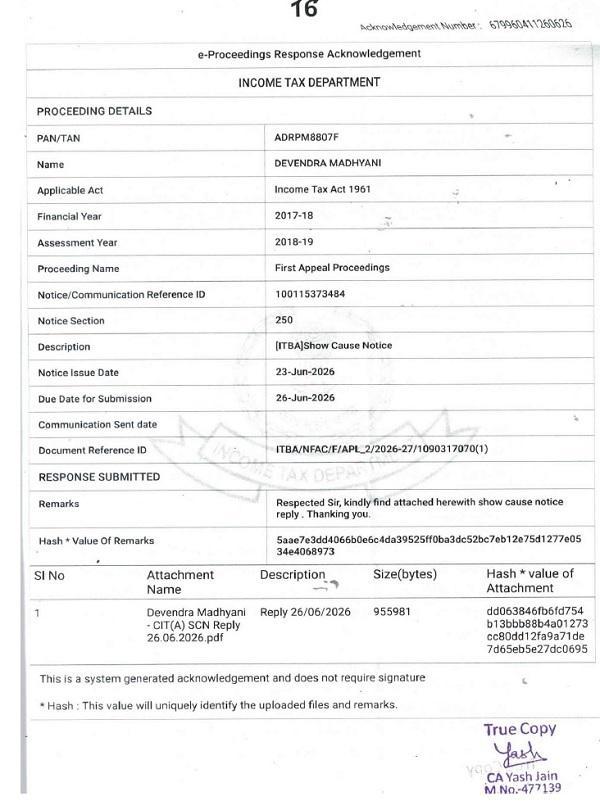
Date: 26/06/2026
To
The Commissioner of Income Tax (Appeals)
National Faceless Appeal Centre (NFAC),
New Delhi.
Sub: Reply to Show Cause Notice u/s 251(2) of the Income Tax Act, 1961 in the case of Shri Devendra Madhyani, Bhilai, Chhattisgarh for the Assessment Year 2018-19 – Reg.
Hon’ble Sir,
Kindly refer to the above. In this connection, it is humbly and respectfully submitted as under:
1. That the Appellant had filed an application under the Vivad se Vishwas Scheme, 2024 (VsVs 2024) vide application dated 16/12/2024 bearing ARN NFAC/2017-18/10227620 for Assessment Year 2018-19.
2. It is respectfully submitted that pursuant to the filing of Form-1 by the Appellant, Form-2 was duly issued by the Department. However, no payment towards the disputed tax was made by the Appellant under the said scheme, and consequently, Form-3 and Form-4 were neither filed by the Appellant nor issued by the Department.
3. In view of the above, the Appellant is not in a position to submit Form-3 and Form-4 as requisitioned in the Show Cause Notice dated 23/06/2026, since the VsVs 2024 proceedings did not proceed to completion and the scheme was not availed of by the Appellant.
4. In the above circumstances, the Appellant respectfully requests this Hon’ble Authority to treat the VsVs application as ‘having lapsed/not proceeded’, and to adjudicate the present appeal on its merits and in accordance with law, based on the submissions and documents already placed on record by the Appellant.
5. It is humbly prayed that in the interest of justice, the appeal may kindly be heard and decided on merits, affording the Appellant a fair opportunity of being heard.
Thanking You,
Yours faithfully,
For, Shri Devendra Madhyani
(CA Yash Jain)
Counsel for the Appellant
Encl: As Above.
4. Therefore, it is discernable from the aforesaid that the Ld. CIT(Appeals)/NFAC had dismissed the appeal of the assessee based on wrong appreciation of facts. The assessee has not got redressal from Vivad Se Vishwas scheme and has never submitted before the Ld. CIT(Appeals)/NFAC that they have settled the tax matter through Vivad Se Vishwas Scheme of the Department. Findings of the Ld. CIT(Appeals)/NFAC is not in terms with Section 250(4) & (6) of the Act.
5. In view thereof, we set aside the order of the Ld. CIT(Appeals)/NFAC and remand the matter back to its file with a direction to adjudicate the matter of the assessee after proper appreciation of facts on record a/w. due verification and come out with a speaking order in terms with Section 250(4) & (6) of the Act while complying with the principles of natural justice. The assessee shall duly comply with the hearing notices issued from the office of the First Appellate Authority.
6. As per afore-stated terms, the appeal of the assessee is allowed for statistical purposes.
Order pronounced in the open court on 18th November, 2026.



