In re Shangri-La Ero (CCPA Delhi)
Summary: The Central Consumer Protection Authority (CCPA), in its order dated 22 October 2026 concerning Shangri-La Eros, New Delhi, imposed a penalty of ₹1,00,000 for automatically levying a 10% service charge at its “Mister Chai” outlet. It directed the restaurant to discontinue and refrain from collecting service charge automatically, by default or under another name, ensure compliance with the service-charge guidelines dated 4 July 2022, and submit a compliance report within 15 days of receiving the order. The Authority held that an arrangement requiring customers to request removal of a pre-added charge undermines free consent, even where the menu describes the payment as optional.
The proceedings arose from grievances dated 30 May 2025 and 10 June 2025 supported by invoices. The disputed service charges were ₹435 on a food subtotal of ₹4,350 and ₹125 on a subtotal of ₹1,250; the invoices also included CGST and SGST, taking the totals to ₹5,646 and ₹1,623 respectively. Following a preliminary inquiry under Sections 18(2) and 19 of the Consumer Protection Act, 2019, CCPA issued notice on 28 July 2025. It considered the software-generated bills capable of affecting consumers as a class under Section 10 and ordered a detailed investigation on 29 August 2025. The Director General (Investigation) submitted the report dated 5 June 2026.
The restaurant denied compulsion and relied on menu wording stating that service charge was discretionary and could be waived on request. It argued that customers had sufficient opportunity to decline payment, that staff obtained consent before issuing invoices, and that charges followed industry standards. It also denied unfair contract terms, unfair trade practices and violations of consumer rights. According to the restaurant, consumers could obtain removal or refund even after payment, and taxes collected had been deposited with the tax department. These were the restaurant’s submissions; CCPA did not accept them as establishing that its default billing practice was lawful.
The investigation found that automatic addition of the charge created an impression of compulsory payment, imposed a unilateral financial obligation without explicit, verifiable consent and subjected customers to pressure at the billing stage. It also noted that consumers paid tax on the added non-statutory charge. CCPA considered that offering a subsequent refund did not cure the infringement because consent had to be free, prior and informed when the bill was raised. The report was supplied to the restaurant, and after an adjournment, counsel appeared at the hearing on 24 August 2026.
Counsel relied on paragraph 174 of the Delhi High Court’s judgment dated 28 March 2025 in National Restaurant Association of India & Ors. v. Union of India & Anr., concerning possible terminology for voluntary contributions. The restaurant changed the invoice description to “Voluntary Service Staff Contribution (Optional)” and later referred to “Charges for Voluntary Service Staff Contribution (optional)”. In its subsequent response dated 22 September 2026, it stated that the complainant had been refunded the service charge along with GST, with the refund processed on 28 August 2026, and that complete stoppage of the contribution would take effect from 1 October 2026.
CCPA rejected the renaming and waiver explanations. It reasoned that menu prices already include the service component and that placing an order signifies consent to the displayed prices plus applicable taxes. Adding a charge through billing software and requiring the consumer to contest it creates an opt-out mechanism, rather than leaving payment to the consumer’s discretion. Fine-print disclosure and a willingness to refund do not remove the social pressure and financial burden generated by that mechanism. The Authority relied on paragraph 7 of its 2022 Guidelines and the Delhi High Court’s ruling that voluntary tips remain permissible but must not be added by default to the bill.
The Authority recorded violations of consumer rights under Sections 2(9)(ii) and 2(9)(v), misleading advertisement provisions under Sections 2(28)(i) and 2(28)(iii), and unfair trade practice under Section 2(47) read with Section 2(46)(vi), together with the 2022 Guidelines. While taking note of the refund and proposed cessation, it found that collection continued for at least fifteen months despite the guidelines, the High Court judgment and CCPA’s notice. Applying the factors under Section 21(7), it imposed the ₹1 lakh penalty and the directions to stop default collection and report compliance.
Cases Discussed
- National Restaurant Association of India & Ors. v. Union of India & Anr. — Judgment dated 28 March 2025 (Delhi High Court). CCPA relied on the ruling upholding the 2022 Guidelines and prohibiting default or mandatory service charges. The restaurant cited paragraph 174 concerning terminology for voluntary contributions; CCPA rejected its defence because the charge remained embedded in default billing.
Alternative SEO Titles
1. Default Service Charge Attracts ₹1 Lakh Penalty for Shangri-La Eros: CCPA
2. Optional Menu Disclosure Cannot Cure Automatic Service Charge Billing: CCPA
3. Renaming Default Service Charge as Voluntary Staff Contribution Is Unlawful: CCPA
4. Customers Cannot Bear Burden of Removing Automatically Added Service Charges: CCPA
5. Refund Does Not Cure Default Service Charge Violation by Shangri-La Eros: CCPA
FULL TEXT OF THE ORDER OF CENTRAL CONSUMER PROTECTION AUTHORITY
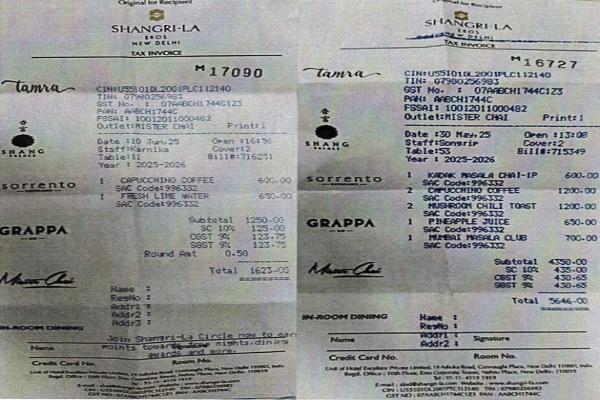
1. The Central Consumer Protection Authority (CCPA) has taken cognizance of grievances dated 30.05.2025 and 10.06.2025 against Shangri-La Eros New Delhi (The Restaurant). The consumers alleged that during visit to the restaurant’s outlet, “Mister Chai,” a 10% service charge was forcibly levied on the food bills. In support of the grievances, the consumer furnished copies of the respective invoices, which are reproduced below:
2. It is pertinent to mention that vide judgement dated 28th March, 2025 the Hon’ble High Court of Delhi in National Restaurant Association of India & Ors. v. Union of India & Anr. had held that: “All restaurant establishments would have to adhere to the guidelines passed by the CCPA. If there is any violation of the same, action would be liable to be taken in accordance with law. CCPA is free to enforce its guidelines in accordance with law.” Further the Hon’ble High Court had upheld the applicability of the CCPA guidelines which is in the interest of consumers and declaring the levy of any mandatory service charge as contrary to law and violates the guidelines.
3. The CCPA in exercise of power conferred under Section 18(2) and Section 19 of the Consumer Protection Act, 2019 (the Act, 2019) conducted a preliminary inquiry to examine the veracity of the claim made against the aforementioned Restaurant.
4. In the preliminary inquiry, CCPA prima facie found, that the Restaurant had levied service charge on the bill despite the Hon’ble High Court of Delhi upholding the Guidelines to Prevent Unfair Trade Practices and Protection of Consumer Interest with regard to levy of service charge in Hotels and Restaurants, 2022 issued by CCPA (hereinafter referred to as Guidelines, 2022). Considering that the bill is software generated, the practice adopted by the Restaurant might have impacted a wider base of consumers visiting the restaurant thereby making it a fit case for class action as envisaged in section 10 of Consumer Protection Act 2019.
5. Based on the preliminary inquiry findings, CCPA directed the restaurant to furnish their response vide Notice dated 28th July, 2025 for violation of various provisions of the Act, 2019 and Guidelines to Prevent Unfair Trade Practices and Protection of Consumer Interest with Regard to Levy of Service Charge in Hotels and Restaurants issued on 04.07.2022.
6. In response to the said notice, on 06th August, 2025 the restaurant has submitted its reply which is as follows:
a. It is a matter of record that the imposition of service charge on food bill is completely discretionary and the same is explicitly stated on every page in the menu of the restaurant “Mister Chai” located in Shangri-La Eros New Delhi. That the menu specifically states “We levy a service charge. Service charge levied is discretionary. Guests can have it waived off as per their request.” It is clearly stated on the menu of the restaurant that payment of service charge is discretionary and voluntary payment by the customer if they are willing to pay the same. That the customer was never forced to pay the service charge and was informed about the same through the restaurant menu and there has never been an attempt to disguise the same or misguide the customer about the service charge being levied. The restaurant does not deny Enclosures 1 and 2 of the show-cause Notice dated 28.07.2025. However, it is submitted that the customer/complainant never asked for non-payment of the service charge despite the fact that the same was written on menu itself that the same is optional.
b. It is denied that the Restaurant is levying service charge on food bill which is against the CCPA Guidelines. As stated above, it is mentioned in the food menu that service charge levied is discretionary and can be waived off.
c. That the customer had enough time to deny payment of service charge from the time of placing order till payment of invoice to convey his intent whether he is willing to pay service charge or not. However, he did not whisper about it even once before or after payment of the bills. The Restaurant have tried our level best to convey to the customer in writing and in clear words that the service charge is discretionary and they can choose the non-payment of the same anytime till the bills have been raised.
d. It is denied that there was an unfair contract between us and the customer. It is further denied that service charge levied was unreasonable and conditions were put on the consumer which put them into stressful situations which amounts to unfair trade contract under the purview of Section 2(46)(vi) of the Act. It is submitted that the percentage of service charge levied is according to industry standards and to reiterate, the customer had the option of getting it removed but chose not to exercise the same at the time of paying the bill and thus consented to pay the service charge.
e. It is denied that the practice of charging additional service charge amounts to unfair trade practices under the purview of Section 2(47) of the Act. It is submitted that there is no mandatory service charge that was levied, and it was fully discretionary in nature. That the customer only had to look at the menu in which it is clearly mentioned in advance about their right to waive off the service charge. That the term “service charge” is clearly mentioned in the menu and no other words were used to disguise the same in order to mislead the customer.
f. It is denied that there was any violation of consumer rights under the purview of Section 2(9) of the Act. It is submitted that the customer did not demand for refund/ waiver of service charge that was already paid by him voluntarily without protest. The Restaurant is always ready and willing to refund the service charge if requested by the customer and are willing to refund Rs. 560/- to the customer towards service charge which was paid by him.
7. Upon examination of the response of the Restaurant, CCPA observed that the restaurant had contended that it is the consumer’s responsibility to actively request a waiver at the counter. Placing the onus on the consumers to opt out of an automatically levied service charge contradicts the CCPA’s Guidelines of 2022, which mandates that no hotel or restaurant shall add service charge automatically or by default in the bill. Also, the restaurant has not given any justification for its continued levy of service charge in the food bill. The Restaurant’s defense that the customer “had enough time to deny payment” itself confirms that their billing software/POS system automatically includes the 10% service charge, thereby impacting a wider class of consumers as envisaged under Section 10 of the Act.
8. In light of the above observations, CCPA vide letter dated 29th August, 2025 directed Director General (Investigation) to conduct a detailed investigation.
9. The Director General (Investigation) submitted the Investigation Report dated 05th June, 2026. The findings in the Investigation report are as under:
a. Shangri-La Eros New Delhi imposed a discretionary service charge of ₹435 (10%) on a subtotal of ₹4,350.00 in Invoice No. M16727 dated May 30, 2025, prior to levying CGST of ₹430.65 and SGST of ₹430.65, resulting in a grand total of ₹5,646.00. Similarly, in Invoice No. M17090 dated July 30, 2025, a service charge of ₹125.00 (10%) was applied to a subtotal of ₹1,250.00, followed by CGST of ₹123.75 and SGST of ₹123.75, yielding a total of 1,623.00. Where a customer has not been clearly informed or provided explicit consent for the service charge, the automatic inclusion of a 10% service charge constitutes an unfair contract terms. Even the menu discloses the charge as discretionary, its mandatory levy imposes a unilateral obligation, creating a reasonable impression of compulsion to pay. This practice exerts undue pressure on the customer, imposing a financial disadvantage absent explicit, verifiable agreement, thereby contravening the provision of unfair contracts as defined under the Act, 2019.
b. Levying a service charge, as discretionary on the menu, constitutes an unfair trade practice as the customer is pressurized to pay. Automatically adding a 10% service charge to the bill may mislead customers into believing that payment is compulsory, creating a deceptive and coercive impression. This practice of levying service charges constitutes an unfair trade practice.
c. Shangri-La Eros New Delhi imposed a discretionary service charge of ₹435 (10%) on a subtotal of ₹4,350.00 in Invoice No. M16727 dated May 30, 2025, prior to levying CGST of ₹430.65 and SGST of ₹430.65, resulting in a grand total of ₹5,646.00. Similarly, in Invoice No. M17090 dated June 10th, 2025, a service charge of ₹125.00 (10%) was applied to a subtotal of ₹1,250.00, followed by CGST of ₹123.75 and SGST of ₹123.75, yielding a total of ₹1,623.00. This practice demonstrates that the consumer was compelled to pay tax on a non-statutory charge, artificially inflating the total payable amount through the automatic inclusion of the service charge without any recorded voluntary consent. Consumers are entitled to protection against unfair trade practices, the right to be informed, under the Consumer Protection Act, 2019.
d. The automatic addition of the service charge undermines informed choice, creates undue pressure at the billing stage, and renders it socially uncomfortable for customers to object, thereby imposing an unjust financial burden unless actively disputed. Offering a refund after payment does not rectify the violation, as the infringement occurs at the time of billing when consent must be free, prior, and informed, which due to its default inclusion negates voluntariness and constitutes a clear violation of consumer rights.
e. In view of the findings on record, it is conclusively established that the automatic levy of Service Charge by Shangri-La Eros, New Delhi amounts to indulgence in violation of Section 2(9), 2(46), 2(47), Consumer Protection Act, 2019.
10. Thereafter, the Investigation Report submitted by DG (Investigation) was shared with the Restaurant vide letter dated 28th July, 2026 to furnish its comments and an opportunity of hearing was also provided to the Restaurant on 07th August, 2026 under Section 20 and 21 of the Act, 2019 before passing an order. However, the restaurant sought an adjournment of two weeks vide email dated 07th August, 2026.
11.Further, hearing was held on 24th August, 2026 wherein Ms. Vidhi Goel, Advocate represented Shangri-La Eros Hotel, represented the restaurant and submitted that
a. The Hon’ble High Court Delhi says that service charge is discretionary, optional and not mandatory and the same is mentioned in the menu card. Moreover, before levying any service charge upon any consumer the restaurant staff verbally asks the consumer whether they are comfortable to pay the service charge or not.
b. Ld. Counsel also referred Para 174 of the Judgement of Hon’ble Delhi High Court “The CCPA may consider permitting change in the nomenclature for Service Charge which is nothing but a ‘Tip or a gratuity or a voluntary contribution’. Terminology such as ‘voluntary contribution’, ‘staff contribution’, ‘staff welfare fund’ or similar terminology can be permitted. The use of the word ‘service charge’ is misleading as consumers tend to confuse the same with service tax or GST or some other tax which is imposed and collected by the government.”
c. In response, the restaurant updated its invoices to describe the charge as ‘Voluntary Service Staff Contribution (Optional)’. It also requested time to respond to the investigation report, assuring that it is complying with the Guidelines and has entirely removed the service charge across all branches.
12.In furtherance of the hearing, vide email dated 27th August 2026, CCPA directed the Restaurant to furnish specific information and documentation, including:
a. Documentary evidence substantiating the concrete steps and efforts undertaken to reach out to the consumer to process the refund;
b. Written comments on the findings of the Investigation Report;
c. The total number of restaurant brands or chains operating under Shangri-La, along with the exact count of operating branches; and
d. Whether the Restaurant has completely discontinued the levy of service charges across all outlets, along with the specific effective date of such discontinuation?
Additionally, CCPA forwarded the latest National Consumer Helpline (NCH) data to the Restaurant for necessary action.
13. In response to the above, the Restaurant on 22nd September, 2026 submitted as follows:
a. The amount has now been successfully refunded to the Complainant.
b. Under Shangri La Eros, there are 3 restaurant ie. Tamra, Shang Palace Sorrento Grappa and Mister Chai, and no branches of the same opened by owner.
c. Although the Restaurant was taking voluntary staff contribution in accordance with directions passed by the Hon’ble Delhi High Court vide judgement dated 28.03.2025, and now the Restaurant is in the process of complete stoppage of the same with effect from 01.10.2026.
d. The reverts on the investigation report are as follows:
(i) Under Shangri La Eros, there are 3 restaurants i.e. Tamra, Shang Palace Sorrento Grappa and Mister Chai, and no branches of the same opened by owner.
(ii) Although the Hotel was taking voluntary staff contribution in accordance with directions passed by the Hon’ble Delhi High Court vide judgement dated 28.03.2025, and now the Hotel is in the process of complete stoppage of the same and the same will be effective from 01.10.2026.
(iii) It is denied that Shangri-La Eros New Delhi imposed/ compelled any Customer to pay service charge. That the service charge was/ is not mandatory and it was only levied on the invoices who consented to pay the same. To make Customer aware about service charge applicability, the Hotel has clearly mentioned on the menu of the outlet that service charge is not mandatory and will be charged only as per advice of the Customer. In fact, even if the service charge consented to by the Customer and charged by the Hotel, the Customer has an option to claim it back after payment.
(iv) Since the Customer consented to for payment of the service charge, then only Shangri-La Eros levied a service charge Of Rs. 435 (10%) on a subtotal of Rs. 4,350 in Invoice No. Ml 6727 dated 30th May, 2025, resulting in a grand total of Rs. 5,646.00. Similarly, in Invoice No. Ml 7090 dated July 30, 2025, a service charge of Rs 125.00 (10%) was applied after taking consent of the Customer, to a subtotal of Rs. 1,250.00, followed by CGST of Rs. 123.75 and SGST of Rs. 123.75, yielding a total of Rs. 1,623.00.
(v) It is stated that Shangri-La Eros New Delhi makes it abundantly clear to Customer dining at its restaurants including “Mister Chai” that the service charge is a discretionary amount and the customer is well within their rights to not pay the same. The service charge is not a compulsory payment which is forced upon the customer, it is completely voluntary in nature.
(vi) In fact, the Hotel further changed the nomenclature as per judgement dated 28032025 passed by the Hon’ble Delhi High Court on the menu of the restaurant as “Charges for voluntary staff contribution are completely optional and not mandatory Such contribution can be waved off as per guest request. “and on the invoice “Charges for Voluntary Service Staff Contribution (optional)” so to make it further clear that the Customer are not bound to pay the same and the same will be charged in case Customer opts for the same.
(vii) It is reiterated that the consumer is not put at a financial disadvantage with the levying of the service charge. The customer is clearly informed about the voluntary nature of the service charge as per the menu of the restaurant and therefore, can get the same removed. That this practice exerts no undue pressure on the Customer as the customer is not under compulsion to pay. Therefore, the restaurant “Mister Chai” at Shangri-La Eros Hotel, New Delhi is not imposing any unreasonable charge, obligation or condition putting the consumer to a disadvantage as per Section 2(46)(vi) of the Consumer Protection Act. The Hotel refunded the service charge to various Customers who paid it at first instance and claimed it back later on by email or through phone calls or messages.
(viii) The Hotel levied service charge only as per industry standards upon following guidelines issued by CCPA It is stated that the payment of service charge by the customer is entirely voluntary in nature and the customer is under no mandatory obligation to pay the same. Therefore, no pressure is created on the dining customer as they can exercise the option of removing it any time before or after the payment is made. Additionally, the Hotel staff used to ask the Customers before issuance of the invoice and after taking their consent, invoices were prepared. There are numerous instances the service charge was not levied by the Hotel upon denial by the Customers.
(ix) It is denied that the customer was compelled to pay tax on a non-statutory charge, artificially inflating the total payable amount through the automatic inclusion of the service charge without any recorded voluntary consent Taxes have been charged by the Hotel as per rules and regulations of Tax department and all such taxes collected from the customers have been deposited with the department concerned.
(x) It is further submitted that the restaurant and the Hotel made no attempt to hide the truth of service charge and they made their best endeavor to disclose the same to the Customer at the first instance Shangri-La Eros Hotel, New Delhi and ‘Mister Chai” have always been transparent about the voluntary nature of service charge.
(xi) It is submitted that the customer consented to the payment of the service charge, and it was therefore added by the restaurant to the invoices bearing Invoice No. MI 6727 and Invoice No. MI 7090 respectively, The Hotel is always ready and willing to refund the same in case the Customer ask for the same anytime, after the payment. The Customer who made the complaint never approached the Hotel for refund of service charge. In fact, the Customer did not leave any of his details, because of which Hotel staff took time to get his details and now the amount paid towards the service charge along with GST amount has been refunded.
(xii) It is submitted that the customer only has to exercise their right by saying yes or no at the time of issuance of bill and the same does not tantamount to public embarrassment or undue pressure as alleged. The customer does not have to actively dispute the same as the restaurant was more than willing not to take the service charge. Furthermore, it is submitted that the refund offered by the restaurant post the payment of bill by the customer whosoever has asked at any point of time is a matter of practice which showcases our clear intention that the service charge is payable only at the option of the customer. It showed our bonafide nature as we were always ready and willing to remove/ refund the service charge as per the customer’s advice. The Hotel issued the customer who filed complaint the refund for the service charge along with GST and it was processed on 28.08.2026.
14. Before delving into the specifics of the case, it is pertinent to examine the relevant legal framework that governs such transactions.
a. Section 2(9) (ii) and (v) of the Act, 2019 includes- “the right to be informed about the quality, quantity, potency, purity, standard and price of goods, products or services, as the case may be, so as to protect the consumer against unfair trade practices” and “the right to seek redressal against unfair trade practices or restrictive trade practices or unscrupulous exploitation of consumers.”
b. From the bare reading of Section 2 (28) of the Act, 2019 it can clearly be concluded that when a restaurant displays a menu with specific prices, a component of service is inherent in the price of food and beverages offered by the restaurant, about which the consumer is duly informed. Pricing of the product thus covers both the goods and services component. However, if a mandatory service charge is added later, it conveys an express or implied representation that the restaurant, a service provider had deliberately concealed the actual price of the food and service thereof, constituting an unfair trade practice.
c. Section 2 (46) “unfair contract” means a contract between a manufacturer or trader or service provider on one hand, and a consumer on the other, having such terms which cause significant change in the rights of such consumer, and imposing on the consumer any unreasonable charge, obligation or condition which puts such consumer to disadvantage;
d. Furthermore, Section- 2(47) of the Consumer Protection Act, 2019 defines “Unfair Trade Practice” which includes deceptive or unethical methods used to promote the sale of goods, use or supply of any goods or provision of services.
e. CCPA had issued Guidelines to Prevent Unfair Trade Practices and Protection of Consumer Interest with Regard to Levy of Service Charge in Hotels and Restaurants, on 4th July, 2022. The extracts of which are given below:
“3. Service charge is being levied in addition to the total price of the food items mentioned in the menu and applicable taxes, often in the guise of some other fee or charge.
4. It may be mentioned that a component of service is inherent in price of food and beverages offered by the restaurant or hotel. Pricing of the product thus covers both the goods and services component. There is no restriction on hotels or restaurants to set the prices at which they want to offer food or beverages to consumers. Thus, placing an order involves consent to pay the prices of food items displayed in the menu along with applicable taxes. Charging anything other than the said amount would amount to unfair trade practice under the Act.
7. Therefore, to prevent unfair trade practices and protect consumer interest with regard to levying of service charge, the CCPA issues the following guidelines —
(i) No hotel or restaurant shall add service charge automatically or by default in the bill.
(ii) Service charge shall not be collected from consumers by any other name.
(iii) No hotel or restaurant shall force a consumer to pay service charge and shall clearly inform the consumer that service charge is voluntary, optional and at consumer’s discretion.
(iv) No restriction on entry or provision of services based on collection of service charge shall be imposed on consumers.
(v) Service charge shall not be collected by adding it along with the food bill and levying GST on the total amount.”
f. The Hon’ble High Court of Delhi [National Restaurant Association of India & Ors. Vs Union of India & Anr.] passed the Judgment on 28th March, 2025 held in favor of CCPA wherein the Court held the following:
i. Service charge or TIP as is colloquially referred, is a voluntary payment by the customer. It cannot be compulsory or mandatory. The practice undertaken by the restaurant establishments of collecting service charge that too on a mandatory basis, in a coercive manner, would be contrary to consumer interest and is violative of consumer rights.
ii. The collection of service charge and use of different terminologies for the said charge is misleading and deceptive in nature. The same constitutes an unfair trade practice under Section 2(47) of the CPA, 2019.
iii. The guidelines framed by the CCPA are thus valid and are in the interest of the consumers and the same are upheld.
iv. While this Court holds that the mandatory collection of service charge is contrary to law and violates the guidelines, it is also of the opinion that if consumers wish to pay any voluntary Tip for services which they had enjoyed, the same would obviously not be barred. The amount however, ought not to be added by default in the bill/invoice and should be left to the customer’s discretion.
v. All restaurant establishments would have to adhere to the guidelines passed by the CCPA. If there is any violation of the same, action would be liable to be taken in accordance with law. CCPA is free to enforce its guidelines in accordance with law.
15. The CCPA is empowered under Section 20 and 21 of the Consumer Protection Act, 2019 to issue directions to modify the advertisement or discontinue such advertisement and practices, if necessary, it may, by order, impose a penalty which may extend to ten lakh rupees and for every subsequent contravention may extend to fifty lakh rupees. Further, Section 21 (7) of the above Act, 2019 prescribes that following may be regarded while determining the penalty:
i. the population and the area impacted or affected by such offence;
ii. the frequency and duration of such offence;
iii. the vulnerability of the class of persons likely to be adversely affected by such offence;
iv. the gross revenue from the sales effected by virtue of such offence
16.In light of the above provisions and consideration of the investigation report of DG Investigation (CCPA) along with the submissions of the Restaurant, CCPA arrives at the following findings:
(a) It is pertinent to note that when a restaurant displays prices on its menu, a component of service is already inherent in the pricing of the food and beverages offered, ensuring consumers are informed of the actual cost upfront. Because Restaurant have absolute freedom to set their menu prices, placing an order constitutes consent only to pay the displayed price plus applicable taxes. Consequently, this practice of levying service charge violates fundamental principles of fairness and contravenes Section 2(28) of the Consumer Protection Act, 2019, as it amounts to misleading representation and creates an express or implied representation that the restaurant concealed the true cost of food and service, thereby misrepresenting the final cost of dining out.
(b) The CCPA held that the restaurant’s revised billing description renaming service charge to “Charges for Voluntary Service Staff Contribution (optional) is legally untenable. Pursuant to Paragraph 7(ii) of the Guidelines, “Service charge shall not be collected from consumers by any other name”. Consequently, the restaurant’s modification of its billing format indicates that the charge remains embedded within the billing software by default. This automatic inclusion creates an opt-out mechanism rather than an opt-in requirement, thereby giving consumers the impression that the levy is mandatory and shifting the burden onto them to actively contest the charge at the billing counter. The amount however, ought not to be added by default in the bill/invoice and should be left to the customer’s discretion as service charge or TIP is a voluntary payment by the consumer.
(c) The Restaurant’s practice of disclosure on the menu card in fine print stating that “Charges for voluntary staff contribution are completely optional and not mandatory such contribution can be waived off as per guest request while automatically levying the charge on the invoice, undermines free and informed consumer consent. By mandating that the charge “can be waived off upon guest request,” the restaurant effectively institutes a coercive “opt-out” mechanism. This unlawfully shifts the burden onto the consumer to actively dispute at the billing counter, exerting social pressure to comply and imposing a financial burden on the consumer amounts to unfair trade practice. Merely displaying this collection of non-statutory charge like “service charge’, on the menu card or on the bill does not cure the underlying compulsion as both the CCPA Guidelines and established judicial precedent of the Hon’ble High Court of Delhi, affirm that any automatic or default addition of such charges to the food bill is void from the beginning.
(d) Service charge or TIP as is colloquially referred, is a voluntary payment by the customer. It cannot be compulsory or mandatory. The practice undertaken by the restaurant establishments of collecting service charge that too by default on bill, is contrary to consumer interest and violative of consumer rights. Moreover, the collection of service charge and use of different terminologies for the said charge is misleading and deceptive in nature. The same constitutes an unfair trade practice under Section 2(47) of the CPA, 2019.
(e) The facts and evidences in this case clearly established that the service charge was mandatorily levied on all consumers till 01st October, 2026, which is in contravention of the CCPA Guidelines, 2022 upheld by the Hon’ble High Court of Delhi dated 28th March, 2025.
(f) Hence, the Restaurant is in violation of the following provisions of Consumer Protection Act 2019:
(i) Consumer rights under section 2(9) (ii) of the Act, 2019.
(ii) Consumer rights under section 2(9) (v) of the Act, 2019.
(iii) Misleading advertisement under Section 2(28) (i) and (iii) of the Act, 2019.
(iv) Engaging in Unfair Trade Practice as defined in section 2(47) of Act, 2019 read with section 2(46) (vi) of Act, 2019;
(v) Guidelines to Prevent Unfair Trade Practices and Protection of Consumer Interest with Regard to Levy of Service Charge in Hotels and Restaurants, on 4 July, 2022.
17. Having regard to the findings, it is concluded that the mechanism of “opt-out” rather than “opt-in” fundamentally vitiates consumers’ free consent. According to the Guidelines, 2022, no hotel or restaurant shall add a service charge automatically or by default to the bill, and shifting the burden onto the consumer to identify, contest, and demand the removal of the levy at the time of payment undermines true voluntariness of the consumer. The CCPA takes due note of the restaurant’s steps in refunding the disputed service charge to the consumer. It is pertinent to observe that, as per the restaurant’s own submission, it initiated the complete cessation of the service charge only with effect from 1st October 2026 i.e., following the CCPA taking cognizance of the present matter. Notably, the CCPA Guidelines were notified in 2022 and subsequently upheld by the Hon’ble High Court of Delhi on 28th March 2025. Despite the judicial reaffirmation and receipt of notice from the CCPA, the establishment persisted in levying the service charge for an extended period of at least fifteen (15) months. Such deliberate, continuous imposition has caused widespread prejudice to consumers as a Class, thereby squarely attracting the penal/remedial provisions under Section 21(7) of the Consumer Protection Act, 2019.
18. In light of the above CCPA issues the following directions:
a. The Restaurant shall discontinue and refrain from levying or collecting any service charge automatically or by default, or under any other name, and shall ensure strict compliance with the Guidelines to Prevent Unfair Trade Practices and Protection of Consumer Interest with Regard to Levy of Service Charge in Hotels and Restaurants dated 04.07.2022.
b. Considering the established violations and applying the statutory factors under Section 21(7) of the Consumer Protection Act, 2019, the Restaurant is directed to pay a penalty of ₹ 1,00,000/- only.
The Restaurant shall submit a compliance report of the above-mentioned directions to the CCPA within 15 days from the receipt of this order.