
Pledge Advertising Private Limited Vs Commissioner of Central Excise (CESTAT Bangalore)
Mere Canvassing of Advertisements on Commission Does Not Attract Service Tax as Advertising Agency Service
Summary: The Bangalore Bench of CESTAT held that an intermediary who merely arranges advertisement space or time for clients on commission does not render Advertising Agency Service under Section 65(105)(e) of the Finance Act, 1994. The Tribunal set aside the differential service tax demand of ₹98,73,926. It remanded the CENVAT credit issue for limited verification, confining any recovery of ineligible credit to the normal limitation period.
Facts of the Case
Pledge Advertising arranged advertisements for clients in print and electronic media. The media issued invoices to Pledge identifying the advertiser, specifying the publication or broadcast particulars, and showing a 15% discount. Pledge generally paid the media 85% of the tariff along with the applicable service tax. It discharged service tax on the 15% treated as commission, partly by utilising CENVAT credit claimed on media invoices.
The Department recomputed the value of the alleged Advertising Agency Service from the company’s financial records. After an earlier remand, the Commissioner confirmed the differential demand for FYs 2006–07 to 2010–11, disallowed CENVAT credit and imposed penalties. The Revenue relied on Pledge’s registration as an advertising agency, its accreditation and ledger entries for printing, creative work, production and copyright income to argue that its activities went beyond canvassing.
Classification Could Be Challenged on Remand
The Revenue argued that Pledge had not disputed the classification in the first round of adjudication. The Tribunal rejected that objection because its earlier remand order expressly permitted the appellant to raise questions of fact and law in the fresh proceedings. The Commissioner had also examined and decided classification on merits in the fresh order. The Tribunal therefore proceeded to determine the nature of the activity from the evidence.
Media Invoices Showed the Nature of the Transaction
The Tribunal examined a Sun Music invoice addressed to Pledge that separately identified Joy Alukkas as the advertiser. It showed a tariff of ₹10 lakh, a discount of ₹1.50 lakh, and a net charge of ₹8.50 lakh on which the broadcaster paid service tax. The invoice supported Pledge’s explanation that it acted as an intermediary between the advertiser and the broadcaster.
The Tribunal relied on Euro RSCG Advertising Ltd. v. CST, Bangalore, 2007 (7) STR 277, and McCann Erickson (India) Pvt. Ltd. v. CST, Delhi, 2008 (10) STR 365. These decisions examined the commercial relationship between the parties. The advertiser was the agency’s client, while the media supplied the space or airtime. A discount granted by the media reduced the amount payable to it and did not, by itself, represent consideration for advertising services rendered to the media.
Mere Canvassing Falls Outside the Classification Invoked
CBEC Circular No. 96/7/2007-ST dated 23 August 2007 clarified that merely canvassing advertisements for publication on commission falls outside Section 65(105)(e). The circular identified Business Auxiliary Service under Section 65(105)(zzb) as the applicable classification for such canvassing. The decision thus concerns the classification on which the Department had raised the demand.
The Tribunal found that the evidence established procurement of advertising space or time. Beyond the accounting entries, the Department had placed no material on record establishing that Pledge had undertaken additional activities such as making, preparing, displaying or exhibiting advertisements in connection with the transactions in dispute. The Tribunal accordingly set aside the demand confirmed under Advertising Agency Service.
CENVAT Credit Remanded for Invoice-Level Verification
The Tribunal found that the record lacked a complete breakup of the credit claimed. It directed the adjudicating authority to verify whether Pledge had availed credit on invoices issued by broadcasters or print media that identified it as the advertiser’s agent. It directed the authority to apply Zapak Digital Entertainment Ltd. v. CST, Mumbai-II, 2017 (49) STR 455, upheld by the Bombay High Court in 2018 (18) GSTL 583, when determining eligibility for such credit.
The show cause notice proposed a penalty under Rule 15A without invoking Rule 15(3) or Section 78 on allegations of fraud, wilful misstatement or suppression. The Tribunal set aside the extended-period credit demand and related penalty. Any ineligible credit established on verification could be recovered only for the normal period. The appeal was therefore partly allowed by way of remand.
Author’s Comments
The decision shows why the same invoice can support the taxpayer on classification and require closer scrutiny on credit. Here, the broadcaster’s invoice helped establish that Pledge arranged airtime for an identified advertiser. The same particulars mattered on remand because they showed the capacity in which Pledge appeared on the invoice. The Tribunal’s approach also gives the financial statements their proper evidentiary weight. Ledger entries for creative work or printing can prompt an enquiry, but the Department must connect those entries to the services actually supplied before relying on them to sustain the classification and demand.
Cases Discussed:
- Grey Worldwide (India) Private Limited Vs Commissioner of Service Tax, Mumbai (CESTAT Mumbai); 2015 (37) STR 597 – Relied upon by the appellant in support of its contention that the disputed activity was not liable to service tax.
- CST, Ahmedabad Vs Poornima Advertisement and Promotion Private Limited (CESTAT Ahmedabad); 2010 (20) STR 107 – Cited by the appellant concerning the taxability of advertisement-related activities.
- Euro RSCG Advertising Ltd. Vs CST, Bangalore (CESTAT Bangalore); 2007 (7) STR 277 – Followed by the Tribunal in distinguishing discounts granted by media organisations from consideration received for services rendered to advertising clients.
- Hindustan Polymers Co. Ltd. Vs CCE, Guntur (Supreme Court of India); 1999 (106) ELT 12 – Relied upon by the appellant in challenging the denial of CENVAT credit on grounds not properly raised in the show cause notice.
- CCE, Nagpur Vs Ballarpur Industries Limited (Supreme Court of India); 2007 (215) ELT 489 – Cited by the appellant concerning the permissible scope of adjudication with reference to the show cause notice.
- CC, Mumbai Vs Toyo Engineering India Limited (Supreme Court of India); 2006 (201) ELT 513 – Relied upon by the appellant in support of the principle that adjudication cannot travel beyond the show cause notice.
- CCE, Bangalore Vs Brindavan Beverages Pvt. Limited (Supreme Court of India); 2007 (213) ELT 487 – Cited by the appellant regarding the importance of specific allegations in a show cause notice.
- Reckitt & Colman of India Vs CCE (Supreme Court of India); 1996 (88) ELT 641 – Relied upon by the appellant in challenging adjudication beyond the allegations contained in the notice.
- Commissioner of Central Excise, Madras Vs Systems & Components Pvt. Ltd. (Supreme Court of India); 2004 (165) ELT 136 – Relied upon by the Revenue in support of its submissions concerning the appellant’s admissions and classification.
- Adwise Advertising Pvt. Ltd. Vs Union of India (Madras High Court); 2006 (2) STR 375 – Cited by the Revenue in support of classification under Advertising Agency Service.
- Commissioner of Central Excise, Chandigarh Vs Reliant Advertising (CESTAT Delhi); 2013 (31) STR 166 – Relied upon by the Revenue concerning the scope of taxable advertisement-related services.
- HMT Ltd. (Machine Tool Division) Vs Commissioner of Central Excise, Hyderabad (CEGAT Bangalore); 2002 (7) TMI 194 – Cited by the Revenue in support of its submissions.
- Shri Balaji Enterprises Vs Commissioner of CGST & Central Excise, Delhi North, New Delhi (CESTAT New Delhi); 2026 (4) TMI 153 – Relied upon by the Revenue in support of its classification submissions.
- D. Paul’s Consumer Benefit Ltd. Vs CCE, Delhi-II (CESTAT New Delhi); 2018 (9) TMI 1513 – Relied upon by the Revenue in support of invocation of the extended period of limitation.
- Mayank Foods & Beverages Pvt. Ltd. Vs Commissioner of Central Excise & Service Tax, Noida (CESTAT Allahabad); 2026 (1) TMI 851 – Cited by the Revenue concerning limitation.
- Jain & Company Vs Commissioner of Central Excise & CGST, Meerut-I (CESTAT Allahabad); 2026 (7) TMI 237 – Relied upon by the Revenue in support of the extended-period demand.
- McCann Erickson (India) Pvt. Ltd. Vs Commissioner of Service Tax, Delhi (CESTAT Delhi); 2008 (10) STR 365 – Followed by the Tribunal for the principle that discounts granted by media organisations do not constitute consideration received from the advertising agency’s clients.
- Zapak Digital Entertainment Ltd. Vs CST, Mumbai-II (CESTAT Mumbai); 2017 (49) STR 455 – Applied while directing verification of eligibility for CENVAT credit on invoices issued by broadcasters to the appellant in its capacity as the advertiser’s agent.
- CST-VI, Mumbai Vs Zapak Digital Entertainment Ltd. (Bombay High Court); 2018 (18) GSTL 583 – High Court judgment upholding the Tribunal’s decision in Zapak Digital Entertainment Ltd., to be considered during the limited remand proceedings.
FULL TEXT OF THE ORDER OF CESTAT BANGALORE
Briefly the facts are that the appellant M/s. Pledge Advertising Pvt. Ltd., Cochin are engaged in the field of advertising working as agents for the advertisement media both print media and visual media. For the above services rendered by them, they were receiving commission on which service tax was being discharged. However, the department found that the amount on which service tax was being discharged was not the right amount and accordingly, show-cause notice was issued demanding the differential service tax amount. The Commissioner in the impugned order observed that the appellant was rendering taxable services under ‘Advertising Agency Services’ and based on the financial records, the gross amount of advertisement charges was redetermined and accordingly, differential service tax amount of Rs.98,73,926/- was confirmed for the period from 2006-2007 to 2010-2011 under Section 73 of the Finance Act, 1994. He also disallowed the cenvat credit of Rs.87,88,601 under Rule 14 of the Cenvat Credit Rules, 2004 and imposed penalties under Section 76, 77 and 78 of the Finance Act, 1994 and also penalty under Rule 15 of Cenvat Credit Rules, 2004. Aggrieved by this order, the appellant is in appeal before us.
2. The Learned Counsel submitted that the appellant was engaged in canvassing for advertisements for clients with the print media and electronic/visual media and were receiving discounts from the print and electronic media. They had availed cenvat credit on the tax invoices issued by the print media and electronic visual media and utilised the same for payment of Service tax. It is submitted that the appellant had canvassed on behalf of the clients with the print and electronic visual media for sale of space/time for advertisements and the appellant had not carried out any other activity in conjunction with canvassing for advertisement. The print and electronic visual media issued tax invoices addressed to the appellant showing name of the client for whom the advertisement is to be published or broadcast, date and time of broadcast, value of service, discount @15%, service tax and cess paid etc. He further submitted that the appellant paid to the media 85% of the amount received from the clients along with service tax and retained 15% of the amount as discount given in the invoices issued by the media and on the 15% retained by them, they paid service tax by utilising the cenvat credit availed on the input services and the balance was paid by cash. It is his submission that, admittedly, the appellant had passed on 14% of the discount amount to the advertising clients and the appellant having taken credit on the basis of tax invoices issued by visual and electronic media and utilised the credit so taken for payment of service tax on the discount receipt from the media there is nothing illegal about availing cenvat credit. He further submits that service tax was not legally leviable and payable on the discounted 15% of the amount as the same was not a consideration receipt for any services provided by the appellant to the print or electronic media. Referring to the definition of ‘Advertisement’ under Section 65(2) of the Finance Act, 1994; ‘Advertising Agency’ under Section 65(3) and ‘Taxable Service’ under Section 65(105)(e), it is submitted that ‘Sale of Space or Time for Advertisement’ was brought to levy of service tax only with effect from 01.05.2006 and CBEC vide Circular No.64/13/2003-ST dated 28.10.2003 had clarified that the activity of canvassing for time or space for advertisement is not a taxable service under ‘Advertising Agency Service’; further, the CBEC vide Circular No.96/7/2007-ST dated 23.08.2007 had clarified that canvassing advertisements for publishing on commission basis is not classifiable under ‘Taxable Service’ under Section 65(105)(e) of the Finance Act, 1994; accordingly, the activity of canvassing with the print and electronic media for publishing advertisements for the client is not liable to service tax under the category of ‘Advertising Agency’. Relying on the decision of the Hon’ble Tribunal in the case of Grey Worldwide (India) Private Limited vs. Commission of Service Tax Mumbai: 2015 (37) STR 597 (Tri- Mumbai), he submits that the appellant is not liable to pay service tax. Also, relies on the decision in the cases of CST, Ahmedabad vs. Poornima Advertisement and Promotion Private Limited: 2010 (20) STR 107 (Tri-Ahmd.) and Euro RSCG Advertising Ltd. vs. CST, Bangalore: 2007 (7) STR- 277 (Tri.-Bang).
2.1 With regard to cenvat credit, it is submitted that the credit has been denied solely on the ground that the appellant had not produced the required documents for taking the credit but the fact that the appellant in their reply to the show-cause notice dated 08.04.2015 had placed a statement of invoices along with the copies of invoices on which cenvat credit was availed is ignored and the show-cause notice had not disputed the eligibility of the service provided by the media towards sale of space or time as input service for availing the credit; hence, denying the credit on non-production of documents cannot be sustained. Relied on the following decisions:
- Hindustan Polymers Co Ltd. Vs. CCE, Guntur 1999 (106) ELT 12 (SC)
- CCE, Nagpur Vs. Ballarpur Industries Limited 2007 (215) ELT 489 (SC)
- CC, Mumbai Vs. Toyo Engineering India Limited 2006 (201) ELT 513 (SC)
- CCE, Bangalore Vs. Brindavan Beverages Pvt. Limited 2007 (213) ELT 487 (SC)
- Reckit & Colman of India Vs. CCE 1996 (88) ELT 641 (SC)
2.2 He further submits that since cenvat credit stands utilised for payment of service tax which was not leviable in the first place, the entire order being revenue neutral, cannot be sustained.
2.3 On limitation, he submitted that the show-cause notice was issued on 09.10.2011 demanding service tax for the period from 2006 to 2007 and 2010 to 2011 and denying cenvat credit for the period from 2008 to 2009 and 2010 to 2011 which is beyond the normal period of limitation and there is no element of fraud, collusion or wilful misstatement or suppression of facts that have been alleged in the show-cause notice; hence, based on several decisions relied, it is submitted that the entire demand is barred by limitation.
3. The Authorised Representative (AR) on behalf of the Revenue submitted that the appellant M/s. Pledge Advertising Private Limited was registered with service tax department for provision of taxable services namely Advertising Agency Services classified under Section 65(105)(e) of the Finance Act, 1994 and was filing ST-3 returns and discharging service tax under the category of Advertising Agency Services. In their statement dated 11.03.2011 of Mr. Jorlin Joseph, Branch Manager and statement dated 11.03.2011 of Ms. Omcy Jones, Director of the appellant stated that they were basically engaged in Advertising Agency Services and registered with Service Tax department and paid service tax on the commission received from advertisement on media. From the financial records, in addition to the commission earned for advertisements, they have received income like printing charges, creative work charges, production charges, copyright income, etc., in relation to the services provided by them; hence, show-cause notice dated 19.10.2011 was issued demanding short-paid service tax on Advertisement Agency Service and irregularly availed and utilised cenvat credit during the period 2006-07 to 2010-11 from M/s. Pledge Advertising Private Limited.
3.1 He further submitted that during the first round of adjudication proceedings, they did not dispute the classification of services under the category of Advertisement Agency Service and the adjudicating authority confirmed demand of service tax and irregular availment of cenvat credit vide Order-in-Original No.46/2013 ST dated 27.03.2013. Against this order, an Appeal No.ST/27294/2013 was filed which was disposed of vide Final Order No.26616/2013 dated 26.09.2013, wherein the CESTAT remanded the matter for fresh adjudication. During the de novo adjudication proceedings, the appellant raised the issue of classification and argued that the activity of canvassing of advertisements on commission basis does not come within the meaning of Advertisement Agency Service. Relying on CBEC circular No.64/13/2003-ST dated 28.10.13 and 96/7/2007-ST dated 23.08.07 and 78/08/2004-ST dated 23.03.2004, they argued that the services of arranging time slots in electronic media and space in print media may come under ‘Business Auxiliary Service’. The Adjudicating Authority, after carefully considering the submissions of the appellant, has held that the activities carried out by the appellant rightly qualify for Advertisement Agency Service and clarifications in the said circulars are not applicable to their case. After excluding certain amounts totalling to Rs.6,63,604/- from the taxable value, confirmed the demand of service tax of Rs.98,73,926/-. With regard to Cenvat credit, adjudicating authority held that a service having value of 85% amount cannot be an input service for a service having value of only 15% amount, as in the instant case, and also for non-submission of original invoices, demand of cenvat credit is upheld.
3.2 Referring to the submissions of the appellant, it is submitted that they are contradicting/inconsistent. He submits that it is an admitted fact that the appellant had been providing Advertising Agency Services and paying service tax under the same and the statements dated 11.03.2011 given by the Director and Branch Manager on their own which were not retracted/ disputed, it is admitted that they are basically engaged in Advertisement Agency Service i.e., canvassing advertisement for print & electronic media. The appellant was an INS Accredited Advertising Agency and is not merely engaged in canvassing on commission basis. As recorded in financials/balance sheet, the appellant had also received income like printing charges, creative work charges, production charges, copyright income, etc., in relation to the services provided by them; hence, the appellant had agreed to that they have received creative work and copyright income during 2009-2010 and claims that these charges/incomes were thus independent of the activity of canvassing for advertisement with the print media and visual media. Mere claim without documentary evidence is not tenable in law. Further, appellant does not justify/prove as to how they were independent of Advertisement Agency Service. During 2009-2010, the Appellant received income from printing charges and production charge, for which, no explanation is submitted. Even during 2007-2008, appellant received printing charges of Rs.10,04,297/- for which no explanation. The activities of the appellant fall within the meaning of Advertising Agency i.e., any person engaged in providing any service connected with the making, preparation, display or exhibition of advertisement and includes an advertising consultant. Appellant was providing service to the Media companies in which advertisement to be flashed/ displayed. Even, locating or selecting a particular media would be a “Service”. The definition of advertising agency and advertising service is very wide to include the activities of the appellant regarding canvassing of advertisements for display in the media. Therefore, the services of the appellant squarely fall under the category of ‘Advertising Agency services’ as classified by the appellant himself. Circular No. 64/13/2003-ST, dated 28-10-2003 and No.96/7/2007-ST dated 23-08-2007, clarifies in the case of mere canvassing of advertisements. However, as discussed, appellant is not merely canvassing. In view of the same, adjudicating authority has rightly held that the said circulars are not applicable in their case. Therefore, case laws cited by the appellant in this regard are also no relevance to the present case.
3.3 Reliance is placed on following case laws:
- Commissioner of C. Ex., Madras vs. Systems & Components Pvt. Ltd.: 2004 (165) E.L.T. 136 (S.C)
- Adwise Advertising Pvt. Ltd. vs. UOI: 2006 (2) S.T.R. 375 (Mad.)
- Commissioner of C. Ex., Chandigarh vs. Reliant Advertising: 2013 (31) S.T.R. 166 (Tri.-Del.)
- HMT Ltd. (Machine Tool Division) vs. Commr. Of C. Ex., Hyderabad: 2002 (7) TMI 194 – CEGAT Bangalore
- Shri Balaji Enterprises vs. Commissioner of CGST & Central Excise, Delhi North, New Delhi: 2026 (4) TMI 153 – CESTAT New Delhi
3.4 With regard to cenvat credit, appellant had not produced cenvat availed documents at the time of investigation. On proper examination of submitted documents, adjudicating authority held that a service having value of 85% amount cannot be an input service for a service having value of only 15% amount and this is not an input service for services of the appellant and cenvat credit is denied; hence, allegations of the appellant that adjudicating authority has gone beyond the scope of SCN, is not correct and liable to be rejected. It is admitted by the appellant in the statements/submissions that they have paid service tax on 15% commission. It is not the case that the service tax is demanded on total income received. Even assuming that the appellant had charged and collected service tax on the entire income, not merely on commission, it is not the argument that the service tax is discharged on such total income. On these grounds also appellant is not entitled for cenvat credit on an input service having value of 85% amount as against output value of meagre 15%. Hence, adjudicating authority has rightly denied cenvat credit.
3.5 With regard to limitation, it is submitted that the appellant has not declared the total taxable value including income like printing charges, creative work charges, production charges, copyright income, etc., in relation to the services provided by them in the ST-3 returns. Assuming that said incomes are exempted from service tax, same should have been declared under the specific columns provided in ST-3 returns. However, the appellant had deliberately chose not to declare in ST-3 returns with an intention to evade service tax. Further, they have taken cenvat credit not admissible to them and utilised for payment of service tax. Under the self-assessment scheme, responsibility is casted upon the appellant. The activities of the appellant amounts to suppression, wilful mis-statement; therefore, extended period is rightly invoked.
- M/s D. Paul’s Consumer Benefit Ltd. Versus CCE, Delhi – II – 2018 (9) TMI 1513 – CESTAT New Delhi.
- M/s Mayank Foods & Beverages Pvt. Ltd. Versus Commissioner of Central Excise & Service Tax, Noida – 2026 (1) TMI 851 – CESTAT Allahabad.
- M/s Jain & Company Versus Commissioner of Central Excise & CGST, Meerut-I – 2026 (7) TMI 237 – CESTAT Allahabad
4. Heard Both Sides. We find that originally show-cause notice was issued only for demanding differential service tax and to deny cenvat credit as seen from the annexure to the show-cause notice placed on record. On confirmation of demand, the appellant filed an appeal before this Tribunal and the Tribunal vide Final Order No. 26616/2013 dated 26.09.2013, in the first round, held as follows:
“Learned counsel fairly says that as against service tax demand of Rs.1,05,37,530, the appellant is entitled to CENVAT credit of Rs.90,94,992/- if the evidence available with the appellant is considered which could not be produced for no communication between the adjudicating authority and the appellant to cause appearance and explain on these CENVATable invoices. He further states that there is a computational error which shall further reduce the demand by another Rs.10 lakhs. It is also fairly submitted on behalf of the appellant that Revenue can be protected making deposit of the balance of Rs.5 lakhs during pendency of readjudication.
2. Heard the learned AR also.
3. In view of the above submissions, we direct the appellant to make deposit of Rs.5 lakhs (Rupees five lakh only) within six weeks from today and challan to be produced before the learned adjudicating authority within a week thereof. If this direction is carried out, learned adjudicating authority shall issue appropriate notice to be appellant and matter may be fixed for readjudication. In the event the direction is not carried out, this appeal shall stand dismissed.
4. We make clear that we have not opined anything on the taxability of the services in question since nothing is pleaded before us. It is left open to the appellant to argue both on facts and law in the course of readjudication before learned adjudicating authority.
5. In the result, appeal is remanded and stay application also gets disposed of.”
4.1 In view of the above, we find that the contention of the Revenue that they could not have raised the classification issued does not hold good. Moreover, we find that the Commissioner has decided the issue on classification after considering the facts placed before him by the appellant in the de novo proceedings.
5. Coming to the merits of the case, we find that the appellant was registered under Advertising Agency Service and was paying service tax on 15% of the income earned by him as commission. We find that the appellant in their reply to the show-cause notice did not dispute the fact that from the amount received from their clients 85% was paid to the print media after deducting 15% of their commission and on this, 15 % service tax was being discharged. The ‘Advertising Agency Service’ and ‘Advertisement’ as defined under Section 65(2) and 65(3) of the Finance Act 1994 is reproduced below:
“Section 65(2) : Advertisement includes any notice, circular, label, wrapper, document, hoarding or any other audio or visual representation made by means of light, sound, smoke or gas.
Section 65(3) : Advertising Agency means any commercial concern engaged in providing any service connected with the making, preparation, display or exhibition of advertisement and includes an advertising consultant.”
5.1 The Commissioner in the impugned order observes that the circulars are not applicable since as per the financial records they were receiving income like printing charges, creative work charges, etc; and he also holds that the appellant was an INS Accredited Advertising Agency. Referring to the above definitions, he holds that the appellant’s activities are rightly classifiable under ‘Advertising Agency service’. We find that the Circular No.96/7/2007-ST dated 23rd August 2007 ‘on the question whether persons/agencies canvassing advertisements for publishing, on commission basis. Such persons/agencies do not provide any other services like making, preparation, display or exhibition of advertisement. Whether merely canvassing advertisement for publishing on a Commission basis by persons/agencies is classifiable as Advertising Agency Service [Section 65(105) (e)] or not? The Board had clarified as follows:
‘Merely canvassing advertisements for publishing, on commission basis, is not classifiable under taxable service falling under Section 65(105)(e).
Such services are liable to service tax under Business Auxiliary Service [Section 65(105)(zzb)]’
In the instant case, there is no doubt that the appellant has been undertaking advertisement to their clients for advertising their clients in print media or visual media. The invoices raised by the appellant which are reproduced below shows that the invoice is issued by Sun Music and addressed to the appellant wherein the advertisers name is Joy Alukkas and the broadcasting agency is Sun Music. We find that the total amount shown in the invoice is Rs.10,00,000/-, out of which, discount is Rs.1,50,000/- (15%), net amount is Rs.8,50,000/- on which service tax has been paid.
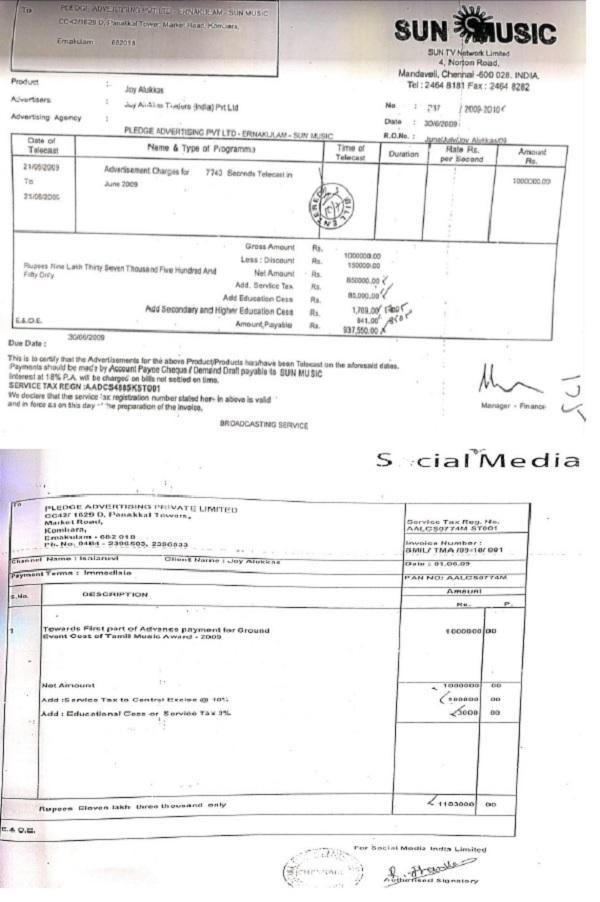
Thus, from the above, it is seen that 15% commission is retained by the appellant after paying the balance to the broadcaster who has discharged service tax.
6. The Tribunal in the case of Euro RSCG Advertising Ltd. (supra), in similar set of facts, this Tribunal held as follows:
“In the present case, a person or an organization who wants to advertise their product approaches an advertising agency. Therefore such a person/organization who wants to avail the services of advertising agency becomes the client of the advertising agency. The advertisement can be done in various ways either through Print Media or through Radio or Television, etc. in order to fulfill the requirements of his client the advertising agency which is the service provider gets in touch with the appropriate media. In other words as far as the advertising agency is concerned, its client is not the media. In order to provide advertising services the advertising agency charges certain amounts from the clients. Such amounts are liable to service tax. With regard to the relationship between the advertising agency and the media, the advertising agency has to pay amount to the media and not the other way. To put it differently, the media such as broadcasting agency charges the advertising agency for insertion of the advertisement either in Print Media or in Television. In the present case, the media gives a discount of 15% to the advertising agency. If the Tariff rate is Rs. 100/-, it is sufficient the advertising agency pay the media Rs. 85/- along with service tax. The service tax component received from the advertising agency in turn is remitted to the exchequer by the media agency. The appellants have demonstrated that they have not received any amount from the media. They got only a discount from them. Perhaps the word “commission” is misleading. There is actually no evidence that the said amount has been received by the appellant from the media. In any case, any amount received by the service provider from his client only is liable to service tax and not amounts received from others.”
7. The above view was also upheld in the case of Mccann Erickson (India) Pvt. Ltd. vs. Commissioner of Service Tax, Delhi: 2008 (10) STR 365 (Tri.-Del.), wherein it had observed as:
“The basic point which should be borne in mind is that service tax is levied on the gross amount received by the service provider from the recipient of the service for the services rendered. In this case, the appellant is the service provider. The appellant being an advertisement agency rendered advertising service by engaging print, electronic media etc. The tax authorities should see whether the appellants had discharged duty liability on the gross amount received from their clients. In this case, the various media are not clients of the appellant namely, the advertising agency. If the media gives discount of 15% to the appellant, that amount has nothing to do with the gross amount received by the appellant from their clients to whom they rendered advertisement services. Therefore, there is no logic in demanding service tax on the discount of 15% received by the appellant from print media.”
8. The fact that from the amount paid by their clients a commission of 15% is retained by the appellant is also not disputed. Therefore, it is as per the clarification by the Board that the services rendered by the appellant do not fall into the category of Advertising Agencies under Section 65(105)(e) since other activities undertaken by them are not placed on record except to state that their financial records show that they have amounts under the category of printing and creative work charges. We also find that from the statement and the reply of the appellant, they have undertaken services of procuring the sale of space for advertisement in the print media and the visual media; therefore, the appellant who is undertaking activities of a mediator between their clients and the broadcaster for a commission of 15% cannot be considered Advertising Agency as clarified by the Board under the above Circular dated 23.08.2007.
9. As regarding the finding on ineligible cenvat credit, we find that during the relevant period, they have taken cenvat credit of Rs.87,88,601/- as Service Tax, Rs.2,04,285/- as Education Cess and Rs.1,02,106/- as Higher Education Cess and had utilized the same for payment of Service Tax. The adjudication authority rejected the claim on the ground that the appellant failed to produce any required document to support their claim. However, to find out whether the cenvat credit availed by them includes the advertisement charges paid to publisher, breakup of the total cenvat credit availed by the appellant is not available on record. Further, on perusal of the invoices relied on by the appellant during the relevant period, an invoice dated 30.06.2010 (reproduced below) was issued by M/s. Sun Music to the appellant. There is no mention regarding the service tax registration of the appellant and it is clearly mentioned that the advertisers are M/s. Joy Alukkas Traders India Pvt. Ltd. and the appellant is shown as advertising agency only.
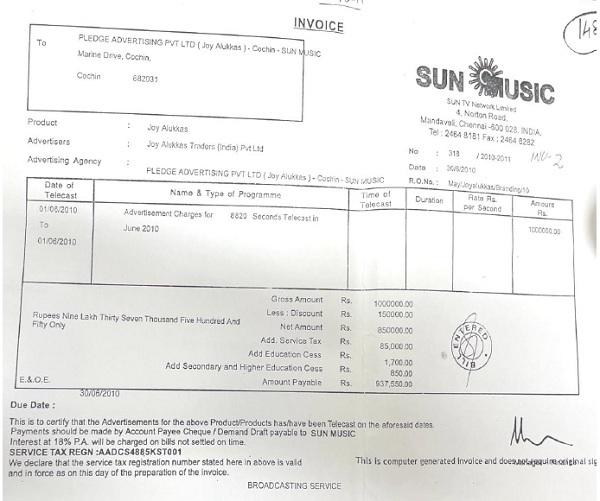
9.1 Similarly, appellant had also drawn our attention to the invoice issued by the appellant to M/s. Joy Alukkas Traders India Pvt. Ltd. dated 31.03.2010 showing the gross value, discounted price, service tax etc. Thus, on perusal of the few invoices, we find that some of the invoices are issued by the appellant to the advertisers on the amount received from them and appellant is eligible for claiming cenvat credit on those invoices. However, if the invoices are issued in the name of the appellant by the broadcaster, as per the decision of the Tribunal in the matter of Zapak Digital Entertainment Ltd. vs. CST, Mumbai -II [2017(49) STR 455 (Tri. Mumbai)] which is upheld by the Hon’ble High Court of Bombay reported as CST-VI, Mumbai Vs. Zapak Digital Entertainment Ltd. [2018(18) GSTL 583 (Bom.)], appellants are not eligible for cenvat credit.
10. As regarding demand confirmed by invoking extended period of limitation and penalty imposed, we find that the show-cause notice proposed to impose penalty under Rule 15A of the CCR, 2004; there was clear absence of invocation of Rule 15(3) of CCR and Section 78 of the Finance Act, 1994 alleging fraud, collusion, willful mis-statement or suppression of facts or contravention of CCR, 2004 or Finance Act, 1994. Accordingly, demand confirmed and penalty imposed due to disallowance of cenvat by invoking extended period of limitation is unsustainable and the same is set aside
11. Thus, demand as per the impugned order confirming the demand on advertising agency service during the period 2006-07 to 2010-11 is set aside. As regarding disallowance of cenvat credit, matter is remanded to the adjudication authority to find out whether the appellant had claimed any ineligible credit on the invoices issued by the broadcaster / print media which is addressed to the appellant as an agent of advertiser and in case, any such cenvat claim is made, demand should be confirmed against said amount only for normal period by considering the judgment of Zapak Digital Entertainment Ltd. (supra).
Accordingly, Appeal is partially allowed by way of remand.
(Order pronounced in Open Court on 18.11.2026.)



