Kuldeep Rai Vs DCIT (ITAT Chandigarh)
Summary: The Chandigarh Bench of the Income Tax Appellate Tribunal allowed the appeal of Kuldeep Rai for Assessment Year 2022-23, holding that additions based solely on unsigned ledger accounts and Excel sheets and statements obtained during a search of a third party could not be sustained without independent corroborative evidence. The assessee was engaged in manufacturing and trading hosiery goods and knitted cloth and had declared income of Rs. 15,57,020. The case was selected for scrutiny following information arising from a search under Section 132 of the Income-tax Act at M/s J.M. Jain LLP. The Assessing Officer treated the material recovered during that search as evidence of unaccounted cash transactions involving the assessee.
The Assessing Officer made three additions: Rs. 1,07,52,470 under Section 69A towards alleged unaccounted receipts or turnover, Rs. 15,97,692 towards alleged capital employed, and Rs. 17,37,071 towards estimated profit. The CIT(A), National Faceless Appeal Centre, confirmed the additions. Before the Tribunal, the assessee contended that the Assessing Officer had not supplied the relied-upon seized material or third-party statements, had denied an opportunity of cross-examination, and had failed to establish any independent nexus between the assessee and the alleged cash transactions.
The assessee relied upon several Tribunal decisions arising from the same J.M. Jain LLP search, including ACIT Vs Kapadia Bros, Vista Tie Up Pvt. Ltd. Vs ITO, Din Dayal Jalan Textile Pvt. Ltd. Vs ACIT, DCIT Vs Vikas Kumar Chhajer and Jeewan Kukreja Vs DCIT. The submissions also referred to judicial principles governing third-party material and corroboration of seized records, cross-examination and the evidentiary value of loose papers.
The Tribunal observed that the unsigned ledger and Excel sheets recovered from the premises of J.M. Jain LLP could not automatically be treated as incriminating evidence against the assessee. No independent evidence established actual cash payments, ownership or possession of unexplained money, or a connection between the entries and the assessee’s undisclosed transactions. Referring to Common Cause Vs Union of India, (2017) 394 ITR 220 (SC), the Tribunal noted that loose sheets did not possess the evidentiary character of regular books of account. It further held that the requirements for invoking Section 69A had not been established.
The Tribunal found the controversy covered by the Mumbai Bench decision in Din Dayal Jalan Textile Pvt. Ltd. Vs ACIT, involving substantially similar third-party search material. It concluded that additions founded on unverified third-party information, without assessee-specific corroboration and an effective opportunity to rebut the evidence, were unsustainable. The impugned additions were deleted and the assessee’s appeal was allowed. The order was pronounced on 10 August 2026.
Cases Discussed
- ACIT Vs Kapadia Bros, ITA No. 878/Mum/2026, dated 13.07.2026 (ITAT Mumbai) — Relied upon by the assessee concerning independent corroboration of third-party seized records.
- Din Dayal Jalan Textile Pvt. Ltd. Vs ACIT, ITA No. 7678/Mum/2025, dated 16.02.2026 (ITAT Mumbai) — Followed on substantially identical facts involving third-party search material and additions under Section 69A.
- Jeewan Kukreja Vs DCIT, ITA No. 492/RPR/2025, dated 12.05.2026 (ITAT Raipur) — Cited by the assessee concerning denial of cross-examination.
- Vista Tie Up Pvt. Ltd. Vs ITO, ITA No. 2091/Kol/2025, dated 14.11.2025 (ITAT Kolkata) — Relied upon by the assessee concerning uncorroborated third-party documents and failure to furnish relied-upon material.
- DCIT Vs Vikas Kumar Chhajer, ITA No. 212/Viz/2025, July 2025 (ITAT Visakhapatnam) — Discussed in the quoted Kapadia Bros decision concerning third-party Excel sheets and absence of corroboration.
- Common Cause (A Registered Society) Vs Union of India, (2017) 394 ITR 220 (Supreme Court) — Relied upon regarding the evidentiary value of loose sheets and informal records.
- Kishan Chand Chellaram Vs CIT, (1980) 125 ITR 713 (Supreme Court) — Discussed in the quoted Vista Tie Up decision concerning disclosure of adverse evidence and opportunity to rebut it.
- ACIT Vs Ms. Lata Mangeshkar, 97 ITR 696 (Bombay High Court) — Discussed in the quoted Vista Tie Up decision concerning reliance on third-party material without corroboration.
- PCIT Vs Forum Sales Pvt. Ltd. (Delhi High Court) — Discussed in the quoted Vista Tie Up decision concerning estimation of income without rejection of books.
FULL TEXT OF THE ORDER OF ITAT CHANDIGARH
This appeal by the assessee is directed against the order dt. 13.01.2026 of the learned Commissioner of Income Tax (Appeals), National Faceless Appeal Centre (NFAC), Delhi [hereinafter referred to as “Ld. CIT(A)”], passed under Section 250 of the Income Tax Act, 1961 (hereinafter referred to as “the Act”) for the Assessment Year (A.Y.) 2022-23.
2. Brief facts of the case are that the Assessee is an individual engaged in the business of manufacturing and trading of hosiery goods and knitted cloth. The Assessee duly furnished his return of income for the assessment year under consideration on 23.09.2022, declaring a total income of Rs. 15,57,020/-.
3. The case was selected for scrutiny for the reasons ‘verification of transactions uploaded CRIU’ through CASS as per the verification report uploaded through VRU on insight portal received from DDIT unit 5(1), New Delhi, search and seizure action u/s 132 of the IT Act, 1961was conducted at M/s J.M.Jain LLP a leading group in the garment sector (erstwhile M/s JM Jain, a proprietorship). During the search action, clinching evidence of unaccounted transaction was found, it was found that the cheque transactions were recorded in the books of the account by the customer/vendor parties. However, the cash transactions were not recorded by the customer/vendor parties in their books of account. These unaccounted transactions were managed and controlled by the employees of J.M.Jain as per the directions. The same was confirmed from the statement recorded during the post search investigation of various customer/vendor parties. Therefore, the cash transactions made by the customer/vendor parties remain unaccounted for customer/vendor. Further as per the information assessee is one such party who has done transaction with the above-mentioned entity as per the ledger and excel sheet available at the time of search, the same is reproduced herein under:
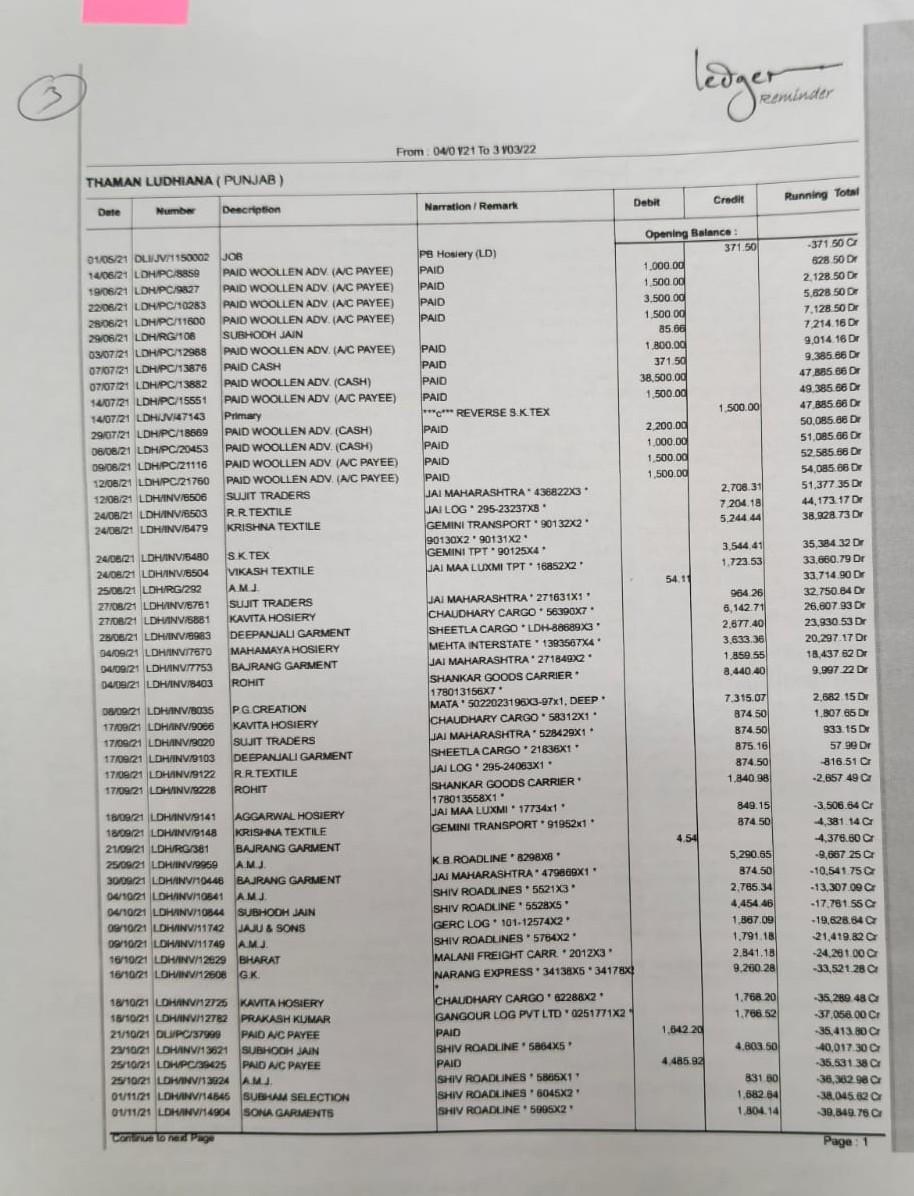
–
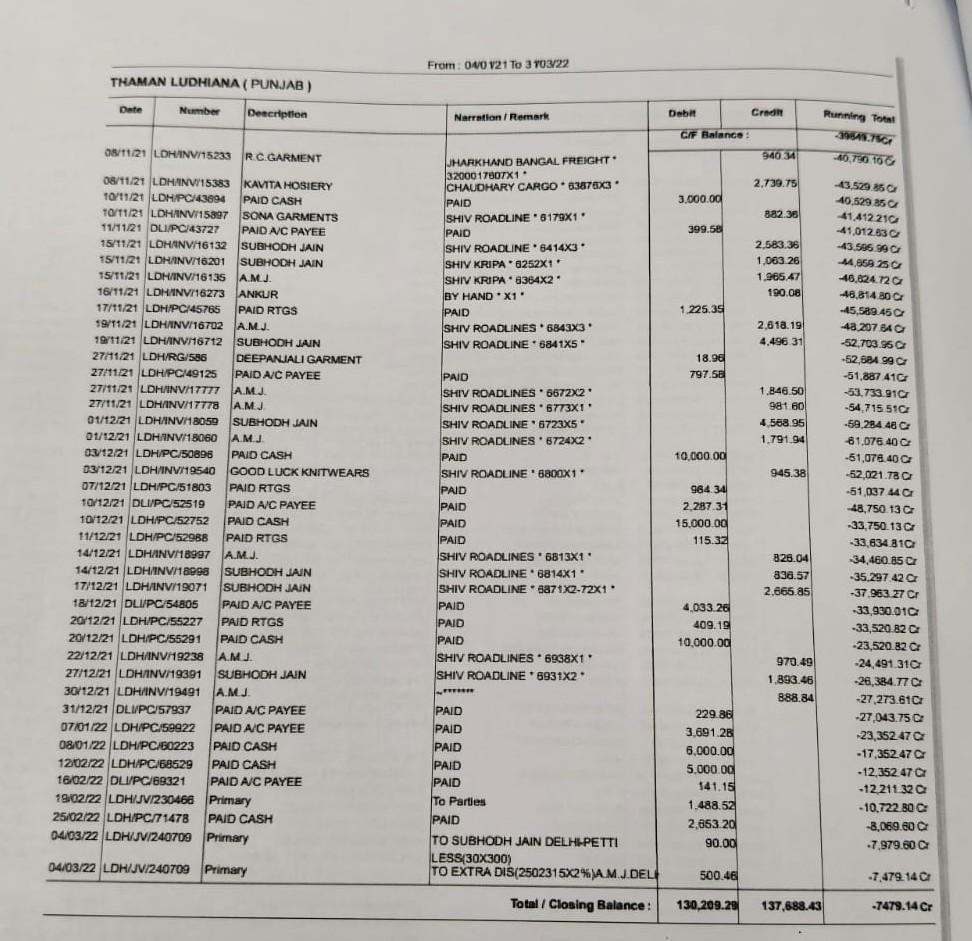
4. While finalising the assessment, the Assessing Officer made addition of –
a) Rs. 1,07,52,470/- u/s 69A on account of alleged unaccounted receipts/ turn over.
b) Rs. 15,97,692/- on account of alleged capital employed in the purported unaccounted transactions; and
c) Rs. 1737071 on account of alleged profit purportedly earned form such alleged unaccounted cash transactions. The detailed working of the above addition was worked out at page 21 of the assessment order.
6. Being aggrieved against the addition made, the Assessee preferred an appeal before the Ld. CIT(A) which was dismissed by Ld. CIT(A) by confirming the addition made by the Assessing Officer.
7. The submissions of the Ld. AR, given through a brief note are as under:-
“The Ld. AR for the Assessee submitted that during the course of assessment proceedings, he has furnished comprehensive documentary evidence – and detailed explanations substantiating the genuineness and completeness of the transactions recorded in its books of account. However, the Ld. AO, without providing any relied upon material, without providing copies of statement of other party recorded and without providing opportunity to cross examine the other person and without appreciating the evidences furnished by the assessee and without conducting any independent enquiry or bringing on record any corroborative material establishing the alleged unaccounted cash transactions, proceeded to make additions merely on the basis of dumb document in the form of unsigned and unverified ledger account alleged to have been seized from a third party and the statements recorded of such 3rd parties, during the course of the search^’ Consequently, the Ld. AO made the following additions:
a) Rs. 1,07,52,470/- u/s 69A on account of alleged unaccounted receipts / turnover;
b) Rs. 15,97,692/- on account of the alleged capital employed in the purported unaccounted transactions; and c) Rs. 17,37,071/- on account of the alleged profit purportedly earned from such alleged unaccounted cash transactions. Being aggrieved by the aforesaid additions, the appellant preferred an appeal before the Worthy CIT(A). However, the Worthy CIT(A), without properly appreciating the factual and legal submissions advanced by the appellant, dismissed the appeal and affirmed the additions made by the Ld. AO. Aggrieved, the appellant preferred the present appeal before this Hon’ble Tribunal.
It is submitted that identical additions arising out of the very same search conducted in the case of M/s J.M. Jain LLP, involving substantially similar allegations of alleged unaccounted cash transactions facilitated through the said entity, have repeatedly come up for consideration before various Benches of the Hon’ble ITAT. The Hon’ble Tribunals, after an exhaustive examination of the factual matrix and settled legal principles, have consistently held that additions founded solely uponthird-party seized material and statements, in the absence of any independent corroborative evidence linking the respective assessee’s with the alleged unaccounted transactions, are legally unsustainable. The relevant judicial precedents, which squarely cover the controversy involved in the present appeal, are reproduced hereunder:
ACIT vs Kapadia Bros (878/Mum/2026) (13.07.2026) (Mumbai ITAT) “
7.3. From the careful reading of the first appellate order and the findings arrived therein, we find that the factual matrix before us and as considered by the Id. CIT(A) is substantially identical to the one already dealt by the Coordinate Bench in the case of Vikas Kumar Chhajer (supra). Thus, the issue before us in the present appeal is no longer res Integra. Except for the excel sheet recovered from the third party, i.e., JM Jain LLP in the course of search and recording of statements of certain persons unrelated to the assessee, no other contemporaneous documents belonging to the assessee has been brought on record to demonstrate that assessee has actually undertaken the said transactions as alleged by the Id. Assessing Officer supposed to be in cash. There is no independent financial trail, no evidence of movement of cash nor any other corroborative material to establish the allegation raised while initiating the re¬assessment proceedings. It is a settled position of law that thepresumption arising from material recovered during the search is primarily available against the person from whose possession or control such material is found. Mere mention of name of assessee in the records maintained by another person or inclusion of such name in a disclosure made in the statement recorded during the course of search cannot by itself dispense the requirement of independent corroboration so as to bring that presumption to a reality.
7.4. Before us, Id. CITDR could not point out any distinguishing feature either on facts or in law to take a divergent view from the one already taken by the Coordinate Bench in the case of Vikas Kumar Chhajer (supra). Since the issues before us arise out of the very same search and the additions made are based on the same category of evidence, following the judicial discipline, more particularly in absence of any distinguishing factual feature, we do not find any reason to depart from the findings given by the Coordinate Bench (supra).
7.5. We also take note of another decision of the Coordinate Bench in the case of Din Dayal Jalan Textile Pvt. Ltd. vs. ACIT in ITA No. 7676/Mum/2025, dated 16.02.2026 wherein also similar factual matrix was dealt with. The fact as considered by the Coordinate Bench in this case are extracted from para-11. 11. During the course of hearing, the learned Authorised Representative (AR) reiterated the facts and submitted that the addition ofRs. 1,00,00,000/- as alleged unaccounted commission paid to M/s J.M. Jain LLP has been made solely on the basis of information received from the Investigation Win.g in consequence of search conducted in the case of J.M. Jain LLP on 28.05.2022. It was submitted that during search proceedings in the case of J.M. Jain LLP, certain entries were allegedly found in a parallel SAP based server known as “JSK Server”, said to record cheque components and cash components of transactions. On that basis, it was alleged that the assessee had paid Rs. 2,00,00,000/- to M/s J.M. Jain LLP, out of which Rs. 1,00,00,000/- was treated as unaccounted commission.
7.6. On the above stated facts, the Coordinate Bench concluded in para-32 that additions confirmed by Id. CIT(A) cannot be sustained based on assessee’s objection on lack of corroboration and denial of effective opportunity. The said para is extracted for ready reference:
32. Considering the totality of facts, the contradictions highlighted by the learned DR, and the assessee’s objections on lack of corroboration and denial of effective opportunity, we are of the view that both additions, as confirmed by the learned CIT(A), cannot be sustained on the present record. The additions are founded primarily on third-party information without assessee-specific corroboration and without due compliance of principles of natural justice in respect of the material relied upon.
8. In the conspectus of the above detailed narration, both on facts and the position of law including provisions of the Act and the judicial precedents, we find that Id. CIT(A) has elaborately dealt with the issues both on fact and law so as to delete the additions made. Accordingly, we do not find any infirmity in the findings arrived at by the Id. CIT(A) wanting our interference. Accordingly, grounds raised by the Revenue are dismissed.
9. In the result, appeal of the Revenue is dismissed.
10. Assessee has filed its cross objection against the appeal filed by the Revenue. From the perusal of the grounds in the cross objection, we note that they are nothing but supporting the order of Id. CIT(A). Several grounds raised in the cross objection by the assessee are more of peripheral arguments, so as to defend its case against the appeal filed by the Revenue. All these contentions raised through several grounds of cross objection have already been addressed and considered by us while adjudicating the appeal by the Revenue which has culminated into dismissal of its appeal. Thus, no separate adjudication is warranted on the grounds of cross objection raised by the assessee. Having dismissed the grounds of the appeal in terms of our above observations and findings, the cross objection filed by the assessee stands allowed.
11. In the result, appeal of the Revenue is dismissed and the cross objection of the assessee is allowed.”
Vista Tie Up Pvt. Ltd. vs ITO (2091/Kol/2025) (14.11.2025) (Kolkata ITAT)
“6. We have carefully considered the rival submissions, examined the record, and perused the judicial precedents cited. The addition of ^61,49,041/- has been made solely on the basis of information emanating from seized documents found in the case of M/s J.M. Jain LLP, which allegedly contained entries of PJ Garments. It is undisputed that the said documents were not seized from the assessee’s premises and were never provided to the assessee for rebuttal. The law is well settled that additions cannot be made on the basis of unverified third-party material. In ACIT v. Ms. Lata Mangeshkar (97ITR 696, Bom), the Hon’ble High Court held that tax authorities cannot make additions merely relying upon third-party documents or statements without independent corroboration. Suspicion, however strong, cannot replace evidence. In the present case, the AO did not establish any direct nexus between the assessee and the seized material. The assessee categorically denied having any business transaction with M/s J.M. Jain LLP and produced purchase bills and confirmations from other regular suppliers. The AO did not’ disprove the genuineness of such records. Further, as rightly contended, the AO did not invoke section 145(3) to reject the books of account. The Hon’ble Delhi High Court in PCIT v. Forum Sales Pvt. Ltd. (supra) has clearly held that estimation of income is permissible only after rejection of books of account on valid grounds. In the absence of such rejection, the AO’s estimation of 8% on alleged unaccounted purchases is legally unsustainable. We also note that the alleged seized ledger has not been authenticated or proved to belong to the assessee. Section 292C of the Act creates a rebuttable presumption of ownership only when documents are found in possession of the assessee or its authorized agent. In the present case, the documents were found in the possession of a third party; hence, such presumption is inapplicable. The AO’s failure to furnish copies of seized material relied upon against the assessee amounts to violation of natural justice, as held by the Hon’ble Supreme Court in Kishan Chand Chellaram v. CIT [1980] 125 ITR 713 (SC),. The Hon’ble Supreme Court in the case of Kishan Chand Chellaram v. CIT [1980] 125 ITR 713 (SC), the Court held that though the proceedings under the Income are not governed by the strict rules of evidence, the department is bound to afford an opportunity to controvert and cross- examine the evidence on which the department places its reliance on. Therefore, the addition made by the AO and confirmed by the CIT(A) is not supported by any tangible material, is based on mere suspicion, and third-party information and cannot be sustained in law. Considering the totality of facts and circumstances, and in light of judicial precedents, we hold that the AO was not justified in making an addition of Rs. 62,49,041/- without rejecting the books of account under section 145(3), furnishing seized materials to the assesses and (establishing any nexus between the assessee and the alleged unaccounted purchases. Accordingly, we hold that the said addition of Rs. 61,49,041/- is unjustified andi s hereby deleted.
7 In the Result, the appeal of the Assessee is allowed.”
Din Dayal Jalan Textile Pvt. Ltd. vs ACIT (7678/Mum/2025) (16.02.2026) (Mumbai ITAT)
DCIT US Vikas Kumar Chhajer (212/Viz/2025) (July, 2025) (Visakhapatnam ITAT)
(deleted on non-allowance of cross examination) Jeewan Kukreja vs DCIT (492/RPR/2025) (12.05.2026) (Raipur ITAT)
(addition deleted since relied upon material not provided)”
6. The ld. DR relied on the orders of the authorities below.
7. We have heard the rival submissions of the parties and perused the material available on record. The ld. AO has relied on the ledger / excel sheets to hold that the Assessee introduced unaccounted cash transactions and the same to be taxed under the provisions of the Act as undisclosed cash transaction of the Assessee. The ledger / excel sheet found from third- party cannot be treated as incriminating material for the assessee unless they are corroborated with cogent evidence. The ledger account/ excel sheet relied upon by the AO are not corroborated one seized document is adumb document for the assessee which cannot be relied upon to make impugned addition in the hands of the assessee. We further hold that unsigned ledger has no evidentiary value. The Assessing Officer has to establish nexus between the ledger / excel sheet and undisclosed transaction of the Assessee. In the said ledger / excel sheet there is no signature of the Assessee. No details of description are mentioned in the said ledger since the ledger are unsigned and contents thereof are inadequate to fasten the liability on the Assessee.
8. Further the Hon’ble Supreme Court in the case of Common Cause (A registered Society) Vs. Union of India (2017) 394 ITR 220 (SC) in Writ Petition (Civil) No.505 of 2015 dated 2.7.2018 considered and observed that the entries in the loose papers/sheets are not “books of accounts” and has no evidentiary value u/s 34 of the Indian Evidence Act. The Hon’ble Supreme Court dismissing the writ petition filed by Common Cause, a registered society, refused to give nod to investigate against the Sahara and Birla Groups in the alleged pay-off scandal.
9. In the present case, the addition made by the Assessing Officer towards the unaccounted cash transactions is solely on the basis of ledger / excel sheet found during the course of search at the third-party premises being ‘scribbling pad’ / loose slips coupled with statement recorded during the course of search from the third party. Except these, Ld. AO has not brought on record any other evidence to support the impugned addition in the hands of the assessee. There is no dispute with regard to the fact that incriminating material was found during the course of search, however, the same was found from third party premises and the same is in the form of unsubstantiated loose papers which is not sufficient enough to draw an adverse inference against the assessee. There is no corroboration to conclude that the information contained in the ledger / excel sheet indicate undisclosed income of the assessee.
10. It has further been noted that the addition has been made by the Assessing Officer u/s 69A of the Act. We find that for the applicability of section 69A, there must be a finding that the assessee is the owner of unexplained money, such money is not recorded in the books of account, and the explanation offered by the assessee is found to be unsatisfactory. However, in the present case, there is no finding establishing possession or ownership of any unexplained money by the assessee. No evidence of actual payment of unaccounted cash has been brought on record and the entire addition is based on third party information. Therefore, we are of the considered view that invoking the provisions of section 69A of the Act in the facts of the present case is unjustified. The case of the Assessee is squarely covered by the decision of the Mumbai Bench of the Tribunal inDin Dayal Jalan Textile Pvt. Ltd, Mumbai vs ACIT (ITA No. 7678/Mum/2025 order dated 16.2.2206). The bench on, identical facts, held that where additions are made on the basis of third-party statements/material, denial of effective opportunity to rebut the same, including cross-examination where statements are relied upon, vitiates the evidentiary use of such statements to the prejudice of the assessee. Since the addition was premised on an inference drawn from third-party information without identifying assessee- specific transaction details and without establishing ownership/possession of unexplained money in the hands of the assessee, addition u/s 69A could not be sustained. Keeping in mind all these facts, we would hold that impugned addition could not be sustained. We order so.
11. In the result, the appeal filed by the assessee is allowed.
Order pronounced in the open court on 10.08.2026.