Naresh Kumar Vs PCIT (ITAT Jaipur)
₹1.49 Crore Land Acquisition Interest: A Possible View Cannot Be Revised Under Section 263
An Exemption Examined by the AO, but Reopened by the PCIT
The Jaipur Tribunal, deciding the appeal in accordance with a Third Member majority opinion, held that an assessment could not be revised under Section 263 merely because the PCIT disagreed with a legally possible view adopted by the Assessing Officer. The dispute concerned ₹1,48,69,136 received as interest under Section 28 of the Land Acquisition Act, 1894, on enhanced compensation for compulsory acquisition of agricultural land.
The decision is significant on two counts. It protects an assessment where the AO had actually examined the disputed claim, and it accepts, on the facts of this case, that the Section 28 receipt formed part of compensation and was not taxable in the assessee’s hands.
The Assessment and the Revision
The assessee filed his return declaring income of ₹9,81,530 and claimed exemption for the amount received on enhanced land acquisition compensation. His case was selected for complete scrutiny concerning the refund claim.
During assessment, the AO issued notices under Sections 143(2) and 142(1). The questionnaire specifically sought an explanation for the exemption claimed on the land acquisition interest, together with relevant orders and supporting evidence.
The assessee furnished the acquisition award, supporting documents and an explanation that the receipt arose under Section 28 of the Land Acquisition Act. Relying on judicial precedents, he contended that it represented an accretion to compensation rather than ordinary interest income. The AO accepted the returned income through an assessment dated 8 September 2021, under Section 143(3) read with Section 144B.
The PCIT subsequently revised the assessment by an order dated 7 February 2024. According to him, Section 145B(1), read with Section 56(2)(viii) and Section 57(iv), required taxation of the interest in the year of receipt, subject to a 50% deduction. He therefore set aside the assessment for fresh verification.
An Assessment Order’s Silence Does Not Establish Absence of Enquiry
The Tribunal’s majority found that the assessment records contradicted the suggestion that the claim had been accepted mechanically. The AO had raised a specific query on the very receipt subsequently questioned by the PCIT, and the assessee had supplied a detailed response supported by documents.
The Third Member emphasised that an assessee has no control over how the AO drafts the assessment order. Where the questionnaire and replies establish examination of the issue, the absence of an elaborate discussion in the final order cannot, by itself, establish non-application of mind.
This distinction was central to the result. An issue examined and accepted cannot automatically be treated as an issue never examined, merely because the assessment order records the conclusion briefly.
Section 263 Requires More Than a Different Opinion
The majority reiterated that the assessment must be both erroneous and prejudicial to the interests of the Revenue before Section 263 can be invoked. Both conditions must coexist.
Following the principles in Malabar Industrial Co. Ltd. v. CIT, 243 ITR 83 (SC), the Third Member explained that every loss of revenue does not justify revision. Where the AO adopts a course permissible in law, or chooses one of two possible views, the Commissioner’s disagreement does not render the assessment erroneous unless the chosen view is legally unsustainable.
Here, the AO’s acceptance of the claim had judicial support. Consequently, the PCIT could not substitute his preferred interpretation through revision without establishing that the AO’s view was unsustainable.
Section 28 Interest and the Judicial Divide
The assessee relied on CIT v. Ghanshyam (HUF), 315 ITR 1 (SC), which distinguished interest under Section 28 from interest under Section 34 of the Land Acquisition Act. Section 28 interest was treated as part of enhanced compensation, whereas Section 34 interest concerned delay in payment.
The controversy arose from the subsequent income-tax amendments governing interest on compensation. The order discusses competing judicial interpretations, including adverse decisions of the Punjab and Haryana High Court and favourable authority treating Section 28 receipts as compensation.
The Third Member also relied on a Kerala High Court judgment dated 11 April 2025 in ITA No. 32 of 2023, reproduced in the order. That judgment treated the relevant land acquisition interest as an accretion to compensation and recognised the consequential benefit of Section 10(37).
No contrary judgment of the jurisdictional High Court was brought to the Third Member’s notice. He therefore accepted the favourable view and held that ₹1,48,69,136 was not taxable in this assessee’s hands.
The Majority Decision
The original Members differed, resulting in a reference under Section 255(4). Vice President Rajpal Yadav, acting as Third Member, agreed with the Accountant Member that the AO had adopted a possible view and that revision was unsustainable. He also rejected the need for a Special Bench reference in the circumstances.
Giving effect to the majority opinion, the Tribunal allowed the assessee’s appeal.
Author’s Comments
The strongest practical lesson is the importance of preserving assessment questionnaires, replies, acquisition awards and supporting certificates. These records can establish actual enquiry even where the assessment order is brief.
The ruling provides substantial support against Section 263 action on an examined, debatable claim. However, the exemption finding should be applied with attention to the nature of the award, Section 10(37) eligibility and the applicable High Court precedent. The existence of a judicial controversy strengthens the protection against revision; it does not make every land acquisition interest receipt automatically exempt.
Cases Discussed
- Malabar Industrial Co. Ltd. v. CIT, (2000) 243 ITR 83 (SC) — relied upon for the twin conditions governing Section 263 and the principle that a permissible view adopted by the AO is not revisable merely because the Commissioner prefers another view.
- CIT v. Ghanshyam (HUF), (2009) 315 ITR 1 (SC) — relied upon concerning the character of interest under Section 28 of the Land Acquisition Act as part of enhanced compensation and the distinction from Section 34 interest.
- Movaliya Bhikhubhai Balabhai v. ITO, (2016) 388 ITR 343 (Guj.) — relied upon for treating Section 28 interest as part of compensation rather than ordinary interest income.
- Mahender Pal Narang v. CBDT, (2020) 423 ITR 13 (P&H) — contrary authority considered on post-amendment taxability of interest on compensation.
- Pawan Kumar v. PCIT, ITA No. 1655/Del/2023 (ITAT Delhi) — considered as authority that the Section 28 taxability controversy was at least debatable and could not support revision where the AO had adopted a possible view.
- Sanjay Kumar Sharma v. PCIT, ITA No. 357/Del/2023 (ITAT Delhi) — relied upon on revision under Section 263 concerning Section 28 land acquisition interest.
- Gulshan Kumar v. PCIT, ITA No. 1676/Del/2023 (ITAT Delhi) — relied upon on the possible-view principle in a Section 263 dispute involving Section 28 interest.
FULL TEXT OF THE ORDER OF ITAT MUMBAI
The present appeal was originally heard by the Division Bench consisting of Hon’ble Accountant Member, Sh. Rathod Kamlesh Jayantbhai and Hon’ble Judicial Member, Sh. Narinder Kumar. On account of a difference of opinion between the Hon’ble Members on certain issues arising in the appeal, the following point(s) of difference were framed and referred to the Hon’ble President of the Tribunal under Section 255(4) of the Income Tax Act, 1961 (hereinafter referred to as “the Act”).
“Whether based on the facts and circumstances of the case when the Ld. AO has verified the issue of chargeability of interest in hands of the assessee and taken a plausible view. Whether that view taken by the Ld. AO which is one of the plausible view can be subjected to revision as per provision of Section 263 of the Act or not”
2. The Hon’ble President, in exercise of powers u/s 255(4) of the Act, nominated a Third Member to resolve the point(s) of difference. The Hon’ble Third Member has since rendered his opinion vide order dated 05.05.2026.
Order of Hon’ble Judicial Member
Per Shri Narinder Kumar
Instant appeal challenges order dated 07.02.2024, passed by Learned PCIT, Jaipur-1 under section 263 of the Income Tax Act, 1961.
2. Matter relates to the assessment year 2019-20.
3. On 08.09.2021, assessment order was passed by the Assessing Officer under section 143(3) read with section 144B of the Income Tax Act, 1961 (in short “the Act”) accepting the computation of income as submitted by the assessee-appellant.
Setting aside of the assessment Order by PCIT
4. Vide impugned order, Learned PCIT has set aside the assessment made by the Assessing Officer and directed assessment afresh.
5. Learned PCIT has held that abovesaid assessment order dated 08.09.2021is erroneous in so far as same is prejudicial to the interest of the Revenue, same having been passed in a routine and causal manner, without applying the relevant provisions of the Act, and without verifying the details, which were required to be verified by the Assessing Officer during scrutiny.
Directions issued by PCIT
6. As a result, Learned PCIT has set aside the assessment order and directed the Assessing Officer to make fresh assessment order, after making necessary verification having regard to the observations made in the impugned order, of course, while allowing reasonable opportunity of being heard to the assessee.
Point in Issue involved here
7. Herein, mainly the question of applicability of provisions of section 145B(1) r.w.s. 56(2)(viii) and section 57(iv) of Income Tax Act is involved.
8. The assessee has challenged the impugned order on the following grounds:-
“1. The Ld. Principal Commissioner of Income Tax, Jaipur-1, (‘PCIT’) was not justified in passing order u/s 263 of the Income Tax Act, 1961 (‘the Act’), overlooking the assessment order passed by the Assessing officer and failing to satisfy the statutory twin conditions prescribed under section 263 of the Act. viz., (i) that the assessment order is erroneous; and (ii) that the assessment order is prejudicial to the interest of Revenue, which are to be cumulatively satisfied.
2. The Ld. PCIT was not justified in passing order u/s 263 of the Act, by failing to appreciate that the assessment order passed by the Ld. assessing officer is in accordance with the decisions of the Hon’ble Supreme Court in the cases of CIT v. Ghanshyam (HUF) [2009] 182 Taxman 368/315 ITR 1(SC), CIT, Rajkot v GovindbhaiMamaiya [2014] 52 taxmann. com 270/[2015] 229 Taxman 138/2014) 367 ITR 498(SC), UOI V Hari Singh [2018] 91 taxmann.com 20 (SC) and, therefore, being so the assessment order passed under section 143(3) r.w.s. 143(3A) & 143(3B) of the Act dated 08.09.2021 was not amenable to revision under section 263 of the Act.
3. The Ld. PCIT was not justified in passing order u’s 263 of the Act, in considering the interest u/s 28 of the Land Acquisition Act received as part of enhanced compensation, being taxable ignoring the fact that the exemption of said interest is duly supported by judicial precedents and therefore, at best, could be said to be debatable issue ousting the jurisdiction under section 263 of the Act.
4. The Ld. PCIT was not justified in passing order u/s 263 of the Act, in considering the interest u/s 28 of the Land Acquisition Act received as part of enhanced compensation, being taxable by failing to appreciate that the same was duly scrutinized by the Assessing Officer while passing the assessment order under section 143(3) r.w.s. 144B of the Act.
5. The Ld. PCIT was not justified in passing order u/s 263 of the Act, in not appreciating that even if the Assessing Officer has not specifically mentioned that he has examined/verified a particular issue in the assessment order, that would not ipso facto mean that there was non-application of mind on the part of the assessing officer on this issue.
6. The Ld. PCIT was not justified in passing order u/s 263 of the Act without providing an opportunity to the appellant of being heard in the matter and thus he has acted against the Principle of Natural Justice.
7. The appellant craves leave to add, amend, delete, modify and/or rectify any grounds of appeal.”
Additional ground-application by the assessee to raise the same
9. It may be mentioned here that during pendency of the appeal, the appellant filed an application seeking permission to raise following additional ground under Rule 11 of Income Tax (Appellate Tribunal) Rules, 1963 so as to challenge the impugned order pleading that same is beyond territorial jurisdiction of Ld. PCIT:-
“ 1. The ld. AO has erred in passing the impugned order for revision under section 263 of the Act, by completely ignoring the fact that the appellant is residing at Gurgaon and neither has any business/place of residence nor any situs of income in Rajasthan, and, therefore, the appellant is beyond the territorial jurisdiction of the ld. PCIT, in accordance with the provisions of section 120 of the Act.”
10. Heard on the application seeking permission to raise additional grounds. File perused.
Contentions
11. In the course of arguments, Ld. AR for the appellant-applicant has submitted that the above said additional ground sought to be raised is a legal ground and that the appellant be allowed to urge the same, even though the same was not raised before Learned PCIT.
Ld. AR has submitted that the appellant had neither any business or place of residence nor any situs of income in Rajasthan, and that since he has been residing at Gurgaon, Learned PCIT, Jaipur-1 had not territorial jurisdiction to deal with the matter and pass impugned order u/s 263 of the Act.
12. On the other hand, Learned DR for the department has strongly opposed the application and submitted that said additional ground should not be allowed to be raised, because the assessee participated in the assessment proceedings conducted by the Assessing Officer, without raising any protest to his jurisdiction to conduct the assessment proceedings as per remedy provided under the Act, and as such, the assessee can safely be said to have accepted the jurisdiction of the Assessing Officer.
Discussion on the application
Assessee never challenged jurisdiction of the Assessing Officer
13. Under section 124(3) of the Act, in case of any objection on the point of jurisdiction of Income Tax Authority/Assessing Officer, assessee is required to take steps at the first opportunity available.
14. Sub-section (3) of section 124 of the Act reads as under:
“(3) No person shall be entitled to call in question the jurisdiction of an Assessing Officer—
(a) where he has made a return 1 [under sub-section (1) of section 115WD or under sub-section
(1) of section 139], after the expiry of one month from the date on which he was served with a notice under sub-section (1) of section 142 or 2 [sub-section (2) of section 115WE or sub-section
(2) of section 143] or after the completion of the assessment, whichever is earlier;
(b) where he has made no such return, after the expiry of the time allowed by the notice under 3 [sub-section (2) of section 115WD or sub-section (1) of section 142 or under sub-section (1) of section 115WH or under section 148 for the making of the return or by the notice under the first proviso to section 115WF or under the first proviso to section 144] to show cause why the assessment should not be completed to the best of the judgment of the Assessing Officer, whichever is earlier;
(c) where an action has been taken under section 132 or section 132A, after the expiry of one month from the date on which he was served with a notice under sub-section (1) of section 153A or sub-section (2) of section 153C or after the completion of the assessment, whichever is earlier.”
15. Being relevant for the purpose of issue sought to be raised by way of additional ground, section 124(2) is reproduced hereunder:
“(2) Where a question arises under this section as to whether an Assessing Officer has jurisdiction to assess any person, the question shall be determined by the Principal Director General or Director General or the Principal Chief Commissioner or Chief Commissioner or the Principal Commissioner or Commissioner; or where the question is one relating to areas within the jurisdiction of different Principal Directors General or Directors General or Principal Chief Commissioners or Chief Commissioners or Principal Commissioners or Commissioners, by the Principal Directors General or Directors General or Principal Chief Commissioners or Chief Commissioners or Principal Commissioners or Commissioners concerned or, if they are not in agreement, by the Board or by such Principal Director General or Director General or Principal Chief Commissioner or Chief Commissioner or Principal Commissioner or Commissioner as the Board may, by notification in the Official Gazette, specify.”
16. In the case of ITO (Exemption) vs. Kalinga Institute of Industrial Technology, (2023) 151 taxmann.com 434 (SC), record revealed that the assessee had participated pursuant to the notice issued u/s 142(1) of the Act, andnot questioned the jurisdiction of the Assessing Officer.
17. Therein, Hon’ble Apex Court observed that Section 124(3)(a) precludes the assessee from questioning jurisdiction of the Assessing Officer, if he does not do so within the prescribed period of receipt of notice under section 142(1) i.e. within 30 days.
18. Herein, the Assessing Officer had issued notices u/s 142(1) of the Act, after having issued notice u/s 143(2) of the Act. Admittedly, the assessee participated in those proceedings by submitting his response, details information and documents sought by the Assessing Officer. Applying the provisions of Section124(3) of the Act, and the above said decision by Hon’ble Apex Court, the appellant cannot be allowed to raise this additional ground before this Appellate Tribunal when firstly, the assessee did not question the jurisdiction of the Assessing Officer, and then before Learned PCIT, and rather, he participated in the assessment proceedings and the proceedings under section 263 of the Act.
Result
19. In view of the above discussion, the assesseecannot be permitted to call in question the jurisdiction of the Assessing Officer by raising abovesaid additional ground.
20. Therefore, prayer made in this regard deserves to be hereby rejected.
Appeal On Merits
21. Then comes the question of legality or illegality of the impugned order passed by Learned PCIT.
Legality or illegality impugned order u/s 263 of the Act
Contentions
22. Learned AR for the appellant has submitted that section 28 of the Land Acquisition Act directs payment of interest on excess compensation as solatium, and therefore, same forms part of compensation. Learned AR has contended that there are decisions to the effect that interest received on enhanced compensation is part of compensation only and therefore provisions of section 56 and 145 of Income Tax Act do not come into application. Further, it has been submitted that it is the interest on delayed payment of compensation that is received under section 34, which would be considered as income from other source for the purposes of section 56 and then taxable as per provisions of section 145 of the Act in the year the same is received.
It has also been submitted that interest having been received by the assessee under section 28 of the Land Acquisition Act on enhanced compensation.
The ultimate contention is that the impugned order passed by Learned PCIT being contrary to law deserves to be set aside.
23. In the written submissions, Learned AR for the appellant has extracted certain portions from certain decisions. Said portion when extracted from the written submissions reads as under:
“On this point, the Hon’ble Gujarat High Court clarified in the case of MovaliyaBhikhubhaiBalabhai v. Income-tax Officer-TDS-1- Surat [2016] 70 taxmann.com 45 (Gujarat) that:
13. The upshot of the above discussion is that since interest under section 28 of the Act of 1894, partakes the character of compensation, it does not fall within the ambit of the expression “interest” as contemplated in section 145A of the I. T Act. The first respondent – Income Tax Officer was, therefore, not justified in refusing to grant a certificate under section 197 of the I.T. Act to the petitioner for non deduction of tax at source, inasmuch as, the petitioner is not liable to pay any tax under the head “ income from other sources” on the interest paid to it under section 28 of the Act of 1894.”
From the above discussion, it can be inferred that the amendments introduced regarding the taxability of interest is with respect to interest on delayed payment under section 34. It is reiterated that in accordance with the decisions and interpretations of the Hon’ble courts, that the interest received on enhanced compensation under section 28, is in the nature of solatium and forms part of the compensation itself. The amendments were introduced to clarify the timing of taxability of the interest component awarded under section 34 of the LA Act which is taxable by virtue of its nature.
The decision of the Apex Court in the case of CIT v. Ghanshyam (HUF) [2009] 182 Taxman 368 had laid down the fact that interest under section 28 of the Act of 1894 is part of the amount of compensation whereas interest under section 34 thereof is only for delay in making payment after the compensation amount is determined. Interest under section 28 is a part of the enhanced value of the land which is not the case in the matter of payment of interest under section 34. Further, insertion of section 145A, 145B, 56(2)(viii) and 57(iv) by the Finance (No.2) Act, 2009 did not change the character of interest under section 28 of the Land Acquisition Act from `capital receipt’ forming part of enhanced compensation. as envisaged in section 45(5) of the Act to ‘revenue receipt’ chargeable to tax as ‘Income from other Sources’.
Decision of Hon’ble P&H High Court
The decision of the the Hon’ble Punjab & Haryana High Court in the case of Manjeet Singh (HUF) Karta Manjeet Singh v. Union of India, [2016] 65 taxmann.com 160 has been considered by different benches of the Hon’ble ITAT and distinguished, based on the authoritative judgement of the Hon’ble Supreme Court in Ghanshyam (HUF). Further, lately, the Hon’ble Delhi ITAT has decided several matters related to land acquisition and interest thereon, considering that the interest received under section 28, i.e., on enhanced compensation of land, forms part of the compensation itself and hence, not taxable.
Further, it is also noted that the Hon’ble Pubjab and Haryana High Court in the case of Mahenderpal Narang vs CBDT CWP17971 of 2019 dated 19/2/2020 as well as in the case of Puneet Singh vs CIT, 110 taxmann.com 16, and Manjeet Singh HUF V Union of India, 137 taxman 116, has decided in favour of revenue. However, it is noteworthy that the Hon’ble Supreme Court dismissed the SLP of the assessee filed against the said decision of Hon’ble P & H High Court in-limine and it is a settled law that the dismissal of SLP in-limine does not amount to affirmation of the view taken by the High Court. Unless the judgment of the High Court is affirmed, at least, with short reasoning, the same would not amount to binding precedent.
Further, it is a settled law that Statute must be interpreted according to the intention of the legislature and the Court should act accordingly while applying the law and its interpretation. If a statutory provision is open to more than one meaning, the Court has to choose the interpretation which represents the intention of the legislature.
(PB Page Nos. 28-66)
The Ld. AO accepted the contentions of the appellant and concluded the assessment by issuing the assessment order dated 08.09.2021, without making any addition to the returned income of the appellant.”
E. JUDICIAL PRECEDENTS
The appellant would like to draw your attention to the judgement of the Hon’ble jurisdictional Tribunal in the case of M/s JAP Info Systems Pvt. Ltd. v. PCIT-2, Jaipur, ITA No. 244/JP/2021, wherein it was held that every loss of revenue as a consequence of the order of the AO cannot be treated as prejudicial to the interest of the Revenue. IT has been consistently observed by the Hon’ble Courts that if the AO has adopted one of the two or more courses permissible in law and it has 27 resulted in loss of revenue, or where two views are possible and AO has taken one view with which the Pr. CIT does not agree, it cannot be treated as an erroneous order and it is prejudicial to the interest of the Revenue, unless the view taken by the AO is totally unsustainable in law. It has been observed that:
“In this regard, we draw strength from the decision of the Hon’ble Supreme Court in the case of Malabar Industrial Co. Ltd vs. CIT (2000) 159 CTR (SC) 1: (2000) 243 ITR 83 (SC). We also draw strength from the decision of the Hon’ble Supreme Court in the case of CIT vs. Max India Ltd (2007) 213 CTR (SC) 266: (2007) 295 ITR 282 (SC) wherein it was held that:
“The phrase prejudicial to the interests of the Revenue’ in s. 263 of the IT Act, 1961, has to be read in conjunction with the expression ‘erroneous’ order passed by the AO. Every loss of Revenue as a consequence of an order of the AO cannot be treated as prejudicial to the interest of the Revenue. For example, when the AO adopts one of two courses permissible in law and it has resulted in loss of revenue, or where two views are possible and the AO has taken one view with which the CIT does not agree, it cannot be treated as an erroneous order prejudicial to the Revenue, unless the view taken by the AO is unsustainable in law.”
15. Thus, when it is very much evident and clear from the record that compensation that the assessee has received is on account of agriculture land on which the agriculture income is already considered and therefore, the action of the assessee and thereby the ld. AO is in accordance with provision of the Act and there is no mistake apparent on record on account of exclusion of the same while computing the book profit under the provisions of section 115JB of the Act. These views are fortified by the Cochin Bench and in fact decisions relied upon by the Id. AR of the assessee. Being consistent with that order of the coordinate bench in ITA No. 37/Coch/2014 in the case of ACIT Vs. M/s. The Nilgiri Tea Estate Limited, we hold that the order passed by the ld. AO is neither erroneous and not prejudicial to the interest of the Revenue and therefore, the same is required to be sustained.
The appellant places reliance on the judgements of various Hon’ble Courts wherein revisionary powers have been invoked by the Ld. PCIT with respect to the exemption claimed by the assessee on interest received on enhanced compensation. The Hon’ble Courts in the enlisted judicial precedents have taken the view that the taxability of interest on enhanced compensation is well settled by the decision of the Apex Court in CIT vs Ghanshyam HUF and is consistently being followed by the subordinate courts as well. Further, where two views are available for interpretation and the Ld. AO has taken the one which is beneficial to the interest of the assessee, also bearing in mind the various judicial precedents, then, it cannot be said that there is non-application of mind at the end of the AO or that the assessment order is erroneous just because the view taken by the AO is different from that of the PCIT. Following decided cases are based on similar facts:
1. ITAT Delhi in Pawan Kumar vs PCIT, ITA No. 1655/Del/2023
“16. Since the order of the ld. AO is based on the decision of the Hon’ble Supreme Court in Ghanshyam HUF (supra) on the issue of taxability of interest received by the assessee under section 28 of Land Acquisition Act, it can at best be said to be a debatable issue on which two views are possible and the Ld. AO accepts one of the views. In this view of the matter too, the Ld. PCIT cannot assume revisional jurisdiction as held by the Hon’ble Delhi High Court in CIT vs. Hindustan Coca Cola Beverages P Ltd (2011) 331 ITR 192 (Del.)”
2. ITAT Delhi in Sanjay Kumar Sharma vs. PCIT, ITA No.357/De1/2023
“13. Further, the Hon’ble Supreme Court in the case of Pr. CIT vs. Canara Bank h Securities Ltd, S.L.P.(C) No. 25651 of 2019, vide order dated 14t October, 2019 dismissed the Department’s appeal affirming the view taken by the Bombay High Court in ITA No.1761 of 2016, dated February 11, 2019, wherein the High Court held that the question whether the income should be taxed as business income or has arisen from other source was a debatable issue and the Assessing Officer had taken the plausible view that it was a business income after due enquiries and therefore not open for the Commissioner to take such an order in revision. Even in the present case, whether the receipt of interest related to the additional compensation granted under Land Acquisition Act, 1894 is a part of exempt u/s 10 (37) of the Act or not is a debatable issue, therefore, following the ratio laid down by the Hon ‘ble Supreme Court in Malabar Industrial Co. Ltd vs. Commissioner of Income Tax (supra) and other decisions mentioned above, we are of the considered opinion that the impugned order of the Ld. PCIT is found to be erroneous, accordingly, order impugned of the Ld. PCIT is hereby quashed”
3. ITAT Delhi in Gulshan Kumar vs. PCIT, ITA No. 1676/Del/2023
“16. Since the order of the Ld. AO is based on the decision of the Hon’ble Supreme Court in Ghanshyam HUF (supra) on the issue of taxability of interest received by the assessee under section 28 of the Land Acquisition Act, it can at best be said to be a debatable issue on which two views are possible and the Ld. AO accepts one of the views. In this view of the matter too, the Ld. PCIT cannot assume revisional jurisdiction as held by the Hon ‘ble Delhi High Court in CIT vs. Hindustan Coca Cola Beverages P Ltd. (2011) 331 ITR 192 (Del.)”
4. ITAT Chandigarh in Ishwar Singh vs. PCIT, ITA NO.45/CHD/2020
“… The Tribunal in the case of Bharat Bhushan vs. PCIT (supra), ITO vs. Chawli Devi (supra), Ram Kishan vs. ITO (supra) and various other cases have consistently followed the principle laid down in CIT vs. Ghanshyam (supra) even after the amendment to sections 56(2), 57(iv) and 145A of the Act by the Finance (No.2) Act, 2009 w.e.f 01/4/2010.
9. Thus, in light of our above finding, we hold that the Assessing Officer found the claim of asssessee in order and in consonance with the law expounded by Hon ‘ble Supreme Court of India. Ergo, the AO has taken one of the possible views, therefore, the assessment order cannot be said to be erroneous. We do not concur with the findings of PCIT. Consequently, the impugned order is set aside and appeal of the asssessee is allowed.”
5. ITAT Bangalore in M/s. ETA Star Infopark vs. PCIT, ITA No.415/Bang/2020 and ITA No.248/Bang/2021
“4.13 Further, recently Hon ‘ble Karnataka High Court in the case of CIT Vs. Cyber Park Development & Construction Ltd. (276 Taxmann 460), wherein held that “When the AO allowed the claim of assessee after due application of mind and on proper consideration of the material available on record, the order passed by AO can neither said to be erroneous nor prejudicial to the interests of revenue. Therefore, the order of Ld. CIT passed u/s 263 of the Act cannot be sustained.”
……………..
4.18 In view of the above discussion, considering the totality of the facts and circumstances of the case, in our opinion, there was proper examination of the issue disputed by Ld. PCIT by AO at the stage of assessment and the Ld. PCIT cannot find fault with the action of the AO in accepting the claim of assessee that income arose out of the JDA dated 28.3.2011 to be treated as business income instead of Long term capital gain offered by assessee.”
6. ITAT Delhi in Smt. Purnima Sareen vs. PCIT, ITA No. 892/Del/2023
“… it can at best be said to be a debatable issue on which two views are possible and the Ld. AO accepts one of the views. In this view of the matter too, the Ld. PCIT cannot assume revisional jurisdiction as held by the Hon’ble Delhi High Court in CIT vs. Hindustan Coca Cola Beverages P Ltd. (2011) 331 ITR 192 (Del.)
16. Accordingly, on the facts and in the circumstances of the case as set out above, we hold that the order of the Ld. PCIT is not sustainable. Accordingly, we allow the appeal of the assessee and quash the impugned order of the Ld. PCIT.”
7. ITAT Kolkata in The Baranagar Jute Factory PLC vs. PCIT, I.T.A. No. 1149/Ko1/2018
“Similar ratio has been laid down in the other judicial precedent relied upon by the assessee. We also note that the issue has been distinguished by the Hon’ble Punjab & Haryana High Court in the case of Mahender Pal Narang v. Central Board of Direct Taxes, New Delhi (2020) 120 taxmann.com 400(P&H). In that scenario where the Assessing Officer has adopted one of the permissible course in the Act and has resulted in the loss of revenue and the Assessing Officer has taken one of the plausible views with which the Id. Pr. CIT does not agree, again the order of the ld. AO cannot be treated as erroneous and prejudicial to the interest of the revenue as the view taken by the AO is not unsustainable in law and this view finds force from the decision of the Hon’ble Apex Court in the case of Malabar Industrieal co. Ltd. vs. CIT (supra).”
Contentions on behalf of the Revenue
24. Ld. DR has contended that in view of the provisions of section 56(2)(viii), 57(vi) and 145A of the Act, income on interest on compensation or enhanced compensation is taxable under the head “income from other source”.
Ld. DR has submitted that after the amendment in the year 2010, by Finance Act, 2009, the position with respect to the imposition of tax on interest on compensation or enhanced compensation got changed.
Ld. DR has submitted that on this issue, provisions of section 56(2)(viii) and 145A of the Income Tax Act are unambiguous.
As regards decision in Ghanshyam’s case (supra), referred to by Learned AR for the appellant, Ld. DR has submitted that said decision being of the year 2009, does not apply to the facts of the present case, which pertains to the year subsequent to the amendment of the year 2009, which came into effect w.e.f. 2010. As regards other decisions, referred to in the written submissions, Learned DR has also submitted that in view of the amendment of the year 2009, which came into effect from 1.4.2010, same also do not come to the aid of the appellant.
Ultimately, Ld. DR has contended that since the AO failed to apply the law actually applicable to the facts of the case, and further that interest on compensation or enhanced compensation being taxable under the Act, the assessment order was erroneous and prejudicial to the interest of Revenue, and as such PCIT was justified in setting aside the assessment order and directing fresh assessment in accordance with law.
Discussion
25. Record reveals that notice u/s 142(1) of the Act was issued by the Assessing Officer to the assessee on 11.06.2021. Contents of said notice need to be reproduced. Same read as under:-
“GOVERNMENT OF INDIA
MINISTRY OF FINANCE
INCOME TAX DEPARTMENT
National Faceless Assessment Centre
Delhi
To,
NARESH KUMAR
VILLAGE SKINDERPUR (BADHA),VP.O.
SIKANDERPUR TEHSIL MANESAR GURGAON 122001, Haryana
India
| PAN: APXPK7727E | Assessment year: 2019-20 | Date: 11/06/2021 | DIN: ITBA/AST/F/142(1)/2021- 22/1033408632(1) |
Notice under sub-section (1) of Section 142 of the Income Tax Act, 1961
Dear Taxpayer,
Kindly refer to notice u/s 143(2) of the Income-tax Act, dated 31/03/2021 for A 2019-20 for conducting assessment proceedings under E-assessment Scheme 2018.
2. We appreciate the anxiety and uncertainty that is facing all of us in the times of Covid-19. This communication is to assist you in ending one uncertainty, which is pending e- Assessment in your case for the Assessment year 2019-20.
3. You are requested and required to kindly furnish or cause to be furnished on or before 28/06/2021 by 11:00 AM, the accounts and documents specified in the Annexure to this notice.
4. The accounts or documents, as mentioned above, are required to be submitted online electronically in ‘E-proceedings’ facility through your account in e-Filing website (www.incometaxindiaefiling.gov.in)
Yours faithfully,
Additional/Joint/Deputy/Assistant Commissioner of Income Tax,
National Faceless Assessment Centre, Delhi
ANNEXURE
Kindly refer to notice u/s 143(2) of the I.T. Act issued vide DIN: ITBA/AST/S/143(2)/2020-21/1031988964(1) on 31.03.2021 and your response submitted to the same on 01.04.2021. In connection with ongoing e-Assessment proceedings for A.Y. 2019-20 in your case, you are requested to submit the following details:
1. Kindly submit copy of Form-16 issued by your employer for the year under consideration.
2. Kindly submit Bank Statement of the bank A/c(s) held by you for F.Y.2018-19 highlighting the entries of receipts of funds from your employer during the year.
3. In your ITR you have claimed an amount of Rs. 1,48,69,130/- exempt income being Interest received on enhanced compensation on land acquisition. In this regard kindly furnish copies of all relevant order and supporting evidences of receiving the amount so claimed
4. Kindly explain the allowbility of Interest received on land acquisition as exempt income under the provisions of IT. Act.
5. Your sources of income as declare in ITR do not apparently attract provisions of Advance Tax. Kindly explain the reason for depositing Advance Tax of Rs. 10,00,000/-
6. Kindly furnish the details of House Property as under:
| S. No. Address of house | property | Give details of total/covered area | Share in house property Whether let | out/vacant/self occupied, tec. |
|---|---|---|---|---|
| 1 | 2 | 3 | 4 | 5 |
–
| If let out, name address and PAN of the Tenant | Whether TDS deducted/deposited, details thereof | Period of tenancy | Monthly rent received | Total rent received during F.Y. 2018-19 | Municipal Taxes paid (with documentary evidence |
If let out, name Whether TDS Period of Monthly rent Total rent Municipal Taxes address and PAN deducted/deposited, tenancy received received paid (with of the Tenant details thereof during F.Y. documentary 2018-19 evidence
7. As per section 23(1) the calculation of let out property is to be calculated as per the Annual Value of the Property. Kindly explain how Annual Value(s) of Property(ies) have been calculated for properties owned during the F.Y. 2018-19 relevant to A.Y. 2019-20.
8. Copy of rent agreement in case of let out properties be submitted.
9. Kindly furnish complete details of deductions claimed by you under Chapter VIA of the I.T. Act alongwith supporting documentary evidences.
Yours faithfully,
Additional / Joint/Deputy/Assistant Commissioner of Income Tax/
Income-tax Officer, National Faceless Assessment Centre, Delhi”
26. Copy of reply dated 22.06.201 to the above said notice dated 11.06.2021 is available at page 28 and 29 of the paper book. Copies of the documents submitted there with finds mentioned in the enclosure of the said reply.
27. Record reveals that case of the assessee was selected for complete scrutiny under e-assessment Scheme, 2019, as regards the issue of refund claim.
The assessee filed his return of income thereby declaring his income of Rs. 9,81,530/-. The Assessing Officer then issued him notice u/s 143(2) of the Act. Said notice was followed by other notices u/s 142(1) of the Act.
In para-3 of the assessment order, the Assessing Officer observed that after considering reply submitted by the assessee and the details/documents available on record, including documents furnished by the assessee, it was a case which did not require making of any addition. Consequently, the assessment of income of the assessee was determined as per computation sheet.
28. It was subsequently i.e. after completion of the assessment u/s 143(3) r.w.s. 144B, in the manner indicated above, that the matter was taken up by Learned PCIT. Matter was so taken up, as the record revealed that during year under consideration, an interest of Rs. 1,48,69,136/- was received by the assesseeon enhanced compensation in connection with compulsory acquisition of agricultural land by the government under Land Acquisition Act, 1894.
29. In para-2 of the impugned order, Learned PCIT observed that as per provisions of section 145B(1) r.w.s. 56(2)(viii) and section 57(iv) of Income Tax Act, theassessee was liable to pay income tax on the above said income by way of interest, after deduction equal to 50%, but, no tax was paid by the assessee on the said income by way of interest.
As further observed by Learned PCIT, the Assessing Officer had not taxed the said income, while passing the assessment order.
As observed by Learned PCIT, a sum of Rs. 74,34,568/- i.e. 50% of the above said income by way of interest, was required to be taxed under the “head income from other sources”.
30. That is how, proceedings u/s 263 of the Act were initiated. The assessee joined the said proceedings and submitted his response on 15.12.2023, to the notice dated 04.11.2023, while furnishing there with relevant documents.
31. After relying on various decisions, Learned PCIT observed in paras 4 to 7 of the impugned order as under:-
“4. The salient facts of the case is as follows. Perusal of the assessment record including Form 26AS and reply of the assessee showed that during the year under consideration, an interest of Rs.1,48,69,136/-was received by the assessee on enhanced compensation on compulsory, acquisition of agriculture land by government under section 28 of the Land Acquisition Act, 1894 As per the document filed by the assessee, the assessee received Rs.34,32,069/- as principal and Rs.46,41,603/- as interest on account of enhanced compensation of land as per the certificate dated 11/06/2021 issued by the Bhumi Arjan Adhikari, Shahari Sampada, Gurugram, Haryana. He also received Rs.96,45,815/- as principal and Rs.1.02.27,533/- as interest on account of enhanced compensation of land as per the certificate dated 11/06/2021 also issued by the same authority mentioned above. TDS of Rs.4.64,160/- and Rs. 10,22,753/- was deducted on account of the above mentioned payments respectively.
5. The assessee in his reply has stated that interest on enhanced compensation received under section 28 of the Land Acquisition Act, 1894, is not taxable as per the Income Tax Act, 1961. The assessee has also relied on Board’s Circular No.36/2016 dated 25/10/2016 on the subject relating to taxability of compensation received by the land owner for land acquired under Right to Fair Compensation and Transparency in Land Acquisition, Rehabilitation and Re-settlement Act, 2013. The assessee has also relied upon various judgments of the Hon’ble Supreme Court and High Courts. The reply of the assessee has been considered and perused carefully but the same was not found tenable.
6. The provisions of section 145B(1) of the Act states that notwithstanding anything to the contrary in section 145 of the Act, the interest received by an assessee on any compensation or on enhanced compensation of land shall be deemed to be the income of the previous year in which it is received. As per the provisions of section 56(2) (viii) of the Act, income by way of interest received on compensation shall be chargeable to income tax under the head ‘Income from Other Sources’. Section 56(2)(viii) of the Act was inserted by the Finance Act, 2009 w.e.f. 01/04/2010. Further section 57(iv) of the Act provides that in case of income of the nature referred to in section 56(2)(vii), a deduction of a sum equal to fifty percent of such income shall be allowed. As per the provisions of above section, interest income i.e. 50% of total Rs. 1,48,69,136/- is liable to be taxed. Thus there is an error in the assessment order under reference.
7. As discussed above, the Assessing Officer failed to apply his mind on the material available on record and failed to invoke the applicable provisions of law. This in turn has resulted in passing of an erroneous order by the AO in the case due to non-application of mind to relevant material, an incorrect assumption of facts and an incorrect application of mind to the law which is prejudicial to the interest of the revenue and hence liable for revision under section 263 of the Act. The Hon’ble Supreme Court in the case of Malabar Industrial Limited V/s CIT 243 ITR it has held as under-
“…………….An incorrect assumption of facts or an incorrect application of law will satisfy the requirement of the order being erroneous. In the same categoryfall orders passed without applying the principles of natural justice or without application of mind.”
32. That is how, vide impugned order, the assessment order dated 08.09.2021 came to be set aside, and matter stands remitted to the Assessing Officer for fresh decision in the light of the observations made therein.
33. For ready reference, provisions of Section 263 of the Act need to be reproduced. Same reads as under:-
E.—Revision by the Principal Commissioner or Commissioner Revision of orders prejudicial to revenue.
263. (1) The Principal Chief Commissioner or Chief Commissioner or Principal Commissioner or Commissioner may call for and examine the record of any proceeding under this Act, and if he considers that any order passed therein by the Assessing Officer or the Transfer Pricing Officer, as the case may be, is erroneous in so far as it is prejudicial to the interests of the revenue, he may, after giving the assessee an opportunity of being heard and after making or causing to be made such inquiry as he deems necessary, pass such order thereon as the circumstances of the case justify, including,—
(i) an order enhancing or modifying the assessment or cancelling the assessment and directing a fresh assessment; or
(ii) an order modifying the order under section 92CA; or
(iii) an order cancelling the order under section 92CA and directing a fresh order under the said section.]
Explanation 1.—For the removal of doubts, it is hereby declared that, for the purposes of this sub-section,—
(a) an order passed on or before or after the 1st day of June, 1988 by the Assessing Officer or the Transfer Pricing Officer, as the case may be,] shall include—
(i) an order of assessment made by the Assistant Commissioner or Deputy Commissioner or the Income-tax Officer on the basis of the directions issued by the Joint Commissioner under section 144A;
(ii) an order made by the Joint Commissioner in exercise of the powers or in the performance of the functions of an Assessing Officer [or the Transfer Pricing Officer, as the case may be,] conferred on, or assigned to, him under the orders or directions issued by the Board or by the Principal Chief Commissioner or Chief Commissioner or
Principal Director General or Director General or Principal Commissioner or Commissioner authorised by the Board in this behalf under section 120;
(iii) an order under section 92CA by the Transfer Pricing Officer;]
(b) “record” shall include and shall be deemed always to have included all records relating to any proceeding under this Act available at the time of examination by the Principal Chief Commissioner or Chief Commissioner or Principal Commissioner or Commissioner;
(c) where any order referred to in this sub-section and passed by the Assessing Officer or the Transfer Pricing Officer, as the case may be, had been the subject matter of any appeal filed on or before or after the 1st day of June, 1988, the powers of the Principal Commissioner or Commissioner under this sub-section shall extend and shall be deemed always to have extended to such matters as had not been considered and decided in such appeal.
Explanation 2.—For the purposes of this section, it is hereby declared that an order passed by the Assessing Officer or the Transfer Pricing Officer, as the case may be, shall be deemed to be erroneous in so far as it is prejudicial to the interests of the revenue, if, in the opinion of the Principal Chief Commissioner or Chief Commissioner or Principal Commissioner or Commissioner,—
(a) the order is passed without making inquiries or verification which should have been made;
(b) the order is passed allowing any relief without inquiring into the claim;
(c) the order has not been made in accordance with any order, direction or instruction issued by the Board under section 119; or
(d) the order has not been passed in accordance with any decision which is prejudicial to the assessee, rendered by the jurisdictional High Court or Supreme Court in the case of the assessee or any other person. Explanation 3.—For the purposes of this section, “Transfer Pricing Officer” shall have the same meaning as assigned to it in the Explanation to section 92CA.
(2) No order shall be made under sub-section (1) after the expiry of two years from the end of the financial year in which the order sought to be revised was passed.
(3) Notwithstanding anything contained in sub-section (2), an order in revision under this section may be passed at any time in the case of an order which has been passed in consequence of, or to give effect to, any finding or direction contained in an order of the Appellate Tribunal, the High Court or the Supreme Court. Explanation.—In computing the period of limitation for the purposes of sub-section (2), the time taken in giving an opportunity to the assessee to be reheard under the proviso to section 129 and any period during which any proceeding under this section is stayed by an order or injunction of any court shall be excluded.”
34. In view of the contentions raised by Learned AR for the appellant and Learned DR for the department, the issue to be decided is
“as to whether interest on compensation or enhanced compensation on compulsory acquisition of land received by the appellant/assessee is taxable income from other sources under Section 56(2)(viii) and entitlement to deduction under section 57(iv)of the Act, as claimed by the department, or the assessee is entitled to deduction from “capital gain” arising from the transfer of agricultural land, in view of provisions of section 10(37) of the Act.”
35. As per scheme of Income Tax Act, 1961, section 10 of the Act deals with the incomes which are not to be included in the total income.
Sub-section (37) of section 10 of the Act provides for deduction from “capital gain” arising from the transfer of agricultural land.
Sub-clause (iii) of section 10(37)of the Act deals with where there is transfer by way of compulsory acquisition.
Sub-clause (iv) ofsection 10(37)of the Act deals with only the income arising from the compensation or consideration for transfer.
Section 56(2)(viii) of the Act provides deals with the interest received on compensation or enhanced compensation. It provides that interest received on compensation or enhanced compensation referred to in clause (b) of section 145A of the Act would be chargeable under “income from other sources”.
Section 57 of the Act provides for deduction of income chargeable under the head “Income from other sources”.
Clause (iv) of Section 57of the Actprovides that for the income referred to in clause (viii) of sub-section (2) of section 56of the Act, there would be deduction of fifty per cent.
Clause (b) of section 145A of the Actprovides that interest received on compensation or enhanced compensation shall be deemed to be income for the year in which it is received. Section 10(37) of the Act reads as under: –
“Incomes are not included in total income.
10(37) in the case of an assessee, being an individual or a Hindu undivided family, any income chargeable under the head “Capital gains” arising from the transfer of agricultural land, where—
i. such land is situated in any area referred to in item (a) or item (b) of sub- clause (iii) of clause (14) of section 2;
ii. such land, during the period of two years immediately preceding the date of transfer, was being used for agricultural purposes by such Hindu undivided family or individual or a parent of his;
iii. such transfer is by way of compulsory acquisition under any law, or a transfer the consideration for which is determined or approved by the Central Government or the Reserve Bank of India;
iv. such income has arisen from the compensation or consideration for such transfer received by such assessee on or after the 1st day of April, 2004.
Clause (viii) of sub-Section 2 to Section 56, as per Finance (No.2) Act, 2009 (with effect from 01.10.2010),needs to be reproduced for ready reference. Same reads as: –
“56. Income from other sources: –
(2) In particular and without prejudice to the generality of the provisions of sub-section (1), the following incomes shall be chargeable to income tax under the head “Income from other sources”, namely: —
xxxxx
(viii) income by way of interest received on compensation or on enhanced compensation referred to in [sub-section (1) of Section 145-B].”
Section 145B of the Act reads as under:-
“145B. Taxability of certain income: –
(1) Notwithstanding anything to the contrary contained in Section 145, the interest received by an assesseeon any compensation or on enhanced compensation, as the case may be, shall be deemed to be the income of the previous year in which it is received.
2) Any claim for escalation of price in a contract or export incentives shall be deemed to be the income of the previous year in which reasonable certainty of its realisation is achieved.
(3) The income referred to in sub-clause (xviii) of clause (24) of Section 2 shall be deemed to be the income of the previous year in which it is received, if not charged to income-tax in any earlier previous year.”
Coming to the provisions of sections 28 and 34 of the Land Acquisition Act, same being relevant also need to be reproduced for ready reference.
Section 28 of Land Acquisition Act reads as under:
“28. Collector may be directed to pay interest on excess compensation.– If the sum which, in the opinion of the court, the Collector ought to have awarded as compensation is in excess of the sum which the Collector did award as compensation, the award of the Court may direct that the Collector shall pay interest on such excess at the rate of [nine per centum] per annum from the date on which he took possession of the land to the date of payment of such excess into Court.”
Section 34 of Land Acquisition Act reads as under:
“34. Payment of interest.– When the amount of such compensation is not paid or deposited on or before taking possession of the land, the Collector shall pay the amount awarded with interest thereon at the rate of nine per centum per annum from the time of so taking possession until it shall have been so paid or deposited.
Provided that if such compensation or any part thereof is not paid or deposited within a period of one year from the date on which possession is taken, interest at the rate of fifteen per centum per annum shall be payable from the date of expiry of the said period of one year on the amount of compensation or part thereof which has not been paid or deposited before the date of such expiry.”
36. Learned DR for the department has contended that in view of the amendment provisions of Sections 56(2)(viii) and 57(iv) of the Act were came into effect w.e.f. 01.04.2010, the decision in Ghanshyam HUF’s case (supra) which held that interest on excess compensation under section 28 of the Land Acquisition Act formed part of enhanced compensation under section 45(5)(b) of the Act and, therefore the same was taxable as capital gains under section 45(5) of the Act and not as income from other sources under section 56 of the Act, does not come to the aid of the appellant.
Learned DR for the department has also contended that after insertion of section 56(2)(viii) and 57(iv) of the Act w.e.f 01.04.2010, interest received under section 28 of the Land Acquisition Act would not fall under the head “Capital Gains”, and rather, it would fall under the head “income from other sources”.
37. In Mahender Pal Narang v. CBDT (2020) 120 taxmann.com 400 (P&H HC), Hon’ble High Court of Punjab and Haryana, while dealing with the issue, has categorically held that the interest received on compensation or on enhanced compensation is taxable under the head “Income from other sources” in the year of receipt.
In Mahender Pal Narang’s case, Hon’ble High Court observed in the manner as:
” 9. The scheme with regard to chargeability of interest received on compensation and enhanced compensation has undergone a sea change with the insertion of Sections 56(2)(viii) and 57(iv) of the 1961 Act. Section 56 deals with income from other sources and a specific provision has been inserted by way of sub- section 2(viii), whereby the interest received on compensation or enhanced compensation, as referred to in clause (b) to Section 145A has been included under the head ‘Income from other sources’. In clause (iv) to Section 57, deduction of fifty per cent is provided on interest received on compensation or enhanced compensation.
10. In view of the amendments, the decision of Apex Court in Ghanshyam’s case (supra) does not come to the rescue of the petitioner to claim that interest received under Section 28 of the 1894 Act is to be treated as compensation and to be dealt with under “Capital gains”.
The fact that there is no amendment carried out under Section 10(37) of the 1961 Act will not change the position. Section 10 deals with deductions and sub- section (37) thereof deals with capital gains arising from transfer of agricultural land, it no where provides as to what is to be included under the head “Capital gains”. The argument raised is not well founded.
11. Learned counsel has relied on Circular No. 5 of 2010 by merely reading clause 46.1. The said clause talks about undue hardship being caused as arrears of interest being taxable on accrual basis. Clause 7 of 9 CWP No. 17971 of 2019 [8] 46.2 states that Section 145A is amended to overcome the difficulty, by deeming the income for the year in which it is received. Clause 46.3 has been ignored in which Section 56(2)(viii) is dealt with that interest on compensation or on enhanced compensation referred to in clause (b) of Section 145A shall be assessed as “income from other sources”.
12. Gujarat High Court in MovaliyaBhikhubhaiBalabhai’s case (supra) while dealing with deduction of tax at source relying upon Circular No. 5 of 2010 held that amendment to the provisions of the 1961 Act by Finance Act, 2010 Act was not in connection with the decision of Supreme Court in Ghanshyam’s case (supra) but to mitigate the hardship caused by the decision of Supreme Court in Rama Bai’s case (supra). It was held that interest under Section 28 of the 1894 Act continues to part take the character of compensation and will not fall within the ambit of expression “interest”.
In view of discussion above, we with utmost respect are not in agreement with the view taken by Gujarat High Court.
There is another aspect, i.e. the language of Sections 56(2)(viii) and 57(iv) of the 1961 Act is plain, simple and unambiguous. There is no scope of taking outside aid for giving an interpretation to newly inserted sub-sections and clauses. Supreme Court in M/s I.T.C. Ltd. v. Commissioner of Central Excise, New Delhi and another, 2004(7) SCC 591 held as under:
“23……… These decisions exemplify the general rule of statutory construction that words have to be construed strictly according to their ordinary and natural meaning, particularly when the statute is a fiscal one irrespective of the object with which the provision was introduced. Of course if there is ambiguity in the statutory language, reference may be made to 8 of 9 CWP No. 17971 of 2019 [9] the legislative intent to resolve the ambiguity. But if the statutory language is unambiguous then that must be given effect to. The legislature is deemed to intend and mean what it says. The need for interpretation arises only when the words used in the statute are, on their own terms ambivalent and do not manifest the intention of the legislature.”
13. In view of the above, it is held that the interest received on compensation or enhanced compensation is to be treated as “income from other sources” and not under the head “Capital gains”. “
38. In the case ofPuneet Singh vs CIT, 110 taxmann.com 16, the Hon’ble of Punjab and Haryana High Court has held as under:-
“19. The cumulative effect of section 145A(b) and section 56(2)(viii) would be that any interest received on compensation or on enhanced compensation shall be taxable under the head “Income from other sources” in the year of receipt.
20. However, by section 27 of the 2009 Act, a new clause (iv) in section 57 has been inserted with effect from April 1, 2010 which lays down that in the case of income of the nature referred to in section 56(2)(viii), a deduction of a sum equal to 50 per cent. of such income would be allowable thereunder and no deduction would be allowed under any other clause of section 57. The said provision reads thus:
“57. Deductions. –The income chargeable under the head ‘Income from other sources’ shall be computed after making the following deductions, namely:…
(iv) in the case of income of the nature referred to in clause (viii) of sub- section (2) of section 56, a deduction of a sum equal to fifty per cent. of such income and no deduction shall be allowed under any other clause of this section.”
21. The Assessing Officer in I. T. A. No. 132 of 2018 where the assessee had received Rs.11,30,561 as interest income, held that the interest payment received on compensation/enhanced compensation to the tune of Rs.5,65,280 (50 per cent. of Rs.11,30,561) is taxable as income from other sources as per provisions of sections 56(2)(viii) read with 57(iv) and section 145A(b) of the Act for the assessment year 2010-11. The Commissioner of Income-tax (Appeals) and the Tribunal had upheld the order of the Assessing Officer in that regard.
22. No illegality or perversity could be pointed out by learned counsel for the assessee in the concurrent findings of fact recorded by the authorities below which may warrant interference by this court. No question of law, much less, substantial question of law arises in these appeals.
23. Accordingly, finding no merit in the appeals, the same are hereby dismissed.”
39. At this stage, reference may be made to the decision by Hon’ble Delhi High Court in the case ofInderjit Singh Sodhi (HUF) v. CIT (2024) 161 taxmann.com 301 (Delhi HC), which involved the same issue. Hon’ble High Court has held as under:
“The 2010 amendment was a conscious departure by the Legislature from the earlier position and the said departure holds good law, as on date. There is no question with respect to the vires of the amendment before us or regarding any ambiguity in the language of the amendment. The only concern is regarding the enunciation of the applicable law and we hold the same to unequivocally mean that interest, whether on compensation or on enhanced compensation, shall be considered as income from other sources and shall be exigible to income tax.”
30. We, accordingly, answer the substantial question of law which has arisen in the instant appeal in affirmative and in favour of the Revenue. We, thus, hold that the ITAT has erred in relying upon the decision of Ghanshyam (supra), ignoring the changes brought about by Finance (No.2) Act, 2009, which came into effect in the year 2010.”
40. At this stage, reference may be made to a decision by the Co-ordinate Bench, ITAT, Delhi Benches, in Veena Shah v. PCIT, [2024] 165 taxmann.com 51 (Delhi Tribunal.), wherein same issue cropped up while adjudicating the legality/illegality of the order passed by PCIT under section 263 of the Act.
Therein, the appellant/assessee filed her ITR on 10.07.2018 declaring income of Rs.11,01,090/-. The case was picked up for limited scrutiny on the issues of ‘income from Other Sources’ and ‘Refund Claim’. It was found that during the relevant year, the appellant/assessee had received interest on enhanced compensation of Rs.7,63,50,616/-,from the Indian Oil Corporation Ltd., on compulsory acquisition of the agricultural land.
In her ITR, the appellant herein had claimed the above-mentioned sum of Rs.7,63,50,616/- as exempt income. The sum of Rs.7,63,50,616/- was inclusive of interest under section 28 of the Land Acquisition Act. Claim of the appellant/assessee there in was that the interest& principal amount was exempt under section 10(37) of the Act.
The AO accepted the income declared in the ITR, vide order dated 11.02.2021, passed under section 143(3) r.w.s. 143(3A) & 143(3B) of the Act.
Thereupon, Ld. PCIT had set aside the assessment order exercising powers under section 263 of the Act. Said order was under challenge by way of an appeal by the assessee before the ITAT, Delhi Bench.
Appeal filed by the assessee came to be dismissed. In the operative paras of the order, it was held:
“26. In view of the foregoing discussions, we are of the considered opinion that the order of Ld. PCIT is in accordance with the ratio laid down by Hon’ble Supreme Court in the cases of Sham Lal Narula (supra) and Malabar Industrial Co. Ltd, 243 ITR83 and the Hon’ble High Courts in the cases of Mahender Pal Narang (Supra), Puneet Singh (Supra) and Inderjit Singh Sodhi (HUF) [2024] 161 com 301 as the AO’s order is not only legally permissible under the provisions of the Act but also against the binding decisions of Hon’ble Punjab and Haryana High Court in the cases of Mahender Pal Narang (Supra) and Puneet Singh (Supra). Thus, we are of the considered view that the PCIT is fully justified in holding that the order passed by the AO is erroneous and prejudicial to the interest of the Revenue as the assessment order is based on an incorrect appreciation of law.
27. In the light of the aforesaid judicial pronouncements and the concerned amendment, we decline to interfere with the impugned order dated 27.03.2023, passed under section 263 of the Act by the PCIT.”
As noticed above, Co-ordinate Bench, ITAT, Delhi Benches in Veena Shah v. PCIT, (2024) 165 taxmann. Com 51 has upheld the decision of PCIT, passed under section 263 of the Act, having regard to the abovesaid two decisions, by Hon’ble High Court of Punjab and Haryana, decision by Hon’ble Delhi High Court in the case of Inderjit Singh Sodhi (HUF) v. CIT (2024) 161 taxmann.com 301 (Delhi HC), and decisions by Hon’ble Apex Court in Sham Lal Narula’s case, reported in 53 ITR 151 Bikram Singh’s case, reported as (1997) 10 SCC 243], and the amendments made by way of Finance Act, 2009, w.e.f. 1.4.2010, and accordingly, held that the AO’s order was not only legally permissible under the provisions of the Act but also against the binding decisions of Hon’ble Punjab and Haryana High Court in the cases of Mahender Pal Narang (Supra) and Puneet Singh (Supra).
41. No decision by our own Hon’ble High Court, as to the interpretation of provisions of section 56(2)(viii) of the Act, inserted by Finance Act, 2009, w.e.f.1.4.2010, has been cited before us in the course of arguments.
42. However, on the same issue, already there is a decision delivered on 11.5.2023, by Co-ordinate Bench, ITAT, Jaipur Benches, in case titled as Kesar Lal Bairwa v. ITO, Ward-2(4), Jaipur, ITA No.381/JP/2022. That case pertained to the assessment year 2016-17.
Therein, the assessee had challenged the order passed by Ld. CIT(A), NFAC, whereby it was held that interest on enhanced compensation was taxable u/s 56(2)(vii) of the Act,and addition of Rs. 11,53,600/-was confirmed.
The amount was received by the assessee from Rajasthan Housing Board in pursuance to the decision of Hon’ble Supreme Court, on acquisition of land.
Case of the assessee was that said amount was exempt from levy of tax.
In response to the notices issued by the department, the assessee explained that interest having been paid under section 28 of the Land Acquisition Act, said amount was a part of the compensation itself, and further that the compensation itself being exempt under section 10(37) of the Act, the interest received on such enhanced compensation was also exempt.
Claim of the assessee that said amount was capital receipt and as such, not liable for taxation, came to be rejected by the Assessing Officer by observing as under:
“(i) Supreme court decision in case of CIT vs. Ghanshyam (HUF) was pronounced on 16.07.2009 whereas section 56(2)(viii) was amended thereafter w.e.f. 01.04.2010 after the order of Hon’ble Supreme Court and thus the judgment of Apex court is not applicable in this case.
(ii) The contention of the assessee that the amendment was not in connection with the decision of the Supreme Court in Ghanshyam (HUF)’s case is not correct.
(iii) Although the enhanced compensation received is exempt from taxation as per section 10(37) of the Income Tax Act, 1961 but interest received on enhanced compensation amounting to Rs. 23,07,200/- is taxable in the hands of the assessee in AY 2016-17 as per provisions of section 56(2)(viii) of the IT Act.
Accordingly, the AO made addition of Rs. 23,07,200/- to the income declared by the assessee. When the order came to be challenged before Ld. CIT(A), assessee got relief in part. Ld. CIT(A) observed that section 56(2)(iii) of the IT Act brings to tax,“interest on compensation or enhanced compensation” and the same is taxable on receipt basis subject to deduction of 50% under section 57(vi).
So, therein, Ld. CIT(A) directed the AO to assess the income at Rs.11,53,600/-.
That is how, on appeal by the assessee, the matter came up before the Co- ordinate Bench, ITAT, Jaipur Benches, while challenging the order passed by Ld. CIT(A), which declined relief to him only in part.
Before the Co-ordinate Bench, it was argued on behalf of the appellant that that interest so paid is statutory interest under section 28 of Land Acquisition Act and not an interest simplicitor under section 34 of the said Act. In support of said contention, on behalf of the appellant, reliance was placed on decision of Hon’ble Supreme Court in case titled as CIT vs. Ghanshyam (HUF), 315 ITR 1 (SC). Therein, Ld. AR further submitted that clause (viii) was inserted in sub section (2) of section 56 so as to provide that income by way of interest received on compensation or on enhanced compensation referred to in clause (b) of section 145A shall be assessed as “income from other sources in the year in which it is received”, and further that said amendment was made to mitigate the undue hardship caused by the decision of Hon’ble Supreme Court in the case of Rama Bai vs. CIT.
On the other hand, ld. D.R stood by the reasons recorded in the order of ld. CIT (A) and submitted that in view of the amendment made by Finance (No. 2) Act, 2009 by inserting section 56(2)(viii), income by way of interest received by way of compensation or enhanced compensation is chargeable to tax. In support of his contention, therein, ld. D.R relied upon the latest decision of Hon’ble Punjab & Haryana High Court in the case of Mahender Pal Narang vs. CBDT, (2020) 120 taxmann.com 400 (Punjab & Haryana).
43. There is no dispute over the proposition that an earlier decision is distinguishable on new grounds, including amendment of law, or changes of fact.
44. It is also well settled that rule of resolving ambiguities in favour of tax payer does not apply to exemptions, deductions and exceptions which are allowable only when clearly authorized.
In this regard, the Co-ordinate Bench, ITAT, Jaipur Benches in the abovesaid case relied on decision in Littman v. Barron (1952) (2) AIR 393 and followed by Hon’ble Apex Court in the case of Mangalore Chemicals & Fertilizers Ltd. vs. Deputy Commissioner of CCT (1992) Suppl. 1 SCC 21 and Novopa India Ltd. vs. CCE & C (1994) 73 ELT 769 (SC).
The Co-ordinate Bench went on to observe therein that in the words of Lord Lohen,” in case of ambiguity, a taxing statute should be construed in favour of a tax-payer does not apply to a provision giving tax payer relief in certain cases from a section clearly imposing liability”.
keeping in view the above principles, the Co-ordinate Bench was of the view that said exception was applicable to the the facts of the case before the Bench, more particularly, having regard to the latest view of Hon’ble Punjab & Haryana High Court in the case of Mahender Pal Narang vs. CBDT (supra) that interest received on compensation on enhanced compensation under Land Acquisition Act is to be treated as “income from other sources” and not under the head “capital gains”.
The Co-ordinate Bench went on to observe that the abovesaid order of Hon’ble High Court of Punjab and Haryana was challenged before the Hon’ble Supreme Court, by way of SLP, but same came to be dismissed.
45. Consequently, the Co-ordinate Bench, ITAT, Jaipur Benches, while relying upon the latest judgment of Hon’ble Punjab & Haryana High Court in the case of Mahender Pal Narang vs. CBDT (supra) that interest received on compensation or enhanced compensation under Land Acquisition Act is to be treated as “income from other sources” and not under the head “capital gains”, dismissed the appeal filed by the assessee,.
Conclusion
46. In view of the above cited decisions and the amended law i.e. provisions of section 56(2)(viii) and section 57(iv) of the Act, which came into force w.e.f. 01.10.2010 onwards, I am of the view that the interest on compensation or interest on enhanced compensation is chargeable to tax under the head “income from other sources‟.
I am also of the view that the Assessing Officer was to take into consideration and apply the amended law-Finance Act, 2009,which came into force w.e.f. 1.4.2010, i.e. provisions of section 56(2)(viii) of the Act for taxability and also give effect to provisions of section 57(iv) of the Act, for deductions.
47. As noticed above, another contention raised by learned AR for the appellant is that where two views are possible, PCIT would not be justified in exercising powers under section 263 of the Act.
On the other hand, learned DR for the department has contended that this contention raised on behalf of the appellant is without any merit. In this regard, Hon’ble High Court of Delhi observed in the above cited case that after 2010 amendment, two differing views or interpretation were not possible with regard to taxability of interest on compensation or enhanced compensation under the provision of the Act.
48. On the issue, Explanation 2 to section 263 of the Act is of significance and as such needs to be reproduced for ready reference. Same reads as under:
“Explanation 2-For the purposes of this section, it is hereby declared that an order passed by the Assessing Officer or the Transfer Pricing Officer, as the case may be shall be deemed to be erroneous in so far as it is prejudicial to the interests of the revenue, if, in the opinion of the Principal Chief Commissioner or Chief Commissioner or Principal Commissioner or Commissioner, –
(a) the order is passed without making inquiries or verification which should have been made;
(b) the order is passed allowing any relief without inquiring into the claim;
(c) the order has not been made in accordance with any order, direction or instruction issued by the Board under section 119, or
(d) the order has not been passed in accordance with any decision which is prejudicial to the assessee, rendered by the jurisdictional High Court or Supreme Court in the case of the assessee or any other person.”
49. While passing the impugned assessment order, when the Assessing Officer ignored the law laid down by the Hon’ble Apex Court and the provisions of the law, there is no merit in this contention raised on behalf of the appellant.
Since, the Assessing Officer failed to correctly appreciate the law and also to apply the correct law, in my view, Learned PCIT was justified in observing that the assessment order as regards the assessee was erroneous and prejudicial to the revenue as per the clause (d) of Explanation 2 to section 263 of the Act.
Inconsistency-Reference to the Hon’ble President of ITAT, need of the hour
50. As noticed above, Co-ordinate Bench, ITAT, Delhi Benches in Veena Shah v. PCIT, (2024) 165 taxmann. Com 51 has upheld the decision of PCIT, passed under section 263 of the Act, having regard to the abovesaid two decisions, by Hon’ble High Court of Punjab and Haryana, decision by Hon’ble Delhi High Court in the case of Inderjit Singh Sodhi (HUF) v. CIT (2024) 161 taxmann.com 301 (Delhi HC), and decisions by Hon’ble Apex Court in Sham Lal Narula’s case, reported in 53 ITR 151 Bikram Singh’s case, reported as (1997) 10 SCC 243], and the amendments made by way of Finance Act, 2009, w.e.f. 1.4.2010, and accordingly, held that the AO’s order was not only legally permissible under the provisions of the Act but also against the binding decisions of Hon’ble Punjab and Haryana High Court in the cases of Mahender Pal Narang (Supra) and Puneet Singh (Supra). Decision by the Co-ordinate Bench, ITAT, Jaipur Benches, in favour of the Revenue has also been cited above.
51. However, on the same issue, there is a decision inPawan Kumar v. Principal Commissioner of Income Tax, (2024) 159 taxmann.com 61, by the Co-ordinate Bench, ITAT, Delhi Benches decided on24.1.2024, where in para 16 of the order, it was observed as under:
“ 16. Since the order of the Ld. AO is based on the decision of the Hon’ble Supreme Court in Ghanshyam HUF (supra) on the issue of taxability of interest received by the assessee under section 28 of Land Acquisition Act, it can at best be said to be a debatable issue on which two views are possible and the Ld. AO accepts one of the views.”
In Pawan Kumar’s case, the Co-ordinate Bench, while dealing with same issue in the matter pertaining to the Assessment Year 2018-19, did not rely on the decision titled as Mahender Narang v. CBDT [2020] 423 ITR 13 (P&H); and PCIT v. Inderjit Singh Sodhi HUF, [2024] 161 taxmann.com 301 (Delhi).
52. I have also come across latest decision on the subject also by Co- ordinate Bench, ITAT, Delhi Benches in ITA No. 2741/Del/2024, titled as Babu Lal v. ITO, delivered on 8.1.2025. Said matter pertained to the Assessment Year: 2017-18, relied on decision dated 24.1.2024, reported in Pawan Kumar v. PCIT [2024] 206 ITD 53 (Delhi), Co-ordinate Bench, ITAT, Delhi Benches.
53. As noticed above, there is difference of view of the Co-ordinate Benches, ITAT, Delhi Benches in two different appeals, from the views on the applicability of provisions of the amended law i.e. provisions of section 56(2)(viii) and section 57(iv) of the Act, which came into force w.e.f. 01.10.2010 onwards, and the decision in Ghanshyam’s case (supra) and the decisions by the Hon’ble High Court of Punjab and Haryana and Hon’ble High Court of Delhi, and the decision by Co-ordinate Bench of ITAT, Jaipur Benches.
54. On the issue as to follow or not a decision of an earlier co-ordinate Bench, recently, in Mary Pushpam v. Telvi Curusumary& Ors., [2024] 1 S.C.R.11, Hon’ble Apex Court relied on certain precedents. Relevant portion of the decision is extracted and reads as:
“The legal position on Coordinate Benches has further been elaborated by this Court 2 in State of Punjab &Anr. v. Devans Modern Breweries Ltd. & Anr.:
“339. Judicial discipline envisages that a coordinate Bench follow the decision of an earlier coordinate Bench.
If a coordinate Bench does not agree with the principles of law enunciated by another Bench, the matter may be referred only to a larger Bench.
340. In Halsbury’s Laws of England (4th Edn.), Vol. 26 at pp. 297-98, para 578, it is stated: “A decision is given per incuriam when the court has acted in ignorance of a previous decision of its own or of a court of coordinate jurisdiction which covered the case before it, in which case it must decide which case to follow.”
19.We have already discussed about the importance of ensuring judicial discipline and the same has also been upheld by various judgement of this Court. In Central Board of 3 Dawoodi Bohra Community &Anr. vs. State of Maharashtra & Anr., this Court has summed up the legal position of rules of judicial discipline as follows:
“12. ***
(1) The law laid down by this Court in a decision delivered by a Bench of larger strength is binding on any subsequent Bench of lesser or coequal strength.
(2) A Bench of lesser quorum cannot disagree or dissent from the view of the law taken by a Bench of larger quorum. In case of doubt all that the Bench of lesser quorum can do is to invite the attention of the Chief Justice and request for the matter being placed for hearing before a Bench of larger quorum than the Bench whose decision has come up for consideration. It will be open only for a Bench of coequal strength to express an opinion doubting the correctness of the view taken by the earlier Bench of coequal strength, whereupon the matter may be placed for hearing before a Bench consisting of a quorum larger than the one which pronounced the decision laying down the law the correctness of which is doubted.”
55. Hon’ble Court has emphasized the principle of judicial discipline and the doctrine of stare decisis, which mandates that Courts follow their own previous decisions to ensure consistency, predictability, and respect for judicial authority. The Court further elucidated that the principle of stare decisis is essential for maintaining the integrity and coherence of judicial decisions and that it promotes legal certainty, fosters public confidence in the legal system, and enhances judicial efficiency by reducing the need for Courts to revisit settled legal issues.
In State of U.P. v. Ajay Kumar Sharma, (2016) 15 SCC 289, Hon’ble Apex Court observed that an exposition of law must be followed and applied by all coordinate benches and smaller benches, and noted that this doctrine ensures that similar cases are decided uniformly, fostering a sense of stability and continuity in the law.
Hon’ble Court acknowledged the challenges posed by conflicting precedents from benches of equal strength, noting that such conflicts may arise due to divergent interpretations or evolving societal norms. Hon’ble Court suggested that one approach to resolving such conflicts is the principle of distinguishing, where meaningful differences between the conflicting precedents are identified and the most applicable precedent is applied to the case at hand while another approach was referring the matter to a larger bench for a more comprehensive review….”
56. On the point of judicial discipline, in Hatkesh Co-op. Hsg. Society Ltd. vs. ACIT ([2016] 75 taxmann.com 39), Hon’ble Bombay High Court observed that judicial discipline mandates that a later bench of the tribunal should adopt the view taken by an earlier co-ordinate bench on the same issues, except in very limited circumstances such as:
(a) The earlier order being per incuriam or sub silentio.
(b) A statutory or judicial change in law.
(c) Differences in factual circumstances.
Further, it was held that in case of deviation, the next bench shall record its reasons for not following the earlier decision and, if necessary, refer the matter to a larger Bench.
57. In Mercedes Benz India Pvt. Ltd. vs. Union of India (MANU/MH/0285/2010), Hon’ble Bombay High Court held that one co- ordinate bench finding fault with another without referring the matter to a larger bench undermines judicial discipline. The tribunal must refer conflicting views to the President for the constitution of a larger bench. Relevant portion is extracted hereunder-
“19. Having said so, the impugned view taken by the Tribunal by no means can be said to be correct approach. Needless to mention that if the Tribunal wanted to differ to the earlier view taken by the Tribunal in the identical set of facts, the judicial discipline required reference to the larger bench. One co-ordinate bench finding fault with another co-ordinate bench is not a healthy way of dealing with the matters.
In this view of the matter, we have no option but to set aside the impugned judgment passed by the Tribunal on 20th November, 2009 incorporated at Exh.A to the petition.
20. In the result, impugned judgment dated 20th November, 2009 is quashed and set aside. Appeal is restored to the file of the Tribunal with direction to hear and decide the same afresh by a reasoned order following principles of natural justice. If the Tribunal decides to take view contrary to the view holding the field, then in that event it is expected of the Tribunal to pass appropriate order leading to reference to a larger bench to resolve differences, if any.”
58. In Union of India vs. Paras Laminates (P) Ltd. (MANU/SC/0173/1991), Hon’ble Supreme Court recognized the necessity of allowing subsequent benches to question earlier decisions in cases of perceived legal error. Such cases must be referred to a larger bench to resolve differences.
59. In DCIT vs. Summit Securities Ltd. ([2011] 11 ITR(T) 88 (Mumbai) (SB)), the Special Bench of the ITAT highlighted that a later bench which was not willing to accept an earlier judgment had to seek a reference to the President to constitute a larger bench. This ensures consistency and prevents judicial inconsistency that can dilute public confidence. It was observed: –
“12. It is however not the end of the road. As the Tribunal is quasi-judicial body, its Members cannot work mechanically by following the view taken by the earlier Co- ordinate Bench when they strongly believe that the earlier decision was not rendered by appreciating the legal position in correct perspective. Naturally there cannot be any fetters on the powers of the subsequent Bench of the Tribunal to dispute the correctness of the earlier order in justifiable cases. To presume that a subsequent Bench, despite having strongly entertained the doubt about the accuracy of the earlier decision should follow the same, would make a mockery of the judicial system and act as a speed breaker on the thinking process and flow of thoughts. The Members have freedom to doubt the correctness of an earlier decision in deserving cases from their own point of view. If after due application of mind the subsequent Bench comes to the conclusion that it cannot agree with the earlier view, it should not straight away proceed to record a conflicting decision. In such a situation the subsequent Bench is empowered or rather duty bound to make a reference to the President on the point they perceive to be an error of law in the earlier decision. The Larger Bench is then made up to consider the correctness of the earlier decision on the facts and circumstances of the case before it. The decision thus arrived at by the larger wisdom becomes a binding precedent for all other Benches across the country unless there is a contrary judgment of the Hon’ble jurisdictional High Court on the point. After such order, no Division Bench can or should question the correctness of view taken by the Special Bench.
29. From the above discussion it clearly emerges that if a subsequent Bench of the Tribunal is disinclined to follow the view taken by an earlier Bench on a particular issue, the only course open before it is to make a reference to the Hon’ble President for the constitution of Special Bench so that the issue may be finally decided by a Larger Bench.”
60. While adherence to earlier decisions promotes stability, tribunals must also ensure the correctness of legal interpretations.
In Union of India vs. Paras Laminates (P) Ltd. (MANU/SC/0173/1991), the Supreme Court recognized the necessity of allowing subsequent benches to question earlier decisions in cases of perceived legal error. Such cases must be referred to a larger bench to resolve differences. Therein, it was observed:
“9. It is true that a Bench of two members must not lightly disregard the decision of another Bench of the same Tribunal on an identical question. This is particularly true when the earlier decision is rendered by a larger Bench. The rationale of this rule is the need for continuity, certainty and predictability in the administration of justice. Persons affected by decisions of Tribunals or Courts have a right to expect that those exercising judicial functions will follow the reason or ground of the judicial decision in the earlier cases on identical matters. Classification of particular goods adopted in earlier decisions must not be lightly disregarded in subsequent decisions, lest such judicial inconsistency should shake public confidence in the administration of justice. It is, however, equally true that it is vital to the administration of justice that those exercising judicial power must have the necessary freedom to doubt the correctness of an earlier decision if and when subsequent proceedings being to light what is perceived by them as an erroneous decision in the earlier case. In such circumstances, it is but natural and reasonable and indeed efficacious that the case is referred to a larger Bench. This is what was done by the Bench of two members who in their reasoned order pointed out what they perceived to be an error of law in the earlier decision and stated the points for the President to make a reference to a larger Bench.”
Result
61. In view of the above decisions and discussion, with a view to ensuring consistency and preventing judicial inconsistency that may dilute public confidence,I deem it to be a fit case to seek a reference to the Hon’ble President to constitute a Special Bench on the issue involved, and discussed above:
“In view of insertion of provisions of section 56(2)(viii) of the Income Tax Act and enforcement of amendments made as per Finance Act, 2009 w.e.f. 01/04/2010, whether the decision of Hon’ble Apex Court in CIT v. Ghanshyam (HUF) [2009] 182 Taxman 368comes to the rescue of the assessee to claim that amount of interest received on compensation or enhanced compensation is to be dealt with under “Capital gains”or as per provisions of section 56(2)(viii) said amount of interest received on compensation or enhanced compensation is to be dealt under the head “Income from other sources”?
Registry to take steps accordingly in accordance with rules.
Order of Hon’ble Accountant Member
Per Shri Rathod Kamlesh Jayantbhai
I have gone through the order of my learned brother dated 02.04.2025 and have given very thoughtful consideration. Despite great efforts I have not been able to persuade myself to agree to the conclusion drawn in the said order. Hence, I am constrained to pass a separate order.
2. By way of the present appeal the assessee challenges the order of the learned Principal Commissioner of Income Tax, Jaipur – 1 [ for short PCIT] dated 07.02.2024. That order of the PCIT relates to the assessment year 2019-20 and was passed as per provision section 263 of the Act.
3. Vide this appeal the assessee challenges that order of the PCIT on the following grounds.
“1. The Ld. Principal Commissioner of Income Tax, Jaipur-1, (‘PCIT’) was not justified in passing order u/s 263 of the Income Tax Act, 1961 (‘the Act’), overlooking the assessment order passed by the Assessing officer and failing to satisfy the statutory twin conditions prescribed under section 263 of the Act. viz., (i) that the assessment order is erroneous; and (ii) that the assessment order is prejudicial to the interest of Revenue, which are to be cumulatively satisfied.
2. The Ld. PCIT was not justified in passing order u/s 263 of the Act, by failing to appreciate that the assessment order passed by the Ld. assessing officer is in accordance with the decisions of the Hon’ble Supreme Court in the cases of CIT v. Ghanshyam (HUF) [2009] 182 Taxman 368/315 ITR 1(SC), CIT, Rajkot v GovindbhaiMamaiya [2014] 52 taxmann.com 270/[2015] 229 Taxman 138/2014) 367 ITR 498(SC), UOI V Hari Singh [2018] 91 taxmann.com 20 (SC) and, therefore, being so the assessment order passed under section 143(3) r.w.s. 143(3A) & 143(3B) of the Act dated 08.09.2021 was not amenable to revision under section 263 of the Act.
3. The Ld. PCIT was not justified in passing order u’s 263 of the Act, in considering the interest u/s 28 of the Land Acquisition Act received as part of enhanced compensation, being taxable ignoring the fact that the exemption of said interest is duly supported by judicial precedents and therefore, at best, could be said to be debatable issue ousting the jurisdiction under section 263 of the Act.
4. The Ld. PCIT was not justified in passing order u/s 263 of the Act, in considering the interest u/s 28 of the Land Acquisition Act received as part of enhanced compensation, being taxable by failing to appreciate that the same was duly scrutinized by the Assessing Officer while passing the assessment order under section 143(3) r.w.s. 144B of the Act.
5. The Ld. PCIT was not justified in passing order u/s 263 of the Act, in not appreciating that even if the Assessing Officer has not specifically mentioned that he has examined/verified a particular issue in the assessment order, that would not ipso facto mean that there was non-application of mind on the part of the assessing officer on this issue.
6. The Ld. PCIT was not justified in passing order u/s 263 of the Act without providing an opportunity to the appellant of being heard in the matter and thus he has acted against the Principle of Natural Justice.
7. The appellant craves leave to add, amend, delete, modify and/or rectify any grounds of appeal.”
4. The assessee under rule 11 of the Income tax (Appellate Tribunal) Rules, 1963 prayed for raising additional ground in the present appeal and the application so moved by the assessee reads as under:
Re: In the matter of Shri Naresh Kumar, PAN: APXPK7727E, Α.Υ. 2019-20, Appeal No. ITA 209/JPR/2024 against the order passed by the Ld. Principal Commissioner of Income Tax. Jaipur-1, Jaipur,
Application for granting leave to urge Additional ground under Rule 11 of the Appellate Tribunal Rules, 1963
It is Most Respectfully submitted that the appellant is a resident of Gurgaon, having income from other sources earned from bank deposits. The address of Gurgaon is reflected on the portal in the profile information of the appellant. The returns of income have been regularly filed at Gurgaon address AY 2011-12 onwards. The details of filing of return of income and acknowledgment right from the AY 2011-12 to 2023-24 are attached for your ready reference and kind perusal. The notices and order of assessment under section 143(3) of the Income Tax Act, 1961 (the Act) as well as the notice and the order of revision under section 263 of the Act were also sent to the Gurgaon address of the appellant. The appellant is neither having any place of business/residence nor any situs of income in Rajasthan. In the case of the appellant, the assessment was completed by the National Faceless Assessment Centre, However, the impugned order under section 263 of the Act was passed by the Ld. PCIT Jaipur and, therefore, the appellant is outside the territorial jurisdiction of the Ld. PCIT Jaipur, in accordance with the provisions of section 120 of the Act.
It is Most respectfully prayed that this Hon’ble Bench may kindly grant leave to the appellant to take the following ground as an additional ground in addition to those taken in the memorandum of appeal by virtue of Rule 11 of the Income Tax (Appellate Tribunal) Rules, 1963.
This being a question of law and, therefore, though not raised before the Id. PCIT, is raised as an additional ground before this Hon’ble Bench for adjudication on merits. Additional ground
“Ground no. 1
The Ld. AO has erred in passing the impugned order for revision under section 263 of the Act, by completely ignoring the fact that the appellant is residing at Gurgaon and neither has any business/place of residence nor any situs of income in Rajasthan, and, therefore, the appellant is beyond the territorial jurisdiction of the Ld. PCIT, in accordance with the provisions of section 120 of the Act.”
In support of his contention to grant leave to urge for additional ground at this stage, the appellant places reliance on the judgement of the Hon’ble Supreme Court in the case of Chitturi Subbannav. Kudapa Subbanna & Others [1965 AIR 1325] wherein it was held by the Hon’ble Apex Court that a question of law can be raised at any stage of the proceedings. Reliance is also placed on the judgment rendered by the Hon’ble Supreme Court in the case of National Thermal Power Co. Ltd. vs. Commissioner of Income-tax [1998] 229 ITR 383 (SC) for admission of additional ground.
5. The brief facts related to the case are that for the year under consideration after submitting the return of income declaring income of Rs. 9,81,530/- the case of the assessee was taken up for scrutiny under CASS. The parameters for selection of the case were to verify the claim of refund, claim of loss from house property or claim of suspicion deduction.
As is evident from the assessment order dated 08.09.2021 vide para 2 and the paper book filed it is evident that the assessee has submitted its response and submitted all the details / documents as available on record in support of the claim made in the return of income filed. Ld. AO vide para three of his order noted that;
“3. The assessee has submitted its response and submitted details / documents as available on record. After considering the reply and documents furnished by the assessee, no addition is being made in this case.”
Ultimately the assessment was completed by the ld. AO accepting the returned income filed by the assessee.
6. On culmination of the assessment proceeding the ld. PCIT called for the record for examination in accordance with the provision of section 263 of the Act. On perusal of the record and details filed ld. PCIT noticed that during the year under consideration, the assessee received an interest of Rs. 1,48,69,136/- for enhanced compensation on compulsory acquisition of agricultural land by the government under the Land Acquisition Act, 1894. Ld. PCIT was of the view that since the assessee has received the interest he was liable to pay income tax on receipt of interest after deduction of equal to fifty percent as per the provision of section 145B(1) r.w.s. 56(2)(viii) and section 57(iv) of the Act.
Ld. PCIT, based on the record, noted that the assessee had not paid the tax on the interest income received by the assessee. She also noted that while undertaking the assessment the ld. AO did not examine that issue. Therefore, she noted that an amount of Rs. 74,34,568/- being the fifty percent of the interest should have been taxed under the head “Income from Other Sources”. In view of those observations she noted that the assessment order passed u/s. 143(3) of the Act dated 08.09.2021 was erroneous and prejudicial to the interest of revenue.
Having noted so, she issued a notice dated 04.12.2023 asking the assessee to file a response by 15.12.2023. The assessee filed the response on 14.12.2023 which was reproduced by the ld. PCIT in her order.
The assessee contended before the PCIT that he has received the interest being the enhanced compensation as per provision of section 28 of the Land Acquisition Act. That interest is covered by the provision of section 10(37) of the Act. The issue has been examined by the ld. AO and after considering the submission and evidence placed on record ld. AO has allowed the claim of the assessee. Therefore, the order of the ld. AO is in accordance with the law and thereby the said order of the ld. AO is neither erroneous nor prejudicial to the interest of the revenue.
Record reveals that the relevant question was raised by the ld. AO vide point no. 3 of the annexure attached with the notice 11.06.2021 [ page 87 of the paper book filed]. The assessee also filed a detailed reply explaining the fact that the income is as per provision of section 28 of the Land Acquisition Act 1894 and in support of that claim relevant documents were placed on record [ para 3 of the reply dated 22.06.2021 to the ld. AO]. The assessee in his reply vide para 4 also dealt with the aspect of the matter that the claim of the assessee is in accordance with the provision of section 10(37) of the Act. The assessee also supports his claim by relying on the various legal judicial precedents in support of his claim before the ld. AO. The ld. AO considered the reply of the assessee and allowed the claim of the assessee.
Ld. PCIT noted that she considered and perused carefully the reply filed by the assessee, but she did not find the same as tenable and she passed the following order as per provision of section 263 of the Act:
6. The provisions of section 145B(1) of the Act states that notwithstanding anything to the contrary in section 145 of the Act, the interest received by an assessee on any compensation or on enhanced compensation of land shall be deemed to be the income of the previous year in which it is received. As per the provisions of section 56(2)(viii) of the Act, income by way of interest received on compensation shall be chargeable to income tax under the head ‘Income from Other Sources’. Section 56(2)(vii) of the Act was inserted by the Finance Act, 2009 w.e.f. 01/04/2010. Further section 57(iv) of the Act provides that in case of income of the nature referred to in section 56(2)(vii), a deduction of a sum equal to fifty percent of such income shall be allowed. As per the provisions of above section, interest income i.e. 50% of total Rs. 1,48,69,136/- is liable to be taxed. Thus there is an error in the assessment order under reference.
7. As discussed above, the Assessing Officer failed to apply his mind on the material available on record and failed to invoke the applicable provisions of law. This in turn has resulted in passing of an erroneous order by the AO in the case due to non-application of mind to relevant material, an incorrect assumption of facts and an incorrect application of mind to the law which is prejudicial to the interest of the revenue and hence liable for revision under section 263 of the Act. The Hon’ble Supreme Court in the case of Malabar Industrial Limited V/s CIT 243 ITR it has held as under-
“…. An incorrect assumption of facts or an incorrect application of law will satisfy the requirement of the order being erroneous. In the same categoryfall orders passed without applying the principles of natural justice or without application of mind.”
8. Considering all the facts and circumstances of the case and for the reasons discussed above, the assessment order dated 08/09/2021 for A.Y. 2019-20 passed by the AO is held to be erroneous in so far as it is prejudicial to the interest of the revenue for the purpose of section 263 of the Act. The said order has been passed by the AO in a routine and casual manner without applying the applicable sections of the Act. The AO has not verified the details which were required to be verified under the scope of scrutiny. The order of the AO is, therefore, liable to revision under the explanation (2) clause (b) and clause (a) of section 263 of the Act. The assessment order is set aside to be made afresh in the light of the observation made in this order. The AO is required to make necessary verification in respect of the observations made in this order after allowing reasonable opportunity to the assessee.
7. Feeling dissatisfied with the above order so passed by ld. PCIT, the assessee has preferred the present appeal before this tribunal. In support of the contention so raised by the assessee, ld. AR of the assessee has filed a detailed written submission which reads as under:
SYNOPSIS
1. Assessee received enhanced compensation on compulsory acquisition of his agricultural land and interest thereon under section 28 of the Land Acquisition Act.
2. Such compensation and interest was not offered to tax in the return of income of AY 2019-20 as it was exempt, being capital gain on acquisition of agricultural land.
3. Assessment proceedings u/s 143(3)/144B were initiated against the assessee and following documents were required by and fumished to the Assessment Unit, NFAC:
i. Land Acquisition certificate
ii. Certificate of enhanced compensation
iii. Copy of Khatauni and Girdawari (crop records)
iv. Judgement of the Hon’ble Punjab and Haryana High Court in favour of the appellant for granting enhanced compensation and interest thereon.
v. Justification for interest under section 28 of LAA being exempt
4. Assessment order was issued by the Ld. AO after considering the submissions of the appellant and, therefore, no addition was made therein.
5. Revision proceedings alleging the wrong application of law under section 263 were initiated and concluded by Ld. PCIT considering the assessment order erroneous and prejudicial to the interest of the revenue. All the documents as submitted to the Ld. AO were furnished to the Ld. PCIT requesting the PCIT that the order was not erroneous.
6. Assessee relied upon the judgement of Hon’ble Supreme Court in CIT vs. Ghanshyam HUF [2009] 182 Taxman 368, where a clear distinction is made between interest u/s 28 and that u/s 34,
i. Intt u/s 28 is paid on the excess amount under section 28 of the 1894 Act depends upon verdict of the Court where excess compensation is claimed, whereas interest under section 34 is for delay in making payment.
ii. Interest under section 28 is part of the amount of compensation whereas interest under section 34 is only for delay in making payment after the compensation amount is determined.
iii. CIT vs. Ghanshyam HUF continues to hold good post amendment in section 56, 57 and 145A of the Act because the Hon’ble Court has held that amount received under section 28 is not interest but is an accretion to the compensation and, therefore, forms part of the compensation. As also held by Hon’ble Gujarat High Court in Movaliya in Bhikhubhai vs. ITO-TDS-1-Surat, [2016] 70 taxmann.com 45. A plethora of cases are there where the Hon’ble Courts/Tribunals have followed CIT Vs Ghanshyam while deciding taxability of interest u/s 28 of LAA and distinguished the amendment in section 56, 57 and 145.
7. Alternatively, one can argue on the decision of the Hon’ble P&H High Court in the cases of Manjeet Singh (HUF) Karta Manjeet Singh v. UOI [2016] 65 taxmann.com 160 and Mahender Pal Narang v. CBDT [2020] 120 taxmann.com 400. SLP was filed in both the cases which was dismissed. without any speaking order and, hence, no binding precedence is created. Thus, CIT v. Ghanshyam continues to hold legal weight.
8. Further, it is a legally accepted point that where two views are possible and the Assessing Officer has taken the one favouring the assessce, such a judgement does not render the decision of the AO as erroneous and prejudicial to the interest of the revenue as has been held by Hon’ble Jaipur Bench in the case of M/s JAP Info Systems Pvt. Ltd. v. PCIT-2, Jaipur, ITA No. 244/JP/2021. List of cases where out of two views, the one favouring the assessee has been accepted, the order does not stand to be erroneous and, hence, revision u/s 263 is not required. i. Hon’ble Delhi High Court in CIT vs. Hindustan Coca Cola Beverages P Ltd. (2011) 331 ITR 192 (Del.)
ii. Max India Ltd. (2007) 213 CTR (SC) 266: (2007) 295 ITR 282 (SC)
iii. Malabar Industrial Co. Ltd. vs. CIT (2000) 159 CTR (SC) 1: (2000) 243 ITR 83 (SC)
iv. ACIT Vs. M/s. The Nilgiri Tea Estate Limited ITA No. 37/Coch/2014
v. ITAT Delhi in Smt. Pumima Sareen vs. PCIT, ITA No. 892/Del/2023
vi ITAT Kolkata in The Baranagar Jute Factory PLC vs. PCIT, LT.A. No. 1149/Kol/2018
vii. ITAT Delhi in Pawan Kumar vs PCIT, ITA No. 1655/Del/2023
viii. ITAT Delhi în Sanjay Kumar Sharma vs. PCIT, ITA No.357/Del-2023
ix. ITAT Delhi in Gulshan Kumar vs. PCIT, ITA No. 1676/Del 2023
x. ITAT Chandigarh in Ishwar Singh vs. PCIT, ITA NO.45/CHD/2020
xi. ITAT Bangalore in M/s. ETA Star Infopark vs PCIT, ITA No.415/Bang/2020 and ITA No.248/Bang/2021
Vide Submission dated 01.10.2024 the assessee submitted as under:
Re: In the matter of Shri Naresh Kumar, PAN: APXPK7727E, Α.Υ. 2019-20, Appeal No. ITA 209/HR/2024 against the order passed by the Ld. Principal Commissioner, Jaipur-1,
This is further to the proceedings held in the matter on September 11, 2024. During the course of the proceedings, this Hon’ble Bench had directed the respondent to provide a copy of the proof of jurisdiction submitted by the Ld. Department Representative (DR) to the Appellate Representative (AR).
We have been provided a copy thereof, as below:-
In this respect, it is submitted that there is no denying the fact that the income tax portal of the appellant shows the details of the jurisdictional officer being in Jaipur. A screenshot of the same is attached for your ready reference.
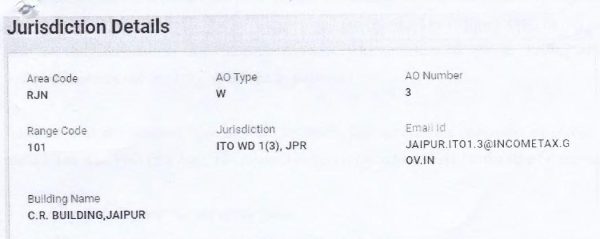
However, it may also be noted that the address of the appellant as per the appellant’s income tax profile is that of Gurgaon. A screenshot of the same is attached below for your ready reference.
Further, attention is drawn to the fact that the first notice in the matter was issued to the appellant by the Directorate of Income Tax, Intelligence and Criminal Investigation Office, Gurgaon, Dated 08.07.2013 (copy attached). This notice was sent at the Gurgaon address of the appellant because it is this address which is available from the Income tax profile of the appellant, as well as from the address appearing in the income tax returns filed by the appellant for the assessment years prior to the date of this notice.
It reiterated that the appellant has been residing at Gurgaon, earning interest income from Gurgaon, the profile address on the portal is that of Gurgaon and the Income Tax Returns (ITR) have been regularly filed at Gurgaon address AY 2010-11 onwards. The appellant isneither having any place of business/residence nor any situs of income in Rajasthan
Jurisdiction of any assessee is determined by taking into account the provisions of section 120 of the Income Tax Act, 1961 (the Act). The relevant extract is reproduced here for the sake of convenience.
Jurisdiction of income-tax authorities.
120
(3) In issuing the directions or orders referred to in sub-sections (1) and (2), the Board or other income-tax authority authorised by it may have regard to any one or more of the following criteria namely:-
(a) territorial area:
(b) persons or classes of persons:
(c) incomes or classes of income, and
(d) cases or classes of cases.
Accordingly, jurisdiction bears a nexus with the territory of the assessee. Territory could be the place of residence or the place of business. This implies that jurisdiction would be determined on the following parameters:
1. Based on the residential address of the assessee
2. Based on the registered office or principal place of business of the assessee
The assessee must file their income tax returns with the income tax office that has jurisdiction over their area and any tax assessments, scrutiny, or notices issued by the Income Tax Department will come from the Assessing Officer (AO) with territorial jurisdiction over the assessee’s location.
In the case before Your Honours, the appellant has received notice under section 143(2)/142(1) from NFAC and notice and order under section 263 of the Act from the Ld. PCIT, Jaipur at his Gurgaon address. It is reiterated that the appellant is residing in Gurgaon and has been filing his return of income from Gurgaon only.
The jurisdiction at Jaipur, as appearing in the income tax profile of the appellant might have been wrongly assigned as appearing on the portal. However, jurisdiction is determined in accordance with the provisions of section 120 of the Act and not on the basis of where the PAN is residing. The Ld PCIT has failed to notice that there is no territorial nexus of the assesse with Jaipur as required under section 120 and, therefore, to take appropriate measures to migrate the PAN wrongly assigned to his jurisdiction instead of exercising the jurisdiction himself beyond the territory assigned to him by the CBDT in accordance with the provisions of section 120 of the Act. It is, therefore, submitted that the action of the Ld. PCIT is not in accordance with the law and order passed by him beyond his jurisdiction is liable to be set aside.
Appellant place reliance on the judgement of the Hon’ble ITAT Delhi in ACIT vs. M/s. UV Realtors Pvt. Ltd., ITA No.6033/Del/2016, wherein it has been held that:
“However, nowhere in the statute it has been provided that PAN address will decide the territorial jurisdiction of the Assessing Officer. Section 1394 merely provides who are the persons required to obtain PAN having regard to the nature of transaction of business and other conditions laid down that, Assessing Officer may allot a PAN and other procedure and mechanism of allotment of the PAN. The territorial jurisdiction is decided by the CBDT in terms of Section 120 only. Here, in this case, as discussed above, none of the parameters laid down for the territorial jurisdiction are applicable to the assessee. Even the Assessing Officer or the Ld. CIT(A) has not LTA. No.6033/DEL/2016 & CO No.11/DEI/2017 23 made out any case that assessee’s case fulls in either of the given categories provided in sub Section (3) of Section 120 Allotment of a PAN from a particular place cannot provide jurisdiction to the Assessing Officer The jurisdiction of the Assessing Officer over an assessee is decided by the CBDT on the basis of from where the assessee is either carrying the business in that area assigned to the Assexxung Officer w/s. 120 or the assessee is residing within that area”
It is clear that fromhe judgement that PAN is not the determinative factor for assessing the jurisdiction of the assessee. It is further submitted that an order which is passed without jurisdiction is non est in the eyes of law. Considering the fact that at the time of assessment, the appellant was residing, earning income and filing his return of income at Gurgaon, the assumption of jurisdiction by the Ld. PCIT at Jaipur was invalid.
Reliance is also placed on the judgement of the Presidential Bench of the Hon’ble Mumbai Tribunal in Jeeri Keerthana Reddy vs. ITO, ITA No. 3224/Mum/2023, wherein it has been held that:
“19. It is trite that on order which is passed without jurisdiction (which is on cave which grex the root of the matter) is non est in the eyes of law Considering the fact that at the time of assessment, the appellant-assessee was residing and carrying on her profession at Bangalore the assumption of jurisdiction by the 40 at Mumbai was invalid. The change of address in the records and/or migration of PAN are not strictly relevant in the matter where the jurisdiction is governed by the stontory provisions as contained in Section 120 read with Section 124 of the Act and the notification issued by the Board”
Further, the Ld. DR has asserted on the jurisdiction of the appellant lies in Jaipur and that is because the PAN was located in Jaipur. It is submitted that PAN is an identifier in the Indian taxation system, which links various activities to a single individual. It is a well- known fact that nowadays quoting of PAN is mandatory on all financial transactions. The purpose is to link and identify the transactions to the individual or the entity and, therefore, it is only a tool for identification, PAN is not the legal factor to determine the jurisdiction of any assessee. The Hon’ble Mumbai High Court has laid down in the case of PCTT vs. M/s Capstone Securities Analysis Pvt. Ltd., [2023] 146 taxmann.com 423 (Bombay) that it is the PAN which follows the jurisdiction and not vice versa.
“5 The Tribunal rejected the argument of the revenue that the assessing officer would continue to exercise the jurisdiction in the case of the assessee mas much as PAN of the assessee came to be transferred only 29 December 2014 It was held that the transfer of PAN is consequential to the Order of transfer of jurisdiction and that it is a PAN, which follows the jurisdiction and not vice versa.”
In view of the above, and from the judicial precedents relied upon by the appellant, it may be inferred that PAN is not a contributing factor for determining the jurisdiction of the assessee. It is the place of residence or the place of business which governs the jurisdiction, which in the case of the appellant is at Gurgaon.
It is, therefore, Most Respectfully prayed that the order of the Ld. PCIT under section 263 of the Act is without proper jurisdiction and, therefore, deserves to be quashed. Your Honours may kindly be pleased to pass such other order as deemed fit.
Vide Submission dated 26.02.2025 the assessee submitted as under:
Re: In the matter of Shri Naresh Kumar, PAN: APXPK7727E, Α.Υ. 2019-20, Appeal No. ITA 209/HR/2024 against the order passed by the Ld. Principal Commissioner, Jaipur-1,
This is further to the proceedings being held in the matter from time to time. For the convenience of the hon hie Bench, the appellant’s contentions are summarized below: The assesseeis a resident of Gurgaon for last 15 years, having income from other sources earned from bank deposits. The address of Gurgaon is reflected on the portal in the profile information of the appellant. The returns of income have been regularly filed from his Gurgaon address AY 2011-12 onwards. The details of filing of retum of income and acknowledgment right from the AY 2011-12 10 2023-24, have already been submitted and are attached for your ready reference and kind perusal (P.B.No. 1-23). The notices and order of assessment under section 143(3) of the Income Tax Act. 1961 (the Act) as well as the notice and the order of revision under section 263 of the Act were also sent to the Gurgaon address of the appellant. The appellant is neither having any place of business/residence nor any situs of income in Rajasthan. In the case of the appellant, the assessment was completed by the National Faceless Assessment Centre and, therefore, the question of jurisdiction did not arise. However, the impugned order under section 263 of the Act was passed by the Ld. PCIT Jaipur and the same was addressed to the Gurgaon address of the appellant, which is indicative of the fact that while reviewing and examining the appellant’s file and issuing notice under section 263 of the Act, the Id. PCTT was well aware of the fact that the appellant is residing in Gurgaon and is not having situs of income or residence in Rajasthan and, therefore, he was bereft of the territorial jurisdiction over the assesseeurisdiction is determined in accordance with the provisions of section 120 of the Act. According to the provisions of section 120, jurisdiction is determined on territorial basis. This implies that jurisdiction would be determined on the following parameters
1. Based on the residential address
2. Based on the registered office or principal place of business.
The assessee must file their income tax returns with the income tax office that has jurisdiction over their area and any tax assessments, scrutiny, or notices issued by the Income Tax Department will come from the Assessing Officer (AO) having territorial jurisdiction over the assessee’s location.
In the case of the appellant, the appellant has received notice and order under section 263 of the Act from the Ld. PCIT, Jaipur. It is reiterated that the appellant is a resident of Gurgaon and has been filing his retum of income from Gurgaon only.
Further, it is understood that an assessee’s right to question the jurisdiction of the Assessing Officer with respect to the instances mentioned in sub section 3 of section 127 is not available beyond 30 days However, such instances exclude the one as in the case of the appellant where jurisdiction of the L.d. PCTT is questioned with respect to the notice and the order of revision issued under section 263, and therefore the time limit of 30 days for challenging the jurisdiction is not applicable in the case of the appellant. Moreover, by virtue of the provisions of sub section 2 of section 124, Principal Commissioner has been vested with the powers to determine jurisdiction whenever any question arises thereto. However, in this case, the Ld. PCIT has failed to determine his own jurisdiction which is based on geographical proximity of the residence/place of business or any other criteria as provided under section 120 of the Act. It is already explained that the appellant’s case doesn’t fall on any criteria within the jurisdiction of the L.d PCIT, Jaipur.
Attention is drawn to the fact that the appellant is a farmer, who is not well versed with every procedural requirement under the Act. On the other hand, PCIT, being the administrative officer, is well versed with the judicial as well as the procedural obligations cast upon him/her under the Act. After reviewing the file and knowing well that the appellant is a resident of Haryana (Gurgaon), filing his ITR therefrom and notices and orders being sent and served upon him at the same address, and, therefore, he would have taken the necessary steps to transfer the PAN to the proper jurisdiction, which he had failed to do so and. therefore, he cannot take shelter of the procedural requirement of section 139A(5), the assessee being a small farmer, not weil versed with the complicated procedures of the tax laws.
It is reiterated that the reliance of the L.d. PCIT on the provisions of section 139A(5)(d) is misplaced as it is only a procedural requirement and it does not prescribe the criteria for determining the jurisdiction. Moreover, nowhere in the statute it has been provided that PAN address will decide the territorial jurisdiction of the AO. Section 139A merely provides who are the persons required to obtain PAN having regard to the nature of transaction of business and other conditions laid down that, AO may allot a PAN and other procedure and mechanism of allotment of the PAN. The territorial jurisdiction is decided by the CBDT in terms of Section 120 only.
Further, the appellant’s contentions can be summarized as below:
Determination of jurisdiction
Jurisdiction is determined in accordance with the provisions laid down under section 120 of the Act where the criteria is-
(a) territorial area,
(b) persons or classes of persons,
(c) incomes or classes of income, and
(d) cases or classes of cases.
It is further elaborated in section 124 of the Act that jurisdiction Assessing officer shall have Jurisdiction:
(a) in respect of any person carrying on a business or profession, if the place at which he carries on his business or profession is situate within the area, or where his business or profession is carried on in more places than one, if the principal place of his business or profession is situate within the area, and
(b) in respect of any other person residing within the area
In the present case, appellant neither resides nor is having any business connection or any situs of income in Jaipur and, hence, the Ld. PCIT is bereft of territorial jurisdiction over the appellant. Appellant has been residing and filing his returns from Gurgaon for more than 15 years and even the impugned notice and order under section 263 were sent at the Gurgaon address only.
Reliance is placed on the following case laws:
Hon’ble ITAT Mumbai in RDC Ventures vs. PCIT, [2024] 159 taxmann.com 395
“Under the Sec. 1448 the whole procedure of faceless assessment has been specified. As per the detailed procedure laid down in clause xxxi of zub-section (1) of Sec. 144AB of the Act the National e-Assessment Center shall after completion of the assessment, transfer all the electronic records of the cave to the assessing officer having jurisdiction over the said cave for such action at may be required under the provisions of the Act. It is evident from the provision of Sec. 1448 of the Act that once after completion of assessment the faceless assessment unit transfer all the electronic record of the case to the assessing officer having territorial jurisdiction thereafter for all the other action the jurisdiction is vested with the assessing officer having territorial jurisdiction and the PCIT having such territorial jurisdiction The provision of Section 263 is invoked after the completion of the assessment on examination of record of any proceedings under the Act, therefore, once the assessment record is transferred by the faceless unit to the assessing officer having territorial jurisdiction then no action w/s 263 of the Act is possible with the PCIT who wat having jurisdiction of the faceless assessment unit.”
(Ρ.Β.Νο. 24-68)
Hon’ble High Court of Delhi in Veena Devi Karnani v. Income Tax Officer, [2019] 102 taxmann.com 470 (Delhi)
5 Rule 127(2) clearly states that the addresses to which a notice or summons or requisition or order or any other communication may be delivered or transmitted shall be either available in the PAN database of the assessee or the address available in the income tax return to which the communication relates or the address available in the last income tax return filed by the assessee all these options have to be resorted to by the concerned authority in this case the AO. Therefore, in the facts of this case when the AO issued the reassessment notice, as he did on 13.12.2013 he was under a duty to access the available PAN data base of the addressee or the address available in the income tax return to which the communication related or the address available in the last income return filed by the addressee.” (Ρ.Β.Νο. 69-75)
Hon’ble Madras High Court in Abdul Azeez Haroon vs The Deputy Commissioner Of Income Tax, WP (MD)No.20171 of 2016 and WMP(MD) Nos. 14462 and 15917 of 2016
“42. In the present case the petitioner has, no doubt obtained a PAN from the Assessing Officer at Maduras, wherein the address of the assessee is stated to be in Madurai. However, no assessments have been completed by the officials at Madurai, till date For AY 2012-2013 to 2015-2016 the petitioner has filed returns of income electronically, stipulating his jurisdictional officer as the Income tax officer. Shimoga. Karnataka. These returns of income have been processed and Intimations issued by the CPC wherein the address of the petitioner is stated to be Shimoga
43. The appropriate officer to assess the pentioner is thus the officer at Shimogo. No doubt, the provisions of Section 124(5) provide for the vesting of jurisdiction concurrently upon twe officers if the situation and circumstances so warrant the same, such as if the assessee in question has business interests or assets as well as income arising there from spread over various party of the country. (Ρ.Β.Νο. 76-92)
2 PAN does not decide jurisdiction
Jurisdiction assumed by the Ld. PCIT on the basis of PAN is incorrect as PAN is not the determinative factor for jurisdiction, which has also been held in the following decided cases:
Hon’ble ITAT Delhi in ACIT vs. Mis. UV Realtors Pvt. Ltd., ITA No.6033/Del/2016
“Allotment of a PAN from a particular place cannot provide jurisdiction to the Assessing Officer. The jurisdiction of the Assessing Officer over an assessee is decided by the CBDT on the baxis of from where the assesseeis either carrying the business in that areu assigned to the Assessing Officer u/s. 120 or the assessee is residing within that area.
(Ρ.Β.No. 93-116)
Hon’ble ITAT Mumbai in Jeeri Keerthana Reddy vs. ITO, ITA No. 3224/Mum/2023
“19. It is trite that an order which is passed without jurisdiction (which is an issue which goes to the root of the matter) is non est in the eyes of law Considering the fact that at the time of assessment, the appellant-assessee wat residing and carrying on her profession at Bangalore, the assumption of jurisdiction by the 10 at Mumbai was invalid The change of address in the records and/or migration of PAN are not strictly relevant in the matter where the jurisdiction is governed by the statutory provisions as contained in Section 120 read with Section 124 of the Act and the notification issued by the Board.”
(Ρ.Β.Νο. 117-127)
Hon’ble Bombay High Court in PCIT v. Capstone Securities Analysis (P) Ltd. [2023] 146 taxmann.com 423 (Bombay)
“The Tribunal rejected the argument of the revenue that the assessing officer would continue to exercise the jurisdiction in the case of the assessee inasmuch as PAN of the assessee came to be transferred only 29 December 2014. It was held that the transfer of PAN is consequential to the Order of transfer of jurisdiction and that it is PAN which follows the price and not
(P.B.No. 128-129)
Hon’ble High Court of Calcutta in PCTT-2, Chermal. Mix. Ojasvi Motor Fasance Pvt. Lat. ITAT/106/2024
“Before us, the Revenue has canvassed that the files as well as the PAN was still lying within the jurisdiction of the Income Tax Officer Ward 1(4) Kolkata. The transfer of the files is a ministerial or an administrative act to be done by the department for which the assessee cannot be held responsible. That apart, the transfer of the PAN was only a consequential proceeding to the transfer of jurisdiction and therefore the same cannot be a ground to hold that the Assessing Officer had jurisdiction over the matter despite the order of transfer passed by the Commissioner on 15.03.2013”
(Ρ.Β.Νο. 130-135)
3. Ld. PCIT to examine jurisdiction on basis of all available data
It is incumbent on the Ld. PCIT to assess the jurisdiction and that the same has to be ascertained and determined every year based upon the complete assessee data available which also includes the return filing details. Determination of jurisdiction goes to the root of the matter and any defect therein, renders the order null and void. Further, the criteria of 30 days for challenging the jurisdiction as per the provisions of section 127, is not applicable to the orders issued under section 263. Reliance is placed on the following judgements:
Hon’ble High Court of Delhi in CIT, Delhi-XVI v. S.S. Ahluwalia, [2014] 46 taxmann.com 169 (Delhi)
“The provisions indicate that Sections 120. 124 and 127 of the Act recognizes flexibility and choice, both with the assessee and the authorities te the Assessing Office before whom return of income could be filed and assessment could be made. The Assessing Officer within whose area an assessee was carrying on business, resided or otherwise income had accrued or arisen (in the last case, subject to the limitation noticed above) has jurisdiction, Similarly, the Assessing Officer also has authority due to class of income or nature and type of business.……….
On the said aspect, decision of the Delhi High Court in the case of K.K. Loomba [2000] 241 ITR 152 (Delhi) is binding on us. Thus, the question of jurisdiction or the place of filing has to be examined each year with reference to provisions of Section 124 of the Act. Decision in K.K Loomba [1996] 220 ITR 446/89 Taxman 536 (Pun & Har.) was pronounced in the year 2000 and dissents from the view/ratio of the Punjab and Haryana: High Court in Lt. Col Paramjit Singh (supra). Thus, when the proceedings were going on, the legal position was not clear and hence debatable. However, as noticed above. Section 124 of the Act provides flexibility and postulates multiple and concurrent jurisdiction including filing of return and where the assessee has permanent or current residence or where he has sole/only source of income.”
(P.B. No. 136-166)
Hon’ble High Court of Calcutta in PCIT v. Divine Light Finance Ltd. [2024] 165 taxmann.com 254 (Calcutta)
9. Where an authority or court lacks inherent jurisdiction in passing a decree or order, the decree or order passed by such authority or court would be without jurisdiction, non est and void abinitio. Lack of territorial jurisdiction of the Commissioner of Income Tax-IV who passed the order dated 19.01.2016 under Section 263 of the Act, 1961 to exercise supervisory jurisdiction goes to the root of the matter and strikes at his very authority to pass the said order. Such defect is basic and fundamental and, therefore, the order passed by the aforesaid C.LT having no territorial jurisdiction over the respondent assessee, is nullity.
(P.B.No. 167-171)
The judgementare also attached for your ready reference and kind perusal.
In view of the above, it is, therefore, Most respectfully prayed that the order of the Ld. PCIT under section 263 of the Act is without proper jurisdiction and, therefore, deserves to be quashed Your Honours may kindly be pleased to pass such other order as deemed fit.
8. To support the contention so raised in the written submission reliance was placed on the following evidence / records / decision:
Index of Paper book – 1
| Attachment No. |
Particulars | Page Nos. |
Filed before |
|---|---|---|---|
| 1. | Submission | 1-24 | Hon’ble Bench |
| 2. | Notice of the Ld. AO under section 142(1) | 25-27 | |
| 3. | Reply to the Notice u/s 142(1) | 28-66 | Ld. AO |
| 4. | Notice of the Ld. PCIT under section 263 | 67-68 | |
| 5. | Reply to the Notice u/s 263 | 69-107 | Ld. PCIT |
–
| Attachment No. | Particulars | Page Nos. | Filed before |
|---|---|---|---|
| 1. | Submission | 1-4 | Hon’ble Bench |
| 2. | Land Acquisition certificate 5-6 | ||
| 3. | Certificate of enhanced compensation 7-8 | ||
| 4. | Copy of Khatauni and Girdawari (crop records) | 9-1 1 | Ld. AO & Ld. |
| 5. | Relevant extract of the Judgement of the Hon’ble Punjab & Haryana High Court in favour of the appellant for granting enhanced compensation and | 12-17 | PCIT |
interest thereon
9. The ld. AR of the assessee also filed a detailed submission in respect of the additional ground raised which reads as follows:
Re. In the matter of Shri Naresh Kumar, PAN: APXPK7727Ε. Α.Υ. 2019-20, Appeal No. ITA 209/JPR/2024 against the order passed by the Ed. Principal Commissioner of Income Tax. Jaipur-1. Jaipur.
Submission on Additional ground under Rule 11 of the Appellate Tribunal Rules, 1963 The appellant, vide letter dated August 22, 2024, had prayed for this Hon’ble Bench for granting leave is urgean additional ground in the appeal. This submission is being filed with respect to the additional ground, under the instructions of the Hon’ble Bench. The appellant had raised an additional ground as below:
“Ground no, 1
The Ld. 40 has erred in passing the impugned order for revision under section 263 of the Act, by completely ignoring the fact that the appellant is residing at Gurgaon and neither has any business/place of residence nor any situs of income in Rajasthan, and, therefore, the uppellant is beyond the territorial jurisdiction of the Ld. PCIT, in accordance with the provisions of section 120 of the Act.”
SUBMISSION
It is submitted that the appellant is a resident of Gurgaon, having income from other sources camed from bank deposits. The profile address on the portal is that of Gurgaon and the Income Tax Returns (ITR) have been regularly filed at Gurgaon address AY 2010-11 onwards. The notices and order of assessment under section 143(3) of the
Income Tax Act, 1961 (the Act) as well as the notice and the order of revision under section 263 of the Act were also sent to the Gurgaon address of the appellant. The appellant is neither having any place of business/residence nor any situs of income in Rajasthan. In the case of the appellant, the assessment was completed by the National Faceless Assessment Centre (NFAC). The appellant being a resident of Gurgaon, is outside the territorial jurisdiction of the Ld. Principal Commissioner of Income Tax (PCIT), Jaipur, and, therefore, the order passed by him under section 263 of the Act is beyond his jurisdiction under section 120 of the Act.
At this juncture, attention is drawn to the provisions of sections 120(3) and 124 of the Act and are also reproduced below for the sake of convenience:
Jurisdiction of income-tax authorities. 120….
(3) In issuing the directions or orders referred to in sub-sections (1) and (2), the Board or other income-tax authority authorised by it may have regard to any one or more of the following criteria, namely
(a) territorial area;
(b) persons or classes of persons.
(e) incomes or classes of income, and
(d) cases or classes of cases.
124. (1) Where by virtue of any direction or order issued under sub-section (1) or sub-section (2) of section 120, the Assessing Officer has been vested with jurisdiction over any area, within the limits of such area, he shall have jurisdiction
(a) in respect of any person carrying on a business or profession, if the place at which he carries on his business or profession is situate within the area, or where his business or profession is carried on in more places than one, if the principal place of his business or profession is situate within the area, and
(b) in respect of any other person residing within the area.
(2) Where a question arises under this section as to whether an Assessing Officer has jurisdiction to assess any person, the question shall be determined by the Principal Director General or Director General or the Principal Chief Commissioner or Chief Commissioner or the Principal Commissioner or Commissioner: or where the question is one relating to areas within the jurisdiction of different Principal Directors General or Directors General or Principal Chief Commissioners or Chief Commissioners or Principal Commissioners or Commissioners, by thePrincipal Directors General or Directors General or Principal Chief Comisioners of Chief Commissioners or Principal Commissioners or Commissioners concerned or, if they are wit agreement, by the Board or by such Principal Direcive General or Director General or Principal Chief Commissioner or Chief Commissioner or Principal Commissioner or Commissioner as the Bourd may, by notification in the Official Gazette, specify
(3) No person shall be entitled to call in question the jurisdiction of an Axxessing Officer-
(a) where he has made a return under sub-section (1) of section 115WD or under sub-section (1) of section 139, after the expiry of one month from the date on which he was served with a notice under sub-section (1) of section 142 or sub-section (2) of section 115WE or sub-section (2) of section 143 or after the completion of the assessment, whichever is earlier;
(b) where he has made no such return, after the expiry of the time allowed by the notice under sub-section (2) of section 115WD or sub-section (1) of section 142 or under sub-section (1) of section 115WH or under section 148 for the making of the return or by the notice under the first proviso to section 115WF or under the first proviso to section 144 to show cause why the assessment should not be completed to the best of the judgment of the Assessing Officer, whichever is earlier;
(c) where an action has been taken under section 132 or section 1324, after the expiry of one month from the date on which he was served with a notice under sub-section (1) of section 1534 or sub-section (2) of section 153C or after the completion of the assessment, whichever is earlier.
(4) Subject to the provisions of sub-section (3), where an axsexsee calls in question the jurisdiction of an Assessing Officer, then the Assessing Officer shall, if not satisfied with the correctness of the claim, refer the matter for determination under sub-section (2) before the assessment is made
(5) Notwithstanding anything contained in this section or in any direction or order issued under section 120, every Assessing Officer shall have all the powers conferred by or under this Act on an Assessing Officer in respect of the income accruing or arising or received within the area, if any. over which he has been vested with jurisdiction by virtue of the directions or orders issued under sub-section (1) or sub-section (2) of section 120.
According to the provisions of section 120, jurisdiction is determined on territorial basis. This implies that jurisdiction would be determined on the following parameters:
1. Based on the residential address
2. Based on the registered office or principal place of business.
The assessee must file their income tax returns with the income tax office that has jurisdiction over their area and any tax assessments, scrutiny, or notices issued by the Income Tax Department will come from the Assessing Officer (AO) with territorial jurisdiction over the assessee’s location.
In the case of the appellant, the appellant has received order under section 263 of the Act from the Ld PCIT, Jaipur. It is reiterated that the appellant is residing in Gurgaon for more than a decade and has been filing their return of income from Gurgaon only.
Further, it is understood that an assessee is bereft of the right to question the jurisdiction of the Assessing Officer with respect to the instances mentioned in sub section 3 of section 127 beyond 30 days. However, such instances exclude the one as in the case of the appellant where jurisdiction of the Ld. PCIT is questioned with respect to the order of revision issued under section 263, and therefore the time limit of 30 days for challenging the jurisdiction is not applicable in the case of the appellant. Moreover, by virtue of the provisions of subsection 2 of section 124, Principal Commissioner has been vested with the powers to determine jurisdiction whenever any question arises thereto. However, in this case, the Ld. PCTT has failed to determine his own jurisdiction which is based on geographical proximity of his residence/place of business or any other criteria as provided under section 120 of the Act. It is already explained that the appellant’s case doesn’t fall on any criteria within the jurisdiction of the Ld. PCIT, Jaipur
Further, the assessment in the case of the appellant was completed under the faceless scheme. Once the assessment is completed, it is handed over to the jurisdictional AO. As per the detailed procedure laid down in clause (xxxi) of section 144AB(1), the National e-Assessment Center shall, after completion of the assessment, transfer all the electronic records of the case to the AO having jurisdiction over the said case for such action as may be required under the provisions of the Act. Section 1448 dictates that the faceless assessment unit shifts electronic case records to the AO with territorial jurisdiction post- assessment. Subsequent actions fall under the purview of the AO and PCIT with corresponding territorial jurisdiction. In the extant case, the appellant is neither having any place of business/residence nor any situs of income in Rajasthan and, therefore, the appellant does not fall within the territorial jurisdiction of either the AO or Ld. PCIT at Jaipur. (Hon’ble ITAT Mumbai in RDC Ventures vs. PCIT, [2024] 159 taxmann.com 395, PB page no. 41)
Otherwise also, it may have been the case that at the time of issuing of PAN, the appellant might have been residing at Jaipur but, allotment of a PAN from a particular place cannot provide jurisdiction to the Assessing Officer. The jurisdiction of the Assessing Officer over an assessee is decided by the CBDTon the basis of from where the assessee is either carrying the business or where the assessee is residing which is also provided by the provisions of section 120 of the Act. Nowhere in the statute it has been provided that PAN address will decide the territorial jurisdiction of the AO. Section 139A merely provides who are the persons required to obtain PAN having regard to the nature of transaction of business and other conditions laid down that, AO may allot a PAN and other procedure and mechanism of allotment of the PAN. The territorial jurisdiction is decided by the CBDT in terms of Section 120 only. (Hon’ble ITAT Delhi in ACIT vs. M/s. UV Realtors Pvt. Ltd., ITA No.6033/Del/2016, PB Page no. 67-68)
In view of the above, it is submitted that an order which is passed without jurisdiction is non est in the eyes of law. Considering the fact that at the time of assessment, the appellant was residing, earning income and filing his return of income at Gurgaon, the assumption of jurisdiction by the Ld. PCIT at Jaipur was invalid. (Hon’ble ITAT Mumbai in Jeeri Keerthana Reddy vs. ITO, ITA No. 3224/Mum/2023, PB Page no. 79-80) It is, therefore, Most respectfully prayed that the order of the Ld. PCIT under section 263 of the Act is without proper jurisdiction and, therefore, deserves to be quashed. Your Honours may kindly be pleased to pass such other order as deemed fit.
10. In support of the above contention on the additional ground raised the ld. AR of the assessee filed the copy of the following judicial precedent;
| Attachment No. | Particulars Page | Nos. |
|---|---|---|
| 1 Hon’ble ITAT Mumbai in RDC Ventures vs. PCIT, [2024] 159 | taxmann.com 395 | 1-45 |
| 2 Hon’ble ITAT Delhi in ACIT vs. M/s UV Realtors Pvt. Ltd. ITA | No. 6033/Del/2016 | 46-69 |
| 3 Hon’ble ITAT Mumbai in Jeeri Keerthana Reddy vs. ITO, ITA No. | 3224/Mum/2023 | 70-80 |
11. The ld. AR of the assessee firstly argued on the jurisdictional ground which was raised as additional ground. On that aspect he submitted the fact that the assessee has filled the ITR from 2011-12 page 2 of submission dated 22.08.2024 wherein the AO was mentioned in the ITR is that ACIT-Circle, Guragon since then the assessee is filling the return of income at that address and therefore, invoking the jurisdiction by the ld. PCIT is wrong and the additional ground be decided based on that facts already on record. So far as the merits of the dispute she submitted that the case of the assessee was selected for scrutiny wherein the issue of chargeability of interest has been raised vide notice dated 11.06.201 and the assessee filed a detailed reply on the issue on 22.06.2021 vide point no 3 & 4. The ld. AO examined the claim of the assessee and taken a view that the interest received by the assessee falls under the provision of section 10(37) of the Act. Thus, when the ld. AO has verified the issue and applied his mind the ld. PCIT has no jurisdiction to impose upon her view on the issue and that is why the order is neither erroneous nor prejudicial to the interest of the revenue. To drive home to the contention so raised she relied upon the written submission and the judicial precedent cited therein.
12. Per contra, ld. DR vehemently argued that there is change in law and the assessee is in receipt of the receipt of the interest and therefore, she supported the finding recorded in the order of the ld. PCIT.
13. Having noted the above sequence of facts, arguments and material placed on record I record my findings herein in the subsequent paras.
14. The apple of discord in the case is that when the ld. AO having verified the issue which the ld. PCIT is raising can again be raised as per provision of section 263 of the Act or not. Record reveals that the issue of chargeability of interest received by the assessee for an amount of Rs. 1,48,69,130/- was verified by the ld. AO. Ld. AO to verify that issue raised a specific query vide point no. 3 & 4 of the notice dated 11.06.2021 [ page 26 of the paper book dated 04.06.2024]. Assessee replied to that questions raised vide letter dated 22.06.2021 [ paper book page 28] wherein the assessee submitted that the interest was granted to the assessee as per provision of section 28 of the Land Acquisition Act. The assessee also with that reply submitted the required proof for receipt of compensation and filed copy of the judicial precedent in support of the claim that the interest so received u/s. 28 of the Land Acquisition Act is covered as per provision of section 10(37) of the Act. Having considered the reply with proof ld. AO considered the claim and allowed it as exempt u/s. 10(37) of the Act. Thereby ld. AO completed the assessment by taking a plausible view on the matter. That view taken by the ld. AO is plausible view and that view once taken cannot be considered as erroneous or prejudicial to the interest of the revenue based on the facts available on record.
15. Whereas the contention of the ld. PCIT is that the provision of section 145B(1) of the Act states that notwithstanding anything to the contrary in section 145 of the Act, the interest received by an assessee on any compensation or enhanced compensation of land shall be deemed to the income of the previous year in which it is received. As per the provision of section 56(2)(viii) of the Act, income by way on interest received on compensation shall be chargeable to income tax under the head “Income from other sources”. Section 56(2)(viii) of the Act was inserted by the Finance Act, 2009 w.e.f. 01.04.2010. Therefore, ld. PCIT hold that the ld. AO failed to apply his mind on the material available on record and failed to invoke the applicable provision of law. Thus, she noted that this action of the ld. AO resulted into erroneous order and due to non-application of mind it has caused prejudice to the interest of the revenue.
16. From the above, it is observed that it is not a case wherein the Assessing Officer failed to conduct enquiry rather it is the case wherein the Assessing Officer has conducted an elaborate enquiry and adopted one of the two views which was plausible view. The question would be as to whether in such circumstances the power u/s 263 of the Act would be invoked or not. The above said question is no longer res-integra and the said issue is well settled in several decisions. In the case of Malabar Industrial Co. Ltd. vs. Commissioner 243 ITR 83 (SC), the Hon’ble Supreme Court held as follows :-
7. There can be no doubt that the provision cannot be invoked to correct each and every type of mistake or error committed by the Assessing Officer; it is only when an order is erroneous that the section will be attracted. An incorrect assumption of facts or an incorrect application of law will satisfy the requirement of the order being erroneous. In the same category fall orders passed without applying the principles of natural justice or without application of mind.
The phrase ‘prejudicial to the interests of the revenue’ is not an expression of art and is not defined in the Act. Understood in its ordinary meaning, it is of wide import and is not confined to loss of tax. The High Court of Calcutta in DawjeeDadabhov& Co. v. S.P. Jain [1957] 31 ITR 872, the High Court of Karnataka in CIT v. T. Narayana Pai [1975] 98 ITR 422, the High Court of Bombay in CIT v. Gabriel India Ltd. [1993] 203 ITR 208 and the High Court of Gujarat in CIT v. Smt. Minalben S. Parikh [1995] 215 ITR 81/ 79 Taxman 184 treated loss of tax as prejudicial to the interests of the revenue.
8. Mr. Abraham relied on the judgment of the Division Bench of the High Court of Madras in Venkatakrishna Rice Co. v. CIT [1987] 163 ITR 129 interpreting ‘prejudicial to the interests of the revenue’. The High Court held, “In this context, it must be regarded as involving a conception of acts or orders which are subversive of the administration of revenue. There must be some grievous error in the Order passed by the ITO, which might set a bad trend or pattern for similar assessments, which on abroad reckoning, the Commissioner might think to be prejudicial to the interests of Revenue Administration”. In our view, this interpretation is too narrow to merit acceptance. The scheme of the Act is to levy and collect tax in accordance with the provisions of the Act and this task is entrusted to the revenue. If due to an erroneous order of the ITO the revenue is losing tax lawfully payable by a person, it will certainly be prejudicial to the interests of the revenue.
9. The phrase ‘prejudicial to the interests of the revenue’ has to be read in conjunction with an erroneous order passed by the Assessing Officer. Every loss of revenue as a consequence of an order of the Assessing Officer cannot be treated as prejudicial to the interests of the revenue, for example, when an ITO adopted one of the courses permissible in law and it has resulted in loss of revenue; or where two views are possible and the ITO has taken one view with which the Commissioner does not agree, it cannot be treated as an erroneous order prejudicial to the interests of the revenue unless the view taken by the ITO is unsustainable in law.
17. Further, the Hon’ble Supreme Court in the case of Pr. CIT vs. Canara Bank Securities Ltd., S.L.P.(C) No. 25651 of 2019, vide order dated 14th October, 2019 dismissed the Department’s appeal affirming the view taken by the Bombay High Court in ITA No.1761 of 2016, dated February 11, 2019, wherein the High Court held that the question whether the income should be taxed as business income or has arisen from other source was a debatable issue and the Assessing Officer had taken the plausible view that it was a business income after due enquiries and therefore not open for the Commissioner to take such an order in revision.
18. Thus, when ld. AO has already considered the claim of the assessee based on the evidence and submission, that view without proving it as contrary to the provision of the Act cannot be subjected to review under the provision of section 263 of the Act. The prerequisite exercise of jurisdiction by the learned PCIT under section 263 of the Act is that the order of the ld. AO should be established to be erroneous in so far as it is prejudicial to the interest of the Revenue. The ld. PCIT must be satisfied of twin conditions, namely (i) the order of the AO sought to be revised is erroneous; and (ii) it is prejudicial to the interests of the Revenue.
If any one of them is absent, i.e., if the assessment order is not erroneous but it is prejudicial to the Revenue, provision of section 263 cannot be invoked. Here since ld. AO has already verified the issue and taken a view which is in accordance with the law, on that aspect provision of section 263 cannot be invoked to correct each and every type of mistake or error committed by the AO; it is only when an order is erroneous as also prejudicial to Revenue’s interest, than the provision will be attracted. An incorrect assumption of the fact or an incorrect application of law will satisfy the requirement of the order being erroneous. The phrase ‘prejudicial to the interest of the Revenue’ has to be read in conjunction with an erroneous order passed by the AO. Every loss of revenue as a consequence of the order of the AO cannot be treated as prejudicial to the interest of the Revenue. It is pertinent to mention that if the AO has adopted one of the two or more courses permissible in law and it has resulted in loss of revenue, or where two views are possible and AO has taken one view with which the PCIT does not agree, it cannot be treated as an erroneous order and it is prejudicial to the interest of the Revenue, unless the view taken by the AO is totally unsustainable in law. In this process even the AO has no power to review his own order.
Even in the present case, ITA No.209/JPR/2024 whether the receipt of interest related to the additional compensation granted under Land Acquisition Act, 1894 is a part of exempt income as per provision of section 10(37) of the Act or not was verified by the ld. AO and he has taken a plausible view which was in accordance with the provision of law. Thus, following the ratio laid down by the Hon’ble Supreme Court in Malabar Industrial Co. Ltd. vs. Commissioner of Income Tax (supra) and other decisions mentioned above, I am of the considered opinion that the impugned order of the Ld. PCIT is found to be erroneous, accordingly, order impugned of the Ld. PCIT is hereby quashed.
19. It is also noteworthy to mention that one of the pre-requisite before invoking S. 263 and the allegation of the Ld. PCIT is that there has been an incorrect assumption of fact and law by the Assessing Officer. However, despite my careful consideration of the material on record including the finding recorded in the subjected Assessment order dated 21.06.2021 and, the findings, recorded in the order under challenge, I do not find any incorrectness and incompleteness in the appreciation of facts made by the AO. In the light of these observations, I do not agree on this aspect to this extent with ld. PCIT. Even on facts as discussed here in above that the issue was raised in the assessment proceeding and there is no error, or it has no prejudice caused to the revenue as the claim of the assessee is within the provision of section 10(37) of the Act. The facts stated in the written submission on the issue were not disputed by the revenue. The ld. AO has recorded his satisfaction in the assessment order that on the reasons of selection he has called for the details and after examination of the details he has passed the order which I would find that the same is in accordance with the law and does not attract the clause;
(a) i.e. the order is passed without making inquiries or verification which should have been made; or
(b) the order is passed allowing any relief without inquiring into the claim” to explanation 2 of section 263 of the Act and thus, it is nothing but a change of opinion which is not permitted in the eyes of the law. In the light of the aforesaid discussion, I hold that the order of the PCIT is not in accordance with the provisions of section 263 of the Act.
20. Before parting, I would like to deal with the salient features of the orders of the Hon’ble Supreme Court on the issue are mentioned below:
-
- The order of the Bikram Singh Vs Land Acquisition Collector is dated 12.09.1996 – Interest of any nature is taxable irrespective of its receipt.
- The order of Ghanshyam (HUF) is dated 16.07.2009 “It is to answer the above questions that we have analysed the provisions of sections 23, 23(1A), 23(2), 28 and 34 of the 1894 Act. As discussed hereinabove, section 23(1A) provides for additional amount. It takes care of increase in the value at the rate of 12 per cent per annum. Similarly, under section 23(2) of the 1894 Act, there is a provision for solatium which also represents part of enhanced compensation. Similarly, section 28 empowers the Court in its discretion to award interest on the excess amount of compensation over and above what is awarded by the Collector. It includes additional amount under section 23(1A) and solatium under section 23(2) of the said Act. Section 28 of the 1894 Act applies only in respect of the excess amount determined by the Court after reference under section 18 of the 1894 Act. It depends upon the claim, unlike interest under section 34 which depends on undue delay in making the award. It is true that “interest” is not compensation. It is equally true that section 45(5) of the 1961 Act, refers to compensation. But as discussed hereinabove, we have to go by the provisions of the 1894 Act, which awards “interest” both as an accretion in the value of the lands acquired and interest for undue delay.
Interest under section 28 unlike interest under section 34 is an accretion to the value, hence it is a part of enhanced compensation or consideration which is not the case with interest under section 34 of the 1894 Act. So also additional amount under section 23(1A) and solatium under section 23(2) of the 1961 Act forms part of enhanced compensation under section 45(5)(b) of the 1961 Act. In fact, what we have stated hereinabove is reinforced by the newly inserted clause (c) in section 45(5) by the Finance Act, 2003 with effect from 1-4-2004.”
-
- The order in the case of Manjit Singh (HUF) has been considered in the case of Ghanshyam (HUF).
- The order in the case Hari Singh & Others in CA No.1504/2017 dated 15.09.2007 – held – While determining as to whether the compensation paid was for agricultural land or not, the Assessing Officer( s) will keep in mind the provisions of Section 28 of the Land Acquisition Act and the law laid down by this Court in CIT v. Ghanshyam (HUF) [2009] 182 Taxman 368/315 ITR 1 (SC) in order to ascertain whether the interest given under the said provision amounts to compensation or not.
- The order in the case GovindbhaiMamaiya 367 ITR 498 (SC) dated 04.09.2014 – Reiterated that “it is equally true that Section 45(5) of the 1961 Act refers to compensation.
But as discussed hereinabove, we have to go by the provisions of the 1894 Act which awards “interest” both as an accretion in the value of the lands acquired and interest for undue delay. Interest under Section 28 unlike interest under Section 34 is an accretion to the value, hence it is a part of enhanced compensation or consideration which is not the case with interest under Section 34 of the 1894 Act. So also additional amount under Section 23 (1-A) and solatium under Section 23(2) of the 1961 Act forms part of enhanced compensation under Section 45(5)(b) of the 1961 Act.”
-
- In the case of Ghanshyam (HUF), the Hon’ble Supreme Court equated the interest received u/s 28 of LA with compensation. It was held that the interest is accretion to the value of compensation and hence it is a part of compensation.
- In the case of Hari Singh (HUF), the Hon’ble Supreme Court reiterated the above proposition.
21. Since, I have considered the appeal of the assessee on its merits vide ground no. 1 to 6 the technical ground raised by the assessee becomes academic. Ground no. 7 being general does not require any finding.
In the result the appeal of the assessee is allowed.
Order of the Hon’ble Vice President (Third Member):-
The present appeal is directed at the instance of the assessee against the order of ld. Commissioner of Income Tax [in short ‘the CIT’] dated 07.02.2024 passed u/s 263 of the Income Tax Act, 1961 in assessment year 2019-20.
2. This appeal was listed before the Division Bench on 20.03.2025. The Division Bench had concluded the hearing and the Sr. Member has allotted this file to ld. JM forpreparing the draft order. The ld. JM has prepared the draft on 02.04.2025. He drawn the conclusion as under:
“6.1 In view of the above decisions and discussion, with a view to ensuring consistency and preventing judicial inconsistency that may dilute public confidence, I deem it to be a fit case to seek a reference to the Hon’ble President to constitute a Special Bench on the issue involved and discussed above.
“In view of insertion of provisions of section 56(2)(viii) of the Income Tax ACT and enforcement of amendments made as per Finance Act. 2009 w.e.f. 01/04/2010, whether the decision of Hon’ble Apex Court in CIT v Ghanshyam (HUF) [2009] 182 Taxman 368 comes to the rescue of the assessee to claim that amount of interest received on compensation or enhanced compensation is to be dealt with under “Capital gains” or as per provisions of section 56(2)(viii) said amount of interest received on compensation or enhanced compensation is to be dealt under the head ‘Income from other sources”?
Registry to take steps accordingly in accordance with rules.
Sd/-
(Narinder Kumar) Judicial Member
3. Since this draft was not in consonance with the procedure and without putting to the ld. Accountant Member, hence it was again placed before the ld. JM who thereafter put it before the ld. AM. The ld. AM did not concur with the view of the ld. JM and passed a dissenting order. He drafted the question of difference which reads as under:
“Since, the order under challenge is not to decide a question as to whether on the facts and circumstances of the case the provision of section 10(37) or that of the provision of section 56(2)(viii) will apply but is to decide the invocation of the provision of section 263 of the Act. Based on that set of facts available on record, I do not agree with the proposal of learned Brother Member to refer the issue before the Hon’ble President to constitute a Special Bench on the issue as framed vide his order dated 02.04.2025 placed before me. Based on this fact I propose a reference to Hon’ble third member through proper channel to decide the question as to:
1. “Whether based on the facts and circumstance of the case when the Id. AO has verified the issue of chargeability of interest in hands of the assessee and taken a plausible view. Whether that view taken by the Id. AO which is one of the plausible view can be subjected to revision as per provision of section 263 of the Act or not.”
4. The Hon’ble President first kept the file with himself as a Third Member but later on assigned it to me for adjudication.
5. I have heard the parties and a perusal of the record would indicate that there are basically two issues adjudicated by the Division Bench through dissenting orders, namely;
a) Whether ld. CIT could take cognizance u/s 263 of the Income Tax Act on an issue which is debatable one and AO has taken one of the possible view;
b) Whether compensation received in the shape of interest u/s 28 of the Land Acquisition Act, 1894 deserves to be assessed as income of the assessee u/s 10(37), 56(2)(vii).
6. First, I take the first question, “whether ld. CIT has rightly taken action u/s 263 of the Income Tax Act or not ?
6.1 The brief facts of the case are that assessee has filed his return of income on 10.07.2019 declaring an income of Rs.9,81,530/-. The case of the assessee was selected for scrutiny assessment and a notice u/s 143(2) of the Income Tax Act was issued and served upon the assessee. According to the AO, he has issued questionnaire and assessee has filed replies to those questionnaires. Thereafter, AO, without making any discussion, accepted the returned income. The ld. CIT was of the view that Assessing Officer has accepted the return without examining the issue and therefore, his order is erroneous which has caused prejudice to the interests of the Revenue. The ld. CIT was of the view that assessee had received an amount of Rs.1,48,69,136/- which falls in the nature of interest as contemplated in Section 145B(1) read with Section 56(2)(viii) and Section 57(iv) of the Income Tax Act. The ld. CIT thereafter made an elaborate discussion by taking cognizance of the above provisions as well as Section 28 of the Land Acquisition Act, 1894. He has reproduced the submissions made by the assessee. The relevant findings of the ld. CIT read as under:
5. The assessee in his reply has stated that interest on enhanced compensation received under section 28 of the Land Acquisition Act, 1894, is not taxable as per the Income Tax Act, 1961. The assessee has also relied on Board’s Circular No.36/2016 dated 25/10/2016 on the subject relating to taxability of compensation received by the land owner for land acquired under Right to Fair Compensation and Transparency in Land Acquisition, Rehabilitation and Re-settlement Act, 2013. The assessee has also relied upon various judgments of the Hon’ble Supreme Court and High Courts. The reply of the assessee has been considered and perused carefully but the same was not found tenable.
6. The provisions of section 145B(1) of the Act states that notwithstanding anything to the contrary in section 145 of the Act, the interest received by an assessee on any compensation or on enhanced compensation of land shall be deemed to be the income of the previous year in which it is received. As per the provisions of section 56(2)(viii) of the Act, income by way of interest received on compensation shall be chargeable to income tax under the head Income from Other Sources’. Section 56(2)(viii) of the Act was inserted by the Finance Act, 2009 w.e.f. 01/04/2010. Further section 57(iv) of the Act provides that in case of income of the nature referred to in section 56(2)(vii), a deduction of a sum equal to fifty percent of such income shall be allowed. As per the provisions of above section, interest income i.e. 50% of total Rs.1,48,69,136/- is liable to be taxed. Thus there is an error in the assessment order under reference.
7. As discussed above, the Assessing Officer failed to apply his mind on the material available on record and failed to invoke the applicable provisions of law. This in turn has resulted in passing of an erroneous order by the AO in the case due to non-application of mind to relevant material, an incorrect assumption of facts and an incorrect application of mind to the law which is prejudicial to the interest of the revenue and hence liable for revision under section 263 of the Act. The Hon’ble Supreme Court in the case of Malabar Industrial Limited V/s CIT 243 ITR it has held as under-
“……….An incorrect assumption of facts or an incorrect application of law will satisfy the requirement of the order being erroneous. In the same categoryfall orders passed without applying the principles of natural justice or without application of mind.”
8. Considering all the facts and circumstances of the case and for the reasons discussed ai the assessment order dated 08/09/2021 for A.Y. 2019-20 passed by the AO is held to be erroneous in so far as it is prejudicial to the interest of the revenue for the purpose of section 263 of the Act. The said order has been passed by the AO in a routine and casual manner without applying the applicable sections of the Act. The AO has not verified under the details which were required to be verified under scope of scrutiny. The order of the AO is, therefore, liable to revision under the explanation (2) clause (b) and clause (a) of section 263 of the Act. The assessment order is set aside to be made afresh in the light of the observation made in this order. The AO is required to make necessary verification in respect of the observations made in this order after allowing reasonable opportunity to the assessee.
7. With the assistance of ld. Representative, I have gone through the record carefully. Before I embark upon an enquiry on the facts and issues agitated before me to find out whether the action u/s 263 of the Act, deserves to be taken against the assessee or not, it is pertinent to take note of this Section. It reads as under:-
“263(1) The Commissioner may call for and examine the record of any proceeding under this Act, and if he considers that any order passed therein by the Assessing Officer is erroneous in so far as it is prejudicial to the interest of the revenue, he may, after giving the assessee an opportunity of being heard and after making or causing to be made such inquiry as he deems necessary, pass such order thereon as the circumstances of the case justify, including an order enhancing or modifying the assessment, or cancelling the assessment and directing a fresh assessment.
[Explanation.- For the removal of doubts, it is hereby declared that, for the purposes of this sub-section,-
(a) an order passed on or before or after the 1st day of June, 1988 by the Assessing Officer shall include-
(i) an order of assessment made by the Assistant Commissioner or Deputy Commissioner or the Income Tax Officer on the basis of the directions issued by the Joint Commissioner under section 144A;
(ii) an order made by the Joint Commissioner in exercise of the powers or in the performance of the functions of an Assessing Officer conferred on, or assigned to, him under the orders or directions issued by the Board or by the Chief Commissioner or Director General or Commissioner authorized by the Board in this behalf under section 120;
(b) “record shall include and shall be deemed always to have included all records relating to any proceeding under this Act available at the time of examination by the Commissioner;
(c) where any order referred to in this sub-section and passed by the Assessing Officer had been the subject matter of any appeal filed on or before or after the 1st day of June, 1988, the powers of the Commissioner under this sub-section shall extend and shall be deemed always to have extended to such matters as had not been considered and decided in such appeal.
(2) No order shall be made under sub-section (1) after the expiry of two years from the end of the financial year in which the order sought to be revised was passed.
(3) Notwithstanding anything contained in sub-section (2), an order in revision under this section may be passed at any time in the case of an order which has been passed in consequence of, or to give effect to, any finding or direction contained in an order of the Appellate Tribunal, National Tax Tribunal, the High Court or the Supreme Court. Explanation.- In computing the period of limitation for the purposes of sub-section (2), the time taken in giving an opportunity to the assessee to be reheard under the proviso to section 129 and any period during which any proceeding under this section is stayed by an order or injunction of any court shall be excluded.”
8. A bare perusal of the sub section-1 would reveal that powers of revision granted by Section 263 to the learned Commissioner have four compartments. In the first place, the learned Commissioner may call for and examine the records of any proceedings under this Act. For calling of the record and examination, the learned Commissioner was not required to show any reason. It is a part of his administrative control to call for the records and examine them. The second feature would come when he will judge an order passed by an Assessing Officer on culmination of any proceedings or during the pendency of those proceedings. On an analysis of the record and of the order passed by the Assessing Officer, he formed an opinion that such an order is erroneous in so far as it is prejudicial to the interests of the Revenue. By this stage the learned Commissioner was not required the assistance of the assessee. Thereafter the third stage would come. The learned Commissioner would issue a show-cause notice pointing out the reasons for the formation of his belief that action u/s 263 is required on a particular order of the Assessing Officer. At this stage the opportunity to the assessee would be given. The learned Commissioner has to conduct an inquiry as he may deem fit. After hearing the assessee, he will pass the order. This is the 4th compartment of this section. The learned Commissioner may annul the order of the Assessing Officer. He may enhance the assessed income by modifying the order. He may set aside the order and direct the Assessing Officer to pass a fresh order.
8.1 A perusal of sub-clause (c) of the above would contemplate that if any order, which is subject matter for revision under section 263 is challenged in appeal, then, on the items which are subject matter of appeal, no power under section 263 could be exercised by the ld. Commissioner. We may elaborate further, for example- an assessment order was passed, it contains five issues, which were challenged before the ld. CIT(A), but ld. Assessing Officer failed to look into few issues, which may arise from the record, then inspite of the assessment order being challenged before the ld. CIT(A), the ld. Commissioner would have jurisdiction on such items, which are not subject matter of appeal in that assessment order.
8.2 At this stage, before considering the multi-fold contentions of the ld. Representatives, I deem it pertinent to take note of the fundamental tests propounded in various judgments relevant for judging the action of the CIT taken u/s 263. The ITAT in the case of Mrs. Khatiza S. Oomerbhoy Vs. ITO, Mumbai, 101 TTJ 1095, analyzed in detail various authoritative pronouncements including the decision of Hon’ble Supreme Court in the case of Malabar Industries 243 ITR 83 and has propounded the following broader principle to judge the action of CIT taken under section 263.
(i) The CIT must record satisfaction that the order of the AO is erroneous and prejudicial to the interest of the Revenue. Both the conditions must be fulfilled.
(ii) Sec. 263 cannot be invoked to correct each and every type of mistake or error committed by the AO and it was only when an order is erroneous that the section will be attracted.
(iii) An incorrect assumption of facts or an incorrect application of law will suffice the requirement of order being erroneous.
(iv) If the order is passed without application of mind, such order will fall under the category of erroneous order.
(v) Every loss of revenue cannot be treated as prejudicial to the interests of the Revenue and if the AO has adopted one of the courses permissible under law or where two views are possible and the AO has taken one view with which the CIT does not agree. If cannot be treated as an erroneous order, unless the view taken by the AO is unsustainable under law.
(vi) If while making the assessment, the AO examines the accounts, makes enquiries, applies his mind to the facts and circumstances of the case and determine the income, the CIT, while exercising his power under s 263 is not permitted to substitute his estimate of income in place of the income estimated by the AO.
(vii) The AO exercises quasi-judicial power vested in him and if he exercises such power in accordance with law and arrive at a conclusion, such conclusion cannot be termed to be erroneous simply because the CIT does not fee stratified with the conclusion.
(viii) The CIT, before exercising his jurisdiction under s. 263 must have material on record to arrive at a satisfaction.
(ix) If the AO has made enquiries during the course of assessment proceedings on the relevant issues and the assessee has given detailed explanation by a letter in writing and the AO allows the claim on being satisfied with the explanation of the assessee, the decision of the AO cannot be held to be erroneous simply because in his order he does not make an elaborate discussion in that regard.
9. In the light of the above, let us examine the facts of the present case. A perusal of the record would indicate that copy of the notice u/s 143(2) dated 31.03.2021 is placed at page 18. Similarly, copy of the notice dated 11.06.2021 issued u/s 142(1) has been placed on page 19. A perusal of this questionnaire would reveal that at Sr.No.3 of the annexures exhibiting the questions asked by the AO would reveal as under:
“In your ITR, you have claimed an amount of Rs.1,48,69,130/- exempt income being interest received on enhanced compensation on land acquisition and in this regard, kindly furnish copies of all relevant orders and supporting evidence for receiving the amount so claimed.”
9.1 Apart from this one questionnaire, ld. AO made 9 more queries. The assessee has replied and submitted that since it has received enhanced compensation u/s 28 of the Land Acquisition Act, 1894, it falls within the ambit of compensation, hence it is not taxable. The assessee has filedcopies of Award passed by the Land Acquisition Collector under Section 9 of the Land Acquisition Act 1894. He also placed copy of the letter dated 11.06.2021 exhibiting the fact that this amount was paid @ 9% and 15% u/s 28 of the Land Acquisition Act. The AO was of the view that as per the judgement of Hon’ble Supreme Court in the case of Ghanshyam, HUF 315 ITR 1, the alleged interest u/s 28 is akin to compensation, therefore, not taxable. The AO accepted the claim of the assessee, though he has not made any discussion. It is pertinent to observe that assessee has no control over the AO as to in which manner, he would draft the assessment order. But it is discernable from the record that AO has raised a specific query on the receipt of alleged compensation u/s 28 of the Land Acquisition Act. The assesseehas replied. Therefore, it is to be construed that AO must have gone through the questionnaire as well as reply of the assessee and after satisfying himself, did not make addition.
9.2 On the other hand, ld. CIT was of the view that after the amendment by Finance Act, 2009 w.e.f. 01.04.2010, 50% of the alleged interest deserves to be taxed u/s 57(iv) read with Section 56(2)(vii). Thus, he treated the assessment order as erroneous.
10. The ld. counsel for the assessee relied upon her submissions made before the Division Bench as well as before the AO whereas ld. CIT DR, on the other hand relied upon the order of the ld. CIT and put emphasis on the ground that after the amendment by Finance Act, 2009, any interest received by the assessee would be taxable. This amendment was brought only to consider these aspects which has been resulted due to the decision of the Hon’ble Supreme Court in the case of Ghanshyam, HUF.
11. I have duly considered the rival contentions and gone through the record carefully. I would like to take note of the findings of the Hon’ble Supreme Court in the case of Ghanshyam, HUF from paragraph No. 22 to 25 and 29 to 36 which read as under:
“22. Section 23(1A) was introduced in the 1894 Act to mitigate the hardship caused to the owner of the land who is deprived of its enjoyment by taking possession from him and using it for public purpose, because of considerable delay in making the award and offering payment thereof [See: Assistant Commissioner, Gadag Sub-Division, Gadag v. MathapathiBasavannewwa and others – AIR 1995 SC 2492]. To obviate such hardship, Section 23(1A) was introduced and the Legislature envisaged that the owner is entitled to 12% per annum additional amount on the market value for a period commencing on or from the date of publication of the notification under Section 4(1) of the 1894 Act upto the date of the award of the Collector or the date of taking possession of the land, whichever is earlier. The additional amount payable under Section 23(1A) of the 1894 Act is neither interest nor solatium. It is an additional compensation designed to compensate the owner of the land, for the rise in price during the pendency of the land acquisition proceedings. It is a measure to offset the effect of inflation and the continuous rise in the value of properties. [See: State of Tamil Nadu and others etc. v. L. Krishnan and others etc. – AIR 1996 SC 497]. Therefore, the amount payable under Section 23(1A) of the 1894 Act is an additional compensation in respect to the acquisition and has to be reckoned as part of the market value of the land. Sub-section (1A) of Section 23 was introduced by Land Acquisition (Amendment) Act, 1984. It provides that in every case the Court shall award an amount as additional compensation at the rate of 12% per annum on the market value of the land for the period commencing on and from the date of publication of the notification under Section 4(1) to the date of the award of the Collector or to the date of taking possession of the land, whichever is earlier. In other words sub- section (1A) of Section 23 provides for additional compensation. The said sub-section takes care of increase in the value at the rate of 12% per annum.
23. In addition to the market value of the land, as above provided, the Court shall in every case award a sum of 30% on such market value, in consideration of the compulsory nature of acquisition. This is under Section 23(2) of the 1894 Act. In short, Section 23(2) talks about solatium. Award of solatium is mandatory. Similarly, payment of additional amount under Section 23(1A) is mandatory. The award of interest under Section 28 of the 1894 Act is discretionary. Section 28 applies when the amount originally awarded has been paid or deposited and when the Court awards excess amount. In such cases interest on that excess alone is payable. Section 28 empowers the Court to award interest on the excess amount of compensation awarded by it over the amount awarded by the Collector. The compensation awarded by the Court includes the additional compensation awarded under Section 23(1A) and the solatium under Section 23(2) of the said Act. This award of interest is not mandatory but is left to the discretion of the Court. Section 28 is applicable only in respect of the excess amount, which is determined by the Court after a reference under Section 18 of the 1894 Act. Section 28 does not apply to cases of undue delay in making award for compensation [See: Ram Chand & others etc v. Union of India & Ors. – 1994(1) SCC 44]. In the case of Shree Vijay Cotton & Oil Mills Ltd. v. State of Gujarat – (1991) 1 SCC 262, this Court has held that interest is different from compensation.
24. To sum up, interest is different from compensation. However, interest paid on the excess amount under Section 28 of the 1894 Act depends upon a claim by the person whose land is acquired whereas interest under Section 34 is for delay in making payment. This vital difference needs to be kept in mind in deciding this matter. Interest under Section 28 is part of the amount of compensation whereas interest under Section 34 is only for delay in making payment after the compensation amount is determined. Interest under Section 28 is a part of enhanced value of the land which is not the case in the matter of payment of interest under Section 34.
25. It is clear from reading of Sections 23(1A), 23(2) as also Section 28 of the 1894 Act that additional benefits are available on the market value of the acquired lands under Section 23(1A) and 23(2) whereas Section 28 is available in respect of the entire compensation. It was held by the Constitution Bench of the Supreme Court in Sunder v. Union of India – (2001) 7 SCC 211, that “indeed the language of Section 28 does not even remotely refer to market value alone and in terms it talks of compensation or the sum equivalent thereto. Thus, interest awardable under Section 28, would include within its ambit both the market value and the statutory solatium. It would be thus evident that even the provisions of Section 28 authorise the grant of interest on solatium as well.” Thus solatium means an integral part of compensation, interest would be payable on it. Section 34 postulates award of interest at 9% per annum from the date of taking possession only until it is paid or deposited. It is a mandatory provision. Basically Section 34 provides for payment of interest for delayed payment. Taxability of additional compensation and interest under Section 45(5) of the 1961 Act in the context of the provisions of L.A. Act, 1894”
x xx
“29. From Section 45 it is clear that capital gains are not income accruing from day to day. It is deemed income which arises at a fixed point of time, viz, date of transfer.
Section 45(5), newly inserted by the Finance Act, 1987, w.e.f. 1.4.88 and subsequently amended, retrospectively w.e.f. 1.4.88, by the Finance Act, 1991, enacts overriding provision and takes care of a situation – where the capital gains arise from the transfer of a capital asset, being a transfer by way of compulsory acquisition and the compensation for such transfer stands enhanced in stages by any court, tribunal or authority. In such a situation, the capital gains so arising is, for and from assessment year 1988-89, has to be dealt with as under: –
(i) the capital gains computed with respect to the compensation awarded in the first instance would be chargeable as Income under the head “Capital Gains” of the previous year in which such compensation or part thereof was first received; and
(ii) amount by which compensation or consideration is enhanced or further enhanced by the court, tribunal or authority is to be Deemed Income chargeable under the head “Capital Gains” of the previous year in which such amount is received by the assessee.
30. For the said purpose, the cost of acquisition is to be taken as Nil [See: Explanation (i)]. Also, where the enhanced compensation is received by any person, other than the transferor by reason of the death of the transferor or for any reason, the amount of such additional compensation or additional consideration is to be deemed to be the income of the recipient of the previous year in which such amount is received by him.
31. Two aspects need to be highlighted. Firstly, Section 45(5) of the 1961 Act deals with transfer(s) by way of compulsory acquisition and not by way of transfers by way of sales etc. covered by Section 45(1) of the 1961 Act. Secondly, Section 45(5) of the 1961 Act talks about enhanced compensation or consideration which in terms of L.A. Act 1894 results in payment of additional compensation.
32. The issue to be decided before us – what is the meaning of the words “enhanced compensation/consideration” in Section 45(5)(b) of the 1961 Act? Will it cover “interest”? These questions also bring in the concept of the year of taxability.
33. It is to answer the above questions that we have analysed the provisions of Sections 23, 23(1A), 23(2), 28 and 34 of the 1894 Act. As discussed hereinabove, Section 23(1A) provides for additional amount. It takes care of increase in the value at the rate of 12 % per annum. Similarly, under Section 23(2) of the 1894 Act there is a provision for solatium which also represents part of enhanced compensation. Similarly, Section 28 empowers the court in its discretion to award interest on the excess amount of compensation over and above what is awarded by the Collector. It includes additional amount under Section 23(1A) and solatium under Section 23(2) of the said Act. Section 28 of the 1894 Act applies only in respect of the excess amount determined by the court after reference under Section 18 of the 1894 Act. It depends upon the claim, unlike interest under Section 34 which depends on undue delay in making the award. It is true that “interest” is not compensation. It is equally true that Section 45(5) of the 1961 Act refers to compensation. But as discussed hereinabove, we have to go by the provisions of the 1894 Act which awards “interest” both as an accretion in the value of the lands acquired and interest for undue delay. Interest under Section 28 unlike interest under Section 34 is an accretion to the value, hence it is a part of enhanced compensation or consideration which is not the case with interest under Section 34 of the 1894 Act. So also additional amount under Section 23(1A) and solatium under Section 23(2) of the 1961 Act forms part of enhanced compensation under Section 45(5)(b) of the 1961 Act. In fact, what we have stated hereinabove is reinforced by the newly inserted clause (c) in Section 45(5) by the Finance Act, 2003 w.e.f.1.4.2004. This newly added clause envisages a situation where in the assessment for any year,- -the capital gain arising from the transfer of a capital asset is computed by taking the- -compensation or consideration referred to in clause (a) of section 45(5) or, as the case may be, -enhanced compensation or consideration referred to in clause (b) of section 45(5), and subsequently such compensation or consideration is reduced by any court, Tribunal or other authority.
34. In such a situation, such assessed capital gain of that year shall be recomputed by taking the compensation or consideration as so reduced by such court, Tribunal or other authority to be the full value of the consideration. For giving effect to such recomputation, the provisions of the newly inserted (w.e.f. 1.4.2004) section 155(16) by the Finance Act, 2003 (32 of 2003), have been enacted.
35. It was urged on behalf of the assessee that Section 45(5)(b) of the 1961 Act deals only with re-working, its object is not to convert the amount of enhanced compensation into deemed income on receipt. We find no merit in this argument. The scheme of Section 45(5) of the 1961 Act was inserted w.e.f. 1.4.88 as an overriding provision. As stated above, compensation under the L.A. Act, 1894, arises and is payable in multiple stages which does not happen in cases of transfers by sale etc. Hence, the legislature had to step in and say that as and when the assessee-claimant is in receipt of enhanced compensation it shall be treated as “deemed income” and taxed on receipt basis. Our above understanding is supported by insertion of clause (c) in Section 45(5) w.e.f. 1.4.04 and Section 155(16) which refers to a situation of a subsequent reduction by the Court, Tribunal or other authority and recomputation/amendment of the assessment order. Section 45(5) read as a whole (including clause “c”) not only deals with re- working as urged on behalf of the assessee but also with the change in the full value of the consideration (computation) and since the enhanced compensation/consideration (including interest under Section 28 of the 1894 Act) becomes payable/paid under 1894 Act at different stages, the receipt of such enhanced compensation/consideration is to be taxed in the year of receipt subject to adjustment, if any, under Section 155(16) of the 1961 Act, later on. Hence, the year in which enhanced compensation is received is the year of taxability. Consequently, even in cases where pending appeal, the Court/Tribunal/Authority before which appeal is pending, permits the claimant to withdraw against security or otherwise the enhanced compensation (which is in dispute), the same is liable to be taxed under Section 45(5) of the 1961 Act. This is the scheme of Section 45(5) and Section 155(16) of the 1961 Act. We may clarify that even before the insertion of Section 45(5)(c) and Section 155(16) w.e.f. 1.4.04, the receipt of enhanced compensation under Section 45(5)(b) was taxable in the year of receipt which is only reinforced by insertion of clause (c) because the right to receive payment under the 1894 Act is not in doubt. It is important to note that compensation, including enhanced compensation/consideration under the 1894 Act, is based on the full value of property as on date of notification under Section 4 of that Act. When the Court/Tribunal directs payment of enhanced compensation under Section 23(1A), or Section 23(2) or under Section 28 of the 1894 Act it is on the basis that award of Collector or the Court, under reference, has not compensated the owner for the full value of the property as on date of notification.
36. Having settled the controversy going on for last two decades, we are of the view that in this batch of cases which relate back to assessment years 1991-92 and 1992-93, possibly the proceedings under the L.A. Act 1894 would have ended. In number of cases we find that proceedings under the 1894 Act have been concluded and taxes have been paid. Therefore, by this judgment we have settled the law but we direct that since matters are decade old and since we are not aware of what has happened in Land Acquisition Act proceedings in pending appeals, the recomputation on the basis of our judgment herein, particularly in the context of type of interest under Section 28 vis-`-vis interest under Section 34, additional compensation under Section 23(1A) and solatium under Section 23(2) of the 1894 Act, would be extremely difficult after all these years, will not be done.”
11.1 There is no dispute with regard to the proposition that land of the assessee was acquired under the Land Acquisition Act of 1894. Hon’ble Supreme Court has specifically laid down that compensation awarded to an assessee u/s 28 of the Land Acquisition Act, 1894 would be akin to compensation granted originally by the Land Acquisition Collector. In other words, it is a different matter that nomenclature is used as interestbut actually it is only compensation which is a capital receipt. Thus, ld. AO has taken one of the possible views in the law and ld. CIT has committed an error in taking action u/s 263 of the Income Tax Act. I concur with the view of the ld. AM on this fold of difference. Accordingly, order of the ld. CIT is not sustainable on this aspect.
12. The next question is whether this alleged interest deserves to be assessed in the hands of the assessee or not. This aspect has been considered by the Hon’ble Kerala High Court wherein an identical issue was involved. The ld. counsel for the assessee has placed on record copy of the order of the Hon’ble Kerala High Court dated 11.04.2025 passed in ITA No. 32 of 2023. Since it is identical on the issue, therefore, I deem it appropriate to take cognizance of this order elaborately. The substantial question of law considered by the Hon’ble High Court and the reasoning given thereon reads as under:
“5. In the appeals before us, the appellants raise the following substantial questions of law:
i. In the facts and circumstances of the case, ought not the Tribunal have allowed the claim of exemption on entire additional compensation received as the original compensation received was found to be entitled for exemption under Section 10(37) of the Act.
ii. In the facts and circumstances of the case, ought not the Tribunal have allowed the entire additional compensation received by the appellant including 9% interest received and 15% interest received and one received under Section 28 of the Land Acquisition Act, more so in view of certificate issued by the learned Tahsildar. iii. In the facts and circumstances of the case, ought not the Tribunal have allowed the application filed under Section 154 of the Act more so, when the several High Court have taken a view in consonance with the Application filed by the Appellant.
6. We have heard the learned senior counsel Sri. Anil D. Nair, assisted by Adv.Sri.Aaditya Nair for the appellants in these appeals and Sri.P.G.Jayashankar, the learned Standing Counsel for the Income Tax Department.
7. On a consideration of the rival submissions and after perusing the precedents relied upon by the learned counsel, we feel that a discussion of the issue must be preceded by an examination of the relevant statutory provisions under the I.T. Act.
“Section 2(28 A):
Definitions.
2. In this Act, unless the context otherwise requires,–
(28A) “interest” means interest payable in any manner in respect of any moneys borrowed or debt incurred (including a deposit, claim or other similar right or obligation) and includes any service fee or other charge in respect of the moneys borrowed or debt incurred or in respect of any credit facility which has not been utilised; Section 10(37):
Incomes not included in total income.—
10. In computing the total income of a previous year of any person, any income falling within any of the following clauses shall not be included-
(37) in the case of an assessee, being an individual or a Hindu undivided family, any income chargeable under the head “Capital gains” arising from the transfer of agricultural land, where– (i) such land is situate in any area referred to in item (a) or item (b) of sub-clause (iii) of clause (14) of section 2;
(ii) such land, during the period of two years immediately preceding the date of transfer, was being used for agricultural purposes by such Hindu undivided family or individual or a parent of his;
(iii) such transfer is by way of compulsory acquisition under any law, or a transfer the consideration for which is determined or approved by the Central Government or the Reserve Bank of India;
(iv) such income has arisen from the compensation or consideration for such transfer received by such assessee on or after the 1st day of April, 2004. Explanation.–For the purposes of this clause, the expression “compensation or consideration” includes the compensation or consideration enhanced or further enhanced by any court, Tribunal or other authority; Section 45(5):
45. Capital gains.
(5) Notwithstanding anything contained in sub-section (1), where the capital gain arises from the transfer of a capital asset, being a transfer by way of compulsory acquisition under any law, or a transfer the consideration for which was determined or approved by the Central Government or the Reserve Bank of India, and the compensation or the consideration for such transfer is enhanced or further enhanced by any court, Tribunal or other authority, the capital gain shall be dealt with in the following manner, namely:–
(a) the capital gain computed with reference to the compensation awarded in the first instance or, as the case may be, the consideration determined or approved in the first instance by the Central Government or the Reserve Bank of India shall be chargeable as 2[income under the head “Capital gains” of the previous year in which such compensation or part thereof, or such consideration or part thereof, was first received]; and
(b) the amount by which the compensation or consideration is enhanced or further enhanced by the court, Tribunal or other authority shall be deemed to be income chargeable under the head “Capital gains” of the previous year in which such amount is received by the assessee: [Provided that any amount of compensation received in pursuance of an interim order of a court, Tribunal or other authority shall be deemed to be income chargeable under the head “Capital gains” of the previous year in which the final order of such court, Tribunal or other authority is made;]
(c) where in the assessment for any year, the capital gain arising from the transfer of a capital asset is computed by taking the compensation or consideration referred to in clause (a) or, as the case may be, enhanced compensation or consideration referred to in clause (b), and subsequently such compensation or consideration is reduced by any court, Tribunal or other authority, such assessed capital gain of that year shall be recomputed by taking the compensation or consideration as so reduced by such court, Tribunal or other authority to be the full value of the consideration. Explanation.–For the purposes of this sub-section,–
(i) in relation to the amount referred to in clause (b), the cost of acquisition and the cost of improvement shall be taken to be nil;
(ii) the provisions of this sub-section shall apply also in a case where the transfer took place prior to the 1st day of April, 1988;
(iii) where by reason of the death of the person who made the transfer, or for any other reason, the enhanced compensation or consideration is received by any other person, the amount referred to in clause (b) shall be deemed to be the income, chargeable to tax under the head “Capital gains”, of such other person. Section 56(1), (2) (viii): Income from other sources.—
56. (1) Income of every kind which is not to be excluded from the total income under this Act shall be chargeable to income-tax under the head “Income from other sources”, if it is not chargeable to income-tax under any of the heads specified in section 14, items A to E. (2) In particular, and without prejudice to the generality of the provisions of sub- section (1), the following incomes, shall be chargeable to income-tax under the head “Income from other sources”, namely:–
(viii) income by way of interest received on compensation or on enhanced compensation referred to in sub-section (1) of section 145B. Section 57 (iv): Deductions
57. The income chargeable under the head “Income from other sources” shall be computed after making the following deductions, namely:-
(iv) in the case of income of the nature referred to in clause
(viii) of sub-section (2) of section 56, a deduction of a sum equal to fifty per cent of such income and no deduction shall be allowed under any other clause of this section. Section 145: Method of accounting
145. (1) Income chargeable under the head “Profits and gains of business or profession” or “Income from other sources” shall, subject to the provisions of sub section (2), be computed in accordance with either cash or mercantile system of accounting regularly employed by the assessee.
(2) The Central Government may notify in the Official Gazette from time to time income computation and disclosure standards to be followed by any class of assessees or in respect of any class of income.
(3) Where the Assessing Officer is not satisfied about the correctness or completeness of the accounts of the assessee, or where the method of accounting provided in subsection
(1) has not been regularly followed by the assessee, or income has not been computed in accordance with the standards notified under sub-section (2), the Assessing Officer may make an assessment in the manner provided in section 144. Section 145B: Taxability of certain income. 145B. (1) Notwithstanding anything to the contrary contained in section 145, the interest received by an assessee on any compensation or on enhanced compensation, as the case may be, shall be deemed to be the income of the previous year in which it is received.
(2) Any claim for escalation of price in a contract or export incentives shall be deemed to be the income of the previous year in which reasonable certainty of its realisation is achieved.
(3) The income referred to in sub-clause (xviii) of clause (24) of section 2 shall be deemed to be the income of the previous year in which it is received, if not charged to income-tax in any earlier previous year.”
8. On a conjoint reading of the above statutory provisions, it is clear that amounts received by an assessee as compensation or enhanced compensation for compulsory acquisition of his landed property would be treated as income under the head of ‘Capital Gains for the purposes of the I.T. Act. If the said compensation amounts are received in relation to agricultural property, then by virtue of the provisions of Section 10 (37) of the I.T. Act, the amounts would stand excluded from the total income of the assessee for the purposes of the I.T. Act. As for the interest amounts received by an assessee in terms of Section 28 or Section 34 of the LAA, it is debatable as to whether the said interest would qualify as interest for the purposes of the I.T. Act as well going by the definition of the term under Section 2 (28A) of the I.T. Act. This is because there are conflicting precedents on the issue as to whether the interest paid to an assessee for delayed payment of compensation for compulsory acquisition of his land partakes the character of the compensation itself or merely that of an interest payment [[Dr. Sham Lal Narula v. Commissioner of Income-Tax, Punjab, Jammu and Kashmir, Himachal Pradesh and Patiala – [(1964) 53 ITR 151]; Puneet Singh v. Commissioner of Income-Tax – [(2019) 415 ITR 215 (P&H)]; Mahender Pal Narang v. Central Board of Direct Taxes and Others – [(2020) 423 ITR 13 (P&H)]; Mahender Pal Narang v. Central Board of Direct Taxes and Others – [(2024) 462 ITR 498 (SC)]; T.N.K. Govindaraju Chetty v. Commissioner of Income-Tax, Madras – [(1967) 66 ITR 465]; Bikram Singh and Others v. Land Acquisition Collector and Others – [(1997) 10 SCC 243]; Commissioner of Income Tax, Faridabad v. Ghanshyam (HUF) – [(2009) 8 SCC 412]; Commissioner of Income-Tax, Faridabad v. Chet Ram (HUF)] – [(2018) 15 SCC 270]; Commissioner of Income Tax, Rajkot v. GovindbhaiMamaiya – [(2014) 16 SCC 449]; Principal Commissioner of Income Tax 10 v. Inderjit Singh Sodhi (HUF) – [MANU/DE/2633/2024]; Manjet Singh (HUF) v. Union of India and Ors. – [MANU/PH/3409/2014] &Manjet Singh (HUF) Karta Manjeet Singh v. Union of India and Ors. -[[MANU/SCOR/55128/2014]].
9. Going by the nature of the payment of interest under the LAA, we are inclined to hold that the payment of interest on delayed payment of compensation to an assessee, be it under Section 28 or Section 34 of the LAA, would partake the character of the principal compensation itself since it is essentially paid to compensate the assessee for the loss he suffered on account of not having the use of the principal compensation amount at the time when it fell due. We cannot lose sight of the fact that compensation amounts paid to a person towards compulsory acquisition of his property traces its roots to the constitutional obligation to pay such compensation under Article 300A of the Constitution. Recent judicial pronouncements have also recognised the right to property as a human right. In Dharnidhar Mishra (D) &Anr. v. State of Bihar & Ors. [(2024) 10 SCC 605] the court pointed out that although the right to property ceased to be a fundamental right by the Constitution (44th Amendment) Act, 1978, it continues to be a human right in a welfare state, and a constitutional right under Article 300A of the Constitution. Accordingly, the State cannot dispossess a citizen of his property except in accordance with the procedure established by law. The court went on to observe that the obligation to pay compensation, though not expressly included in Article 300A, can be inferred from that Article since the court has recognized the right to property as a basic human right. That apart, recently in Kolkata Municipal Corporation &Anr. v. Bimal Kumar Shah & Ors. – [(2024) 10 SCC 533] the court, while rejecting the contention of the Corporation that it had effectively acquired the property of a citizen, drew a distinction between a statutory provision that confers a power of acquisition to the Corporation and other provisions that dealt with the procedure to be followed in the exercise of that power. The court found that Article 300A of the Constitution, that prohibited the deprivation of property of a citizen save as authorized by law, conferred on a citizen seven sub-rights viz. (i) the right to a notice of the proposed acquisition, (ii) the right to be heard on the objections if any to such proposal (iii) the right to a reasoned decision thereon (iv) the right to insist that the acquisition could only be for a public purpose (v) the right to restitution or fair compensation
(vi) the right to an efficient and expeditious process and (vii) the right to a conclusion of the proceedings. In essence, the court saw the concepts of substantive and procedural due process as integral aspects of the phrase ‘authority of law’ in Article 300A of the Constitution. The developed jurisprudence on property rights therefore unambiguously points to the necessity of treating interest payments for delayed payment of principal compensation amounts for compulsory acquisition of property, as an accretion to the compensation amount itself. For a citizen whose property has been compulsorily acquired by the State, the right to receive the compensation in full accrues from the date of his dispossession and any statutory interest paid to him for delayed payment of the principal compensation amounts partakes the character of the compensation itself. This is irrespective of whether the interest that is paid is under Section 28 or Section 34 of the LAA because the interest payments under both of the said provisions are premised on the same rationale [See: The constitution bench decision in Sundar v. Union of India (2001) 7 SCC 211].
10. In the light of the discussion above, we hold that interest amounts received by an assessee in respect of delayed payment of compensation under the LAA will be treated as accruals to the principal compensation amount and be classified as “Capital Gains’ for the purposes of the I.T. Act. Consequently, the interest amounts will also get the benefit10 (37) of the I.T. Act if the land compulsorily acquired is agricultural land. Further, since the interest amounts so received are not in the nature of interest as defined under Section 2 (28A), the provisions of Section 56 of the I.T. Act will not be attracted in such cases. While the provisions of Section 56 (2)(viii) deal with interest on compensation or enhanced compensation, the said reference to compensation or enhanced compensation need not be seen as made in connection with compulsory acquisition of property. The applicability of Section 56 (2)(viii) will depend upon whether or not, in the particular factual situation, the interest amount can be treated as different in nature from the principal compensation amount. The upshot of the above discussions is that these appeals are allowed by answering the questions of law raised therein in favour of the assessee and against the revenue
13. I put it specifically to the ld. CIT DR, that is there any contrary decision available from the jurisdictional High Court? but she replied in negative.
14. Considering the above situation, I deem it appropriate to take the decision in favour of the assesseeon the basis of single judgement favourable to the assessee brought to my notice by the ld. counsel for the assessee. Therefore, on the second ground also, I am of the view that alleged compensation of Rs.1,48,69,136/- received by the assessee is not taxable in the hands of the assessee.
15. As far as the question framed by the ld. J.M. is concerned that this issue be referred to the Hon’ble President for constitution of a Special Bench, I am of the view that sincejudgement of Kerala High Court is available on the field which is squarely applicable on the facts of the present case, there is no need to make the reference for Special Bench.
16. The Registry is directed to place this order before the Division Bench for giving effect to the order of the Third Member. Order pronounced on 05.05.2026.
Sd/-
(RAJPAL YADAV)
VICE PRESIDENT
3. Final Disposal of the appeal:-
In accordance with the majority opinion, comprising the opinion of the Hon’ble Accountant Member and the Hon’ble Third Member, the appeals are decided as under:-
Hon’ble AM:- “When ld. AO has already considered the claim of the assessee based on the evidence and submission, that view without proving it as contrary to the provision of the Act cannot be subjected to review under the provision of section 263 of the Act.”
Hon’ble Vice President (Third Member):- “Ld. AO has taken one of the possible views in the law and ld. CIT has committed an error in taking action u/s 263 of the Income Tax Act. I concur with the view of the ld. AM on this fold of difference.
…….
Therefore, on the second ground also, I am of the view that alleged compensation of Rs.1,48,69,136/- received by the assessee is not taxable in the hands of the assessee.”
The Ld. CIT(A) could not have taken cognizance u/s 263 of the Act on the issue which is debatable and the AO has taken one of the possible view and the compensation received in the shape of interest u/s 28 of the Land Acquisition Act 1894 cannot be assessed as income of the assessee u/s 10(37), 56(2)(vii) of the Act.
4. Conclusion:-
In effect, the appeal of the assessee is allowed.
Order pronounced in the open court on 28.09.2026