
Garg Duplex & Paper Mills Private Limited Vs State of U.P. and 2 others (Allahabad High Court)
Summary : Garg Duplex & Paper Mills Private Limited, a manufacturer and supplier of craft paper, claimed IGST credit of ₹38,63,690.55 on waste paper purchases from Rahul Paper Traders and JMD Traders in FY 2017–18. The judgment records taxable purchase values of ₹7,10,21,300 and ₹6,25,25,300, respectively. The company relied on tax invoices, e-way bills, transport receipts, weighment slips, purchase ledgers, banking records and entries in its GSTR-2A. An audit reported that both suppliers had nil GSTR-2A and had failed to deposit tax. The department proposed reversal under Section 16(2) and Rule 36, issued a pre-show-cause intimation in Form GST DRC-01A and then issued a notice in Form GST DRC-01 under Section 74(1) on 24 February 2023.
On 11 May 2023, the proper officer disallowed ITC under Section 16(2)(c), citing bogus credit in the supply chain. The Section 74(9) order raised ₹53,42,142 in tax, ₹50,89,913 in interest and ₹53,42,142 in penalty, totalling ₹1,57,74,197. On appeal under Section 107, the authority allowed credit for four other suppliers but held that credit was inadmissible for purchases from Rahul Paper Traders and JMD Traders. It accepted the documentary evidence of purchase and receipt of goods and found no fraud or collusion by the buyer. Both suppliers were registered at the time of supply, their registrations were subsequently cancelled and the transactions appeared in the buyer’s GSTR-2A. The appellate authority annulled the Section 74 demand and directed the proper officer to determine tax, interest and penalty afresh under Section 73(9) for the two suppliers.
The company challenged that direction, arguing that Section 107(11) barred the appellate authority from remanding the case and that the proper officer had to exercise independent judgment. It relied on Anand and Anand and Shaurya Alloys. The Revenue argued that Section 107(11) had to be read with Section 75(2) and cited Bhavani Tractors, Maruti Enterprise and Bhandari Scrap Traders. At the hearing, the Revenue proposed fresh adjudication by the proper officer with independent consideration of the evidence and applicable law. The company consented.
The High Court drew on Shaurya Alloys, which upheld the validity of Section 16(2)(c) read with Section 155 and required officers to examine purchaser evidence and supplier default under the statutory scheme applicable to the relevant tax period. The safeguards include identifying the precise default, disclosing relied-upon material, considering recovery action against the supplier, avoiding double recovery, and addressing the buyer’s evidence in a reasoned order after a hearing. The High Court also reproduced Bhavani Tractors on redetermination under Section 75(2) where the facts did not support invoking Section 74.
The High Court disposed of the writ petition by consent. It preserved the appellate findings favourable to the company and modified the direction for fresh adjudication. The Joint Commissioner was directed to decide the issue independently in accordance with law, bearing in mind Shaurya Alloys, Bhavani Tractors, Bhandari Scrap Traders and Maruti Enterprise, and to pass a reasoned and speaking order after hearing both sides within four months. The merits of the ITC claim remain open, and the department may proceed against the defaulting sellers in accordance with law.
Cases Discussed
- Shaurya Alloys Pvt. Ltd. v. State of Punjab and Another — CWP No. 34296 of 2024 (O&M) and connected petitions, 1 October 2026 (Punjab and Haryana High Court, Division Bench). The High Court relied on its interpretation of Section 16(2)(c) and directed the officer to consider it in the fresh adjudication.
- M/s Tata Steel Limited v. Union of India through the Secretary, Ministry of Finance and Others — 2026 INSC 920, Civil Appeal No. 12020 of 2026 arising out of SLP (C) No. 16859 of 2026, 25 August 2026 (Supreme Court). Cited in the reproduced Shaurya Alloys guidelines for the requirement to disclose the foundational facts supporting allegations of fraud, wilful misstatement or suppression.
- M/s G.R. Infra Projects Limited, Ratlam v. State of Madhya Pradesh and Others — Civil Appeal No. 11277 of 2026 arising out of SLP (C) No. 33594 of 2025, 19 August 2026 (Supreme Court). Cited in the reproduced Shaurya Alloys guidelines on why a bare recital of fraud or suppression is insufficient.
- M/s Bhandari Scrap Traders v. Union of India and Others — 2026 SCC OnLine SC 1570, SLP (C) No. 23931 of 2026 and connected matters including SLP (C) No. 24103 of 2026, 24 July 2026 (Supreme Court). The Revenue cited the dismissal of the special leave petitions against Maruti Enterprise. The High Court included this decision among the authorities to be considered afresh.
- M/s Maruti Enterprise v. Union of India and Others — 2026 SCC OnLine Guj 4013, R/Special Civil Application No. 18080 of 2023 and connected matters, 1 May 2026 (Gujarat High Court). The Revenue cited this decision upholding the validity of Section 16(2)(c). The High Court directed the officer to consider it.
- Anand and Anand (Law Firm) v. Principal Commissioner, Central Goods & Services Tax and Two Others — 2026 taxguru.in 2631, Writ Tax No. 852 of 2026 and connected matters, 16 February 2026 (Allahabad High Court). The purchaser relied on this decision for the bar on appellate remands under Section 107(11).
- M/s Bhavani Tractor v. Union of India and Others — 2025 (7) TMI 1702, R/Special Civil Application No. 13787 of 2024, 10 July 2025 (Gujarat High Court). The High Court reproduced the decision directing fresh determination under Section 73 pursuant to Section 75(2) where the record disclosed no wilful misstatement or suppression.
- On Quest Merchandising India (P) Ltd. v. Government of NCT of Delhi and Others — 2017 SCC OnLine Del 11286, (2018) 56 GSTR 177, W.P. (C) No. 6093 of 2017 and connected matters, 26 October 2017 (Delhi High Court). The quoted Shaurya Alloys passage declined to read down the CGST provision along the lines of this Delhi VAT decision.
- M/s Gheru Lal Bal Chand v. State of Haryana and Another — 2011 SCC OnLine P&H 13205, CWP No. 6573 of 2007, 23 September 2011 (Punjab and Haryana High Court). The quoted Shaurya Alloys passage likewise declined to adopt the reading down applied in this Haryana VAT decision.
FULL TEXT OF THE JUDGMENT/ORDER OF ALLAHABAD HIGH COURT
1. Heard Sri Shubham Agrawal, along with Ms. Chhaya Gautam, learned counsel for the petitioner, Sri Ravi Shankar Pandey, learned Standing Counsel for the respondent/ Revenue.
2. A joint statement has been made by the learned counsels for the rival parties that they do not propose to file any further affidavit, and the writ petition be decided on the basis of the documents available on record.
3. With the consent of the parties, the writ petition is being decided at the fresh stage.
4. The facts worded in the present petition are that the petitioner happens to be a dealer duly registered under the Central Goods and Services Tax Act, 2017 and is engaged in the business of manufacturing / supply of craft paper. As per the petitioner, the petitioner had purchased waste paper for being used as raw material from various suppliers for the period 2017-18. It is also the case of the petitioner that regular books of accounts are being maintained and statutory obligations are being discharged by it. It is also the case of the petitioner that during the Financial Year 2017-18, the petitioner received inward supplies of waste paper from two registered dealers namely M/s Rahul Paper Traders for taxable value of Rs.7,10,21,300/- with IGST of Rs. 36,51,064.51 and M/s JMD for taxable value of Rs. 6,25,25,300/- with IGST of Rs. 3,12,626.50. The petitioner claimed Input Tax Credit aggregating to IGST Rs. 38,63,690.55 on the inward supplies from the said suppliers. As per the writ petitioner, the petitioner has maintained the Books of Account including compliance of the requirement as stipulated under law being Tax Invoice, E-way Bills, Bilties, Kanta Parchi, Purchase Ledger and Banking Channel Payment and the same stood reflected in petitioner’s GSTR-2A. An audit came to be conducted and a report was submitted according to which the two suppliers, M/s Rahul Paper Traders and M/s JMD Traders had nil GSTR-2A and they had not deposited the tax. On the said basis, the petitioner’s ITC was proposed to be denied as allegedly contrary to Section 16(2) of the 2017 Act and Rule 36 of the 2017 Rules. The Joint Commissioner, Corporate Circle, State Tax, Saharanpur Zone, Muzaffarnagar, Third Respondent issued a pre-show cause intimation in Form GST DRC-01A proposing reversal of ITC and consequential liability in respect of the transactions with M/s Rahul Paper Traders and M/s JMD Traders.
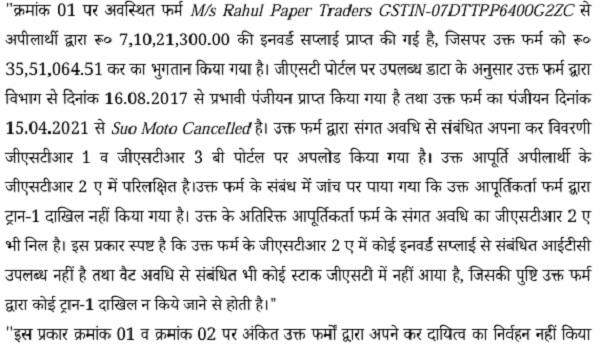
5. Shocked and surprised with the same, the petitioner submitted a detailed reply thereto controverting the proposed allegations while hinging upon the records being tax invoices, e-way bills, bilties, kanta parchis, purchase ledger accounts, banking channel payment evidence, GSTR-2A which came to be reflected in petitioner’s return. Thereafter a show cause notice in Form GST DRC-01 dated 24.02.2023 was issued under Section 74(1) of the Act for tax period 2017- 18. The petitioner on the receipt of the same tendered his detailed reply. . In the reply itself the petitioner annexed and detailed its contentions while referring to invoices, e-way bills, bilties, kanta parchi, purchase ledger, banking channel payments. It was the consistent case of the petitioner that the petitioner happened to be the purchaser and he had paid each and every amount due towards tax etc. to the supplier. However, on 11.05.2023 the proper officer proceeded to pass an order under Section 74(9) disallowing ITC and the third respondent proceeded to pass an order raising demand of tax to the tune of Rs. 53,42,142/-, interest Rs. 50,89,913/- and penalty of Rs. 53,42,142/- aggregating to Rs. 1,57,74,197/-. As per the order dated 11.05.2023, the reasoning assigned was that these supplies in the chain had passed on bogus ITC and ITC benefit was denied to the petitioner under Section 16(2)(c) of the Act in that regard. The petitioner being aggrieved against the order dated 11.05.2023 preferred an appeal before the appellate authority purported to be under Section 107 of the Act. However, on 22.06.2024, the second respondent, Additional Commissioner Grade-II (Appeal), State Tax, Judicial Division, Muzaffarnagar proceeded to pass an order whereby the ITC so claimed by the petitioner was disallowed under Section 16(2)(c) and Rule 36 relating to two supplies, ITC benefit was granted relating for other four supplies. However, it was also recorded that the petitioner had produced proper documentary evidence including tax invoice, e-way bills, bilties, kanta parchi, ledger entities, banking channel payment proof and evidence with respect to the goods, but both these supplies were registered on the dates of the supply, that the transactions appeared in GSTR-2A of the petitioner and that of GSTR-1 and GSTR-3B and thereafter, the Appellate Authority held that the supplier M/s Rahul Paper Traders was registered effectively and cancelled only by suo moto action with effect from 15.04.2021 and so far as GMD Traders is concerned, the same was registered effectively and cancelled w.e.f. 31.10.2021 and the supplies were reflected in GSTR-2A and the petitioner had produced tax invoices, e-way bills, bilties, Kanta Parchi, purchase ledger and other documents. As per the appellate order, a direction was issued to the proper officer by the Appellate Authority to proceed against the petitioner in terms of Section 73(9) of the Act.
6. Questioning the order dated 22.06.2024 passed by the second respondent – Appellate Authority, in so far as it directed the third respondent / Joint Commissioner, Corporate Circle, State Tax, Saharanpur Zone, Muzaffarnagar to determine tax, interest and penalty afresh under Section 73(9) of the Act, the present petition has been preferred.
7. This Court entertained the writ petition on 22.09.2026 while passing the following orders:-
“1. The contention of the learned counsel for the petitioner is that though the appellate authority had recorded findings in favour of the petitioner, however, remanded the matter back to proceed under Section 73 of the Act which is not permissible as the appellate authority has no power to remand the matter. Reliance has been placed upon the decision in Tax No. 852 of 2026 (M/s Anand and Anand (Law Firm) Vs. The Principal Commissioner Central Goods and Service Tax and others), decided on 16.02.2026.
2. Shri N.P. Singh, learned Standing Counsel seeks time to obtain instructions / file affidavit.
3. Respondents-State shall file their counter affidavit by 01.10.2026. Rejoinder affidavit, if any, may be filed by 06.10.2026 thereafter.
4. Put up this case on 07.10.2026 as fresh.“
8. A counter affidavit has been filed by respondent nos. 2 and 3 sworn by Joint Commissioner, Corporate Circle, State Tax, Saharanpur dated 30.09.2026. However Sri Shubham Agrawal, learned counsel for the petitioner has made a statement at the Bar that he does not propose to file any rejoinder to the same.
9. Learned counsel for the petitioner has sought to argue that the order dated 22.06.2026 passed by the second respondent/ Additional Commissioner Grade 2 (Appeals) State Tax Judicial Division Muzaffarnagar insofar as it directs the Joint Commissioner Corporate Circle, State Tax, Saranpur Zone, Muzaffarnagar, to determine tax, interest and penalty afresh cannot be said to be legal in the eyes of law, as the discretion to pass an order and to take a decision vests upon the third respondent being the proper officer. Though it might be that the Appellate Authority may direct the proper officer to take action in accordance with law, but he cannot in any manner whatsoever in a mechanical manner direct to proceed in terms of a particular provision in that regard.
10. Sri Shubham Agarwal has also placed reliance upon the appellate order so as to contend that no fault/ discrepancy whatsoever was found against the writ petitioner, as the writ petitioner has deposited the tax and made all the payments, but it was the supplier itself who might have committed an act or omission, which exposed him to penalty in that regard. Reliance has been placed upon a decision of the High Court of Punjab and Haryana, being Shaurya Alloys Pvt. Ltd. vs. State of Punjab and others, being CWP No. 34296 of 2024 decided on 01.10.2026. Learned counsel for the petitioner has invited the attention of the Court towards Section 16(2)(c) of the Act as well as the provisions contained under Sections 73, 74 and 76. He submits that the Punjab and Haryana High Court in the said decision had opined that a mechanical approach is not to be adopted and the proper officer on being confronted with a remand order is to apply its independent mind in this regard bearing the facts and circumstances of each and every case. He further submits that though under under sub-section (11) of Section 107 of the Act there is no power of remand in that regard.
11. Sri Ravi Shankar Pandey, learned Standing Counsel submits that none of the contentions raised by the learned counsel for the petitioner has any legs to stand for the simple reason that sub-section (11) of Section 107 of the Act cannot be read in isolation as it is to be read in conformity and consonance with sub-section (2) of Section 75 of the Act and here the proper officer has the power to determine the same. He however, could not dispute the fact that whatever records is available, the same should not be in a mechanical manner. He seeks to rely upon the judgement of M/s Bhavani Tractors vs Union of India and others of the Gujarat High Court in R/ Special Civil Application No. 13787 of 2024 decided on 10.07.2025, M/s Bhandari Scrap Traders v. Union of India (SLP (C) No.24103 of 2026) decided on 24.07.2026 and the judgment of the Gujarat High Court in M/s Maruti Enterprises v. Union of India, (Special Civil Application No. 18080 of 2023) decided on May 1, 2026 affirmed by the Hon’ble Supreme Court in its judgment dated 24.07.2026 in M/s Bhandari Scrap Traders (supra).
11. I heard the submissions made across the Bar and perused the record carefully.
12. Plainly and simply, the entire controversy boils down to a contingency wherein the writ petitioner being the purchaser has discharged his obligation as per the statute. However, the supplier has though submitted returns but it had claimed ITC without payment of tax in that regard. In order to proceed with the matter, what would be relevant would be the findings recorded in the order impugned dated 22.06.2024, which would assume significance in that regard. The relevant extract whereof are as under:-
–
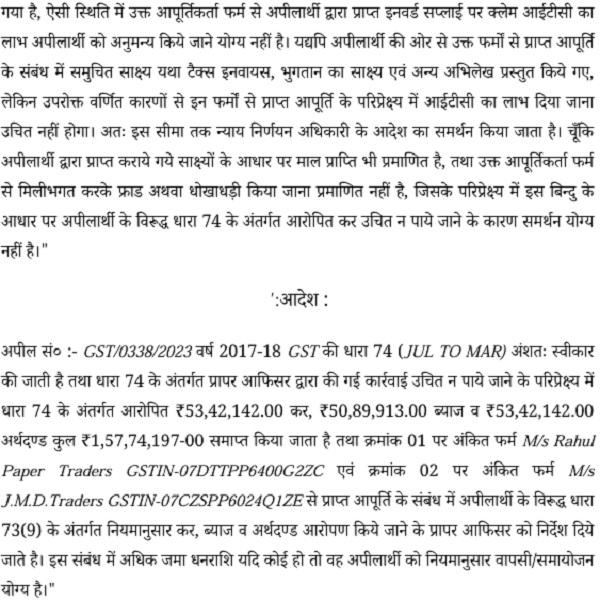
13. A bare look at the order dated 22.06.2026, passed by the second respondent, Additional Commissioner Grade-II (Appeal), State Tax, Judicial Division, Muzaffarnagar would go to show that the Appellate Court after evaluating the evidence available on record has recorded a finding that the writ petitioner herein, who happened to be the purchaser has discharged his obligation. He has paid the tax and returns were also submitted by him. However, it was also concluded that the suppliers, who happen to be M/s Rahul Paper Traders and M/s JMD Traders had not deposited the tax though returns were submitted by them. A finding has also been recorded in favour of the writ petitioner that there is no element of fraud in that regard. Thus, there was no occasion to proceed under Section 74 of the Act itself. However, in the concluding portion of the order dated 22.06.2026, this much has been recited that the matter stands remitted back to the proper officer to take appropriate decision in the light of the observations made in the body of the order dated 22.06.2026 while proceeding under Section 73(9) of the Act. Though according to Sri Shubham Agrawal, there is no power of remand and once finding has been recorded in favour of the writ petitioner by the Appellate Authority, then it was for the Appellate Authority to have decided the matter without remanding the same, but he in his usual fairness submits that he has no objection in case, the proper officer adjudicates, but the same should be with independent application of mind and not in a mechanical manner in the light of the judgment of the Punjab and Haryana High Court in Shaurya Alloys Pvt. Ltd. (supra).
14. In Shaurya Alloys Pvt. Ltd. (supra) the Division Bench of Punjab and Haryana High Court has observed as under:-
“73. The Act of 2017 originally contained a scheme where ITC was to be credited to the electronic credit ledger on self-assessed basis and was to be utilized only for payment of self-assessed output tax as per the return. Section 42 then contemplated matching, reversal and reclaim of ITC. Section 42 was not implemented and was ultimately deleted vide Finance Act, 2022 w.e.f. 01.10.2022. Section 41 was also substituted providing for availment of credit of eligible input tax, on self-assessment basis by way of credit to the electronic credit ledger. The concept of provisional availment of ITC and later its matching has been done away with w.e.f. 01.10.2022.
74. Section 16(2)(c) was actually a part of the GST scheme contained in the Act of 2017 with provisions incorporated therein containing mechanism of verification and matching etc., such that Section 16(2)(c) of the Act of 2017 was capable of being given effect to. It, i.e., Section 16(2)(c) of the Act of 2017, cannot be construed as standalone provision bereft of other provisions which contained the mechanism for its implementation.
75. If it is treated to be a standalone provision without any mechanism put in place in the statute to ascertain whether the selling dealer has deposited tax or to secure its deposit with the Government then the maxim lex non cogit ad impossibilia meaning that the law cannot impose an impossible obligation would clearly get attracted exposing the provision to a possible challenge on the ground of violating Articles 14 and 19 of the Constitution of India.
….
78. The aforesaid principle assumes significance where the statutory scheme requires the purchasing dealer to bear a liability dependent upon an event occurring at the hands of the selling dealer, while the former has no statutory means of ascertaining whether such event has occurred. In somewhat similar situation, a Constitution Bench the incidence of such amount.
……
80. Section 76 of the Act of 2017 specifically deals with a situation where a selling dealer has not deposited tax even after collecting it from the purchasing dealer. The statute empowers the proper officer to serve notice on the person liable to pay such amount and after considering reply, if any, determine the amount payable along with interest in terms of Section 50 of the Act of 2017.
81. GST scheme therefore contains elaborate provision to deal with instances of non-deposit of tax collected by the selling dealer from the purchasing dealer. Where the supplier has collected tax from the purchasing dealer but has failed to deposit the same, the liability of the supplier is specifically recognised and provision is made for determination and recovery of such amount under Section 76 of the Act of 2017.
82. Section 76 of the Act of 2017 cannot be rendered otiose in the GST scheme on account of indiscriminate invocation of Section 16(2)(c) of the Act of 2017. This would lead to an anomalous situation, wherein the person liable to pay tax is spared and obligation to pay tax is imposed on the purchasing dealer even though it has already paid tax on the transaction. The statutory intent will be frustrated in such an eventuality. Section 16(2)(c) would have to be construed in harmony with the statutory mechanism, rather than in a manner which, without regard to the statutory mechanism applicable to the relevant period, places the entire consequence of the selling dealer’s default upon the purchasing dealer.
……
90. The provisions as discussed hereinabove, will, therefore, have to be kept in mind by the proper officer when it proposes to take shelter of Section 16(2)(c) of the Act of 2017. Proper application of mind on part of the proper officer is required, particularly in instances where the purchasing dealer is able to satisfy other conditions specified in Section 16(2) of the Act of 2017 by producing tax invoice, actual movement of goods/services and other relevant material. In such cases, the mere fact that the selling dealer has subsequently failed to deposit the tax with the Government cannot, by itself and without examination of the surrounding circumstances, result in mechanical reversal of the ITC. The aforesaid requirement would, however, have to be applied with reference to the statutory mechanism applicable to the period in question and the material available before the proper officer.
…..
96. However, since the original scheme was not implemented and had to be diluted due to technical glitches or the issuance of various notifications, no mechanism was accessible for matching the data, nor did the GST mechanism enable the purchasing dealer to know whether Form GSTR-3B furnished by the supplier was correct or whether the tax admissible had been paid by the selling dealer. It is in this context that the GST Council, in its 43rd GST Council Meeting, approved amendments to the entire system of automation under the GST regime, and various sections such as Sections 42 and 43 were entirely deleted. The system of provisional ITC was done away with and was substituted with final availment of ITC at the initial stage based on self-assessment. However, where the tax itself had not been paid by the supplier on such ITC, the ITC availed, along with interest, was to be reversed. It was with effect from 26.12.2022 that Rule 37A was added to the CGST Rules. It provided for re-availment of reversed ITC due to non-payment of tax by the supplier once the supplier paid such tax along with interest in terms of Section 50 of the Act of 2017.
97. It is worth noticing that prior to the introduction of Rule 37A of the CGST Rules, there existed no statutory mechanism for re-availment of reversed credit which had been reversed on account of non-payment of tax by the selling dealer, even if the selling dealer deposited the unpaid tax later along with interest. Therefore, in respect of matters governed by the statutory framework prior to the amendment of Rule 37 w.e.f. 01.10.2022 and the introduction of Rule 37A of the CGST Rules w.e.f. 26.12.2022, the purchasing dealer did not have the benefit of the specific re-availment mechanism subsequently incorporated in Rule 37A. This assumes significance in cases where reversal is sought, on account of a subsequent default by the selling dealer, despite the purchasing dealer having paid the tax component to the selling dealer, possessed the requisite tax invoice and actually received the goods or services. The purchasing dealer also had no corresponding statutory mechanism under the ITC framework for immediate re-availment of the reversed credit upon subsequent payment by the selling dealer.
98. Having elaborately examined the GST scheme, we are of the view that Section 16(2)(c) of the Act of 2017 does not suffer from any constitutional infirmity warranting its invalidation, though, as we shall presently indicate, it cannot be construed and applied as a standalone provision. The condition that the tax charged in respect of a supply must have been actually paid to the Government is not a condition extraneous to the concept of ITC, it constitutes its very foundation. The Statement of Objects and Reasons of the Act of 2017 itself contemplates the availability of ITC in respect of taxes paid, and the credit of input tax, being a statutory concession, is available only upon fulfilment of the conditions subject to which it is conferred. The competence of Parliament to prescribe such a condition is not in question, nor have the petitioners seriously contended that such a condition, in the abstract, falls outside the wide latitude which the legislature enjoys in matters of fiscal policy. As already noticed in paragraph 91 hereinabove, the challenge to the vires is, at best, feeble, and the real grievance of the petitioners is directed against the manner in which the provision is being invoked. The vice complained of, namely, that the purchasing dealer is called upon to perform an impossible act, does not inhere in the text of Section 16(2)(c). It arises when the provision is torn out of the statutory scheme of which it is an integral part and is applied in a routine and mechanical manner, as noticed in paragraphs 88 and 89 hereinabove. The possibility of a provision being applied improperly or arbitrarily in individual cases is not a ground to invalidate the provision itself. The remedy lies in ensuring that the power is exercised in the manner, and subject to the safeguards, which the statute contemplates. We are also conscious that the Gujarat High Court in Maruti Enterprises (supra) has upheld the constitutional validity of Section 16(2)(c) of the Act of 2017, and the Special Leave Petition against the said judgment has been dismissed by the Supreme Court in Bhandari Scrap Traders (supra), with the observation that no parity can be drawn between the provisions of the Delhi Value Added Tax Act, 2004 and the Act of 2017 so as to treat a purchasing dealer under the latter on par with a bona fide purchasing dealer under the former. Judicial discipline, therefore, also counsels us against reading down the provision on the lines of Gheru Lal Bal Chand (supra) and On Quest (supra), so as to confine its operation only to cases of fraud, collusion or non-existent transactions. The challenge to the vires of Section 16(2)(c), read with Section 155 of the Act of 2017, is accordingly repelled.
…..
103. In the light of the aforesaid discussion, we hold that Section 16(2)(c) of the Act of 2017 shall be read and invoked in consonance with the statutory scheme, in accordance with the following guidelines:-
(i) Section 16(2)(c) shall not be invoked against a purchasing dealer in a routine or mechanical manner. The subsequent cancellation, including retrospective cancellation, of the registration of the selling dealer; the reflection of ‘nil’ or short tax liability in the return of the selling dealer; or the receipt of an alert or intimation from some source or complaint etc., may furnish a legitimate starting point for an inquiry, but shall not, by themselves, constitute the basis for denial or reversal of ITC availed by the purchasing dealer.
(ii) Before issuing a show cause notice to a purchasing dealer founded upon Section 16(2)(c), the proper officer shall apply his mind to the material available and record his satisfaction as to factors such as: (a) the particulars of the selling dealer, the invoices, the tax periods and the amount of ITC involved; (b) the precise nature of the default, i.e., whether the tax charged has not been paid at all, has been short paid, or has been discharged through utilisation of ITC which is itself inadmissible; (c) the circumstances in which the selling dealer has failed to deposit the tax; and (d) the proceedings, if any, initiated against the selling dealer for recovery of such tax, including under Sections 73, 74, 75(12) read with Section 79, or Section 76 of the Act of 2017, and the status thereof.
(iii) Investigation leading to issuance of Show Cause Notice should be carried out in order to establish some direct link of the petitioner with the suppliers in order to satisfy the violation of conditions mentioned in Section 16 (2).
(iv) The show cause notice shall disclose the aforesaid particulars, the material on which the proposed denial or reversal of ITC is founded, the details of the supplier(s) from whom ITC is alleged to have been wrongly availed, and the manner in which it is alleged to have been wrongly availed. The documents relied upon, such as alert notices, inspection reports, panchnamas, statements recorded during investigation, and e-way bill, vehicle registration, toll and banking data, shall be supplied to the noticee, subject to any privilege lawfully claimed.
(v) Where Section 74 of the Act of 2017 (or, for the period to which it applies, Section 74A on the ground of fraud, wilful misstatement or suppression of facts) is invoked, the notice shall itself contain the foundational facts from which the inference of fraud, wilful misstatement or suppression of facts on the part of the noticee is drawn, in terms of G.R. Infra Projects (supra) and Tata Steel (supra). A bald or mechanical recital of these expressions shall not suffice, and the deficiency cannot be supplied by a counter affidavit or by subsequent explanation. The fraud of the selling dealer shall not be attributed to the purchasing dealer unless the notice discloses the facts connecting the purchasing dealer with such fraud.
(vi) The burden under Section 155 of the Act of 2017 lies upon the purchasing dealer to establish its eligibility to ITC. The purchasing dealer may discharge the burden by producing material such as the tax invoice; proof of receipt of goods or services, including e-way bills, transport receipts, weighbridge slips and stock and consumption records etc.. The proper officer shall consider such material and deal with it in the order.
(vii) Where the denial of ITC is premised upon the retrospective cancellation of the registration of the selling dealer, the proper officer shall examine the grounds on which, and the date from which, the registration has been cancelled, and whether such grounds have any bearing on the genuineness of the particular supply made to the purchasing dealer.
(viii) The existence of the statutory remedy against the selling dealer is a relevant consideration which cannot be rendered toothless. The proper officer shall ascertain and record the status of the proceedings against the selling dealer and, where the selling dealer falls within the jurisdiction of another authority, whether Central or State, shall communicate with the jurisdictional officer concerned. Where tax in respect of the same supply has been recovered from, or deposited by, the selling dealer, that fact shall be taken into account so that the same tax is not realised twice, and the purchasing dealer shall be entitled to avail or re- avail the credit to the extent permissible under the proviso to Section 41(2) of the Act of 2017 and Rule 37A of the CGST Rules, subject to Section 17(5)(i) of the Act of 2017, the applicability of which shall be examined on the facts of each case.
(ix) The proper officer shall apply the statutory framework as it stood during the tax period in question, bearing in mind the distinct phases of the scheme, namely, (a) the period prior to 01.10.2022, when the original Section 41 was in force and Sections 42 and 43, though on the statute book, were never operationalised, and when no mechanism for re-availment of reversed credit existed; (b) the period from 01.10.2022, when Section 41 was substituted, Sections 42 and 43 were omitted and clause (ba) was inserted in Section 16(2); and (c) the period from 26.12.2022, when Rule 37A was inserted in the CGST Rules. A condition or mechanism introduced by a later amendment, including clause (aa) of Section 16(2) with effect from 01.01.2022, shall not be applied to a period prior to its coming into force. In respect of the period prior to 26.12.2022, the absence of a re-availment mechanism shall be borne in mind while determining the consequence of the default of the selling dealer.
(x) The registration of a purchasing dealer shall not be cancelled, much less with retrospective effect, merely because ITC has been availed on purchases made from a selling dealer whose registration has subsequently been cancelled, without independent satisfaction as to the existence of a ground under Section 29(2) of the Act of 2017 and compliance with the procedure prescribed therefor.
(xi) An opportunity of personal hearing shall be afforded in terms of Section 75(4) of the Act of 2017. Where the statements of third persons are relied upon and the noticee seeks their cross-examination, the request shall be considered and decided by a reasoned order, having regard to whether such statements form the basis of the proposed action.
(xii) The order shall set out the relevant facts and the basis of the decision, as mandated by Section 75(6) of the Act of 2017, deal with the reply and the documents produced by the noticee, and record a specific finding on each of the conditions of Section 16(2) which is in dispute. Where Section 74 has been invoked, the order shall also record a specific finding as to the fraud, willful misstatement or suppression of facts attributable to the noticee.
(xiii) The fact that the purchasing dealer has deposited an amount during the course of investigation, whether through Form GST DRC-03 or otherwise, shall not, by itself, dispense with the requirement of the show cause notice disclosing the foundational facts. The character of such deposit and its effect shall be determined by the proper officer on the facts of each case.
(xiv) The aforesaid guidelines shall govern all proceedings pending before the proper officers as well as proceedings initiated hereafter.
104. We are also of the view that a number of suggestions placed before us, merit consideration at the appropriate level. These include the display of an immediate alert on the common portal upon initiation of proceedings for cancellation of the registration of a supplier; a technology-driven mechanism enabling real-time verification by the recipient of the payment of tax by the supplier against specific invoices; alerts to the recipients where a supplier defaults in complying with Rule 86B of the CGST Rules; random physical verification of registrations at the threshold, coupled with biometric and PAN/Aadhaar based authentication; and the notification of supplies such as scrap from the unorganised sector under the reverse charge mechanism. These are matters of policy within the domain of the Government and the GST Council, and we refrain from issuing any mandamus in that regard. We, however, commend them for consideration, echoing the expectation expressed by the Gujarat High Court in paragraph 89 of Maruti Enterprises (supra) that the Government would address the issue of genuine purchasers at the earliest.
105. Coming to the individual cases, we have, as noticed in paragraph 4 hereinabove, refrained from examining the facts of each case. The impugned show cause notices and orders have been issued or passed without the benefit of the guidelines laid down hereinabove, and many of them appear to have been founded solely upon the default or the retrospective cancellation of the registration of the selling dealer. At the same time, the revenue has asserted that in several cases the transactions are not genuine, and that assertion cannot be rejected without an examination of the facts, which is best undertaken by the proper officer. Balancing these considerations, we deem it appropriate to dispose of the writ petitions with the following directions:-
(i) Where the proceedings are at the stage of show cause notice, the Petitioners shall be at liberty to file a reply or supplementary reply, along with supporting materials, within a period of eight weeks. The proper officer shall thereafter decide the matter by passing a reasoned and speaking order, after granting an opportunity of hearing, keeping in view the guidelines laid down hereinabove.
(ii) Where the show cause notice does not disclose the particulars or the material contemplated by the aforementioned guidelines, the proper officer shall supply the same to the noticee.
(iii) Where any supplementary notice or corrigendum is issued introducing a new ground or provision other than the one originally invoked, the noticee shall be at liberty to raise any objection in that regard, which shall be decided in the fresh order.
(iv) In cases where orders have been passed by the adjudicating authority, the proper officer shall re-visit the matter in the light of the guidelines set out in this judgment, after affording an opportunity of personal hearing, and shall pass a fresh reasoned order in accordance with law. While undertaking such an exercise, the proper officer may issue a supplementary notice or corrigendum along with the particulars or the material contemplated by the aforementioned guidelines and shall provide a proper opportunity to the petitioner(s) to file their Reply.
(v) It is clarified that the orders impugned in the present petitions are not being interfered with. However, they shall abide by the fresh orders that shall be passed in pursuance to this judgment.
(vi) Any amount deposited by or recovered from the petitioners, including by way of reversal of ITC or debit to the electronic credit or cash ledger, shall also abide by the fresh decision of the proper officer and shall be adjusted or refunded, along with interest as admissible, in accordance with law, wherever warranted.
(vii) No fresh coercive action regarding recovery etc., shall be taken against the petitioners pursuant to the impugned show cause notices or orders till the decision of the proper officer, in light of the above observations.
(viii) All pleas on merits, including those on fact and law are left open.
(ix) We make it clear that nothing in this judgment shall preclude the Department from proceeding against the defaulting selling dealers, in accordance with law.“
15. Reference may also be made to the judgment in M/s Bhavani Tractors (Supra), wherein following has been observed:-
“4.4 It was therefore submitted that as per the provision of Sec.75(2) of the GST Act, the Court may direct the respondent authority to pass a fresh de novo order under the provisions of Sec.73 of the Act so as to enable the petitioner to get the benefit of sec.128A of the GST Act. In support of his submission, learned advocate Mr.Uchit Sheth, referred to and relied upon the Agenda for 53rd GST Council Meeting held on 22.06.2024, wherein, in Agenda Item 3(vii), it was proposed for insertion of sec.128A in the GST Act to provide for conditional waiver of interest of penalty or both relating to demand raised under Sec. 73 for Financial Year 2017-18 to Financial Year 2019- 20.
4.5 Learned advocate Mr.Sheth, invited the attention of the Court to para 3.5 of the Agenda to point out that if any order is passed under Sec. 75(2) and the proper officer passes an order under Sec.73 pursuant to such order, then the benefit of Sec.128A would be available to the assessee. Learned advocate Mr.Sheth, also pointed out the paragraph Nos. 4.91 and 4.93 of the Minutes of the 53rd Meeting of the GST Council to submit that the GST Council has agreed with the agenda and the recommendations made in the agenda of the Law Committee along with the suggestion of the Secretary regarding the date to be notified for the payment of tax liability.
4.6 Learned advocate Mr.Sheth also referred to Circular No.238/32/2024-GST dated 15.10.2024 and pointed out paragraph No. 3.1.5 thereof to submit that by the Circular the CBIC has considered the proviso to sec.128A(1) of the GST Act and has also taken note of the sub- rule(6) of Rule 164 which is inserted along with the provision of Sec.128A in the CGST Rules to provide the procedure to be followed for implementation of sec.128A of the GST Act. It was submitted that once an order is passed under sec.75(2) of the GST Act, the proper Officer has to pass an order under Sec.73, and thereafter, the petitioner will be entitled to file Form GST SPL-02 as per Rule 164 of the GST Rules within six months from the date of communication of the order of the proper officer redetermining the amount of tax to be paid under Sec.73 of the GST Act by the petitioner.
4.7 It was submitted that in the facts of the case, that the petitioner is saddled with the liability of payment of interest and penalty, and therefore, the proper officer has to pass an order under Sec.73 of the GST Act for levy of interest and penalty only as per the provisons of Sec.73 of the GST Act redetermining the interest and penalty as per the provision of Sec.73 of the GST Act.
5 On the other hand, learned advocate Ms.Hetvi Sancheti for the respondent submitted that the respondent authority has issued the notice under Sec.74 of the GST Act only considering the fact that, but for the Audit of query, the petitioner would not have filed the Form DRC-03 voluntarily to offset the tax liability from the balance in the electronic credit ledger. It was therefore submitted that there is an implied suppression by the petitioner with regard to not offsetting the tax liability from the electronic credit ledger and therefore the provision of Sec.75(2) cannot be pressed into service so as to hold that there is no wilful mis- statement or suppression by the petitioner.
6 Having heard the learned advocates appearing for the respective parties and having considered the facts of the case and on perusal of the impugned orders passed by the adjudicating authority as well as the Appellate Authority it is apparent that the petitioner inadvertently did not offset the tax liability from the credit balance in the electronic ledger. It is not even the case of the respondent that there was no credit balance in the electronic credit ledger and the petitioner did not pay the outstanding tax liability. The only fault on the part of the petitioner was that the petitioner did not offset the tax liability from credit balance in the electronic ledger. Be that as it may, it is apparent from the facts of the case emerging from the record that there is no wilful mis-statement or suppression on the part of the petitioner to attract the provisions of sec.74 of the GST Act.
7 In view of such facts, we deem it fit to pass an order under Sec.75(2) of the GST Act by directing the respondent-Assessing Officer to pass a fresh de novo order under provision of Section 73 of the Act instead of invoking the provision of Sec.74(1) of the GST Act.“
16. A bare look of the judgment in Shaurya Alloys Private Limited (supra) would reveal that the Court had interpreted the provisions contained under Section 16(2)(c) and had opined that there has to be an exercise undertaken by the competent/ proper authority strictly in accordance with law while bestowing independent application of mind in order to come to a conclusion whether the purchaser was liable or not in that regard.
17. At this stage, Sri Ravi Shankar Pandey submits that the matter be remitted to the matter be directed to be decided by the proper officer, i.e., third respondent, Joint Commissioner, Corporate Circle, State Tax, Saranpur Zone, Muzaffarnagar, while independently applying its mind in accordance with the law of the land and the parties be accorded liberty to produce documentary evidence and law on the said subject.
18. To such a submission, learned counsel for the writ petitioner has no objection.
19. Bearing in mind the statements so made across the Bar, this Court is disposing of the writ petition in the following manner:-
(a). The findings recorded in the order dated 22.06.2026 by the Additional Commissioner Grade 2 (Appeal), State Tax, Judicial Division, Muzaffarnagar in favour of the writ petitioner is not interfered with.
(b) However, the order dated 22.06.2026 passed by the second respondent/ Additional Commissioner Grade 2 (Appeal), State Tax, Judicial Division, Muzaffarnagar is modified to the extent that now, the proper Officer/ Joint Commissioner, Corporate Circle, State Tax, Saranpur Zone, Muzaffarnagar, shall proceed to decide the issue strictly in accordance with law, bearing in mind the judgment of the Hon’ble Punjab and Haryana High Court in Shaurya Alloys (supra), M/s Bhavani Tractors (supra), Bhandari Scrap Traders (supra) and Maruti Enterprises (supra), while passing a reasoned and a speaking order after hearing the respective parties within a period of 4 months.
20. Any observations made hereinabove are not on the merits of the matter.
21. Needless to point out that it shall always be open for the respondents to proceed against the defaulting selling dealer, if so occasions.
22. With the above observations, the writ petition stands disposed of.
23. The present order has been passed on the basis of the consent of the parties.





