LT Foods Limited Vs Saraswati Trading Company (Delhi High Court)
Summary: The Delhi High Court, in LT Foods Limited Vs Saraswati Trading Company, decreed a trademark infringement and passing-off suit involving counterfeit DAAWAT-branded rice packaging and awarded Rs.25 lakh towards damages and costs. The plaintiff, LT Foods Limited, engaged in processing, marketing and exporting rice and other food products, alleged that the defendant, Saraswati Trading Company of Raipur, Chhattisgarh, was selling inferior Jawaphool rice as premium Basmati rice in packaging identical to its DAAWAT CHEF’S SECRETS BASMATI RICE products. The plaintiff relied upon its longstanding use of the DAWAT/DAAWAT marks, trademark registrations dating back to 1987, substantial domestic and international sales, and extensive goodwill. The proceedings sought permanent injunction, damages and other reliefs for infringement of registered trademarks, passing off and unfair competition.
The plaintiff submitted that the DAWAT mark had originally been adopted by Lal Chand Tirath Ram Rice Mills in 1985 and subsequently assigned to LT Foods Limited in 2003. Its trademarks were registered in India as word and device marks and in numerous foreign jurisdictions. The plaintiff claimed that its DAWAT/DAAWAT products generated sales exceeding Rs.700 crore in the financial year 2020–21 and promotional expenditure of approximately Rs.33 crore. It also referred to earlier proceedings against Narwal Foods Products Private Limited, RBAK Agro India Private Limited and Sri Siva Sai Datta Enterprises, in which protection had been sought against unauthorised use of DAWAT-related marks. In the present proceedings, the plaintiff alleged not merely a deceptively similar mark but the use of counterfeit packaging reproducing the plaintiff’s established branding on rice of a different description and quality.
On 7 September 2021, the Court granted an ex parte ad interim injunction restraining infringement and appointed a Local Commissioner to inspect the defendant’s premises. The Local Commissioner conducted inspections on 10 September 2021, including at three additional premises identified during the execution of the commission. The report recorded 89 packets of different categories of rice and packaging material bearing the DAAWAT marks. Photographs and the inventory indicated that the defendant was using packaging resembling the plaintiff’s products. The defendant’s owners, Satish Meghani and Govindram Meghani, were present during execution of the commission and were served with the relevant papers and order. Nevertheless, the defendant did not file a written statement or appear at the final hearing. The interim injunction was confirmed on 25 April 2022.
The High Court examined the evidentiary value of the Local Commissioner’s report under Order XXVI Rule 10(2) of the Code of Civil Procedure, 1908. Relying upon M L Brother LLP v. Mahesh Kumar Bhrualal Tanna, Levi Strauss & Co. v. Rajesh Agarwal, Vinod Goel v. Mahesh Yadav and the Supreme Court’s decision in Misrilal Ramratan v. A. S. Shaik Fathimal, the Court reiterated that a Local Commissioner acts as an officer and representative of the Court. The Commissioner’s report and evidence collected during inspection form part of the record and can be relied upon without compulsory examination of the Commissioner, particularly where the report remains unchallenged. The Court also referred to Disney Enterprises Inc. v. Balraj Muttneja and Cross Fit LLC v. RTB Gym and Fitness Centre in concluding that separate ex parte evidence was unnecessary in the circumstances.
The Court found that the defendant had deliberately used counterfeit packaging of an established rice brand to misrepresent Jawaphool rice as Basmati rice intended for human consumption. This conduct infringed the plaintiff’s statutory and common-law rights and threatened both its commercial reputation and consumer interests. Referring to McCarthy on Trademarks and Unfair Competition, the Court emphasised the consumer-protection function of trademark law. It further considered Proctor & Gamble Company v. Joy Creators, Burberry Limited v. 99 Labels.Com and Dhani Loans and Services Limited v. WWW.DHANIFINANCE.COM regarding damages for dishonest infringement and the importance of ensuring that deliberate counterfeiters do not escape financial liability merely by remaining absent from proceedings.
After considering the counterfeit goods and packaging recovered, the deliberate nature of the infringement, the plaintiff’s reputation, the costs of executing the local commission and the absence of the defendant’s accounting records, the High Court decreed the suit in terms of prayers (a), (b), (c) and (d) of the plaint. It awarded Rs.20 lakh as damages and Rs.5 lakh as costs, aggregating Rs.25 lakh. The judgment establishes that effective civil relief against trademark infringement may be granted on the basis of credible, unchallenged evidence collected by a court-appointed Local Commissioner, without requiring additional formal ex parte evidence in every case.
Cases Discussed
- Misrilal Ramratan & Ors. Mansukhlal & Ors. Vs A. S. Shaik Fathimal & Ors., 1995 Supp (4) SCC 600 (Supreme Court). Relied upon for the principle that a Commissioner’s report forms part of the judicial record and cannot be rejected merely because the Commissioner was not personally examined.
- Disney Enterprises Inc. & Anr. Vs Balraj Muttneja & Ors. (Delhi High Court); CS (OS) 3466/2012; 20/02/2014. Cited in support of dispensing with separate ex parte evidence where the available material sufficiently establishes the plaintiff’s entitlement to relief.
- Burberry Limited and Ors. Vs 99 Labels.Com (Delhi High Court); CS(OS) 2306/2013; 10/07/2017. Referred to for reaffirming judicial principles concerning damages in intellectual-property infringement proceedings.
- Levi Strauss & Co. Vs Rajesh Agarwal (Delhi High Court); RFA 127/2007; 03/01/2018; 2018 IAD (Delhi) 622. Relied upon for the admissibility of an unchallenged Local Commissioner’s report under Order XXVI Rule 10(2) CPC without mandatory examination of the Commissioner.
- Vinod Goel Vs Mahesh Yadav (Delhi High Court); RFA 598/2016; 23/05/2018. Cited regarding the status of a Local Commissioner as an officer of the Court and the evidentiary value of the report.
- LT Foods Limited Vs Narwal Foods Products Private Limited (Delhi High Court); CS (COMM) 491/2019. An earlier trademark-protection proceeding cited by the plaintiff concerning use of the mark INDIA DAWAT.
- LT Foods Vs RBAK Agro India Pvt. Ltd. (Delhi High Court); CS (COMM) 25/2020. An earlier proceeding relied upon by the plaintiff concerning the mark MUGHLAI PASAND DAAWAT.
- LT Foods Vs Sri Siva Sai Datta Enterprises (Delhi High Court); CS (COMM) 26/2020. An earlier proceeding cited concerning unauthorised use of the DAAWAT mark.
- Proctor & Gamble Company Vs Joy Creators, 2011 (450) PTC 541 Del (Delhi High Court). Relied upon for principles governing damages against dishonest trademark infringers, particularly those who avoid participation in proceedings.
- M L Brother LLP Vs Mahesh Kumar Bhrualal Tanna (Delhi High Court); CS(COMM) 126/2022; 12/05/2022. Relied upon for Order XXVI Rule 10(2) CPC and the proposition that an unchallenged Local Commissioner’s report may be accepted in evidence.
- Cross Fit LLC Vs RTB Gym and Fitness Centre (Delhi High Court); CS(COMM) 543/2021; 06/09/2022. Cited regarding disposal of trademark infringement proceedings without additional ex parte evidence where the record sufficiently supports relief.
- Dhani Loans and Services Limited and Ors. Vs WWW.DHANIFINANCE.COM (Delhi High Court); CS(COMM) 675/2019; 12/10/2022. Referred to for the approach to damages and monetary relief in trademark infringement cases.
FULL TEXT OF THE ORIGINAL JUDGMENT/ORDER OF DELHI HIGH COURT
1. This hearing has been done through hybrid mode.
2. The present suit for permanent injunction and damages for infringement of marks, passing off, unfair competition has been filed by the Plaintiff- LT Foods Limited against the Defendant- M/s.Saraswati Trading Company. The Plaintiff is engaged in the business of processing, marketing and exporting food products including rice. The annual turnover of the Plaintiff is over Rs.2,000 crores in the financial year 2020-2021 and it is amongst the top 50 food processing companies in North India as per the Dun and Bradstreet survey.
3. The case of the Plaintiff is that it has a strong distribution network in all major Basmati Rice consuming cities in India as also in foreign countries including USA, Canada, UK and EU. Some of the well-known brands used by the Plaintiff are HERITAGE, DAWAT, DAAWAT, DAAWAT DEVAYA, DAAWAT BESTOW, ORANGE, DEVAAYA, CHEF’S SECRET, SONA, ROYAL, etc.
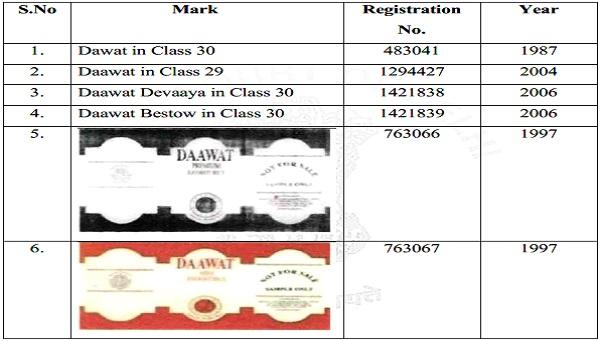
4. The present suit relates to the trademarks ‘DAWAT’ / ‘DAAWAT’ used in respect of rice. The said marks are registered by the Plaintiff in both word mark and device mark form since 1987. Details of the registrations of the Plaintiff are set out below:
5. The mark ‘DAWAT’ itself was adopted in 1985 by one M/s Lal Chand Tirath Ram Rice Mills. The said mark was later assigned to the Plaintiff-company in 2003. The mark ‘DAWAT’ is also registered in several foreign countries such as Australia, Bahrain, Brunei, Canada, China, Colombia, Iraq (Kurdistan region), European Union, Gambia, Iran, Israel, Kenya, Malaysia, Mauritius, New Zealand, Oman, Pakistan, Qatar, Saudi Arabia, Singapore, South Africa, UAE, United Kingdom, Yemen and USA.
6. The Plaintiff’s case is that owing to the strict quality control standards maintained by it, the products under the marks ‘DAWAT’ / ‘DAAWAT’ have attained enormous goodwill and reputation not only in India but in several countries of the world. According to the Plaintiff, the marks ‘DAWAT’ / ‘DAAWAT’ are well-known marks having achieved considerable sales turnover of more than Rs. 700 crores in 2020-2021. The sales promotion is claimed to be to the tune of Rs.33 crores in the year 2020-21 in respect of the said marks.
7. The Plaintiff also pleads that it has filed various actions to protect its marks, details of which are as under:
“i. In CS (COMM) No. 491 of 2019 titled LT Foods Limited v Narwal Foods Products Private Limited, the Plaintiff had filed a suit before the Hon’ble Delhi High Court against an entity by the name of Narwal Foods Products Private Limited for unlicensed/unauthorized usage of its trademarks and the infringement of trademark and copyright vested in its DAWAT and related marks. Pertinently, while granting an ad-interim injunction in the favour of the Plaintiff, the Hon’ble Court held that the Defendant by adopting the mark ‘INDIA DAWAT’, which predominantly contains the Plaintiff’s trademark ‘DAWAT’ is infringing the Plaintiff’s trademark and passing off its goods as that of the plaintiff.
ii. In CS (COMM) No. 25 of 2020 titled as LT Foods v RBAK Agro India Pvt. Ltd., the Plaintiff had filed a suit before the Hon’ble Delhi High Court against an entity by the name of RBAK Agro India Pvt. Ltd. for unlicensed/unauthorized usage of its trademarks and the infringement of trademark and copyright vested in its DAWAT and related marks. Pertinently, the Hon’ble Court held that the Defendant by adopting the mark ‘MUGHLAI PASAND DAAWAT’, the Plaintiff made out a case for a grant of an ex-parte ad interim order in favour of the Plaintiff.
iii. In CS (COMM) No. 26 of 2020 titled as LT Foods v Sri Siva Sai Datta Enterprises, the Plaintiff had filed a suit before the Hon’ble Delhi High Court against an entity by the name of Sri Siva Sai Datta Enterprises for unlicensed/unauthorized usage of its trademarks and the infringement of trademark and copyright vested in its DAWAT and related marks. Pertinently, the Hon’ble Court held that the Defendant by adopting the mark ‘DAAWAT’, the Plaintiff made out a case for a grant of an ex-parte ad interim order in favour of the Plaintiff.”
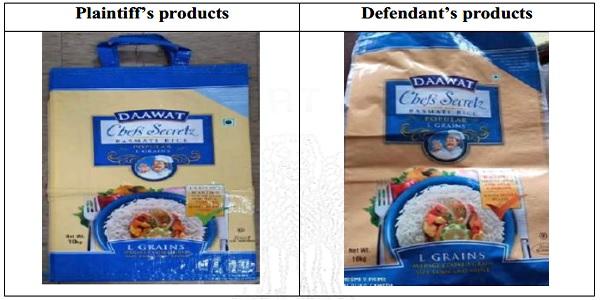
8. In the present suit, the grievance of the Plaintiff is that the Defendant who is based out of Raipur, Chhattisgarh is selling, storing and distributing counterfeit ‘DAAWAT’ branded products. The knowledge of the Defendant’s activities was acquired by the Plaintiff in August, 2021 when it procured Defendant’s product. The said product upon examination revealed that, though, the product is claimed to be Basmati Rice, it is actually Jawaphool Rice which does not match the standards of Basmati Rice which is high quality rice. The same was being rebranded as Basmati Rice and sold in ‘DAAWAT CHEF’S SECRETS BASMATI RICE’ branded product packaging. The product packaging of the Defendant is identical to that of the Plaintiff. The images of the two products are set out below:
9. In the present suit, on 7th September, 2021, an ex parte ad interim injunction was passed and a Local Commissioner was also appointed to visit the premises of the Defendant and prepare an inventory of the infringing goods. The operative portion of the said order reads as under:
“16. Upon hearing the submissions advanced by learned counsel for the plaintiff and perusal of the plaint, application for interim injunction and documents annexed thereto, this Court is of the opinion that a prima facie case for grant ex-parte ad interim injunction in favour of plaintiff and against the defendant is made out.
17. Accordingly, till further orders, the defendant and its officers, its principal officers, family members, servants and agents are restrained from manufacturing, selling, distributing, retailing and anyone acting for and on its behalf are restrained from producing, selling, offering for sale or advertising, promoting its goods or services, exporting or enabling advertising campaigns either directly or indirectly in physical/electronic form, internet, websites or in any manner any product bearing the impugned mark/package or its related marks including or any mark which is identical or deceptively similar to the plaintiffs marks ‘DAWAT OR DAAWAT”
10. In terms of the above order, the Local Commissioner visited the Defendant’s premises on 10th September, 2021. It is the submission of ld. Counsel for the Plaintiff that upon visiting the Defendant’s premises in Raipur, three further premises were identified. The Local Commissioner also visited the said premises and prepared an inventory there. The Local Commissioner’s report reveals that a total of 89 packets of different types of rice bearing the mark ‘DAAWAT’ were found. The images of the said packaging have also been placed on record in the Local Commissioner’s report which reveals that the Defendant’s product packaging is nothing but a counterfeiting packaging of the Plaintiff’s ‘DAAWAT’ products.
11. In the opinion of this Court, the Defendant is clearly indulging in blatant violation of the Plaintiff’s statutory and common law rights in the marks ‘DAWAT’ / ‘DAAWAT’. Moreover, considering that the product is rice for human consumption, the misrepresentation by the Defendant that the same is Basmati Rice is also impermissible. The owners of the Defendant, Saraswati Trading Company- Mr. Satish Meghani and Mr. Govindram Meghani were present at the time of the execution of the commission and the complete paperbook and order were also served upon them. Thus, they obviously have knowledge of the orders passed by this Court.
12. Considering these facts, on 25th April, 2022, the interim injunction was confirmed by this Court during the pendency of the suit. Today also none appears for the Defendant. No written statement has also been filed.
13. The settled legal position is that the Local Commissioner’s report can be read in evidence in terms of Order XXVI Rule 10(2) CPC. In M L Brother LLP v. Mahesh Kumar Bhrualal Tanna [CS(COMM) 126/2022, date of decision 12th May, 2022] this Court held as under:
“10. Order 26 Rule 10(2) CPC stipulates that the report of the Commissioner and the evidence taken by the Commissioner shall be evidence in the suit and shall form part of the record. The said provision reads as under:
10. Procedure of Commissioner.— (1) The Commissioner, after such local inspection as he deems necessary and after reducing to writing the evidence taken by him, shall return such evidence, together with his report in writing signed by him, to the Court.
(2) Report and depositions to be evidence in suit. Commissioner may be examined in person.—The report of the Commissioner and the evidence taken by him (but not the evidence without the report) shall be evidence in the suit and shall form part of the record; but the Court or, with the permission of the Court, any of the parties to the suit may examine the Commissioner personally in open Court touching any of the matters referred to him or mentioned in his report, or as to his report, or as to the manner in which he has made the investigation.”
11. In Levi Strauss & Co. v. Rajesh Agarwal 2018 IAD (Delhi) 622, this Court examined the said provision and held that once the Commissioner has filed the evidence along with his report, it becomes evidence in the suit itself. Under Order 26 Rule 10(2) CPC it is not mandatory to examine the Commissioner to admit the report of the Commissioner as evidence in the suit. The relevant observations are as under:
8. The Local Commissioner is in fact a representative of the Court itself and it is for this reason that Order 26 Rule 10 (2) of CPC clearly provides that once the Commissioner has filed the evidence along with his report the same shall be treated as evidence in the suit and shall form part of the record.
XXX XXX XXX
10. The rationale behind Order 26 Rule 10 (2) of CPC is clear i.e., the Commissioner is appointed as a representative of the Court and evidence collected by the Commissioner along with the report of the Commissioner would be evidence in the suit, subject to any objection raised by any party. If any party has any objection to Commissioner’s report or to the evidence, such party has an option to examine the Commissioner personally in open Court. Such examination is however, neither compulsory nor required especially in cases where the party does not challenge the report. In the present case, a perusal of the written statement filed by the Defendant clearly reveals that the Defendant does not challenge the Commissioner’s report. Para of the written statement is set out below…”
12. This position of law has been reiterated by this Court in Vinod Goel v. Mahesh Yadav [RFA 598/2016 decided on 23rd May, 2018] wherein the Court observed as under:
“7. It is the settled proposition in law that when a Commissioner is appointed, he acts as the officer of the Court and it is not necessary for the Commissioner to be examined. This is clearly laid down by the Supreme Court in Misrilal Ramratan & Ors. Mansukhlal & Ors. v. A. S. Shaik Fathimal & Ors., 1995 Supp (4) SCC 600, wherein the Court held as under:
“It is now settled law that the report of the Commissioner is part of the record and that therefore the report cannot be overlooked or rejected on spacious plea of non-examination of the Commissioner as a witness since it is part of the record of the case.”
8. Even this Court, recently in Levis Strauss v. Rajesh Agarwal [RFA 127/2007 decision dated 3rd January, 2018], held as under:
“11. The rationale behind Order 26 Rule 10 (2) of CPC is clear i.e. the Commissioner is appointed as a representative of the Court and evidence collected by the Commissioner along with the report of the Commissioner would be evidence in the suit, subject to any objection raised by any party. If any party has any objection to Commissioner’s report or to the evidence, such party has an option to examine the Commissioner personally in open Court. Such examination is however, neither compulsory nor required especially in cases where the party does not challenge the report.”
9. Mr. Prag Chawla clearly concedes that there may be no requirement to examine the Local Commissioner once the Commissioner is appointed by a Court.
10. Under these circumstances, since the Commissioner had visited the suit property and had submitted the report, it is deemed appropriate that the matter is remanded back to the Trial Court to decide the matter afresh after taking into consideration the report of the Local Commissioner, Mr. Y.D. Nagar dated 5th January, 2000 in Suit No.2198/1999.
13. In view of Order 26 Rule 10(2) CPC and the judgments discussed above, the settled legal position that emerges is that the report of the Local Commissioner can be treated as evidence in the suit where it is not challenged by any party. Accordingly, in the present case the report of the Local Commissioner and the contents therein can be relied upon by the Court as evidence as the same is unchallenged.”
14. Considering the report of the Local Commissioner which has been prepared and the evidence which has been collected by the Local Commissioner as also the non-filing of the written statement, this Court is of the opinion that no ex parte evidence is required in this matter. This view is supported by the decisions of this Court in Disney Enterprises Inc. & Anr. v. Balraj Muttneja &Ors. [CS (OS) 3466/2012 decided on 20th February, 2014] and Cross Fit LLC v. RTB Gym and Fitness Centre [CS(COMM) 543/2021, date of decision 6th September, 2022].
15. The present is not an ordinary case where the brand of the Plaintiff is misused. It is a case where the Defendant is using a counterfeit packaging which is identical to the Plaintiff’s packaging to sell Jawaphool Rice portraying the same to be Basmati Rice. These are goods for human consumption. Considering the Plaintiff’s reputation and the fact that ‘DAAWAT’ is a well-known mark in India, the suit is liable to be decreed.
16. Coming to the relief of costs and damages which have been prayed for by the Plaintiff, the Defendant’s counterfeiting is completely contrary to law and is also diluting the reputation and goodwill of the Plaintiff’s marks. There can be no justification for manufacturing and selling rice in counterfeit ‘DAAWAT’ branded packaging. Clearly, customers are being misled by the Defendant and the entire effort is deliberate, and dishonest. In McCarthy on Trademarks and Unfair Competition [4th Ed. § 2.33, page 2-57], the manner in which consumers need to be protected against use of infringing marks and counterfeit products is highlighted in the following words:
“ Thus, while the consumer is not a directly participating litigant, the consumer’s state of mind is paramount. In this sense, protection of trademarks is merely a facet of consumer protection. As a result, the plaintiff in trademark litigation may accurately be characterized as the “vicarious avenger” of consumer interests.
The consumer who has mistakenly purchased a box of JEM brand soap, thinking he or she was buying GEM brand soap is not going to file a suit for consumer fraud, even though such a person has a legal right to do so. The amount of financial damage, if any, is too small to justify expensive litigation. It is also unlikely that government consumer protection agencies will file suit. A consumer class action will probably meet insuperable procedural difficulties. Trademarks deter and prevent misrepresentation of source or sponsorship by creating private exclusive rights in trademark owners. While consumers would have standing to sue under state law, the consumer’s stake is small, making cost-efficient litigation a rarity. The consumer suits unlikely to be brought.
Thus, “the plaintiff is acting, not only in its own interest, but in the public interest.” Many decisions have stated that the law of trademarks and unfair competition rests not alone on a property right in the plaintiff, but in the right of the consuming public to be told the truth. The Supreme Court has upheld the order of a federal agency which was designed to prevent consumer confusion as a proper exercise of the “public interest”. And the Ninth Circuit has warned the trial courts that while the trademark owner is harmed, “the consuming public is equally injured by an inadequate judicial response to trademark infringement.”
17. A ld. single judge of this Court in Proctor & Gamble Company v. Joy Creators 2011 (450) PTC 541 Del outlined the factors behind grant of damages. The relevant part of the said order reads as under:
23. Also, the Court needs to take note of the fact that a lot of energy and resources are spent in litigating against those who infringe the trademark and copyright of others and try to encase upon the goodwill and reputation of other brands by passing of their goods and/or services as those of that well known brand. If punitive damages are not awarded in such cases, it would only encourage unscrupulous persons who actuated by dishonest intention, use the well-reputed trademark of another person, so as to encase on the goodwill and reputation which that mark enjoys in the market, with impunity, and then avoid payment of damages by remaining absent from the Court, thereby depriving the plaintiff an opportunity to establish actual profit earned by him from use of the infringing mark, which can be computed only on the basis of his account books.
This would, therefore, amount to putting premium on dishonesty and give an unfair advantage to an unscrupulous infringer over those who have a bona fide defense to make and therefore come forward to contest the suit and place their case before the Court.
The said judgment has been re-affirmed by a ld. Judge of this Court in Burberry Limited and Ors. v 99 Labels.Com [CS(OS) 2306/2013, date of decision 10th July, 2017]. A similar view has also been taken in Dhani Loans and Services Limited and Ors. v. WWW.DHANIFINANCE.COM [CS(COMM) 675/2019, date of decision 12th October, 2022].
18. From the On-Spot proceedings prepared by the Local Commissioner it appears that accounts were not produced before the Local Commissioner. Considering that these are counterfeit products, it is nigh possible that the Defendants are not maintaining proper accounts. The seizure which was made by the Local Commissioner reveals the following:
Inventory Sheet
| 1. | Packed Daawat’s Chef’s Secretz | 10 Packets of 10 Kgs each |
| 2. | Empty Packaging Material of Daawat’s Chef’s Secretz | 52 Packets of 10 Kgs each |
| 3. | Packed Daawat Rice (Packages in Blue Colour) | 2 Packets of 25 kgs each |
| 4. | Empty Packaging material of Daawat Rice (Packaging material in blue colour) | 25 Packets of 25 Kgs each |
19. Considering the amount of seizure made, the nature of the counterfeiting indulged into by the Defendant, the costs incurred by the Plaintiff for executing the local commission and the court fees deposited, it is clear that the Plaintiff’s mark and business has been diluted due to the infringing use. Considerable costs have also been incurred. The illegal acts of the Defendant are not innocent and are clearly deliberate with a dishonest intention.
20. The present suit is accordingly decreed in terms of prayer (a), (b), (c) and (d) of the plaint as also for a sum of Rs.25,00,000/- towards damages and costs as under:
i. Damages to the tune of Rs.20,00,000/-.
ii. Costs of Rs.5,00,000/-
21. Decree sheet be drawn accordingly. All pending applications are disposed of.