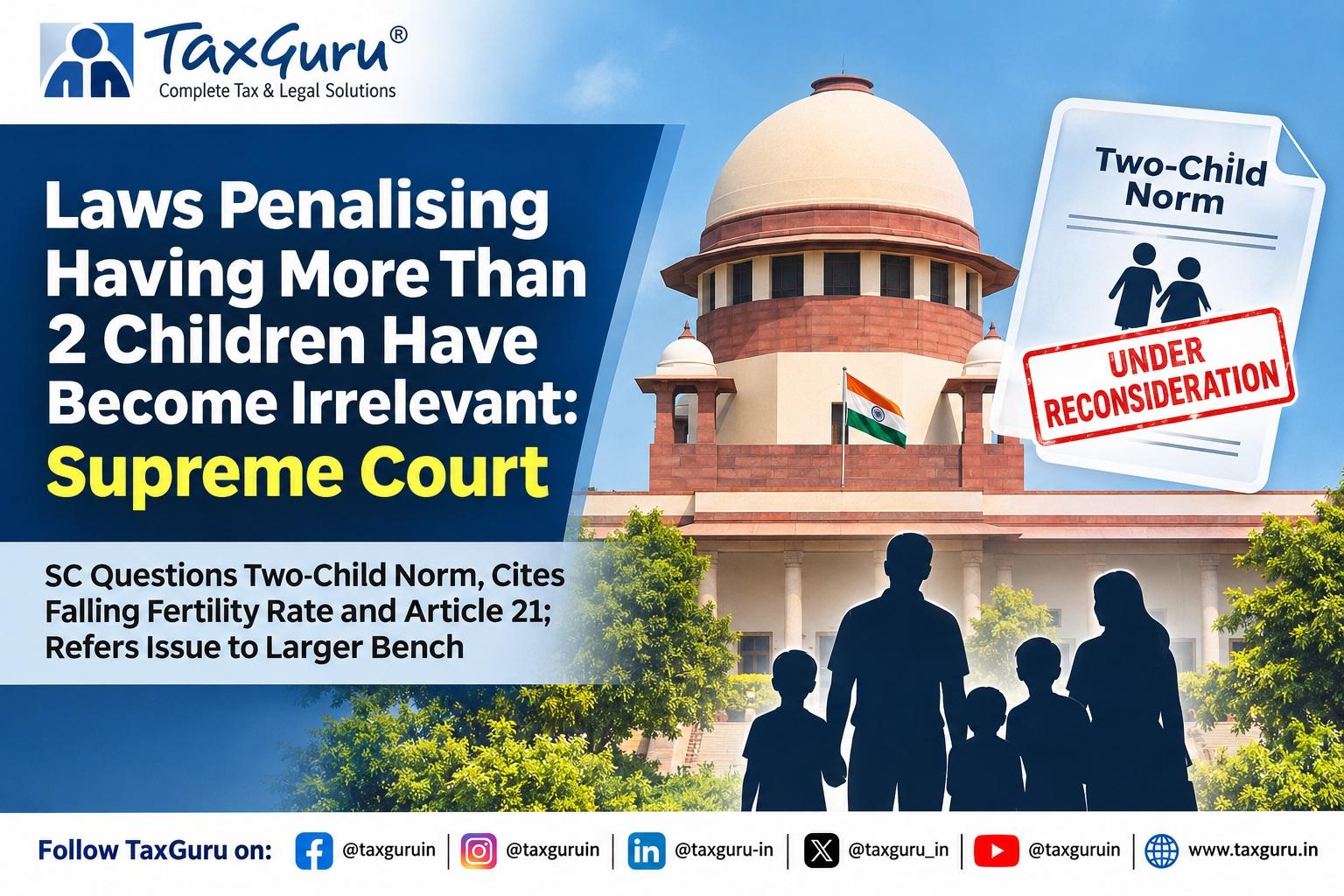
Summary: The Supreme Court, in its judgment dated 4 November 2026 in Mangala Bhimrao Ingle Vs Additional Commissioner, Amravati Division & Ors. (, expressed the strong view that laws penalising individuals for having more than two children have lost their relevance because the demographic assumptions supporting such restrictions have substantially changed. In Mangala Bhimrao Ingle v. Additional Commissioner, Amravati Division & Ors., the Court examined the disqualification of an elected Maharashtra sarpanch under Section 14(1)(j-1) of the Maharashtra Village Panchayats Act, 1959. The Bench noted that India’s total fertility rate had declined from approximately 3.0 when the Supreme Court upheld similar restrictions in Javed v. State of Haryana in 2003 to 1.9, below the replacement level of 2.1. It questioned whether excluding individuals from democratic representation merely because they have a third child continues to serve a constitutionally legitimate objective. The Court also highlighted the disproportionate consequences of such restrictions for women and disadvantaged communities, observing that reproductive decisions form an integral part of personal liberty under Article 21 of the Constitution. Recognising that the earlier precedent requires reconsideration, the Bench referred the matter to a larger Bench. It continued the interim protection permitting the appellant to remain sarpanch until disposal of the appeal. Importantly, the judgment does not constitute a final nationwide invalidation of two-child disqualification provisions.
- Supreme Court Questions the Continued Relevance of Two-Child Norm Laws
- Background: Maharashtra Sarpanch Disqualified for Having Three Children
- Earlier Supreme Court Judgment in Javed v. State of Haryana
- India's Fertility Rate Has Fallen Below Replacement Level
- Can a Law Become Unconstitutional Because Circumstances Change?
- Two-Child Norm and Article 21: Right to Reproductive Autonomy
- Disproportionate Impact on Women
- Impact on Democratic Representation
- Supreme Court Refers Javed Judgment to Larger Bench
- Interim Protection for Maharashtra Sarpanch Continues
- Have Two-Child Norm Laws Been Declared Unconstitutional?
- Implications for State Governments and Election Authorities
- Key Takeaways
- Frequently Asked Questions (FAQs)
- 1. Has the Supreme Court abolished the two-child norm in India?
- 2. What was the Supreme Court case about?
- 3. Why did the Supreme Court question the two-child norm?
- 4. What is the significance of Javed v. State of Haryana?
- 5. Can a person with three children now contest a panchayat election?
- 6. What relief did the appellant receive?
- 7. Does the judgment apply to government employees or family-planning service rules?
- 8. What happens next?
- Conclusion
- Cases Discussed
Supreme Court Questions the Continued Relevance of Two-Child Norm Laws
The Supreme Court has raised fundamental questions about the constitutional validity of laws that disqualify individuals from contesting local-body elections because they have more than two children. In its judgment delivered on 4 November 2026, the Court observed that the demographic circumstances which once justified population-control restrictions have undergone substantial changes.
The decision represents an important development in constitutional law, particularly concerning reproductive autonomy, political representation, equality and the continuing validity of legislation enacted in response to circumstances that no longer exist. The central question is whether a law considered constitutionally reasonable two decades ago can continue to operate when the factual assumptions supporting it have substantially disappeared. The Court concluded that the issue requires reconsideration by a larger Bench.
Background: Maharashtra Sarpanch Disqualified for Having Three Children
The proceedings arose from the election of Mangala Bhimrao Ingle as sarpanch of Kakoda Gram Panchayat in Maharashtra in 2022. The appellant had given birth to a third child in 2014. A complaint was filed alleging that she had incurred disqualification under Section 14(1)(j-1) of the Maharashtra Village Panchayats Act, 1959. The provision imposes disqualification in specified circumstances upon persons having more than two children.
The Additional Collector, Buldhana, disqualified the appellant in October 2024. Her appeal before the Additional Commissioner, Amravati Division, was unsuccessful. The Bombay High Court subsequently upheld the disqualification in August 2025. The dispute concerning the birth certificate and proof of the third child ultimately reached the Supreme Court.
However, the Supreme Court considered that the case raised a larger constitutional issue extending beyond the individual election dispute. The Court therefore examined whether laws imposing electoral disabilities on the basis of family size continue to have a rational constitutional justification.
Earlier Supreme Court Judgment in Javed v. State of Haryana
In Javed v. State of Haryana, (2003) 8 SCC 369, a three-Judge Bench of the Supreme Court upheld provisions of the Haryana Panchayati Raj Act, 1994, disqualifying persons with more than two living children from holding specified Panchayati Raj positions. At that time, population growth was treated as a significant national challenge. The Court accepted population control as a legitimate legislative objective and considered the electoral disqualification to have a rational connection with that objective.
The decision was based partly on the demographic circumstances and population-policy concerns prevailing at the time. However, the Supreme Court in the present case observed that those circumstances have materially changed. It questioned whether the reasoning in Javed remains constitutionally sustainable when the demographic foundation of the earlier decision no longer exists.
India’s Fertility Rate Has Fallen Below Replacement Level
One of the most important aspects of the judgment is the Court’s reliance on demographic evidence. The Bench noted that India’s total fertility rate has fallen significantly since the earlier decision in Javed.
| Demographic Indicator | Position |
|---|---|
| Total fertility rate around 2003 | Approximately 3.0 |
| Total fertility rate in 2024, as cited by the Court | 1.9 |
| Replacement-level fertility rate | 2.1 |
| Current demographic concern identified by the Court | Ageing population and declining future working-age share |
The total fertility rate represents the average number of children a woman would have during her reproductive years if prevailing age-specific fertility rates continued. A rate of approximately 2.1 is generally considered the replacement level under standard demographic assumptions. The Court observed that India’s fertility rate has fallen below this threshold.
It also clarified that India’s total population has not yet begun to decline. Population growth may continue because of demographic momentum arising from the country’s existing age structure. Nevertheless, the Court considered that continued fertility decline could eventually create substantial challenges involving population ageing, labour supply, dependency ratios and economic growth. Accordingly, population-control measures introduced under earlier demographic conditions cannot automatically be presumed necessary or constitutionally reasonable today.
Can a Law Become Unconstitutional Because Circumstances Change?
The judgment raises an important constitutional principle: the validity of legislation must sometimes be reconsidered when the social, economic or factual circumstances supporting it have fundamentally changed. A law that was reasonable when enacted may subsequently become arbitrary if its original justification ceases to exist. This principle is often discussed in terms of temporal reasonableness.
The Supreme Court referred to earlier decisions recognising that legislation must remain responsive to changing conditions. The Court emphasised that constitutional review cannot always be confined to the circumstances prevailing at the time of enactment. A restriction must continue to satisfy constitutional requirements in the circumstances in which it operates.
In the present case, the Court questioned whether disqualifying a person from democratic participation for having a third child continues to advance any legitimate population-control objective. The Bench also recognised that legislative reform ordinarily falls within the legislature’s domain. Nevertheless, constitutional courts may examine whether continued statutory restrictions remain constitutionally sustainable.
Two-Child Norm and Article 21: Right to Reproductive Autonomy
Another important aspect of the judgment concerns reproductive freedom under Article 21 of the Constitution. The Supreme Court reaffirmed that decisions concerning whether to have children, when to have them and how many children to have are intimately connected with personal liberty, dignity and privacy.
The Court referred to established constitutional jurisprudence recognising reproductive choice as an essential aspect of individual autonomy. The Bench expressed concern that electoral disqualification creates a difficult choice between exercising reproductive freedom and participating in democratic governance.
Although the State may regulate matters affecting public welfare through constitutionally permissible measures, restrictions on reproductive autonomy must satisfy applicable constitutional standards. The Court questioned whether population-control objectives can justify imposing adverse political consequences upon individuals who choose to have more than two children.
Disproportionate Impact on Women
The Supreme Court also examined the consequences of two-child restrictions for women. Although such laws may be framed in gender-neutral language, their practical operation can have unequal consequences. The Court referred to research indicating that decisions concerning childbirth are frequently influenced by patriarchal family structures and unequal control over reproductive choices.
In such circumstances, women may suffer electoral disqualification even where they have limited influence over decisions concerning family size. The judgment discussed documented concerns involving forced abortions, desertion, denial of paternity and other harmful consequences associated with attempts to avoid disqualification. It also considered the influence of son preference and wider gender inequalities upon reproductive decisions.
Impact on Democratic Representation
The Court also questioned the relationship between family size and eligibility to hold public office. The underlying issue is whether having a third child bears any rational connection with a person’s ability to discharge the responsibilities of an elected representative. The Bench considered that such restrictions could exclude an entire class of citizens from political representation without adequately establishing their connection to administrative competence or public service.
The judgment discussed the constitutional importance of democratic participation, particularly for women and socially disadvantaged communities. It also examined how earlier judicial reasoning concerning electoral qualifications had influenced subsequent restrictions on participation in local self-government.
Supreme Court Refers Javed Judgment to Larger Bench
After examining demographic changes, constitutional principles and earlier judicial precedents, the Supreme Court concluded that the reasoning adopted in Javed v. State of Haryana requires reconsideration. The Bench directed the Registry to place its judgment and order before the Chief Justice of India for constitution of an appropriate larger Bench.
This is significant because Javed was decided by a three-Judge Bench and continues to have precedential importance. The present two-Judge Bench did not purport to overrule that decision. Instead, it identified the reasons for reconsideration and referred the matter through the appropriate judicial process. The final constitutional position will depend upon the decision of the larger Bench and any subsequent proceedings.
Interim Protection for Maharashtra Sarpanch Continues
The Supreme Court had earlier stayed the Bombay High Court judgment, thereby allowing the appellant to continue in her elected position as sarpanch. In its judgment dated 4 November 2026, the Court directed that the interim protection would continue until disposal of the Civil Appeal.
Consequently, the appellant remains protected by the interim order while the constitutional issues await further consideration. This relief is specific to the proceedings before the Supreme Court. It should not be interpreted as a general suspension of all two-child disqualification provisions operating under different State laws.
Have Two-Child Norm Laws Been Declared Unconstitutional?
No final nationwide declaration of invalidity has been made by the Supreme Court in this judgment. The distinction is important. The Court expressed a strong constitutional view that the rationale supporting such laws has become outdated. It also questioned their compatibility with reproductive autonomy and democratic participation.
However, the validity of the Maharashtra statutory provision was not directly under challenge in the appeal, as the judgment itself records. The Bench therefore referred the earlier precedent for reconsideration instead of issuing a final ruling striking down all comparable laws.
Until the constitutional questions are conclusively determined, the applicability of individual State provisions must be assessed with reference to the relevant legislation, judicial orders and subsequent developments. Persons affected by such disqualifications should not assume that the Supreme Court’s observations automatically eliminate every existing statutory restriction.
Implications for State Governments and Election Authorities
The judgment has potentially important implications for States that retain two-child restrictions in their local-government laws. Legislatures may need to reassess whether such provisions continue to advance a legitimate public objective. Election authorities must also distinguish between the Court’s observations on constitutional validity and its operative interim directions.
Unless a particular provision has been repealed, invalidated or stayed by a competent court, its legal operation cannot be disregarded merely because the Supreme Court has referred the broader issue for reconsideration. At the policy level, the judgment raises the possibility of moving away from coercive population-control measures towards approaches that respect reproductive choice and respond to changing demographic realities.
Key Takeaways
- No nationwide invalidation: The Supreme Court has not struck down all laws disqualifying persons with more than two children from local-body elections.
- Earlier precedent under reconsideration: The Court referred the reasoning in Javed v. State of Haryana, (2003) 8 SCC 369, to a larger Bench.
- Changed demographic circumstances: The Bench noted that India’s total fertility rate had declined to approximately 1.9, below the replacement level of 2.1.
- Constitutional concerns: The judgment examines reproductive autonomy under Article 21, gender inequality and democratic participation.
- Interim relief continues: The appellant’s protection allowing her to continue as sarpanch remains operative until disposal of the appeal.
- State laws require individual examination: Existing disqualification provisions should not be treated as automatically repealed or suspended.
Frequently Asked Questions (FAQs)
1. Has the Supreme Court abolished the two-child norm in India?
No. The Supreme Court questioned the continuing justification for electoral disqualification based on having more than two children, but did not invalidate all such laws. It referred the earlier precedent for consideration by a larger Bench.
2. What was the Supreme Court case about?
The case concerned the disqualification of a Maharashtra gram panchayat sarpanch under Section 14(1)(j-1) of the Maharashtra Village Panchayats Act, 1959, on the ground that she had a third child.
3. Why did the Supreme Court question the two-child norm?
The Court noted a significant fall in India’s fertility rate and questioned whether a population-control-based electoral disqualification continues to have a constitutionally sufficient justification. It also considered concerns relating to reproductive autonomy, gender equality and political representation.
4. What is the significance of Javed v. State of Haryana?
In Javed v. State of Haryana, (2003) 8 SCC 369, a three-Judge Bench upheld a two-child disqualification under Haryana’s panchayat law. The November 2026 Bench referred the reasoning in that decision for reconsideration by a larger Bench; it did not itself overrule Javed.
5. Can a person with three children now contest a panchayat election?
Not necessarily. Eligibility continues to depend on the applicable State legislation and any relevant court order. The November 2026 judgment does not confer a general right to contest irrespective of existing statutory disqualifications.
6. What relief did the appellant receive?
The Supreme Court continued its earlier interim protection permitting the appellant to remain in the office of sarpanch until disposal of the Civil Appeal. This protection is case-specific.
7. Does the judgment apply to government employees or family-planning service rules?
The dispute concerned disqualification from elected local-body office. The judgment should not be read as automatically invalidating separate service rules, incentive schemes or other policies concerning family size.
8. What happens next?
The matter is to be placed before the Chief Justice of India for constitution of an appropriate larger Bench. The final constitutional position will depend on further judicial proceedings.
Conclusion
The Supreme Court’s judgment in Mangala Bhimrao Ingle v. Additional Commissioner, Amravati Division & Ors. marks an important development in the constitutional debate surrounding India’s two-child norm. The Court has questioned whether electoral disqualifications based on family size remain justified when the country’s fertility rate has fallen below replacement level.
It has also brought reproductive autonomy, gender equality and democratic participation into the constitutional examination of such restrictions. Most importantly, the Court has recognised that legislation cannot be evaluated indefinitely on the basis of demographic assumptions prevailing decades earlier.
However, the judgment is not the final word on the validity of two-child restrictions. The larger Bench will have to determine whether the earlier constitutional position established in Javed v. State of Haryana should continue, be modified or be overruled. Until then, the November 2026 judgment represents a significant judicial reconsideration of population-control restrictions rather than their complete nationwide abolition.
Cases Discussed
Javed v. State of Haryana, (2003) 8 SCC 369 (Supreme Court, 30 July 2003) — Earlier three-Judge ruling upholding the two-child electoral disqualification; referred for reconsideration by a larger Bench.