
Nasir Ali Siddiqui Vs DCIT (ITAT Lucknow)
Less Than Seven Days to Reply Under Section 148A(b): ITAT Quashes Reassessment
Failure to Provide Minimum Response Period Invalidates Assessment
The Income Tax Appellate Tribunal, Lucknow Bench, quashed a reassessment after finding that the assessee had been given less than the mandatory seven-day period to respond to a notice under Section 148A(b).
The notice was issued on 21 March 2022, requiring a response by 26 March 2022. The Tribunal held that this failed to provide the minimum statutory opportunity applicable to the proceedings.
Describing the assessment as suffering from patent illegality and a manifest violation of natural justice, the Tribunal set aside and quashed it. Other disputed issues were left open.
Background of the Reopening
The assessee was a Non-Resident Indian. The Department possessed information concerning transactions relating to the purchase and sale of immovable property amounting to ₹1.10 crore, together with information reported by HDFC Bank.
Following proceedings under Section 148A, a notice under Section 148 was issued on 30 March 2022.
The assessee filed his return for Assessment Year 2018-19 on 11 June 2022 in response to that notice.
During reassessment, the authorities examined deposits in his bank accounts. The disputed amounts included ₹7,40,000 and ₹1,50,000 deposited in an SBI NRO account, and ₹1,87,050 representing USD 3,000 deposited with HDFC Bank.
The assessment determined total income at ₹10,82,020. The Commissioner (Appeals) sustained the additions, leading to the appeal before the Tribunal.
Assessee Raised Several Legal Objections
The assessee challenged the reassessment on multiple grounds, including the validity of the scrutiny notice, limitation, jurisdiction and approval for reopening.
He also disputed the additions under Section 69A and the application of Section 115BBE.
Through an additional ground, the assessee specifically contended that the notice under Section 148A(b) provided less than seven days to submit a response, rendering the subsequent proceedings invalid.
That objection ultimately determined the outcome. The Tribunal examined the actual notice and the order subsequently passed under Section 148A(d).
Notice Allowed Response Only Until 26 March
The notice dated 21 March 2022 asked the assessee to explain why a notice under Section 148 should not be issued.
It required him to submit his response, together with supporting documents, through the electronic proceedings facility on or before 26 March 2022.
The Assessing Officer thereafter passed an order under Section 148A(d) on 29 March 2022.
The Tribunal found that the response period specified in the notice was shorter than the statutory minimum. The relevant defect concerned the time actually afforded for answering the show-cause notice.
The Revenue’s representative could not rebut that the required seven-day opportunity had not been given.
Revenue Relied on Absence of Reply or Extension Request
The Revenue defended the reassessment and submitted that the assessee had not satisfactorily established the sources of the deposits.
Regarding the additional ground, it pointed out that the assessee had neither furnished a reply to the Section 148A(b) notice nor requested additional time.
However, the Tribunal’s conclusion rested on the authority’s failure to provide the minimum period required by the applicable provision.
The absence of a reply or extension request did not overcome the established deficiency in the notice.
Tribunal Considers Decisions on Statutory Hearing Opportunity
The assessee relied on Rakesh Agrawal v. Central Board of Direct Taxes and Others, decided by the Madhya Pradesh High Court, concerning an effective opportunity before initiation of reassessment proceedings.
He also cited the Lucknow Tribunal’s decision in Murlidhar Lohia v. ITO and the Delhi Tribunal’s decision in DCIT v. Vishwanath Singhal.
The latter decision applied the Delhi High Court’s ruling in Shri Sai Co-operative Thrift and Credit Society Ltd. v. ITO, which addressed a notice allowing less than seven days to respond.
The Tribunal considered these authorities in examining the mandatory response period and the consequences of non-compliance.
Assessment Quashed for Statutory Non-Compliance
Applying the precedents discussed in its order, the Tribunal held that the reassessment could not be sustained.
It found non-compliance with the statutory opportunity under Section 148A and a corresponding violation of principles of natural justice.
The impugned assessment was therefore set aside and quashed. The matter was not restored for verification of the bank deposits.
The relief arose from the procedural illegality affecting the assessment’s foundation.
Merits of Deposits Remain Undecided
The Tribunal expressly declined to adjudicate the remaining merits after quashing the assessment.
It did not determine whether the bank deposits were explained, whether Section 69A applied, or whether the assessee’s other jurisdictional and limitation objections independently succeeded.
The appeal was recorded as partly allowed. The decisive finding was that the notice issued in March 2022 failed to provide the required minimum response period.
Cases Discussed
1. Rakesh Agrawal Vs Central Board of Direct Taxes and Others (Madhya Pradesh High Court); W.P. No. 16139 of 2024. The Tribunal reproduced the High Court’s reasoning that a taxpayer must receive an effective opportunity of hearing before initiation of reassessment proceedings under Section 148A(b). The precise decision date was not supplied in the ITAT order.
2. Murlidhar Lohia Vs ITO (ITAT Lucknow); ITA No. 418/LKW/2025; AY 2018-19.The coordinate Bench quashed reassessment proceedings for inadequate statutory opportunity, following Mukesh J. Ruparel Vs ITO. The decision date was not specified in the present order.
3. Mukesh J. Ruparel Vs ITO (Bombay High Court). Cited through the decision in Murlidhar Lohia for the invalidity of reopening proceedings based on a notice granting insufficient time to respond under Section 148A(b).
4. DCIT Vs Vishwanath Singhal (ITAT Delhi); ITA No. 2028/Del/2025 and C.O. No. 255/Del/2026; AY 2018-19. The Tribunal adopted the Delhi High Court’s reasoning concerning the mandatory minimum time under Section 148A(b), quashed the reopening, allowed the assessee’s cross-objection and dismissed the Revenue’s appeal.
5. Shri Sai Co-operative Thrift and Credit Society Ltd. Vs ITO (Delhi High Court); W.P.(C) No. 7385/2022; 12/05/2022. The High Court held that a notice allowing only three days to respond violated the statutory seven-day requirement, resulting in the quashing of the order under Section 148A(d) and the consequential notice under Section 148. The decision is reproduced in the Vishwanath Singhal ruling.
FULL TEXT OF THE ORIGINAL ORDER OF ITAT LUCKNOW
This appeal, filed by the assessee, is directed against the order of the Learned Commissioner of Income-tax (Appeals)-2, Noida dated 28.10.2025 pertaining to the assessment year 2018-19. The assessee has raised the following grounds of appeal: –
“1. The Learned Commissioner Income Tax (Appeals), NFAC, Delhi (hereinafter referred to as the Ld. CIT-A) has erred on facts and in law in rejecting the grounds of the appellant and confirming the action of the Learned Assessing Officer who passed the impugned assessment order without issuing any notice u/s 143(2) of the Act, which is SINE QUA NON for passing an assessment order.
2 The Ld. CIT-A is not justified at all in rejecting the grounds of the appellant that the impugned assessment order passed in absence of notice u/s 143(2) is bad in law and illegal and while rejecting the grounds of the appellant, the Ld. CIT-A has completely failed to give any specific and concrete findings and reasons for doing so.
2.1. The Ld. CIT-A erred on facts and in law in rejecting the grounds of the appellant and confirming the action of the Ld. AO in passing the impugned assessment order which is barred by limitation as stated in the statement of facts.
2.2. The Ld. CIT-A is not justified at all in rejecting the grounds of the appellant that the impugned assessment order passed by the Ld. A.O. is barred by limitation and while rejecting the grounds of the appellant, the Ld. CIT-A has completely failed to give any specific and concrete findings and reasons for doing so.
3. The Ld. CIT-A has erred on facts and in law in not appreciating the fact that the approval for initiating the proceedings u/s 148 of the Act was obtained from the office of the PCIT, Bareilly who is not the competent authority to grant the approval as the assesse in the present case does not fall under his/her jurisdiction and hence the notice issued u/s 148 of the Act is void-ab-Initio.
4. The Ld. CIT-A has erred on facts and in law by not appreciating the law that after bringing the faceless assessment scheme into the statute book, Faceless Assessing Officer (FAD) is the only officer competent to issue any notice uls 148 of the IT Act and hence the notice issued uls 148 of the Ad in the present case by the ITO-2(2), Bareilly ie the Jurisdictional Assessing Officer (JAO) is bad in law and illegal leading to make the impugned assessment order passed by the JAO void-ab-initio
5. The Ld. CIT-A has erred on facts and in law in not appreciating the law that the Learned Deputy Commissioner Income Tax (International Taxation). Lucknow was not having any proper jurisdiction to pass the impugned assessment order.
6 The Ld. CIT-A has erred on facts and in law in confirming the aggregate additions of Rs.10,72,050/-(Rs.7,40,000+1,87,050+Rs. 1,50,000) made by the Ed. A.O. in the hands of the assessee which does not have any legal footing to stand and survive because of the fact that no addition has been made in the hands of the assessee on the reasons recorded for reopening the case of the assessee and hence the entire aggregate addition of Rs. 10,77,050/-deserves to be deleted
7. The Ld. CIT-A has erred on facts and in law in confirming the addition of Rs.7,40,000/- and Rs.1,50,000/- made by the Ld. A.O. in the hands of the assessee by treating the cash deposits made in bank account maintained with SBI as unexplained money u/s 69A of the Act by not appreciating the fact that the entire cash deposits were made out of disclosed sources of income.
8. The Ld. CIT-A has erred on facts and in law in confirming the addition of Rs. 1,87,050/- made by the Ld. A.O. in the hands of the assessee by treating the amount of USD 3000 (Rs. 1,87,050/-) deposited in HDFC Bank as unexplained money u/s 69A of the Act entirely on presumption, surmise and conjecture by not appreciating the fact that this amount was deposited by the appellant out of the surplus amount available with him in USD while visiting India.
9. The Ld. CIT-A has erred on facts and in law confirming the action of the Ld A.O. in invoking the provisions of section 115BBE of the Act for computing the tax liability against the appellant.
10. The appellant reserves his right to advance such other grounds before or at the time of hearing which he may consider fit and appropriate, for which he craves leaves to amend, alter or otherwise modify the grounds appearing hereinabove with kind permission of the Hon’ble Bench.”
2. The assessee has also raised the additional grounds of appeal: –
“The Learned Commissioner of Income Tax (Appeals), NFAC erred on facts and in law in not appreciating the fact that the time period provided in notice issued u/s 148A(b) of the I. T. Act, 1961 was less than 7 days, which renders the entire subsequent proceedings null and void.”
3. The facts in brief are that the Assessing Officer (“AO”, for short) noted that the assessee is a Non-Resident Indian (“NRI”, for short) and as per the information available with the Department, there were transactions relating to the purchase and sale of immovable property amounting to Rs.1,10,00,000/-. Further, information was available in the form of a Statement of Reportable Account from HDFC Bank reflecting an amount of Rs.1,48,597/-. Accordingly, after conducting the proceedings u/s 148A of the Income Tax Act, 1961 (“Act”, for short), the case of the assessee was reopened and notice u/s 148 of the Act was issued. In response to the notice issued u/s 148 of the Act, the assessee filed his return of income for the Assessment Year 2018-19 on 11.06.2022. Thereafter, the AO raised various queries and called for information from the assessee. However, after considering the material available on record and the submissions made by the assessee, the AO treated a sum of Rs.7,
3. The facts in brief are that the Assessing Officer (“AO”, for short) noted that the assessee is a Non-Resident Indian (“NRI”, for short) and as per the information available with the Department, there were transactions relating to the purchase and sale of immovable property amounting to Rs.1,10,00,000/-. Further, information was available in the form of a Statement of Reportable Account from HDFC Bank reflecting an amount of Rs.1,48,597/-. Accordingly, after conducting the proceedings u/s 148A of the Income Tax Act, 1961 (“Act”, for short), the case of the assessee was reopened and notice u/s 148 of the Act was issued. In response to the notice issued u/s 148 of the Act, the assessee filed his return of income for the Assessment Year 2018-19 on 11.06.2022. Thereafter, the AO raised various queries and called for information from the assessee. However, after considering the material available on record and the submissions made by the assessee, the AO treated a sum of Rs.7,40,000/- and Rs.1,87,050/- as deemed income of the assessee. Consequently, the total income of the assessee was assessed at Rs.10,82,020/-. Aggrieved by this, the assessee preferred an appeal before the Ld. CIT(A), who also sustained the addition. Now the assessee is in appeal before this Tribunal.
4. The assessee has raised multiple grounds assailing the validity of the re-opening of the assessment and also has taken an additional ground with regard to validity of the notice issued u/s 148(A)(b) of the Act since the AO provided time less than seven days to the Assessee which is contrary to the statutory provisions. Apropos to the grounds related to the legality of the re-opening of the assessment, the Ld. Counsel for the assessee contended that, in this case, notice u/s 148 of the Act was issued on 30.03.2022 by the office of the ITO-2(2), Raipur. In response thereto, the assessee filed its return of income on 11.06.2022. Subsequently, the case was transferred to the NFAC Assessment Centre, Delhi, which issued a notice u/s 143(2) of the Act on 09.11.2022. Thereafter, the assessment order dated 24.11.2022 was passed by the DDIT/ADIT (International Taxation), Lucknow, under Section 147 read with Section 144C(3) of the Act. The objection of the assessee with regard to the passing of the order by the AO is that the concerned authority failed to issue notice u/s 143(2) of the Act. With regard to another objection, the Ld. Counsel for the assessee submitted that, in this case, notice u/s 148 of the Act was issued and served upon the assessee on 30.03.2022 and as per the provisions provided u/s 153(2) of the Act, the assessment order was required to be framed within the period of 12 months which was expired on 31.03.2023 whereas the impugned assessment order was passed on 24.05.2023 which is clearly barred by time. Another objection in the form of additional ground taken by the assessee, the Ld. Counsel contended that the entire proceedings are vitiated on account of the notice issued u/s 148(A)(b) of the Act provided time less than of seven days. In respect of the grounds with regard to the factual merit of the case, Ld. Counsel contended that the assessee had provided all details and explanation but the authorities below failed to appreciate the fact in right perspective and made impugned addition(s) purely on the conjectures and surmises. He further submitted that the assessee is in full-time employment in Saudi Arabia since 2009 and has been paying the applicable taxes in Saudi Arabia on his salary accrued and earned in Saudi Arabia as per there prevailing Tax Rules. However, he pointed out that the case was re-opened on the basis of the house property purchased by the assessee. However, no addition was made in this regard but authorities have proceeded to make addition on the basis of other issues related to the cash deposits of Rs.7,40,000/- in the NRO account maintained with SBI, Rs.1,87,050/- deposited in the HDFC Bank account, and a further sum of Rs.1,50,000/- deposited in the NRO account maintained with SBI. The Ld. Counsel for the assessee vehemently argued that the authorities below were not justified in making the aforesaid additions without properly appreciating the explanation tendered by the assessee regarding the source and nature of the deposits. Hence, he prayed that the assessment order so passed is illegal and unjustified. Further, the impugned addition deserves to be deleted.
5. On the other hand, the Ld. Departmental Representative for Revenue opposed the submissions and submitted that the assessee failed to substantiate his explanation regarding the amount allegedly kept in cash by his partner. Accordingly, the Ld. DR submitted that the AO was justified in making the impugned addition. The Ld. DR reiterated the written submissions as made vide letter dated 30.06.2026. The relevant contents of the written submissions are reproduced as under: –
“2. Vide above referred, Ld. Addl.CIT, Sr. DR-I, Lucknow has asked to furnish comment on ground as well as additional grounds filed by assessee in above referred appeal before Hon’ble ITAT, Lucknow Bench.
3. Brief of the case: Assessee has not furnished his ITR for the year under consideration. However, as per information flagged by the risk management strategy formulated by the Central Board of Direct Taxes in accordance with Explanation-1 (i) to section 148 of the Income-tax Act, 1961, assessee has made huge investment in immovable property. Therefore, after following the due process, case of the assessee was reopened u/s 147 of IT Act and notice u/s 148 of IT Act was issued on 30/03/2022.
During the course of assessment proceedings, it was found that assessee made cash deposits of Rs.7,40,000/- & Rs.1,50,000/- in his bank accounts and also deposited 3,000 dollar (Rs.1,87,550/-) in his bank accounts. Assessee could not furnish satisfactory reply of source of these deposits. Therefore, these deposits were considered his unexplained income u/s 69A of IT Act during the year under consideration and assessment was completed vide order u/s 147 r.w.s 144C(3) of Income-tax Act, 1961 dated 24/05/2023 at Rs.10,82,020/-.
Aggrieved from above additions, assessee preferred an appeal before the Ld. CIT(A) vide appeal No. CIT (A) Noida-2/10264/2017-18 dated 22/06/2023 and Ld. CIT(A) has dismissed the appeal of the assessee vide order No ITBA/APL/S/250/2025-26/1082042266(1) dated 28/10/2025.
4. Comments on grounds and additional grounds: The comments of this office on grounds as well as additional grounds are as under:
4.1 Ground 1.1 and 1.2: Assessee has contended that assessment order passed without issuing notice u/s 143(2) of IT Act is bad in law and illegal. Contention of the assessee is not correct as notice u/s 143(2) of IT Act was issued on 09/11/2022 by NFAC
4.2 Ground 2.1 and 2.2: Assessee has contended that assessment order was passed after expiry of limitation. Contention of the assessee is not correct as draft order u/s 144C(1) of IT Act was passed on 13/03/2023 and final order u/s 147 r.w.s 144C(3) of IT Act was passed on 24/05/2023. As per section 144C(2) of IT Act, assessee was required to file his acceptance/communication regarding objection before DRP within 30 days ie. upto 12/04/2023 and as per section 144C(3) of IT Act, AO is required to pass final order within one month from end of month in which acceptance is received. Therefore, in this case, time to pass final order was upto 31/05/2023 and order was passed on 24/05/2023. Therefore, assessment order was passed well within time. Copy of orders are enclosed herewith.
4.3 Ground 3 and 4: Assessee has contended that notice u/s 148 of IT Act was issued by JAO instead of FAO and approval was taken from the PCIT, Bareily which is not competent authority as his jurisdiction does not fall under the PCIT, Bareily. In this regard, it is to state that assessee has applied for PAN as resident stating his residential address at Lucknow and office address at Bareily, Uttar Pradesh. Therefore, PAN was issued to assessee on 17/04/2002 as resident having office address at Bareily, Uttar Pradesh. ITBA Screen shot is pasted as under:
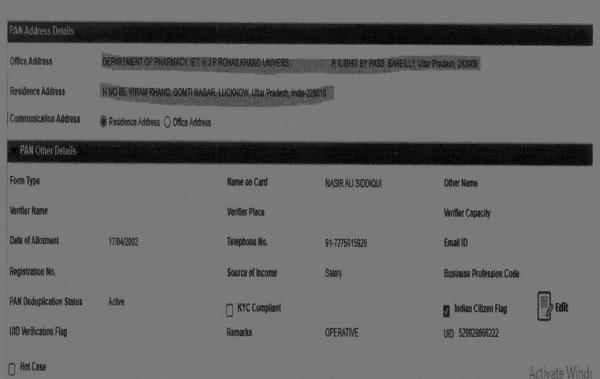
Therefore, jurisdiction of the assessee was allotted to the Income Tax Officer, Ward-2(2), Bareilly. Thereafter, assessee has never filed any ITR till notice u/s 148 of IT Act and also not applied to change his status from resident to non-resident or even informed the department about his change of status.
Thus, when the information was received against assessee, default jurisdiction of the assessee as per details provided by him to the department was the Income Tax Officer, Ward-2(2), Bareilly. It was when he informed the department through his reply to notice u/s 142(1) of IT Act and ITR, the department got to know that he is an NRI and rightly transferred the PAN to the O/o the DCIT, International Taxation, Lucknow. Hence, notice issued by the Income Tax Officer, Ward-2(2), Bareilly u/s 148 of IT Act due to non-compliance by assessee as onus to inform the department about his change of status was totally on assessee which he completely failed. Therefore, the the Income Tax Officer, Ward-2(2), Bareilly was in bonafide impression that assessee is Resident and living under his jurisdiction and has done nothing wrong by issuing notice u/s 148 of IT Act.
Further, it is pertinent to mention here that jurisdiction of an individual is determined by the section 6(1) of IT Act i.e. number of days stayed by some in India (individual). Thus, an individual can be NRI but not non-resident unless he has not stayed in India for less than 182 days.
4.4 Ground 5: Assessee has contended that the DCIT(IT), Lucknow has passed assessment order without having jurisdiction. Contention of the assessee is not correct as assessee’s address is of Lucknow and Bareily and the DCIT(IT), Lucknow hold the jurisdiction of whole UP(East).
4.5 Ground 6: Assessee has claimed that addition of Rs.10,77,050/-Rs.7,40,000+1,87,050+Rs.1,50,000) is not correct as no addition was made on reasons recorded for reopening. Contention of the assessee is correct as there is no such bar in Income tax Act, 1961.
4.6 Ground 7: Assessee has claimed that addition of Rs.7,40,000/- and Rs.1,50,000/- on account of cash deposit is not correct as the same was done from disclosed source of income. In this regard, it is to state that assessee has failed to furnish substantial proof of the same. Further, reply of the assessee has also been rejected by Ld. CIT(A).
4.7 Ground 8, 9 and 10: Assessee has claimed that addition of Rs.1,87,050/- (USD 3000) on account of depositing USD while visiting India from his surplus amount available with him is based on presumption, surmise and conjecture and not correct. Contention of the assessee is not correct as assessee has failed to furnish any documentary evidence in support of his claim. Further, onus is on assessee to prove his claim.
4.8 Additional ground: Assessee has claimed that AO has provided less than 07 days in notice issued u/s 148A(b) of the I.T.Act, 1961 which renders the entire subsequent proceedings null and void. In this regard, it is to state that notice u/s 148A(b) of IT Act was issued on 21/03/2022 providing the time upto 26/03/2026. It is pertinent to mention here that assessee has neither furnished his reply nor requested for any additional time to furnish his reply.
5. Copy of notice u/s 148 of IT Act, notice u/s 143(2) of IT Act, notice u/s 148A(b) of IT Act, draft order u/s 144C(1) of IT Act, assessment order u/s 147 r.w.s 144C(3) of IT Act and order of Ld. CIT(A) are enclosed herewith.
6. I have heard the rival submission and perused the material on record. In this case, one of the objections of the assessee is that the AO, while issuing the notice under clause (b) of Section 148A of the Act, failed to afford the minimum period of seven days to furnish a response, as prescribed under the law. In support of this contention, the assessee has placed reliance on the judgment of the Hon’ble Madhya Pradesh High Court in Rakesh Agrawal vs. Central Board of Direct Taxes and Others, rendered in Writ Petition No. 16139 of 2024. The Hon’ble High Court, after considering the submissions advanced by the parties and the relevant statutory provisions, held as under: –
“ 6. Admittedly, order passed under Section 148A(d) of the Income Tax Act is not an appealable order, therefore, except writ petition the petitioner has no other alternative efficacious remedy. Once the statute provides an opportunity of hearing before initiation of proceedings under Section 148 of the Act, then effective opportunity of hearing should be provided to the assessee. It is not the case where the time to pass final order was going to expire and the order was liable to be passed on 05.04.2024. As per Section 148A(b) of the Income Tax Act, minimum 7 days time and maximum 30 days time is liable to be given as an opportunity of hearing to the notice. In the present case, the impugned order has been passed before expiry of 30 days from the date of issuance of show cause notice, therefore, the order is unsustainable the eyes of law.
7. In view of the above, the impugned order dated 05.04.2024 is hereby set aside without entering into the merits of the case. The matter is remitted back to the respondents to decide the show cause notice issued under section 148A(d) of the Income Tax Act afresh after giving opportunity of hearing to the petitioner.”
7. Further, the Ld. Counsel for the assessee has also placed reliance on the decision of the Co-ordinate Bench of this Tribunal rendered in the case of Murlidhar Lohia vs. Income Tax Officer, in ITA No. 418/LKW/2025 for Assessment Year 2018-19. In the said case, the Co-ordinate Bench, after considering the submissions advanced by the parties and relying upon the judgment of the Hon’ble Bombay High Court, held as under: –
“6.1 Respectfully following the judgment of the Hon’ble Bombay High Court in the case of Mukesh J Ruparel vs. Income Tax Officer (supra), the re-assessment notice dated 17.03.2022, and further order under section 148A(d) of the Act along with notice under section 148 of the Act are quashed. Consequently, the order dated 15.03.2022 passed under section 147 of the Act read with sections 144 and 144B is also quashed.”
8. The assessee has also placed reliance on the decision of another Co-ordinate Bench of this Tribunal rendered in the case of DCIT Vs. Vishwanath Singhal in ITA. No.2028/Del/2025 and Cross objection No.255/Del/2026 wherein, under identical facts and circumstances, the Tribunal held as under: –
“3. This being the clinching factual position going unrebutted from the Revenue side, the assessee has quoted hon’ble jurisdictional high court’s recent decision being W.P.(C) No.7385/2022, Shri Sai Co-operative Thrift and Credit Society Ltd. Vs. ITO, dated 12.05.2022 that any such notice giving less than seven days mandatory response time, vitiates the reopening itself; as follows:
“2. Learned counsel for the Petitioner states that the Respondent has issued a notice to petitioner-society under clause (b) of Section 148A of the Act on 22nd March, 2022 on the ground that the Petitioner had made cash deposits of Rs.92,11,800/- in its bank accounts but had not filed its Income Tax Return. He states that the Petitioner was asked to furnish a reply to the said notice on or before 25th March, 2022. He further states that the Petitioner duly replied to the said notice on 25th March, 2022 clearly explaining that all the cash deposited by the Petitioner was received from the members of the society, for which cash receipts had been issued to the members and proper record in this regard had been maintained. He states that in the reply, the petitioner had also explained that KYC of all the members were properly done and books of accounts of the Petitioner were duly audited and were furnished to the Registrar of Companies
3. Learned counsel for the Petitioner states that the respondents passed the order dated 6th April, 2022 under clause (d) of Section 148A rejecting the reply of the Petitioner on the ground that although the Petitioner had stated that the cash deposited in the bank account of the Petitioner was received from its members yet it had failed to provide the list of members who had given cash to the Petitioner.
4. Learned counsel for the Petitioner states that the Petitioner was granted only three days’ time to file its response to the notice. He states that the list of members could not be filed along with the reply as the time granted to the Petitioner to prepare the list and furnish along with its reply was inadequate. He emphasises that the revenue has failed to give a minimum time of seven days to the petitioner to file its reply and, thus, failed to fulfil the criterion of ‘not less than seven days” as provided in clause (b) of Section 148A of the Act.
5. Issue notice. Mr.Sunil Agarwal, learned counsel for the revenue, accepts notice.
6. He, on instructions, states that the Assessing Officer did not issue any corrigendum extending the time limit for filing the reply as no such request was made. He further states that as the said reply was filed within the time stipulated in the notice dated 22nd March, 2022, no prejudice has been caused to the petitioner.
7. Having heard learned counsel for the parties, this Court is of the view that under Section 148A(b) of the Act, a minimum time of seven days has to be granted to the assessee to file its reply to the said show cause notice.
8. In the present case, though the petitioner responded to the show cause notice, yet it could not provide all the relevant details and documents, as the time period of three days to respond to the show cause notice was inadequate. Consequently, this Court is of the view that in the present case not only there has been a violation of the mandatory time period stipulated under Section 148A(b) of the Act, but grave prejudice has been caused to the petitioner.
9. Accordingly, the impugned order dated 6th April, 2022 under Section 148A(d) and notice under Section 148 of the Act are quashed. If the law permits the respondent/revenue to take further steps in the matter, it shall be at liberty to do so. Needless to state that if and when such steps are taken and if the petitioner has a grievance, it shall be at liberty to take its remedies in accordance with law.
10. With the aforesaid direction, the present writ petition stands disposed of.”
4. I adopt the above extracted detailed order of hon’ble jurisdictional high court mutatis mutandis to quash the impugned reopening. The assessee succeeds in his cross objection C.O. No. 255/Del/2026 and the Revenue’s main appeal ITA No. 2028/Del/2025 is dismissed therefore. All other remaining pleadings on merits stands rendered academic.
9. In the present case, the Ld. Counsel for the assessee contended that the notice issued under clause (b) of Section 148A of the Act did not afford the assessee the minimum period of seven days to furnish a response, as prescribed under the law. In support of this contention, the Ld. Counsel placed on record a copy of the notice dated 21.03.2022 issued by the AO under clause (b) of Section 148A of the Act. A perusal of the notice, read in conjunction with the order dated 29.03.2022 passed under clause (d) of Section 148A of the Act, is relevant for examining whether the assessee was afforded the minimum statutory period to respond to the notice. The relevant portion of the notice dated 21.03.2022 issued under clause (b) of Section 148A of the Act is reproduced as under: –
“2. Your are required to show-cause as to why, in view of the details contained in annexure A, a notice section 148 of the Income Tax Act, 1961 should not be issued.
3. Your may, to the extent technologically feasible, submit your response with supporting documents (if any) on the above mentioned issues electronically in ‘e-proceeding’ facility through your account in e-filing portal at your convenience on or before 26.03.2022.”
10. Thereafter, the Assessing Officer (“AO”, for short) passed an order dated 29.03.2022, purportedly under clause (d) of Section 148A of the Income-tax Act, 1961 (“Act”, for short). A copy of the said order is enclosed at page No. 3 of the paper book. It is evident from the record that the notice under clause (b) of Section 148A of the Act was issued on 21.03.2022 and the order under clause (d) of Section 148A of the Act was passed on 29.03.2022. Thus, the time afforded to the assessee to respond to the notice was less than seven days. Hence it is clear that the Assessee was not provided time as stipulated under laws. For the sake of clarity section 148A is reproducing herein below:
“148. (1) Before making the assessment, reassessment or re-computation under section 147, the Assessing Officer shall serve on the assessee a notice requiring him to furnish within such period, as may be specified in the notice, a return of his income or the income of any other person in respect of which he is assessable under this Act during the previous year corresponding to the relevant assessment year, in the prescribed form and verified in the prescribed manner and setting forth such other particulars as may be prescribed; and the provisions of this Act shall, so far as may be, apply accordingly as if such return were a return required to be furnished under section 139 :
Provided that in a case—
(a) where a return has been furnished during the period commencing on the 1st day of October, 1991 and ending on the 30th day of September, 2005 in response to a notice served under this section, and
(b) subsequently a notice has been served under sub-section (2) of section 143 after the expiry of twelve months specified in the proviso to sub-section (2) of section 143, as it stood immediately before the amendment of said sub-section by the Finance Act, 2002 (20 of 2002) but before the expiry of the time limit for making the assessment, re-assessment or recomputation as specified in sub-section (2) of section 153, every such notice referred to in this clause shall be deemed to be a valid notice:
Provided further that in a case—
(a) where a return has been furnished during the period commencing on the 1st day of October, 1991 and ending on the 30th day of September, 2005, in response to a notice served under this section, and
(b) subsequently a notice has been served under clause (ii) of sub-section (2) of section 143 after the expiry of twelve months specified in the proviso to clause (ii) of sub-section (2) of section 143, but before the expiry of the time limit for making the assessment, reassessment or recomputation as specified in sub-section (2) of section 153, every such notice referred to in this clause shall be deemed to be a valid notice.
Explanation.—For the removal of doubts, it is hereby declared that nothing contained in the first proviso or the second proviso shall apply to any return which has been furnished on or after the 1st day of October, 2005 in response to a notice served under this section.
(2) The Assessing Officer shall, before issuing any notice under this section, record his reasons for doing so.”
11. Ld. D.R. could not rebut the fact that a notice of seven days as contemplated under section 148A of the Act was not given. Therefore, in the light of binding precedents, the assessment so framed can not be sustained. I therefore respectfully following the binding precedents cited hereinbefore hold that assessment order suffers from patent illegality on account of manifest violation of principles of natural justice hence cannot be sustained. The impugned assessment order is hereby set aside and quashed. It is clarified all other issues on merit are not being adjudicated since the assessment has been quashed on the ground of non-compliance of statutory provision embodied u/s 148A of the Act and other issues are left opened.
12. In the result, the appeal of the assessee is partly allowed.
Order pronounced in the open Court on 04/11/2026.



