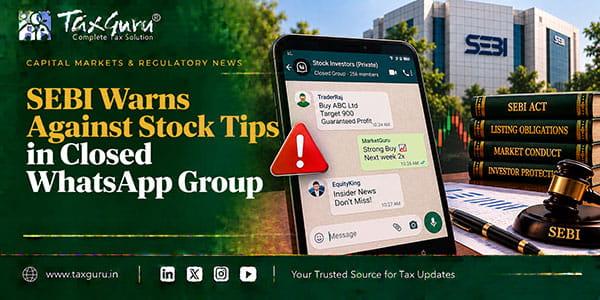
Securities and Exchange Board of India (SEBI) has issued a public caution (PR No. 30/2025) regarding fraudulent communications falsely claiming to be from SEBI. These messages, sometimes shared through social media, use forged SEBI letterheads, logos, and seals to mislead individuals. Incidents include fake notices demanding fines to avoid alleged SEBI action, counterfeit sale certificates of PACL properties, and fabricated certificates authorizing the use of third-party vendor accounts. In response, SEBI advises the public to verify the authenticity of such communications using the SEBI website. Orders passed by SEBI carry unique reference numbers and can be found under the “Enforcement > Orders” section, while Recovery Certificates are listed under “Enforcement > Recovery Proceedings.” All official SEBI communications, including notices and summons, contain a unique Document Identification Number (UDIN) that can be authenticated under the “Authenticate Document Number Issued by SEBI” section. Additionally, a directory of SEBI officials, including names, email IDs, and contact numbers, is available on the website under “About > SEBI Directory.” Official SEBI emails are only sent through addresses ending in “@sebi.gov.in.” SEBI urges the public and investors to remain vigilant, verify any suspicious communication through its official channels, and refrain from responding to fraudulent demands for payments or information.
Securities and Exchange Board of India
PR No. 30/2025
Caution to Public
It has come to the notice of Securities and Exchange Board of India (SEBI) that certain individuals have received communication wherein sender falsely claims to be an official of SEBI using letter head, logo and seal of SEBI. It is noted in certain instances that, sender issued notices through Social Media Platforms asking for payment of fine to prevent SEBI from taking action against the recipient, sender forged Sale Certificate to show that he was a buyer of PACL property, sender issued fake Certificate of use of third party vendor account.
In view of the above, public is urged to exercise caution and to verify the authenticity of any communication that they might deem to have received from SEBI. Communication from SEBI can be verified from the website of SEBI (www.sebi.gov.in) as follows:
i. Every Order passed by SEBI bears a unique reference number and is available on the SEBI website under the path Home>Enforcement>Orders.
ii. Every Recovery Certificate issued by SEBI is available on the SEBI website under the path Home>Enforcement>Recovery Proceedings.
iii. Every official communication such as letter, notice, Show-cause Notice, Summons etc. issued by SEBI bears a unique document identification number (UDIN). The same may be verified from the SEBI website under the path Home>Authenticate Document Number Issued by SEBI. A detailed Guidance Note on SEBI-Document Number Verification System is available under this link.
iv. Names, email IDs and contact numbers of SEBI officials are available on the SEBI website under the path Home > About >SEBI Directory.
v. Official electronic communication from SEBI is issued through the official e-mail IDs of SEBI officials. These email IDs end with domain address @sebi.gov.in.
Public/investors are cautioned to verify communication purported to have been issued by SEBI in the above manner from the SEBI website. Investors are advised to be vigilant while dealing with communication/senders demanding information or payment on behalf of SEBI.
Mumbai
June 04, 2025
Guidance Note on SEBI-DNVS
1. A typical SEBI Outward Number would be in the following format:
“SEBI/HO/LAD1/LAD1_DoP1/P/OW/2025/xxxxxxxx37”
2. To avail the facility of verification, –
(a) The recipient of SEBI notice/letter or any person on his/her behalf may access the SEBI-DNVS page on the SEBI website and enter the following details-
i. Name of the verifier;
ii. Relationship of the verifier with the recipient of the SEBI communication (in case the verifier is the same as the recipient of the SEBI communication, ‘self’ may be entered);
iii. Mobile number used for verification;
iv. OTP received on such mobile number; and
v. Captcha code.
(b) On successful verification of the OTP received on the verifier’s mobile number in the system, the verifier shall enter the following details within the time limit specified on the webpage-
i. Outward Number quoted in the SEBI communication in the field ‘Document Number’;
ii. Sender’s Name (name of SEBI Official who is the signatory of the communication being verified);
iii. Date of issue of the communication; and
iv. Name of the Recipient.
While keying in the Document/Outward number, care should be taken to key in the number in the same format as is mentioned in the communication. While entering the Outward number given in paragraph 1 above, the only liberty that may be taken is the non-inclusion of zeroes before the unique number (‘37’ in the above example).
(c) Upon entering the above inputs, if the details provided above are correct/genuine, the system shall return the query with the following result:-
“A letter/communication with these details has been issued by SEBI. This, however, does not constitute a verification of the contents of the letter/communication. For verification of the contents of the document, the recipient may contact the sender as per the details mentioned therein.”
(d) If incorrect details are entered or if the Document/Outward number is not found to be correct, the system shall return the following result:
“No record found. The recipient is advised to confirm the inputs provided or confirm the authenticity of the document by sending an email to SEBI at [email protected].”
In such a case, the verifier/recipient is advised to confirm the correctness of the inputs entered in the system. If the inputs are found to be correct and the document number is still not verified, the recipient may immediately send an e-mail at [email protected] for necessary verification. Such intimation would also serve as a means for SEBI to be made aware of issuance of any forged letter. The names of the SEBI employees along with their contact details including email addresses (with the domain address @sebi.gov.in) are available in the SEBI website.
(e) After three failed attempts at verification either on the user authentication page (first page) or the document credential verification page (second page) of the system, the mobile number used to access the SEBI-DNVS shall be blocked from accessing the system for a period of 24 hours and the following message shall be displayed on 4th attempt onwards:
“Too many failed attempts. You are requested to retry after 24 hours.”
(f) If after 24 hours, the subsequent three attempts using the same mobile number result in a failure, the mobile number used to access the system shall be permanently blocked and no verification shall be allowed through the use of such number. In such a case, the following message shall be displayed:
“Too many failed attempts. The verifier is advised to confirm the authenticity of the document by sending an email to SEBI at [email protected]”.
The users are advised to re-check the inputs entered to the system during their attempts at verification of the details of the document issued by SEBI.