Mahesh Dalodra Vs NFAC (ITAT Indore)
Summary : The Indore Bench of the Income Tax Appellate Tribunal, in Mahesh Dalodra Vs NFAC, Delhi, considered the rejection of a ₹56,97,688 deduction claimed under Section 54 for AY 2018-19. The appeal challenged the CIT(A)’s order dated 5 February 2025. The assessee had originally filed his return on 30 August 2018 declaring ₹61,74,960 and revised it on 1 September 2018 to declare ₹5,86,260, stating that the exemption had been omitted through a clerical error. The assessment dated 23 February 2021 added ₹56,97,688 and determined total income at ₹62,83,948.
According to the order, the assessee sold land on 18 December 2017 for ₹1,59,78,002. Against an indexed acquisition cost of ₹1,02,80,314, the resulting long-term capital gain was ₹56,97,688. He claimed that he had purchased another plot on 31 July 2017 for ₹52,45,600, jointly with his wife, and constructed an approximately 750 sq. ft. house for ₹5,75,000. The Assessing Officer rejected the Section 54 claim because the original asset was land rather than a residential house, corroborative construction evidence was missing, and the new property was jointly purchased.
The CIT(A) found that the construction agreement, made on plain paper, did not sufficiently establish the construction or payments. Approved plans, sanction documents, payment particulars and independent supporting evidence were absent. The assessee argued that the Assessing Officer had not specifically called for those documents, but the CIT(A) noted that they had not been supplied even during the first appeal. The assessee also did not answer the objection that Section 54 applies to transfer of a residential house, whereas the transferred asset had been described as land. The first appeal was therefore dismissed.
Before the Tribunal, the assessee relied on the construction agreement dated 7 January 2018, a bank entry showing ₹5 lakh paid to contractor Jagdish Ajmera on 2 July 2018, a municipal property-tax receipt dated 1 January 2018, an electricity bill dated 6 November 2018 and a municipal official’s letter dated 12 March 2026 referring to a 750 sq. ft. house/building and tax for 2018-19. His reproduced written submissions also argued that joint ownership with his wife did not defeat the claim and that investment in construction was material. They cited CIT v. Bharti Mishra and CIT v. Smt. B.S. Shanthakumari in support of the completion-related submissions. Those propositions were the assessee’s arguments; the Tribunal did not finally accept them as resolving his eligibility.
The Revenue disputed whether a completed, habitable residential house had been established. It pointed out that the electricity bill related to a construction connection, rather than ordinary domestic consumption, and that approved building plans, completion evidence and other utility records were absent. It also contrasted the ₹5 lakh bank payment with the ₹5.75 lakh construction expenditure claimed. The Revenue relied on Ashok Syal v. CIT and Sandeep Hooda v. PCIT, and alternatively sought remand for a detailed inquiry. The assessee expressed no objection to that alternative.
The Tribunal held that the burden of substantiating the Section 54 claim rested on the assessee. It observed that the Assessing Officer had lacked material construction evidence and that only the registry and construction agreement had been before the CIT(A). It treated the municipal receipt, electricity bill and bank statement as new/additional evidence requiring inquiry and verification. The order also recorded that sanctioned plans and municipal approval documents remained unproduced. It did not finally establish that the new structure was habitable or decide the exemption claim on merits.
Accordingly, the Tribunal set aside the impugned appellate order and remanded the matter to the Assessing Officer for de novo adjudication. It directed production and verification of electricity bills, municipal-tax receipts, the assessee’s bank statement, approved and sanctioned plans, the municipal sanction letter and all other documents showing habitability; the list was expressly illustrative. The assessee must attend hearings and furnish the information required, and the Assessing Officer must pass a speaking, well-reasoned order on merits. The appeal was allowed for statistical purposes. The original-asset objection and the other eligibility questions were not conclusively resolved in the assessee’s favour by the remand.
Cases Discussed
- Sandeep Hooda v. Principal Commissioner of Income Tax, (2024) 169 taxmann.com 20 (Delhi High Court). Cited by the Revenue in disputing proof of a residential house; the Tribunal remanded the factual inquiry.
- CIT v. Smt. B.S. Shanthakumari, (2015) 60 taxmann.com 74 (Karnataka High Court). Cited in the assessee’s reproduced written submissions concerning construction expenditure and completion requirements.
- CIT v. Bharti Mishra, (2014) 41 taxmann.com 50 (Delhi High Court). Cited in the assessee’s reproduced written submissions in support of his construction-related argument.
- Ashok Syal v. Commissioner of Income-tax, (2012) 24 taxmann.com 274 (Punjab and Haryana High Court), IT Appeal No. 566 of 2005, decided 4 May 2012. Cited by the Revenue, with particular reference to paragraphs 8 and 9, in contesting the residential-house claim.
FULL TEXT OF THE ORDER OF ITAT INDORE
This is an Appeal filed by the Assessee under section 253 of the income tax Act 1961,[ herein after referred to as the Act for the sake of brevity] before this tribunal as & by way of a second Appeal. The Assessee is aggrieved by the order bearing No:-ITBA/NFAC/S/250/2024-25/1072946896(1) dated 05.02.2025 passed by the Ld. CIT (A) u/s 250 of the Act, which is herein after referred to as the “Impugned order”. The Relevant Assessment year is 2018-19 and the corresponding previous year period is from 01.04.2017 to 31.03.2018.
2. Factual Matrix
2.1 That as and by way of an Assessment order made u/s 143(3) rws 143(3A) &143(3B) of the Act, the total income of the Assessee was computed & assessed at Rs. 62,83,948/- .The total income as per the return of income was at Rs.5,86,260/-. The addition of Rs.56, 97,688/- was made. That the aforesaid assessment order bears No. ITBA/AST/S/143(3)/2020-21/103089577(1) & that the same is dated 23.02.2021 which is herein after referred to as the “Impugned Assessment Order”
2.2 That the assessee filed the return of income originally for the assessment year 2018-19 on 30.08.2018 admitting an income of Rs. 61,74,960/-. Subsequently the assessee filed revised return of Income on 01.09.2018 admitting an income of Rs. 5, 86,260/-. The revised return of income was selected for scrutiny and notices u/s 143(2) and 142(1) were issued and the assessee furnished the information called for.
2.3 That during the year assessee sold a property for a consideration of Rs. 1,59,78,002/-and after deducting the cost of acquisition at Rs. 1,02,80,314/- arrived at the Long Term Capital Gains of Rs. 56,97,688/-. In the original return of income, assessee offered the Long Term Capital gains to tax. However, in the revised return of income, the assessee claimed the same as deduction u/s.54 of the IT Act. When the assessee was asked to substantiate the deduction claimed u/s.54 in the revised return, the assessee stated that the deduction was claimed in the revised return after finding that the same was not claimed in the original return due to clerical error. In the Impugned Assessment Order following is recorded which we reproduce as below:-
(a) “Coming to the facts, the assessee sold immovable property viz., land on 18-12-2017 and received an amount of Rs.1,59,78,002/-, The said land was purchased by him during the financial year 2015-16 for a consideration of Rs.96,00,000/- and the indexed cost of acquisition of the same worked out to Rs. 1,02,80,314/- and the resultant capital gains worked out to Rs.56,97,688/-. Against this, the assessee claimed deduction u/s.54 claiming that he has purchased a plot on 31-07-2017 for a consideration of Rs.52,45,600/- and also stating vide reply dated 31-01-21 that he constructed a house of approximate 750 sq. ft. on it and the payment of Rs. 5,75,000 is made to the contractor. Though he stated that the copy of construction agreement is attached herewith, but no such agreement was furnished by the assessee.”
(b) “The information furnished by the assessee is carefully considered. In order to avail the benefits of deduction u/s 54, the long term capital asset sold should be a residential house whereas the asset sold by the assessee is land. Further, in order to avail the deduction u/s.54, assessee should within a period of one year before or two years after the date on which the transfer took place purchased, or has within a period of three years after that date constructed, one residential house in India. However, in this case, the new asset purchased is land and though the assessee claimed that he has constructed a house of approximate 750 S.Ft and made a payment of Rs.5,75,000/-, no evidence regarding the construction viz., approval from revenue authorities for construction, plan, proof of payment, alleged construction agreement etc, were furnished to substantiate his claim. Also, it is seen from the property purchased that the same was purchased jointly with one Sri/Ms.Madhu Dalora whereas the capital asset sold by him was not held jointly. It is also pertinent to mention that the assessee admitted Long Term Capital gains in the original return and also paid advance tax and self-assessment tax and subsequently claimed deduction u/s.54 and consequent refund of the taxes paid in the revised return.”
(c) “A show cause notice dated 12-02-21 was issued proposing the above disallowance and in reply letter dated 23-2-21 assessee while agreeing that the property purchased was in joint names, stated that he has constructed a 750 S.Ft. house on the said plot and enclosed a copy of agreement stated to be entered on 07.01.2018. However, as discussed in detail in the foregoing paragraphs, the assessee is not eligible for the deduction u/s.54 claimed as he has not furnished any corrobatratory evidence regarding the construction viz., approval from revenue authorities for construction, plan, proof of payment to the contractor etc. and the property was not purchased in his name but jointly.”
In view of the above, it is held that the assessee is not eligible for the deduction claimed u/s.54 and the same is rejected.”
2.4 That the assessee being aggrieved by the aforesaid “Impugned Assessment Order” prefers the first appeal u/s 246A of the act before the Ld. CIT (A) who by the “Impugned Order” has dismissed the first appeal of the assessee on the grounds and reasons stated therein. The core grounds and reasons for the dismissal of the first appeal was as under:-
“A mere perusal of this only piece of evidence submitted by the appellant indicates that the same is an agreement merely made on simple plain paper and is it totally devoid of specifics and supporting/corroborating details and evidences. In other words, this sole piece of evidence in itself cannot be considered sufficient to establish the claim of the appellant w.r.t. construction of house by making payment of Rs.575000/-. Leave aside other details or any third party and independent evidence, the appellant has not even specified nor submitted any evidences w.r.t. any particulars of the stated payments of Rs.575000/-. In this backdrop, it is mentioned that there is full force in the observations of the Ld. AO i.e. the assessee had failed to furnish any evidence regarding the construction, viz., approval from revenue authorities for construction, plan, proof of payment, alleged construction agreement etc. to substantiate his clalm. Needless to mention that such claim of the appellant is purely evidence-based claim and ought to have been substantiated and established by submission of the relevant details as well as supporting evidences. In his submission made during the present appellate proceedings though the appellant has submitted that the Ld. AO never demanded the proof of payments, plan, sanction letter, etc during the assessment proceedings and without asking for the same he has assumed and disallowed the exemption claimed but the fact remains that in the present appellate proceedings also the appellant has not submitted such details even though as per the statule the primary onus is on the person making claim of exemption/deduction to substantiate such claim by submitting all relevant details dully supported by cogent and tangible evidences.
However, the fact remains that the appellant had squarely failed to discharge this onus at the time of subject assessment proceedings and the position also DID NOT improve during the present appellate proceedings.
In addition to this, it is also noted that the Ld. AO has clearly recorded in the impugned order that the exemption u/s 54 is applicable in those cases in which the Long Term Capital Asset [original asset] which has been transferred is residential house and that in the present case it is land. Inspite of such categorical recording by the Ld. AO in the impugned order, the submission of the appellant made during the course of present appellate proceedings is totally silent on this issue.
In view of the above it is clear that during the course of the assessment proceedings as well as the present appellate proceedings the appellant has squarely failed to substantiate his claim of having constructed a house in terms of provisions of section 54 on the said plot of land which is sine-qua-non for the considering his eligibility w.r.t. claim of exemption u/s 54 and his submission is also silent on the primary issue i.e. exemption u/s 54 is available only in respect of transfer of original asset i.e. residential house and not on plot of land, hence, no interference is called for in the impugned order and there is now no further need to examine other reasons mentioned by the Ld. AO while denying the claim of exemption u/s 54 vide the impugned order.
Hence, there is no reason to interfere with the conclusion of the Ld. AO in this regard. Accordingly all such contentions of the appellant fail and resultantly, the corresponding ground does NOT succeed and is thus DISMISSED.
6. In the result, the present appeal is DISMISSED. ”
2.5 That the assessee being aggrieved by the “Impugned Order” has preferred the instant second appeal before this tribunal and has raised the following grounds of appeal in the form no. 36 against the “Impugned Order” which are as under:-
“1. Rejection of exemption u/s 54 and Addition of income by Rs. 56,97,688 by rejection of exemption is unjustified, illegal and bad in law.”
3. Record of Hearing
3.1 The hearing in the matter took place before this tribunal on 06.04.2026 when the Ld. AR for and on behalf of the assessee appeared before us and interalia contended that the “Impugned Order” is bad in law, illegal and not proper. It therefore deserves to be set aside. The Ld. AR has placed on the record of this tribunal a written submission dated 11.11.2025 which is reproduced by us as below:-
Written Submission on Behalf of the Appellant
1. Brief Facts of the Case
1.1 The assessee sold a long-term capital asset on 18.12.2017 and earned a capital gain of ₹62,83,948/-. Subsequently, the assessee filed a revised return claiming deduction of ₹56,97,688/- under Section 54 of the Income Tax Act, 1961, as he had purchased a plot and constructed a small residential house thereon.
1.2 The investment was made within the prescribed time period in the construction of a new residential house at Pinnacle City, Indore, jointly with his wife, Smt. Madhu Dalodra.
1.3 The assessee submitted the following evidences before the Assessing Officer:
-
- Copy of the construction agreement dated 07.01.2018;
- Bank statements reflecting relevant payments;
- Ownership documents of the plot on which the residential house was constructed.
1.4 The Assessing Officer (AO) disallowed the deduction claimed u/s 54 on the ground that the assessee had not furnished “corroborative” evidence such as approved building plan, receipts from contractor, etc., and also observed that the property was purchased jointly.
1.5 The CIT(A), without properly appreciating the facts and evidences on record, mechanically upheld the AO’s order.
1.6 Aggrieved by the same, the appellant has preferred this appeal before the Hon’ble Tribunal.
2. Grounds of Appeal
The learned authorities below have erred in law and on facts in disallowing the deduction claimed u/s 54. The disallowance is based on mere technicalities and ignores the uncontroverted fact of investment in construction of a residential house within the prescribed period.
3. Submissions
3.1 Investment in Construction is Established
-
- The assessee furnished copies of plot registration deed, construction agreement, and bank statements showing payments for construction.
- The AO has not disputed the source of funds or alleged any diversion or misuse.
- The observation regarding joint ownership with Smt. Madhu Dalodra (wife of the assessee) is untenable in law, as purchase in joint names of spouse does not disentitle deduction u/s 54.
- No specific opportunity or query was given by the AO to explain the details of construction payments, despite submission of bank statements.
- The appellant now encloses payment proofs to the contractor, photographs of the constructed house, and other supporting evidences.
Once the investment in the construction of a new residential house is established, the assessee is entitled to deduction u/s 54.
3.2 Completion or Registration Not Mandatory
Section 54 merely requires that the assessee construct a residential house within three years from the date of transfer of the original asset. There is no requirement under the law for:
-
- Completion certificate,
- Registered sale deed, or
- Physical possession within three years.
The crucial factor is utilization of the capital gain for construction within the stipulated period.
3.3 Judicial Precedents
1. CIT v. Bharti Mishra (2014) 41 taxmann.com 50 (Delhi HC) – Physical completion is not mandatory; investment in construction within time suffices.
2. CIT v. Smt. B.S. Shanthakumari (2015) 60 taxmann.com 74 (Karnataka HC) – Completion certificate not required; construction expenditure qualifies for exemption.
3.2 The Ld. AR has also placed on the record of this tribunal a submission dated 10.02.2026 whereby copy of Nagar Nigam [Municipal Corporation] property tax receipt and copy of electricity bill pertaining to the relevant residential premises are enclosed.
3.3 In addition to above two documents (supra) the Ld. AR has placed on the record of this tribunal an additional submission enclosing a letter dated 12.03.2026 issued by Shri Gopal Vyas Asst. Revenue inspector, Zone-22, Ward No.- 36, Indore Municipal Corporation and so also the assessee letter dated 18.02.2026.
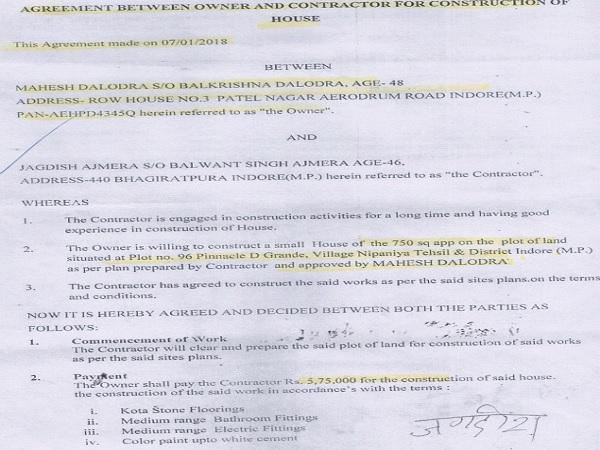
3.4 Basis above documents it was contended by the Ld. AR that the assessee had sold a long term capital asset on 18.12.2017 i.e. immovable property vis land for Rs. 1,59,78,002/-. The said land was purchased by him during the financial year 2015-16 for a consideration of Rs. 96,00,000/- and indexed cost of acquisition of the same worked out to Rs. 1,02,80,314/- and the resultant capital gain worked out to Rs. 56,97,688/- against this, the assessee claimed deduction u/s 54 of the act claiming that he has purchased a plot on 31.07.2017 for a consideration of Rs. 52,45,600/- and had constructed a house of approximately 750 sq. feet on it and that payment of Rs. 5,75,000/- was made to the contractor for the said purpose. Our attention was then invited to page 31 of submissions dated 10.02.2026 which is a copy of agreement dated 07.01.2018 between the assessee and the contractor whereby in the recital it is stated that owner is willing to construct a small house of 750 sq. feet on the plot of land situated at plot no.-96, “Pinnacle D Grande” village Nipania, Teh. and District Indore MP and that the contractor has agreed to construct the said works for Rs. 5,75,000/-. Other details are provided in the said agreement. The said agreement is a two pager document at pages 31 to
32. Our attention was then invited to page no. 33 wherein sum of Rs. 5 Lakh was debited on 02.07.2018 from the assesse bank A/c in favour of “Jagdish Ajmera” the contractor. The Ld. AR then spoke about the original ITR and the revised ITR. It was stated that since refund arose due to revised return the matter was taken up for the scrutiny assessment. The Ld. AO in the “Impugned Assessment Order” has stated that no agreement between the assessee and contractor is placed on record by the asseseee. It is also recorded in the “Impugned Assessment Order” that in order to avail the benefit of deduction u/s 54, the long term capital asset sold should be a residential house whereas the asset sold by the assessee is a land. However now, the agreement between the assessee and the contractor is placed on record and so also payment of Rs. 5 Lakh to the contractor (supra).
The Ld. AR has placed reliance on copy of Nagar Nigam Property Tax receipt dated 01.01.2018 in support of his contention that a house was constructed on the land purchased and so also electricity bill dated 06.11.2018 [page 34&35]. It was prayed that the Impugned Order should be set aside. Per contra Ld. DR for and the Revenue stated that the agreement between the owner and the contractor for the construction of the house is dated 07.01.2018 basis page 31. Mere construction agreement perse is not sufficient exercise in law. House/ construction should complete. The Ld. DR for the Revenue emphasised that there is no material on the record that the site in issue was cleared for and that all the plans are all cleared by competent authorities. No building house approvals and plans [drawings and sketches] are on record of the competent authorities duly approved. No completion certificate is too on the record of the competent authorities. Our attention was then invited to page 34 which is a copy of the electricity bill dated 06.11.2018 from the reading of the same it was pointed out that the electricity connection was provided for purpose of only the “construction of house” and that the electricity bill is not for domestic electric connection for use as light, fans etc. It is common fact that during the construction phase the temporary electric connections are provided by the electric company’s. The domestic consumption of electricity for a house therefore cannot be inferred basis electric bill page 34 as same is for the purpose of the construction of the house. Further no water bill, garbage bill etc. in respect of house are on the records. Basis page 20 [registry], it was emphasised that the land measures 5590 sq. ft. i.e. plot no.-96, “Pinnacle D Grande” colony. The Ld. DR then placed the reliance on the Judgement of the Hon’ble P&H High Court in case of Ashok Syal v/s CIT, CC Jalandhar reported in (2012) 24 Taxmann.com 274 (P & H) and laid emphasis on Para 8 & 9. Reliance was also placed on the Judgement of the Hon’ble Delhi High Court in case of Sandeep Hooda v/s PCIT reported in (2024) 169 Taxmann.com 20 (Delhi) and laid emphasis on Para 18. It was then submitted that the factum of the investment is only the transfer of money to the contractor and that there is no iota of evidence for a house. There is absolutely nothing before the Ld. CIT (A) and the Ld. AO in respect of house. Electricity bill is too temporary one as pointed out earlier. There is a very strong doubt whether the assessee is living or not at this stage of the argument during the course of the hearing. The Ld. AR for the assessee at this stage promptly rebutted that the house/ residential building is in habitable state by the assessee. The Ld. DR then promptly answered what is the proof that the assessee is living in a habitable house and what is the material on record. The only material which is on record is agreement between the owner and the contractor to construct a house and payment of Rs. 5 lakh through banking channel, though the assessee has claimed the amount of Rs.
5.75 Lakh expended on house construction. A little later the Ld. DR finally prayed that the “Impugned Order” be upheld and/or in the alternative the matter should be remanded back to the file of the Ld. AO for a through ‘inquiry’ and the ‘due verification’ basis documents so filed before this tribunal with full and complete liberty to the Ld. AO to make a further and detailed inquiry on the entire subject matter. The Ld. AR then promptly re-joined and submitted that he has no objection if matter is remanded back to the Ld. AO for inquiry and due verification as suggested by the Ld. DR . Hearing was then concluded and closed.
4. Observations Findings & conclusions
4.1 We have to decide the legality, validity and proprietary of the “impugned order” basis records of the case & the rival submission canvassed before us.
4.2 We have carefully perused the records of the case and have heard the submissions.
4.3 We basis records of the case and after hearing and upon examining the rival contentions of the Ld. AR and the Ld. DR canvassed before us, are of the considered opinion that in the “Impugned Assessment Order” the Ld. AO initially has held that the new asset purchased is land, though the assessee has claimed that he has constructed a house of approximately 750 sq. feet on it and made a payment of Rs. 5,75,000/- however there is no evidence regarding the construction of house viz the approval from the Revenue authorities for the construction, plan, proof of payments, the alleged construction agreement etc. were furnished to substantiate the claim.
4.4 We further observe that in the “Impugned Assessment Order” it is further observed & held by the Ld. AO that in response to the show cause notice dated 10.02.2021 wherein the assessee was put to notice & was called upon to show cause as to why the disallowance should not be made against him the assessee vide reply dated 23.02.2021 has stated amongst others that he has constructed a 750 square feet house on the said plot. The assessee is not eligible for the deduction u/s 54 claimed as no corroborative evidence regarding the construction of house viz approval from the revenue authorities for the construction of the house, plans, proof of payment to the contractor etc are on record as the same is not filed in support of claim. Finally in the “Impugned Assessment Order” the claim u/s 54 is rejected.
4.5 In view of above observation of the Ld. AO in the “Impugned Assessment Order” we are of the considered opinion that for a claim u/s 54 of the Act the burden for proof/onus of proof is on the assessee & the Ld. AO at the original stage of the assessment has rightly held as above as no material evidence was before him in support of construction of a house of 750 sq. feet.
4.6 Before the Ld. CIT(A) in the form No. 35 reference & reliance is placed on the construction agreement dated 07.01.2018 which is reproduced by the Ld. CIT(A) in the impugned order on the internal page 7 & 8 which is a agreement between the owner [Assessee] & contractor for a construction of a house.
4.7 We also observe that the assessee during the course of the first appellate proceedings internal page 3 of the impugned order made ‘e’ submissions on 17.08.2023 where in, it is pleaded that the Ld. AO has not verified the documents of purchase of Plot [Plot No. 96 pinnacle city] & the construction of small house on the said plot. It is also avered that the Ld. AO has never demanded that proof payments, Plan, sanction letter etc during the course of the assessment proceedings & even without asking for the same the Ld. AO has disallowed deduction u/s 54 of the Act, which is very unfortunate & illegal. The copy of the registry dated 02.08.2017 copy of construction agreement dated 07.01.2018 were only enclosed before the Ld. CIT (A).
Therefore only the two documents i.e. the copy of registry dated 02.08.2017 & copy of construction agreement dated 07.01.2018 were before the Ld. CIT (A). [Internal page 3 of CIT(A) order & para 2.4(supra)]
4.8 We observe that apart from above two documents the Ld. CIT (A) on page 4 of the “Impugned Order” has observed that the assessee had not submitted other documents meaning there by the approvals from the revenue authorities, for the construction of a house, plans, sanction letter, proof of payment to the contractor etc were not filed & submitted before the first appellate authority despite averment in this regard [Para
4.7 supra]. It is also observed by the Ld. CIT(A) in the “Impugned Order” that a latest opportunity was too afforded to the assessee vide communication dated 12.12.2024 to which also the assessee did not submitted any response & No adjournment request was made consequently the Ld. CIT(A) drew an inference that save except the two documents i.e. copy of registry dated 02.08.2017 & copy of construction agreement dated 07.01.2018. No other documents are being relied upon by the assessee.
4.9 We observe basis internal page 6,7,8 & 9 of the “Impugned Order” the Ld. CIT(A) has held as follows:-
“Thus, it is evident that the Ld. AO has denied the claim of exemption u/s 54 on multiple counts, but the foremost moot point to be considered is whether the appellant has substantiated his claim w.r.t. construction of a house by making payment of Rs.575000/-. This is explained as under:
There is no dispute that the matter relates to the claim of exemption of Rs.5697688/-u/s 54 of the Act and the extract of relevant provisions of the said section are as reproduced below: 54. (1) Subject to the provisions of sub-section (2), where, in the case of an assessee being an individual or a Hindu undivided family, the capital gain arises from the transfer of a long-term capital asset [***], being buildings or lands appurtenant thereto, and being a residential house, the income of which is chargeable under the head “Income from house property” (hereafter in this section referred to as the original asset), and the assessee has within a period of one year before or two years after the date on which the transfer took place purchased, or has within a period of three years after that date constructed, a residential house, then, instead of the capital gain being charged to income-tax as income of the previous year in which the transfer took place, it shall be dealt with in accordance with the following provisions of this section, that is to say,—
xxxxxxxxxxxxxx
Thus, the above provisions unambiguously make it clear that the exemption u/s 54 would be available only in case the corresponding investment is made in purchase/construction of house, subject to other conditions.
There is also no dispute on the fact that major part of this exemption claimed at Rs.5697688/- pertains to the purchase cost of land i.e. Rs.5122688/- [Rs.5697688/-(-)Rs.575000/-] as the same is directly forthcoming from the appellant’s own submission that he had constructed a house on said plot of land of around 750 sq. ft. by making payment of Rs.575000/- In other words, the entire claim of exemption claimed u/s 54 of the Act of Rs.5697688/-solely, wholly and necessarily hinges on the submission of the appellant that he had constructed a house on the said plot of land by making payment of Rs.575000/- and hence it is imperative to examine and ascertain if the assessee-appellant has been able to substantiate such claim.
In this respect, to support such claim, during the course of the present appellate proceedings the appellant has submitted copy of agreement, the relevant extract of which is as reproduced below:
–
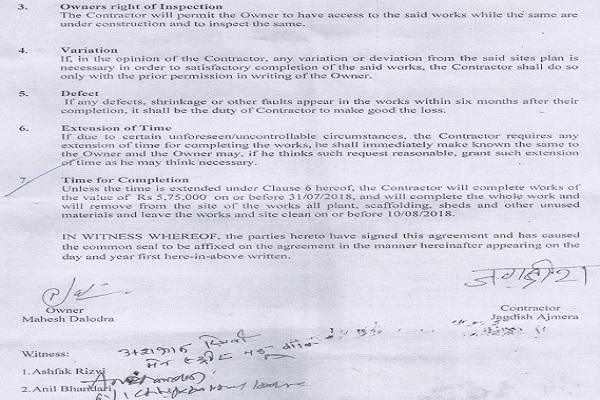
A mere perusal of this only plece of evidence submitted by the appellant indicates that the same is an agreement merely made on simple plain paper and is it totally devoid of specifics and supporting/corroborating details and evidences. In other words, this sole piece of evidence in itself cannot be considered sufficient to establish the claim of the appellant w.r.t. construction of house by making payment of Rs.575000/-, Leave aside other details or any third party and independent evidence, the appellant has not even specified nor submitted any evidences w.r.t. any particulars of the stated payments of Rs.575000/-, In this backdrop. it is mentioned that there is full force in the observations of the Ld. AO Le. the assessee had failed to furnish any evidence regarding the construction viz., approval from revenue authorities for construction, plan, proof of payment, alleged construction agreement etc. to substantiate his claim. Needless to mention that such claim of the appellant is purely evidence-based claim and ought to have been substantiated and established by submission of the relevant details as well as supporting evidences. In his submission made during the present appellate proceedings though the appellant has submitted that the Ld. AO never demanded the proof of payments, plan, sanction letter, etc during the assessment proceedings and without asking for the same he has assumed and disallowed the exemption claimed but the fact remains that in the present appellate proceedings also the appellant has not submitted such details even though as per the statute the primary onus is on the person making claim of exemption/deduction to substantiate such claim by submitting all relevant details dully supported by cogent and tangible evidences.
However, the fact remains that the appellant had squarely failed to discharge this onus at the time of subject assessment proceedings and the position also DID NOT improve during the present appellate proceedings.
In addition to this, it is also noted that the Ld. AO has clearly recorded in the impugned order that the exemption u/s 54 is applicable in those cases in which the Long Term Capital Asset [original asset] which has been transferred is residential house and that in the present case it is land. Inspite of such categorical recording by the Ld. AO in the impugned order, the submission of the appellant made during the course of present appellate proceedings is totally silent on this issue.
In view of the above it is clear that during the course of the assessment proceedings as well as the present appellate proceedings the appellant has squarely failed to substantiate his claim of having constructed a house in terms of provisions of section 54 on the said plot of land which is sine-qua-non for the considering his eligibility w.r.t. claim of exemption u/s 54 and his submission is also silent on the primary issue l.e. exemption u/s 54 is available only in respect of transfer of original asset i.e. residential house and not on plot of land, hence, no interference is called for in the impugned order and there is now no further need to examine other reasons mentioned by the Ld. AO while denying the claim of exemption u/s 54 vide the impugned order.
Hence, there is no reason to interfere with the conclusion of the Ld. AO in this regard. Accordingly all such contentions of the appellant fail and resultantly, the corresponding ground does NOT succeed and is thus DISMISSED.
6. In the result, the present appeal is DISMISSED. ”
We find No infirmity in the “Impugned Order”. However now at page 34 a electricity bill dated 06.11.2018 is produced before us which too has been strongly assailed by the Ld. DR during the hearing as is recorded above i.e. for the purpose of construction of house and not for domestic use. This document is contrary to the submission of Ld. AR during the hearing that house is a habitable one. Regular electricity bills are not produced for the domestic use i.e. lights & fan etc. as corroborative evidences. Another document at page 35 is municipal tax receipt dated 01.01.2018 which was not in the existence at the original stage as well as at the first appellate stage [& so also electricity bill dated 06.11.2018]. Yet another piece of evidence is letter dated 12.03.2026 of Shri Gopal Vyas Asst. Revenue inspector IMC Zone 22, ward – 18 stating that in respect of Plot no 96 there is house/building of 750 sq. feet in respect of which house tax for year 2018-19 is levied. We also observe that on page 33 there is a bank statement of the assessee were in it is claimed that on 02.07.2018 a debit of Rs. 5 lakh is seen in favour of Jagdish Ajmera the contractor who has been claimed as person who has constructed the house admeasuring 750 sq. feet on the said plot no. 96 pinnacle city as a contractor.
4.10 We observe thus that the so called municipal tax receipt dated 01.01.2018, electricity bill dated 06.11.2018, bank statement from 15.2.18 to 5.7.18 of Assessee bearing A/c NO. 50100073560263, customer id no. 2374529 [P 33] are new & additional evidences which were not before the Ld. AO at the time of the original adjudication. Further we observe that for the house admeasuring 750 sq. feet the plans, sanction letter of competent authorities like IMC are not placed on record despite making a grievance of same by the assessee as recorded in the “Impugned Order” [para 4.7 & 2.4 (supra] under these circumstances & facts we at the end of the hearing saw both the Ld. AR & the Ld. DR [In alternative submission] were at least ad idem on the issue of remand back to the file of the Ld. AO for De novo adjudication.
4.11 In the premises drawn by us we are of the considered opinion that the “Impugned Order” deserves to be set aside & matter should be remanded back to the file of the Ld. AO on denovo basis so that he can pass a fresh order on merits of the case. Accordingly we set aside the “Impugned Order” as & by way of remand back to the file of the Ld. AO with a direction to place before the Ld. AO the following documents for due inquiry & due verification of the same which are enumerated as under:-
(1) Copy of electricity bills
(2) Copy of Municipal tax receipts
(3) Copy of bank statement of assessee.
(4) Approved & sanctioned plans, Sanction letter of Municipal authorities in respect of house admeasuring 750 sq. feet (supra).
(5) All other papers & documents showing that house is habitable one.
Note: – Above list is only illustrative and not exhaustive.
4.12 The assessee is directed to attend hearings as & when fixed & to file reply & to furnish such details as may be sought by the Ld. AO for purpose of due inquiry & due verification so that correct income of the assessee is computed & assessed as per law. The Ld. AO is directed to pass a speaking & well-reasoned order basis merits of the case.
5 Order
5.1 In the result-the Impugned order is set Aside as and by way of remand back to the file of the Ld. AO with directions as aforesaid.
5.2. The Appeal of the assessee is allowed for statistical Purpose.
Pronounced in open court on 17.04.2026.