ITO Vs Mayank Khandelwal (ITAT Jaipur)
The Jaipur Bench of the Income Tax Appellate Tribunal dismissed the Revenue’s appeal and allowed the assessee’s cross-objection in the case of ITO v. Mayank Khandelwal concerning Assessment Year 2019-20. The reassessment arose from an alleged bogus political donation of Rs.1,00,000 claimed as a deduction under Section 80GGC. Information was received following a search of registered unrecognised political parties at Ahmedabad on 7 September 2022. The Assessing Officer issued a notice under Section 148 on 12 April 2023 after following the procedure under Section 148A and subsequently disallowed the deduction. The CIT(A), by order dated 29 December 2025, deleted the addition on the ground of limitation.
Before the Tribunal, the assessee argued that the Section 148A procedure followed by the Assessing Officer was inapplicable to the search-derived information in the circumstances of the case. Accordingly, the notice under Section 148 had to be considered independently, without the benefit of the time exclusions connected with Section 148A. The assessee submitted that the notice dated 12 April 2023 was issued more than three years after the end of AY 2019-20, while the alleged escaped income was only Rs.1 lakh, below the Rs.50 lakh threshold for the extended reopening period under Section 149(1)(b). The Departmental Representative did not controvert the material facts or the legal position advanced before the Tribunal.
The Tribunal accepted the jurisdictional objection. It held that the Section 148A procedure had been wrongly followed for the third-party-search information and that the Section 148 notice, considered on a standalone basis, was beyond the three-year limitation prescribed under Section 149(1)(a). The assumption of jurisdiction under Section 147 was consequently invalid and the reassessment order unsustainable. The assessee’s cross-objection was allowed and the Revenue’s appeal dismissed without adjudicating its remaining grounds, which became academic. The Tribunal did not decide whether the underlying political donation was genuine or deductible.
FULL TEXT OF THE ORDER OF ITAT JAIPUR
The present appeal has been filed by the Revenue and the cross-objection has been filed by the assessee against the order passed by National Faceless Appeal Centre (NFAC), Delhi (hereinafter referred to as “Ld. CIT(A)”) dated 29.12.2025 under Section 250 of the Income Tax Act, 1961 (hereinafter referred to as “the Act”).
2. Brief facts relating to the case are that, the case of the assessee was reopened on the basis of information with the Department that the assessee had claimed deduction u/s 80GGC of the Actof an alleged bogus political donation amounting to Rs.1,00,000/-. Subsequently assessment order was passed u/s 147 of the Act disallowing the claim of donation made by the assessee. The Ld. CIT(A) deleted the addition made by the AO allowing the legal ground raised by the assessee that the order passed was barred by limitation in terms of Section 149(1) of the Act.
3. Aggrieved by the same, the Revenue has come up in appeal before us and the assessee has filed cross-objection to the same. The assessee has raised a legal ground contending that the assessment order passed was barred by limitation for a different reason. The said ground is raised in ground No.1 of the assessee’s cross objection as under:-
1. Ground 1. Whether on facts and in the circumstances of the case and in law, the Ld. CIT(A) was justified in holding that the notice issued under section 148 dated 12.04.2023 was barred by limitation, by incorrectly ignoring the fifth and sixth provisos to section 149, which mandate exclusion of time allowed under section 148A(b) and statutory extension of limitation.
4. Since it is a legal ground raised by the assessee, we shall be first dealing with the same.
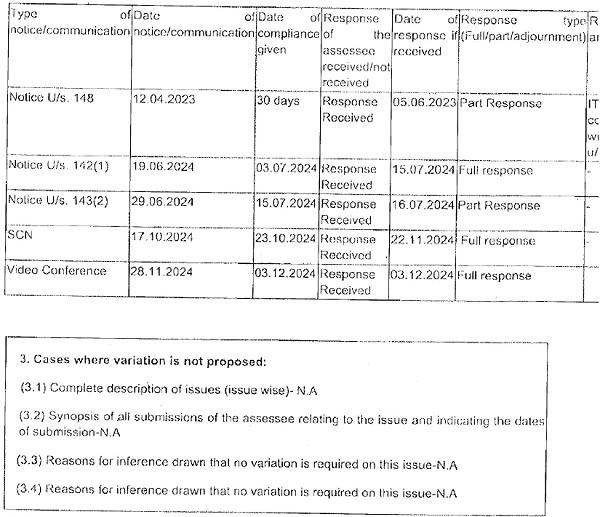
5. Ld. Counsel for the assessee pointed out at the outset that in the facts of the present case reopening was resorted to on the basis of information with the AO that the assessee had wrongly claimed deduction u/s 80GGC of the Act for a bogus political donation made of Rs.1 lacs. The information was revealed from a search action conducted on Recognised Unregistered Political Parties (RUPP’s) by the Investigation Wing of the Department. He stated that the AO reopened the case of the assessee issuing notice u/s 148 of the Act after following the procedure prescribed u/s 148A of the Act. The notice u/s 148 of the Act was issued on 12.04.2023. The Ld. CIT(A) found the same being issued beyond three years and noting the income escaping assessment to be less than Rs. 50 lacs, he held the notice issued u/s 148 of the Act to be barred by limitation as per section 149 of the Act.
6. De hors the aforesaid finding of the Ld. CIT(A), ld. Counsel for the assessee contended that even on another basis the impugned notice u/s 148 of the Act was barred by limitation. He contended that the procedure followed by the AO as prescribed u/s 148A of the Act, for issuing notice u/s 148 of the Act, was not that prescribed in law. That therefore the notice issued u/s 148 of the Act was to be considered on stand alone basis ignoring all the other notices issued as per section 148A of the Act. And admittedly the said notice was issued beyond the period of three years prescribed u/s 149 of the Act for incomes escaping assessment less than 50 Lacs.
7. He drew our attention to the applicable provisions of law, drawing our attention first to section 149(1)(a) of the Act pointing out therefrom that the reopening in the impugned case could have been resorted only upto three years from the end of the relevant assessment year since the income escaping assessment was less than Rs.50 lakhs. He drew our attention to Section 149(1)(a) and (b) of the Act in this regard as under:-
…………………
149. Time limit for notice.- (1) No notice under section 148 shall be issued for the relevant assessment year,-
a. if three years have elapsed from the end of the relevant assessment year, unless the case falls under clause (b);
b. if three years, but not more than ten years, have elapsed from the end of the relevant assessment year unless the Assessing Officer has in his possession books of account or other documents or evidence which reveal that the income chargeable to tax, represented in the form of-
(1) an asset;
i. expenditure in respect of a transaction or in relation to an event or occasion, or
ii. an entry or entries in the books of account, which has escaped assessment amounts to or is likely to amount to fifty lakh rupees or more:
8. Thereafter he pointed out the facts of the present case, that the information relating to the escapement of the income of the assessee had emanated during the course of search action in the case of Registered Unrecognised Political Party (RUPPs) Group of Ahmedabad on 07.09.2022. He drew our attention to para 1 to 3 of the assessment order recording the said facts as under:
1. Reasons for selection of the Case and Type of Case and background facts:-
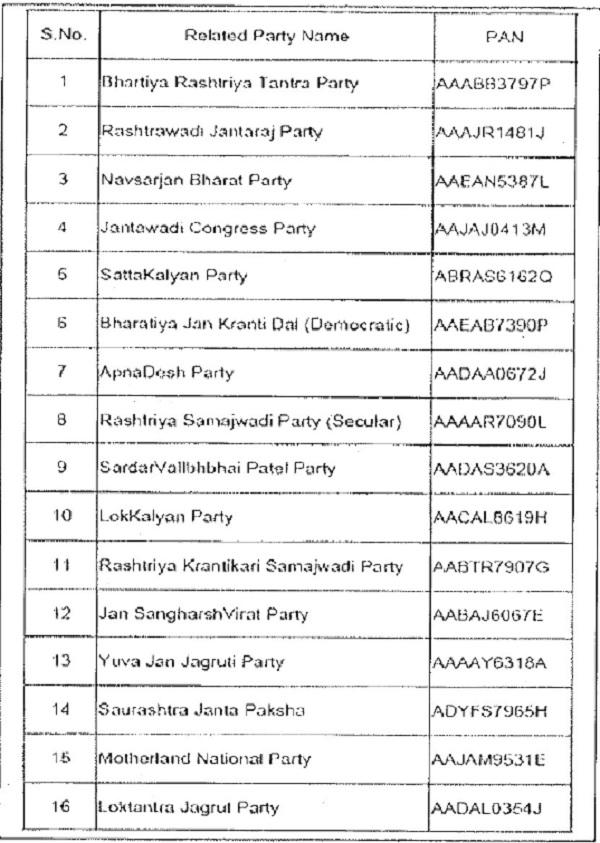
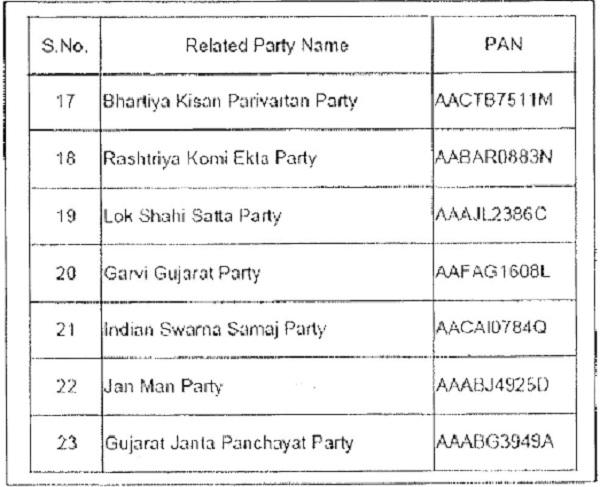
In case of the assessee, specific information was flagged as per Risk Management Strategy formulated by the CBDT through Insight Portal under head ‘High Risk CRIU/VR U Cases’ for A.Y. 2019-20. The information has been received on the basis of the search u/s 132 of the Act, in the case of RUPPs group of Ahmadabad on 07.09.2022. In this search, a total of 23 Registered Unrecognized Political Parties, 35 bogus intermediary entities and 3 major exit providers were covered which was combined called as RUPP group of Ahmadabad. The 23 RUPPs, inter alia, covered in the action are as hereunder:
–
2. During the course of search action, large number of incriminating documents related to bogus donation receipts, diaries containing details of commission charged, loose papers containing vital information and Whats App chats in the mobile phones of the office bearers of the RUPPs and their key handlers confirming the allegations, were found. Documentary and digital evidences collected during the course of search action, were confronted with the key persons of the group and subsequently seized. Further, during the course of pre as well as post search it has been established that these RUPPs were involved in the activity of providing accommodation entry by way of bogus donation. Thereafter, on the basis of bank account statements of these RUPPs, beneficiaries/donors who had availed accommodation entries in form of the bogus donation made to these RUPPs have been identified.
3. As per information, the assessee MAYANK KHANDELWA, (PAN- BLMPK8222N) has obtained accommodation entry in form of Political Donation of Rs. 1,00,000/- from Rashtriya Samajwadi Party (Secular) during F.Y. 2018-19 relevant to A.Y.2019-20. Further, on-going through return of income filed by the assessee on 11.05.2023 for A.Y. 2019-20, it is noticed that the assessee has claimed Donation to Political Party of Rs. 1,00,000/- u/s 80GGC of the I.T. Act. Thus, donation shown to above mentioned Political Party by the assessee is bogus and claim of deduction u/s 80GGC of the Act on the basis of such bogus donation is not allowable. Thus, assessee has claimed bogus deduction and reduced taxable income and has not paid due tax on such income. The information in this case has been identified and flagged by the board as per the provisions of clause (i) of explanation 1 to section 148 of the I.T. Act, 1961.
Accordingly, Order u/s 148A(d) of the Act has been passed on 12.04.2023 and subsequently Notice u/s 148 of the Act issued and served upon the assessee on 12.04.2023. The assessee, MAYANK KHANDELWA, (PAN: BLMPK8222N) is an individual, has filed his return of income on 11.05.2023 in compliance with notice u/s 148 of the Act, admitting a total income of Rs.9,20,610/-.
2. Details of opportunities given
9. Ld. Counsel for the assessee thereafter drew our attention to the provisions of Section 148A applicable for the impugned year pointing out therefrom that where information available with the AO was gathered during search, the procedure prescribed u/s 148A of the Act was not required to be followed:
…………
148A. Conducting inquiry, providing opportunity before issue of notice under section 148.- The Assessing Officer shall, before issuing any notice under section 148,-
a. conduct any enquiry, if required, with the prior approval of specified authority, with respect to the information which suggests that the income chargeable to tax has escaped assessment;
b. provide an opportunity of being heard to the assessee, by serving upon him a notice to show cause within such time, as may be specified in the notice, being not less than seven days and but not exceeding thirty days from the date on which such note is issued, or such time, as may be extended by him on the basis of an application this behalf, as to why a notice under section 148 should not be issued on the basis of information which suggests that income chargeable to tax has escaped assessment in his case for the relevant assessment year and results of enquiry conducted if any, as per clause (a);
c. consider the reply of assessee furnished, if any, in response to the show-cause note referred to in clause (b);
the Assessing Officer has received information under the scheme notified under section 135A.
Explanation-For the purposes of this section and section 148, “specified
authority” means the specified authority referred to in section 151.
d. decide, on the basis of material available on record including reply of the assessee, whether or not it is a fit case to issue a notice under section 148, by passing an order, with the prior approval of specified authority, within one month from the end of the month in which the reply referred to in clause (c) is received by him, or where no such reply is furnished, within one month from the end of the month in which time or extended time allowed to furnish a reply as per clause (b) expires:
Provided that the provisions of this section shall not apply in a case where,-
a. a search is initiated under section 132 or books of account, other documents or any assets are requisitioned under section 132A in the case of the assessee on or after the 1st day of April, 2021; or
b. the Assessing Officer is satisfied, with the prior approval of the Principal Commissioner or Commissioner that any money, bullion, jewellery or other valuable article or thing, seized in a search under section 132 or requisitioned under section 132A, in the case of any other person on or after the 1st day of April, 2021, belongs to the assessee, oг
c. the Assessing Officer is satisfied, with the prior approval of the Principal Commissioner or Commissioner that any books of account or documents, seized in a search under section 132 or requisitioned under section 132A, in case of any other person on or after the 1st day of April, 2021, pertains or pertain to, or any information contained therein, relate to, the assessee; or
d. the Assessing Officer has received any information under the scheme notified under section 135A pertaining to income chargeable to tax escaping assessment for any assessment year in the case of the assessee.
…….
Explanation. For the purposes of this section, specified authority means the specified authority referred to in section 151.”
10. He therefore contended that applying the law to the facts of the present case the procedure followed by the AO for reopening the case of the assessee as per section 148A of the Act was incorrect and the notice issued u/s 148 of the Act on 12.04.2023 was to be considered on a standalone basis, ignoring all other previous notices issued u/s 148A(b) of the Act and the time given to the assessee to file reply for the same . And since the said notice u/s 148 of the Act was admittedly issued beyond three years from the end of the relevant assessment year and the income escaping assessment also admittedly was less than 50 lacs, the notice was clearly barred by limitation.
11. Ld. DR before us was unable to controvert the factual contention of the ld. Counsel for the assessee that the reopening in the present case was resorted to on the basis of information procured during search conducted on the RUPPs cases. She was unable to controvert the proposition of law applicable for the impugned year, that reopening of cases by issuing notices u/s 148 of the Act on the basis of information procured during search were not required to follow the procedure prescribed u/s 148A of the Act. She also was unable to controvert the fact before us that in the present case the AO had followed the procedure prescribed u/s 148A of the Act and also the fact that the notice issued u/s 148 of the Act was beyond the prescribed period of three years from the end of the relevant assessment year. She admitted to the fact that the income escaping assessment in the present case was less than 50 lacs, being Rs.1 lacs. She was also unable to controvert the law of limitation applicable to reopening of cases u/s 149 of the Act, that for income escaping assessment less than Rs.50 lacs, reopening could not be resorted to beyond three years from the end of the relevant assessment year.
12. In effect, Ld. DR was unable to controvert both the facts of the case and the law applicable and it is abundantly clear therefore that in the facts of the present case where reopening was resorted to on the basis of information procured during search conducted on a third party, the procedure for reopening the case as prescribed u/s 148A of the Act was wrongly followed by the AO. That the notice issued u/s 148 of the Act by the AO by following the procedure u/s 148A of the Act therefore was to be considered on a standalone basis, de hors the earlier notices issued u/s 148A of the Act. That considering so, the notice issued u/s 148 of the Act on 12.04.2023 was beyond three years from the end of the relevant assessment year i.e. AY 2019-20. The income escaping assessment being less than Rs. 50 lacs i.e. Rs. 1 lac, undoubtedly, the notice u/s 148 of the Act, being the jurisdictional notice for framing assessment u/s 147 of the Act, was issued beyond the period prescribed u/s 149(1)(a) of the Act.
13. In the light of the above, we have no hesitation in holding that the jurisdiction assumed by the AO to frame assessment u/s 147 of the Act was not as per law and was invalid. The assessment order passed by the AO therefore was not sustainable in law.
The ground of appeal raised by the assessee in its cross-objection accordingly is allowed.
14. Since we have allowed the legal ground raised by the assessee in its cross objection and held the assessment order to be invalidly passed, the grounds raised by the Department, are not being adjudicated since they are mere academic in nature.
15. In the combined result, the appeal filed by the Revenue is dismissed and the CO filed by the assessee is allowed.
Order pronounced in the Open Court on 25.08.2026.