Mittal Alloy Castings Co. Vs ACIT (ITAT Raipur)
Seven Days Means Seven Clear Days: Short Section 148A(b) Notice Invalidates Reassessment
The Controversy
The assessee challenged the reassessment on the ground that the show-cause notice issued under section 148A(b) did not provide the minimum statutory period for submitting a response.
The notice was dated 21 March 2022, and the assessee was required to comply by 28 March 2022.
Although the two dates were seven days apart, the assessee contended that the statutory expression “not less than seven days” requires seven clear intervening days, excluding both the date of the notice and the date fixed for compliance.
On that computation, only six clear days—22 March to 27 March 2022—were available. The assessee argued that the defective notice could not support a valid reassessment.
Tribunal’s Examination of the Notice
The Tribunal examined the notice and accepted the assessee’s computation.
It held that section 148A(b), as applicable to the proceedings, required a response period of not less than seven days. This requirement had been interpreted by judicial authorities as requiring exclusion of both terminal dates.
Consequently, the notice dated 21 March 2022, requiring compliance by 28 March 2022, provided only six clear days and was invalid and bad in law.
The Tribunal followed the reasoning adopted by the Raipur Bench in DCIT v. Avani Ferro Alloys Pvt. Ltd., ITA Nos. 88 to 91/RPR/2025, order dated 6 August 2026.
Earlier Decision on the Same Issue
In Avani Ferro Alloys, the notice under section 148A(b) had been issued on 16 March 2022, requiring a response by 23 March 2022.
The Revenue had argued that seven days had been allowed. However, the Tribunal rejected that approach because it did not provide seven clear intervening days after excluding the notice date and the compliance date.
The earlier decision relied on Bijendra Singh v. PCCIT, 478 ITR 493 (Rajasthan), which examined the meaning of “not less than seven days” in section 148A(b).
The Rajasthan High Court, in turn, applied the Supreme Court’s decision in Pioneer Motors (Private) Ltd. v. Municipal Council, Nagercoil, AIR 1967 SC 684. That decision explained that where a prescribed notice period uses the expression “not less than”, both terminal days are excluded in computing the intervening period.
Thus, merely subtracting the notice date from the response date does not establish compliance with the statutory minimum.
Karnataka and Gujarat High Court Decisions
The reasoning reproduced and followed by the Tribunal also referred to PCCIT v. Smt. Komarla Yogendra Keertana, (2025) 307 Taxman 106 (Karnataka).
That decision was cited for the principle that a section 148A(b) notice which does not provide the minimum statutory period of seven days to respond is liable to be quashed.
A similar view was noted in Atul Mahavirprasad Paldecha v. ITO, (2025) 307 Taxman 331 (Gujarat).
The Tribunal further referred to the Raipur Bench’s decisions in Atal Agrawal v. ITO, ITA No. 231/RPR/2026, dated 3 September 2026, and Kaizen Motoventures Pvt. Ltd. v. ACIT, ITA No. 409/RPR/2026, dated 22 September 2026, following the same approach.
Final Decision
Applying these principles, the Tribunal held that the notice issued to Mittal Alloy Castings Co. was non-compliant with section 148A(b) and void ab initio.
It further held that an invalid foundational notice could not give rise to a valid assessment order. Accordingly, it quashed the consequential assessment and held the subsequent proceedings to be non-est.
The remaining grounds became academic and were not adjudicated. The assessee’s appeal was allowed.
Author’s Comments
A seven-day difference between two dates is not necessarily seven clear days of opportunity. That simple distinction decided the appeal.
For a notice dated 21 March, fixing compliance on 28 March leaves only six intervening days once both terminal dates are excluded. On the computation adopted in this order, 29 March would be the earliest compliance date providing seven clear intervening days, assuming the notice is issued on 21 March.
The statutory opportunity under section 148A(b) enables the assessee to examine the information, collect records and explain why reopening is unwarranted. The minimum response period is therefore a substantive procedural safeguard, not a formality satisfied by mentioning two dates a week apart.
For practitioners, scrutiny of the notice chronology should precede examination of the proposed addition. The issue date, actual communication record, stipulated response date and any extension granted should all be preserved and examined.
The Karnataka High Court authority cited in the reasoning is particularly relevant for Karnataka matters. However, the present ruling should be understood on its actual facts: the notice provided only six clear days, and the Tribunal found it non-compliant. It did not examine situations involving a subsequently granted extension or other materially different procedural circumstances.
Finally, the assessee obtained relief on the validity of the reopening process. The Tribunal did not decide the substantive tax dispute, because the reassessment itself could not survive the defective foundational notice.
Cases Discussed
- DCIT-1(1), Raipur v. Avani Ferro Alloys Pvt. Ltd., ITA Nos. 88 to 91/RPR/2025, order dated 06.08.2026 (ITAT Raipur) — Followed for the mandatory requirement of seven clear intervening days under Section 148A(b) and the invalidity of notices providing a shorter response period.
- Kaizen Motoventures Private Limited v. ACIT-1(1), Raipur, ITA No. 409/RPR/2026, order dated 22.09.2026 (ITAT Raipur) — Referred to as a coordinate Bench decision adopting the same approach to the minimum statutory notice period.
- Atal Agrawal v. ITO-1, Raigarh, ITA No. 231/RPR/2026, order dated 03.09.2026 (ITAT Raipur) — Referred to as an earlier decision of the Raipur Bench on compliance with Section 148A(b).
- Bijendra Singh v. PCCIT, (2025) 478 ITR 493 (Rajasthan High Court) — Held that both terminal dates must be excluded in computing the mandatory response period when the statute requires not less than a specified number of days.
- Atul Mahavirprasad Paldecha v. ITO, (2025) 307 Taxman 331 (Gujarat High Court) — Referred to for the consequence of failing to provide the statutory minimum response period under Section 148A(b).
- PCCIT v. Smt. Komarla Yogendra Keertana, (2025) 307 Taxman 106 (Karnataka High Court) — Held that the failure to provide the minimum seven-day statutory period rendered the reassessment notice legally unsustainable.
- Pioneer Motors (Private) Ltd. v. Municipal Council, Nagercoil, AIR 1967 SC 684 (Supreme Court) — Established the principle that both terminal days are excluded where the law requires a notice period of not less than a specified duration.
FULL TEXT OF THE ORDER OF ITAT RAIPUR
The present appeal preferred by the assessee emanates from the order of the Ld.CIT(Appeals)/NFAC, Delhi dated 01.07.2026 for the assessment year 2018-19 as per the grounds of appeal on record.
2. The contention in law assailed by the Ld. Counsel for the assessee is that show cause notice u/s.148A(b) of the Income Tax Act, 1961 (for short ‘the Act’ is violative of the provision itself since the said show cause notice does not provide the assessee a clear cut 7 days time excluding the date of notice and date of compliance sought for from the assessee, therefore, such notice being void ab initio cannot set in motion a valid order of assessment and is liable to be quashed.
3. In this regard, relevant notice u/s.148A(b) of the Act, dated 21.03.2022 is extracted as follows:
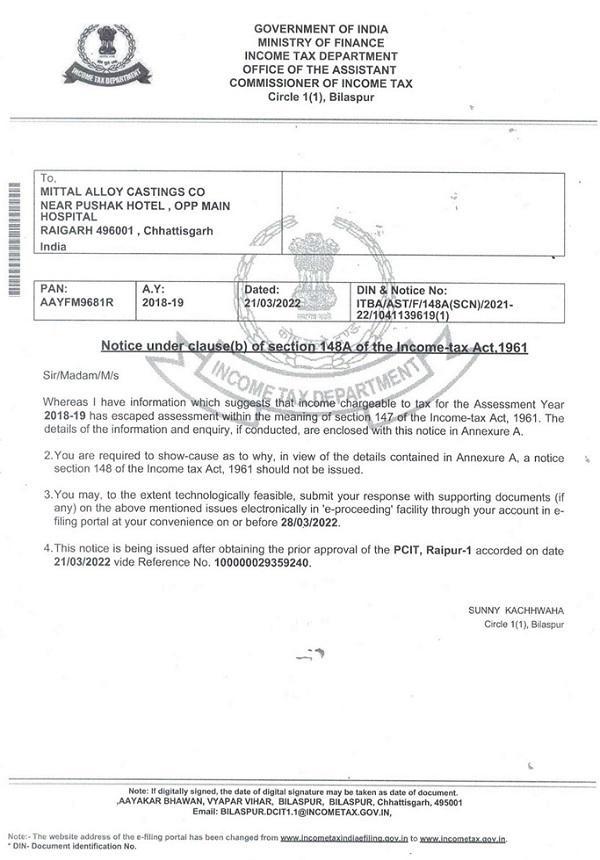
4. The date of notice is 21.03.2022 and date on which compliance sought for from the assessee is 28.03.2022 and in between, there is only 6 clear days time. However, Section 148A(b) of the Act provides that “being not less than 7 days”, which has been interpreted by various judicial forums that clear cut 7 days time has to be given to the assessee excluding the date of notice and date of compliance of the assessee. In the present case, as evident clear cut 6 days time only given to the assessee and hence, such notice u/s. 148A(b) of the Act is invalid and bad in law.
5. I find that similar issue has been dealt with by this Bench in favour of the assessee and against Revenue recently in the case of DCIT-1(1), Raipur Vs. Avani Ferro Alloys Pvt. Ltd, ITA Nos.88 to 91/RPR/2025, dated 06.08.2026 wherein it was held and observed as follows:
“60. The Ld. Counsel for the assessee submitted that the notice issued u/s 148A(b) on 16.03.2022 is void ab initio. He submitted that the notice called for a response on or before 23.03.2022 which does not constitute a clear 7 days as required by the mandatory provisions of section 148A(b). He submitted that the statutory mandate requires a period of ‘not less than seven days’ to be provided for compliance. He submitted that in computing this period, both the date of issuance and the date of compliance must be excluded. Consequently the jurisdictional notice is rendered void and all subsequent proceedings emanating from it are a ‘nullity and non-est in the eyes of law’.
61. Referring to the decision of Hon’ble Karnataka High Court in the case of PCCIT vs. Smt. Komarla Yogendra Keertana reported in (2025) 307 Taxman 106 (Kar), he submitted that the Hon’ble High Court in the said decision has held that where impugned notice issued u/s 148A(b) did not provide the assessee minimum statutory period of seven days to respond, same was rightly quashed.
62. Referring to the decision of Hon’ble Rajasthan High Court in the case of Bijendra Singh vs. PCCIT reported in (2025) 478 ITR 493 (Raj), he submitted that the Hon’ble High Court in the said decision following the decision of Hon’ble Supreme Court in the case of Pioneer Motors (Private) Ltd. vs. Municipal Counsel, Nagrecoil reported in AIR 1967 SC 684 has held that both the terminal dates have to be excluded for the purpose of complying with the requirement of words ‘not less than .. days”.
63. The Ld. DR on the other hand submitted that the Assessing Officer has issued notice u/s 148A(b) on 16.03.2022 asking the assessee to submit its details on or before 23.03.2022. Thus, a period of 7 days have been given. Therefore, the arguments advanced by the Ld. Counsel for the assessee are liable to be rejected and the notice issued is to be held as valid notice.
64. We have heard the rival arguments made by both the sides, perused the orders of the Assessing Officer and the Ld. CIT(A) / NFAC and the paper book filed on behalf of the assessee. We have also considered the various decisions cited before us. We find the Assessing Officer issued a notice under clause (b) of section 148A on 16.03.2022 by asking the assessee to submit the details in the portal on or before 23.03.2022, the details of which are as under:
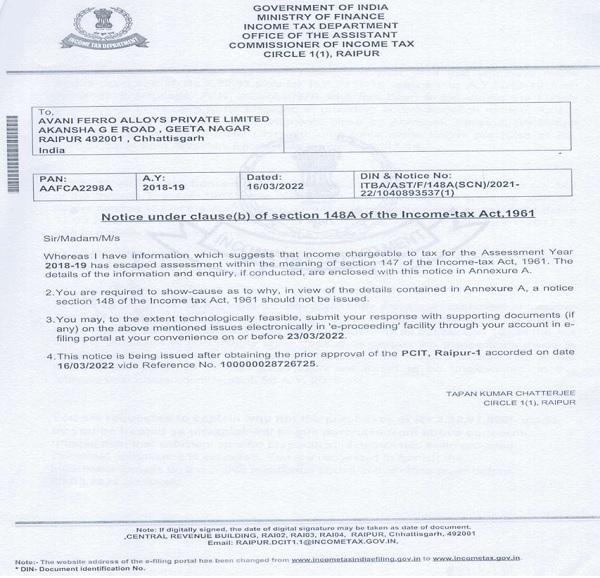
65. Under these circumstances, we have to see as to whether a period of 7 days as mandated by the provisions of section 148A(b) are fulfilled or not. We find an identical issue had come up before Hon’ble Rajasthan High Court in the case of Bijendra Singh vs. PCCIT (supra). The Hon’ble High Court in the said decision while deciding the aspect of calculating the days in a case where the provision requires a notice of ‘not less than particular days’, following the decision of Hon’ble Supreme Court in the case of Pioneer Motors (Private) Ltd. vs. Municipal Council (supra) has observed as under:
“10. Section 148A(b) of the Act requires providing opportunity of being heard to the assessee by serving upon him/her notice to show cause within such time, as may be specified in the notice being ‘not less than seven days’ but not exceeding thirty days from the date, on which such notice is issued.
11. The aspect of calculating the days in a case where the provision requires a notice of ‘not less than particular days’, has been dealt with by the Hon’ble Supreme Court in the Pioneer Motors (Private) Ltd. vs. The Municipal Council, Nagrecoil : AIR 1967 SC 684, wherein it has, inter-alia, been laid down as under:
“The words “not being less than one month” do imply that clear one month’s notice was necessary to be given, that is, both the first day and the last day of the month had to be excluded. To put it in the language used by Maxwell on Interpretation of Statutes, 10th Edition, p. 351 :-
“..when…….. ‘not less than’ so many days are to intervene, both the terminal days are excluded from the computation.”
12. It has been laid down by the Hon’ble Supreme Court that both the terminal days have to be excluded for the purpose of complying with the requirement of words ‘not less than …. days “. Admittedly, in the present case, the notice dated 16.03.2022 was issued/posted on 17.03.2022 and the date fixed for response was 23.03.2022. Excluding two days i.e. the date of sending of the notice as well the last date indicated, even if the notice was received by the petitioner, the same falls short of seven days’ period, as envisaged by provisions of Section 148A(b) of the Act; and as such, for violation of mandatory provisions of Section 148A(b) of the Act, the notice issued to the petitioner cannot be sustained.”
66. We find the Hon’ble Karnataka High Court in the case of PCCIT vs. Smt. Komarla Yogendra Keertana (supra) has held that where impugned notice issued u/s 148A(b) did not provide the assessee minimum statutory period of seven days to respond, the same is liable to be quashed.
67. Similar view has been taken by Hon’ble Gujarat High Court in the case of Atul Mahavirprasad Paldecha vs. ITO reported in (2025) 307 Taxman 331 (Guj). Since in the instant case the Assessing Officer has not given the mandatory period of clear 7 days for replying to the notice issued under clause (b) of section 148A, therefore, such notice being not in accordance with law is liable to be quashed. We, accordingly, hold that the notice issued by the Assessing Officer on 16.03.2022 under clause (b) of section 148A is not in accordance with law and therefore, the same is quashed. Since the assessee succeeds on this legal ground, the appeal filed by the Revenue becomes infructuous and the same is dismissed.
68. In the result, all the 4 appeals filed by the Revenue are dismissed”
6. Similar view has been held by this Bench in the cases of Atal Agrawal Vs. ITO-1, Raigarh (C.G.), ITA No.231/RPR/2026, A.Y.2018-19, dated 03.09.2026 and Kaizen Motoventures Private Limited Vs. ACIT-1(1), Raipur (C.G.), ITA No. 409/RPR/2026, dated 22.09.2026.
7. Resultantly, following the same parity of reasoning and upon examination of the notice u/s.148A(b) of the Act, I hold that the said notice being non-compliant of the said legal provision itself is invalid, void ab initio and such invalid, void ab initio notice cannot give rise to a valid assessment order. Hence, the assessment order in pursuant of such void ab initio notice is therefore, quashed. That all other subsequent proceedings are non-est as per law. Rest other grounds stands academic only.
8. In the result, appeal of the assessee is allowed.
Order pronounced in open court on 12th day of October, 2026.