Skill Promoters Private Limited Vs DCIT (ITAT Hyderabad)
Three Penalty Provisions, One Fatal Defect: Vague Charges Sink Four Penalties Before Hyderabad ITAT
Penalties Deleted for Failure to Specify the Charge
The Hyderabad ITAT has deleted penalties imposed on Skill Promoters Private Limited under Sections 271(1)(c), 270A and 271AAB, holding that the Assessing Officer had failed to clearly identify the applicable charge or statutory clause.
The consolidated order covered four assessment years arising from search proceedings. Although the underlying additions concerned unaccounted cash receipts and profits estimated on those receipts, the decisive issue was the absence of clear satisfaction and specific charges in the penalty proceedings.
The Tribunal found defects extending beyond the notices to the assessment and penalty orders. A general statement that penalty proceedings were being initiated, or that the case was fit for penalty, did not sufficiently identify the alleged default.
All four appeals were allowed.
Search and Estimation of Business Income
The assessee was engaged in construction and land development. A search under Section 132 was conducted on the Skill Promoters group and associated entities on 22 October 2019.
For Assessment Year 2016-17, the ensuing assessment included additions concerning unaccounted cash receipts. The quantum dispute eventually reached the Tribunal.
By its earlier order dated 31 October 2023, the Tribunal directed estimation of profit at 15% of the unaccounted cash receipts. The undisclosed income was determined at ₹1,24,34,208.
After considering ₹1 crore already disclosed in the return filed under Section 153A, the balance addition sustained was ₹24,34,208.
The Assessing Officer subsequently imposed a ₹41,11,122 penalty under Section 271(1)(c). Separate penalties under Section 270A were imposed for Assessment Years 2017-18 and 2018-19, and under Section 271AAB for Assessment Year 2020-21.
Section 271(1)(c): Concealment or Inaccurate Particulars?
For Assessment Year 2016-17, the Tribunal examined whether the Assessing Officer had clearly specified concealment of particulars of income or furnishing inaccurate particulars of income.
It found that the assessment order merely stated that penalty proceedings under Section 271(1)(c) were initiated separately. The show-cause notice referred to both charges, while the penalty order failed to clearly establish the particular charge on which penalty was imposed.
The Tribunal held that the Assessing Officer must arrive at a specific satisfaction, which should be discernible from the assessment order and communicated through the notice.
Following the principles discussed in Manjunatha Cotton and Ginning Factory and SSA’s Emerald Meadows, it deleted the ₹41,11,122 penalty.
The Revenue’s reliance on Explanation 5A did not overcome the defects identified in the initiation and imposition of penalty.
Section 270A: “Misreporting” Required a Specific Statutory Basis
For Assessment Year 2017-18, the Assessing Officer imposed a ₹22,55,376 penalty under Section 270A, treating the addition as under-reported income resulting from misreporting.
The Tribunal found that the notices referred generally to under-reporting/misreporting, without identifying the applicable clause of Section 270A(9).
The assessment order did not record clear satisfaction concerning that clause, and the penalty order similarly failed to establish misreporting with reference to a specific statutory category.
Section 270A(9) contains six categories of misreporting, including suppression or misrepresentation of facts and failure to record receipts affecting total income. The Tribunal held that the Assessing Officer must identify the category invoked so that the assessee can furnish an effective explanation.
Consequently, the penalty was deleted. The same reasoning was applied to Assessment Year 2018-19, and that penalty was also deleted.
The remaining merits grounds for these years were treated as infructuous.
Section 271AAB: The Applicable Clause Was Again Missing
For Assessment Year 2020-21, the assessee challenged a ₹98,34,886 penalty under Section 271AAB.
The Tribunal found that the notices merely stated that a search had occurred and undisclosed income had been found. They did not specify whether the case fell under Section 271AAB(1A)(a) or Section 271AAB(1A)(b).
Those provisions contemplate different conditions and penalty rates of 30% and 60%.
The Tribunal held that the absence of a clearly identified clause vitiated the proceedings. Relying on decisions including Sri Kishan Kumar Agarwal, Kavya Boppana, and the Madras High Court’s R. Elangovan decision, it deleted the penalty.
Relief Did Not Reverse the Quantum Additions
The consolidated order concerns the validity of the penalty proceedings. It does not reverse the earlier quantum determination of business income.
Although the assessee argued that penalties could not be levied on estimated additions and also raised limitation objections under Section 275, the operative relief rested on defective charges and absence of clear satisfaction.
The order should therefore not be reported as establishing an unconditional rule that estimated income can never attract penalty.
Author’s Comments
The decision demonstrates that changing the penalty provision does not remove the need to identify the alleged default precisely.
Under Section 271(1)(c), the relevant limb mattered. Under Section 270A, the specific misreporting category mattered. Under Section 271AAB, the applicable clause and corresponding conditions mattered.
For penalty appeals, the assessment order, notice and penalty order should be read together to determine whether the charge was clearly identified and consistently pursued.
The important feature here was that the ambiguity continued throughout the proceedings. The Tribunal treated that failure as substantive because it affected the assessee’s opportunity to answer the charge.
A sustained addition supplies the background; a properly identified statutory default supplies the basis for penalty.
FULL TEXT OF THE ORDER OF ITAT MUMBAI
The appeals filed by the assessee are directed against the orders of the Ld. Commissioner of Income Tax (Appeals)-12, Hyderabad, dated 09.02.2026, passed under Section 271(1)(c) of the Act for A.Y. 2016-17 (ITA No. 875/Hyd/2026), order dated 06.02.2026, passed under Section 270A of the Act for A.Ys. 2017- 18 and 2018-19 (ITA Nos. 876 and 877/Hyd/2026), and order dated 09.02.2026, passed under Section 271AAB of the Act for A.Y. 2020-21 (ITA No. 878/Hyd/2026). Since the facts are identical and common issues are involved in all the appeals, the same were heard together and are being disposed of by this single consolidated order for the sake of convenience and brevity.
2. The grounds raised by the assessee in ITA No.875/Hyd/2026 read as under:
“1. The order of the learned Commissioner of Income Tax (Appeals) is The order of the CIT(A) passed u/s 250 of the Act dated 09-02-2026 is erroneous both on facts and in law to the extent the order is prejudice to the interests of the appellant.
2. The Ld. CIT(A) erred in law and on facts in confirming the penalty of Rs. 41,11,122/- levied u/s 271(1)(c) of the Act, which is arbitrary, unjustified and without appreciating the facts and circumstances of the case.
3. The Ld. CIT(A) failed to appreciate that the penalty u/s 271(1)(c) cannot be levied on an addition sustained purely on an estimation basis and the Hon’ble ITAT, in its quantum order dated 31.10.2023, estimated income at 15% of cash receipts, which is a subjective determination and does not constitute as concealment of income.
4. The Ld. CIT(A) ought to have appreciated that the penalty order passed by the AO is time-barred under the provisions of section 275 of the Act, as the same was not passed within six months from the date of receipt of the ITAT order and therefore, the penalty order is unsustainable in law and liable to be quashed.
5. The Ld. CIT(A) ought to have appreciated the fact that the cash receipts included registration charges, additional specifications and these were in the nature of reimbursements and not concealed income.
6. The Ld. CIT(A) ought to have considered that penalty u/s 271(1)(c) of the Act cannot be levied on the assessee when the reasonable justification has been submitted for the same.
7. The Ld. CIT(A) failed to appreciate that the AO has failed to record satisfaction for initiation of penalty proceedings and therefore, in absence of such mandatory satisfaction, the levy of penalty is unsustainable and bad-in-law.
8. Appellant may, add or alter or amend or modify or substitute or delete and/or rescind all or any of the grounds of appeal at any time before or at the time of hearing of the appeal.”
3. The brief facts of the case are that, the assessee is engaged in the business of construction and land development, filed its return of income for the assessment year 2016-17 on 29.09.2016, admitting a total income of Rs. 1,92,28,420/-. A search and seizure operation under Section 132 of the Income-tax Act, 1961, was conducted in the case of Skill Promoters Private Limited Group and Associated Entities on 22.10.2019. Consequent to search, the assessment was completed under Section 143(3) r.w.s. 153A of the Act, on 27.09.2021, assessing the total income at Rs. 10,21,28,420/- by making additions of Rs. 7,29,00,000/- towards cash receipts as undisclosed income of the assessee.
4. The assessee challenged the assessment order before the Ld. CIT(A) with regard to the additions made towards undisclosed income on account of cash receipts, and the Ld. CIT(A), after considering the submissions of the assessee, has estimated 30% profit on total unaccounted cash receipts and scaled down the additions to Rs. 2,23,00,000/-. After considering the undisclosed income of Rs. 1,00,00,000/- admitted by the assessee in the return of income, the Ld. CIT(A) sustained the balance addition of Rs. 1,93,00,000/-.
5. Further, on cross-appeals filed by the assessee and the Revenue, the ITAT, Hyderabad, in ITA Nos. 622/Hyd/2022 and 677/Hyd/2022, vide order dated 31.10.2023, has directed the A.O. to estimate profit at 15% on total unaccounted cash receipts and finally determined the undisclosed income at Rs. 1,24,34,208/-. After considering the undisclosed income of Rs. 1,00,00,000/- declared by the assessee in the return of income filed in response to notice under Section 153A of the Act, the balance amount of Rs. 24,34,208/- was sustained.
6. Thereafter, the A.O. issued show-cause notices under Section 274 r.w.s. Section 271(1)(c) of the Act, on 09.05.2024 and 14.05.2024 and called upon the assessee to explain why an order imposing penalty under Section 271(1)(c) of the Act, should not be passed for concealment of cash receipts amounting to Rs. 1,24,34,208/-. In response, the assessee submitted that, the addition so sustained was purely on an estimation basis and there was no clear establishment of concealment of a particulars of income so as to levy penalty under Section 271(1)(c) of the Act. The assessee also challenged the show-cause notices issued in light of the provisions of Section 275 and argued that, the show- cause notices issued by the A.O. were beyond the limitation provided under Section 275(1)(a) of the Act. The A.O., after considering the submissions of the assessee and also taking note of the provisions of Section 275(1)(a) of the Act, levied penalty of Rs. 41,11,122/- under Section 271(1)(c) of the Act. The relevant findings of the A.O. are as under:
“4.4 Decision of the Hon’ble ITAT, Jodhpur Bench in the case of Mahaveer Jain vs DCIT; [2014] 51 taxmann.com 204 (Jodhpur-Trib.), wherein it was held that: “Assessee filed return under section 153A and surrendered certain amount on account of sundry creditors and offered same for levy of tax as amounts in question were small and assessee wanted to avoid undue litigation -Assessing Officer framed assessment on basis of return filed by assessee under section153A and not on basis of original return – Whether assessee could be said to have concealed income in respect of sundry creditors so as to levy penalty under section 271(1)(c)- Held, no [Para 9] Whether penalty under section 271(1)(c) could not be levied on account of addition made on estimate basis Held, yes [Para 91]” The
assessee company submitted that penalty u/s. 271(1)(c) could not be levied on account of addition made on estimate basis by placing reliance on the decision of the Hon’ble ITAT, Jodhpur Bench in the case of Mahaveer Jain Vs. DCIT [2014]. The assessee’s contention is not acceptable. as the said decision is not stayed or over ruled or confirmed by any of the higher judicial forums the decision of Hon’ble ITAT, Jodhpur Bench is not binding on the undersigned.
4.5 Further, the assessee company stated that it has offered additional income of 1 Cr during post Search proceedings and paid the corresponding taxes. Therefore, the same cannot be considered as concealment of income. The assessee’s contention is not accepted. Explanation 5A to Section 271 states that additional income offered on or after date of Search shall be deemed to be concealment of particulars of income for the purpose of imposition of penalty. Relevant extract is produced as under:
“Where, in course of search assessments initiated under section 132 on or after the 1st day of June, 2007, the assessee is found to be the owner of
(i) any money, bullion jewellery or other valuable article or thing ( hereafter in this Explanation referred to as assets) and the assessee claims that such assets have been acquired by him by utilizing ( wholly or in part) his income for any previous year; or
(ii) any income based on any entry in any books of account or other documents or transactions and he claims that such entry in the books of account or other documents or transactions represents his ( wholly or in part) for any previous year,
Which has ended before the date of search and–
(a) Where the return of income for such previous year has been furnished before the said date but such income has not been declared therein; or
(b) The due date for filing the return of income for such previous year has expired but the assessee has not filed the return,
then, notwithstanding that such income is declared by him in any return of income furnished on or after the date of search, he shall, for the purposes of imposition of a penalty under clause (c) of sub-section (1) of this section, be deemed to have concealed the particulars of his income or furnished inaccurate particulars of such income.
5. In view of the above, I am satisfied that this is a fit case for levy of penalty u/s.271(1)(c) of the Act. The minimum and maximum penalty leviable u/s.271(1)(c) is worked out to Rs. 41,11,122/- (100%) and Rs. 1,23,33,366/- (300%) respectively.
6. Considering the facts and circumstances of the case, a minimum penalty of Rs. 41,11,122/- i.e. 100% of tax) is hereby levied u/s.271(1)(c) of the Act. This should be paid as per the Demand Notice enclosed.”
7. Aggrieved by the penalty order, the assessee preferred an appeal before the Ld. CIT(A) and raised various contentions, including the validity of the order passed by the A.O. in light of the provisions of Section 275(1)(a) and also on merits, and argued that undisclosed income determined on the basis of estimation of profit on unaccounted cash receipts cannot be considered as concealment of a particulars of income. The Ld. CIT(A), after considering the submissions of the assessee and also taking various facts, has rejected the submissions of the assessee on the issue of limitation and upheld the penalty order and held that, as per the provisions of Section 275(1)(a), the A.O. rightly passed the order within the time prescribed under the Act. The Ld. CIT(A) had also rejected the arguments of the assessee on the issue of penalty levied on undisclosed income determined on an estimation basis and held that, in view of the clear provisions of Explanation 5A to Section 271(1)(c), where, in the course of a search under Section 132, initiated on or after 01.06.2007, the assessee is found to be the owner of any money, bullion, jewellery or other valuable articles or things, and further, any income is found based on any entry in the books of account or other documents or transactions, and the assessee claims that, such entry in the books of account or other documents or transactions represents his income for any previous year, then, notwithstanding that such income is declared by him in any return of income furnished on or after the date of search, he shall, for the purpose of imposition of penalty, be deemed to have concealed the particulars of such income or furnished inaccurate particulars of such income. Since the assessee has admitted undisclosed income on account of unaccounted cash receipts arising from the business and further, the income has been finally determined on an estimation basis, with a clear difference between the assessed income and returned income, the difference falls under the category of concealment of particulars of income and therefore, the A.O. rightly levied penalty under Section 271(1)(c) of the Act and thus, rejected the explanation of the assessee and upheld the penalty levied by the A.O.
8. Aggrieved by the Ld. CIT(A)’s order, the assessee is now in appeal before the Tribunal.
9. The learned counsel for the assessee, Shri P. Murali Mohan Rao, C.A. submitted that, the Ld. CIT(A) erred in sustaining penalty levied under Section 271(1)(c) of the Act, on estimated addition towards unaccounted cash receipts without appreciating the fact that the show-cause notice issued by the A.O. under Section 274 r.w.s. Section 271(1)(c) dated 27.09.2021 is vague and without any application of mind, which is evident from the show- cause notice where the A.O. had initiated penalty proceedings for both charges, i.e., concealment of particulars of income and furnishing inaccurate particulars of such income. Further, in the assessment order, the A.O. initiated penalty proceedings under Section 271(1)(c) read with Explanation 5A for concealment of income, whereas, in the order passed under Section 271(1)(c), there is no finding as to whether it is for concealment of particulars of income or furnishing inaccurate particulars of income. Since the show-cause notice issued by the A.O. is vague and further, in the assessment order, the A.O. has initiated penalty proceedings for concealment of particulars of income under Section 271(1)(c) r.w. Explanation 5A., however, in the order passed under Section 271(1)(c), the A.O. neither considered concealment of particulars of income nor furnishing inaccurate particulars of income and, therefore, in the absence of any clear satisfaction as to the limb under which the A.O. initiated penalty proceedings, the entire proceedings become vitiated and liable to be quashed. In this regard, he relied on the decision of the Hon’ble Supreme Court in the case of CIT Vs. SSA’s Emerald Meadows reported in (2016) 220 Taxman 242 (SC). He also relied on the decision of the Hon’ble Karnataka High Court in the case of Commissioner of Income Tax v. Manjunatha Cotton and Ginning Factory is reported in [2013] 359 ITR 565 (Kar)
10. The learned Senior A.R. for the Revenue, Shri K. Prasad, supporting the order of the Ld. CIT(A), submitted that, there is a clear satisfaction from the A.O. in the assessment order about concealment of particulars of income, which is evident from the relevant discussion in the assessment order where the A.O. has discussed the issue of unaccounted cash receipts and, after considering the relevant income disclosed by the assessee, has made additions towards unaccounted cash receipts. Further, the Ld. CIT(A) had also confirmed the findings of the A.O. but estimated 30% profit on unaccounted cash receipts and, from the above, it is very clear that, the income finally estimated on unaccounted cash receipts falls under the category of undisclosed income, which is nothing but concealment of particulars of income within the meaning of Section 271(1)(c) of the Act r.w. Explanation 5A and therefore, The A.O. has rightly levied penalty under Section 271(1)(c) of the Act r.w. Explanation 5A and, thus, the arguments of the learned counsel for the assessee that the show- cause notice dated 09.05.2024 and 14.05.2024 are vague and that there is no specific limb, whether it is for concealment of particulars of income or for furnishing inaccurate particulars of income, are devoid of merit, going by the show-cause notice issued by the A.O. and the discussion in the assessment order. Therefore, he submitted that there is no merit in the arguments of the learned counsel for the assessee and the relevant case laws referred to in support of his arguments and, thus, the grounds taken by the assessee should be rejected.
11. We have heard both the parties, perused the material available on record and had gone through the orders of the authorities below. The A.O. levied penalty u/s Section 271(1)(c) of the Act r.w. Explanation 5A on the ground that, it is a fit case for levy of penalty u/s 271(1)(c) of the Act. In other words, in the order passed u/s 143(3) r.w.s. 153A of the Act, the A.O. has not specified or recorded clear satisfaction as to which limb of Section 271(1)(c) of the Act is applicable, which is evident from the relevant assessment order passed by the A.O., where the A.O. has simply stated that penalty proceedings under Section 271(1)(c) of the Act, are initiated separately. Further, even in the penalty order, there is no clear finding as to the specific charge under which the penalty is levied, which is evident from the relevant order passed by the A.O., where the A.O. simply stated that it is a fit case for levy of penalty under Section 271(1)(c) of the Act, without any discussion as to whether it is a case of concealment of particulars of income or furnishing inaccurate particulars of income.
12. From the discussion in the assessment order, the show-cause notice and the order imposing penalty under Section 271(1)(c) of the Act, it is very clear that, there is no clear application of mind to the relevant facts before initiating penalty proceedings under Section 271(1)(c) of the Act, in light of the relevant facts. Further, the provisions of Section 271(1)(c) have two limbs, i.e., concealment of particulars of income or furnishing inaccurate particulars of income. Therefore, in our considered view, the A.O. should specifically arrive at a satisfaction as to whether he is proceeding with initiation of penalty for concealment of particulars of income or for furnishing inaccurate particulars of income, and such satisfaction should be discernible from the assessment order, followed by issuance of a show-cause notice under Section 274 r.w.s. Section 271(1)(c) of the Act. Initiating penalty proceedings for one limb and levying penalty for another limb and further, initiating penalty proceedings for both limbs without striking out the inapplicable part of the show-cause notice clearly vitiate the entire penalty proceedings, as held by the Hon’ble Karnataka High Court in the case of CIT Vs. Manjunatha Cotton and Ginning Factory. This principle is further affirmed by the Hon’ble Supreme Court in the case of CIT Vs. SSA’s Emerald Meadows (supra). From the ratios laid down by the Hon’ble Karnataka High Court and affirmed by the Hon’ble Supreme Court, it is very clear that, the A.O. should specifically arrive at a satisfaction and issue a show-cause notice and clearly specify the limb for which he is initiating penalty proceedings under Section 271(1)(c) of the Act. In case the show-cause notice is silent about the charge and further, the assessment order does not record any satisfaction with regard to the specific limb, then, in our considered view, the entire penalty proceedings become vitiated and liable to be quashed.
13. In the present case, going by the assessment order passed by the A.O., there is no clear satisfaction as to the charge under which the A.O. has proposed to initiate penalty proceedings under Section 271(1)(c) of the Act. This lapse is continued in the show- cause notice issued by the A.O. under Section 274 r.w.s. Section 271(1)(c), where the A.O. has initiated penalty proceedings for both charges. Finally, in the penalty order, the A.O. neither clearly specified penalty for concealment of particulars of income nor for furnishing inaccurate particulars of income, which is evident from the relevant order passed by the A.O. under Section 271(1)(c) of the Act, where the A.O. simply stated that, it is a fit case for levy of penalty under Section 271(1)(c) of the Act, without even any iota of discussion on whether it is a case of concealment of particulars of income or furnishing inaccurate particulars of income. The order passed by the A.O. imposing penalty under Section 271(1)(c) of the Act, in the absence of clear satisfaction and a specific charge, cannot be sustained. The Ld. CIT(A), without appreciating the relevant facts, simply sustained the penalty levied by the A.O. Thus, we set aside the order of the Ld. CIT(A) and delete the penalty levied by the A.O. under Section 271(1)(c) of the Act.
14. In the result, the appeal filed by the assessee in ITA No.875/Hyd/2026 is allowed.
ITA No. 876/Hyd/2026 for A.Y. 2017-18
15. The grounds raised by the assessee in ITA No.876/ Hyd/2026 read as under:
“1. The order of the CIT(A) passed u/s 250 of the Act dated 06-02-2026 is erroneous both on facts and in law to the extent the order is prejudice to the interests of the appellant.
2. The Ld. CIT(A) erred in law and on facts in confirming the penalty of Rs. 22,55,376/- levied u/s 270A of the Act, which is arbitrary, unjustified and without appreciating the facts and circumstances of the case.
3. The Ld. CIT(A) failed to appreciate that the penalty u/s 270A cannot be levied on an addition sustained purely on an estimation basis and the Hon’ble ITAT, in its quantum order dated 31.10.2023, estimated income at 15 percent of cash receipts, which is a subjective determination and does not constitute misreporting OR concealment of income.
4. The Ld. CIT(A) ought to have appreciated that the penalty order passed by the AO is time-barred under the provisions of section 275 of the Act, as the same was not passed within six months from the date of receipt of the ITAT order and therefore, the penalty order is unsustainable in law and liable to be quashed.
5. The Ld. CIT(A) erred in concluding that the case falls under misreporting u/s 270A(8) of the Act as the Hon’ble ITAT in the quantum appeal had already held that cash receipts included registration charges, additional specifications and these were in the nature of reimbursements and not concealed income.
6. The Ld. CIT(A) ought to have considered that penalty u/s 270A of the Act cannot be levied on the assessee when the reasonable justification has been submitted for the same.
7. The Ld. CIT(A) upheld the penalty despite the AOs failure to record clear satisfaction as to whether the penalty was for under reporting OR misreporting of income
8. Appellant may, add OR alter OR amend OR modify OR substitute OR DLEETE and/OR rescind all OR any of the grounds of appeal at any time before OR at the time of hearing of the appeal.”
16. In this case, the facts are exactly identical to the facts which we had considered for the assessment year 2016-17, except the levy of penalty under Section 270A of the Act, for under-reporting of income, which is in consequence of misreporting thereof.
17. The learned A.O. levied penalty of Rs. 22,55,376/- under Section 270A of the Act, on the addition finally sustained by the ITAT by estimating 15% profit on unaccounted cash receipts, on the ground that, the assessee has under-reported income which is in consequence of misreporting thereof.
18. The learned counsel for the assessee, referring to the order passed by the A.O. under Section 143(3) r.w.s. Section 153A of the Act, dated 26.09.2021, submitted that the A.O. has simply stated that penalty proceedings under Section 270A of the Act are initiated separately. Further, in the show-cause notices issued under Section 274 r.w.s. Section 270A of the Act, dated 26.09.2021 and 09.05.2024, the A.O. has initiated penalty proceedings for under-reported/misreported income without specifying as to whether the assessee has under-reported income which is in consequence of misreporting thereof and further not specified the sub-clause under which the assessee is charged for under-reporting of income. In the absence of any specific charge on which penalty proceedings have been initiated with a clear satisfaction in the assessment order followed by issuance of a show-cause notice under Section 274 r.w.s. Section 270A of the Act, the penalty levied under Section 270A(9) of the Act, on the ground that the assessee has under-reported income which is in consequence of misreporting thereof is a clear case of non- application of mind by the A.O. and consequently, the order passed by the A.O. imposing penalty under Section 270A of the Act cannot be upheld.
19. The learned counsel for the assessee further, referring to the additions made by the A.O. and finally sustained by the Tribunal, submitted that there is no dispute with regard to the fact that during the course of search, the Department has found various documents which show unaccounted cash receipts from business and the assessee has also admitted the unaccounted cash receipts and quantified the undisclosed income, filed the return of income and paid the relevant taxes. The A.O. has made additions towards total unaccounted cash receipts as undisclosed income of the assessee and the additions made by the A.O. have been finally determined on an estimation basis by the Tribunal by estimating 15% profit on total unaccounted receipts. From the above, it is very clear that, there are no clear details with the A.O. to allege that the assessee has under-reported income which is in consequence of misreporting and, therefore, once the income has been finally determined on an estimation basis, then, as per the provisions of Section 270A(6) of the Act, the under-reported income for the purpose of this section shall not include the amount of under-reported income determined on the basis of an estimate, if the accounts are correct and complete to the satisfaction of the A.O., but the method employed is such that the income cannot properly be deduced therefrom. Since the income has been finally determined on an estimation basis, it is very clear that, the A.O. has not made out a case of under-reported income which is in consequence of misreporting and, therefore, penalty levied by the A.O. under Section 270A of the Act, cannot be upheld. In this regard, he relied on the decision of the ITAT, Hyderabad Bench, in the case of MSN Laboratories Private Limited Vs. ACIT in ITA Nos. 2304 and 2305/Hyd/2025 dated 25.02.2026 and also the decision of the Hon’ble Delhi High Court in the case of Prem Brothers Infra LLP Vs. NFAC reported in (2022) 288 Taxmann.com 768 (Delhi). The assessee has also relied upon the decision of ITAT, Chennai in the case of Pallava Textiles (P.) Ltd., Vs. ITO reported in (2023) 157 Taxmann.com 744.
20. The learned Senior A.R. for the Revenue, supporting the order of the Ld. CIT(A), submitted that, the A.O. has recorded clear satisfaction as to under-reporting of income, which is in consequence of misreporting, which is evident from the findings recorded by the A.O. in the assessment order where the A.O. has discussed the unaccounted cash receipts from business. Further, although the additions made by the A.O. have been finally scaled down by estimating profit on unaccounted cash receipts, but fact remains that, the income finally assessed falls in the category of under-reported income which is in consequence of misreporting thereof, because the entire addition sustained by the Tribunal is on account of suppressed receipts from business and, therefore, the arguments of the learned counsel for the assessee that the A.O. has not specified the charge under which penalty under Section 270A of the Act, was initiated is incorrect. Further, the arguments of the learned counsel for the assessee that penalty under Section 270A(9) of the Act, is not applicable if the income is finally determined on an estimation basis, is also incorrect, because it is not a case of simple estimation of income but a case of undisclosed income unearthed on account of search, and therefore, the assessee cannot claim the benefit of Section 270A(6) of the Act. Therefore, the order passed by the Ld. CIT(A) should be upheld.
21. We have heard both the parties, perused the material available on record and had gone through the orders of the authorities below. We have also carefully considered the relevant case laws referred to by the learned counsel for the assessee in support of his arguments. The preliminary objection raised by the learned counsel for the assessee is on the show-cause notices issued by the A.O. under Section 274 r.w.s. Section 270A of the Act, dated 26.09.2021 and 09.05.2024 and according to the learned counsel for the assessee, the A.O. has issued a vague show-cause notice without specifying the sub-clause which is applicable for the assessee for imposing penalty under Section 270A(9) of the Act. We have gone through the relevant show- cause notice issued by the A.O. under Section 274 r.w.s. Section 270A of the Act and find that, the A.O. has issued a show-cause notice for under-reported income/misreporting of income. However, the A.O. has not specified as to which sub-clause is applicable for misreporting of income. Further, in the assessment order also, the A.O. has not specified or recorded clear satisfaction as to which sub-clause of Section 270A(9) of the Act, is applicable, which is evident from the relevant assessment order passed by the A.O., where the A.O. has simply stated that penalty proceedings under Section 270A of the Act, are initiated separately. Further, even in the penalty order, there is no clear finding as to misreporting of income with reference to a specific clause, which is evident from the relevant order passed by the A.O., where the A.O. simply stated that, it is a fit case for levy of penalty under Section 270A on the additions made towards unaccounted cash receipts. From the assessment order, show-cause notice and the order imposing penalty under Section 270A of the Act, it is not clear as to whether the A.O. has initiated penalty proceedings under Section 270A(9) of the Act, for misrepresentation or suppression of facts, failure to record investments in the books of account, failure to record any receipts in books of account having a bearing on total income, etc. Therefore, from the above, it is very clear that, the A.O. has not arrived at a clear satisfaction as to misreporting of income with reference to a specific clause and, therefore, in our considered view, in the absence of a specific show-cause notice with clear satisfaction, the order passed by the A.O. under Section 270A(9) of the Act cannot be sustained.
22. Further, section 270A(9) of the Act, has six sub-clauses which deal with different situations, including misrepresentation or suppression of facts and failure to record any receipt in books of account having a bearing on total income, etc. Therefore, in our considered view, it is incumbent upon the A.O. to specify clearly under which sub-clause, he proposes to initiate penalty proceedings under Section 270A of the Act, so as to enable the assessee to give a clear explanation with reference to the facts of its case. Therefore, the A.O. can consider the case of the assessee in light of the provisions of Section 270A(9) of the Act. Since the A.O. has levied penalty under Section 270A(9) without recording any clear satisfaction as to under which sub-clause, he proposed to initiate penalty proceedings, in our considered view, the penalty levied under Section 270A(9) of the Act, cannot be sustained.
23. The assessee has relied upon a plethora of judicial precedents, including the decision of the ITAT, Hyderabad Bench, in the case of MSN Laboratories Private Limited Vs. ACIT in ITA Nos. 2304 and 2305/Hyd/2025 (supra). The Coordinate Bench of the ITAT, on an identical set of facts, in light of penalty levied under Section 270A(9) of the Act on the basis of show-cause notice issued under Section 274 r.w.s. Section 270A, deleted the penalty levied by the A.O. The relevant findings of the Tribunal are as under:
“16. We have heard both the parties, perused the materials on record and had gone through the orders of the authorities below. We have also carefully considered the relevant show cause notice under section 274 r.w.s 270A of the I.T. Act, 1961 dated 27/03/2023 and 12/06/2025 in light of provisions of section 270A of the I.T. Act, 1961. The A.O levied penalty under section 270A(9) of the Act, for under reporting of income in consequence of misreporting of income thereof on additional income admitted by the assessee in the return of income filed under section 153A of the Act towards receipts from sale of spent solvent and scraps, unsubstantiated inflation of purchase of raw material and unsubstantiated expenses incurred in cash and booked under the head “travelling and conveyance, foreign travel expenses and other expenses. Out of the additions considered by the A.O for the purpose of levy of penalty under section 270A of the Act, the first addition was unaccounted receipts from sale of spent solvent and scraps for Rs.2,70,81,379/-. The assessee company had admitted unaccounted income of Rs.6,77,03,448/- on the basis of evidence found during the course of search coupled with the statement recorded from the M.D of the assessee company, where the company had admitted unaccounted income from sale of spent solvent and scraps and also filed return of income under section 153A of the Act and paid taxes. However, in the appellate proceedings, the appellant has claimed deduction for expenditure incurred for handling the spent solvent and scraps which is also available in the very same seized material which has been considered for the purpose of ascertaining unaccounted receipts from sale of spent solvent and scraps. The ITAT, Hyderabad Benches had considered the issue in light of relevant incriminating material found during the source of search and has allowed deduction towards various expenditure for handing spent solvent and scraps to the extent of 60% of receipts and directed the A.O to sustain the additions to the extent of 40% of receipts admitted by the assessee. In other words, out of the gross receipts admitted by the assessee towards sale of spent solvent and scraps for Rs. 6,77,03,448/-, finally the addition has been reduced to the extent of Rs.2,70,81,379/-. The other additions considered by the A.O for the purpose of levy of penalty under section 270A(9) of the Act is additions towards unsubstantiated inflation of purchase of raw material and expenses incurred in cash and booked under the head travelling and conveying expenses, foreign travel expenses and other expenses. The additional income offered towards the disallowance of unsubstantiated expenditure was already recorded in the regular books of account of the assessee and were also part of return of income filed for the year under consideration on or before the due date provided under section 139(1) of the Act. Therefore, it is necessary for us to adjudicate the issue of penalty levied under section 270A(9) of the Act, for under reporting of income as a consequence of misreporting of income thereof in light of provisions of section 270A of the Act, the arguments of the learned Counsel for the assessee and the Sr. AR present for the revenue and the facts available on record.
17. The assessee has raised a preliminary objection and questioned validity of penalty proceedings in light of notice issued under section 274 r.w.s. 270A of he I.T. Act and claimed that the show cause notice issued by the A.O without specifying a particular charge under which penalty is initiated, vitiate the entire penalty proceedings and consequently, the order passed by the A.O under section 270A of the Act is bad in law and liable to be quashed. In light of above factual back ground, if we examine the order passed by the AO, imposing penalty u/s.270A(9) of the Act, it is necessary to refer to provisions of Sec.270A of the Act, and the reasons given by the AO to impose penalty u/s.270A(9) of the Act. The provisions of Sec.270A of the Act, deals with penalty for ‘under reporting of income and under reporting as a consequence of misreporting of income’. Sub-section (1) to (6) of Sec.270A of the Act deals with ‘under reporting of income and under reporting as a consequence of misreporting of income’, has been specified in sub- section (7) to Sec.270A of the Act. Sub-section (8) & (9) deals with ‘under reporting of income and under reporting as a consequence of misreporting of income’ thereof by any person and such case of ‘misreporting of income’ referred to in sub-sec.(8) has been specified in Sec.(9) of Sec.270A of the Act. From the above, it is manifestly clear that a provision of Sec.270A of the Act has two limbs or two charges for which penalty can be levied. The first limb or first charge is ‘under reporting of income and such under reporting of income’ has been specifically referred to in sub- sections (2) of Sec.270A of the Act. In the present case, these provisions are not relevant, because the AO has not invoked under reporting of income. The second limb or charge is ‘under reporting of income as consequence of misreporting of income’ thereof and in the present case, the AO invoked the second limb of provisions of Sec.270A of the Act. Admittedly, these provisions have been substituted by the Finance Act, 2016 w.e.f.01.04.2017 and applicable for AY 2017-18 onwards. Prior to insertion of Sec.270A of the Act, a similar provision was existed in the statue by way of sec.271(1)(c) of the Act, for concealment of particulars of income or furnishing of inaccurate particulars of income. Provisions of Sec.271(1)(c) of the Act, was also having two limbs or two charges i.e. i) for concealment of particular of income and ii) furnishing of inaccurate particulars of income. If you go by provisions of Sec. 271(1)(c) of the Act & Sec.270A of the Act, and wordings therein, both provisions are similar and para materia to each other. Although, the term ‘tax evasion’ has been redefined by way of ‘under reporting of income and under reporting as a consequence of misreporting of income’ but it is synonymous with concealment of particular of income or furnishing of inaccurate particulars of income. Therefore, it is necessary to examine, whether penalty proceedings u/s.270A of the Act, is mandatory in nature and further, such penalty can be invoked without providing an opportunity to the assessee as required u/s.274 of the Act.
18. The order passed u/s.270A of the Act, is an appealable order u/s.246A of the Act before the First Appellate Authority. If the penalty u/s.270A of the Act had been mandatory, then there cannot be any provision of appeal u/s.246A of the Act. Since, the order passed Sec.270A of the Act, is an appealable order, it cannot be said that penalty u/s.270A of the Act, is mandatory in nature. Since, penalty u/s.270A of the Act, is not mandatory in nature, the AO is required to give an opportunity to the assessee to show cause ‘as to why’ penalty should be levied in terms of sec.274 of the Act, therefore, it is important to see the reasons given by the in the order in light of show cause notice u/s 274 r.w.s 270A of the Act. Admittedly, the AO issued notice u/s.274 r.w.s.270A of the Act. Sec.274 of the Act deals with the procedure for levy of penalty, wherein, it directs that no order imposing penalty shall be made unless the assessee has been heard or has been given a reasonable opportunity of hearing. Thus, it is evident that the penalty u/s.270A of the Act, cannot be imposed unless the assessee has given a reasonable opportunity and the assessee is being heard. Once, the AO is bound to act to hear the assessee and give reasonable opportunity to explain its case, then, there is no mandatory requirement of imposing penalty, because the opportunity of hearing is not a mere formality, and it is in order to the principle of natural justice. Therefore, in our considered view, the penalty u/s.270A of the Act, is not mandatory and it is based on the facts and explanation placed before the AO.
19. Having said so, let us come back to notice issued u/s.274 r.w.s.270A of the Act. We have gone through relevant show cause notice issued by the AO, wherein, the AO has stated that ‘under reporting of income and under reporting as a consequence of misreporting of income’. From the above, it is not discernable, whether penalty has been initiated for ‘under reporting of income’ as per section 270A (1) to (6) or ‘misreporting of income’ as per section (8) & (9) of Sec.270A of the Act. The AO issued a notice in a routine manner without specifying under which clause of Sec.270A of the Act, the assessee is liable for penalty. Though, the AO while passing the impugned order has imposed penalty u/s.270A(9) of the Act, but no such ground was specified in the show cause notice. In our considered view, notice u/s.274 r.w.s.270A of the Act, is not valid for the reason that the AO did not specify the satisfaction as to whether assessee had either ‘under reporting of income’ or ‘misreporting of income’. In absence of proper notice, which is mandatory, the AO cannot impose penalty, because, it is a clear violation of principles of natural justice. Further, issuing a vague notice without specifying the charge under which limb the proposed penalty proceedings is initiated, would vitiate the entire proceedings, because the assessee was not given an opportunity to explain its case on specific charge. Therefore, in our considered view, penalty levied on the basis of invalid or vague notice is invalid and void ab initio. The concept of ‘under reporting of income’ and ‘misreporting of income’ are two different charges with very clear boundaries. As we have already discussed in earlier part of this order, sub-section (2) to (6) of sec Sec.270A of the Act, deals with concept of ‘under reporting of income’, for which separate rate of penalty is provided. Sub-sec.(9) deals with a concept of ‘misreporting of income’ and for this cases separate rate of penalty is provided. Therefore, ‘under reporting of income’ and ‘misreporting of income’ shall not be used interchangeably, nor are they synonymous, but each operates under strict definition and do not overlap each other. Since, ‘under reporting of income’ and ‘misreporting of income’ are two concepts and separate charges, the AO before initiating penalty proceedings should specifically arrive at a satisfaction to the effect that, for which charge, he has initiated penalty Sec.270A of the Act. In the present case, if you go by the assessment order passed by the AO, there is no satisfaction in respect of initiation of penalty proceedings u/s.270A of the Act, whether it is for ‘under reporting of income and under reporting as a consequence of misreporting of income’ thereof which is clearly evident from the assessment order passed by the AO, where, the AO simply referred to initiation of penalty proceedings u/s.270A of the Act for misreporting of income. Then, said lapse is even continued while issuing show cause notice u/s.274 r.w.s.270A of the Act, where the AO specified ‘under reporting of income and under reporting as a consequence of misreporting of income’, without specifying for which charge the assessee is directed to pay penalty u/s.270A of the Act. There is no whisper as to which limb of Sec.270A of the Act, is attracted and how the ingredients of clause (a) to (f) of sub-sec.(9) of Sec.270A of the Act specified. In absence of such particulars, the mere reference to the word ‘misreporting of income’ in the assessment order or in the show cause notice makes the impugned order manifestly arbitrarily.
20. In the present case, the A.O initiated penalty proceedings under section 270A of the Act for misreporting of income, which is evident from the assessment order passed by the A.O. The misreporting of income referred to in sub-section (8) has Six limbs from (a) to (f). The A.O initiated the penalty proceedings and issued show cause notice under section 274 r.w.s. 270A of the Act, without specifying particular clause under which penalty proceedings has been initiated, whether it is for misrepresentation or suppression of facts or claim of expenditure not substantiated by evidence or failed to record any expenses in the books of account having a bearing on total income etc. Since the additions considered by the A.O for the purpose of levy of penalty under section 270A(9) of the Act, falls under different categories of misreporting, it is the duty of the of the A.O to specifically refer to sub clause and issue a show cause notice to the assessee for its explanation. Since the A.O has not specified in the notice under which clause the assessee company is liable for underreporting of income in consequent to misreporting thereon, the notice issued by the A.O is bad in law and consequent penalty proceedings are abinitio. It is a settled law that under provisions of section 271(1)(c) of the Act, the notice issued for initiating penalty should specifically set out grounds for such initiation as to whether for furnishing any inaccurate particulars of income or concealment of particulars of income. Provisions of section 270A of the Act is para materia to section 271(1)(c) of the Act, because it has two limbs of penalty i.e. one for underreporting of income and another for misreporting of income. Therefore, the A.O is bound to issue show cause notice and specify the charge under which he propose to initiate the penalty proceedings, whether it is for under reporting of income or misreporting of income and in case, it is for misreporting, then he must specify the sub clause provided thereon. Since the show cause notice issued by the A.O is vague and without application of mind, the entire proceedings become vitiate and consequently, the penalty levied by the A.O cannot be upheld. This legal principle is supported by the decision of the Hon’ble Supreme Court in the case of CIT vs. SSA’s Emerald Meadows (2016) 73 Taxman.com 248 (SC) wherein the SLP filed against the judgement of the Hon’ble Karnataka High Court in the said case was dismissed. The said judgement of the Hon’ble Karnataka High Court was rendered by following the earlier judgment of the same Court in the case of CIT vs. Manjunatha Cotton & Ginning Factory (2013) 35 taxmann.com 250 (Kar.). Therefore, we are of the considered view that, show cause notice issued by the AO u/s.274 r.w.s.270A of the Act, without specifying the charge under which penalty is proposed u/s.270A of the Act, is a clear case of non- application of mind at the time of issuing show cause notice and thus, in absence of specific charge against the assessee, the assessee is not in a position to counter the show cause notice issued by the AO as well as cogent reply to the show cause notice and thus, entire proceedings becomes invalid and ab-initio.”
24. The assessee also relied upon the decision of the Hon’ble Delhi High Court in the case of Prem Brothers Infra LLP Vs. NFAC (supra), where, on an identical set of facts, the Hon’ble Delhi High Court deleted the penalty levied by the A.O. The relevant findings of the Hon’ble Delhi High Court are as under:
“6. This court in the case of Schneider Electric South East Asia (HQ) PTE Ltd. Vs. ACIT, International Taxation Circle 3(1)(2), New Delhi and Ors. W.P.(C) No. 5111/2022 vide judgment dated 28.03.2022 observed as under:-
“6. Having perused the impugned order dated 9th March, 2022, this Court is of the view that the Respondents’ action of denying the benefit of immunity on the ground that the penalty was initiated under Section 270A of the Act for misreporting of income is not only erroneous but also arbitrary and bereft of any reason as in the penalty notice the Respondents have failed to specify the limb – “underreporting” or “misreporting” of income, under which the penalty proceedings had been initiated.
7. This Court also finds that there is not even a whisper as to which limb of Section 270A of the Act is attracted and how the ingredient of sub- section (9) of Section 270A is satisfied. In the absence of such particulars, the mere reference to the word “misreporting” by the Respondents in the assessment order to deny immunity from imposition of penalty and prosecution makes the impugned order manifestly arbitrary.
8. This Court is of the opinion that the entire edifice of the assessment order framed by Respondent No.1 was actually voluntary computation of income filed by the Petitioner to buy peace and avoid litigation, which fact has been duly noted and accepted in the assessment order as well and consequently, there is no question of any misreporting.
9. This Court is further of the view that the impugned action of Respondent No.1 is contrary to the avowed Legislative intent of Section 270AA of the Act to encourage/incentivize a taxpayer to (i) fast-track settlement of issue, (ii) recover tax demand; and (iii) reduce protracted litigation.
10. Consequently, the impugned order dated 09th March, 2022 passed by Respondent No.1 under Section 270AA (4) of the Act is set aside and Respondent No.1 is directed to grant immunity under Section 270AA of the Act to the Petitioner.”
7. This Court is of the opinion that the only addition in the assessment order framed by Respondent No.1 is in respect of disallowance under section 14A of the Act. The Petitioner has made a disallowance of Rs.3,20,14,010/- which was recomputed by the Assessing Officer at Rs.6,82,45,759/-. Thus, this is a case where the amount of underreporting of income is consequent to increase in the disallowance voluntarily estimated by the assessee. This court is conscious of the fact that there can be cases where underreporting of income may result in misreporting of income, however, in peculiar facts of the present case, the underreporting allegedly done by the assessee cannot amount to misreporting as the assessee had furnished all the details of the transactions relating to disallowance made under Section 14A of the Act and the AO as well as assessee has used the same details to arrive at different conclusions i.e. differing quantum of disallowances under Section 14A of the Act. This by no stretch of imagination can be held to be ‘misreporting’.
8. This Court also finds that there is not even a whisper as to which limb of Section 270A of the Act is attracted and how the ingredient of sub- section (9) of Section 270A is satisfied. In the absence of such particulars, the mere reference to the word “misreporting” by the Respondents in the penalty order to deny immunity from imposition of penalty and prosecution makes the impugned order manifestly arbitrary.
9. Consequently, the impugned penalty order dated 28th March, 2022 passed by Respondent No.1 under Section 270A of the Act is quashed and Respondent No.1 is directed to grant immunity under Section 270AA of the Act to the Petitioner.”
25. In this view of the matter and considering the facts of the present case and also by respectfully following the various case laws discussed hereinabove, we are of the considered view that, the order passed by the A.O. under Section 270A(9) of the Act, in light of the show-cause notice issued under Section 274 r.w.s. Section 270A(9) of the Act, cannot be sustained. The Ld. CIT(A), without appreciating the relevant facts, simply sustained the penalty levied by the A.O. Therefore, we set aside the order of the Ld. CIT(A) and delete the penalty levied by the A.O. under Section 270A(9) of the Act.
26. Since, the penalty levied on the assessee under Section 270A(9) of the Act, has been deleted on a legal ground, in our considered view, the other grounds taken by the assessee on merits become infructuous and thus, the other grounds taken by the assessee are dismissed as infructuous.
27. In the result, the appeal filed by the assessee in ITA No.876/Hyd/2026 for A.Y. 2017-18 is allowed.
ITA No. 877/Hyd/2026 for A.Y. 2018-19
28. The facts and issue involved in the present appeal are identical to the facts and issue which we have considered in assessee’s own case in ITA No. 876/Hyd/2026 for A.Y. 2017-18. Therefore, our findings and directions in the said appeal shall apply mutatis mutandis to the present appeal, as well. Accordingly, for similar reasons, we set aside the order of the Ld. CIT(A) and delete the penalty levied by the A.O. under Section 270A(9) of the Act. Consequently, the other grounds taken by the assessee on merits are dismissed as infructuous.
29. In the result, the appeal filed by the assessee in ITA No.877/Hyd/2026 for A.Y. 2018-19 is allowed.
ITA No.878/Hyd/2026 for A.Y. 2020-21
30. The grounds raised by the assessee in ITA No.878/Hyd/2026 for A.Y.20201 read as under:
“1. The order of the CIT(A) passed u/s 250 of the Act dated 06-02-2026 is erroneous both on facts and in law to the extent the order is prejudice to the interests of the appellant.
2. The Ld. CIT(A) erred in law and on facts in confirming the penalty of Rs. 98,34,886/-levied u/s 271AAB of the Act, which is arbitrary, unjustified and without appreciating the facts and circumstances of the case.
3. The Ld. CIT(A) erred in upholding the penalty order which was based on a defective and invalid notice u/s 274 r.w.s 271AAB of the Act.
3.1 The Ld. CIT(A) erred in not considering that the AO failed to specify in the show cause notice as under which limb the penalty is being initiated.
4. The Ld. CIT(A) ought to have appreciated that the penalty order passed by the AO is time-barred under the provisions of section 275 of the Act, as the same was not passed within six months from the date of receipt of the ITAT order and therefore, the penalty order is unsustainable in law and liable to be quashed.
5. The Ld. CIT(A) erred in law and on facts by not appreciating the fact that penalty cannot be levied o the additions that are sustained purely on estimate basis.
6. The Ld. CIT(A) ought to have appreciated the fact that the cash receipts included registration charges, additional specifications and these were in the nature of reimbursements and not concealed income.
7. The Ld. CIT(A) ought to have considered that penalty u/s 271AAB of the Act cannot be levied on the assessee when the reasonable justification has been submitted for the same.
8. Appellant may, add or alter or amend or modify or substitute or delete and/or rescind all or any of the grounds of appeal at any time before or at the time of hearing of the appeal.”
31. In this case, the A.O. levied penalty under Section 271AAB of the Income-tax Act, 1961 on the undisclosed income of the specified previous year, on the addition made towards unaccounted cash receipts finally sustained on estimation.
32. The learned counsel for the assessee, referring to the show- cause notices issued by the A.O. under Section 274 r.w.s. Section 271AAB of the Act, dated 09.05.2024 and 14.05.2024, submitted that, the A.O. has initiated penalty proceedings by issuing show- cause notices without specifying the clause which is applicable to the assessee and, therefore, the order passed by the A.O. levying penalty under Section 271AAB of the Act, is unsustainable and is liable to be quashed. The learned counsel for the assessee further submitted that, even in the assessment order, the A.O. simply initiated penalty proceedings under Section 274 r.w.s. Section 271AAB(1A)(b) of the Act, without recording a clear justification as to whether the assessee is liable to pay penalty at 30% or 60%. Further, even in the penalty order, the A.O. has not arrived at a clear finding as to whether the assessee is liable for penalty under Section 271AAB(1A)(a) or Section 271AAB(1A)(b) of the Act, but levied penalty @ 60% on the undisclosed income. Since the A.O. levied penalty without recording any clear satisfaction by issuance of a proper show-cause notice, the order passed by the A.O. under Section 271AAB of the Act cannot be upheld. In this regard, he relied upon the decision of ITAT, Hyderabad, in the case of Shri Kishan Kumar Agarwal Vs. ACIT in ITA No.2107/Hyd/2015 dated 17.06.2026 and the decision of the ITAT, Delhi Bench, in the case of Jaina Marketing & Associates Vs. DCIT, reported in (2024) 162 taxmann.com 439.
33. The learned Senior A.R. for the Revenue, supporting the order of the A.O., submitted that it is a clear case of undisclosed income which falls under the provisions of Section 271AAB of the Act, because the assessee has admitted undisclosed income, which is evident from the relevant findings recorded in the assessment order. Further, the A.O. had also clearly arrived at a satisfaction and issued show-cause notices under Section 274 r.w.s. Section 271AAB of the Act and, therefore, the arguments of the learned counsel for the assessee that, in the absence of referring to the specific clause in the show-cause notice, the order passed by the A.O. is incorrect and contrary to the facts of the assessment and the undisclosed income and, consequently, the penalty proceedings under Section 271AAB of the Act are unsustainable, are devoid of merit. Therefore, the arguments of the learned counsel for the assessee should be rejected and the order of the Ld. CIT(A) should be upheld.
34. We have heard both parties, perused the material available on record and had gone through the orders of the authorities below. We have also carefully considered the relevant case laws relied upon by the learned counsel for the assessee in support of his contentions. Admittedly, the A.O. initiated penalty proceedings under Section 271AAB of the Act, on the addition made by the A.O. towards undisclosed cash receipts found during the course of search. The A.O. issued show-cause notices under Section 274 r.w.s. Section 271AAB of the Act, dated 09.05.2024 and 14.05.2024, and in both the show-cause notices, the A.O. simply stated that a search was conducted in the case of the assessee and the assessee was found to have undisclosed income. From the observations of the A.O. in the assessment order, followed by the show-cause notices issued under Section 274 r.w.s. Section 271AAB of the Act, we find that, there is no clear satisfaction recorded by the A.O. as to whether the undisclosed income of the assessee falls under Section 271AAB(1A)(a) or Section 271AAB(1A)(b) of the Act. This is further evident from the assessment order, wherein the A.O. has not specifically mentioned whether the case falls under Section 271AAB(1A)(a) or Section 271AAB(1A)(b) of the Act. Therefore, from the assessment order, show-cause notices and finally the order imposing penalty under Section 271AAB of the Act, in our considered view, there is no clear satisfaction recorded by the A.O. as to the limb under which he has initiated penalty proceedings and, therefore, in the absence of clear satisfaction referring to the specific sub-clause, the entire penalty proceeding is vitiated and are liable to be quashed.
35. In this regard, the assessee has relied upon the decision of Sri Kishan Kumar Agarwal Vs. ACIT (supra), wherein, under identical set of facts and on the issue of identical show-cause notice issued by the A.O., the Tribunal deleted the penalty levied by the A.O. under Section 271AAB of the Act. The relevant findings of the order read as under:
“7. We have heard the rival submissions and perused the material available on record including the case laws relied upon. The issue arising for our consideration is whether the penalty levied under section 271AAB of the Act can survive when the notice issued under section 274 read with section 271AAB of the Act does not specify the particular limb under which the penalty is proposed to be levied. We have carefully gone through the copy of the notice dated 31.12.2019 issued under section 274 read with section 271AAB of the Act, which is to the following effect:
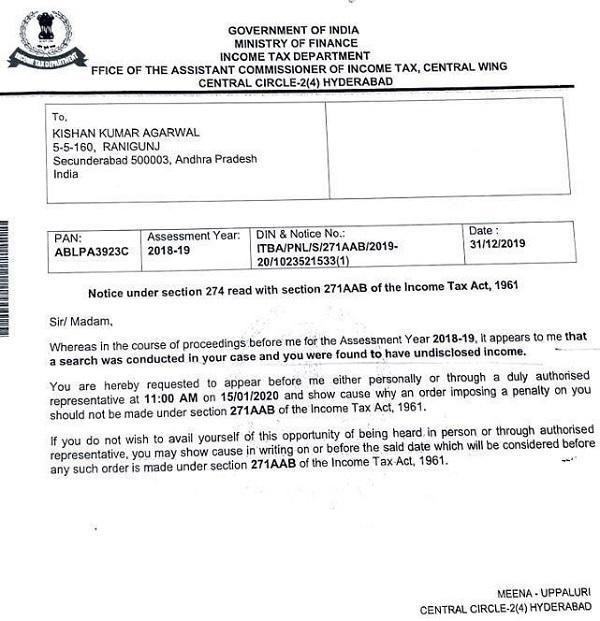
8. On perusal of the above, we find that the Ld. AO has not specified the particular limb or category under which penalty proceedings were proposed to be initiated against the assessee. We have also gone through the para nos. 5 to 5.4 of the decision of this Tribunal in the case of Kavya Boppana Vs. ACIT (supra) which is to the following effect:
“5. We have considered the rival submissions as well as relevant material on record. There is no dispute that during the course of search and seizure action the transactions of cash payments for purchase of property were detected which were also offered to tax by the assessee in the return of income against which the Assessing Officer has initiated the proceedings for levy of penalty u/sec.271AAB of the Act by issuing show cause notice dated 28.09.2021 which reads as under:
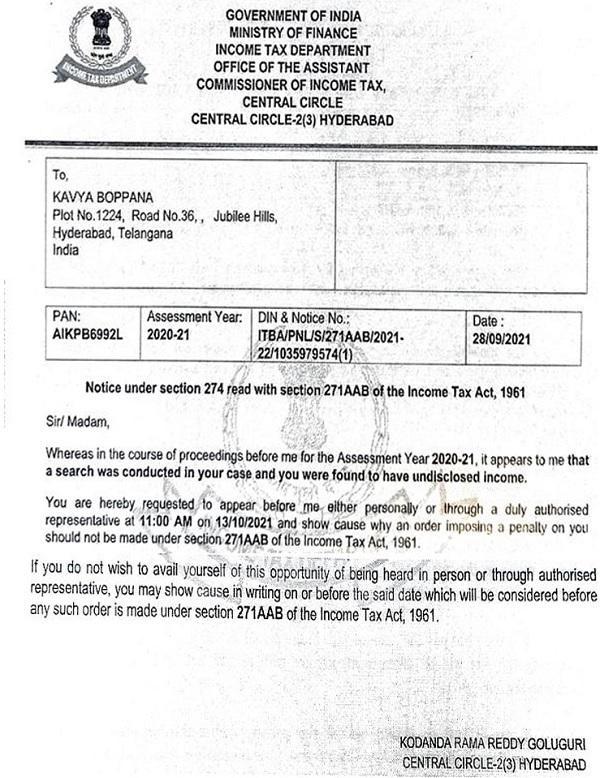
5.1. Thus, it is clear that the Assessing Officer has not specified under which clause of sec.271AAB(1) of the Act the penalty was proposed to be levied in respect of the income offered by the assessee to tax. Sec.271AAB(1A) clause (a) and (b) of the Act contemplates the penalty at 30% and 60% respectively, in respect of two contingencies attracting the penalty u/sec.271AAB of the Act. The Hon’ble Madras High Court in the case of Pr. CIT-1, Coimbatore vs. Shri R. Elangovan (supra), has considered an identical issue and held in Para nos.14 to 17 as under:
“14. In our considered view, the Tribunal is fully right in vacating the penalty on the ground that the notice defective. The provisions of the Act have clearly laid down the procedure to be followed and adhered to while imposing the penalty. The proposal for such penalty proceedings separately initiated upon completion of assessment and there may be cases where the assessee would not even contest the order of assessment. But, that would not preclude the assessee from challenging the penalty proceedings, as penalty proceedings are independent and the procedure required to be followed cannot be dispensed with.
15. As rightly pointed out by the learned counsel appearing for the assessee, Section 271AAB of the Act, which deals with penalty consists of three contingencies. Therefore, Assessing Officer should point out to the assessee as to under which of the three clauses, he chooses to proceed against the assessee so as to enable the assessee to give an effective reply. Since the same has not been mentioned, the assessee has been denied reasonable opportunity to put forth submissions. The Tribunal, in paragraph 5 of the impugned order, has verbatim reproduced the penalty notice and we find that the notice is absolutely vague and none of the irrelevant portions had been struck off nor the relevant portions had been marked or indicated. Hence, the Tribunal is right in observing that the penalty could not have been levied based on such defective notice and more particularly, when the assessee has been strenuously canvassing the jurisdictional issue from inception.
16. In so far as the decision of the Allahabad High Court in the case of Sandeep Chandak is concerned, the factual position is slightly different. This decision is for the principle that where the assessee, in the course of search, makes a statement, in which, he admits the undisclosed income and specifies the manner, in which, such Income has been derived, then the provisions of Section 271AAB of the Act would automatically get attracted. There can be no quarrel over this proposition. But, once the provisions get attracted, it is incumbent on the part of the Assessing officer to specify as to under which clause in Section 271AAB (1) of the Act, he intends to proceed against the assessee. In the instant case, in the absence of such material in the penalty notice, it has to be held that the notice is defective.
17. The decisions of the Karnataka High Court in the cases of Manjunatha Cotton and Ginning Factory and SSA’s Emerald Meadows and the decision of this Court in the case of Babuji Jacob clearly support our above conclusion. For all the above reasons, we find no grounds to interfere with the common order passed by the Tribunal.”
5.2. It is also pertinent to note that in the quantum appeal this Tribunal vide Order dated 27.06.2024 in ITA.No.696/Hyd./2022 has held in Para nos.24.6 to 24.9 as under:
“24.6. Heard both the parties, perused the material available on record and have gone through the orders of authorities below. There is no dispute with regard to the fact that loose sheets found during the course of search revealed cash payment for purchase of the property by the assessee. In fact, Shri Sarat Gopal Boppana, father of assessee has admitted in his statement that cash payment has been made by his children for purchase of property at Mamidipalli Village. It is also an admitted fact that the assessee has declared total income of Rs.3,02,23,230/ which includes sum Rs. 1,23,92,500/- income from other sources for A.Y. 2020-21. The due date for closure of books of accounts or filing of return of income for A.Y. 2020-21 was not due or expired as on the date of search i.e., 22.10.2019. Admittedly, the assessee is deriving income from house property and income from other sources and does not have income from business or profession. Therefore, the income declared by the assessee under the head income from other sources and assessed by the Assessing Officer as unexplained investment u/s 69A of the Act and taxing u/s 115BBE of the Act needs to be examined in light of the above facts. If the assessee is not carrying out any business or specified profession, then the assessee need not to maintain any books of accounts.
24.7. In the present case, the assessee is neither carrying out any business activity nor involved in any specified profession. Therefore, the arguments of the assessee that she needs not to maintain books of accounts for the impugned assessment year is acceptable. Once, the assessee needs not to maintain books of accounts, then the question of recording any investment in books of accounts for any assessment does not arise. Further, when the due date for filing of return of income was not offered or due, then it cannot be presumed that the assessee would not have disclosed the said income for the purpose of tax. Since the assessee is not required to maintain any books of accounts for the impugned assessment year and further, the due date of return of income was not expired as on the date of search, in our considered opinion, the explanation offered by the assessee regarding source for cash payment for the purchase of the property needs to be accepted. The assessee declared income to an extent of Rs.1,23,92,500/-, in respect of cash payment for purchase of property as income from other sources and paid taxes.
24.8. Therefore, in our considered opinion, the Assessing Officer and Ld.CIT(A) are erred in treating income declared under the head ‘income from other sources’ as unexplained investment u/s 69 and brought it to tax under Section 115BBE of the Act. Further, the provisions of Section 69 can be invoked whether in the financial year, immediately preceding the assessment year, the assessee has made investments, which are not recorded in the books of accounts, if any, maintained by her from any source of income, and the assessee offers no explanation about the nature and source of investment or the explanation offered by the assessee is satisfactory in the opinion of the Assessing Officer, then the value of the investment may be deemed to be the income of the assessee of such financial year.
24.9. In the present case, the conditions for invoking provisions of section 69 of the Act are not satisfied.
Therefore, we have to consider that the Assessing Officer and ld. CIT(A) are erred in invoking the provisions of section 69 r.w.s. 115BBE of the Act, in respect of income declared under the head ‘income from other sources’. Thus, we reverse the findings of the Ld.CIT(A) and direct the Assessing Officer to assess the income under the head income from other sources’ as declared by the assessee.”
5.3. Thus, the stand of the Assessing Officer in assessing the income offered by the assessee to tax u/sec.69A r.w.s.115BBE of the Act has been reversed by this Tribunal and considered the said income as taxable at normal rate of 30% under the Head “Income from other sources”. Therefore, once the Order of the Assessing Officer treating the income as unexplained investment u/sec.69A of the Act is reversed by this Tribunal, then, the Assessing Officer was required to specify the charges and default on the part of the assessee for levy of the penalty u/sec.271AAB of the Act. This issue of validity of show cause notice u/sec.274 r.w.s.271AAB of the Act was also considered by the Indore Bench of the Tribunal in the case of Shri Ashok Bhatia, Indore vs. DCIT, Central-1, Indore in ITA.No.869/Ind./2018 dated 05.02.2020 in Para no.15 as under:
“15. We, therefore respectfully following the judgment of jurisdictional High Court in the case of PCIT V/s Kulwant Singh Bhatia (supra), decision of Co- ordinate Bench of Chennai in the case of DCIT V/s R. Elangovan (supra) and Jaipur Bench in the case of Ravi Mathur Vs DCIT (supra) and in the given facts and circumstances of the case wherein the matter written in the body of the notice issued u/s 274 of the Act does not refer to the charges of provision of Section 271AAB of the Act makes the alleged notice defective and invalid and thus deserves to be quashed. Since the penalty proceedings itself has been quashed the impugned penalty of Rs.64,22,348/- stands deleted. Thus, assessee succeeds on legal ground challenging the validity of notice issued u/s 274 r.w.s. 271AAB of the Act.”
5.4. Accordingly, in the facts and circumstances of the case, when the Assessing Officer has not specified the charge and the category under which the penalty was proposed to be levied in the show cause notice, then, the said show cause notice suffers from irreparable infirmities and illegalities. Hence, the initiation of the penalty itself is invalid, then the ITA.No.1274/ Hyd/2025 Order for levy of penalty u/sec.271AAB of the Act also got vitiated. Accordingly, the penalty levied by the Assessing Officer u/sec.271AAB of the Act is not sustainable in law and the same is deleted.
9. On perusal of the above, we find that this Tribunal relying upon the judgment of the Hon’ble Madras High Court in the case of PCIT Vs. Shri R. Elangovan in Tax Case Appeal Nos.770 & 771 of 2018 and CMP No.18581 of 2018 dated 30.03.2021, held that where the Assessing Officer has failed to specify the charge and the category under which penalty is proposed to be levied, the notice suffers from infirmity and illegality. The Coordinate Bench further held that initiation of penalty proceedings itself becomes invalid and consequently the penalty levied pursuant thereto cannot survive. On comparison of the notice issued in the case before us with the notice considered by the Coordinate Bench in the case of Kavya Boppana Vs. ACIT (supra), we find that the defect is identical. In the present case also, the Ld. AO has not specified the particular limb under which penalty under section 271AAB of the Act was proposed to be levied. Respectfully following the decision of the Coordinate Bench in the case of Kavya Boppana Vs. ACIT (supra), which in turn follows the judgment of the Hon’ble Madras High Court in the case of PCIT Vs. Shri R. Elangovan (supra), we hold that the notice issued under section 274 read with section 271AAB of the Act dated 31.12.2019 is invalid in law. Consequently, the penalty order passed on the basis of such invalid notice is unsustainable and liable to be quashed. Accordingly, we direct the Ld. AO to delete the penalty of Rs.12,76,800/- levied under section 271AAB of the Act.”
36. A similar view has been taken by ITAT, Delhi Bench in the case of Jaina Marketing & Associates Vs. DCIT and also the decision of ITAT, Chennai Bench in the case of DCIT Vs. Ethirajulu Vajravel Kumaran reported in (2025) 180 taxmann.com 11.
37. In this view of the matter and considering the facts and circumstances of the case and also by following various case laws discussed hereinabove, we are of the considered view that, the order passed imposing penalty under Section 271AAB of the Act, is not sustainable under law. The Ld. CIT(A), without appreciating the relevant facts, simply confirmed the penalty levied by the A.O. Thus, we set aside the order of the Ld. CIT(A) and delete the penalty levied under Section 271AAB of the Act.
38. In the result, the appeal filed by the assessee in ITA No.878/Hyd/2026 for A.Y. 2020-21 is allowed.
39. To sum up, all the appeals of assessee are allowed.
Order pronounced in the Open Court on 30th September, 2026.