Kishan Kumar Agarwal Vs ACIT (ITAT Hyderabad)
Summary: ITAT Hyderabad allowed the assessee’s appeal and quashed penalty of Rs.12,76,800/- levied under Section 271AAB of the Income Tax Act, 1961 for AY 2018-19, holding that the notice issued under Section 274 read with Section 271AAB was invalid because the Assessing Officer failed to specify the particular limb or category under which penalty was proposed. Assessment under Section 143(3) had been completed on 26.12.2019, wherein penalty proceedings under Section 271AAB were initiated. The AO thereafter issued notice dated 31.12.2019 and ultimately passed the penalty order on 26.10.2021. The CIT(A) upheld the penalty. Before the Tribunal, the assessee specifically challenged the validity of the notice, contending that failure to identify the applicable limb deprived him of a reasonable opportunity to meet the precise charge.
The Tribunal examined the notice and found that the AO had not specified the particular limb or category under which penalty proceedings were proposed. It considered its Coordinate Bench decision in Kavya Boppana Vs. ACIT, which had examined an identical defect. That decision, relying upon the Madras High Court judgment in PCIT Vs. Shri R. Elangovan, held that Section 271AAB contemplates different contingencies carrying different rates of penalty and therefore the AO must inform the assessee of the specific clause under which penalty is proposed. A notice which does not identify the charge or category suffers from a foundational defect because the assessee is denied an effective opportunity to defend himself.
The Tribunal also reproduced the findings in Kavya Boppana concerning the underlying quantum proceedings, where income originally treated as unexplained investment under Section 69 read with Section 115BBE had ultimately been directed to be assessed under “Income from other sources”. It further referred to Shri Ashok Bhatia, Indore Vs DCIT, where a notice under Section 274 that failed to refer to the specific charge under Section 271AAB was held defective and invalid. The Coordinate Bench in Kavya Boppana had consequently held that failure to specify the charge and category in the show cause notice rendered initiation of penalty invalid and vitiated the consequential penalty order.
Applying that principle, ITAT Hyderabad found the defect in the assessee’s notice to be identical. The AO had failed to specify the particular limb under which penalty under Section 271AAB was proposed. Respectfully following Kavya Boppana Vs. ACIT, which itself followed the Madras High Court judgment in PCIT Vs. Shri R. Elangovan, the Tribunal held that the notice dated 31.12.2019 issued under Section 274 read with Section 271AAB was invalid in law. Consequently, the penalty order founded upon that notice was unsustainable. The AO was directed to delete the penalty of Rs.12,76,800/- and the assessee’s appeal was allowed.
Cases Discussed
- Kavya Boppana Vs ACIT, ITA No.1274/Hyd/2025, AY 2020-21, dated 25.03.2026 — Directly followed. The Coordinate Bench held that where the AO does not specify the charge and category under which Section 271AAB penalty is proposed, the show cause notice is defective and the penalty cannot survive.
- PCIT Vs Shri R. Elangovan, Tax Case Appeal Nos.770 and 771 of 2018 and CMP No.18581 of 2018, dated 30.03.2021 — Madras High Court judgment followed through Kavya Boppana. The Court held that the AO must identify the applicable clause of Section 271AAB in the notice to enable an effective response. This is distinct from the ITAT decision in DCIT Vs R. Elangovan linked below.
- ACIT Vs Sri Maheswary Granites Pvt. Ltd., ITA No.3054/Chny/2025, AY 2015-16, dated 20.02.2026 — Cited by the assessee for the proposition that failure to specify the applicable limb in a Section 274 notice invalidates the notice and the consequential penalty. The present Tribunal did not separately analyse this decision in its findings.
- Ashok Bhatia Vs DCIT, ITA No.869/Ind/2018, dated 05.02.2020 — Referred to in the quoted Kavya Boppana order. The Indore Bench held that a Section 274 notice which failed to identify the Section 271AAB charge was defective and invalid.
- PCIT Vs Kulwant Singh Bhatia — Referred to in the quoted passage from Ashok Bhatia concerning the validity of a penalty notice.
- DCIT Vs R. Elangovan (ITAT Chennai) — Referred to in the quoted passage from Ashok Bhatia concerning a vague notice under Section 274 read with Section 271AAB.
- Ravi Mathur Vs DCIT — Referred to in the quoted passage from Ashok Bhatia in support of quashing penalty based on a defective notice.
- CIT Vs Manjunatha Cotton and Ginning Factory, (2013) 359 ITR 565 (Kar.) — Cited by the Madras High Court in PCIT Vs Shri R. Elangovan as supporting its conclusion on defective penalty notices.
- CIT Vs SSA’s Emerald Meadows, (2016) 73 taxmann.com 241 (Kar.) — Cited by the Madras High Court in support of its conclusion on vague penalty notices.
- Babuji Jacob Vs ITO, (2021) 124 taxmann.com 363 (Mad.) — Madras High Court decision cited in PCIT Vs Shri R. Elangovan as supporting its conclusion on defective notices.
- PCIT Vs Sandeep Chandak, (2018) 93 taxmann.com 405 (All.) — Distinguished by the Madras High Court in PCIT Vs Shri R. Elangovan. Applicability of Section 271AAB does not remove the requirement to identify the particular clause proposed in the penalty notice.
FULL TEXT OF THE ORDER OF ITAT HYDERABAD
This appeal is filed by Shri Kishan Kumar Agarwal (“the assessee”), feeling aggrieved by the order passed by the Learned Commissioner of Income Tax (Appeals)-12, Hyderabad (“Ld. CIT(A)”) dated 23.09.2025 for the A.Y. 2018-19.
2. The assessee has raised the following grounds of appeal:
“1. The order of the Appellate Commissioner is contrary to law, facts and circumstances of the case.
2. The Appellate Commissioner erred in confirming the levy of penalty of Rs.12,76, 800/- u/s.271AAB(1A)(a) of the Income Tax Act.
3. The Appellate Commissioner erred in confirming the penalty levied u/s.271AAB, wherein the A.O has not
2 specified the limb under which the penalty is being levied.
4. Any other grounds which the assessee may urge either before or at the time during the hearing.”
3. The brief facts of the case are that in the case of the assessee, the assessment under section 143(3) of the Income Tax Act, 1961 (“the Act”) for Assessment Year 2018-19 was completed by the Learned Assessing Officer (“Ld. AO)” on 26.12.2019, wherein the Ld. AO initiated penalty proceedings under section 271AAB of the Act. Subsequently, the Ld. AO issued a notice under section 274 read with section 271AAB of the Act dated 31.12.2019. Thereafter, the Ld. AO passed a penalty order dated 26.10.2021 levying penalty of Rs.12,76,800/- under section 271AAB of the Act.
4. Aggrieved by the penalty order, the assessee preferred an appeal before the learned CIT(A). The learned CIT(A) upheld the penalty levied by the Ld. AO and dismissed the appeal of the assessee.
5. Aggrieved by the order of the Ld. CIT(A), the assessee is in appeal before the Tribunal. The Learned Authorized Representative (“Ld. AR”) submitted that under Ground No.3 of the appeal, the assessee has challenged the validity of the notice issued under section 274 read with section 271AAB of the Act dated 31.12.2019. Inviting our attention to the copy of the said notice, the Ld. AR submitted that the Ld. AO failed to specify the particular limb or category under which penalty under section 271AAB of the Act was proposed to be levied. According to the Ld. AR, in the absence of specifying the applicable limb, the assessee was deprived of a reasonable opportunity to meet the precise charge levelled against him. Therefore, the notice itself is invalid in law and any penalty 3 order passed pursuant to such invalid notice is liable to be quashed. In support of the aforesaid contention, the Ld. AR relied upon the order of this Tribunal in the case of Kavya Boppana Vs. ACIT in ITA No.1274/Hyd/2025 for Assessment Year 2020-21 dated 25.03.2026. Reliance was also placed on the decision of the Chennai Bench of the Tribunal in the case of ACIT Vs. Sri Maheswary Granites Pvt. Ltd. in ITA No.3054/Chny/2025 for Assessment Year 2015-16 dated 20.02.2026, wherein the Coordinate Bench, relying upon the judgment of the Hon’ble Madras High Court, held that non- specification of the applicable limb in the notice issued under section 274 of the Act renders the notice invalid and consequently the penalty levied pursuant thereto is unsustainable in law. Accordingly, it was prayed that the penalty levied by the Ld. AO be deleted.
6. Per contra, the Learned Departmental Representative (“Ld. DR”) relied upon the orders of the lower authorities and submitted that the penalty has been validly levied under section 271AAB of the Act. Therefore, no interference is called for in the order of the Ld. CIT(A).
7. We have heard the rival submissions and perused the material available on record including the case laws relied upon. The issue arising for our consideration is whether the penalty levied under section 271AAB of the Act can survive when the notice issued under section 274 read with section 271AAB of the Act does not specify the particular limb under which the penalty is proposed to be levied. We have carefully gone through the copy of the notice dated 31.12.2019 issued under section 274 read with section 271AAB of the Act, which is to the following effect:
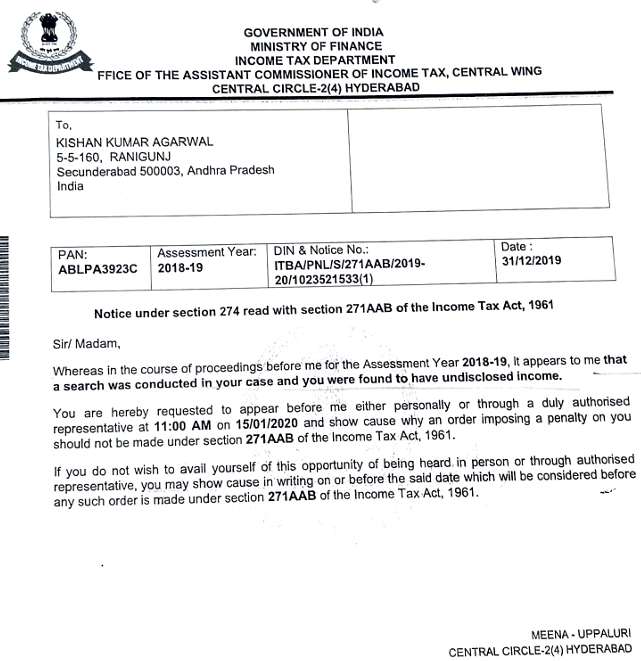
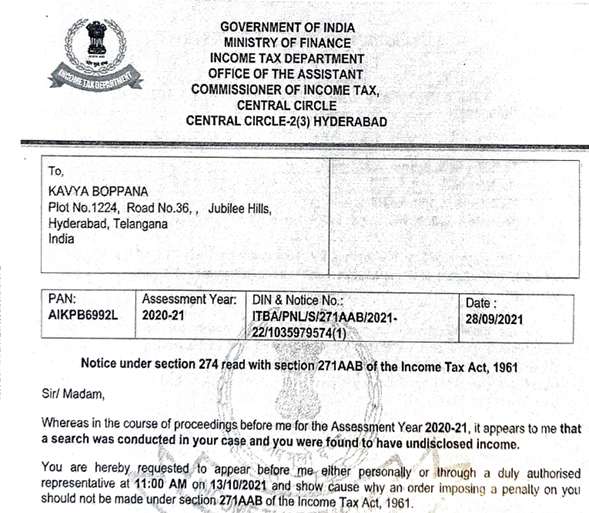
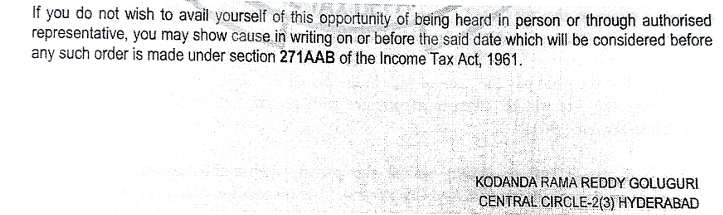
8. On perusal of the above, we find that the Ld. AO has not specified the particular limb or category under which penalty proceedings were proposed to be initiated against the assessee. We have also gone through the para nos. 5 to 5.4 of the decision of this Tribunal in the case of Kavya Boppana Vs. ACIT (supra) which is to the following effect: “5. We have considered the rival submissions as well as relevant material on record. There is no dispute that during the course of search and seizure action the transactions of cash payments for purchase of property were detected which were also offered to tax by the assessee in the return of income against which the Assessing Officer has initiated the proceedings for levy 5 of penalty u/sec.271AAB of the Act by issuing show cause notice dated 28.09.2021 which reads as under:
5.1. Thus, it is clear that the Assessing Officer has not specified under which clause of sec.271AAB(1) of the Act the penalty was proposed to be levied in respect of the income offered by the assessee to tax. Sec.271AAB(1A) clause (a) and (b) of the Act contemplates the penalty at 30% and 60% respectively, in respect of two contingencies attracting the penalty u/sec.271AAB of the Act. The Hon’ble Madras High Court in the case of Pr. CIT-1, Coimbatore vs. Shri R. Elangovan (supra), has considered an identical issue and held in Para nos.14 to 17 as under:
“14. In our considered view, the Tribunal is fully right in vacating the penalty on the ground that the notice defective. The provisions of the Act have clearly laid down the procedure to be followed and adhered to while imposing the penalty. The proposal for such penalty proceedings separately initiated upon completion of assessment and there may be cases where the assessee would not even contest the order of assessment. But, that would not preclude the assessee from challenging the penalty proceedings, as penalty proceedings are independent and the procedure required to be followed cannot be dispensed with.
15. As rightly pointed out by the learned counsel appearing for the assessee, Section 271AAB of the Act, which deals with penalty consists of three contingencies. Therefore, Assessing Officer should point out to the assessee as to under which of the three clauses, he chooses to proceed against the assessee so as to enable the assessee to give an effective reply. Since the same has not been mentioned, the assessee has been denied reasonable opportunity to put forth submissions. The Tribunal, in paragraph 5 of the impugned order, has verbatim reproduced the penalty notice and we find that the notice is absolutely vague and none of the irrelevant portions had been struck off nor the relevant portions had been marked or indicated. Hence, the Tribunal is right in observing that the penalty could not have been levied based on such defective notice and more particularly, when the assessee has been strenuously canvassing the jurisdictional issue from inception.
16. In so far as the decision of the Allahabad High Court in the case of Sandeep Chandak is concerned, the factual position is slightly different. This decision is for the principle that where the assessee, in the course of search, makes a statement, in which, he admits the undisclosed income and specifies the manner, in which, such Income has been derived, then the provisions of Section 271AAB of the Act would automatically get attracted. There can be no quarrel over this proposition. But, once the provisions get attracted, it is incumbent on the part of the Assessing officer to specify as to under which clause in Section 271AAB (1) of the Act, he intends to proceed against the assessee. In the instant case, in the absence of such material in the penalty notice, it has to be held that the notice is defective.
17. The decisions of the Karnataka High Court in the cases of Manjunatha Cotton and Ginning Factory and SSA’s Emerald Meadows and the decision of this Court in the case of Babuji Jacob clearly support our above conclusion. For all the above reasons, we find no grounds to interfere with the common order passed by the Tribunal.”
5.2. It is also pertinent to note that in the quantum appeal this Tribunal vide Order dated 27.06.2024 in ITA.No.696/Hyd./2022 has held in Para nos.24.6 to 24.9 as under:
“24.6. Heard both the parties, perused the material available on record and have gone through the orders of authorities below. There is no dispute with regard to the fact that loose sheets found during the course of search revealed cash payment for purchase of the property by the assessee. In fact, Shri Sarat Gopal Boppana, father of assessee has admitted in his statement that cash payment has been made by his children for purchase of property at Mamidipalli Village. It is also an admitted fact that the assessee has declared total income of Rs.3,02,23,230/ which includes sum Rs. 1,23,92,500/- income from other sources for A.Y. 2020-21. The due date for closure of books of accounts or filing of return of income for A.Y. 2020-21 was not due or expired as on the date of search i.e., 22.10.2019. Admittedly, the assessee is deriving income from house property and income from other sources and does not have income from business or profession. Therefore, the income declared by the assessee under the head income from other sources and assessed by the Assessing Officer as unexplained investment u/s 69A of the Act and taxing u/s 115BBE of the Act needs to be examined in light of the above facts. If the assessee is not carrying out any business or specified profession, then the assessee need not to maintain any books of accounts.
24.7. In the present case, the assessee is neither carrying out any business activity nor involved in any specified profession. Therefore, the arguments of the assessee that she needs not to maintain books of accounts for the impugned assessment year is acceptable. Once, the assessee needs not to maintain books of accounts, then the question of recording any investment in books of accounts for any assessment does not arise. Further, when the due date for filing of return of income was not offered or due, then it cannot be presumed that the assessee would not have disclosed the said income for the purpose of tax. Since the assessee is not required to maintain any books of accounts for the 8 impugned assessment year and further, the due date of return of income was not expired as on the date of search, in our considered opinion, the explanation offered by the assessee regarding source for cash payment for the purchase of the property needs to be accepted. The assessee declared income to an extent of Rs.1,23,92,500/-, in respect of cash payment for purchase of property as income from other sources and paid taxes.
24.8. Therefore, in our considered opinion, the Assessing Officer and Ld.CIT(A) are erred in treating income declared under the head ‘income from other sources’ as unexplained investment u/s 69 and brought it to tax under Section 115BBE of the Act. Further, the provisions of Section 69 can be invoked whether in the financial year, immediately preceding the assessment year, the assessee has made investments, which are not recorded in the books of accounts, if any, maintained by her from any source of income, and the assessee offers no explanation about the nature and source of investment or the explanation offered by the assessee is satisfactory in the opinion of the Assessing Officer, then the value of the investment may be deemed to be the income of the assessee of such financial year.
24.9. In the present case, the conditions for invoking provisions of section 69 of the Act are not satisfied. Therefore, we have to consider that the Assessing Officer and ld. CIT(A) are erred in invoking the provisions of section 69 r.w.s. 115BBE of the Act, in respect of income declared under the head ‘income from other sources’. Thus, we reverse the findings of the Ld.CIT(A) and direct the Assessing Officer to assess the income under the head income from other sources’ as declared by the assessee.”
5.3. Thus, the stand of the Assessing Officer in assessing the income offered by the assessee to tax u/sec.69A r.w.s.115BBE of the Act has been reversed by this Tribunal and considered the said income as taxable at normal rate of 30% under the Head “Income from other sources”. Therefore, once the Order of the Assessing Officer treating the income as unexplained investment u/sec.69A of the Act is reversed by this Tribunal, then, the Assessing Officer was required to specify the charges and default on the part of the assessee for levy of the penalty u/sec.271AAB of the Act. This issue of validity of show cause notice u/sec.274 r.w.s.271AAB of the Act was also considered by the Indore Bench of the Tribunal 9 in the case of Shri Ashok Bhatia, Indore vs. DCIT, Central-1, Indore in ITA.No.869/Ind./2018 dated 05.02.2020 in Para no.15 as under:
“15. We, therefore respectfully following the judgment of jurisdictional High Court in the case of PCIT V/s Kulwant Singh Bhatia (supra), decision of Co- ordinate Bench of Chennai in the case of DCIT V/s R. Elangovan (supra) and Jaipur Bench in the case of Ravi Mathur Vs DCIT (supra) and in the given facts and circumstances of the case wherein the matter written in the body of the notice issued u/s 274 of the Act does not refer to the charges of provision of Section 271AAB of the Act makes the alleged notice defective and invalid and thus deserves to be quashed. Since the penalty proceedings itself has been quashed the impugned penalty of Rs.64,22,348/- stands deleted. Thus, assessee succeeds on legal ground challenging the validity of notice issued u/s 274 r.w.s. 271AAB of the Act.”
5.4. Accordingly, in the facts and circumstances of the case, when the Assessing Officer has not specified the charge and the category under which the penalty was proposed to be levied in the show cause notice, then, the said show cause notice suffers from irreparable infirmities and illegalities. Hence, the initiation of the penalty itself is invalid, then the ITA.No.1274/ Hyd/2025 Order for levy of penalty u/sec.271AAB of the Act also got vitiated. Accordingly, the penalty levied by the Assessing Officer u/sec.271AAB of the Act is not sustainable in law and the same is deleted.
9. On perusal of the above, we find that this Tribunal relying upon the judgment of the Hon’ble Madras High Court in the case of PCIT Vs. Shri R. Elangovan in Tax Case Appeal Nos.770 & 771 of 2018 and CMP No.18581 of 2018 dated 30.03.2021, held that where the Assessing Officer has failed to specify the charge and the category under which penalty is proposed to be levied, the notice suffers from infirmity and illegality. The Coordinate Bench further held that initiation of penalty proceedings itself becomes invalid and consequently the penalty levied pursuant thereto cannot survive. On comparison of the notice issued in the case before us with the 10 notice considered by the Coordinate Bench in the case of Kavya Boppana Vs. ACIT (supra), we find that the defect is identical. In the present case also, the Ld. AO has not specified the particular limb under which penalty under section 271AAB of the Act was proposed to be levied. Respectfully following the decision of the Coordinate Bench in the case of Kavya Boppana Vs. ACIT (supra), which in turn follows the judgment of the Hon’ble Madras High Court in the case of PCIT Vs. Shri R. Elangovan (supra), we hold that the notice issued under section 274 read with section 271AAB of the Act dated 31.12.2019 is invalid in law. Consequently, the penalty order passed on the basis of such invalid notice is unsustainable and liable to be quashed. Accordingly, we direct the Ld. AO to delete the penalty of Rs.12,76,800/- levied under section 271AAB of the Act.
10. In the result, the appeal of the assessee is allowed.
Order pronounced in the Open Court on 17th June, 2026.