New T.C. & Sons Vs ITO (ITAT Chandigarh)
A Name in a Third-Party Server Is Not Proof of Hidden Purchases: ITAT Deletes ₹1.16 Crore Additions
Third-Party Data Required Independent Corroboration
The Chandigarh Bench of the Income Tax Appellate Tribunal deleted additions of ₹86.45 lakh for AY 2022-23 and ₹29.48 lakh for AY 2023-24, made by applying a gross profit rate of 15% to alleged unaccounted purchases.
The additions originated from a ledger extracted from a parallel SAP-based server found during a search at a third party’s premises. The Tribunal held that the Assessing Officer had failed to produce independent corroborative evidence connecting those entries with actual undisclosed purchases by the assessee.
The decisive principle was that third-party records cannot, by themselves, establish an assessee’s unaccounted transactions without a demonstrated nexus and supporting evidence.
The Search and the Parallel “JSK” Server
The assessee, a partnership firm engaged in trading hosiery items, filed its return for AY 2022-23 declaring income of ₹14,33,590. The return was selected for scrutiny under CASS.
Meanwhile, a search conducted on 28 May 2022 in the case of M/s JM Jain LLP, formerly M/s JM Jain, revealed what the Revenue described as parallel records maintained on a server commonly known among the group’s employees as “JSK” or “Jai Shri Krishna”.
According to the Assessing Officer, this SAP-based server recorded transactions between vendors and customers involving both cheque and cash components. The cheque components were allegedly reflected in the parties’ regular books, whereas the cash components remained unrecorded.
The Assessing Officer also referred to the group’s alleged generation of unaccounted commission and interest income. However, those findings concerning the searched party still required evidence connecting the particular entries to the assessee.
Ignoring Decimals Produced a ₹5.76 Crore Purchase Figure
The Assessing Officer extracted a ledger attributed to the assessee from the JSK server. On the premise that the figures had to be read without decimals, he interpreted the transactions as amounting to ₹576.35 lakh.
He treated this amount as purchases made outside the assessee’s books and applied a gross profit rate of 15%, resulting in an addition of ₹86.45 lakh.
The CIT(A) upheld the assessment. The assessee consequently approached the Tribunal.
A similar exercise for AY 2023-24 resulted in an addition of ₹29.48 lakh, again by estimating gross profit at 15% on alleged unaccounted purchases.
The Assessee Relied on Its Documented Transactions
The assessee argued that the additions were presumptive and unsupported by independent verification.
Its representatives submitted that no defects had been identified in the books and that the books had not been rejected under section 145(3). Purchases, sales, stock records and GST returns, including GSTR-1 and GSTR-3B, were stated to be fully documented and uncontroverted.
The assessee also referred to confirmation letters, bank statements showing supplier payments, invoices, e-way bills and consignment notes furnished in support of its transactions.
It further contended that third-party statements had not been confronted to it. The Revenue, on the other hand, supported the Assessing Officer’s findings.
These submissions challenged the attempt to replace the assessee’s documented transaction trail with an inference drawn from material maintained by another person.
The Assessing Officer Failed to Establish the Nexus
The Tribunal found that the Assessing Officer had relied on ledgers or Excel sheets recovered from third-party premises to conclude that the assessee had undertaken unaccounted cash purchases.
Such documents could not be treated as incriminating material against this assessee unless supported by cogent corroborative evidence.
The Tribunal expressly placed the onus on the Assessing Officer to establish the connection between the seized records and the assessee. That connection had not been established.
It also observed that the documents lacked sufficient details or descriptions and that their contents were inadequate to fasten liability on the assessee. Consequently, the alleged ledger entries did not establish actual undisclosed purchases.
Earlier Decision Followed; Both Additions Deleted
The Tribunal followed its decision in Kuldeep Rai v. DCIT, ITA No. 180/Chd/2026, dated 10 August 2026, involving an identical issue.
It also referred to other Tribunal decisions placed in the paper book, which had rejected additions founded solely on third-party seized material and statements without independent corroboration.
The addition for AY 2022-23 was deleted. Since the facts for AY 2023-24 were admittedly identical, the addition for that year was also deleted. Both appeals were partly allowed.
Author’s Comments
The judgment illustrates the distinction between discovering suspicious records and proving a taxable transaction in another person’s hands.
Evidence of parallel accounting by the searched party does not automatically prove unaccounted purchases by every person appearing in its database. The Revenue must establish the connection through reliable supporting material.
The central reason for deletion was absence of corroboration and nexus. The decision should therefore not be presented merely as a ruling that an addition fails whenever books have not been rejected under section 145(3).
Likewise, multiplying alleged transactions by a gross profit percentage cannot cure a missing factual foundation. An estimate can quantify an established transaction; it cannot establish the transaction itself.
Cases Discussed
- Kuldeep Rai Vs DCIT, ITA No. 180/Chd/2026, dated 10.08.2026 (ITAT Chandigarh)
FULL TEXT OF THE JUDGMENT/ORDER OF ITAT CHANDIGARH
1. Aforesaid two appeals have been filed by the assessee for Assessment Years (AY) 2022-23 and 2023-24 against separate orders of Ld. Commissioner of Income Tax (Appeals), NFAC [CIT(A)] dated 02.09.2025 and 04.09.2025 respectively. Since facts in both the appeals are similar, the appeals were heard together and are now being disposed of by this common order for the sake of convenience & brevity. For the purpose of adjudication, facts are being taken from ITA No.1621/CHD/2025 for AY 2022-23.
2. The assessee being partnership firm carried on trading of hosiery items. The assessee filed return of income on 30.09.2022 at Rs.14,33,590/- which was subjected to scrutiny under CASS. It transpired that pursuant to search & seizure operation on 28.05.2022 in the case of M/s JM Jain, LLP (erstwhile M/s JM Jain), clinching evidence of the unaccounted transactions were found which prima facie indicated that unaccounted transactions of JM Jain were maintained in the parallel server commonly known amongst the employee of the JM Jain group as “JSK”. The SAP-based JSK Server was used for recording transactions between vendors and customers containing cheque (accounted for in books of vendors and customers) and cash components (not accounted for in the books of vendors and customers). The server recorded unaccounted commission and interest income of JM Jain on such transactions. As per Ld. AO, the corroboration of the JSK server at multiple levels squarely establishes that the JM Jain group had been routinely engaged in generation of out-of-book commission and interest income. It was observed by Ld. AO that the parallel books of accounts of JM Jain [In the name of Jai Shri Krishna (JSK)] were being maintained in SAP business-one software, Upon examination of the data, Ld. AO was of the view that the JSK Server was used for keeping records of transactions between vendors and customers. The analysis of the parallel books (commonly referred to as “JSK Server”) revealed that the JSK Server housed transactions between thousands of vendors and customers from FYs 2020-21 onwards. It was concluded by Ld. AO that the said software recorded cheque and cash transactions. The cheque transactions were duly been accounted for in the regular books of accounts of vendors and customers while the cash component was un-recorded. The said parallel ledgers as found in the JSK server were to be read without decimals to get the actual value of transactions in the ledger.
3. The assessee’s ledger as found recorded therein was extracted as under: –
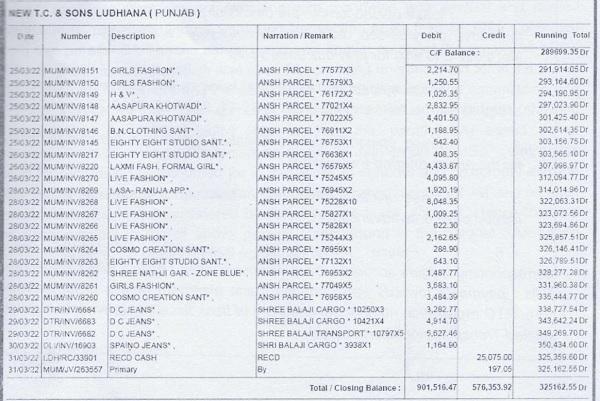
The Ld. AO deciphered assessee’s transactions as Rs.576.35 Lacs after ignoring the decimals and concluded that the assessee made out-of-book purchases for Rs.576.35 Lacs. On this, Ld. AO applied Gross Profit Rate of 15% to make addition of Rs.86.45 Lacs in the hands of the assessee. The Ld. CIT(A) confirmed the assessment against which the assessee is in further appeal before us.
4. Before us, Ld. AR contended that addition is purely presumptive in nature. Even no defects have been pointed out in the books of accounts and the books have not been rejected u/s 145(3). The purchase, sales, stock records and GST records (GSTR-1, GSTR-3B) are fully documented and remained uncontroverted. In the absence of any corroborative evidence or independent verification, such an addition could not be sustained in law, as mere suspicion cannot substitute proof of concrete evidecne. The Ld. AR also stated that the statements of third-parties were not confronted whereas the assessee furnished confirmation letters, bank account statement highlighting payment made to all the suppliers, invoice details, e-way bills, and consignment notes containing complete details. Reference has been made to various decisions of the Tribunal taking a view favoring the assessee on identical facts. The copies of the same have been placed on record. The Ld. Sr. DR has supported the findings of Ld. AO.
5. We have carefully heard rival submissions and perused the material on record. It is clear that Ld. AO has relied on the ledger / excel sheets found at third-party premises to hold that the assessee has carried out unaccounted cash purchases. However, these documents could not be treated as incriminating material for the assessee unless they are corroborated with cogent evidences. The onus was on Ld. AO to establish nexus between the ledger / excel sheet with the assessee which has not been done. We also find that no details or description are mentioned in the said documents and the contents thereof are inadequate to fasten the liability on the assessee.
6. As rightly pointed out by Ld. AR, similar issue on identical facts, stood adjudicated in assessee’s favor by this very bench in the case of Kuldeep Rai vs. DCIT (ITA No.180/Chd/2026 dated 10.08.2026). In that case, the bench has deleted similar addition as made by Ld. AO. Similar view has been expressed in various other decisions rendered by different benches of this Tribunal, the copies of which have been placed in the paper-book. The benches, after an exhaustive examination of the factual matrix and settled legal principles, have consistently held that additions founded solely upon third-party seized material and statements, in the absence of any independent corroborative evidence linking the respective assessee’s with the alleged unaccounted transactions, are legally unsustainable. In the present case, the addition towards alleged unaccounted purchases rests solely on a ledger extracted from the SAP-based JSK server during a search at a third-party’s premises. The Assessing Officer has failed to bring on record any corroborative evidence to connect these third-party entries to the assessee. It is a settled position that such third-party documents, without independent verification or supporting material, could not form the basis for drawing an adverse inference against the assessee. In the absence of any corroborative proof linking the contents of the ledger to actual undisclosed purchases by the assessee, the impugned addition is legally untenable. We order so. No other ground has been urged in the appeal. The appeal stand partly allowed.
7. The facts in AY 2023-24 are admittedly identical wherein Ld. AO has estimated GP rate of 15% on alleged unaccounted purchases to make addition of Rs.29.48 Lacs. Fact being pari-materia the same, taking the same view, we delete the impugned addition as made by Ld. AO.
8. Both the appeals stand partly allowed.
Order pronounced on 01.10.2026.