Harshali Lavishkumar Jain Vs ITO (ITAT Surat)
Reopening Saved, But the Clock Ran Out: ₹50 Lakh Assessment Quashed
A Saved Notice Still Has a Deadline
The Surat ITAT quashed a reassessment involving an addition of ₹50 lakh, holding that the fresh notice under section 148 dated 29 June 2022 had been issued beyond the permissible “surviving time”.
Following the Supreme Court’s decisions in Union of India v. Ashish Agarwal and Union of India v. Rajeev Bansal, along with jurisdictional precedent, the Tribunal held that preservation of an earlier reopening notice did not give the AO an unrestricted period to complete the subsequent statutory steps.
The assessee succeeded on this jurisdictional ground. The separate dispute concerning her declaration under the Income Declaration Scheme, 2016, and the alleged bank error affecting tax payment, remained undecided on merits.
IDS Declaration Became the Basis of the Addition
The assessee filed her return for AY 2017-18 on 7 November 2017, declaring income of ₹6,88,140.
The AO subsequently received information from PCIT-1, Surat, that she had declared ₹50 lakh under IDS, 2016 for AY 2012-13, but had not completed the process culminating in Form 4, the certificate of final acceptance.
Following the Supreme Court’s directions in Ashish Agarwal and the relevant CBDT instruction, the AO proceeded with reassessment. A fresh notice under section 148 was issued on 29 June 2022, followed by a notice under section 142(1).
The assessee submitted some documents but did not produce Form 4. A subsequent show-cause notice also remained unanswered. The AO therefore completed the assessment on 19 May 2023 under section 147 read with sections 144 and 144B, adding ₹50 lakh as unexplained income under the head “Income from other sources”.
The CIT(A) dismissed the assessee’s appeal. viewOrder-6-1
Bank Error Was Pleaded, But Limitation Became Decisive
In her grounds, the assessee contended that she had paid the required taxes on the IDS declaration. She attributed the delayed credit of an instalment of ₹5,62,500 to a technical error on the bank’s side and referred to a certificate issued by the bank acknowledging its fault.
She also maintained that the full tax of ₹22.50 lakh on the declared income of ₹50 lakh had been paid. viewOrder-6-1
Before the Tribunal, however, the decisive challenge concerned the limitation governing the fresh reopening notice. The Tribunal ultimately did not examine whether the bank-related explanation preserved the validity of the IDS declaration.
Ashish Agarwal Preserved Notices and Assessees’ Defences
The assessee’s representative explained that the original notice under section 148 had been issued on 30 June 2021, the last date of the extended period under TOLA.
In Ashish Agarwal, the Supreme Court treated old-regime notices issued between 1 April and 30 June 2021 as deemed show-cause notices under section 148A(b). The Revenue was required to supply the relevant information and material, allow the prescribed response opportunity and thereafter undertake the remaining statutory steps.
Crucially, the Supreme Court also preserved the assessees’ available defences, including limitation under section 149. Saving the original notices did not eliminate those defences. viewOrder-6-1
Rajeev Bansal Explained the Surviving Time
Relying on Union of India v. Rajeev Bansal (2024) 469 ITR 46 (SC), the assessee argued that the AO had to complete the remaining reopening procedure within the available surviving period, after accounting for the relevant exclusions.
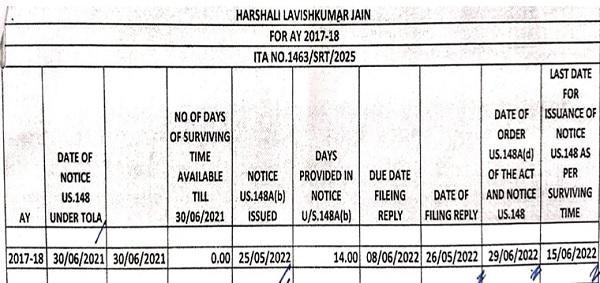
In this case, the section 148A(b) communication was issued on 25 May 2022. The assessee was allowed two weeks to respond, up to 8 June 2022, and submitted her reply on 26 May 2022.
The representative contended that, applying the seven-day period to the response deadline, the fresh notice could have been issued only up to 15 June 2022. The notice dated 29 June 2022 was therefore beyond limitation. viewOrder-6-1
The Revenue supported the assessment and alternatively sought remand for verification. The assessee opposed remand, pointing out that the notices and chronology were already available in the paper book.
Tribunal Followed Binding and Coordinate Bench Precedents
After condoning a 29-day delay in filing the Tribunal appeal, the Bench followed its earlier decision in Kanchan Devi Agarwal v. ITO, ITA Nos. 479 and 480/SRT/2025, dated 23 December 2025.
That decision applied Rajeev Bansal and the Gujarat High Court’s ruling in Dhanraj Govindram Kella [2025] 177 taxmann.com 194 (Guj) concerning notices issued beyond surviving time.
The Revenue could not distinguish the precedent. The Tribunal consequently held the notice dated 29 June 2022 time-barred and invalid, quashed the resulting assessment and allowed the appeal. The grounds concerning the merits of the addition were left open. viewOrder-6-1
Author’s Comments
The ruling highlights why a date-wise examination of transitional reopening proceedings can be decisive. The original notice, supply of information, response opportunity, reply, section 148A(d) order and fresh section 148 notice must be considered together.
Care is needed when reproducing the calculations: the coordinate Bench extract quoted in this order contains inconsistent deadline references. The present case’s chronology and operative finding should therefore remain distinct from those quoted dates.
The assessee obtained relief because the reopening notice was late. The order does not establish that a delayed IDS payment caused by bank error must necessarily be accepted.
The Supreme Court saved the earlier notice; it did not give the Revenue unlimited time to act on it.
Cases Discussed:
- Union of India Vs Ashish Agarwal (Supreme Court), 2022 SCC OnLine SC 543 — Followed for treatment of old-regime notices issued between 1 April 2021 and 30 June 2021 as deemed notices under section 148A(b), while preserving the available statutory defences.
- Union of India Vs Rajeev Bansal (2024) 469 ITR 46 (SC) — Followed for determining the “surviving time” available to the Revenue to complete the remaining reassessment procedure and issue the new-regime section 148 notice.
- Kanchan Devi Agarwal Vs ITO (ITAT Surat), ITA Nos. 479 & 480/SRT/2025, order dated 23.12.2025 — Followed. The coordinate Bench had applied the surviving-time principle to quash a consequential section 148 notice issued beyond limitation. viewOrder-6-1
- Dhanraj Govindram Kella Vs ITO [2025] 177 taxmann.com 194 (Gujarat) — Followed on computation of surviving time and invalidity of notices issued beyond that period.
FULL TEXT OF THE ORDER OF ITAT SURAT
The appeal filed by the assessee is against the order passed by the Commissioner of Income Tax (Appeals), National Faceless Appeal Centre (NFAC), Delhi [in short “CIT(A)”] dated 10.09.2025 for the Assessment Year (in short “AY”) 2017-18.
2. The assessee has raised the following grounds of appeal:
“1. On the facts and in the circumstances of the case as well as the law on the subject, the learned Assessing Officer has erred in reopening the assessment u/s 147 of the Act and notice u/s. 148 of the Act was issued.
2. On the facts and in the circumstances of the case as well as the law on the subject, the learned Commissioner of the Income Tax (Appeals) has erred in confirming the action of The Assessing Officer, the assessee has timely paid required taxes on declared income under IDS, 2016 and also submitted required forms. It is because of technical errors from the bank side that the tax of Rs.5,62,500/- which was deposited by assessee could not got credited in government account before due date. For this bank has issued a certificate to assessee mentioning their fault and because of that assessee has missed the deadline of 30.11.2016 as declared by IT department. Assessing officer has also in point 6.6 of assessment order agreed that the assessee has paid full tax of Rs.22,50,000/- for the income of Rs. 50,00,000/- as declared in IDS,2016, but only form-4 could not submitted due to technical error of bank. We are hereby aggrieved by the order of assessing.
3. On the facts and in the circumstances of the case as well as the law on the subject, the learned Commissioner of the Income Tax (Appeals) has not offered adequate opportunities to hear the case and passed ex-parte order and hence, the case may please be set aside and restored back to the CIT(A) or AO.
4. It is therefore prayed that the above addition may please be deleted us learned members of the tribunal may deem it proper.
5. Appellant craves leave to add, alter or delete any ground(s) either before or in the course of the hearing of the appeal.”
3. The assessee filed return of income on 07.11.2017 declaring income of Rs.6,88,140/- for A.Y. 2017-18. The Assessing Officer (in short “the AO”) received information from PCIT-1, Surat on 26.05.2021 indicating that the assessee had declared Rs.50,00,000/- under the Income Declaration Scheme (IDS), 2016 for A.Y. 2012-13 but failed complete the process by submitting Form-4, the certificate of final acceptance. As per CBDT Instruction No.01/2022 and in compliance with Hon’ble Supreme Court directions in case of Ashish Agarwal (2022 SCC online SC 543) dated 04.05.2022 the case was reopened u/s.147 of the Income Tax Act, 1961 (in short “the Act”) after obtaining necessary approvals from the appropriate authority. Notice u/s.148 was issued on 29.06.2022, followed by notice u/s. 142(1) on 20.01.2023. The assessee responded partially on 24.01.2023, submitting some document, but did not produce Form-4. A show cause notice was issued on 19.04.2023, but the assessee did not response. Consequently, the Assessing Officer (in short “the AO”) vide assessment order u/s. 147 r.w.s. 144 r.w.s. 144B dt.19.05.2023 made addition of Rs.50,00,000/- as unexplained under the income from other sources.
4. Being aggrieved by the assessment order the assessee filed appeal before the CIT(A). The CIT(A) dismissed the appeal of the assessee.
5. The Ld. Authorised Representative (in short “Ld. AR”) for the assessee submitted that the notice issued by the AO u/s.148 of the Act to frame assessment u/s. 147 is time-barred. Initial notice u/s.148 was issued on 30.06.2021, which was within the extended time limit as per TOLA. That, as per decision of Hon’ble Supreme Court in Ashish Agarwal (supra). all notices issued u/s 148 during the period from 01.04.2021 to 30.06.2021, were saved and deemed to be the notices in terms of section 148A(b) i.e. under the new/substituted regime of re-assessment u/s 147 w.e.f. 01.04.2021 through Finance Act, 2021. That, the Hon’ble Supreme Court, also issued direction that the assessing officer shall supply the information/material available with Revenue for framing assessment u/s 147 to assessee within 30 days from date of Judgement of Hon’ble Supreme Court (i.e. from 04.05.2022) and grant two weeks’ time to assessee to file reply. Only thereafter, the assessing officer shall pass order u/s 148A(d) and after completing such procedure of section 148A, may issue a fresh notice u/s 148. It was further held that all defences which may be available to the assesses including those available u/s 149 and all rights and contentions which may be available to the concerned assessees and Revenue under the Finance Act, 2021 and in law shall continue to be available.
6. Subsequently, in Union of India Vs. Rajeev Bansal (2024) 469 ITR 46 (SC) dated 03.10.2024, the Hon’ble Supreme Court further held that the order u/s 148A(d) was required to be passed as well as the new notice u/s 148 was required to be issued within the “surviving time” available as per outer time-limit available under Income-Tax Act, 1961 read with TOLA (i.e. available upto 30.06.2021). Ld. AR explained that since the original notice u/s 148 of the Act was issued on 30.06.2021, the AO did not have surviving period as it was issued on very last date. Therefore, new notice u/s.148 of the Act was required to be issued from the last date on which the assessee was required to file reply to notice u/s.148A(b) issued by the AO. In present case, the AO issued notice u/s.148A(b) to assessee on 25.05.2022, the assessee was having two weeks’ time to file reply uptill 08.06.2022. The assessee filled reply on 26.05.2022 which was considered & accepted by AO. Thereafter, the AO was having time period to issue notice u/s.148 uptill 15.06.2022 (08.06.2022 due date for filing reply +7 days). That means, the AO could have issue new/subsequent notice u/s.148 by 15.06.2022 only. However, the AO has issued new/subsequent notice u/s.148 dated 29.06.2022 which is barred by limitation and hence invalid. Consequently, the assessment order is void ab initio being time barred.
7. With these submissions, Ld. AR requested to quash the assessment framed by AO u/s 147.
8. Per contra, Ld. DR for revenue supported the action of Ld. AO and requested to uphold the AO’s order. Alternatively, he submitted that these matters may be remanded to Ld. AO for examination/verification of assessee’s claim.
9. In rejoinder, Ld. AR submitted that all notices issued by Ld. AO have been filed by him in Paper-Book. Further, he has also compiled the chart of chronology of events taking into account those notices as well as the law settled by Hon’ble Supreme Court in Ashish Agarwal (supra) and Rajeev Bansal (supra). Hence, there is no purpose in remanding this matter to AO. He requested the bench to decide this matter and quash the assessment-order passed by AO.
10. We have heard both the parties and perused all the relevant materials available on record. There is delay of 29 days in filing present appeal. The same is condoned. For reference, we re-produce the Chart giving chronology of events filed by Ld. AR:
11. We find that the identical controversy involving similar facts has already been decided by Co-ordinate Bench of ITAT, Surat in ITA 479 & 480/SRT/2025, Kanchan Devi Agarwal Vs. ITO, order dated 23.12.2025 wherein the Co-ordinate Bench has accepted assessee’s claim. We re-produce below the relevant portion of order of ITAT for an immediate reference:
“10. The contention of the assessee is that the Assessing Officer was required to pass order under Section 148A(d) of the Act and also issue notice under Section 148 of the Act within the surviving period of three days (which was extended to seven days) of filing its reply on 06.06.2022. Thus, the Assessing Officer had time limit till 14.06.2022 only to take these actions. However, the order under Section 148A(d) of the Act and the notice under Section 148 of the Act was issued on 25.07.2022 i.e. beyond the period of seven days from its reply on 06.06.2022 and thus the notice was barred by limitation.
11. The Hon’ble Supreme Court, in the case of Ashish Agarwal (supra), had directed that all the notices u/s 148 of the Act issued under the old provision shall be treated as show cause notice issued u/s 148A(b) of the Act of the new provisions. Further, the Hon’ble Court had directed the assessing officers to supply the assesses with the relevant material and information relied upon by the Revenue within thirty days from the date of the judgment. The effect of this direction was summarized by the Apex Court in the case of Rajeev Bansal [2024] 167 taxmann.com 70/301 Taxman 238/469 ITR 46 (SC) as under:
106. …..To summarize, the combined effect of the legal fiction and the directions issued by this Court in Ashish Agarwal (supra) is that the show cause notices that were deemed to have been issued during the period between 1 April 2021 and 30 June 2021 were stayed till the date of supply of the relevant information and material by the assessing officer to the assessee. After the supply of the relevant material and information to the assessee, time begins to run for the assesses to respond to the show cause notices. [Emphasis supplied.]
12. The Hon’ble Court had held that only the time surviving under the Income Tax Act read with TOLA will be available to the Revenue to complete the remaining proceedings in furtherance of such deemed notice, including issuance of notice u/s 148 of the new regime. The surviving or balance time limit was required to be calculated by computing the number of days between the date of issuance of deemed notice and 30th June, 2021. The reasoning and the relevant part of the judgement of the Court is as under:
110. The effect of the creation of the legal fiction in Ashish Agarwal (supra) was that it stopped the clock of limitation with effect from the date of issuance of Section 148 notices under the old regime [which is also the date of issuance of the deemed notices]. As discussed in the preceding segments of this judgment, the period from the date of the issuance of the deemed notices till the supply of relevant information and material by the assessing officers to the assesses in terms of the directions issued by this Court in Ashish Agarwal (supra) has to be excluded from the computation of the period of limitation. Moreover, the period of two weeks granted to the assesses to reply to the show cause notices must also be excluded in terms of the third proviso to Section 149.
111. The clock started ticking for the Revenue only after it received the response of the assesses to the show causes notices. After the receipt of the reply, the assessing officer had to perform the following responsibilities: (i) consider the reply of the assessee under Section 149A(c); (ii) take a decision under Section 149A(d) based on the available material and the reply of the assessee; and (iii) issue a notice under Section 148 if it was a fit case for reassessment. Once the clock started ticking, the assessing officer was required to complete these procedures within the surviving time limit. The surviving time limit, as prescribed under the Income Tax Act read with TOLA, was available to the assessing officers to issue the reassessment notices under Section 148 of the new regime.
112. Let us take the instance of a notice issued on 1 May 2021 under the old regime for a relevant assessment year. Because of the legal fiction, the deemed show cause notices will also come into effect from 1 May 2021. After accounting for all the exclusions, the assessing officer will have sixty-one days [days between 1 May 2021 and 30 June 2021] to issue a notice under Section 148 of the new regime. This time starts ticking for the assessing officer after receiving the response of the assessee. In this instance, if the assessee submits the response on 18 June 2022, the assessing officer will have sixty one days from 18 June 2022 to issue a reassessment notice under Section 148 of the new regime. Thus, in this illustration, the time limit for issuance of a notice under Section 148 of the new regime will end on 18 August 2022.
113. In Ashish Agarwal (supra), this Court allowed the assesses to avail all the defences, including the defence of expiry of the time limit specified under Section 149(1). In the instant appeals, the reassessment notices pertain to the assessment years 2013-2014, 2014-2015, 2015-2016, 2016-2017, and 2017-2018. To assume jurisdiction to issue notices under Section 148 with respect to the relevant assessment years, an assessing officer has to: (i) issue the notices within the period prescribed under Section 149(1) of the new regime read with TOLA; and (ii) obtain the previous approval of the authority specified under Section 151. A notice issued without complying with the preconditions is invalid as it affects the jurisdiction of the assessing officer. Therefore, the reassessment notices issued under Section 148 of the new regime, which are in pursuance of the deemed notices, ought to be issued within the time limit surviving under the Income Tax Act read with TOLA. A reassessment notice issued beyond the surviving time limit will be time-barred. [Emphasis supplied.]
13. The Hon’ble Supreme Court had thus categorically held that the assessing officers were required to issue the reassessment notice under Section 148 of the new regime within the time limit surviving under the Income Tax Act read with TOLA and that all notices issued beyond the surviving period were time barred and liable to be set aside. This time line was also demonstrated in para 112 of the order with an illustration. In the present case, the original notice u/s 148 of the Act was issued on 28.06.2021 which was treated as deemed notice u/s 148A(b) of the Act. Since this notice was issued on 28.06.2021, the surviving time period available to the Assessing Officer to complete the further proceedings, including the issue of notice u/s 148 of the Act, was three days only, which was extended to seven days. Accordingly, the Assessing Officer was required to pass the order a u/s 148A(d) of the Act and also to issue notice u/s 148 of the Act in this case within a period of seven days from the date of receipt of reply of the assessee. As the assessee had filed its reply on 06.06.2022, the time limit available to the Assessing Officer to issue the notice u/s 148 of the Act was till 08.07.2022 only. As the notice in the present case was issued on 25.07.2022, the same is found to be beyond the limitation period.
14. Identical issue was decided by the Hon’ble Gujarat High Court in the case of Dhanraj Govindram Kella [2025] 177 taxmann.com 194 (Gujarat). The findings given by the Hon’ble Court on this issue are reproduced below:
65. The alternative contention of the petitioner as to whether notices would be valid notice or invalid notice considering ‘surviving time’ between the date of the issuance of notices under TOLA and 30th June, 2021 or not is required to be considered and for that each matter has to be considered separately on the basis of the facts of case considering the date of issuance of notices under section 148 under TOLA by the Revenue and thereafter date of supplying information to the assessee and date of passing of order under section 148A(d) and date of issuance of notice under section 148 of the Act so as to consider whether issuance of notice under section 148 of the Act is within ‘surviving time’ as per the direction of Hon’ble Apex Court in case of Rajeev Bansal (supra) or not.
66. So far as Assessment Years 2013-2014 and 2014-2015 are concerned, the period of three years from the end of the assessment year would be over prior to 20.03.2020 and the period of six years would be over between 20.03.2020 and 30.06.2021. Therefore, the notices issued under section 148 of the Act under old regime between 01.04.2021 and 30.06.2021 as per TOLA, will be a valid notice if the notice under section 148 of the Act under new regime is issued within the period of ‘surviving time’ as per the directions issued by Hon’ble Apex Court in case of Rajeev Bansal (supra). For the Assessment Years 2016-2017 and 2017-2018 are concerned, the notice issued under section 148 of the Act under old regime between 01.04.2021 and 30.06.2021 under TOLA would be considered to be issued within three years from the end of the relevant assessment year as three years would complete within the period of 20.03.2020 and 30.06.2021.
67. Therefore, in facts of these petitions, following data is required to be considered to find out ‘surviving time’ to decide as to whether the impugned notices under section 148 of the Act issued under the new regime as per the decision of Hon’ble Apex Court in case of Ashish Agarwal (supra) would be valid notice or not in view of the decision of the Hon’ble Apex Court in case of Rajeev Bansal (supra):
| SCA NO | AY | Date of notice under section 148 under TOLA | No of days of surviving time available 30.06.2021 | Date of providing information under section 148A(b) |
|---|---|---|---|---|
| 6387/2023 | 2013-2014 | 17.06.2021 | 13 | 26.05.2022 |
| 5688/2023 | 2014-2015 | 09.06.2021 | 21 | 23.05.2022 |
| 22260/2022 | 2016-2017 | 30.06.2021 | / | 23.05.2022 |
| 996/2023 | 2017-2018 | 2017-2018 | / | 24.05.2022 |
| SCA NO | Due date of filing reply | Due date of reply:- | Date of order under section 148A(d) and notice under section 148:- | Last date for issuance of notice under section 148 as per surviving time:- |
| 6387/2023 | 09.06.2022 | 04.06.2022 | 29.07.2022 | 22.06.2022 |
| 5688/2023 | 06.06.2022 | – | 27.07.2022 | 27.06.2022 |
| 22260/2022 | 07.06.2022 | 06.07.2022 | 30.07.2022 | 14.06.2022 |
| 996/2023 | 11.06.2022 | 10.06.2022 | 19.07.2022 | 18.06.2022 |
68. It is apparent from the above details that impugned notice under section 148 of the Act is issued beyond the period of ‘surviving time’ as per the direction of Hon’ble Apex Court in case of Rajeev Bansal (supra)and therefore, such notices would be invalid notices.
69. The impugned notices issued under section 148 of the Act are accordingly quashed and set aside being invalid having been issued beyond the ‘surviving time’. Accordingly, impugned orders passed under section 148A(d) of the Act would also not survive and are accordingly, quashed and set aside. Subsequent proceedings, if any, undertaken by the respondent would not survive and are also quashed and set aside.
The Hon’ble Court held that since the notices under section 148 were issued beyond period of ‘surviving time’ as per direction of Supreme Court in Union of India v. Rajeev Bansal (supra), such notices were invalid.
15. In view of the facts discussed above and the judgement of the Hon’ble Supreme Court as well as the jurisdictional High Court, the impugned notice dated 25.07.2022 issued u/s 148 of the Act is held to be invalid as the same was issued beyond the surviving period as per the decision of Hon’ble Supreme Court in the case of Rajiv Bansal (supra). Accordingly, the proceeding initiated u/s 148 of the Act is quashed being time-barred. As a consequence, the impugned assessment order dated 25.04.2023 does not survive and the same is quashed and set aside. The legal ground taken by the assessee is allowed.
16. Since the legal ground taken by the assessee has been allowed, and the assessment order has been consequently quashed and set aside, other grounds on merits taken by the assessee has become infructuous. Accordingly, the appeal of the assessee is allowed.”
12. The analysis given and view taken by Co-ordinate Bench is very much applicable to present matter before us. The Revenue is not able to distinguish the same by placing any material. Respectfully following the view taken by Co-ordinate Bench and in the light of pre-existing decisions of Hon’ble Supreme Court and Hon’ble Jurisdictional High Court of Gujrat referred therein, we are inclined to hold that the impugned notice dated 29.06.2022 issued by Ld. AO u/s 148 is time-barred and therefore invalid. Consequently, the impugned assessment-order passed by Ld. AO u/s 147 does not survive and the same is hereby quashed. The legal ground raised by assessee is thus allowed.
13. As we have quashed the order of assessment itself, there is no necessity of adjudicating other ground dealing with the merit of the addition made by AO; the same is kept open undecided.
14. Resultantly, this appeal is allowed.
Order pronounced in the open court on 01.10.2026