ACIT Vs JKM Infra Projects Ltd (ITAT Delhi)
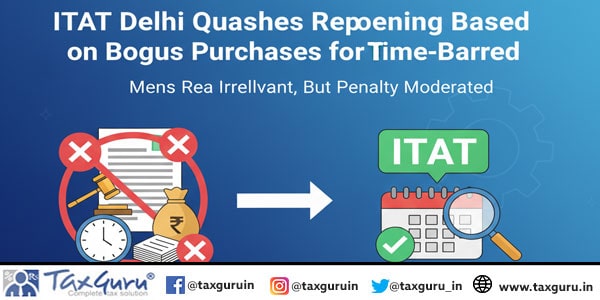
Delhi ITAT held that reopening of assessment after three years was invalid since escaped income was not represented in the form of an asset under Section 149(1)(b). The reassessment notice issued beyond limitation was quashed.
Facts:
- The assessee, M/s JKM Infra Projects Ltd., filed its return of income for Assessment Year (AY) 2013–14 on 30 September 2013, declaring a total income of Rs. 27,38,23,720/–.
- Based on information received through the Insight Portal from the Investigation Wing, Ghaziabad, the Assessing Officer (AO) believed that the assessee had made non-genuine purchases from a concern named Bansal Traders, amounting to Rs. 99,99,900/-
- The information indicated that Bansal Traders’ proprietor, Shri Dharmendra Kumar Bansal, was not traceable at the given address, and the firm had disclosed meagre income in its return, suggesting that it was not engaged in any genuine business activity.
- Relying on this information, the AO issued a notice under Section 148 on 23 April 2021 to reopen the assessment.
- The reassessment order was completed on 22 May 2023 under Sections 147/143(3), wherein the AO disallowed the entire purchases of Rs.99.99 lakh, treating them as accommodation entries.
- On appeal, the CIT(A) upheld the reopening but restricted the addition to Rs. 8,00,000/–, holding that only the profit element embedded in the disputed purchases could be taxed.
- The Revenue filed an appeal before the ITAT against the relief given by the CIT(A), and the assessee filed cross-objections challenging the validity of the reopening on legal grounds- particularly that the notice under Section 148 was barred by limitation under Section 149(1)(b).
Issues:
- Whether the notice issued under Section 148 on 23 April 2021 for AY 2013–14 was barred by limitation, in view of the amended Section 149(1)(b) effective from 1 April 2021.
- Whether the alleged escaped income (bogus purchases of Rs. 99.99 lakh) could be said to be “income represented in the form of an asset”, as required under the Explanation to Section 149(1)(b), for reopening beyond three years.
- Whether the reassessment proceedings initiated on the basis of the disallowance of expenditure were valid in law.
Observations:
- The ITAT noted that under the amended Section 149(1)(b) (effective from 1 April 2021), reassessment after three years from the end of the relevant assessment year is permissible only when:
-
- The AO has information indicating that income chargeable to tax exceeding Rs.50 lakh has escaped assessment, and
- Such income is represented in the form of an “asset.”
- The Explanation to Section 149(1)(b) defines “asset” to include immovable property, shares and securities, loans and advances, and deposits in bank accounts.
- In the present case, the AO reopened the assessment only to disallow purchases of Rs.99.99 lakh allegedly made from Bansal Traders. Such disallowance of expenditure cannot be treated as income represented in the form of an asset.
- The notice under Section 148 was issued on 23 April 2021, which is beyond three years from the end of AY 2013–14. Hence, the reopening could be valid only if the escaped income was represented in the form of an “asset,” which was not the case here.
- The ITAT observed that the AO had no evidence of any income represented in the form of an asset- only an allegation that certain purchases were bogus. Thus, the conditions for reopening beyond three years were not satisfied.
- The Tribunal relied upon two key judicial precedents:
1. Delhi High Court in Smart Chip Pvt. Ltd. v. ACIT [2025] 476 ITR 389 (Del), which held that reassessment beyond three years is permissible only when the escaped income is represented in the form of an asset.
2. Supreme Court in Union of India v. Rajeev Bansal [2024 SCC OnLine SC 2693], which clarified that the new ten-year limit under Section 149(1)(b) applies prospectively and cannot revive time-barred cases under the old regime.
Paid content
Become a Basic or Premium Member, or log in if you are already a Basic or Premium member.