In re Immense Construction Company (GST AAAR Telangana)
Summary: The Telangana Appellate Authority for Advance Ruling (AAAR) dismissed the appeal filed by Immense Construction Company and upheld the denial of GST exemption on services supplied to The Indian Hume Pipe Company Limited under a subcontract connected with the Government of Telangana’s Mission Bhagiratha drinking-water supply project. The principal contractor had undertaken operation and maintenance of water-supply infrastructure for the State Government, while the appellant was engaged under a separate subcontract. The appellant claimed exemption under Entries 3 and 3A of Notification No. 12/2017-Central Tax (Rate), contending that its activities constituted pure services or a composite supply involving goods not exceeding 25% of the total value, performed in relation to functions entrusted to municipalities and panchayats under Articles 243W and 243G of the Constitution. It relied on the government nature of the underlying project, an earlier service-tax circular and judicial decisions to support its claim.
The AAAR held that the subcontract constituted an independent supply whose immediate recipient was The Indian Hume Pipe Company Limited, a private company, rather than the State Government or another recipient specified in the exemption notification. The fact that the services were ultimately connected with a government drinking-water project did not satisfy the mandatory recipient condition. The work order also described the engagement of manpower and expressly provided for payment of GST. The Authority observed that even if the services were treated as pure services or a qualifying composite supply, exemption could not be granted without satisfying the prescribed recipient requirement. It distinguished the Supreme Court’s decision in State of Karnataka v. Taghar Vasudeva Ambrish, which concerned exemption for residential dwelling rentals and did not involve an equivalent recipient-specific condition. Referring to Commissioner of Customs (Import) v. Dilip Kumar and Company, the AAAR emphasised that exemption notifications must be interpreted strictly and their express conditions cannot be disregarded. Accordingly, the appeal was rejected, the original advance ruling was upheld, and the supply was held liable to GST at 18%, comprising 9% CGST and 9% SGST, subject to the applicable classification and rate notification.
Cases Discussed
- State of Andhra Pradesh v. Larsen and Toubro Ltd., (2008) 17 VST 1 (SC) — Supreme Court: Relied upon by the appellant concerning transfer of property in goods under subcontracts; the AAAR held that the earlier-regime decision could not override express GST exemption conditions.
- The State of Karnataka v. Taghar Vasudeva Ambrish, Civil Appeals Nos. 7846–7847 of 2023, decided on 4 December 2025 — Supreme Court: Relied upon by the appellant for purposive interpretation; distinguished by the AAAR because the residential-dwelling exemption did not involve the same recipient-specific condition as Entries 3 and 3A.
- Shailesh Dhairyawan v. Mohan Balkrishna Lulla, (2016) 3 SCC 619 — Supreme Court: Referred to within the quoted passage from Taghar Vasudeva Ambrish concerning purposive statutory interpretation; no separate application of this decision was made by the AAAR. The supplied quotation spells the names “Shailesh Dhanycnran” and “Mohan Balkrihna Lulla”.
- Commissioner of Customs (Import), Mumbai v. Dilip Kumar and Company and Ors., (2018) 9 SCC 1 — Supreme Court: Relied upon by the AAAR for the principle that exemption notifications must be interpreted strictly.
Also Read AAR Telangana Order in this case: GST exemption extended to a works contractor is not applicable for his procurement
FULL TEXT OF THE ORDER OF APPELLATE AUTHORITY FOR ADVANCE RULING, TELANGANA
In terms of Section 102 of the Telangana Goods and Services Tax Act, 2017 (TGST Act, 2017 or the Act), this Order may be amended by the Appellate Authority so as to rectify any error apparent on the face of the record, if such error is noticed by the Appellate Authority on its own accord, or is brought to its potica by the concerned officer, the jurisdictional officer or the applicant within a period of six months from the date of the order. Provided that no rectification which has the effect of enhancing the tax liability or reducing the amount of admissible input tax credit shall be made, unless the applicant or the appellant has been given an opportunity of being heard.
Under Section 103 (1) of the Act, this advance ruling pronounced by the Appellate Authority under Chapter XVII of the Act shall be binding only
(a) On the applicant who had sought it in respect of any matter referred to in sub- Section (2) of Section 97 for advance ruling;
(b) On the concerned officer or the jurisdictional officer in respect of the applicant.
Under Section 103 (2) of the Act, this advance ruling shall be binding unless the law, facts or circumstances supporting the original advance ruling have changed.
Under Section 104 (1) of the Act, where the Appellate Authority finds that advance ruling pronounced by it under sub-Section (1) of Section 101 has been obtained by the appellant by fraud or suppression of material facts or misrepresentation of facts, it may, by order, declare such ruling to be void ab initio and thereupon all the provisions of this Act or the rules made thereunder shall apply to the appellant as if such advance ruling has never been made.
Sub:- GST – Appeal filed by M/s immense construction company, Rangareddy, Telangana 500 048, under Section 100 (1) of TGST Act, 2017 against Advance Ruling TSAAR Order No.23/2023, dated 13.11.2023 passed by the Telangana State Authority for Advance Ruling – Order-in-Appeal – Regarding.
*****
BRIEF FACTS
a. The appellant, M/s immense construction company, Plot No, 105, sunrise Homes Colony, Upparapally, Rajender Nagar, Rangareddy, Telangana 500 048 (GST NO. [partly illegible]1112K1ZD) (hereinafter referred to as “the appellant”) is engaged in undertaking Contracts/ Sub-Contracts of the entire work for Operation and Maintenance of Water Supply Projects / Sewerage Projects/Facilities.
b. The Appellant was awarded a subcontract by M/s. The Indian Hume Pipe Company Ltd. (herein after referred to as “Principal Contractor”) vide Letter No. IHP-HIM/Balkonda: TDWSP/O&M/Amendment-1/2022-23 dated 23 May, 2022.
c. The Contract so awarded as mentioned above, is a sub-contract awarded by the Principal Contractor out of the Original Contract as received by them from State of Telangana, Mission Bhagiratha.
d. As per the Contract awarded by Mission Bhagiratha-the Principal Contractor shall undertake Operation and Maintenance Contract with the State Government of Telangana in respect of water pipe lines meant for providing drinking water to Balkonda, Armoor, Nizamabad, Kamareddy and part of Yellareddy Constituencies from SRSP reservoir, Nizamabad district including 1) CPWSS to Armoor & Other habitations 2) CPWS to Balkonda & other habitations 3) CPWS to Kamareddy & other habitations of SRSP Balkonda segment
e. The sub contract agreement as carved out of the Principal Contract clearly indicates scope of the work to be undertaken and obligations of such sub-contractor. Further, the conditions of sub-contract provides that sub-contract agreement is liable to termination if the work is not executed and maintained as per Guidelines of Mission Bhagiratha, as agreed by client viz State Government of Telangana.
f. In the Contract so executed by the Principal Contractor, total value of supply of Goods constitutes not more than 25% of the Sub- Contracted value (as can be verified from the Contract so awarded) and therefore exempted from payment of GST in terms of entry 3A in Notification No 12/2017 – Central Tax (Rate) as amended by Notification No. 2/2018 Central Tax (Rate) dated 25/01/2018; and
g. Further, the Sub Contract so executed between the Applicant and the Principal Contractor, is only for supply of Man Power – which is Pure Service and hence exempted from payment of GST in terms of Entry 3 in Notification No 12/2017 – Central Tax (Rate) as amended by Notification No. 2/2018 Central Tax (Rate) dated 25/01/2018.
2. The applicant filed an appeal before the lower authority seeking advance ruling on the following questions.
a. Whether the supply of Services by the Applicant to M/S. THE INDIAN HUME COMPANY LTD. is covered by Notification No. 12/2017- Central Tax (Rate), dated 28th November, 2017 as amended by Notification No 2/2018 – Central Tax (Rate) dated 25/01/2018;
b. If the supplies as per Question (a) are covered by Notification No. 12/2017 Central Tax (Rate), dated 28th November, 2017 as amended by Notification No 2/2018 Central Tax (Rate) dated 25/01/2018, then what is the applicable rate of Tax under the Goods and Services Tax Act, 2017 on such Supplies; and
c. In case if the supplies as per Question (a) are not covered by the Notification supra then what is the applicable rate of tax on such supplies under the Goods and Services Tax Act, 2017.
ADVANCE RULING
After due process of law, the lower authority, vide its order No. 23/2023, dt. 13.11.2023, has given the ruling as under:
| Question | Ruling |
|---|---|
| a. Whether the supply of Services by the Applicant to M/S. THE INDIAN HUME COMPANY LTD. is covered by Notification No. 12/2017- Central Tax (Rate), dated 28th November, 2017 as amended by Notification No 2/2018 – Central Tax (Rate) dated 25/01/2018; | No |
| b. If the supplies as per Question a are covered by Notification No. 12/2017 Central Tax (Rate), dated 28th November, 2017 as amended by Notification No 2/2018 Central Tax (Rate) dated 25/01/2018, then what is the applicable rate of Tax under the Goods and Services Tax Act, 2017 on such Supplies; and | Not applicable |
| c. In case if the supplies as per Question a are not covered by the Notification supra then what is the applicable rate of tax on such supplies under the Goods and Services Tax Act, 2017. | 9% CGST+ 9% SGST |
At the outset, this authority makes it clear that as per sub section 1 of section 100 of the CGST Act, 2017, read with similar provisions of the TSGST Act, 2017, an applicant aggrieved by any advance ruling pronounced under sub section (4) of section 98, may appeal to the Appellate Authority.
Aggrieved by the above ruling, the applicant filed the present appeal before this Appellate Authority requesting to set aside or modify the impugned advance ruling on the following grounds.
GROUNDS OF APPEAL
The Appellant submitted that the learned Advance Ruling Authority had failed to appreciate that the tax liability on services was required to be determined in accordance with Notification No. 12/2017-Central Tax (Rate) dated 28th June, 2017, as amended from time to time.
1. The Appellant submitted that, as per Serial No. 3 of Notification No. 12/2017-Central Tax (Rate) dated 28th June, 2017, “pure services (excluding works contract service or other composite supplies involving supply of any goods) provided to the Central Government, State Government or Union territory or local authority or a Governmental authority by way of any activity in relation to any function entrusted to a Panchayat under article 243G of the Constitution or in relation to any function entrusted to a Municipality under article 243W of the Constitution” were liable to tax at Nil rate.
2. The Appellant submitted that it squarely fell within the aforesaid provision.
3. The Appellant further submitted that Notification No. 12/2017-Central Tax (Rate) dated 28th June, 2017 had subsequently been amended by Notification No. 2/2018-Central Tax (Rate) dated 25th January, 2018, whereby Serial No. 3A was inserted. The said entry provided that a composite supply of goods and services in which the value of supply of goods constituted not more than 25 per cent of the value of the said composite supply, provided to the Central Government, State Government or Union territory or local authority or a Governmental authority or a Government Entity by way of any activity in relation to any function entrusted to a Panchayat under article 243G of the Constitution or in relation to any function entrusted to a Municipality under article 243W of the Constitution, was liable to tax at Nil rate.
4. The Appellant submitted that the principal contractor in the impugned transaction, namely M/s The Indian Hume Pipe Company Ltd., was covered by the aforesaid amendment and was therefore liable to tax at Nil rate.
5. The Appellant also placed reliance on Circular No. 147/16/2011-ST dated 21st October, 2011 issued under the erstwhile Service Tax regime. It was submitted that the said circular had clarified that, in similar situations, services provided by sub-contractors to the main contractors in relation to those very projects which were classifiable as infrastructure / works-contract services would also enjoy the benefit of exemption so long as they were in relation to the very same infrastructure projects.
6. The Appellant further drew support from the observations of the Hon’ble Supreme Court in State of Andhra Pradesh v. Larsen and Toubro Ltd., (2008) 17 VST 1 (SC). It was submitted that the Hon’ble Court had upheld the contention that the transfer of property in goods effected by the sub-contract resulted in adirect sale to the contractee and consequently did not involve multiple sales either in favour of the main contractor or in favour of the contractee.
In the course of hearing, the Appellant made the following additional submissions.
i. The Appellant submitted that it was annexing the detailed scope of work carried out by its personnel on site under the Operation and Maintenance Contract dated 15th April, 2022. It was contended that the said scope of work was not confined to supply of manpower alone. It was further submitted that, even assuming without admitting it is man power supply contract, even this qualifies as “pure service” and would be eligible for exemption under Entry no. 3 of the exemption notification.
ii. The Appellant also placed on record a copy of the judgment of the Hon’ble Supreme Court in The State of Karnataka v. Taghar Vasudeva Ambrish, decided on 4th December, 2025 in Civil Appeals Nos. 7846-7847 of 2023, and invited attention to the observations of the Hon’ble Court in paragraphs 49, 51-53 and 59-61 read as below:-
“49. In the present case, the third condition could also be said to be satisfied as the property was taken on rent onlylbr use as a residence. There is no further condition that the tenant or lessee must itself use it as a residence. Indeed M/s DTwelve Spaces Private Limited (lessee) is an aggregator who facilitates the use of residential dwelling for hostel accommodation. The third condition stood satisfied as M/s DTwelve Spaces Private Limited is the lessee and all the students/working women are none else but sub-lesseesit is well-settled that what is a lease between the owner of a property and a tenant becomes a sub-lease when it is entered into between the tenant and his sub-tenant.
51. We are not impressed by the submission canvassed on behalf of the revenue that since lessee did not use the hostel as a residence but rather sub-leased the same to students/working women, iuch transaction does not fall within Entry 13 of the Exemption Notification. At the cost of repetition, it is observed that Entry 13 of the Exemption Notification does not mandate that the lessee must use the residential dwelling as its own residence. Giving any other interpretation would mean adding an additional condition to Entry 13.
52. Mr. Datar is right in his submission that giving Entry 13 a narrow interpretation by holding that it is available only when the property so rented is used by service recipient themselves would ultimately lead to the legislative intent being defeated as the exemption is extended to cases wherein residential dwelling is rented out and ultimately used as residence even for the purpose of the person using it. In other words, the legislative intent behind this exemption clause is that a rented property that is used as residence should not suffer 18% GST or IGST.
53. In the case on hand, the ultimate use of the property as residence remains unchanged. However, if 18% GST is levied on this transaction between the respondent No. 1 and the lessee i.e. Plies DTwelve Spaces Private Limited, the same would ultimately be passed on to the students and working professionals which would lead to a situation where the legislative intent behind granting exemption for residential use is defeated
59. Of the aforesaid three components, namely, language, purpose and discretion of the Court’, insofar as purposive component is concerned, this is the ratio furls, the purpose at the core of the text. This purpose is the values, goals, interests, policies and aims that the text is designed to actualize. It is the function that the text is designed to fulfil
60. We may also emphasize that the statutory interpretation of a provision is never static but is always dynamic. Though literal rule of interpretation, till some time ago, was treated as the ‘golden rule’, it is now the doctrine of purposive interpretation’ which is predominant, particularly in those cases where literal interpretation may not serve the purpose or may lead to absurdity. If it brings about an end which is at variance with the purpose ofstatute, that cannot be countenanced. Not only legal process thinkers such as Hart and Sacks rejected intentionalism as a grand strategy for statutory interpretation, and in its place they offered purposivism, this principle is now widely applied by the Courts not only in this country but in many other legal systems as well. (See Shailesh Dhanycnran v. Mohan Balkrihna Lulla reported in (2016) 3 SCC 619)
61. Giving Entry 13 a narrow interpretation by holding that it is available only when the property so rented is used by service recipient themselves would ultimately lead to legislative intent being defeated as the exemption is extended to cases wherein residential dwelling is rented out and ultimately used as residence, irrespective of the person using it. The legislative intent behind this exemption clause is that a rented property, that is used as residence should not suffer 18% GST Or IGST. However, if Entry 13 is given such a narrow interpretation, then, exemption will not be available in cases where a lessee has sub- leased the property for use as residence”
iii. In view of the written and oral submissions, the Appellant contended that the supply of services rendered by it qualified for exemption under Serial Nos. 3 and 3A of Notification No. 12/2017-Central Tax (Rate), as amended, and that the said claim was supported by judicial rulings and departmental circulars issued from time to time. The Appellant accordingly prayed that the appeal be allowed and the impugned Advance Ruling be set aside.
PERSONAL HEARING:
A personal hearing in the matter was held on 04.08.2026. Shri Manish Goel, Chartered Accountant and Authorised Representative of the Appellant, appeared for the personal hearing. During the hearing, he submitted that M/s Immense Construction Company had provided pure services in the form of supply of manpower to the Principal Contractor, M/s The Indian Hume Pipe Company Ltd., who, in turn, was providing services to the Government of Telangana. He further requested time to submit additional written submissions along with relevant case laws on the issue. He also stated that he had no further submissions to make at that stage.
Subsequently, vide letter dated 05.08.2026, the Appellant furnished additional submissions along with the detailed scope of work performed by its personnel at the site under the Operation and Maintenance Contract dated 15.04.2022. In the additional submissions, the Appellant stated that the scope of work undertaken by it was not limited to mere supply of manpower. The Appellant further submitted that, even assuming, without admitting, that the contract was for supply of manpower, such supply would qualify as “pure services” and would be eligible for exemption under Entry 3 of the relevant exemption notification. The Appellant also furnished a copy of the judgment of the Hon’ble Supreme Court in The State of Karnataka v. Taghar Vasudeva Ambrish, decided on 04.12.2025 in Civil Appeals Nos. 7846 and 7847 of 2023, and relied upon the said judgment in support of its submissions.
DISCUSSIONS & FINDINGS :
1. We have carefully considered the grounds of appeal, the written submissions, the documents placed on record, the ruling of the Telangana State Authority for Advance Ruling, the oral submissions and written submissions made at the time of personal hearing and additional submissions made subsequently. The questions raised in the appeal are required to be examined with reference to the actual contractual arrangement and the conditions prescribed in the relevant exemption notification.
2. The first issue for determination is whether the services supplied by the appellant to M/s. The Indian Hume Pipe Company Limited (the Principal Contractor) are covered by SI. No. 3 of Notification No. 12/2017-Central Tax (Rate), dated 28.06.2017, as amended.
3. Sl. No. 3 of Notification No. 12/2017-Central Tax (Rate) exempts Pure services (excluding works contract service or other composite supplies involving supply of any goods) provided to the Central Government, State Government or Union territory or local authority or a Governmental authority [or a Government Entity] by way of any activity in relation to any function entrusted to a Panchayat under article 243G of the Constitution or in relation to any function entrusted to a Municipality under article 243W of the Constitution. Thus, the exemption is conditional and all the prescribed conditions have to be satisfied.
4. In the present case, it is not in dispute that the original work relating to operation and maintenance of the water supply project was awarded by the Government of Telangana/Mission Bhagiratha to M/s. The Indian Hume Pipe Company Limited. The appellant, in turn, has entered into a sub-contract with the Principal Contractor. Therefore, the immediate recipient of the services supplied by the appellant under the sub-contract is M/s. The Indian Hume Pipe Company Limited and not the State Government, Mission Bhagiratha or a local authority.
5. The expression used in SI. No. 3 is ‘provided to the Central Government, State Government or Union territory or local authority’. The exemption is therefore linked to the recipient of the supply. The fact that the ultimate project is a Government project or that the services are ultimately used for a function entrusted to a Municipality/Panchayat does not, by itself, change the identity of the recipient under the sub-contract.
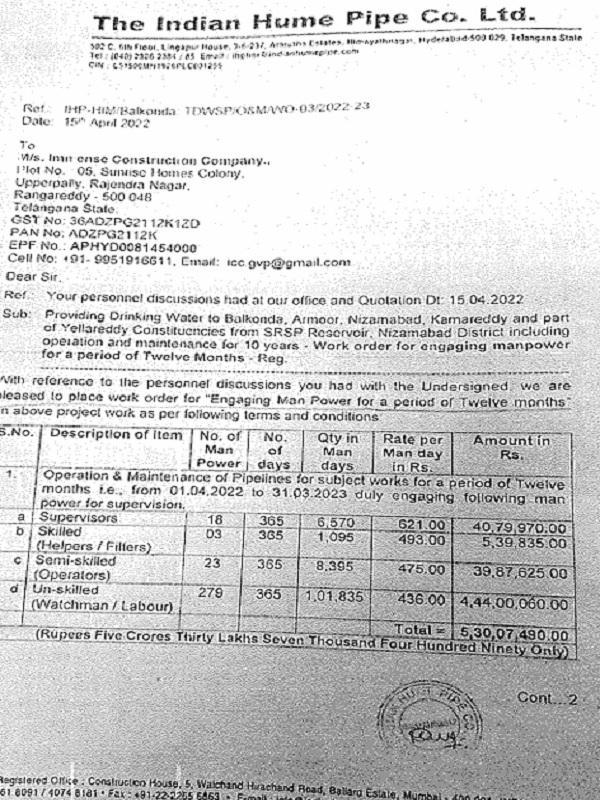
6. The contention of the appellant that the benefit of the exemption should be extended to the sub-contractor merely because the Principal Contractor is executing the Government contract cannot be accepted. Further it is seen that the Principal Contractor M/s The Indian Hume Pipe Co. Ltd, in work order Ref: HIM/Balkonda: TDWSP/O&M/W0-03/2022-23 dated 15th April 2022 have placed work order for “engaging Man Power for period of Twelve months”. The man power includes Supervisors, Skilled (Helpers/Fitters), Semi-skilled (Operators) and Un-skilled (Watchman/Labour). Rates were quoted for each category for man days. It is further seen from the Terms and Conditions of the work order that “The rates mentioned above are excluding GST i.e., CGST @9% & SGST @ 9%” and “Payment shall be released on monthly basis against certification by our Company Engineer and upon submission of GST invoice, payment proof of EPF & EST challans of respective month”. The copy of work order is placed here:
–
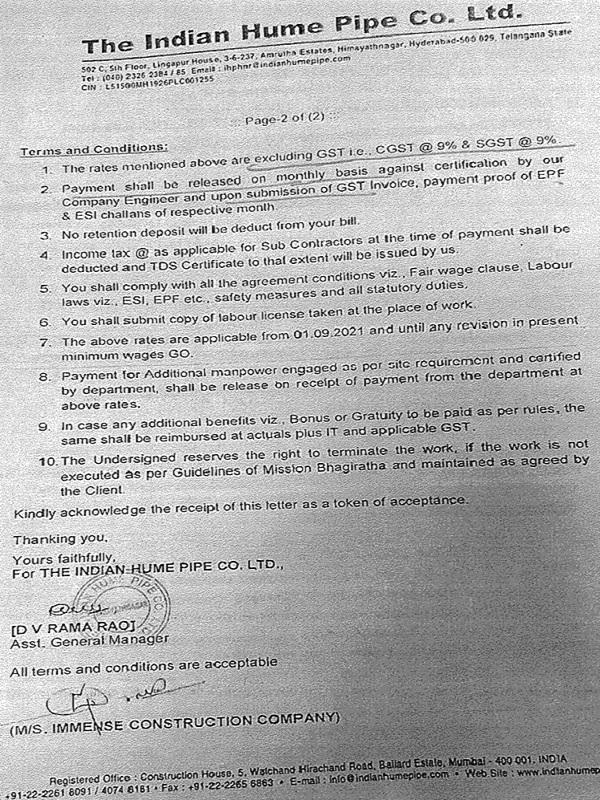
Thus, in the work order itself it is clear that the Appellant is only supplying man power to the principal Contractor M/s The Indian Hume Company Co Ltd., and it cannot be construed as supply to Govt bodies etc., in relation to the specified constitutional functions mentioned in the exemption notification. Further there is provision for GST payment made in the work order itself. It is also seen from clause 9 of the Terms and Conditions that there is provision for payment of applicable GST in case of additional benefits also. The supply made by the appellant under the sub-contract is a separate taxable supply under GST and its taxability has to be examined with reference to the contract between the appellant and the Principal Contractor. The Principal Contractor, M/s The Indian Hume Company Co Ltd., being a private company, does not fall within the specified class of recipients in SI. No. 3 of Notification No. 12/2017-Central Tax (Rate).
7. The appellant has also relied upon SI. No. 3A of Notification No. 12/2017-Central Tax (Rate), inserted by Notification No. 2/2018-Central Tax (Rate), contending that the value of goods is not more than 25 per cent of the total value of the supply. SI. No. 3A, however, likewise requires the composite supply to be provided to the Central Government, State Government, Union territory, local authority, Governmental Authority or Government Entity in relation to the specified constitutional functions. Since the appellant’s supply is to the Principal Contractor and not to any of the specified recipients, the basic recipient condition is not satisfied. Consequently, the appellant cannot claim exemption under SI. No. 3A also.
8. The appellant has relied upon Circular No. 147/16/2011-Service Tax, issued under the erstwhile Service Tax regime, and the decision in State of Andhra Pradesh vs. Larsen & Toubro, which pertain to the earlier indirect tax regime and/or issues concerning transfer of property in goods. They cannot override the express conditions of the exemption notification under the GST law. The entitlement to an exemption under GST has to be determined with reference to the statutory provision and the notification applicable to the supply in question.
9. The subsequent reliance placed by the appellant on the judgment of the Hon’ble Supreme Court in The State of Karnataka v. Taghar Vasudeva Ambrish does not advance the appellant’s case. The said decision concerned interpretation of a specific exemption relating to residential dwelling. The issue before us is materially different, namely, whether the appellant’s sub-contract supply satisfies the recipient condition contained in SI. Nos. 3 and 3A of Notification No. 12/2017-Central Tax (Rate). The said judgment therefore does not dispense with the express conditions of the GST exemption notification.
10. The appellant has also placed reliance on the judgment of the Hon’ble Supreme Court in The State of Karnataka & Anr. v. Taghar Vasudeva Ambrish & Anr. However, the said judgment is distinguishable for the reason that the issue before the Hon’ble Supreme Court in that case was whether the exemption under Entry 12 of Notification No. 12/2017-Central Tax (Rate), relating to services by way of renting of a residential dwelling for use as a residence, was applicable, and the dispute primarily concerned the scope and interpretation of the expression “use as a residence”. The facts of that case are materially different from the issue involved in the present appeal. In the present case, the question is whether the services supplied by the appellant as a sub-contractor satisfy the specific conditions prescribed under SI. Nos. 3 and 3A of Notification No. 12/2017-Central Tax (Rate), particularly the condition relating to the category of the recipient of the service. Entry 3/3A of the said Notification expressly restricts the exemption to specified services supplied to specified recipients, such as the Central Government, State Government, etc. Therefore, the identity and status of the recipient of the service constitute an essential condition for availing the exemption.
In contrast, the exemption entry considered by the Hon’ble Supreme Court in Taghar Vasudeva Ambrish did not involve a similar recipient-specific condition for determining eligibility to the exemption. The judgment was concerned with the interpretation of the expression “use as a residence” by any entity without any distinguished categories of Service receiver/Service provider. Accordingly, the ratio of the said judgment cannot be applied to dispense with or override the specific conditions expressly prescribed under SI. Nos. 3 and 3A of Notification No. 12/2017-Central Tax (Rate). The appellant is required to independently establish that the supply made by it satisfies all the conditions stipulated in the relevant exemption entry, including the prescribed recipient condition.
In this context, attention is drawn to the Judgement of Hon’ble Supreme Court in the case of Commissioner of Customs (Import), Mumbai Vs. Dilip Kumar and Company and Ors. [(2018) 9 SCC 1] wherein it was held that “Exemption notification should be interpreted strictly”.
Further, the well settled principle is that when the words in a statute are clear, plain and unambiguous and only one meaning can be inferred, the said meaning has to be given effect to irrespective of consequences. If the words in the statute are plain and unambiguous, it becomes necessary to expound those words in their natural and ordinary sense. The criteria defining the category of service recipients eligible for the exemption are clear and unambiguous in entries 3/3A of Notification number : 12/2017.
11.We also find that the description of the appellant’s activity as ‘pure services’ or ‘manpower supply’ does not, by itself, confer exemption. Even assuming, without deciding, that the appellant’s supply is a pure service and is in relation to a function covered by Article 243W/243G, the recipient condition in SI. No. 3 remains unsatisfied. Likewise, even if the supply is treated as a composite supply in which the value of goods does not exceed 25 per cent, the recipient condition in SI. No. 3A is not satisfied.
12. Accordingly, the services supplied by the appellant to M/s. The Indian Hume Pipe Company Limited under the sub-contract are not exempt under SI. No. 3 or Sl. No. 3A of Notification No. 12/2017-Central Tax (Rate), dated 28.06.2017, as amended.
13. We therefore find no reason to interfere with the conclusion of the lower authority that the appellant’s supply is not covered by the exemption claimed under Notification No. 12/2017-Central Tax (Rate). The appeal is liable to be rejected and the ruling of the lower authority is upheld.
In view of the above discussions and findings we pass the following order
ORDER
1. The services supplied by the appellant to M/s. The Indian Hume Pipe Company Limited are not covered by the exemption under Notification No. 12/2017-Central Tax (Rate), there is no merit in the appeal filed by the appellant and thus the ruling of the lower authority is upheld.
2. The services supplied by the appellant to M/s. The Indian Hume Pipe Company Limited are not covered by SI. No. 3 or 3A of Notification No. 12/2017-Central Tax (Rate), dated 28.06.2017, as amended.
3. The supply is liable to GST at 18%, i.e. CGST @ 9% and SGST @ 9%, subject to the applicable classification and rate notification.
(This order is issued in terms of Section 101 of the CGST Act, 2017 read with the corresponding provisions of the TGST Act, 2017 and shall be binding in terms of Section 103 of the said Acts, subject to the provisions of law.)