Sh. Nagendra Kumar Biyani Vs Indiabulls Real Estate Ltd. (NAA)
The Respondent has contended that Section 171 of the CGST Act and Rule 126 of the CGST Rules are violative of Article 14 and Article 19 of the Constitution of India. In this connection, this Authority holds that the Authority has not acted in any way as price controller or regulator as it doesn’t have the mandate to regulate the same. The Respondent is absolutely free to exercise his right to practice any profession, or to carry on any occupation, trade or business, as per the provisions of Article 14 and 19 (1) (g) of the Constitution. He can also fix his prices and profit margins in respect of the supplies made by him Under Section 171 this Authority has only been mandated to ensure that both the benefits of tax reduction and ITC which are the sacrifices of precious tax revenue made from the kitty of the Central and the State Governments are passed on to the end consumers who bear the burden of tax. The intent of this provision is the welfare of the consumers who are voiceless. unorganised and vulnerable. This Authority is charged with the responsibility of ensuring that the both the above benefits are passed on to the general public as per the provisions of Section 171 read with Rule 127 and 133 of the CGST Rules, 2017. The anti-profiteering related Rules and Section 171 of the Act have express approval of the Parliament, all the State Legislatures, the Central and all the State Governments and the GST Council and therefore, Section 171 and the Rules are constitutional and are not violative of Article 14 and 19 (1) (g) of the Constitution. This Authority has nowhere interfered with the business decisions of the Respondent and therefore. there is no violation of Article 14 and 19 (1) (g) of the Constitution
The Respondent has also cited the judgement of the Hontle Supreme Court passed in case of Commissioner, Central Excise & Customs, Kerala vs. Larsen & Toubro Limited 2016 (1) SCC 170, CIT vs. B.C. Srinivasa Setty 1981 (2) SCC 460, K. Damodarswamy Naidu & Bros and others vs. State of T.N. 2000 (1) SCC 521 and Govind Saran Ganga Saran vs. CST 2985 (Supp.) SCC 205 and stated that in the absence of a machinery provision for assessment of tax, the levy itself failed and is liable to be struck down as unconstitutional. On this aspect it is to be noted that no tax has been imposed under the above measures and hence the law settled in the above cases is not applicable. However, it would be relevant to mention here that Section 171 (2) of the CGST Act, 2017 and Rule 122, 123, 129 and 136 of the CGST Rules, 2017 have provided an elaborate machinery in the form of this Authority, the Standing and Screening Committees, the DGAP and a large number of field officers of the Central and the State Taxes to implement the anti-profiteering provisions. Therefore, the Respondent cannot allege that no machinery has been provided to implement the above measures.
The Respondent has submitted that Rule 126 of the CGST Rules is in violation of Section 171 itself In this regard, the Authority finds that, as per Rule 126 of the CGST Rules, the Authority has been empowered to determine the methodology and procedure for determination as to whether the reduction in the rate of tax or the benefit of input tax credit has been passed on by the registered person to the recipients by way of commensurate reduction in prices or not Rule 126 of the CGST Rules is reproduced below for ready reference: –
“126. The authority may determine the methodology and procedure for determination as to whether the reduction in the rate of tax on supply of goods or services or the benefit of input tax credit has been passed on by the registered poison to the recipient by way of commensurate reduction in price.”
Rule 126 of the CGST Rules nowhere stipulates that the Authority must prescribe methodology and procedure to quantify the amount of profiteering. However, the Methodology & Procedure for passing on both the above benefits and for computation of the profiteered amount has been duly prescribed under Section 171 itself and hence, it is not required to be prescribed separately It is also submitted that no uniform methodology can be prescribed for determination of the quantum of benefit. The extent of profiteering has to be arrived at on a case to case basis_ by adopting suitable method based on the nature and facts of each case. Rule 126 of CGST rules uses the word ‘determine’ and not the word ‘prescribe’ which means the Authority is endowed with the power to determine the methodology to oversee transfer of benefit of reduction in tax rate and benefit of Input Tax Credit to the Recipients. It is noteworthy that the Authority in exercise of the powers conferred under Rule 126 of the CGST Rules. 2017 has notified the methodology and procedure for determination as to whether the reduction in the rate of tax on supply of goods or services or the benefit of input tax credit has been passed on by the registered person to the recipient by way of commensurate reduction in prices. Under the provisions of Section 171 of the Act. ibid, this Authority has only been authorized to ensure that the benefit of tax reduction which is nothing but sacrifice of tax revenue made by the Government is passed on to the consumers who actually bear the impact of the tax and not pocketed by the Respondent The intent of this provision is the welfare of the consumers who are voiceless. unorganized ‘1/and vulnerable. This Authority is charged with the responsibility of ensuring that the benefit is passed on to consumers in line with the provisions of Section 171 read with Rule 127 and 133 of the CGST Rules, 2017 This Authority has in no manner interfered with the business choices made by the Respondent Hence the judgment of the Hon’ ble Supreme Court passed in the case of Indraprastha Gas Ltd. vs. Petroleum and Natural Gas Regulatory Board & Ors. 2015 (9) SCC 209 relied upon by the Respondent is of no help to him. Hence, the contention of the Respondent is not correct and can not be accepted.
FULL TEXT OF ORDER OF NATIONAL ANTI-PROFITEERING AUTHORITY
1. The present Report dated 26.06.2020 has been received from the Applicant No. 2 i.e. the Director General of Anti-Profiteering (DGAP) after detailed investigation under Rule 129(6) of the Central Goods & Service Tax (CGST) Rules. 2017. The brief facts of the present case are that an application was filed before the Standing Committee on Anti-profiteering, under Rule 128 of the CGST Rules, 2017 by the Applicant No. 1 alleging profiteering in respect of construction service supplied by the Respondent. The Applicant No. 1 had alleged that the Respondent had not passed on the benefit of input tax credit (ITC) to him by way of commensurate reduction in the price of the Flat No. C-402 purchased from the Respondent in the Respondent’s project “Sierra-Vizag’, situated at Vizag on introduction of GST w.e.f 01 07 2017. in terms of Section 171 of the CGST Act, 2017.
2. The DGAP in his Report dated 28.02.2020, inter-alia stated that-
i. The aforesaid application was examined by the Standing Committee on Anti-profiteering, in its meeting held on 05.07 2019, the minutes of which were received by the DGAP on 05.08.2019, whereby it was decided to forward the same to the DGAP to conduct a detailed investigation in the matter. Accordingly, investigation was initiated to collect evidence necessary to determine whether the benefit of input tax credit had been passed on by the Respondent to the Applicant No. 1 in respect of construction service supplied by the Respondent
ii On receipt of the reference from the Standing Committee on Anti-profiteering, a notice under Rule 129 of the Rules was issued by the DGAP on 14.08.2019, calling upon the Respondent to reply as to whether he admitted that the benefit of input tax credit had not been passed on to the Applicant No. 1 by way of commensurate reduction in price and if so, to suo moto determine the quantum thereof and indicated the same in his reply to the notice as well as furnish all supporting documents Vide the said notice, the Respondent was also given an opportunity to inspect the non-confidential evidences/information furnished by the Applicant No 1 during the period 19.08.2019 to 20.08 2019. However the Respondent did not avail of this opportunity. Vide e-mail dated 03.06 2020, the Applicant No. 1 was also afforded an opportunity to inspect the non-confidential documents/reply furnished by the Respondent on 08.06 2020 or 09.06.2020. However, the Applicant No. 1 did not avail of the said opportunity.
iii. The period covered by the current investigation was from 01.07.2017 to 31.03.2019.
iv. The time limit to complete the investigation was extended upto 04.05.2020 by this Authority, vide order dated 30.01.2020, in terms of Rule 129(6) of the Rules. However, in terms of Notification No. 35/2020-Central Tax dated 03.04 2020, it was provided that “where, any time limit for completion/furnishing of any report, has been specified in, or prescribed or notified under the Central Goods and Service Tax Act, 2017 which falls during the period from the 20th day of March, 2020 to the 29th day of June. 2020, and where completion or compliance of such action has not been made within such time, then, the time limit for completion or compliance of such action, shall be extended upto 30.06.2020” Accordingly, time limit to complete the investigation stood extended upto 30.06.2020.
v In response to the notice dated 14 08.2019, the Respondent submitted his replies vide letters and e-mails dated 11.10.2019, 29.10.2019, 17.12.2019, 27.01.2020, 10.02.2020 and 09.06.2020.
a. Vide his submissions, the Respondent has stated that the modalities of the computation were explained to the customer considering the regular changes in rate of tax on materials/services relating to real estate sector. The Respondent also stated that his customers were also informed that the benefit of ITC/GST, if any, would be passed at the time of possession and based upon the above explanation, the Applicant No. 1 had withdrawn the complaint
vi. Vide the aforementioned letters, the Respondent had also submitted the following documents/information.
a Copies of GSTR-1 Returns for the period July, 2017 to July. 2019
b Copies of GSTR-3B Returns for the period July, 2017 to July, 2019.
c. Copy of Trans-1 filed by the Respondent.
d. Electronic Credit Ledger for the period July. 2017 to July.2017.
e. Copies of VAT returns (including all annexures)& ST-3 Returns for the period April, 2016 to June, 2017.
f. Copies of all demand letters issued and sale agreement made with the Applicant.
g. Copy of Balance Sheet for Financial Years 2016-17 & 2017-18.
h. Details of VAT, Service Tax, ITC of VAT, Cenvat credit for the period April, 2016 to June,2017 and output GST and ITC of GST for the period July, 2017 to July, 2019
i. Copy of Electronic Credit Ledger for the period 01.07.2017 to 31.07.2019.
j. Cenvat/Input Tax Credit Register for the Financial Years 2016-17, 201718, 2018-19 and for the period April, 2019 to July.2019 reconciled with VAT, ST-3 and GSTR-3B return.
k. Details of applicable tax rates, Pre-GST and Post-GST.
l. List of home buyers in the project -Sierra-Vizag”.
m. Copy of RERA registration certificate and certificate from Architect and Engineer.
vii In the notice dated 14.08 2019, the Respondent was informed that if any information/documents were provided on confidential basis, in terms of Rule 130 of the above Rules, a non-confidential summary of such information/documents was required to be furnished. However, the Respondent informed vide e-mail dated 09.06.2020 that (a) ST-3 return submitted by the Respondent (b) details of customers who had booked flat in his project with the corresponding sales value, should be treated as confidential.
viii The subject application. various replies of the Respondent and the documents/evidences on record had been carefully examined. The main issues for determination were. –
a. Whether there was benefit of reduction in rate of tax or input tax credit on the supply of construction service by the Respondent after implementation of GST w.e.f. 01 07.2017 and if so.
b. Whether the Respondent had passed on such benefit to the recipients by way of commensurate reduction in price, in terms of Section 171 of the Central Goods and Services Tax Act, 2017.
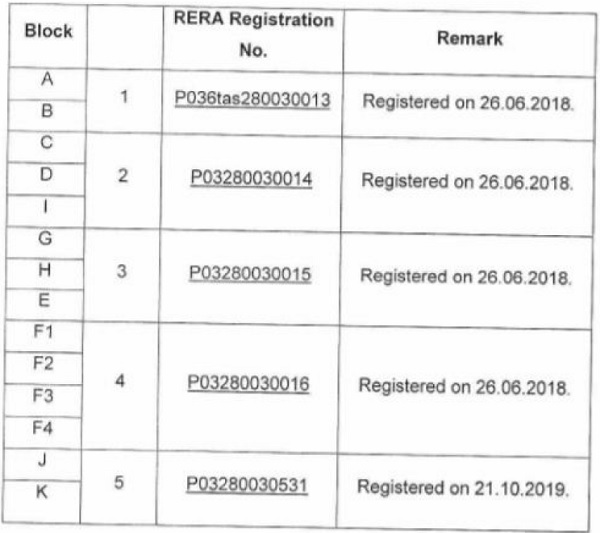
ix. Though the notice was issued to M/s Indiabulls Real Estate Ltd, Vishakhapatnam, the reply was received from M/s Airmid Real Estate Ltd. At the outset. it was observed from the website of the Respondent (https.//www.indiabullsrealestate.com/residential-prdects/sierra-vizao/), that there were Block-wise 5 RERA registrations for the project ‘INDIABULLS SIERRA”, in the name of promoter M/s Airmid Real Estate Limited. The registration-wise details of the project have been furnished in Table-A below. The project was registered under the Brand Name “INDIABULLS” which had a pan-India presence.
Table-‘A’
x. The Respondent vide letter dated 17.12.2019 submitted a copy of demand letter issued to the Applicant No.1. The details of schedule of payment plan has been furnished in Table-B below.
Table-‘B’