Summary: Filing a second appeal before the Goods and Services Tax Appellate Tribunal (GSTAT) under Section 112 of the CGST Act, 2017 involves a comprehensive electronic procedure extending beyond the preparation of FORM GST APL-05. Taxpayers challenging orders passed under Sections 107 or 108 must examine appealability and limitation, reconcile admitted and disputed tax liabilities, comply with statutory pre-deposit requirements, register on the GSTAT portal and prepare a properly indexed digital appeal record. The electronic filing framework is governed by Rule 110 of the CGST Rules and the GSTAT Procedure Rules, 2025. Importantly, electronic submission initially generates Part A of FORM GST APL-02A as provisional acknowledgement. The Registry may identify defects requiring correction and electronic re-submission. Part B of FORM GST APL-02A, containing the final appeal number, is issued after completion of the prescribed scrutiny process. The article provides a practical, step-by-step explanation of GSTAT account registration, professional representation, pre-deposit calculation, appeal fees, digital documentation, portal entries, electronic authentication and Registry compliance, enabling taxpayers and professionals to complete second-appeal filing systematically while avoiding procedural defects.
- Filing a Second Appeal before the GST Appellate Tribunal under Section 112
- 1. The Entire Filing Process at a Glance
- 2 The Legal Architecture Behind the Filing
- 3 Stage One — Check the Filing Preconditions Before Opening APL-05
- A. Identify the appealable order
- B. Check limitation separately
- C. Separate admitted and disputed amounts
- 4 Stage Two — Section 112(8) Pre-Deposit Before Filing
- 5 Stage Three — Create the Taxpayer’s Account on the GSTAT Portal
- Who should control this account?
- 6 Stage Four — Registration of Advocate, CA, CMA, CS or Other Authorised Representative
- Registration does not itself authorise appearance
- 7 Stage Five — Prepare the Appeal as a Digital Paper-Book
- Recommended digital appeal set
- 8 How Should the Digital Paper-Book Be Formatted?
- Is certification required on every document?
- 9 Stage Six — Start FORM GST APL-05 from the Taxpayer Account
- Tab 1 — Order Details
- Tabs 2 and 3 — Basic Details and Case Details
- Tab 4 — Appellant Details
- Tab 5 — Who should be made respondent?
- Tab 6 — Add the Advocate / CA / other representative
- Tab 7 — Demand Details and Pre-Deposit
- 10 Stage Seven — Appeal Fee under Rule 110(5)
- How the fee is paid
- 11 Stage Eight — Uploading the Digital Documents
- 12 A Special Rule for the Impugned Order — Seven Days Matter
- 13 Stage Nine — How Is the Appeal Signed?
- Who should perform the final signature?
- Does every page of the paper-book require DSC?
- 14 Stages Ten and Eleven — Checklist, Final Preview and Submission
- 15 Provisional Acknowledgement Is Not the End of Filing
- Stage Twelve — Registry scrutiny and re-filing
- Final acknowledgement — when filing is complete
- 16 Taxpayer and Representative Accounts — The Correct Relationship
- Digital paper-book — a suggested professional standard
- 17 Ten Filing Errors to Eliminate Before Pressing “Submit”
- 18 The Filing Process in One Professional Checklist
- 19 The Most Important Concept: GSTAT Filing Is a Digital Litigation File
Filing a Second Appeal before the GST Appellate Tribunal under Section 112
| GST LITIGATION · GSTAT PRACTICE SERIES Filing a Second Appeal before the GST Appellate Tribunal under Section 112 From GSTAT account creation to digital paper-book, payment, signature and final filing |
| POSITION AS ON 22 OCTOBER 2026 · Appeals under FORM GST APL-05 · Section 112 CGST Act · Rule 110 |
The Goods and Services Tax Appellate Tribunal has moved appellate litigation substantially into a digital environment. For a taxpayer approaching the GSTAT against an order under section 107 or section 108, the exercise is no longer merely the preparation of FORM GST APL-05. It now involves four interlinked exercises:
| 1. Creation of the taxpayer and representative accounts | 2. Statutory pre-deposit | 3. Preparation of an electronic appeal / paper-book | 4. Completion, payment, digital signing and scrutiny of FORM GST APL-05 |
–
| SCOPE OF THIS ARTICLE This article is confined to the filing process. It does not deal with the merits of drafting grounds, hearing strategy, additional evidence, stay applications after filing, or disposal of the appeal. |
–
| 10% additional pre-deposit on remaining disputed tax (ceiling ₹20 crore) | ₹5,000 – ₹25,000 GSTAT appeal fee under Rule 110(5) | 7 days to upload the self-certified order copy under Rule 110(4) | Part B of APL-02A, with the appeal number, completes filing |
1. The Entire Filing Process at a Glance
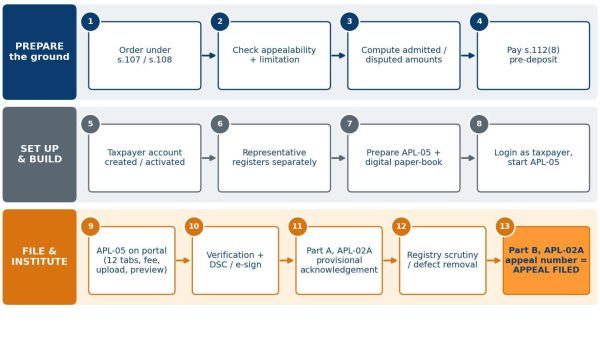 Figure 1 — The thirteen-step roadmap, from the impugned order to the final acknowledgement Rule 110 presently requires FORM GST APL-05 with relevant documents to be filed electronically. Provisional acknowledgement is generated in Part A of FORM GST APL-02A, while the final acknowledgement carrying the appeal number is issued in Part B of FORM GST APL-02A after removal of defects, if any. The GSTAT’s present system is designed as an electronic filing system, and the earlier ordinary manual-filing route has been removed from Rule 110. The GSTAT Procedure Rules likewise provide for electronic uploading, electronic scrutiny and electronic filing through the GSTAT portal.
2 The Legal Architecture Behind the Filing
| Filing requirement | Governing provision | Practical effect |
|---|---|---|
| Right to approach GSTAT | Section 112(1) | Second appeal against an order under section 107 or 108 |
| Normal limitation | Section 112(1) | Three months from communication of the order, subject to the notified-date mechanism |
| Condonation | Section 112(6) | Tribunal may admit a taxpayer appeal within a further three months on sufficient cause |
| Form of appeal | Section 112(7) + Rule 110 | FORM GST APL-05 |
| Mandatory pre-deposit | Section 112(8) | Full admitted dues plus statutory additional pre-deposit |
| Automatic stay | Section 112(9) | Balance recovery deemed stayed after section 112(8) payment |
| Electronic appeal | Rule 110(1) | APL-05 plus relevant documents, electronically |
| Authentication | Rule 110(3) read with Rule 26 | Electronic authentication / signature |
| Order copy and filing date | Rule 110(4) | The seven-day rule becomes crucial where the order is not available on the portal |
| Appeal fee | Rule 110(5) | Minimum ₹5,000; maximum ₹25,000, subject to prescribed computation |
| Representation | Section 116 | Advocate, CA, CMA, CS and other specified persons may represent |
| Form and presentation | GSTAT Procedure Rules 18, 20, 21 | Cause title, numbered paragraphs, distinct grounds, indexing, supporting orders / documents |
| Defect scrutiny | GSTAT Procedure Rule 24 | Registry can call for rectification of filing defects |
| Respondent | GSTAT Procedure Rule 33 | Concerned Commissioner to be arrayed as respondent in a taxpayer appeal |
| Appearance by professional | GSTAT Procedure Rule 72 / FORM GSTAT-04 | Vakalatnama / authorisation and memorandum of appearance |
| Electronic proceedings | GSTAT Procedure Rule 115 | Electronic filing and uploading prevail for portal proceedings |
| Payment of fees | GSTAT Procedure Rule 119 | Fee paid through the GSTAT portal in the prescribed manner |
Section 112 itself presently requires an additional 10% of the remaining disputed tax, over and above the amount already deposited for the first appeal under section 107(6), subject to the statutory maximum of ₹20 crore.
3 Stage One — Check the Filing Preconditions Before Opening APL-05
The portal should be the last place where the appeal is assembled, not the first. Before starting the online form, four issues should be closed internally.
A. Identify the appealable order
The taxpayer’s appeal under section 112(1) lies against an order passed against him under section 107 or section 108. Therefore, keep ready at least:
| Document | Purpose |
|---|---|
| Order-in-Appeal / Revision Order | Primary impugned order before GSTAT |
| Order-in-Original | Underlying adjudication record |
| Show Cause Notice | Origin of the dispute |
| Relevant relied-upon documents | To complete the record |
| Proof / date of communication of OIA | Limitation |
| GST demand / payment records | Pre-deposit reconciliation |
B. Check limitation separately
The normal taxpayer limitation under section 112(1) is three months from communication of the impugned order, subject to the special notified-date provision. Section 112(6) gives the Tribunal power to admit the appeal within a further three months where sufficient cause exists.
| LEGACY ORDERS — A CAUTION FOR OCTOBER 2026 For legacy orders, the special general filing window notified for the initial GSTAT rollout has already expired. A legacy appeal should therefore not be filed merely on the assumption that the portal’s technical acceptance makes it within time. Wherever necessary, the appropriate condonation application with supporting affidavit and explanation should accompany the appeal. |
C. Separate admitted and disputed amounts
This exercise drives the section 112(8) payment. The taxpayer should reconcile:
| Amount confirmed by OIA | › | Amount admitted | › | Amount disputed | › | First-appeal pre-deposit made | › | Additional GSTAT pre-deposit payable |
–
| DO NOT CONFUSE The statutory pre-deposit and the GSTAT filing fee are two entirely different payments. |
4 Stage Two — Section 112(8) Pre-Deposit Before Filing
For admission of the appeal, section 112(8) presently requires full payment of the admitted tax, interest, fine, fee and penalty, plus the prescribed additional pre-deposit in relation to the disputed tax. For the disputed component, the present law requires:
| First appeal: section 107(6) deposit | + | Second appeal before GSTAT: 10% of remaining tax in dispute | = | Statutory appellate deposit structure |
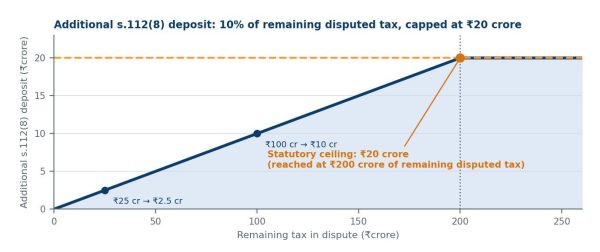
Figure 2 — The additional deposit rises with the remaining disputed tax and stops at the ₹20 crore ceiling The additional second-appeal deposit is subject to the statutory ceiling of ₹20 crore. Where the impugned order demands penalty without involving any demand of tax, the special proviso to section 112(8) governing the penalty deposit must be applied. Once the required amount under section 112(8) has been paid, section 112(9) provides a deemed stay of recovery for the balance amount during pendency of the appeal.
| A CURRENT-LAW CAUTION Some older portal guidance / FAQ material continued for some time to display the earlier 20% figure. That is no longer the statutory position. The amended section 112(8), as also reflected in the present filing architecture, uses 10%. |
5 Stage Three — Create the Taxpayer’s Account on the GSTAT Portal
The GSTAT e-filing portal maintains its own user-registration layer. Merely having a GST portal username does not mean that the GSTAT account has automatically been completed. The taxpayer should first choose the Taxpayer registration category on the GSTAT portal.
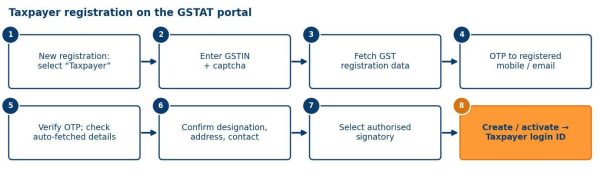
Figure 3 — Taxpayer registration flow
The GSTAT taxpayer-registration functionality fetches the registration on the basis of the GSTIN, sends OTP verification to the registered contact particulars and thereafter permits completion of the GSTAT user profile. The taxpayer login is linked to the GSTIN.
Who should control this account?
For a taxpayer appeal, the taxpayer account should remain the principal filing account. The professional should not ordinarily create an appeal by pretending to be the taxpayer. The GSTAT’s own filing advisory distinguishes the roles:
- Taxpayer — for filing the taxpayer’s appeal.
- Authorised Representative — for registration as representative and subsequent participation in the appeal in which he is appointed.
This distinction is important.
6 Stage Four — Registration of Advocate, CA, CMA, CS or Other Authorised Representative
Registration of the representative and appointment of the representative in a particular appeal are two different acts. Section 116 permits representation through, amongst others:
| Representative | Broad statutory qualification |
|---|---|
| Advocate | Entitled to practise in any court in India and not debarred |
| Chartered Accountant | Certificate of Practice and not debarred |
| Cost Accountant | Certificate of Practice and not debarred |
| Company Secretary | Certificate of Practice and not debarred |
| Regular employee / relative | Subject to section 116 |
| Specified retired tax officer | Subject to statutory conditions |
| GST Practitioner | Where authorised in accordance with section 116 |
Figure 4 — Professional registration flow The present registration module seeks the representative category, name, registration / enrolment details and professional documentation, with OTP authentication of mobile / email.
Registration does not itself authorise appearance
After registering, the professional must still be added to the particular APL-05 and the appropriate authority document uploaded. For an Advocate, the current filing instruction requires the Vakalatnama. For a CA / CMA / CS or other tax professional, an authorisation in favour of the tax professional is required. The GSTAT Procedure Rules separately contemplate the Memorandum of Appearance in FORM GSTAT-04, together with the relevant Vakalatnama or letter of authorisation. The GSTAT President’s current filing instructions, extended up to 31 December 2026, specifically require the taxpayer / appellant to upload the professional’s authorisation or the Advocate’s Vakalatnama.
7 Stage Five — Prepare the Appeal as a Digital Paper-Book
This is one of the most important changes in GSTAT practice. The underlying procedural discipline remains that of a properly prepared appellate paper-book: numbered paragraphs, separate grounds, A4 presentation, pagination, indexing and supporting documents. But Rule 115 shifts the filing environment to an electronic record. Practitioners should therefore think in terms of a digital paper-book, not a bundle of loose PDF attachments.
Recommended digital appeal set
| # | Document | # | Document |
|---|---|---|---|
| 1 | Cover / cause title | 11 | Impugned Order-in-Appeal / revision order |
| 2 | Index | 12 | Order-in-Original |
| 3 | FORM GST APL-05 / appeal memorandum | 13 | Show Cause Notice |
| 4 | Chronology / list of dates, where prepared | 14 | Relied-upon documents / material necessary for appeal |
| 5 | Statement of Facts | 15 | Relevant replies / submissions forming part of record |
| 6 | Grounds of Appeal | 16 | Pre-deposit computation and payment proof, wherever required |
| 7 | Prayer | 17 | Appeal-fee payment proof, where separately generated |
| 8 | Verification | 18 | Condonation application and affidavit, if required |
| 9 | Vakalatnama or professional authorisation | 19 | Certified English translations, where a relied-upon document is in another language |
| 10 | FORM GSTAT-04 / Memorandum of Appearance, where applicable |
The present President’s instructions identify, for taxpayer appeals, the SCN, OIO, OIA, Statement of Facts, Grounds of Appeal, pre-deposit and court / appeal fee wherever required amongst the important filing documents.
8 How Should the Digital Paper-Book Be Formatted?
The safest filing practice is to preserve traditional tribunal discipline even though the file is electronic.
| Aspect | Practice |
|---|---|
| A. Page size and text | Prepare the appeal and written material in A4, with clear paragraphs and consecutively numbered grounds, placed under distinct heads. The GSTAT Procedure Rules prescribe formal presentation and indexing requirements. |
| B. Pagination | Use one continuous pagination structure within each electronic volume. If separate PDFs are uploaded, the index should identify the document description, internal page number and PDF / volume name. This saves enormous time at scrutiny and later at hearing. |
| C. Bookmarking | PDFs should be properly bookmarked, particularly large compilations. The current GSTAT filing manual expressly calls for proper PDF bookmarking in the upload process. |
| D. Scanning quality | Portal guidance recommends approximately 300 DPI, while managing file size; individual files ordinarily within about 20 MB, splitting large material into volumes. Do not scan a 300-page record as one uncontrolled image-heavy PDF. The upload dialogue displayed at the time of filing is the final technical limit, as different modules have at times displayed different ceilings. |
| E. Searchable PDF | Where documents originate electronically, upload the native / searchable PDF rather than printing and rescanning. For physical documents, scan clearly and, where possible, make the PDF text-searchable without altering the underlying image. |
| F. Non-English documents | The GSTAT Procedure Rules contemplate an appropriate English translation, duly authenticated / certified as required. |
| VOL-1_APL05-SOF-GROUNDS.pdf Pages 1 – 75 VOL-2_OIA-OIO-SCN.pdf Pages 76 – 240 VOL-3_RUD-ANNEXURES.pdf Pages 241 – 410 |
A good naming and pagination structure (illustrative) A sensible bookmark structure would run: 01 FORM GST APL-05 · 02 Statement of Facts · 03 Grounds of Appeal · 04 OIA · 05 OIO · 06 SCN · 07 Reply to SCN · 08 Annexure A · 09 Annexure B, and so on.
Is certification required on every document?
No uniform rule should be applied mechanically to every PDF. The current instructions distinguish between documents that are already digitally generated and physical documents converted into scans. Digitally generated GST / GSTN documents need not be subjected merely to ritualistic re-certification, whereas scanned physical documents should carry the required signature / certification before upload. For the impugned order, Rule 110(4) has its own specific consequence, discussed in Section 12.
9 Stage Six — Start FORM GST APL-05 from the Taxpayer Account
Before entering data online, the GSTAT itself recommends using its Offline Draft Filing Excel Sheet, which mirrors the principal portal tabs. This is good practice because portal filing should be a data-entry exercise from an already finalised appeal, not the place where facts and calculations are being decided.
| Portal stage | What should be completed |
|---|---|
| 1. Order Details | Identify OIA / revision order through ARN / CRN or permitted manual particulars |
| 2. Basic Details | Act, jurisdiction, relevant Bench and foundational case particulars |
| 3. Case Details | Category, dispute details, tax period, case summary, Statement of Facts / grounds particulars |
| 4. Appellant Details | Taxpayer particulars and authorised signatory |
| 5. Add Respondent | Appropriate departmental respondent |
| 6. Add Representative | Registered Advocate / CA / CMA / CS / other AR plus authority document |
| 7. Demand / Payment Details | Demand breakup, admitted / disputed figures and section 112(8) deposit |
| 8. Appeal Fee | Fee computation and Bharatkosh / payment workflow |
| 9. Upload Documents | Digital appeal / paper-book and supporting PDFs |
| 10. Checklist | Mandatory filing requirements |
| 11. Final Preview | Entire appeal before locking / signing |
| 12. Verification & Signature | Digital execution and final submission |
Tab 1 — Order Details
The filing begins with the ARN / CRN or other identification particulars of the appellate / revisional order. Where the system successfully fetches the order, check the order number, date of order, date of communication, authority passing the order, GSTIN and demand particulars. The communication date deserves special attention because it drives limitation. Where portal data and the taxpayer’s evidence of actual communication do not coincide, the discrepancy should not simply be ignored: use the functionality available for entering the order details correctly and preserve documentary proof supporting the date relied upon.
Tabs 2 and 3 — Basic Details and Case Details
This stage creates the electronic metadata of the appeal: governing GST enactment, State / jurisdiction, nature / category of dispute, period, subject, brief case description, Statement of Facts, grounds and relief sought. The dropdown classification is essentially a system classification tool; it should not replace the carefully drafted Statement of Facts and Grounds uploaded with the appeal. If the matter involves place of supply, particular care is required in selecting the appropriate jurisdiction / Bench particulars.
Tab 4 — Appellant Details
Check the appellant’s legal name, GSTIN, address, email / mobile, legal constitution, authorised signatory and the signatory’s designation. The person selected for final verification should have valid authority to authenticate the appeal on behalf of the appellant, which is especially important for companies, LLPs, firms, societies and other juridical persons.
Tab 5 — Who should be made respondent?
The taxpayer should not mechanically enter the name of the officer who personally signed the Order-in-Appeal as the only respondent. Under the GSTAT Procedure Rules, in an appeal by a taxpayer, the concerned Commissioner is to be arrayed as respondent in accordance with the prescribed jurisdictional structure. Confirm the correct Central / State jurisdiction before final submission.
Tab 6 — Add the Advocate / CA / other representative
The registered professional’s name is selected from the portal’s representative database, and the taxpayer then uploads the representation document.
| Professional | Filing document |
|---|---|
| Advocate | Vakalatnama + relevant memorandum of appearance |
| CA / CMA / CS | Letter / authority from appellant + FORM GSTAT-04 as applicable |
| Other authorised representative | Authority satisfying section 116 + prescribed appearance particulars |
| Professional registers with GSTAT | + | Taxpayer authorises professional for the particular appeal | = | Valid representative linkage |
The representative’s portal registration is not the appellant’s authorisation. Both are required. The current filing directions make the authority / Vakalatnama an important scrutiny document.
Tab 7 — Demand Details and Pre-Deposit
The demand figures should be reconciled with the impugned order and GST records. Before moving ahead, the appeal file should internally contain a reconciliation such as:
| Particulars | Amount |
|---|---|
| Tax confirmed by impugned order | ₹ ______ |
| Interest | ₹ ______ |
| Penalty | ₹ ______ |
| Other amount | ₹ ______ |
| Amount admitted by appellant | ₹ ______ |
| Tax disputed | ₹ ______ |
| First-appeal pre-deposit | ₹ ______ |
| Additional section 112(8) deposit | ₹ ______ |
| Balance disputed amount | ₹ ______ |
The GSTAT functionality interfaces with GST payment information for pre-deposit confirmation. If there is any mismatch between portal-fetched data and the taxpayer’s legally correct computation, do not conceal it: upload the calculation / payment evidence and supporting material through the functionality provided.
10 Stage Seven — Appeal Fee under Rule 110(5)
Rule 110(5) presently prescribes the appeal / restoration fee at ₹1,000 for every ₹1 lakh of the relevant tax / ITC / difference in tax or ITC / fine / fee / penalty involved, subject to a minimum of ₹5,000 and maximum of ₹25,000. For an order not involving demand of tax, interest, fine, fee or penalty, the prescribed fee is ₹5,000.
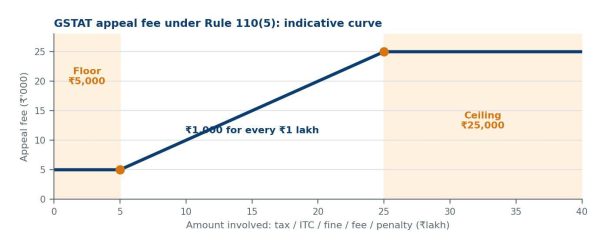
Figure 5 — The fee scales with the amount involved, between its floor and ceiling
| Type | GSTAT appeal fee |
|---|---|
| Appeal involving monetary demand | As per Rule 110(5), minimum ₹5,000 and maximum ₹25,000 |
| Order involving no demand of tax / interest / fine / fee / penalty | ₹5,000 |
| Rectification application under section 112(10) | No fee under Rule 110(6) |
How the fee is paid
The present GSTAT portal integrates appeal-fee payment with Bharatkosh. It supports online payment through the available gateway modes (Net Banking, Card, UPI, as available) and, where the permitted offline Bharatkosh route is used, uploading of the relevant payment receipt.
| APL-05 demand details completed | › | Portal computes / displays fee | › | Bharatkosh: online or permitted offline | › | Payment success; receipt reflected |
The taxpayer should download and preserve the challan / payment receipt even where the portal has automatically captured the successful transaction.
11 Stage Eight — Uploading the Digital Documents
Once the payment / pre-deposit stages are complete, the appeal set is uploaded. A clean upload matrix may look like this:
| Portal document description | Suggested file |
|---|---|
| Appeal | 01_APL05_SOF_GROUNDS.pdf |
| Impugned order | 02_OIA.pdf |
| Original adjudication order | 03_OIO.pdf |
| SCN | 04_SCN.pdf |
| Appeal documents / annexures | 05_ANNEXURES_VOL-I.pdf |
| Further annexures | 06_ANNEXURES_VOL-II.pdf |
| Authorisation | 07_AUTHORISATION_FORM04.pdf |
| Pre-deposit | 08_PREDEPOSIT.pdf |
| Fee | 09_APPEAL_FEE.pdf |
| Condonation, if required | 10_CONDONATION_AFFIDAVIT.pdf |
–
| AVOID GENERIC FILENAMES Do not upload scan1.pdf, new.pdf or final-final2.pdf. The Registry and the Bench should be able to understand the file from its name. |
12 A Special Rule for the Impugned Order — Seven Days Matter
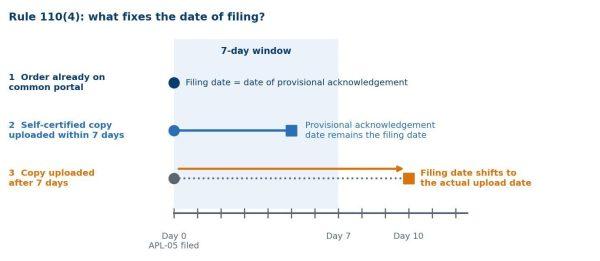
Figure 6 — Effect of Rule 110(4) on the date of filing
| Situation | What happens |
|---|---|
| 1. Order already uploaded on the common portal | The final acknowledgement is issued after removal of defects, if any, and the date of provisional acknowledgement is treated as the filing date. |
| 2. Order not on the common portal; copy furnished in time | The appellant uploads the prescribed self-certified copy within seven days from filing APL-05. The provisional-acknowledgement date remains relevant as the date of filing. |
| 3. Self-certified copy furnished after seven days | Rule 110(4) shifts the effective filing date to the date on which the copy is actually submitted / uploaded. The consequence can be serious where the appeal is close to limitation. |
–
| PRACTICAL RULE Never leave the impugned-order copy pending merely because APL-05 has been submitted. |
13 Stage Nine — How Is the Appeal Signed?
There are two levels of signatures that should not be confused. Level 1 — Signatures / certification on documents. An affidavit, Vakalatnama, authority, self-certified order or other document that legally requires execution should first be validly signed / executed in its own right, and then converted to PDF and uploaded. Level 2 — Final electronic verification of APL-05. Rule 110(3) refers back to Rule 26 for signing. Rule 26 recognises electronic authentication through Digital Signature Certificate, e-signature or other prescribed electronic verification modes, subject to the requirements applicable to the category of registered person. A company registered under the Companies Act is required to furnish documents / application verified through DSC, subject to the applicable rule. The current GSTAT filing interface provides digital-signing options including the portal-supported DSC / e-sign utilities.
Who should perform the final signature?
Although the Procedure Rules contain general provisions regarding execution through the appellant / authorised representative, the current GSTAT President’s filing instructions require one verification and digital signature of the appellant. As a filing practice, complete the appeal through the taxpayer account and have the appellant’s duly authorised signatory perform the final portal verification / digital execution. The professional separately executes his Vakalatnama, Memorandum of Appearance or authorisation documentation.
Does every page of the paper-book require DSC?
No. The present electronic system does not require a DSC to be cryptographically placed on every page merely because the paper-book is in PDF. The better distinction is:
| Document | Signature approach |
|---|---|
| Final APL-05 verification | Portal digital signature / e-sign as applicable |
| Vakalatnama | Independently executed by client / Advocate |
| CA / CMA / CS authorisation | Signed by competent appellant signatory |
| FORM GSTAT-04 | Signed / executed as prescribed |
| Affidavit | Independently executed / attested as required |
| Self-certified physical document | Certification / signature before scanning |
| Native GST portal-generated document | Upload the authentic electronic document; unnecessary ritualistic certification should be avoided |
14 Stages Ten and Eleven — Checklist, Final Preview and Submission
This is the point to stop entering new information and begin verifying consistency. A useful three-way check:
| APL-05 data | = | Impugned / appellate order data | = | Digital paper-book |
–
| Verification point | Why it matters | Verification point | Why it matters |
|---|---|---|---|
| GSTIN and legal name | Basic identity | Representative | Valid appearance |
| Order number / date | Identifies appeal | Statement of Facts | Must match uploaded document |
| Communication date | Limitation | Grounds | Must match final appeal |
| Tax period | Scope of appeal | Prayer | Relief must be clear |
| Demand amounts | Pre-deposit calculation | OIA / OIO / SCN | Current scrutiny requirement |
| Admitted amount | Section 112(8)(a) | Fee status | Filing completion |
| Disputed tax | Section 112(8)(b) | Uploaded PDF names | Registry usability |
| Pre-deposit | Admission / stay | Pagination / index | Digital paper-book integrity |
| Respondent Commissioner | Proper constitution of appeal | Verification | Valid execution |
Once the final preview is generated, save a PDF copy for the appellant’s internal file before performing the final digital signature. The final submission then runs:
| Select digital signing method | › | Authenticate signatory | › | Sign / verify; final submit | › | Filing reference; Part A, APL-02A |
Immediately preserve the filing reference and acknowledgement together with: the signed final appeal; the uploaded paper-book; pre-deposit challan / payment evidence; the appeal-fee receipt; the final preview; and the SMS / email filing confirmation.
15 Provisional Acknowledgement Is Not the End of Filing
This distinction under Rule 110 is extremely important. The appeal may first generate Part A of FORM GST APL-02A, but Rule 110 provides that the appeal is treated as filed only when the final acknowledgement indicating the appeal number is issued.
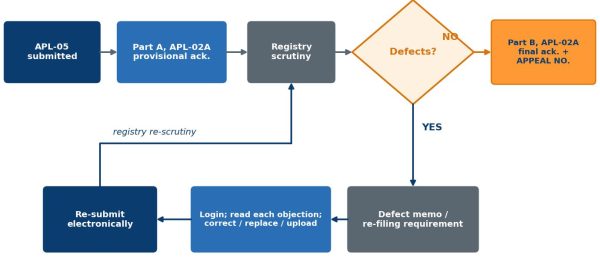
Figure 7 — From provisional acknowledgement to appeal number: the scrutiny loop
Stage Twelve — Registry scrutiny and re-filing
The GSTAT Registry electronically scrutinises the filing. Rule 24 contemplates rectification of defects within the prescribed filing process. Typical defects include:
| Typical defect | Typical defect |
|---|---|
| ▪ Missing OIA / OIO / SCN | ▪ Unreadable scan |
| ▪ Incomplete Statement of Facts or grounds | ▪ Wrong respondent |
| ▪ Missing authorisation / Vakalatnama | ▪ Pre-deposit discrepancy |
| ▪ Missing fee | ▪ Absence of certification where required |
| ▪ Illegible annexure | ▪ Improper pagination / indexing |
| ▪ Missing translation | ▪ Mismatch between portal data and uploaded appeal |
| ▪ Failure to upload the impugned order correctly |
Where a defect memo is generated: log in, open the defect / re-filing module, read each objection, correct the data, replace the PDF or upload the omitted document, respond to the defect and re-submit electronically for Registry re-scrutiny.
| RELAXATION, NOT LICENCE The current President’s instructions seek to avoid hyper-technical objections where the essential soft copies and requisite filing material have already been supplied; those directions presently stand extended up to 31 December 2026. This relaxation should not, however, be treated as permission to file an incomplete appeal. |
Final acknowledgement — when filing is complete
Once scrutiny is cleared, Part B of FORM GST APL-02A containing the final appeal number is generated. At that stage, preserve a permanent electronic folder:
| 01_Final_Signed_APL05 06_Provisional_APL02A_PartA 02_Final_Digital_PaperBook 07_Defect_Memo_If_Any 03_Predeposit_Proof 08_Defect_Response_If_Any 04_Appeal_Fee_Receipt 09_Final_APL02A_PartB 05_Authorisation_Vakalatnama |
This is the correct closure point for the filing process
16 Taxpayer and Representative Accounts — The Correct Relationship
A frequent conceptual error is to think that because the CA or Advocate is preparing the appeal, the appeal should originate entirely from the professional’s account. The better understanding of the present GSTAT system:
| Step | Taxpayer | Representative | Outcome |
|---|---|---|---|
| 1 | Creates GSTAT account | Registers separately on the portal | Identity established |
| 2 | Initiates APL-05 appeal | — | Appeal begins in the taxpayer’s case record |
| 3 | Adds registered representative | Advocate: Vakalatnama · CA: authority · CMA / CS / other: authority | FORM GSTAT-04 / representative linkage |
| 4 | Appeal continues in the taxpayer’s case record | Appears as authorised | Valid appearance |
The GSTAT portal therefore separates identity, authority and filing. That separation should be maintained in office practice as well.
Digital paper-book — a suggested professional standard
For an appeal of reasonable size, the following electronic architecture works well:
| Volume I — Pleadings | Volume II — Orders and proceedings | Volume III onwards — Documentary record |
|---|---|---|
| Cover · Index · FORM GST APL-05 · Synopsis / Chronology · Statement of Facts · Grounds of Appeal · Prayer · Verification · Authorisation / Vakalatnama · FORM GSTAT-04 | Impugned OIA / Revision Order · Order-in-Original · Show Cause Notice · Reply to SCN · Relevant hearing submissions | Relied-upon documents · Invoices / returns / reconciliations · Correspondence · Certificates · Statements · Other documents forming part of record |
–
| Clear filename | › | Index | › | Consecutive pagination | › | Bookmarks | › | Readable scan | › | Sensible file size |
Every volume should carry all six. This converts the old concept of a physical paper-book into a genuinely usable electronic appellate record.
17 Ten Filing Errors to Eliminate Before Pressing “Submit”
| # | Error | Correct approach |
|---|---|---|
| 1 | Treating 20% as the current second-appeal deposit | Apply current section 112(8): 10% additional disputed tax |
| 2 | Filing from the professional’s identity as though the professional were the appellant | Initiate the taxpayer appeal through the taxpayer filing role |
| 3 | Professional registered but no authority uploaded | Add Vakalatnama / authorisation and FORM GSTAT-04 as applicable |
| 4 | Treating pre-deposit as appeal fee | Keep both payments completely separate |
| 5 | Uploading only the OIA | Keep OIA, OIO, SCN and relevant record ready |
| 6 | Uploading a huge unindexed scan | Split into bookmarked digital volumes |
| 7 | Wrong departmental officer shown as respondent | Apply Rule 33 and identify the concerned Commissioner |
| 8 | Assuming provisional acknowledgement completes filing | Track the Part B final acknowledgement and appeal number |
| 9 | Order unavailable online but seven-day requirement ignored | Upload self-certified copy within the Rule 110(4) period |
| 10 | DSC placed on every PDF page but final portal verification omitted | Complete the legally required final electronic verification / signature |
18 The Filing Process in One Professional Checklist
| ORDER, LIMITATION & AMOUNTS |
| ☐ OIA / revision order identified |
| ☐ Date of communication checked |
| ☐ Limitation calculated |
| ☐ Condonation papers prepared, if required |
| ☐ Admitted liability identified |
| ☐ Disputed tax identified |
| ☐ Section 107 first-appeal deposit reconciled |
| ☐ Section 112(8) additional 10% deposit made |
| ☐ Payment proof downloaded |
–
| PLEADINGS & RECORD |
| ☐ APL-05 finalised |
| ☐ Statement of Facts finalised |
| ☐ Grounds finalised |
| ☐ Prayer finalised |
| ☐ Verification finalised |
| ☐ SCN, OIO, OIA available |
| ☐ Relevant annexures available |
| ☐ English translations, if required |
–
| ACCOUNTS & AUTHORITY |
| ☐ Taxpayer GSTAT registration complete |
| ☐ Authorised signatory checked |
| ☐ Advocate / CA / CMA / CS registration complete |
| ☐ Vakalatnama / authority prepared |
| ☐ FORM GSTAT-04 prepared, where applicable |
–
| FEE, UPLOAD & SIGNATURE |
| ☐ Appeal fee calculated |
| ☐ Bharatkosh payment completed; receipt saved |
| ☐ All PDFs uploaded |
| ☐ Checklist completed |
| ☐ Final preview checked against paper-book |
| ☐ Final electronic verification completed |
| ☐ DSC / permitted e-sign completed |
–
| DIGITAL PAPER-BOOK |
| ☐ Digital index prepared |
| ☐ PDFs paginated and bookmarked |
| ☐ Scans legible |
| ☐ Files within portal limits |
| ☐ Filenames intelligible |
–
| AFTER FILING |
| ☐ Part A, APL-02A downloaded |
| ☐ Seven-day order-copy requirement checked |
| ☐ Defect status monitored |
| ☐ Defects cured / re-filed, if any |
| ☐ Part B, APL-02A downloaded |
| ☐ GSTAT appeal number preserved |
19 The Most Important Concept: GSTAT Filing Is a Digital Litigation File
The current GSTAT filing system should not be approached as “uploading an appeal form”. A properly instituted second appeal now rests on six digital layers: Figure 8 — The six layers of a properly instituted GSTAT second appeal
| THE SINGLE MOST IMPORTANT PROCEDURAL POINT A practitioner who completes only the first four layers has prepared an appeal. He has not necessarily instituted it. The appeal reaches filing completion only after the statutory and portal requirements culminate in the final acknowledgement carrying the appeal number, subject to the filing-date rules in Rule 110(4). That distinction — between drafting an appeal, uploading an appeal and legally completing its institution — is perhaps the single most important procedural point in the new GSTAT e-filing regime. |