Summary: The 57th GST Council meeting held on 8 October 2026 recommended wide-ranging changes to GST administration, including registration and cancellation, return reconciliation, Invoice Management System, tax refunds, input tax credit, adjudication, appeals, prosecution, movement of goods, exports, e-commerce and selected goods and services. CA Rajender Arora groups these proposals into 91 separately identifiable changes across 11 themes. Major recommendations include automated refunds, faster acknowledgements, changes to accumulated-credit refunds, rationalisation of blocked ITC, limits on arrest and prosecution, simplified GST registration, and intelligence-led transit interception. The article compares the existing situation, reasons for change and likely impact, then discusses implementation dates and practical concerns over legal drafting. These are Council recommendations: legal effect depends on implementing Acts, Rules, notifications or circulars.
57th GST Council Meeting: 91 Changes That Could Reshape GST Administration, Credit, Refunds and Litigation
- Introduction
- The 57th Meeting at a Glance
- Thematic Map of the 91 Changes
- I. REGISTRATION AND CANCELLATION
- II. RETURNS, IMS AND RECONCILIATION
- III. REFUND REFORMS
- IV. ADJUDICATION, PENALTIES AND APPEALS
- V. ITC AND ACCUMULATED CREDIT
- VI. EXPORTS AND ZERO RATING
- VII. ARREST AND PROSECUTION
- VIII. GOODS IN MOVEMENT
- IX. OTHER PROCESS REFORMS
- X. GOODS — RATE AND CLASSIFICATION CHANGES
- XI. SERVICES — RATE, EXEMPTION AND CREDIT CHANGES
- Same-Line ITC: A Particularly Important Service Reform
- The Overall Direction of the Reforms
- Implementation: The Most Important Caution
- Conclusion
- My Assessment by Theme
- What Professionals and Businesses Should Do Now
Introduction
The 57th meeting of the GST Council, held on 8 October 2026, marks an important transition in the evolution of GST. While the 56th meeting concentrated substantially on rate rationalisation, the 57th meeting has moved decisively towards process reform, automation, credit neutrality, faster refunds, decriminalisation, reduction of litigation and ease of doing business.
The recommendations cover registration, cancellation, returns, Invoice Management System (IMS), refunds, input tax credit, exports, adjudication, penalties, arrest, prosecution, movement of goods, e-commerce and several goods-and-services rate issues. Importantly, these are Council recommendations and not yet law merely because they appear in the press release. The official release itself states that legal effect will follow through the relevant amendments, Rules, notifications and circulars.
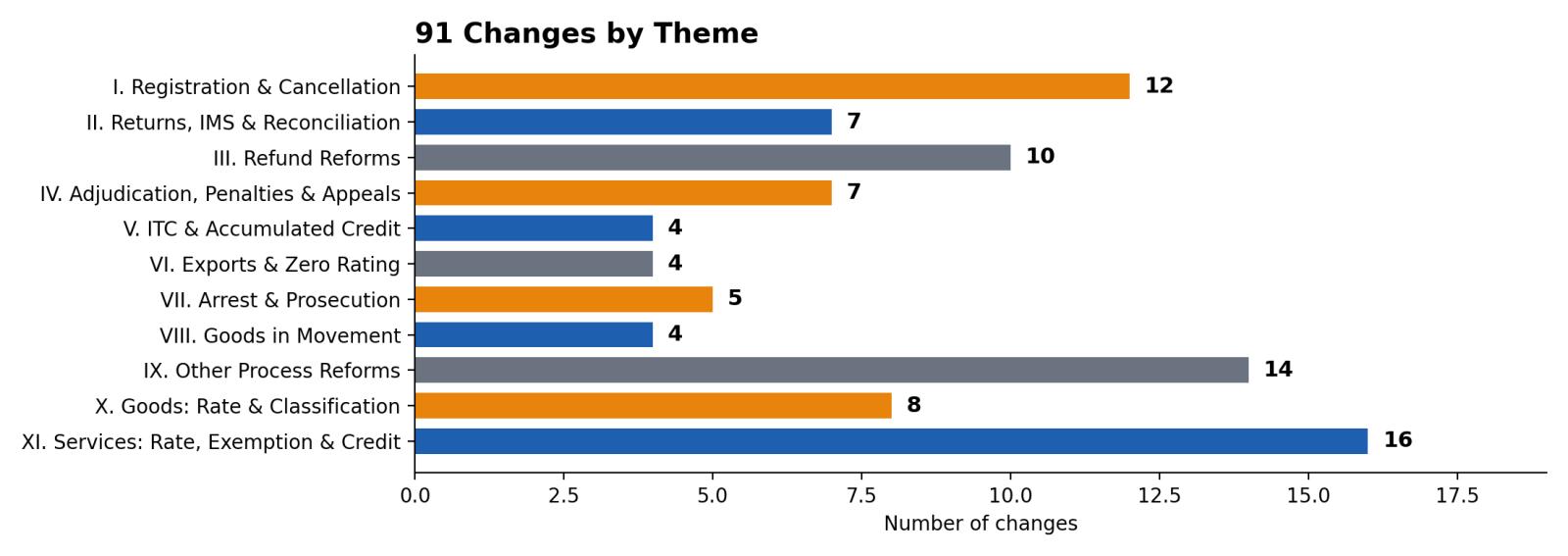
For analytical purposes, I have segregated the recommendations into 91 separately identifiable changes. Since several recommendations contain multiple operational limbs, this is an analytical count rather than an officially announced numerical count.
| How to read this article The discussion follows the format: existing situation → proposed change → reason for change → likely impact. Each table below carries the change numbers 1 to 91 exactly as analysed. |
The 57th Meeting at a Glance
| 91 Separately identifiable changes |
11 Thematic areas covered |
4 Key dates indicated by the Council |
57th Council meeting, held on 8 October 2026 |
Thematic Map of the 91 Changes
| Part | Theme | Core focus | Change Nos. | Count |
|---|---|---|---|---|
| I | Registration and cancellation | Objective, system-driven registration, amendment and cancellation | 1–12 | 12 |
| II | Returns, IMS and reconciliation | Legal recognition of IMS, RCM and ITC statements; mismatch correction | 13–19 | 7 |
| III | Refund reforms | Automatic and risk-based refunds; zero-rated refund reform | 20–29 | 10 |
| IV | Adjudication, penalties and appeals | Quality of notices, proportionate penalties, appeal access | 30–36 | 7 |
| V | ITC and accumulated credit | Credit neutrality, IDS refunds, Section 17(5) | 37–40 | 4 |
| VI | Exports and zero rating | Service-export liberalisation and place-of-supply fixes | 41–44 | 4 |
| VII | Arrest and prosecution | Deletion of arrest power; focused prosecution | 45–49 | 5 |
| VIII | Goods in movement | Intelligence-led interception; transit-State limits | 50–53 | 4 |
| IX | Other process reforms | Procedural relief, circulars, validation and e-invoicing | 54–67 | 14 |
| X | Goods — rate and classification changes | HSN clarifications, scrap RCM/TDS, regularisation | 68–75 | 8 |
| XI | Services — rate, exemption and credit changes | EV, ECO delivery, same-line ITC, exemptions | 76–91 | 16 |
I. REGISTRATION AND CANCELLATION
The Council has sought to substantially reduce officer interface at the registration and cancellation stages. Registration documentation, amendment and cancellation are all proposed to move towards objective and system-driven processing.
| No. | Change | Existing situation | Reason for change | Likely impact |
|---|---|---|---|---|
| 1 | Comprehensive registration circular | Documentary requirements can vary during processing of REG-01. | To establish a uniform national documentary standard. | Fewer REG-03 queries, reduced discretion and faster registrations. |
| 2 | Structured FORM GST REG-01 | Registration involves substantial document uploading and free-form information. | To make applications machine-verifiable and predictable. | Reduced errors and faster scrutiny. |
| 3 | Guided GST portal registration | Taxpayers presently navigate forms without sufficient contextual assistance. | To reduce incorrect filing through drop-downs, tooltips and guidance. | Lower rejection rates and better compliance. |
| 4 | Automatic amendment under Rule 19 | Core registration amendments generally require officer approval. | Routine changes should not remain dependent on manual approval. | Near real-time amendment of registration particulars. |
| 5 | Automatic PPoB amendment for Rule 14A cases | Principal Place of Business amendments normally require approval. | Rule 14A taxpayers are already classified as low-risk. | Greater automation for low-risk taxpayers. |
| 6 | Phase-I automatic REG-16 cancellation | Cancellation applications can remain pending for officer action. | To permit objective system closure where compliance is complete. | Faster exit from GST and reduced officer interface. |
| 7 | Cancellation where ₹2.5 lakh ITC threshold was crossed | Higher ITC-passing taxpayers face greater scrutiny. | Timely GSTR-10 filing provides an additional closure safeguard. | Wider eligibility for automatic cancellation. |
| 8 | Phase-II universal system cancellation | Cancellation is presently substantially officer-driven. | Once system controls mature, manual approval adds limited value. | Significant reduction in pendency. |
| 9 | GSTR-10 details within REG-16 | Cancellation application and final return are separate exercises. | To integrate business closure reporting. | One consolidated compliance journey. |
| 10 | Rationalisation of Rule 21 | Several defaults can trigger officer-initiated cancellation. | Not every technical default warrants cancellation proceedings. | More proportionate use of cancellation power. |
| 11 | Rules 21A/22 amended; Rule 23A inserted | Suspension, cancellation and revocation require multiple officer-driven stages. | Objective defaults can be identified and cured electronically. | System cancellation followed by system revocation on compliance. |
| 12 | New Rule 14B for small ECO sellers | Small sellers may need a physical presence/registration footprint in multiple States. | To facilitate nationwide e-commerce without creating an office in each State. | Major ease-of-business benefit for small online sellers. |
–
| What does “all dues are paid” mean?
This expression used for automatic cancellation deserves particular attention. Section 29(3) already provides that cancellation does not extinguish liabilities relating to an earlier period even if determined later. Consequently, “all dues” should logically mean crystallised, admitted or system-identifiable dues—self-assessed tax, interest, late fee, confirmed recoverable demand, Section 29(5) liability and similar amounts—not an unquantified future exposure under scrutiny or audit. The final Rules should expressly deal with disputed demands, stayed demands, pending rectification, uncomputed interest and liabilities arising from the final return. |
II. RETURNS, IMS AND RECONCILIATION
The Council proposes a significant legalisation and restructuring of portal-based return controls. The revised mechanism is proposed from the April 2027 return period, after stakeholder consultation.
| No. | Change | Existing situation | Reason for change | Likely impact |
|---|---|---|---|---|
| 13 | Enhance GSTR-1/GSTR-1A/IFF | Outward liability mismatch with GSTR-3B generates notices. | Reconcile liability before final return filing. | Fewer mismatch intimations. |
| 14 | New Rule 86D—RCM statement | RCM liability and corresponding ITC are tracked largely through portal functionality. | Give explicit Rule-based framework. | Better RCM reconciliation and audit trail. |
| 15 | New Rule 61(1A) | GSTR-1 liability and GSTR-3B liability can diverge. | Provide statutory correction mechanism. | Fewer demand notices for reporting mismatches. |
| 16 | Invoice details in DRC-03 | Voluntary payments may not be invoice-linked. | Improve transaction-level identification. | Easier adjustment of payment against subsequent proceedings. |
| 17 | Rule 60(6A) for IMS | IMS functionality exists primarily as portal architecture. | Provide explicit legal basis for accept/reject/pending actions. | Greater certainty in GSTR-2B generation. |
| 18 | New Rule 86C | Reversal/reclaim statement exists technologically. | Align portal mechanism with Rules. | Clearer tracking of temporary ITC reversals. |
| 19 | Rule 61(1B) | GSTR-3B ITC and GSTR-2B frequently differ. | Allow structured correction/rectification. | Improved ITC integrity across the supply chain. |
–
| Closing the gap between law and portalA notable feature is that Electronic Credit Reversal and Reclaim Statement, RCM statement and IMS functionality preceded their proposed express Rule-based recognition. The reform is therefore also an attempt to close the gap between GST law and GST portal architecture. Technology should implement law; it should not independently create substantive tax disabilities. |
III. REFUND REFORMS
Refund automation is one of the strongest features of the 57th meeting. Phase I contemplates automatic cash-ledger refund, deemed acknowledgement and 90% provisional refund; Phase II moves towards complete system sanction of qualifying zero-rated refunds.
| No. | Change | Existing situation | Reason for change | Likely impact |
|---|---|---|---|---|
| 20 | Automatic cash-ledger refund | Officer processing is involved despite system-known balance. | Manual verification adds little value. | Faster cash release. |
| 21 | Acknowledgement: 15 to 10 days | Rule 90 provides 15 days for scrutiny. | Accelerate refund cycle. | Earlier commencement of processing. |
| 22 | Deemed acknowledgement | Officer delay can stall refund acknowledgement. | Make administrative silence consequential. | Greater certainty to claimant. |
| 23 | 90% automatic provisional refund | Provisional refund involves officer intervention. | Use risk analytics for low-risk claims. | Major working-capital relief. |
| 24 | Phase-II system acknowledgement | Acknowledgement remains officer-dependent. | Fully automate objective checks. | Reduced departmental interface. |
| 25 | Automated full zero-rated refund | Final sanction remains substantially manual. | Mature risk systems can sanction eligible claims. | Faster exporter refunds. |
| 26 | System-readable RFD-01 | Refund support is frequently uploaded as scanned documents. | Automation requires structured machine-readable data. | Better cross-verification with returns/customs data. |
| 27 | Remove 1.5-times cap in Rule 89(4)(C) | Export turnover is artificially restricted by domestic comparable value. | Genuine export pricing can differ from domestic pricing. | Higher legitimate exporter refund. |
| 28 | ₹1,000 threshold on aggregate refund | Threshold has created tax-head-based issues. | Treat refund as a combined amount. | Small genuine refunds will not be lost merely by tax-head breakup. |
| 29 | Section 115 standalone interest provision | Pre-deposit refund interest presently links back to Section 56. | Remove rate ambiguity. | Greater certainty in appellate refunds. |
| “System-readable” does not merely mean electronic A scanned PDF is electronic but not necessarily system-readable. A system-readable RFD-01 means structured invoice, shipping, realisation and tax data capable of automated matching, risk scoring and computation. The challenge will be ensuring that minor data differences do not result in mechanical rejection. |
IV. ADJUDICATION, PENALTIES AND APPEALS
The Council seeks to reduce low-value and procedurally weak litigation.
| No. | Change | Existing situation | Reason for change | Likely impact |
|---|---|---|---|---|
| 30 | National standards for notices/orders | Quality of notices and adjudication varies. | Improve reasoning, natural justice and fraud invocation. | Better quality litigation and fewer avoidable appeals. |
| 31 | ₹10,000 SCN threshold | Even very small demands can enter adjudication. | Administrative cost should be proportionate. | Reduction in petty litigation. |
| 32 | Penalty treated as “charge” on timely discharge | Settlement consequences can remain uncertain. | Encourage voluntary compliance. | Faster closure of disputes. |
| 33 | 5% penalty in specified non-fraud cases | Post-order penalty can be substantially higher. | Reward prompt post-adjudication payment. | Lower litigation incentive. |
| 34 | Remove minimum ₹10,000 penalty | Minimum penalty can be disproportionate to tax. | Restore proportionality. | Relief in low-value cases. |
| 35 | Section 125 maximum ₹25,000 to ₹10,000 | General residual penalty can reach ₹25,000. | Minor technical contraventions should not attract excessive penalty. | More proportionate compliance regime. |
| 36 | Cap penalty-only appeal pre-deposit | Penalty-only appeals may involve very large pre-deposits. | Access to appeal should not become financially illusory. | Reduced appellate hardship. |
V. ITC AND ACCUMULATED CREDIT
The Council has recognised that blocked or non-refundable credit ultimately becomes a cost and weakens GST neutrality.
| No. | Change | Existing situation | Reason for change | Likely impact |
|---|---|---|---|---|
| 37 | Capital-goods ITC refund for zero-rated supplies | Capital-goods credit can remain accumulated. | Exports should not bear domestic tax cost. | Better exporter cash flow. |
| 38 | Input-service ITC refund under IDS | IDS refund is largely input-goods focused. | Services are a genuine component of production cost. | Reduced stranded credit from 1 Nov 2026. |
| 39 | Capital-goods ITC refund under IDS | Capital credit remains embedded in inverted sectors. | Improve tax neutrality while protecting revenue. | Refund available from 1 Apr 2027, spread over 60 months. |
| 40 | Section 17(5) rationalisation | Catering, employee insurance, towers, pipelines, free samples and specified destroyed stock face credit blocks. | Reduce cascading on genuine business costs. | Major recurring ITC benefit. |
| Section 17(5): watch the final wording The Section 17(5) proposal is particularly important. However, its final wording must be watched carefully—for example, free-sample credit and destruction of expired goods may not necessarily become universally available; the latter recommendation is specifically linked to destruction required by law. |
VI. EXPORTS AND ZERO RATING
| No. | Change | Existing situation | Reason for change | Likely impact |
|---|---|---|---|---|
| 41 | Delete IGST Section 2(6)(v) | Export fails where supplier/recipient are merely distinct establishments. | Overseas branch structures should not automatically destroy export character. | Major benefit for Indian service exporters. |
| 42 | Circular on forex/permitted INR | Payment-realisation conditions generate disputes. | Clarify RBI-permitted modes. | Greater export certainty. |
| 43 | Delete Section 13(3)(a) | Services on goods physically made available in India may have Indian POS. | Physical presence of goods should not defeat genuine foreign-consumer services. | Benefit to testing, R&D, repair and technical sectors. |
| 44 | Foreign buyer–SEZ/FTWZ delivery explanation | Foreign billing with domestic SEZ delivery creates zero-rating uncertainty. | Recognise commercial bill-to/deliver-to arrangements. | Wider zero-rating for qualifying transactions. |
| Objective of the export reforms These export reforms are expressly intended to improve service-export competitiveness. |
VII. ARREST AND PROSECUTION
| No. | Change | Existing situation | Reason for change | Likely impact |
|---|---|---|---|---|
| 45 | Delete Section 69 arrest power | GST law contains a special statutory arrest mechanism. | Reduce coercive enforcement and criminalisation. | Fundamental shift in GST enforcement philosophy. |
| 46 | Prosecution threshold ₹1 crore to ₹5 crore | Criminal proceedings can arise at lower monetary level. | Reserve prosecution for serious cases. | Fewer criminal proceedings in ordinary disputes. |
| 47 | Narrow Section 132 clauses | Broad words such as “evades tax” and “in any other manner deals with” exist. | Prevent over-criminalisation of interpretational matters. | Clearer offence boundaries. |
| 48 | Restrict Section 132(1)(c) | ITC-related offence wording is broad. | Focus criminal law on fraudulent credit. | Technical ITC disputes less likely to become prosecutions. |
| 49 | Rationalise punishment | Existing punishment slabs require recalibration. | Align punishment with seriousness. | More proportionate criminal consequences. |
| Prosecution changes The Council’s prosecution changes are detailed in the release. |
VIII. GOODS IN MOVEMENT
| No. | Change | Existing situation | Reason for change | Likely impact |
|---|---|---|---|---|
| 50 | Intelligence-based interception | Vehicles may face compliance checks during movement. | Stop indiscriminate/random interception. | Faster logistics. |
| 51 | State-nexus requirement | Transit States can become enforcement points. | Origin/destination States have stronger transaction nexus. | Reduction in repeated State-wise detention. |
| 52 | Exception where documents/e-way bill absent | Jurisdictional protection could otherwise be abused. | Preserve enforcement against undocumented movement. | Balanced trade facilitation. |
| 53 | Section 130 not for transit goods/conveyances | Confiscation power may be invoked in movement disputes. | Confiscation is disproportionately severe for transit violations. | Reduced transport litigation. |
| Statutory provisions affected These proposals amend Sections 68, 129 and 130. |
IX. OTHER PROCESS REFORMS
| No. | Change | Existing situation | Reason for change | Likely impact |
|---|---|---|---|---|
| 54 | Permanent/temporary IPR transfer = service | Schedule II expressly covers temporary IPR transfer. | End goods-versus-services classification disputes. | Uniform IPR taxation and easier cross-border transactions. |
| 55 | Rule 86A hearing | Credit may be blocked before a substantive hearing mechanism. | Blocking can seriously affect business liquidity. | Stronger natural-justice protection. |
| 56 | Small taxpayer late-fee relief | Delay beyond due date ordinarily attracts late fee. | Short delays should not be punished like sustained default. | Relief to ≤₹5 crore taxpayers. |
| 57 | ISD circular | ISD implementation continues to raise technical questions. | Standardise credit distribution. | Lower ISD disputes. |
| 58 | Banks/NBFC Section 17(4) circular | 50% credit option creates interpretational issues. | Clarify special banking-credit regime. | Consistent treatment. |
| 59 | Pre-deposit circular | Different issues exist around mode/quantum of deposit. | Standardise appellate practice. | Easier appeals. |
| 60 | Demo vehicle ITC circular | Demonstration vehicle credit is frequently disputed. | Distinguish business use from blocked motor-vehicle credit. | Greater dealer certainty. |
| 61 | Rule 96(10) omission from 23-10-2017 | Legacy exporter claims remain affected by historical restriction. | Align past treatment with Supreme Court position. | Major legacy refund relief. |
| 62 | ARQP scheme | Small B2C businesses face periodic return burden. | Simplify compliance for turnover up to ₹5 crore. | Quarterly payment/yearly-return concept may reduce compliance cost. |
| 63 | Align Sections 16, 37 and 39 | ITC, outward-statement and return timelines can diverge. | Create one coherent cut-off architecture. | Fewer time-limit disputes. |
| 64 | Section 9(5) irrespective of ECO model | Tax outcome can be argued around contractual platform structure. | Liability should follow substance, not business-model labels. | Greater ECO certainty. |
| 65 | Validate multi-FY notices | Courts have differed on consolidated notices covering several financial years. | Protect past administrative proceedings. | Reduces Revenue exposure but may trigger constitutional litigation. |
| 66 | E-invoice for specified RCM inward supplies | Recipient-generated RCM transactions have limited invoice-system validation. | Create transaction-level digital trail. | Better compliance, but additional burden for ₹5 crore+ taxpayers. |
| 67 | GSTAT alignment | Tribunal framework must coexist with 2026 tribunal legislation. | Harmonise appointment/service conditions. | Institutional consistency. |
| Multi-year SCN proposal: special scrutiny The multi-year SCN proposal deserves special scrutiny. A validation law may remove the legal basis of a judgment retrospectively, but it should not simply declare judicial decisions ineffective without curing the underlying defect. Ideally, limitation should continue to be tested separately for each financial year. |
X. GOODS — RATE AND CLASSIFICATION CHANGES
The goods recommendations include classification clarifications, RCM/TDS, exemptions and historical regularisation.
| No. | Change | Existing situation | Reason for change | Likely impact |
|---|---|---|---|---|
| 68 | Sublimation paper under 4809 | Classification uncertainty exists. | Establish uniform HSN treatment. | Past cases regularised; future certainty. |
| 69 | Toys under Heading 9503 | Rate entries may be read narrowly. | Ensure dolls, puzzles and other toys are covered. | Uniform classification. |
| 70 | Seaweed bio-stimulants under 3101 | Competing classification possibilities exist. | Align with fertiliser-control registration. | Predictable tax treatment and past regularisation. |
| 71 | Second-hand vehicle margin scheme ITC | Restriction can be interpreted broadly. | Block only tax on procured second-hand vehicle, not operating inputs/services. | ITC on repairs, spares, rent, technology and marketing. |
| 72 | Scrap—RCM/TDS | Waste trade contains substantial unregistered activity. | Improve tax trail and collection. | RCM for U-R supplies; 2% TDS for specified B2B supplies. |
| 73 | Psyllium seeds nil-rated | Form/state of seeds causes rate uncertainty. | Uniform agricultural treatment. | Nil GST whether fresh, chilled, frozen or dried. |
| 74 | Retreaded tractor tyre alignment | Rate anomaly exists versus new tractor tyre. | Remove unintended distortion. | Lower/comparable taxation. |
| 75 | CSD cess regularisation | Compensation cess was not levied in specified historical periods. | Close legacy disputes. | Historical protection for CSD/URC transactions. |
XI. SERVICES — RATE, EXEMPTION AND CREDIT CHANGES
The service recommendations extend across EV transport, e-commerce delivery, hotels, catering, gyms, helicopters, agriculture, shipping, highways and banking.
| No. | Change | Existing situation | Reason for change | Likely impact |
|---|---|---|---|---|
| 76 | EV transport/rental 5% option | Charging cost can complicate rate economics. | Encourage uniform concessional treatment. | 5% with restricted ITC where conditions met. |
| 77 | ECO delivery under Section 9(5) | Small delivery provider may remain outside registration/tax chain. | Shift tax liability to platform. | Better collection with lower small-provider burden. |
| 78 | ECO-related delivery at 5% without ITC | Delivery may otherwise attract higher rate. | Standardise last-mile delivery taxation. | Lower headline rate but embedded ITC cost. |
| 79 | Remove GTA Entry 21A exemption for ECO goods | GTA to qualifying unregistered recipients is exempt. | Avoid different tax outcome merely because e-commerce order uses GTA. | ECO-related transport becomes taxable. |
| 80 | Motor-lease recoveries clarification | Road tax, registration, insurance, FASTag recoveries face valuation disputes. | Clarify whether recoveries form taxable value. | Reduced leasing litigation. |
| 81 | Same-line ITC for restaurant/hotel/gym | 5% concessional entries broadly deny ITC. | Prevent cascading where the same service is subcontracted. | Limited same-line input-service credit; not full ITC. |
| 82 | Helicopter seat-sharing exemption | Such passenger services are taxable. | Improve connectivity to specified regions. | Lower travel cost in North-East/Sikkim/Bagdogra routes. |
| 83 | Seed warehousing exemption | Storage may otherwise attract GST. | Treat sowing seeds as agricultural input. | Reduced agricultural logistics cost. |
| 84 | Coffee curing exemption | Curing supplied to cultivators can face tax uncertainty. | Recognise agricultural-support character. | Lower tax burden on growers. |
| 85 | SPFO exemption | Provident-fund organisation services can technically be taxable. | Social-security services warrant relief. | Exemption for covered seamen. |
| 86 | R&D self-certification | Research-versus-consultancy distinction creates disputes. | Use institutional accountability rather than repeated officer determination. | Easier Entry 44A exemption. |
| 87 | Foreign shipping line related-party import exemption | Schedule I can tax related-establishment services without consideration. | Avoid notional tax within one international shipping enterprise. | Reduced shipping-sector tax cost. |
| 88 | Shipping past period regularisation | Historical demands may exist. | Prevent legacy disputes after policy correction. | “As is where is” closure. |
| 89 | NHAI/TOT concession exemption | Concession/right to collect toll can create GST exposure. | Avoid tax on grant underlying infrastructure monetisation. | Lower concession cost. |
| 90 | TOT O&M special procedure | Valuation and timing of O&M consideration can be complex. | Match tax procedure to concession economics. | Greater certainty for NHAI/concessionaires. |
| 91 | Bank Funds Transfer Pricing | Internal notional interest between HO/branches may invite tax questions. | Recognise banking FTP as “interest”. | Exemption certainty for internal fund allocation. |
Same-Line ITC: A Particularly Important Service Reform
Change 81 must not be mistaken for full ITC to restaurants, caterers, hotels and gyms. The Council proposes limited ITC of input service in the same line of business, following the model already applicable to passenger transport, tour operators and renting of motor vehicles.
| Input | Position under the recommendation | Illustration |
|---|---|---|
| Same service, subcontracted | May become eligible, subject to the final notification | An outdoor caterer subcontracts part of an event to another caterer; GST suffered on that catering service |
| General business inputs | Not automatically eligible | Rent, advertising, kitchen equipment or other general business inputs |
–
| The underlying mischief Under a 5%-without-ITC regime, outsourcing the same taxable service creates cascading and therefore economically rewards in-house execution over subcontracting. The proposed exception seeks to restore neutrality without giving full ITC at the concessional output rate. |
|---|
The Overall Direction of the Reforms
The common thread across the 91 changes is unmistakable:
| Officer discretion | → | System-driven processing |
|---|---|---|
| Manual refund | → | Risk-based automation |
| Credit blockage | → | Greater credit neutrality |
| Broad prosecution | → | Focused prosecution |
| Routine interception | → | Intelligence-led enforcement |
| Portal functionality without explicit Rules | → | Express statutory framework |
| Physical business presence | → | Digital / e-commerce facilitation |
The phrase “ease of living and doing business” therefore has a concrete tax meaning. For a business owner, a refund delay, credit blockage, registration cancellation, vehicle detention or arrest proceeding is not merely a compliance inconvenience—it affects liquidity, business continuity and personal time.
Implementation: The Most Important Caution
These recommendations will not all become effective simultaneously. Some require amendments to the CGST Act or IGST Act; some require changes to the CGST Rules; some need rate/exemption notifications, Forms, circulars, or substantial GSTN development.
| CGST / IGST Act | CGST Rules | Rate / exemption notifications | Forms and circulars | GSTN development |
The Council has specifically indicated dates such as:
| Date | Matter |
|---|---|
| 1 November 2026 | Eligible input-service ITC under the proposed IDS refund reform |
| 1 April 2027 | Capital-goods ITC refund eligibility |
| April 2027 return period | Revised return correction mechanism |
| 23 October 2017 | Retrospective treatment for Rule 96(10) |
But these dates must ultimately be read with the actual legal instruments giving effect to the recommendations.
Conclusion
The 57th GST Council meeting may eventually be remembered less for changing tax rates and more for changing the manner in which GST is administered.
The most consequential recommendations, in my view, are:
| 1 Deletion of GST arrest power |
2 Rationalisation of prosecution |
3 Widening Section 17(5) credit |
4 Refund of accumulated input-service and capital-goods ITC |
5 System-driven refunds |
|---|---|---|---|---|
| 6 Simplification of registration and cancellation |
7 Export-of-services liberalisation |
8 Restrictions on transit-State interception |
9 Legal recognition of IMS and portal statements |
10 Reduced mismatch-driven litigation |
At the same time, taxpayers should watch the final drafting very carefully. Expressions such as “all dues”, “same line of business”, “risk evaluation”, “system-readable”, and the proposed validation of multi-financial-year notices can acquire consequences much wider than their plain-language description in the press release.
| The real law The Council has announced the policy. The real law will emerge from the exact words of the amendments, Rules, notifications and circulars that follow. That distinction remains fundamental for every professional advising on the 57th GST Council recommendations. |
|---|
| AUTHOR’S VIEW CA Rajender Arora | On what the 57th Council recommendations mean in practice |
In my view, the 57th meeting is the first Council meeting in some time where the administrative philosophy of GST, rather than its rate structure, has taken centre stage. A taxpayer who loses working capital to a delayed refund, who is denied credit on a genuine business cost, or who faces arrest for an interpretational dispute does not experience GST as a rate table. The taxpayer experiences it as process. That is why I regard these recommendations as more consequential than a rate reduction of equal headline size.
The direction is right. My reservations lie almost entirely in execution: a recommendation is policy, and policy becomes law only through precise drafting.
My Assessment by Theme
| Theme | Change Nos. | My rating | Comment |
|---|---|---|---|
| Arrest and prosecution | 45–49 | Strongly welcome | Deleting the Section 69 arrest power and narrowing Section 132 mark a fundamental shift in enforcement philosophy. Criminal law is best reserved for fraudulent credit and serious cases. |
| Refunds and automation | 20–29 | Strongly welcome | Automatic cash-ledger refund and 90% provisional refund bring real working-capital relief. The risk is mechanical rejection on minor data differences. |
| ITC and accumulated credit | 37–40 | Strongly welcome | Blocked credit becomes cost and weakens neutrality. The final wording of Section 17(5) must be watched. |
| Exports and zero rating | 41–44 | Strongly welcome | Deleting IGST Section 2(6)(v) and Section 13(3)(a) removes long-standing impediments for service exporters. |
| Same-line ITC and ECO delivery | 78, 81 | Cautious | Limited relief only; it is not full ITC. A 5% rate without ITC carries an embedded credit cost. |
| Validation of multi-FY notices | 65 | Watch closely | Limitation should continue to be tested separately for each financial year. Constitutional litigation is a real possibility. |
What Professionals and Businesses Should Do Now
- Treat the press release as a recommendation, not law. Do not alter positions until the Act amendments, Rules, notifications and circulars are issued.
- Track the stated dates: 1 November 2026, 1 April 2027, the April 2027 return period and the retrospective date of 23 October 2017 for Rule 96(10).
- Read the final drafting word by word. The real consequences will lie in the exact language.
| In summary The 57th Council has shifted GST from a regime of discretion towards one of design, where the system, rather than the officer, does the routine work. If the final law honours the spirit of these recommendations, it will be remembered as the meeting that made GST easier to live with. If the drafting falls short, the benefit will be diluted. I will be reading the notifications very closely.— CA Rajender Arora |