Western Coalfields Limited Vs Commissioner of Customs (CESTAT Mumbai)
Summary : The Mumbai Bench of the Customs, Excise and Service Tax Appellate Tribunal (CESTAT), in Western Coalfields Limited Vs Commissioner of Customs, Central Excise & Service Tax, partly allowed 17 connected appeals involving the valuation of coal under Section 4 of the Central Excise Act, 1944. The dispute concerned whether royalty paid under Section 9 of the Mines and Minerals (Development and Regulation) Act, 1957, and Stowing Excise Duty (SED) levied under Section 6 of the Coal Mines (Conservation and Development) Act, 1974, were includible in the transaction value of coal for calculating central excise duty. The demands related to March 2011 to March 2013. The adjudicating authority had included both components in the assessable value and confirmed demands with interest, penalties and redemption fines.
The appellant contended that royalty had historically been treated as a tax following the Supreme Court’s seven-judge decision in India Cement Limited Vs State of Tamil Nadu, and therefore its exclusion from the assessable value was based on a bona fide understanding of the law. However, the nine-judge Constitution Bench in Mineral Area Development Authority Vs Steel Authority of India, decided on 25 July 2024, subsequently clarified that royalty is not a tax but contractual consideration paid by a mining lessee for enjoyment of mineral rights. Accepting the binding legal position, the appellant conceded that royalty was includible in the assessable value but argued that the demands could not extend beyond the normal limitation period because the earlier exclusion was based on judicial precedent rather than any intention to evade duty.
The Tribunal held that royalty forms part of the transaction value of coal under Section 4(3)(d) of the Central Excise Act, 1944. Since royalty is not a tax, it does not qualify for exclusion under the statutory provision permitting deduction of excise duty, sales tax and other taxes actually paid or payable. Conversely, Stowing Excise Duty is a specific statutory duty imposed under Section 6 of the Coal Mines (Conservation and Development) Act, 1974. Accordingly, it falls within the exclusion contemplated by Section 4(3)(d) and cannot be included in the assessable value for charging central excise duty. The Tribunal followed its earlier decisions in South Eastern Coalfields Limited and Eastern Coalfields Limited, which had addressed the same valuation controversy.
On limitation, the Tribunal accepted that the appellant’s treatment of royalty was based on a bona fide interpretation of the prevailing judicial position. The subsequent reversal of that position did not establish suppression of facts or an intention to evade central excise duty. Consequently, the extended period of limitation could not be invoked, and the royalty-related duty demand was restricted to the normal limitation period. However, the Tribunal rejected the contention that interest should also be waived. It distinguished the Supreme Court’s directions in the Mineral Area Development Authority litigation concerning interest and penalties on specified State tax demands from the independent statutory liability to interest under Section 11AA of the Central Excise Act. Interest on delayed payment of the surviving central excise duty remained payable because of its compensatory character.
The Tribunal ultimately sustained central excise duty on royalty only for the normal period of limitation, together with applicable interest under Section 11AA. It set aside royalty-related demands raised by invoking the extended limitation period, the entire central excise duty demands relating to Stowing Excise Duty, and the consequential penalties and redemption fines. The matters were remanded to the adjudicating authority solely for re-quantification of the surviving royalty-related duty and interest. The ruling distinguishes the valuation treatment of royalty and statutory excise levies while clarifying that bona fide reliance on an earlier judicial interpretation may defeat extended limitation and penalties without extinguishing statutory interest liability.
FULL TEXT OF THE CESTAT MUMBAI ORDER
Brief facts of the case are that the appellants herein are engaged in the mining/production of coal, classifiable under Chapter heading 2701 of the First Schedule to the Central Excise Tariff Act, 1985. For carrying out such activities, the appellants got themselves registered with the jurisdictional Central Excise authorities. The appellants having their headquarters at Nagpur, Maharashtra; along with M/s Eastern Coalfields Limited, Kolkata and M/s South-Eastern Coalfields Limited, Bilaspur, Chhattisgarh are major subsidiary companies of Coal India Limited (CIL), a Public Sector Undertaking, functioning under the Ministry of Coal, Government of India.
2.1 A specific intelligence was developed by the Central Excise department, indicating that the appellants were clearing coal produced by them in gross undervaluation, by not including the amount of ‘Royalty’ and ‘Stowing Excise Duty’, which are not in the nature of ‘duty of excise, sales tax or other taxes’ and therefore, are includable in the assessable value of coal in terms of Section 4 of the Central Excise Act, 1944, for the purpose of payment of central excise duty. On the basis of such understanding, the department had conducted detailed investigation and had come to the conclusion that central excise duty was short paid by the appellants to the extent of non-inclusion of Royalty and Stowing Excise Duty in the assessable value of coal produced and cleared by them from their various coal mining areas/ units.
2.2 On the above backdrop of the issue, show cause proceedings were initiated by the department against the appellants, seeking for demand of short paid Central Excise duty for the period March 2011 to March 2013, in terms of Section 11A(1)/11A(4) of the Act of 1944 along with interest under Section 11AA ibid; and for imposition of penalty under section 11AC ibid read with Rule 25 of the Central Excise Rules, 2002. The Show Cause Notices (SCNs) issued in this regard, were adjudicated vide the Orders-in-Original No.73/2012/C dated 28.12.2012; No.02/2013/C dated 22.01.2013; No.03/2013/C dated 22.01.2013; No.05/2013/C dated 22.01.2013; No.72/2012/C dated 28.12.2012; No.74/2012/C dated 28.12.2012; No.75/2012/C dated 28.12.2012; No.76/2012/C dated 28.12.2012; No.77/2012/C dated 28.12.2012; No.11/2013/C dated 28.12.2012; No.09/CEX/2014/C dated 28.12.2012; No.10/CEX/2014/C dated 28.12.2012; No.11/CEX/2014/C dated 28.12.2012; No.12/CEX/2014/C dated 28.12.2012; No.13/CEX/2014/C dated 28.12.2012; No.14/CEX/2014/C dated 28.12.2012; and No.03/CEX/NGP-II/2015/C dated 25.06.2015 (herein after, referred together as ‘the impugned orders’) by the learned Commissioner of Central Excise & Customs, Nagpur. In the said impugned orders, the learned adjudicating authority has confirmed the proposals made in the SCNs. Feeling aggrieved with the impugned orders, the appellants have preferred these seventeen numbers of appeals before the Tribunal.
3.1 Learned Counsel appearing for the appellants submitted that the appellants are engaged in the production and clearance of coal, falling under Chapter heading 2701; attracting Central Excise Duty @ 5% ad valorem w.e.f. 01.03.2011 by the Finance Act, 2011, which was enhanced to 6% ad valorem, by the Finance Act, 2012; for arriving at the Assessable Value of the Coal, the appellants were not adding the components like “Royalty‟, “Stowing Excise Duty‟ (SED) etc., on the ground that these were held to be in the nature of tax. In support of their stand for not including the royalty charges in the assessable value, the learned Counsel for the appellants has relied upon the decision of Seven Judges Bench of the Hon’ble Supreme Court, in the case of India Cement Limited Vs. State of Tamil Nadu (1990) 1 SCC 12 (34), wherein it was held that royalty is a tax and the state legislatures lack competence to levy taxes on mineral rights, because the subject-matter is covered by Mines and Minerals (Development and Regulation) Act, 1957. During the adjudication proceedings before the learned Commissioner, he submitted that the appellants had also contended that the ratio in the judgement dated 15.01.2004 decided by the Hon’ble Supreme Court in the case of The State of West Bengal Vs. Kesoram Industries Ltd. and Ors. in Civil Appeal No.1532-1533 of 1993, cannot have any binding effect inasmuch as, the said judgement was pronounced by Five Judges Bench and therefore, the Larger Bench judgement in India Cement’s case (supra) would be binding on all the authorities below. However, he further submitted that when the matters were referred to Constitution Bench of Nine Judges of Hon’ble Supreme Court, in the case of Mineral Area Development Authority & Anr. Vs. Steel Authority of India & Anr. in Civil Appeal Nos.4056-4064 of 1999, it was finally held in the judgement dated 25.07.2024, that royalty is not a tax. Therefore, he submitted that there is liability on the part of the appellants for paying Central Excise Duty to the extent of royalty charges, and since there was no intention to evade payment of central excise duty, and that the appellants were simply following the legal position laid down by the Hon’ble Supreme Court in the case of India Cements (supra), the duty demands can only be confined to the normal period of limitation alone.
3.2 As regards the levy of central excise duty to the extent of non-inclusion of SED, learned Counsel had relied upon the orders of this Tribunal in the cases of South Eastern Coalfields Limited Vs. Commissioner of Central Excise and Service Tax – Final Order No.50227-50256/2026 dated 06.02.2026 [2026 SCC Online CESTAT 1278] and Eastern Coalfields Limited Vs. Commissioner of Central Excise, Bolpur vide Final Order No.75656-75666/2025 dated 11.03.2025, wherein he had claimed that the entire duty demand along with interest and penalty was set aside, on the ground that the dispute in the said decided appeals is in the nature of interpretation of statue and allegation of suppression of facts etc., are not sustainable.
3.3 On the above basis, learned Counsel submitted that the central excise duty demand for royalty charges could be confirmed only for the normal period of limitation and no consequential interest can be demanded on such duty amount. In this context, he has relied upon various orders passed by the Coordinate Benches of the Tribunal on the identical matters. He further pleaded that adjudged demands of central excise duty on SED forming part of sale proceeds, penalty and redemption fine may be set aside in their entirety on the basis of the relied upon orders referred to in his written submissions filed during the course of hearing of the appeals. Further, learned Counsel also submitted a detailed chart, tabulating confirmation of the adjudged demands made in various impugned orders, which is extracted below:
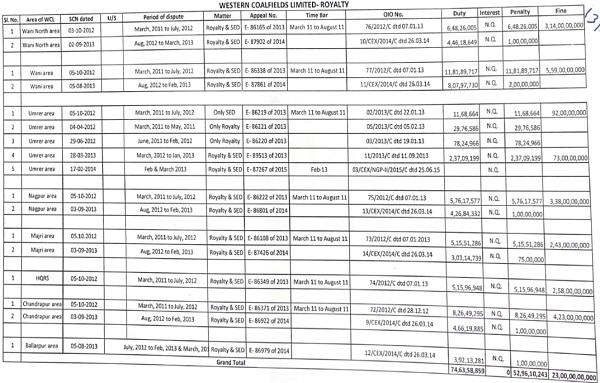
3.4 To strengthen the case of the appellants, that the impugned orders cannot be sustained on merits, learned Counsel has relied upon the following orders passed by the various judicial forums:
i. Mineral Area Development Authority Vs. Steel Authority of India – (2024) 21 Centax 313 (S.C.)
ii. Central Coalfields Limited Vs. Principal Commissioner of CGST & Central Excise – 2026 SCC Online CESTAT
iii. Indsur Global Ltd. Vs. Union of India – 2014 (310) E.L.T. 833 (Guj.)
iv. Nandan Auto Tech Limited Vs. Commissioner of Central Excise – (2024) 19 Centax 268 (P&H)
v. Commissioner of Central Excise Vs. Saurashtra Cement Limited – 2010 (260) E.L.T. 71 (Guj.)
vi. Mercedes Benz India Private Limited Vs. Commissioner of Central Excise, Pune – 2018 (364) E.L.T. 226 (Tri. – Mum)
(vi) Central Board of Dawoodi Bohra Community Vs. State of Maharashtra – (2005) 2 SCC 673
vii. Union of India Vs. Kamalakshi Finance Corporation Ltd. – 1991 (55) E.L.T. 433 (S.C.)
viii. East India Commercial Co. Ltd., Calcutta and Another Vs. Collector of Customs, Calcutta – 1962 SCC Online SC 142
ix. United Sprits Limited Vs. State of Maharashtra – 2022 SCC Online Bom 941.
4. On the other hand, learned Special Counsel appearing for Revenue submitted that on the basis of statutory provisions of Section 4(3)(d) of Central Excise Act, 1944, transaction value includes amount related to the sale of coal except excise duty, sales tax and other taxes. Since the Hon’ble Supreme Court in the case of Civil Appeal No.4056-4064 of 1999 have held that royalty is not a tax, as it is a contractual consideration paid by the mining lessee to the lessor for enjoyment mineral rights, the same is includable in the assessable value. He further claimed that imposition of SED under Section 6 of the Coal Mines (Conservation and Development) Act, 1974 is also not a tax and therefore, no deduction on account of SED is permissible under Section 4 of the Act of 1944. Learned Special Counsel also reiterated the findings of the learned Commissioner in the impugned orders with respect to confirmation of interest, penalty and for imposition of redemption fine upon confiscation of goods.
5. Heard both sides and perused the case records. We have also examined the arguments advanced by the learned Counsel appearing for the appellants and the learned Special Counsel for the Department. Further, we have also perused the additional written submissions in the form of paper books submitted in this case, by both sides.
6. The issue that arises for consideration before the Tribunal in these appeals are as follows:
i. whether the ‘Royalty’ payable under Section 9 of the Mines and Minerals (Development and Regulation) Act, 1957; and Stowing Excise Duty (SED) leviable under Section 6 of the Coal Mines (Conservation and Development) Act, 1974, forms part of ‘transaction value’, as provided under Section 4 (3)(d) of the Central Excise Act, 1944 or otherwise?
ii. whether confirmation of central excise duty demands under the provisions of Sections 11A(1) / 11A(4) of the Act of 1944, along with interest payable on delayed payment under Section 11AA ibid; and imposition of penalty under Rule 25 of the Central Excise Rules, 2002 in the impugned orders, are sustainable in law.
The period of dispute involved in the present appeals relates to March, 2011 to March, 2013.
7.1 In the impugned orders, learned Commissioner has recorded his findings on the disputed issue, for not allowing deduction of ‘Royalty’ and ‘Stowing Excise Duty’ (SED) from the transaction value defined under Section 4(3)(d) of the Central Excise Act, 1944 and for demand of central excise duty by including such royalty charges and SED on the following grounds. The relevant paragraphs in the illustrative impugned order dated 28.12.2012 are quoted herein below:
“14.8 The contention Raised by the Noticee in relation to “royalty” as a tax thus does not hold good in view of the decision of the Apex court in re Kesoram Industries Ltd. (supra). The issue is well settled. Accordingly, I hold that amount recovered by the Noticee under the nomenclature “royalty” is not a tax and hence the said amount does not qualify for deduction from “transaction value” and that such amount shall form part of assessable value for levy of excise duty on coal in terms of section 4(1) of the Central Excise Act, 1944.
15. The Noticee has also charged amounts from its buyers under the nomenclature “Stowing Excise Duty”. The said amount is collected from buyers for payment under the Coal Mines (Conservation and Development) Act, 1974. The purpose and objective of the said Act is regulation and development of coal mines. The Coal Mines (Conservation and Development) Act, 1974 aim for conservation of coal and regulation of stowing activity. The Noticee recovers this charge as part of price of coal from customers and claims to pay the same to the Coal Controller, Kolkata on the basis of quantity of dispatches of non-coaking coal or sand stowed in the void left after excavation of coal in the mines. There is a clear distinction between the general subjects of legislation and heads of taxation and the same are enumerated separately in the scheme of the lists in the Seventh Schedule of the Constitution. It is well settled that the power of ‘regulation and control’ is separate and distinct from the power of ‘taxation’. I find that the charge designated as “Stowing Excise Duty” in terms of the Coal Mines (Conservation and Development) Act, 1974 is for the purpose of conservation development of mines. It is not in the nature of ‘tax’ as understood in the constitution and the laws of the land. The Noticee has canvassed that it is compulsory excavation and therefore in the nature of tax. There are several imposts or levies which may be compulsory, but that does not determine the nature of such levy as a tax. It would be required to be established that such levy is an exercise of powers of imposition of a tax and not otherwise. In the facts and circumstance of the case in hand, the contention raised by the Noticee does not hold good. Accordingly, I hold that “Stowing Excise Duty” is not a tax and the amount collected under the nomenclature “Stowing Excise Duty” does not qualify for deduction from “transaction value” and such amount shall form part of the assessable value for levy of excise duty on coal in terms of section 4(1) of the Central Excise Act, 1944.”
7.2 The relevant provisions with respect of valuation of excisable goods for the purposes of charging Central Excise Duty as provided under Section 4 of the Central Excise Act, 1944, the true meaning and purport of ‘transaction value’ for the purpose of charging the excise duty thereon; and the related other legislations are extracted herein below:-
Central Excise Act, 1944
“Section 4. Valuation of excisable goods for purposes of charging of duty of excise.
(1) Where under this Act, the duty of excise is chargeable on any excisable goods with reference to their value, then, on each removal of the goods, such value shall—
a. in a case where the goods are sold by the assessee, for delivery at the time and place of the removal, the assessee and the buyer of the goods are not related and the price is the sole consideration for the sale, be the transaction value;
b. in any other case, including the case where the goods are not sold, be the value determined in such manner as may be prescribed.
xxx xxx xxx xxx
(3) For the purposes of this section,—
(a) “assessee” means the person who is liable to pay the duty of excise under this Act and includes his agent;
xxx xxx xxx xxx
(d) “transaction value” means the price actually paid or payable for the goods, when sold, and includes in addition to the amount charged as price, any amount that the buyer is liable to pay to, or on behalf of, the assessee, by reason of, or in connection with the sale, whether payable at the time of the sale or at any other time, including, but not limited to, any amount charged for, or to make provision for, advertising or publicity, marketing and selling organization expenses, storage, outward handling, servicing, warranty, commission or any other matter; but does not include the amount of duty of excise, sales tax and other taxes, if any, actually paid or actually payable on such goods.”
Section 11AA.Interest on delayed payment of duty.
1 Notwithstanding anything contained in any judgment, decree, order or direction of the Appellate Tribunal or any court or in any other provision of this Act or the rules made thereunder, the person, who is liable to pay duty, shall, in addition to the duty, be liable to pay interest at the rate specified in sub-section (2), whether such payment is made voluntarily or after determination of the amount of duty under section 11A.
2 Interest, at such rate not below ten per cent and not exceeding thirty-six per cent per annum, as the Central Government may, by notification in the Official Gazette, fix, shall be paid in terms of section 11A after the due date by the person liable to pay duty and such interest shall be calculated from the date on which such duty becomes due up to the date of actual payment of the amount due.
3 Notwithstanding anything contained in sub-section (1), no interest shall be payable where—
a the duty becomes payable consequent to the issue of an order, instruction or direction by the Board under section 37B; and
b such amount of duty is voluntarily paid in full, within forty-five days from the date of issue of such order, instruction or direction, without reserving any right to appeal against the said payment at any subsequent stage of such payment
Mines and Minerals (Development and Regulation) Act, 1957
“Section 9. Royalties in respect of mining leases.
1 The holder of a mining lease granted before the commencement of this Act shall, notwithstanding anything contained in the instrument of lease or in any law in force at such commencement, pay royalty in respect of any mineral removed or consumed by him or by his agent, manager, employee, contractor or sub-lessee from the leased area after such commencement, at the rate for the time being specified in the Second Schedule in respect of that mineral.
2 The holder of a mining lease granted on or after the commencement of this Act shall pay royalty in respect of any 4[mineral removed or consumed by him or by his agent, manager, employee, contractor or sub-lessee from. the leased area at the rate for the time being specified in the Second Schedule in respect of that mineral.
xxx xxx xxx xxx
SECOND SCHEDULE
(See Section 9)
RATES OF ROYALTY IN RESPECT OF MINERALS AT ITEMS
1 TO 9, 11 TO 40 AND 42 TO 55
xxx xxx xxx xxx
10. COAL:
A. Coal produced in all the States and Union territories except the State of West Bengal.
(1) Royalty on Coal:
The rate of royalty on coal shall be @ 14% (Fourteen percent.) ad-valorem on price of coal, as reflected in the invoice, excluding taxes, levies and other charges.
Provided that for the coal produced from the coal blocks or mines auctioned for the purpose of sale of coal (commercial mining), the rate of royalty @ 14% (Fourteen percent.) ad-valorem shall be calculated on the notional price or the actual price, whichever is higher.”
Coal Mines (Conservation and Development) Act, 1974.
Section 3. Definitions.—In this Act, unless the context otherwise requires,— (j) “stowing” means the operation of filling, with sand or any other material, or with both, spaces left underground in a coal mine by the extraction of coal;
CHAPTER II
PROVISIONS RELATING TO CONSERVATION OF COAL AND
DEVELOPMENT OF COAL MINES
Section 4. Power of Central Government in respect of conservation of coal and development of coal mines.—
(1) The Central Government may, for the purpose of conservation of coal and for the development of coal mines, exercise such powers and take, or cause to be taken, such measures as it may deem necessary or proper or as may be prescribed.
(2) Without prejudice to the generality of the foregoing power, the Central Government may, by order in writing addressed to the owner, agent or manager of a coal mine, require him to take such measures as it may think necessary for the purpose of conservation of coal or for development of coal mines, including—
a. in any coal mine, stowing for safety, or
b. the prevention of any factor which may adversely affect the conservation of coal or development of coal mine, or
c. washing of coal with a view to beneficiating and reducing the ash-contents of coal.
(3) The Central Government may, if it is satisfied after consideration of all the facts and circumstances that the recovery of the cost of measures, if any, undertaken by it under sub-section (1) or sub-section (2) in relation to a coal mine is justified, recover such cost from the owner, agent or manager of the coal mine, either wholly or partly, in the same manner as an arrear of land revenue.
Section 6. Imposition of excise duties.—
1 With effect from the appointed day, there shall be levied and collected on all coal raised and dispatched, and on all coke manufactured and dispatched, from the collieries in India, such duty of excise, not exceeding rupees ten per tonne, as may be fixed from time to time by the Central Government by notification, and different rates of duty may be levied on different grades or description of coal or coke:
Provided that the Central Government may, by general or special order, exempt any special grade or grades or description of coal or coke from the levy of such duty of excise.
2 For the purposes of sub-section (1), coal shall be graded by the Central Government in accordance with such specifications as may be laid down by that Government from time to time.
3. All notifications issued under this section shall be laid, as soon as may be, before both Houses of Parliament.
Section 7. Imposition of customs duty.—
During the period in which any duty of excise is being levied under section 6, the Central Government may, by notification, impose on all coal (including soft and hard coke), imported or brought into India from any place outside India, a duty of customs (which shall be in addition to any duty of customs for the time being leviable under any other law), at the rates equivalent to the rates of duty of excise levied under section 6.
Section 8. Collection of excise duties.—
1 The duties of excise levied under section 6 shall be collected by such agencies and in such manner as may be prescribed.
2. Where any duty of excise referred to in sub-section (1) cannot be collected in the manner prescribed under that sub-section, it shall be recovered from the owner of the coal mine in the same manner as an arrear of land revenue.”
We also find that in exercise of the powers conferred on the Central Government, the Ministry of Energy (Department of Coal) had issued Notification S.O. No.727(E) dated 25.06.2003, specifying the rate of stowing excise duty per tonne @ Rs.10.00/- for Coking/non-coking coal. The extract of the same is quoted below:
7.3 On perusal of the above statutory provisions, it transpires that a holder of a mining lease shall pay royalty in respect of any mineral removed or consumed by him or by his agent, manager, employee, contractor or sublessee from the leased area, at the rate for the time being specified by the Central Government in the Second Schedule to the Mines and Minerals (Development and Regulation) Act, 1957, in respect of that mineral. The rate at which the royalty charges are payable has also been specified in the Second Schedule to the said Act of 1957. In respect of ‘coal’, the said Second Schedule to the Act of 1957 has specified the rate of royalty as 14% ad valorem. Therefore, it is clearly flowing from the above legal provisions that royalty is a contractual consideration, that is required to be paid by the mining lessee to the lessor for enjoyment of mineral rights. Though, the form and manner of payment of royalty and its collection involves the Government authorities, but it is clearly distinguishable from the levy of a tax, under a statute designed by the Parliament. In this regard, we find that the Hon’ble Supreme Court in the case of Mineral Area Development Authority & Another (supra), in Civil Appeal Nos. 4056-4064 of 1999 has clearly held as under:
“J. Conclusions
342. In view of the above discussion, we answer the questions formulated in the reference in terms of the following conclusions:
a. Royalty is not a tax. Royalty is a contractual consideration paid by the mining lessee to the lessor for enjoyment of mineral rights. The liability to pay royalty arises out of the contractual conditions of the mining lease. The payments made to the Government cannot be deemed to be a tax merely because the statute provides for their recovery as arrears;…”
7.4 The issue, whether the judgement in the case of Mineral Area Development Authority & Another (supra), should be given the prospective effect or otherwise, has been discussed in the subsequent judgement dated 14.08.2024 by the same Bench of the Hon’ble Supreme Court, holding as under:
“ D. A pragmatic solution to reconcile the conflicting interests
13. In India Cement (supra), a Bench of seven Judges of this Court held that royalty is tax. Resultantly, it was held that the State legislatures have no legislative competence to impose cess on royalty under Entries 23 and 50 of List II. Fifteen years later, a Constitution Bench in Kesoram (supra) held that royalty is not a tax. It was further held that the power to levy tax on mineral rights vests with the State legislatures and is subject to any limitations laid down by Parliament by law relating to mineral development. Given this divergence, a reference was made to a larger Bench. MADA (supra) has laid down the principles for interpreting Entry 54 of List I and Entries 23 and 50 of List II. In the process, this Court overruled India Cement (supra).
14. The doctrine of prospective overruling has been applied by this Court in situations where the new declaration results in the invalidation of legislation, which would otherwise have been valid under the old declaration. 1The doctrine has also been used where this Court has declared a legislation as ultra vires. 2In the case of taxing statutes, such a declaration would make the State liable to refund all amounts collected under the invalid legislation. Therefore, this Court declares the new rule to apply prospectively not only to secure the revenues of the State but also to protect the rights and obligations crystallized by persons and entities under the old regime.3
xxx xxx xxx xxx
20. After India Cement (supra), Parliament enacted the Cess and Other Taxes on Minerals (Validation) Act 1992 to validate the imposition and collection of taxes on minerals made under the State legislations before 1991. The Central Government also increased the rates of royalty to compensate the States for the loss of mineral revenues. 4The recalibration of the royalty rates protected the States from the amount lost due to the abolition of cess on minerals and mineral rights. The assesses submit that in the interregnum they have structured their commercial bargains in terms of the prevalent law. Subsequently, Kesoram (supra) took a view that diverged from the ruling in India Cement (supra). Kesoram (supra) is an operative fact based on which many State legislatures have already enacted taxing statutes. A pragmatic solution to reconcile the financial interests of the States and the assesses can be achieved by proscribing the States from demanding taxes pertaining to Entries 49 and 50 of List II of the Seventh Schedule for the period before Kesoram (supra).
xxx xxx xxx xxx
22. The total amount, that is the principal plus the interest, due by the assesses in the pending matters may be substantial in comparison to their total net worth. Steel Authority of India has stated on affidavit that retrospective application of MADA (supra) will lead to revival of cumulative demands to the tune of approximately Rupees three thousand crores from different States. The delay in the court proceedings should not be to the detriment of the assesses.5 Taking into consideration the lapse of more than three decades since India Cement (supra) and more than a decade since the matter was referred to a larger Bench, equities will be balanced if the State governments waive the outstanding interest accrued on the principal due from the assesses. This direction applies to all assesses, regardless of whether they have approached this Court or the High Courts challenging the validity of the relevant statutes.
23. During the proceedings, the Solicitor General submitted that a few States do not wish to collect the dues accrued before the decision in MADA (supra). It is the prerogative of the State legislatures to determine whether to forego the dues for the period before 25 July 2024.
E.Conclusion
24. The submission that MADA (supra) should be given prospective effect is rejected.
25. Bearing in mind the consequences that would emanate from the past period, the following conditionalities are directed to prevail:
a. While the States may levy or renew demands of tax, if any, pertaining to Entries 49 and 50 of List II of the Seventh Schedule in terms of the law laid down in the decision in MADA (supra) the demand of tax shall not operate on transactions made prior to 1 April 2005;
b. The time for payment of the demand of tax shall be staggered in instalments over a period of twelve years commencing from 1 April 2026; and
c. The levy of interest and penalty on demands made for the period before 25 July 2024 shall stand waived for all the assesses.”
8. Section 6 of the Coal Mines (Conservation and Development) Act, 1974 provides for a specific levy of excise duty on all coal raised, dispatched and their collection. Therefore, it clearly flows from the above legal provisions that there is a levy imposed by the Central Government with due approval of the Parliament and therefore, the Stowing Excise Duty is in the nature of duty / cess. It also transpires from the legal provisions of Section 4 of the Act of 1944 that for the purpose of charging of central excise duty, the assessable value of goods is determined from the transaction value, which is the price paid or payable for each removal of goods, and the same does not include the amount of duty of excise, sales tax and other taxes actually paid or payable. Therefore, it also flows from the above, that the ‘Royalty’ which is not a tax, is includable in the assessable value for having been received by the appellants as part of the sale proceeds from their customers; and, the ‘Stowing Excise Duty’ which is a specific levy of duty of excise is not includable in the assessable value and thus, there is no levy of central excise duty on such amount of SED recovered from the customers by the appellants.
9.1 We also find that in the case of South Eastern Coalfields Limited (supra), the Co-ordinate Bench of the Tribunal has held that levy of central excise duty on the amount received towards royalty is confirmed for the normal period of limitation and the demand of central excise duty on Stowing Excise Duty was set aside. The relevant paragraphs of the said order are quoted below:
“19. The issue that now arises for consideration is whether the amount received by the appellant under ‘b’ to ‘g’ of the chart is also includible in the definition of “other taxes” under section 4(3)(d) of the Central Excise Act. Each of these heads would be considered separately.
Stowing Excise Duty
20. Stowing Excise Duty is levied under the Coal Mines (Conservation and Development) Act, 1974 read with the Coal Mines (Conservation and Development) Amendment Rules 2011. The Preamble to the said Act states that it has been enacted to provide for the conservation of coal and development of coal mines and for matters connected therewith or incidental thereto.
21. Section 6 deals with imposition of excise duties and sub-section (1) provides that: “Section 6(1) With effect from the appointed day there shall be levied and collected on all coke raised and dispatched, and on all the coal manufactured and dispatched, from the collieries in India, such duty of excise, not exceeding rupees ten per tonne, as may be fixed from time to time by the Central Government by notification, and different rates of duty may be levied on different grades or description or coal or coke.
Provided that the Central Government may, by general or special order, exempt any special grade or grades or description of coal or coke from the levy of such duty of excise.”
22. Section 8 of the Act provides that the duty of excise levied under section 6 shall be collected by such agencies and in such manner as may be prescribed. Section 9 of the Act deals with utilization of proceeds of duties levied and collected under section 6 and section 7 of the Act. Chapter III of the Coal Mines (Conservation and Development) Amendment Rules 2011 deals with collection of excise duty. Rule 8
provides for collection and assessment of excise duty while rule 9 provides for the review of assessment of excise duty.
23 This issue was examined by the Tribunal in Eastern Coalfields Ltd. Commr. of Central Excise . It was held that stowing excise duty is a duty of excise and, therefore, has to be excluded from the transaction value under the exclusion clause of “other taxes” as contemplated under section 4(3)(d) of the Central Excise Act. The relevant portion of the decision is reproduced below:
“38. We have seen the earlier paragraphs that the levy is being termed as ―Duty of Excise‟ and also being treated as such. It is also not disputed that in the case of the goods in question, the Stowing Excise Duty is being paid by the appellant. The Revenue cannot take a contorted and narrow view that only when the Duty of Excise is paid as Central Excise Duty, such exclusion is available. It is to be noted that the word used is “duty of excise‟ along with “sales tax‟ and “other taxes‟, which would clarify that if these are paid to State Govt or to any other agency also, the transaction value should exclude the same. Considering these provisions, we set aside the confirmed demand in respect of the Stowing Excise Duty and allow the Appeals.”
24. It has, therefore, to be held, in view of the aforesaid decision of the Tribunal, that the amount received by the appellant towards the stowing excise duty has to be excluded from the transaction value. The Commissioner, therefore, committed an error in holding that it would be includible in the transaction value.
xxx xxx xxx xxx
66. The contention of the appellant that it bonafide believed that it was not liable to pay excise duty on the amount of royalty and also on the other amount mentioned from ‘b’ to ‘g’ of the chart deserves to be accepted. At the relevant time the judgment of the Supreme Court in India Cement did hold that royalty was in the nature of tax and, therefore, in terms of section 4(3)(d) of the Central Excise Act, the amount of royalty was not required to be included in the transaction value. It is subsequently that the judgment of the Supreme Court in India Cement was reversed by the Supreme Court in Mineral Area Development Authority and it was held that royalty is not in the nature of a tax. In respect of the amount collected from Serial No. ‘b’ to ‘g’ of the chart, it has been found that they are in the nature of “other taxes” contemplated under section 4(3)(d) of the Central Excise Act.
67. It can, therefore, safely be said that the appellant, a Government of India undertaking, could have bonafide believed that it was not liable to pay central excise duty and, therefore, there cannot be any intent to evade payment of duty.
68. The extended period of limitation, therefore, could not have been invoked in the facts and circumstances of the case.
xxx xxx xxx xxx
Conclusion
i. Levy of central excise duty on the amount received towards royalty is confirmed for the normal period of limitation, as this amount is includible in the transaction value. It is set aside for the extended period of limitation. However, even for the normal period, the imposition of penalty and demand of interest is set aside; and
ii. The demand of central excise duty on Stowing Excise Duty, Forest Transit Fees, Madhya Pradesh Rural Infrastructure and Road Tax Entry Tax, Terminal Tax and CG Development and Environment Cess and captive consumption is set aside. Accordingly, the imposition of penalty and interest are also set aside.”
9.2 Furthermore, we also find that in the case of one another subsidiary company of the appellants i.e., M/s Eastern Coalfields Limited Vs. Commissioner of Central Excise, Bolpur, the Co-ordinate Bench of the Tribunal vide Final Order No. 75656-75666/2025 dated 11.03.2025, has allowed the appeal in favour of the appellant on identical set of facts, by relying upon the judgement of the Hon’ble Supreme Court in the case of Mineral Area Development Authority & Others (supra). In the aforesaid order, the Tribunal has held that in respect of the confirmed demand on account of the Royalty component, the appellant is required to discharge the same along with interest, as per law. However, it was held that confirmation of the demand for the extended period of limitation is not legally sustainable.
10.1 The question of liability to pay interest in respect of delayed payment of central excise duty, arises for various reasons viz., confirmation of demand and recovery of non-levy or short levy or non-payment or short payment; delay beyond the prescribed time frame for payment of duty etc. Section 11AA of the Act of 1944 provides for payment of interest on delayed payment of central excise duty. Sub-section (1) of Section 11 ibid starts with the non-obstante clause, providing that no effect shall be made on the basis of any judgement, decree, order or direction of the Appellate Tribunal or any Court, or in any other provision of the Act of 1944 or the rules made thereunder; and the person liable for payment of central excise duty, shall, in addition to the duty, be liable to pay interest at the specified rate; whether such payment is made voluntarily or after determination of the amount of duty under Section 11A ibid. In other words, wherever the central excise duty has not been paid within the stipulated time frame, then interest liability is automatic for compensating the Government for the period of delay i.e., between the date on which such duty becomes due, and upto the date of actual payment of such duty. Therefore, the legislative intent behind Section 11AA ibid is manifest that wherever there is delay in payment of central excise duty, such delay should be compensated by way of payment of interest.
10.2 Upon careful reading of the judgement dated 14.08.2024 delivered by the Hon’ble Supreme Court, in the case of Mineral Area Development Authority & Another (supra), it becomes clear that the direction was given by the Hon’ble Supreme Court to the State Governments, to waive the outstanding interest accrued on the principal due from the assessees in respect of royalty under Mines and Minerals (Development and Regulation) Act, 1957. Since, there is no specific provisions being made in Section 11AA of the Act of 1944 for waiving the interest, we are of the considered view that the liability to pay interest in respect of delayed payment of central excise duty under the Act of 1944, is required to be paid by the appellants in these appeals before us inasmuch as, the said statutory provision is amply clear that interest liability is automatic, when the duty liability has not been discharged within the stipulated time frame.
10.3 In this regard, we also find that the Hon’ble Supreme Court in the case of Associated Cement Company Limited Vs. Commercial Tax Officer, Kota & Others – AIR 1981 SUPREME COURT 1887 & (1981) 4 SCC 578, have held that payment of interest is an existing liability at the relevant point of time, when the tax/duty is liable to be paid, and that interest claimed on unpaid tax dues could be charged as it was compensatory in character and not penal in nature. The relevant paragraphs of the said judgement are quoted below:
“42. We are of the view that the statutory liability under S. 11B (a) arises wherever there is default in payment of the tax within the period allowed by law irrespective of any doubt which an assessee may be entertaining about the liability to pay the tax.
43. It is not disputed in this case that freight charges had to be included in the taxable turnover of the assessee mentioned in the return that were filed within the prescribed time under S. 7(1) of the Act and that the tax payable in respect of freight charges should have been paid as required by sub-s. (2) of S. 7 before the returns were filed. The fact that the question relating to the liability of the assessee to pay sales tax in respect of the freight charges was decided by the Supreme Court subsequently does not in any way affect the question which arises for consideration in this case. The decision of this Court did not create any new liability, It only declared that such a liability was existing at the relevant point of time. Since it is clear that the amount of tax due in respect of the freight charges which was payable under sub-section (2) of S. 7 was not paid within the period allowed, S. 11B is clearly attracted and the liability to pay interest as required by it arises.”
10.4 Further, we also find that the Hon’ble Supreme Court in the case of J.K. Synthetics Limited Vs. Commercial Tax Officer – (2026) 41 Centax 451 (S.C.), has held that payment of interest is to compensate for the loss occasioned to the Revenue due to delay caused in making payment of tax/ duty. The relevant paragraph of the said judgement is quoted herein below:
“16. It is well-known that when a statute levies a tax it does so by inserting a charging section by which a liability is created or fixed and then proceeds to provide the machinery to make the liability effective. It, therefore, provides the machinery for the assessment of the liability already fixed by the charging section, and then provides the mode for the recovery and collection of tax, including penal provisions meant to deal with defaulters. Provision is also made for charging interest on delayed payments, etc. Ordinarily the charging section which fixes the liability is strictly construed but that rule of strict construction is not extended to the machinery provisions which are construed like any other statute. The machinery provisions must, no doubt, be so construed as would effectuate the object and purpose of the statute and not defeat the same. (See Whitney v. IRC 1926 AC 37: 42 TLR 58, CIT v. Mahaliram Ramjidas [1940] 8 ITR 442 (PC): AIR 1940, PC 124: 67 IA 239, India United Mills Ltd. v. Commissioner of Excess (1955) 1 SCR 810: AIR 1955 SC 79: [1955] 27 ITR 20 (SC), Profits Tax, Bombay and Gursahai Saigal v. CIT, Punjab (1963) 3 SCR 893: AIR 1963 SC 1062: [1963] 48 ITR 1 (Bombay)). But it must also be realised that provision by which the authority is empowered to levy and collect interest, even if construed as forming part of the machinery provisions, is substantive law for the simple reason that in the absence of contract or usage interest can be levied under law and it cannot be recovered by way of damages for wrongful detention of the amount. (See Bengal Nagpur Railway Co. Ltd. v. Ruttanji Ramji AIR 1938 PC 67: 65 IA 66: 67 CLJ 153 and Union of India v. A.L. Rallia Ram (1964) 3 SCR 164, 185-90: AIR 1963 SC 1685). Our attention was, however, drawn by Mr Sen to two cases. Even in those cases, CIT v. M. Chandra Sekhar (1985) 1 SCC 283: 1985 SCC (Tax) 85: [1985] 151 ITR 433 (SC) and Central Provinces Manganese Ore Co. Ltd. V. CIT (1986) 3 SCC 461: 1986 SCC (Tax) 601: [1986] 160 ITR 961 (SC), all that the Court pointed out was that provision for charging interest was, it seems, introduced in order to compensate for the loss occasioned to the Revenue due to delay. But then interest was charged on the strength of a statutory provision, may be its objective was to compensate the Revenue for delay in payment of tax. But regardless of the reason which impelled the Legislature to provide for charging interest, the Court must give that meaning to it as is conveyed by the language used and the purpose to be achieved. Therefore, any provision made in a statute for charging or levying interest on delayed payment of tax must be construed as a substantive law and not adjectival law. So construed and applying the normal rule of interpretation of statutes, we find, as pointed out by us earlier and by Bhagwati, J. in the Associated Cement Co. case, that if the Revenue’s contention is accepted it leads to conflicts and creates certain anomalies which could never have been intended by the Legislature”
11. In view of the foregoing discussions and analysis, and on the basis of the judgements delivered by the Hon’ble Supreme Court referred supra, we are of the considered view that the central excise duty demands confirmed under Section 11A of the Act of 1944 for non-inclusion of ‘Royalty’ payments in the assessable value of ‘coal’ for the purpose of levy of central excise duty, for the normal period of limitation alone sustains, along with the interest payable thereon under Section 11AA ibid. Accordingly, the demand of central excise duty confirmed in the impugned orders by invoking the extended period of limitation in respect of ‘royalty’ and the entire demands in respect of ‘stowing excise duty’ along with consequential penalty and redemption fine are set aside. Since part of the duty demands that are sustained in our above order and consequential interest liability thereon, are required to be re-quantified by the learned adjudicating authority, we consider it appropriate to remit the matter back to him, only for the limited purpose of demanding the central excise duty liable to be paid by the appellants along with interest thereon for the normal period.
12. The appeals filed by the appellants are disposed of in above terms.
(Order pronounced in the open court on 16.11.2026)