Geetanshu Aggarwal Vs Commissioner of Customs (Preventive) (CESTAT Kolkata)
Summary: The Customs, Excise and Service Tax Appellate Tribunal (CESTAT), Kolkata, considered three connected appeals filed by Geetanshu Aggarwal, Dharmender Kumar Jha and Tirlok Singh against the absolute confiscation of 3,152.900 grams of gold valued at ₹1,66,31,547, confiscation of ₹97,000 in Indian currency and penalties imposed under Section 112(a)/(b) of the Customs Act, 1962. Acting on intelligence alleging that gold smuggled from Bangladesh was being transported to Delhi, officers of the Directorate of Revenue Intelligence intercepted the appellants at Howrah Railway Station on 16 March 2022. The officers recovered 15 gold bars, biscuits and cut pieces from their possession. The adjudicating authority ordered absolute confiscation and imposed penalties of ₹10 lakh each on Tirlok Singh and Geetanshu Aggarwal and ₹5 lakh on Dharmender Kumar Jha. The Commissioner (Appeals) upheld the order on 27 December 2024, leading to the appeals before the Tribunal.
The appellants challenged the confiscation on the ground that the seized gold bore no foreign markings and that the Department had failed to establish its alleged foreign origin. They contended that their initial statements, recorded on 16 and 17 March 2022, had been obtained under threat and coercion and were subsequently retracted through a prison petition dated 23 March 2022 and communications dated 20 April 2022. The appellants also submitted documentary evidence supporting domestic ownership. Tirlok Singh relied on an invoice dated 15 March 2004 showing purchase of gold by his mother, Krishna Devi. Geetanshu Aggarwal relied on his mother’s declaration concerning ancestral jewellery, documents relating to the Voluntary Disclosure of Income Scheme and a declaration from his father. Dharmender Kumar Jha explained that the gold had passed through his family and produced an affidavit supporting its ownership. The Tribunal noted that the adjudicating and appellate authorities had neither adequately considered nor controverted these materials.
Examining the seizure, the Tribunal observed that the gold consisted of pieces of non-standard weights, with purity below 99.9%, and did not bear foreign markings. The goods had not been recovered from a customs bonded area or a specified area under Section 11H of the Customs Act. Referring to Notification No. 31/2008-Customs (N.T.), the Tribunal also noted that Howrah Railway Station was situated more than 150 kilometres from the Bangladesh international border. No independent evidence established that the seized gold had been brought from Bangladesh or any other foreign country. The Tribunal held that foreign origin could not be established through assumptions or presumptions and that the domestic procurement evidence produced by the appellants had not been disproved.
On the applicability of Section 123, the Tribunal explained that the burden of proving that gold is not smuggled shifts to its possessor or owner only when the goods are seized on a reasonable belief that they are smuggled. The mere absence of purchase documents at the moment of interception did not automatically establish smuggling, particularly when supporting evidence was produced subsequently. Since the Revenue had not established the required reasonable belief and the appellants’ evidence remained unrebutted, the Tribunal held that Section 123 was inapplicable. It further concluded that confiscation under Sections 111(b) and 111(d) could not be sustained without proof that the gold was imported or smuggled. The Tribunal referred to judicial decisions concerning the evidentiary requirements for confiscation and the burden of proof in gold-seizure cases.
The Tribunal also examined the penalties under Section 112(a)/(b) and found that the essential ingredients for imposing them had not been established. There was no specific finding demonstrating the appellants’ knowledge, conscious involvement or conduct rendering the goods liable to confiscation. Relying on the principles governing penalty under Section 112, the Tribunal held that the penalties were unsustainable. It separately considered the confiscation of ₹97,000 under Section 121 as alleged sale proceeds of smuggled gold and found no supporting evidence. Consequently, the Tribunal set aside the confiscation of all 3,152.900 grams of gold, the penalties imposed on the three appellants and the confiscation of ₹97,000. All three appeals were allowed with consequential relief in accordance with law.
Cases Discussed
- Kranti Associates (P) Ltd. Vs Masood Ahmed Khan, 2011 (273) E.L.T. 345 (S.C.)
- Century Textile & Ind. Ltd. Vs UOI, 2008 (232) E.L.T. 389 (Bom.)
- Commissioner of Customs Vs Sanjay Soni, 2022 (381) E.L.T. 509 (T)
- Union of India Vs Imtiaz Iqbal Pothiawala, 2019 (365) E.L.T. 167 (Bom.)
- Balanagu Naga Venkata Raghavendra Vs Commissioner of Customs, 2021 (378) E.L.T. 493 (T)
- Aadil Majeed Banday Vs Commissioner of Customs, 2021 (378) E.L.T. 540 (T)
- Principal Commissioner of Customs (Prev.), Delhi Vs Ahamed Mujjaba Khaleefa, 2019 (366) E.L.T. 337 (T)
- Commissioner of Customs (Prev.), Shillong Vs Manisha Devi Jain, 2019 (370) E.L.T. 401 (T)
- Commissioner of Customs Vs Trinetra Impex Pvt. Ltd., 2020 (372) E.L.T. 332 (Del.)
FULL TEXT OF THE ORIGINAL JUDGMENT/ORDER
All the three appeals are filed against the Order- in-Appeal No. Kol/Cus/CCP/KS/708-710/2024 dated 27.12.2024 passed by the Commissioner of Customs (Appeals) 3RD Floor Customs House, 15/1, Strand Road, Kolkata-700 001.
1.1. Customs appeal No. C/75166/2025 has been filed by Mr. Geetanshu Aggarwal, wherein he prayed for setting aside the absolute confiscation of the gold seized from him and the penalty imposed on him.
1.2. Customs Appeal No. C/75167/2025 has been filed by Mr. Dharmender Kumar Jha, wherein he prayed for setting aside the absolute confiscation of the gold seized from him and the penalty imposed on him.
1.3. Customs Appeal No.C/75211/2025 has been filed by Mr. Tirlok Singh, wherein he prayed for setting aside the absolute confiscation of the gold seized from him and the penalty imposed on him.
1.4. All the three appeals emanate from the same Order-in-Appeal dated 27.12.2024 and hence they are taken up together for decision by a common order.
2. The facts of the case are that on the basis of intelligence that three person by name Sh. Tirlok Singh, Sh. Geetanshu Aggarwal and Sh. Dharmender Kumar Jha (herein after referred as the appellants), were carrying huge quantity of smuggled gold from Bangladesh to Delhi via 12301 Howrah-New Delhi Rajdhani Express, scheduled to leave Howrah station at 16.50 hours, the officers of Directorate of Revenue Intelligence (DRI) intercepted them at Howrah Station. The first two persons mentioned above were scheduled to travel in coach A3 and Shri. Dharmender Jha was scheduled to travel in coach A5.
2.1. On their personal search, total 15 pieces of rectangular shaped yellow colour metallic bar, biscuits and cut pieces weighing 3152.900 grams, valued at Rs. 1,66,31,547/- believed to be of gold pieces of foreign origin smuggled into India, were recovered. The details of the goods seized are detailed as below:
| SNo . | CESTAT Appeal No. & name of appellant | Quantit y of gold & cash seized – RUD No. to SCN | Value of gold seized | Numb er of pcs . Seized |
|---|---|---|---|---|
| 1. | 2. | 3. | 4. | 5. |
| 1. | C/75166/20 25 Geetanshu Aggarwal |
1112.750 gms and Cash Rs.97,000/- – RUD- A3 |
58,69,756/- | 13 |
| 2. | C/75167/2025 Dharmender Kumar Jha | 872.910 gms – RUD- A3 | 46,04,600/- | 1 |
| 3. | C/75211/2025 Tirlok Singh | 1167.240 gms – RUD- A3 | 61,57,191/- | 1 |
| Total | Gold 3152.900 gms Cas h 97,000/- | 1,66,31,547/- | 15 Pcs |
2.2. The aforesaid gold was seized under the reasonable belief that the said gold was liable for confiscation, as the appellants were not in possession of any documents for the licit purchase and lawful acquisition of the said gold. The said persons were arrested on 16.03.2022 under Section 104 of Customs Act, 1962 for committing the offence under Section 135 of Customs Act, 1962.
2.3. Shri. Trilok Singh in his statement dated 16.03.2022 stated that he is running a travel agency in the name of Bajaj Tours and Travels for the last 15 years. Dharmender Kumar Jha is his employee. Both came to Kolkata and purchased the gold from one person nick named as N.B, whose address he doesn’t know. He used to sell the gold to One Mr. Pappu in Delhi and earn Rs.40,000/- to 50,000/- per Kg. Later Geetanshu Aggarwal also joined him to purchase gold from Kolkata. He does not have any document in support of the licit purchase of the gold seized from his possession. In his statement dated 17.03.2022, he admitted that the gold pieces seized from his possession were defaced so that its foreign markings are obliterated.
2.4. In his statements dated 16.03.22 and 17.03.22, Geetanshu Aggarwal stated that as instructed by Tirlok Singh, he came along with him and purchased the said gold seized from his possession from the person nick named as N.B.
2.5. In his statements dated 16.03.22 and 17.03 22, Shri Dharmendra Kumar Jha stated that he is an employee of Shri. Tirlok Singh and he came along with him to kolkata to purchase the gold.
2.6. All the three persons were arrested and remanded to judicial custody.
2.7. On 20.04.2022, two mails were received from the email addresses [email protected] and [email protected] wherein two identical letters dated 20.04.2022 purportedly signed by Shri Tirlok Singh and Shri Dharmender Jha respectively were attached. In the said letters Shri Tirlok Singh and Shri Dharmender Jha, inter alia stated that the seized gold is their ancestral property and they had taken the gold to Kolkata for making ornaments. As they could not get the proper jewellery and design of ornaments, the gold as such was brought back and the same was seized on 16.03.2022 by DRI officers. They emphasized that the seized gold is of lndian origin and requested that seized gold may be not disposed.
2.9. The appellants Shri. Tirlok Singh vide Prisoner’s Petition dt. 23.03.2022 addressed to Hon’ble Chief Metropolitan Magistrate, Calcutta through Superintendent, Jail wherein it was submitted that he is not involved in any smuggling activity, gold seized from him is of Indian origin and not smuggled in nature. The statements recorded from him was under threat, coercion which is not at all voluntary in nature.
2.10. On completion of the investigation, a SCN dated 30.08.2022 was issued to the appellants proposing confiscation of the seized gold and imposition of penalties on them for their role in the commission of the offence.
2.11. The Ld. Additional Commissioner of Customs, adjudicated the case vide Order-in-Original No. 12/ ADC/CUSP/WB/2024-25 dt. 13.06.2024, wherein he has passed the following order:
i) ordered for absolute confiscation of two pieces of gold bars and thirteen cut pieces of gold collectively weighing 3152.900 grams, valued Rs.1,66,31,548/- seized from the appellants. Indian Currency amounting to Rs. 97,000/- was confiscated, as the sale proceeds of smuggled gold, in terms of section 121 of the Customs Ac, 1962.
ii) imposed penalty of Rs. 10,00,000/-, 10,00,000/- and Rs. 5,00,000/- upon Shri Tirlok Singh, Sh. Geetanshu Aggarwal and Sh. Dharmender Kumar Jha respectively, under Section 112 (a)/(b) of the Customs Act, 1962
(iii) Five (05) number of seized mobile phones were ordered to be released.
2.13. Being aggrieved, the appellants filed appeals before the Ld. Commissioner (Appeals), Kolkata, who vide Order-in-Appeal No. KOL/CUS/CCP/ KS/708-710/2024 dt. 27.12.2024 rejected all the three appeals filed by the appellants and upheld the order-in-original. The present appeals are against the impugned Order-in-Appeal dated 27.12.2024.
3. The appellant Shri. Tirlok Singh submits that he is engaged in the business of travel agency and in brokerage work like booking of hotels for random travellers. The appellant also operate an office in the name of Jaskaran Forex Pvt. Ltd., which is primarily engaged in business of exchange of foreign currency and is also a sub-agent of Western Union Money transfer.
3.1. The gold weighing 1167.240 gram, valued at Rs. 61,57,191/- was seized on 16.03.2022 from him in Train No. 12301 – Howrah New Delhi Rajdhani Express by DRI officials, Kolkata and same has been ordered absolute confiscation vide the impugned order, on the reasonable belief that same was smuggled into India from foreign country (Bangladesh).
3.2. The appellant submits that the Ld. Adjudicating Authority failed to appreciate that seized gold neither bore any foreign marking nor any expert opinion brought on records to substantiate that impugned gold was smuggled into India from foreign country (Bangladesh).
3.3. The appellant submits that the ld. Appellate Authority passed the impugned order by relying upon the initial statements of appellants dt. 16.03.2022/17.03.2022 without giving credence to the retractions dt. 23.03.2022 & 20.04.2022. The statements dt. 16.03.2022 and 17.03.2022 of appellant were recorded under threat and coercion by the department and same was retracted. The Ld. Adjudicating Authority failed to appreciate the submissions of appellant dt. 23.03.2022 made vide Prisoner’s Petition dt. 23.03.2022 addressed to Hon’ble Chief Metropolitan Magistrate, Calcutta through Superintendent, Jail wherein it was submitted that he is not involved in any smuggling activity; gold seized from him is of Indian origin and not smuggled in nature; the statements recorded from him were not voluntary and they were forcefully recorded.
3.4. The appellant submits that pursuant to order dt. 17.03.2022 of the Hon’ble Chief Metropolitan Magistrate, Bankshall, Calcutta, the DRI officials visited the Presidency Correctional Home on 21.03.2022 for interrogation and recording of their statement; the appellant tendered his voluntary statement, however, the DRI have forced him to change his version of statement which he did not and hence the statement so tendered by the petitioner was not recorded by the DRI..
3.5. The appellant submits that the Order-in- Original is reproduction of the Show Cause Notice, passed without giving due consideration to the defenses put forth by them. Such an Order falls in the category of non-speaking order. In support of this view, the appellant relied on the decision of the Hon’ble Supreme Court in case of Kranti Associates ( P) Ltd Vs. Masood Ahmed Khan 2011 (273) ELT 345 (SC).
3.6. The appellant submits that the impugned order has been passed in defiance to principles of natural justice as submissions of appellant neither considered nor controverted. The appellant cited the decision of the Hon’ble Bombay High Court in the case of Century Textile & Ind. Ltd. vs. UOI 2008 (232) ELT 389 (Bom), wherein it has been held that if the Commissioner (Appeals) failed to consider the material which was relevant for making an order, then such an order suffers from non observance of principles of natural justice and accordingly, the impugned order was set aside.
3.7. The Ld. Adjudicating Authority incorrectly relied upon provisions of section 123 of Customs Act, 1962. In the instant case, as per the test memo report dt. 31.03.2022 of Custom House Chemical Laboratory, the purity of the seized gold is 99.6 to 99.8%. It has been alleged and held that how gold of such high purity could be extracted from purported ancestral gold ornaments / gold by the appellant. The Ld. Adjudicating Authority failed to appreciate that appellant submitted copy of invoice showing purchase of gold vide invoice No. 52 dt. 15.03.2004 of M/s Manik Jewellers, Mall Road, Ludhiana by her mother Smt. Krishna Devi. There is no finding given in the order-in-original &
impugned order with respect to procurement of impugned gold and the affidavit given by the appellant in support of the purchase of gold by his mother.
3.8. The Tribunal in the case of Commissioner of Customs Vs. Sanjay Soni 2022 (381) ELT 509 (T) held that section 123 ibid attracted only in case of gold bar having foreign marking in the absence of any explanation as to it’s licit source. Accordingly, absolute confiscation with respect to one piece of gold having foreign marking was upheld and the other four pieces of gold bars having no foreign marking and cut piece were held as not liable for confiscation.
3.9. The Hon’ble Bombay High Court in the case of Union of India Vs. Imtiaz Iqbal Pothiawala 2019 (365) ELT 167 (Bom) held that gold is a notified item under Section 123 of Customs Act, 1962. Hence, Burden of proof in case of notified goods is upon the person from whose possession the gold is seized. The burden is on the person who claims ownership of gold to prove that the seized gold is not smuggled in nature. However, Revenue should be able to establish reasonable belief that goods seized under Section 110 ibid were smuggled goods.
3.10. The Tribunal in the cases of Balanagu Naga Venkata Raghavendra Vs. Commissioner of Custom 2021 (378) ELT 493 (T) held that there neither being any admittance of smuggling nor any foreign marks on recovered gold to indicate that same of foreign origin, department could not have formed a reasonable belief as per Section 123 of Customs Act, 1962 that gold was smuggled one so as to shift burden of proof upon appellants under aforesaid section, particularly when appellant’s statements recorded by Department contradictory and purity of seized gold not as such that same to be considered as of foreign origin gold.
3.11. In the case of Aadil Majeed Banday Vs. Commissioner of Customs 2021 (378) ELT 540 (T) it has been held that the appellant never travelled from abroad to India, but was from Jammu to Sri Nagar, both place being located within India, therefore, impugned goods not have the character of imported goods. Reasonable belief as to gold being smuggled to be established first by Revenue to invoke Section 123 of Customs Act, 1962. Such reasonable belief nowhere established by Revenue. Appellant also brought on record that marking on gold in question freely available in Indian market and the gold legally imported can be purchased by any Indian. No investigation having been done to establish that goods in question are of foreign origin, provision of Section 123 ibid. not applicable. In that circumstances, absolute confiscation of gold in question is bad in law.
3.12. In view of the above submissions, the appellant Tirlok Singh prayed for setting aside the absolute confiscation of the gold seized from him and the penalty imposed on him.
3.13. In his submissions, the appellant Shri. Geetanshu Aggarwal reiterated the above submissions made by Tirlok Singh. In addition, he also submitted that the seized gold was derived from family’s old ancestral jewellery which was under the possession of his mother Smt. Mamta Aggarwal and the said fact was declared by her vide affidavit dt. 03.12.1997 wherein she had admitted that she was in possession of 1004.20 grams of gold jewellery and had paid income tax of Rs. 65,848/- and accordingly had received a certificate in terms of section 68 (2) of Voluntary Disclosure of Income Tax Scheme. The said documents were submitted to ld. Adjudicating Authority – (Internal page 35 of order-in-original refers). Further, the said gold was melted and refined to 919.84 gram of pure gold in the form of strips from which a couple of cut-pieces were obtained for its easy conveyance to Kolkata so that the same be crafted into gold jewellery of new design. Out of 1112.75 gram of seized gold, procurement of 919.84 gram of gold was from old jewellery and 193 gram of gold approx. was given to the appellant by his father Sh. Vijender Kumar Aggarwal. Declaration to this effect by appellant’s father was submitted to ld. Adjudicating Authority (internal page 36 of order-in-original refers). Thus, the appellant Geetanshu Aggarwal submitted that he has produced enough evidence for the ownership of the gold. However, the Ld. Authorities have not considered his submission and not given any findings on the submissions made by him. Accordingly, he prayed for setting aside the absolute confiscation of the gold seized from him and the penalty imposed on him.
3.14. The appellant Shri. Dharmender Kumar Jha submitted that gold weighing 872.910 gram valued at Rs. 46,04,600/- was seized from him on 16.03.2022 in Train No. 12301 – Howrah New Delhi Rajdhani Express by DRI officials, Kolkata on the reasonable belief that same were smuggled into India from Bangladesh in contravention of provisions of Customs Act and liable for confiscation under Customs Act. In this regard, the appellant submitted that vide mail dt. 20.04.2022, he has informed DRI officials that the seized gold was their ancestral property and he carried the impugned gold to Kolkata for making ornaments. The impugned gold weighing 872.910 gram, 24 carat was given by his grandfather Sh. Nikunta Jha to his father Sh. Makeshar Jha. The appellant’s father gave the impugned gold to appellant for making ornaments for distribution among his children. To this effect the appellant has filed an affidavit dt. 10.07.2023 before the Ld. Adjudicating Authority. However, no finding has been given in the impugned order against the claim made by him in the impugned order. Accordingly, he prayed for setting aside the absolute confiscation of the gold seized from him and the penalty imposed on him.
4. The Ld. A.R. reiterated the findings of the Adjudicating Authority and Appellate Authority in the impugned order. He submitted that under section 123 of the Customs Act, 1962, it is the responsibility of the person who claims ownership of the gold to prove that the gold in his possession was not smuggled in nature. In the present case, the appellants were not having any document in support of the licit purchase of the gold seized from their possession. Accordingly, he supported the absolute confiscation of the gold seized from the appellants and the penalty imposed on them.
5. Heard both sides and perused the appeal documents.
6. We observe that 15 pieces of rectangular shaped yellow colour metallic bar, biscuits and cut pieces weighing 3152.900 grams, valued at Rs. 1,66,31,547/- believed to be of gold pieces of foreign origin smuggled into India, were recovered from the appellants. As the appellants were not having any document in support of the licit purchase of the gold seized from their possession, the said gold was confiscated and the confiscation was upheld vide the impugned order.
6.1. Thus, we observe that the questions to be answered in this case are:
(i) Whether the officers of DRI had ‘reason to believe’ that the gold biscuits/ bars seized from the appellants were smuggled in nature?
(ii) Whether the burden of proving that the gold in question are not smuggled in nature, in this case is on the appellants under Section 123 of the Customs Act, 1962?
(iii) Whether the evidences submitted by the appellants establish that the gold weighing 3152.900 were procured from domestic sources and hence not liable for confiscation?
(iv) Whether penalties imposed on the Appellants under section 112(a)/(b) of the Customs Act, 1962 are sustainable in this case?
(i) Whether the officers of DRI had ‘reason to believe’ that the gold biscuits/ bars seized from the appellant were smuggled in nature?
6.2. We observe that the officers of Directorate of Revenue Intelligence (DRI) intercepted the appellants at Howrah Station on the basis of an intelligence that they were carrying smuggled gold of foreign origin. At the time of interception, the appellants were not having any documents in support of the licit purchase of the gold seized from their possession. We observe that the lower authorities have passed the impugned orders by relying upon initial statements of appellants dt. 16.03.2022/17.03.2022 without giving credence to the retractions dt. 23.03.2022 & 20.04.2022. The appellants submitted that the statements dt. 16.03.2022 and 17.03.2022 recorded from them were under threat and coercion by department and the same were retracted at the earliest possible opportunity. We observe that the Ld. Adjudicating Authority failed to take into account the retractions made by the appellant when they were still in the prison. We observe that the appellants vide Prisoner’s Petition dt. 23.03.2022 addressed to Hon’ble Chief Metropolitan Magistrate, Calcutta through Superintendent, Jail submitted that they were not involved in any smuggling activity; the gold seized from them was of Indian origin and not smuggled in nature; the statements given by them on 16.03.2022/17.03.2022 were not voluntary and they were forcefully recorded; this is evident from the two emails sent by the appellants on 20.04.2022 wherein thy have categorically stated that the seized gold was their ancestral property and had been taken to Kolkata for making ornaments; as they could not get the proper jewellery and design of ornament, the gold as such was brought back and same was seized on 16.03.2022 by DRI officials; the seized gold is of Indian origin and requested same be not disposed off. We observe that the adjudicating authority has not taken into account the retractions made by the appellant and passed the order of confiscation of the gold on the basis of their initial statements.
6.3. We find that the appellant Tirlok Singh has submitted copy of invoice No. 52 dt. 15.03.2004 of M/s Manik Jewellers, Mall Road, Ludhiana substantiating purchase of impugned gold by his mother Smt. Krishna Devi and filed an Affidavit dt. 23.03.2023 to the ld. Adjudicating and Appellate Authority in support of this claim. Thus, we observe that the appellant Tirlok Singh has produced enough evidence for the legal ownership of the gold. However, the Ld. Authorities have neither considered nor controverted the said submissions.
6.4. The appellant Geetanshu Aggarwal submitted that the seized gold was derived from family’s old ancestral jewellery which was under the possession of his mother Smt. Mamta Aggarwal and the said fact was declared by her vide affidavit dt. 03.12.1997 wherein she had admitted that she was in possession of 1004.20 grams of gold jewellery and had paid income tax of Rs. 65,848/- and accordingly had received a certificate in terms of section 68 (2) of Voluntary Disclosure of Income Tax Scheme, The said gold was melted and refined to 919.84 gram of pure gold in the form of strips from which a couple of cut-pieces were obtained for its easy conveyance to Kolkata so that the same be crafted into gold jewellery of new design. Out of 1112.75 gram of seized gold, procurement of 919.84 gram of gold was from old jewellery and 193 gram of gold approx. was given to the appellant by his father Sh. Vijender Kumar Aggarwal. Declaration to this effect by appellant’ s father was submitted to ld. Adjudicating Authority. Thus, the appellant Geetanshu Aggarwal submitted that he has produced enough evidence for the ownership of the gold. Thus, we observe that the appellant Geetanshu Aggarwal has produced enough evidence for the legal ownership of the gold. However, the Ld. authorities have neither considered nor controverted the said submissions.
6.5. The appellant Shri. Dharmender Kumar Jha submitted that gold weighing 872.910 gram valued at Rs. 46,04,600/- was seized from him on 16.03.2022 in Train No. 12301 – Howrah New Delhi Rajdhani Express by DRI officials, Kolkata on the reasonable belief that same were smuggled into India from Bangladesh in contravention of provisions of Customs Act and liable for confiscation under Customs Act. In this regard, the appellant submitted that vide mail dt. 20.04.2022, he has informed DRI officials that the seized gold was their ancestral property and he carried the impugned gold to Kolkata for making ornaments. The impugned gold weighing 872.910 gram, 24 carat was given by his grand father Sh. Nikunta Jha to his father Sh. Makeshar Jha. The appellant’s father gave the impugned gold to appellant for making ornaments for distribution among his children. To this effect the appellant has filed an affidavit dt. 10.07.2023 before the Ld. Adjudicating Authority. Thus, we observe that the appellant Dharmender Jha has produced enough evidence for the legal ownership of the gold. However, the Ld. authorities have neither considered nor controverted the said submissions.
6.6. The department claims that the gold seized was of foreign origin. However, no evidence was brought on record by the investigation to substantiate the allegation the gold is of foreign origin. It is on record that there is no foreign markings available on the gold seized. The weight of the gold seized from the appellants are furnished below:
Tirlok Singh – 1167.24 grams
Geetanshu Aggarwal – 1112.75 grams
Dharmender Jha – 872.910grams
From the above, we find that the gold seized are in the form of cut pieces and they were not in the standard weight.
6.7. The test Report dated 31.03.2012 received in respect of the gold seized is tabulated below:
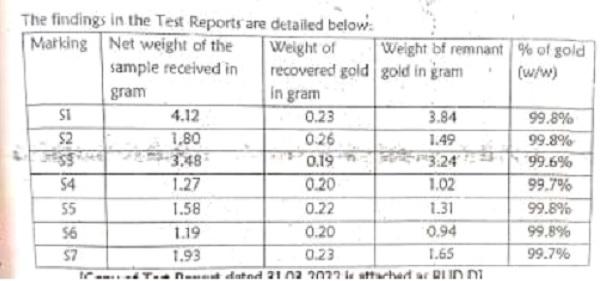
The test reports received reproduced above shows that the purity of the gold is not of 99.9%.
6.8. The gold pieces in non standard weight and with purity less than 99.9% gives credence to the submission of the appellants that the family gold available with them have been melted and gold pieces of 24 carats have been made from them.
6.9. We observe that impugned gold neither bear any foreign marking nor it was seized from the customs bonded area nor from “specified area” defined under section 11H of Customs Act. The Central Government vide Notn. No. 31/200 8 Cus (NT) dt. 25.03.2008 issued under clause (c) of section 11H of Customs Act having regard to vulnerability to therein, specified the area as “ specified area” as under:-
The inland area, 50 KM in width, from india’s land border with Bangladesh falling within the territories of West Bengal, Tripura, Assam, Meghalaya and Mizoram.
The Howrah Railway Station is more than 150 KM from International Border of Bangladesh. Thus, we find merit in the argument of the appellant that there is no evidence available on record to establish that the gold seized was of foreign origin.
6.10. We observe that the foreign origin nature of the gold cannot be established on the basis of assumptions and presumptions. There must be positive evidence to substantiate the allegation of foreign origin of the gold, which is not available in this case. On the contrary, the evidences submitted by the appellant’s shows that the gold has been procured from domestic sources. We find that the evidences submitted by the appellant are not negated. Thus, we hold that the evidence on record does not indicate that the gold seized is of foreign origin and smuggled from Bangladesh. Accordingly, answer to question no (i) in para 6.1 above is in the negative.
(ii) Whether the burden of proving that the gold in question are not smuggled in nature, in this case is on the appellant under Section 123 of the Customs Act, 1962?
(iii) Whether the evidences submitted by the appellants establish that the gold weighing 3152.900 were procured from domestic sources and hence not liable for confiscation?
7. Gold is an item notified under Section 123 of the Customs Act,1962. Section 123 of Customs Act, 1962 stipulates that the onus to prove that the gold is not of smuggled in nature is on the person who claims the ownership of the gold. For ready reference the said section 123 is reproduced below: SECTION 123. Burden of proof in certain cases.
(1) Where any goods to which this section applies are seized under this Act in the reasonable belief that they are smuggled goods, the burden of proving that they are not smuggled goods shall be –
(a) in a case where such seizure is made from the possession of any person, –
(i) on the person from whose possession the goods were seized; and
(ii) if any person, other than the person from whose possession the goods were seized, claims to be the owner thereof, also on such other person;
(b) in any other case, on the person, if any, who claims to be the owner of the goods so seized.
(2) This section shall apply to gold, and manufactures thereof, watches, and any other class of goods which the Central Government may by notification in the Official Gazette specify.
7.1. In this case, we observe that all the three appellants claimed the ownership of the gold which were in their possession. However, the gold was seized as they could not produce any valid documents for the legal purchase of the said gold at the time of their interception. Not having any document with them at the time of interception would not ipso facto make the gold is of smuggled in nature. If the appellants could produce valid documents for the licit purchase of the gold subsequently, it cannot be ignored.
7.1. In the present case, we find that the appellant Shri. Tirlok Singh has produced copy of invoice No. 52 dt. 15.03.2004 of M/s Manik Jewellers, Mall Road, Ludhiana substantiating purchase of impugned gold by his mother Smt. Krishna Devi along with Affidavit dt. 23.03.2023, which was submitted to the ld. Adjudicating Authority and Appellate Authority. However, both the authorities neither considered nor controverted the said submissions.
7.2. We find that the appellant Shri. Geetanshu Aggarwal has submitted that the seized gold was derived from family’s old ancestral jewellery which was under the possession of his mother Smt. Mamta Aggarwal and the said fact was declared by her vide affidavit dt. 03.12.1997 wherein she had admitted that she was in possession of 1004.20 gram of gold jewellery and had paid income tax of Rs. 65,848/- and accordingly she had received a certificate in terms of section 68 (2) of Voluntary Disclosure of Income Tax Scheme. Further, the appellant submitted that the said gold was melted and refined to 919.84 gram of pure gold in the form of strips from which a couple of cut-pieces were obtained for its easy conveyance to Kolkata so that same be crafted into gold jewellery of new design. Out of 1112.75 gram of seized gold, procurement of 919.84 gram of gold was from old jewellery and 193 gram of gold approx.. was given to appellant by his father Sh. Vijender Kumar Aggarwal – declaration to this effect by appellant’ s father submitted to ld. Adjudicating Authority. Thus, we find that the appellant Geetanshu Aggarwal has produced enough evidence for the ownership of the gold which was found in his pocession. However, the Ld. authorities have not considered his submission and not given any findings on the submissions made by him.
7.3. The appellant Shri. Dharminder Kumar Jha The gold weighing 872.910 gram valued at Rs. 46,04,600/- was seized on 16.03.2022. The appellant vide mail dt. 20.04.2022 informed DRI that the seized gold was their ancestral property and he carried the impugned gold to Kolkata for making ornaments. The impugned gold weighing 872.910 gram, 24 carat was given by his grand father Sh. Nikunta Jha to his father Sh. Makeshar Jha. The appellant’s father gave the impugned gold to appellant for making ornaments for distribution among his children. As he could not get proper jewellery designs for ornaments, the gold as such was carried back and same was seized on 16.03.2022 by DRI officials. To this effect the appellant has filed an affidavit dt. 10.07.2023 before the Ld. Adjudicating Authority. However, no finding has been given in the impugned order against the claim made by him in the impugned order.
7.4. We observe that the section 123 stipulates its applicability where goods are seized on the reasonable belief that the said goods were smuggled in nature, then the burden of proving the same shall shift to the person who claims ownership of the goods. In the present case, we observe that the impugned gold were neither bearing foreign marking nor seized from customs area. Further, we observe that the appellants have submitted enough evidence for domestic procurement of the gold, which has not been negated by the investigation. Accordingly, we hold that the provisions of Section 123 of Customs Act, 1962 is not applicable in this case and the burden of proving that the gold seized is not of smuggled in nature is not on the appellants.
7.5. Regarding the confiscation of the gold seized, we observe that the ld. Appellate Authority has upheld the absolute confiscation of the impugned gold under section 111 (b) & 111 (d) of Customs Act, 1962. For ready reference, the provisions of the said sections 111(b) and 111 (d) of Customs Act, 1962 are reproduced below:
SECTION 111 of Customs Act, 1962- Confiscation of improperly imported goods, etc.
The following goods brought from a place outside India shall be liable to confiscation: —
(a) ….
(b) any goods imported by land or inland water through any route other than a route specified in a notification issued under clause (c) of section 7 for the import of such goods;
(c) …
(d) any goods which are imported or attempted to be imported or are brought within the Indian customs waters for the purpose of being imported, contrary to any prohibition imposed by or under this Act or any other law for the time being in force;
7.6. We observe that the sections 111(b) and 111(d) are applicable only when it is established that the goods are of foreign origin and smuggled into the country without payment of applicable customs duties. In this case, we find that there is nothing records to substantiate the allegation that the impugned goods seized from the appellants were smuggled from Bangladesh or any other foreign country
7.7. Our view is supported by the decision of the CESTAT in the cases of:-
i) Principal Commissioner of Customs (Prev), Delhi Vs. Ahamed Mujjaba Khaleefa 2019 (366) ELT 337 (T) dismissed the appeal of revenue holding that jewellary not bearing any foreign marking – other than statement of passenger no other proof produced by revenue to substantiate claim that jewellary smuggled into India.
ii) Commissioner of Customs (Prev), Shillong Vs. Manisha Devi Jain 2019 (370) ELT 401 (T) held that indian origin remolten gold/gold ornaments could not be legally confiscated as its possession not prohibited under any provisions of law.
7.8. Thus, by relying on the decisions cited above, we observe that the provisions of section 111(b) and 111(d) of Customs Act, 1962 are confined to the imported goods. As there is no evidence brought on record to substantiate the allegation that the impugned gold was imported, we hold that the provisions of sections 111(b) and 111 (d) of Customs Act, 1962 are not applicable to the seized gold in this case.
7.9. We also hold that the evidences submitted by the appellants establish that the gold weighing 3152.900 were procured from domestic sources and hence not liable for confiscation. In view of the above, the answer to question nos. (ii) and (iii) in para 6.1 above, are in the negative.
(iv) Whether penalties imposed on the Appellants under section 112(a)/(b) of the Customs Act, 1962 are sustainable in this case?
8. We observe that penalties have been imposed on the appellants under sections 112(a)/(b) of the Customs Act, 1962. For the sake of ready reference, the provisions of the said section is reproduced below:
Section 112
Penalty for improper importation of goods, etc.
Any person, –
(a) who, in relation to any goods, does or omits to do any act which act or omission would render such goods liable to confiscation under section 111, or abets the doing or omission of such an act, or
(b) who acquires possession of or is in any way concerned in carrying, removing, depositing, harbouring, keeping, concealing, selling or purchasing, or in any other manner dealing with any goods which he knows or has reason to believe are liable to confiscation under section 111, shall be liable, –
(i) in the case of goods in respect of which any prohibition is in force under this Act or any other law for the time being in force, to a penalty not exceeding the value of the goods or five thousand rupees, whichever is the greater;
(ii) in the case of dutiable goods, other than prohibited goods, subject to the provisions of section 114A, to a penalty not exceeding ten per cent. of the duty sought to be evaded or five thousand rupees, whichever is higher:
Provided that where such duty as determined under sub- section (8) of section 28 and the interest payable thereon under section 28AA is paid within thirty days from the date of communication of the order of the proper officer determining such duty, the amount of penalty liable to be paid by such person under this section shall be twenty-five per cent. of the penalty so determined;
(iii) in the case of goods in respect of which the value stated in the entry made under this Act or in the case of baggage, in the declaration made under section 77 (in either case hereafter in this section referred to as the declared value) is higher than the value thereof, to a penalty not exceeding the difference between the declared value and the value thereof or five thousand rupees, whichever is the greater;
(iv) in the case of goods falling both under clauses (i) and (iii), to a penalty [not exceeding the value of the goods or the difference between the declared value and the value thereof or five thousand rupees, whichever is the highest;
(v) in the case of goods falling both under clauses (ii) and (iii), to a penalty not exceeding the duty sought to be evaded on such goods or the difference between the declared value and the value thereof or five thousand rupees, whichever is the highest.
8.1. The essential ingredients for invoking the provisions of Section 112 are as under: a) act or omission on part of person which rendered the goods liable to confiscation under section 111 ibid.
b) knowledge or c) reason to belief on the part of the person who is in any way concerned in any goods which he knows or has reason to believe are liable to confiscation under section 111 ibid.
8.2. We find that the ingredients for invocation of section 112 are completely absent in the instant case. We also find that there are no specific allegation/findings regarding contravention of section 112 (a) and/or section 112 (b) of Customs Act, 1962, in the impugned order.
8.3. The Hon’ble Delhi High Court in the case Commissioner of Customs Vs. Trinetra Impex Pvt. Ltd – 2020(372) ELT 332 (Del) on imposition of penalty under section 112 (b) held that the said provisions clearly reveals that the penalty therein can be imposed wherever there is an element of mens rea or conscious knowledge, which is a sine qua non for imposition of the penalty. This is evident from a plain reading of Sections 112 of the Act, which uses the expressions “does or omits to do”, “or abets the doing or omission of such act”, “which he knows or has reason to believe are liable to confiscation under Section 111″. From the facts of the case, we find that there is no such element of mens rea or conscious knowledge established on the part of the appellants.
8.4. We also find that the ld. Adjudicating Authority has imposed penalty under section 112(a)/112(b) of Customs Act without disclosing specific contravention of section 112(a) and 112 (b) of Customs Act. The specific section under which the penalty has been imposed also not clear from the impugned order. Accordingly, we hold that the penalties imposed on the appellants under sections 112(a)/(b) of the Customs Act, 1962 is not sustainable and hence, we set aside the same. Accordingly, we answer to question no. (iv) in para 6.1 above is in the negative.
9. In view of the above discussions, we summarize the answers to the questions raised in para 6.1 supra as follows:
(i) We hold that the evidence on record does not indicate that the gold seized is of foreign origin and smuggled from Bangladesh.
(ii) We hold that the provisions of Section 123 of Customs Act, 1962 is not applicable in this case and the burden of proving that the gold seized is not of smuggled in nature is not on the appellants.
(iii) We hold that the evidences submitted by the appellants establish that the gold weighing 3152.900 were procured from domestic sources and hence not liable for confiscation. Accordingly, the absolute confiscation of the gold is set aside.
(iv) We hold that the penalties imposed on the appellants under sections 112(a)/(b) of the Customs Act, 1962 is not sustainable and hence, we set aside the same.
10. Regarding the Indian Currency of Rs. 97,000/- confiscated from the appellants, we observe that the said currency was confiscated in terms of section 121 of the Customs Ac, 1962, on the ground that it was sale proceeds of smuggled gold. However, we find that the investigation has not brought in any evidence to substantiate this allegation. Accordingly, we hold that the Indian Currency is not liable for confiscation and hence we set aside the same.
11. In view of the above discussions,
(i) We set aside the confiscation of the gold weighing 3152.900 grams seized from all the three appellants together.
(ii) We set aside the penalties imposed on all the three appellants.
(iii) We set aside the confiscation of Indian Currency of Rs. 97,000/-.
(iv)Thus, the appeals filed by the appellants are allowed with consequential relief, if any, as per law.
(Operative part of Order was pronounced in Open court)