In re Deepa Bangles (CAAR Mumbai)
Summary: The Customs Authority for Advance Rulings, Mumbai, in the application of M/s Deepa Bangles, clarified that the 12.5% threshold appearing in the relevant customs circulars governs computation of export incentives and does not prescribe a cap on overseas agency commission. The applicant, an exporter holding IEC No. 0313089230, had agreed to pay an overseas agent commission at 40% of the invoice value of export sales secured through the agent. It sought rulings on the permissibility of commission exceeding 12.5% of FOB value, its effect on customs valuation and export benefits, and the respective scope of customs circulars and FEMA/RBI requirements.
The applicant explained that its agents undertook market development, identification of buyers, product promotion, customer acquisition, commercial negotiations, procurement of orders, customer relationship management and coordination of export transactions. It submitted that the agreed rate reflected the services, markets, commercial risks and expected benefits, and that the arrangement was genuine, documented and at arm’s length. It undertook to produce records of the agency arrangement, services, transactions and remittances. Its position was that the rate was commercially negotiable, that the customs circulars affected only export incentive calculations, and that remittance was governed by FEMA and RBI requirements. These were the applicant’s submissions; the Authority did not grant an unrestricted approval under those other enactments.
The application was received on 17 July 2026 and forwarded to the Commissioner of Customs (Export), NS-II, JNCH, Nhava Sheva, for comments on 24 July 2026. No comments were received. At the hearing on 7 August 2026, the applicant’s advocate reiterated the submissions and produced Circular No. 64/2003-Cus. dated 21 July 2003, Circular No. 33/2019-Cus. dated 19 September 2019 and Circular No. 20/2026-Customs dated 10 April 2026. No departmental representative appeared. The applicant declared that no proceedings involving the same issue were pending before any customs authority, tribunal or court. The Authority considered the valuation and export incentive questions within Section 28H(2) of the Customs Act, 1962.
On customs valuation, the Authority examined Section 14 and the Customs Valuation (Determination of Value of Export Goods) Rules, 2007. Rule 3 makes transaction value the starting point, subject to rejection under Rule 8 and sequential determination under Rules 4 to 6 where required. Neither Section 14 nor those Rules prescribes a commission ceiling or provides for reducing transaction value by commission paid by the exporter to its own agent. Such commission is the exporter’s selling expense paid out of sale proceeds; it does not reduce the price paid or payable by the buyer. Accordingly, where the declared transaction value is otherwise acceptable, commission is not deductible from that value merely because it exceeds 12.5%.
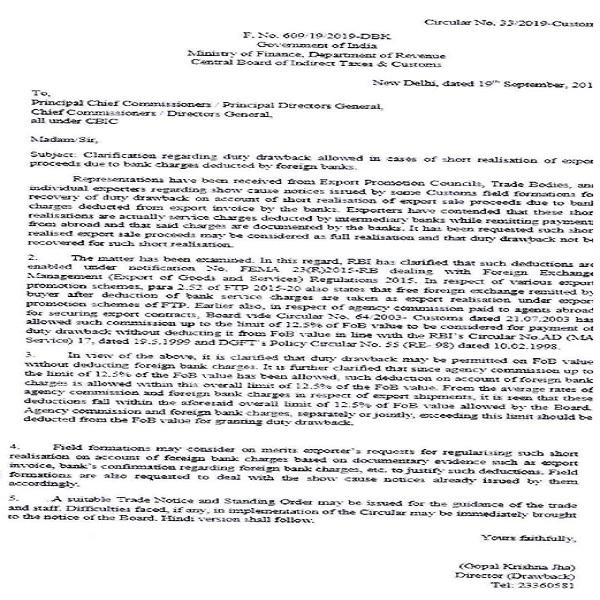
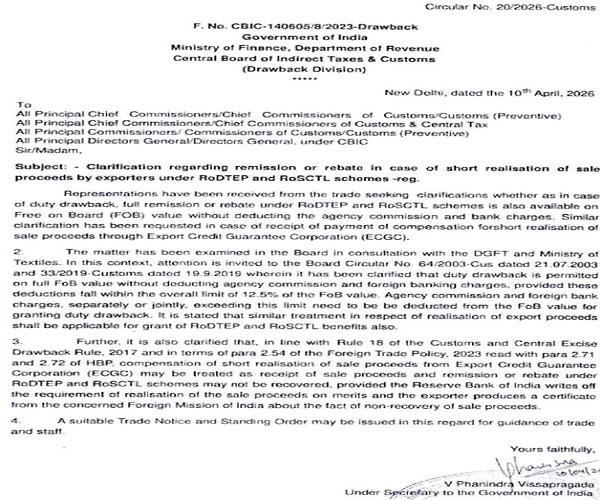
The Authority separately examined the three CBIC circulars. The 2003 circular addresses agency commission in computing benefits under the specified export schemes. The 2019 circular permits foreign bank charges within the overall 12.5% threshold together with agency commission for duty drawback. The 2026 circular extends the same treatment to RoDTEP and RoSCTL. These circulars determine the value eligible for the specified benefits; they do not amend Section 14 or the Export Valuation Rules, redefine transaction value for general assessment and declaration, or regulate commission payments and remittances.
In its operative answers, the Authority held that, for Duty Drawback, RoDTEP and RoSCTL benefits governed by these circulars, agency commission and foreign bank charges, separately or jointly, are allowed up to 12.5% of FOB value, and only the amount exceeding 12.5% is deductible from FOB value when computing the incentives. Subject to this adjustment and correct declaration of commission in the shipping bill, no other consequence follows under the Customs Act merely because commission exceeds 12.5%. The ruling therefore distinguishes the acceptable customs transaction value from the incentive computation base.
The applicant relied on four Supreme Court decisions concerning the binding effect of departmental circulars and their inability to override the statute. The Authority referred to those principles while interpreting the circulars within their subject matter. It expressly declined to decide whether the RBI’s A.D. (M.A. Series) Circular No. 17 dated 19 May 1999 imposes or continues to impose any remittance limit, treating that as a FEMA question outside Section 28H(2). It also refrained from ruling on the FTDR/Foreign Trade Policy/FEMA framework beyond its customs jurisdiction. Any consequences under FEMA or DGFT-administered Foreign Trade Policy schemes remain outside the ruling; the decision does not amount to a general clearance for the proposed 40% remittance under those laws.
Cases Discussed
- Commissioner of Central Excise v. Ratan Melting & Wire Industries, 2008 (231) E.L.T. 22 (S.C.). The applicant relied on this decision concerning the legal effect of Board circulars; the Authority referred to the principle that a circular cannot override or travel beyond the statute.
- Commissioner of Customs v. Indian Oil Corporation Ltd., 2004 (165) E.L.T. 257 (S.C.). Cited by the applicant in support of the binding effect of circulars on departmental officers and the restriction on taking a contrary stand.
- Collector of Central Excise v. Dhiren Chemical Industries, 2002 (139) E.L.T. 3 (S.C.). Relied upon by the applicant in the discussion of the binding effect of departmental circulars.
- Paper Products Ltd. v. CCE, 1999 (112) E.L.T. 765 (S.C.). Relied upon by the applicant on departmental adherence to Board circulars; the Authority discussed the cited authorities collectively.
FULL TEXT OF THE ORDER OF CUSTOMS AUTHORITY OF ADVANCE RULING, MUMBAI
M/s Deepa Bangles (IEC No. 0313089230) (hereinafter referred to as ‘the Applicant’) filed an application (CAAR-1) for advance ruling in the Office of Secretary, Customs Authority for Advance Rulings (CAAR), Mumbai. The said application was received in the secretariat of the CAAR, Mumbai on 17.07.2026 along with its enclosures in terms of Section 28H (1) of the Customs Act, 1962 (hereinafter referred to as the ‘the Act’). The Applicant has sought a ruling on permissibility of overseas agency commission exceeding 12.5% of the FOB value of export goods under the applicable customs, foreign trade and foreign exchange laws; whether such commission affects the determination of FOB value for export purposes; and whether export incentives remain admissible on exports where such commission exceeds 12.5% of the FOB value under the provisions of the Customs Act, 1962 and the rules made thereunder.
2. Question(s) on which Advance Ruling is required:
Question 1: Whether payment and remittance of overseas agency commission exceeding 12.5% of the FOB value of export goods are permissible under the applicable provisions of the Customs Act, 1962, the Foreign Trade (Development and Regulation) Act, 1992, the Foreign Trade Policy, the Foreign Exchange Management Act, 1999 (FEMA), and the regulations, directions and Master Directions issued by the Reserve Bank of India (RBI)?
Question 2: Whether Customs Circular No. 64/2003-Cus. dated 21.07.2003, Circular No 33/2019-Cus. dated 19.09.2019 and Circular No. 20/2026-Customs dated 10.04.2026 are confined to determination of FOB value for export incentive purposes, or whether they also operate as a restriction on the payment and remittance of overseas agency commission exceeding 12.5% of the FOB value of export goods?
Question 3: Whether Customs Circular No. 64/2003-Cus. dated 21.07.2003, Circular No. 33/2019-Cus. dated 19.09.2019 and Circular No. 20/2026-Customs dated 10.04.2026 regulate or govern the payment and remittance of overseas agency commission, or whether such remittances are governed exclusively by the provisions of the Foreign Exchange Management Act, 1999 (FEMA) and the regulations, directions and Master Directions issued by the Reserve Bank of India (RBI)?
Question 4: Whether, in cases where overseas agency commission exceeds 12.5% of the FOB value of export goods, the consequence is limited to adjustment, exclusion or deduction of the excess commission component for the purpose of determination of FOB value and computation of export incentives, or whether any other legal consequence follows under the applicable Customs, Foreign Trade Policy or FEMA framework?
3. Applicant’s eligibility for Advance Ruling:
The applicant holds a valid IEC No. 0313089230 and therefore qualifies as an “applicant” under Section 28E(c) of the Customs Act, 1962. The questions on which the advance ruling is sought relate to the permissibility of overseas agency commission exceeding 12.5% of the FOB value of export goods under the applicable customs, foreign trade and foreign exchange laws; whether such commission affects the determination of FOB value for export purposes; and whether export incentives remain admissible on exports where such commission exceeds 12.5% of the FOB value under the provisions of the Customs Act, 1962 and the rules made thereunder, which is admissible under Section 28H (2). The relevant Section of the Customs Act 1962 has been reproduced below:
Section 28E. Definitions. — (c) “applicant” means any person, – (i) holding a valid Importer-exporter Code Number granted under section 7 of the Foreign Trade (Development and Regulation) Act, 1992; or
Section 28H. Application for advance ruling. – (1) An applicant desirous of obtaining an advance ruling under this Chapter may make an application in such form and in such manner and accompanied by such fee as may be prescribed, stating the question on which the advance ruling is sought. (2) The question on which the advance ruling is sought shall be in respect of, – (c) the principles to be adopted for the purposes of determination of value of the goods under the provisions of this Act
The applicant has declared that no proceedings involving the same issue are pending before any Customs authority, Appellate Tribunal or any Court of Law. Accordingly, the application appears admissible under Section 28-I (2) of the Customs Act, 1962.
4. Applicant’s Submissions:
4.1 Applicant is a company incorporated under the provisions of the Companies Act, 2013 and is engaged in the business of export of goods from India to various international markets. The Applicant holds a valid Import Export Code (IEC No. 0313089230) issued under the provisions of the Foreign Trade (Development and Regulation) Act, 1992 and regularly undertakes export transactions in the ordinary course of its business.
4.2 The Applicant exports goods to customers located in various overseas jurisdictions and undertakes continuous marketing, business development and customer acquisition activities for expansion of its export business and international market presence.
4.3 In the course of its export business, the Applicant engages overseas agents for procuring export orders, identifying prospective buyers, facilitating commercial negotiations and providing other marketing and liaison services in foreign markets, such agents are remunerated by way of commission linked to the export transactions secured through their efforts.
4.4 Engagement of Overseas Commission Agents
4.4.1 In the ordinary course of its export business, the Applicant engages independent commission agents located outside India for the purpose of developing overseas markets, identifying prospective buyers and procuring export orders from foreign customers.
4.4.2 Such overseas agents possess specialized knowledge of local market conditions, established business networks and expertise in international trade practices. The services rendered by such agents generally include market development, identification of prospective buyers, promotion of the Applicant’s products, facilitation of commercial negotiations, customer relationship management, coordination of export transactions and other allied marketing and liaison activities.
4.4.3 The engagement of overseas commission agents is a recognized and widely accepted practice in international trade and serves as an important mechanism for exporters to access foreign markets, expand their customer base and enhance the competitiveness of their export business.
4.4.4 In consideration of the services rendered by such overseas agents, the Applicant pays commission at rates mutually agreed upon between the parties, having regard to factors such as the nature of products, market conditions, geographical coverage, scope of services and prevailing commercial practices in the relevant export market.
4.4.5 The commission payable to overseas agents is incurred wholly and exclusively in connection with the Applicant’s export business and is directly linked to the procurement and facilitation of export orders.
4.5 Commercial Agreement and Commission Arrangement
4.5.1 In furtherance of its export marketing and business development strategy, the Applicant has entered into a commercial agreement with an overseas commission agent for promotion of the Applicant’s products, development of export markets and procurement of export orders in designated overseas territories.
4.5.2 Under the terms of the said agreement, the overseas agent undertakes various activities including market development, identification of prospective buyers, promotion of products, customer acquisition, facilitation of commercial negotiations, order procurement, customer relationship management and coordination of export transactions.
4.5.3 In consideration of the services rendered by the overseas agent, the Applicant has agreed to pay commission at the rate of 40% of the invoice value of export sales secured through the efforts of the overseas agent,
4.5.4 The commission rate has been determined on the basis of commercial negotiations between the parties, taking into account the nature and extent of services to be rendered, the geographical markets covered, prevailing market conditions, anticipated marketing efforts, business risks assumed by the agent and the expected commercial benefits accruing to the Applicant.
4.5.5 The Applicant submits that the commission arrangement has been entered into on an arm’s length basis in the ordinary course of business and represents a genuine and bona fide commercial arrangement.
4.5.6 The agency arrangement is supported by appropriate contractual documentation and other relevant records evidencing the scope of services to be rendered by the overseas agent and the basis for payment of commission.
4.5.7 The Applicant maintains and undertakes to produce, as and when required, complete documentary records relating to the agency arrangement, services rendered by the overseas agent, export transactions facilitated through such services and the payment and remittance of commission in accordance with applicable legal and regulatory requirements.
4.6 Applicant’s Interpretation of the Questions Raised
Question 1: The Applicant respectfully submits that payment of overseas agency commission exceeding 12.5% of FOB value is legally permissible. Neither FEMA, RBI Master Directions, the Customs Act, 1962 nor the Foreign Trade Policy prescribes any statutory ceiling on such commission. The commission is a matter of commercial negotiation and may vary depending upon the nature of services rendered and prevailing market conditions.
Question 2: The Applicant submits that the aforesaid Circulars do not prohibit payment of overseas agency commission exceeding 12.5%. The Circulars merely prescribe the treatment of such commission while calculating export incentive benefits and do not regulate contractual arrangements or foreign exchange remittances
Question 3: The Applicant submits that the Circulars do not regulate remittance of overseas agency commission. Remittance is governed exclusively by FEMA, RBI Regulations and RBI Master Directions. The Circulars operate in a different field and are confined to determination of export incentive benefits.
Question 4: The Applicant submits that the only consequence contemplated by the Customs Circulars is adjustment of FOB value for the limited purpose of determining export incentive benefits. Such adjustment does not affect the legality of the commission payment or the permissibility of remittance under FEMA.
5. Port of Export and reply from jurisdictional Commissionerate:
The applicant in their CAAR-1 indicated that they intend to export the subject goods at the jurisdiction of Office of the Commissioner of Customs (Export), NS-II, JNCH, Nhava Sheva, Uran, Raigad, Maharashtra. Accordingly, the application was forwarded to the concerned Commissionerate for their comments on 24.07.2026. However, no comments have been received from the said Commissioner of Customs (Export), NS-II, JNCH.
6. Details of Personal Hearing:
A personal hearing in the matter was held on 07.08.2026. During the personal hearing, the advocate appeared and reiterated the submissions made in the application on the permissibility of overseas agency commission exceeding 12.5% of the FOB value of export goods under the applicable customs, foreign trade and foreign exchange laws and admissibility of export incentives on exports where such commission exceeds 12.5% of the FOB value under the provisions of the Customs Act, 1962 and the rules made thereunder. The advocate also produced Customs Circular No. 64/2003-Cus. dated 21.07.2003, Circular No. 33/2019-Cus. dated 19.09.2019 and Circular No. 20/2026-Customs dated 10.04.2026 seeking clarity in the matter.
6.1 No representative appeared on behalf of the Department at the time of the personal hearing.
7. Discussion and Findings
7.1 I have carefully considered the application filed by the applicant, namely M/s Deepa Bangles, the submission made by the applicant during the personal hearing and the documents and materials placed on record.
7.2 For the issues raised in the question 1, 2, 3 and 4 in the form CAAR-1 are covered under Section 28H (2) of the Customs Act, 1962, being a matter of valuation and applicability of export incentive schemes under the provisions of this Act.
7.3 Statutory Framework
7.3.1 Section 14 of the Customs Act, 1962 provides the statutory basis for valuation of goods. Under Section 14 (1) of the Customs Act, 1962, the value of export goods for assessment is the transaction value, i.e. the price actually paid or payable for the goods when sold for export from India.
Section 14. Valuation of goods. –
(1) For the purposes of the Customs Tariff Act, 1975 (51 of 1975), or any other law for the time being in force, the value of the imported goods and export goods shall be the transaction value of such goods, that is to say, the price actually paid or payable for the goods when sold for export to India for delivery at the time and place of importation, or as the case may be, for export from India for delivery at the time and place of exportation, where the buyer and seller of the goods are not related and price is the sole consideration for the sale subject to such other conditions as may be specified in the rules made in this behalf:
Provided that such transaction value in the case of imported goods shall include, in addition to the price as aforesaid, any amount paid or payable for costs and services, including commissions and brokerage, engineering, design work, royalties and licence fees, costs of transportation to the place of importation, insurance, loading, unloading and handling charges to the extent and in the manner specified in the rules made in this behalf:
Provided further that the rules made in this behalf may provide for, –
(i) the circumstances in which the buyer and the seller shall be deemed to be related:
(ii) the manner of determination of value in respect of goods when there is no sale, or the buyer and the seller are related, or price is not the sole consideration for the sale or in any other case;
(iii) the manner of acceptance or rejection of value declared by the importer or exporter, as the case may be, where the proper officer has reason to doubt the truth or accuracy of such value, and determination of value for the purposes of this section: 2[(iv) the additional obligations of the importer in respect of any class of imported goods and the checks to be exercised, including the circumstances and manner of exercising thereof, as the Board may specify, where, the Board has reason to believe that the value of such goods may not be declared truthfully or accurately, having regard to the trend of declared value of such goods or any other relevant criteria] Provided also that such price shall be calculated with reference to the rate of exchange as in force on the date on which a bill of entry is presented under section 46, or a shipping bill of export, as the case may be, is presented under section 50.
(2) Notwithstanding anything contained in sub-section (1), if the Board is satisfied that it is necessary or expedient so to do, it may, by notification in the Official Gazette, fix tariff values for any class of imported goods or export goods, having regard to the trend of value of such or like goods, and where any such tariff values are fixed, the duty shall be chargeable with reference to such tariff value.
Explanation – For the purposes of this section –
(a) rate of exchange” means the rate of exchange –
(i) determined by the Board, or
(ii) ascertained in such manner as the Board may direct, for the conversion of Indian currency into foreign currency or foreign currency into Indian currency,
(b) “foreign currency” and “Indian currency” have the meanings respectively assigned to them in clause (m) and clause (q) of section 2 of the Foreign Exchange Management Act, 1999 (42 of 1999).]
7.3.2 The value of export goods under Section 14 (1) of the Customs Act, 1962, is determined in accordance with the Rule 3 of Customs Valuation (Determination of Value of Export Goods) Rules, 2007, which shall be the transaction value of goods unless rejected under Rule 8 of the said valuation rules. Where the declared transaction value is rejected in accordance with Rule 8, the value is to be determined sequentially under the succeeding rules.
Rule 3. Determination of the method of valuation. –
(1) Subject to rule 8, the value of export goods shall be the transaction value.
(2) The transaction value shall be accepted even where the buyer and seller are related, provided that the relationship has not influenced the price.
(3) If the value cannot be determined under the provisions of sub-rule (1) and sub-rule (2), the value shall be determined by proceeding sequentially through rules 4 to 6.
Rule 8. Rejection of declared value. – (1) When the proper officer has reason to doubt the truth or accuracy of the value declared in relation to any export goods, he may ask the exporter of such goods to furnish further information including documents or other evidence and if, after receiving such further information, or in the absence of a response of such exporter, the proper officer still has reasonable doubt about the truth or accuracy of the value so declared, the transaction value shall be deemed to have not been determined in accordance with sub-rule (1) of rule 3.
2) At the request of an exporter, the proper officer shall intimate the exporter in writing the ground for doubting the truth or accuracy of the value declared in relation to the export goods by such exporter and provide a reasonable opportunity of being heard, before taking a final decision under sub-rule (1).
Explanation . – (1) For the removal of doubts, it is hereby declared that-
(i) This rule by itself does not provide a method for determination of value, it provides a mechanism and procedure for rejection of declared value in cases where there is reasonable doubt that the declared value does not represent the transaction value; where the declared value is rejected, the value shall be determined by proceeding sequentially in accordance with rules 4 to 6.
(ii) The declared value shall be accepted where the proper officer is satisfied about the truth or accuracy of the declared value after the said inquiry in consultation with the exporter.
(iii) The proper officer shall have the powers to raise doubts on the declared value based on certain reasons which may include-
(a) the significant variation in value at which goods of like kind and quality exported at or about the same time in comparable quantities in a comparable commercial transaction were assessed.
(b) the significantly higher value compared to the market value of goods of like kind and quality at the time of export.
(c) the declaration of goods in parameters such as description, quality, quantity, year of manufacture or production.
7.3.3 Neither Section 14 nor the Export Valuation Rules, 2007 provide for any deduction from the transaction value on account of commission paid by the exporter to its overseas agent, nor do they prescribe any limit on such commission. The transaction value is the price actually paid/ payable by the buyer for the goods for delivery at the time and place of exportation and Commission paid by the exporter to its own agent out of the sale proceeds is the exporter’s selling expense and does not reduce the price paid or payable by the buyer. Consequently, the “FOB value” of export goods for the purposes of Section 14 is the transaction value so determined, irrespective of the rate of agency commission.
7.4 Nature and scope of the relevant Circulars
7.4.1 Circular 64/2003-Cus. dt. 21.07.2003
The said Circular clarified that field formations may continue to permit export benefits on FOB value without deducting agency commission if such commission is up to 12.5% of FOB value, and that agency commission exceeding this limit should be deducted from the FOB value for granting export benefits under the Drawback/DEPB/Advance Licence/DFRC Schemes.
7.4.2 Circular 33/2019-Cus. dt. 19.09.2019
The Circular 33/2019-Cus. dt. 19.09.2019 clarified that duty drawback may be permitted on FOB value without deducting foreign bank charges, provided that such charges, together with agency commission, fall within the overall limit of 12.5% of FOB value; agency commission and foreign bank charges, separately or jointly, exceeding this limit are to be deducted from the FOB value for granting duty drawback.
7.4.3 Circular 20/2026-Cus. dt. 10.04.2026
The Circular 20/2026-Cus. dt. 10.04.2026 extends the identical 12.5% of FOB treatment for commission/bank charges (as per Circulars 64/2003 and 33/2019) to RoDTEP and RoSCTL.
7.4.4 As regards RBI A.D. (M.A. Series) Circular No. 17 dated 19.05.1999, the question whether it imposes, or continues to impose, any limit on the remittance of agency commission is a matter under FEMA. It does not fall within Section 28H(2) and no view is expressed thereon.
7.4.5 It follows, and is so held, that the said Circulars issued by CBIC are confined to computation of the value of export goods that is eligible for the specified benefits, and cannot be read as either redefining “FOB value” or “transaction value” for the general purposes of assessment and declaration under Section 14 of the Customs Act and the Export Valuation Rules, 2007. They do not amend Section 14 or the Customs Valuation (Determination of Value of Export Goods) Rules, 2007. Nor do they regulate the payment or remittance of agency commission, which lies outside their subject-matter.
7.5 Judicial Precedents
The Applicant has relied upon various case laws including:
i. Commissioner of Central Excise v. Ratan Melting & Wire Industries, 2008 (231) E.L.T. 22 (S.C.)
ii. Collector of Central Excise v. Dhiren Chemical Industries, 2002 (139) E.L.T. 3 (S.C.)
iii. Commissioner of Customs v. Indian Oil Corporation Ltd., 2004 (165) E.L.T. 257 (S.C.)
iv. Paper Products Ltd. v. CCE, 1999 (112) E.L.T. 765 (S.C.)
These decisions consistently held that a circular is binding on departmental officers and
prohibits the Department from taking a stand contrary to it. Also, a circular cannot override or travel beyond the statute. In other words, the Department /Authority is bound to the Circulars issued by CBIC.
7.6. In view of the foregoing discussion, the findings recorded and the legal provisions discussed above, I rule as under:
7.6.1 Question No. 1 —The Circular 64/2003 — Cus. Dated 21.07.2003 makes it clear that Agency commission up to limit of 12.5% of FOB value is not to be deducted for the purpose of export benefits. However, there is no mention about limit of Agency commission in said circular, neither it prescribes any limit or cap. However, this Authority refrains from issuing ruling on provision of FIDR, FP, FEMA etc.
7.6.2 Question No. 2 — The relevant customs circulars govern the treatment of agency commission and foreign bank charges for the export-benefit purposes specified therein. The 12.5% limit in these Circulars is only a threshold for computing export-benefits and it does not mention any limit or prescribe any cap on agency commission. The Circulars are, therefore, confined to the determination of FOB value for export-benefit purposes and doesn’t cover aspects of Agency commission to be paid/ remitted as such.
7.6.3 Question No. 3 — The said Circulars makes it clear that agency commission up to limit of 12.5% of FOB value is not to be deducted for the purpose of export benefits and only the amount by which they exceed 12.5% of the FOB value is to be deducted from the FOB value for computing such incentives. However, there is no mention about limit of Agency commission in said circular, neither it prescribes any limit or cap. However, this Authority refrains from issuing ruling on provision of FEMA, RBI etc.
7.6.4 Question No. 4 — Customs valuation and export-benefit consequence: Where the declared export transaction value is otherwise acceptable under Section 14 and the Export Valuation Rules, 2007, the agency commission is not to be deducted from the transaction value merely because it exceeds 12.5%. However, for the export incentives under Duty Drawback, RoDTEP and RoSCTL Schemes, to which the relevant Board circulars apply, agency commission and foreign bank charges, separately or jointly, are allowed up to 12.5% of the FOB value, and only the amount by which they exceed 12.5% of the FOB value is to be deducted from the FOB value for computing such incentives. Subject to the above, and to the agency commission being correctly declared in the shipping bill, no other consequence follows under the Customs Act, 1962 merely because the agency commission exceeds 12.5% of the FOB value. Consequences, if any, under FEMA or under schemes administered by the DGFT under the Foreign Trade Policy are outside the scope of this ruling.
8. I rule accordingly.