In re Cistro Packaging LLP (GST AAR Karnataka)
Summary: The Karnataka Authority for Advance Rulings (AAR), in the case of Cistro Packaging LLP, held that paper bags manufactured and supplied by the applicant are classifiable under Tariff Item 48194000 of the First Schedule to the Customs Tariff Act, 1975, and attract GST at 5%, comprising 2.5% CGST and 2.5% KGST. The Authority held that the specific description of paper sacks and bags under Entry No. 319 of Schedule I to Notification No. 09/2025-Central Tax (Rate), dated 17 September 2025, prevails over the general coverage of goods falling under Heading 4819 under Entry No. 185 of Schedule II, which prescribes an aggregate GST rate of 18%.
The applicant is engaged in the manufacture and supply of paper-based packaging products, including paper bags, paper sacks and other paper containers, both within the State and in the course of inter-State trade. Its product range includes printed and plain flat-handle bags, self-opening square bags, twisted-handle bags, V-bottom bags, e-commerce courier bags and peel-and-seal square-bottom bags. The products are manufactured through cutting, printing, folding and pasting of paper, kraft paper or paperboard having a GSM range of 50–140. The applicant submitted that no plastic lamination or coating constituting more than half of the total thickness was applied to the products, which consequently retained their essential character as articles of paper falling under Chapter 48.
The applicant sought clarification regarding whether its paper bags, classifiable under Heading 4819, were liable to GST at 18% under Entry No. 185 of Schedule II or at 5% under Entry No. 319 of Schedule I to Notification No. 09/2025-Central Tax (Rate). The applicant contended that its products were specifically classifiable under Tariff Item 48194000, covering other sacks and bags, including cones. It further submitted that Notification No. 09/2025-Central Tax (Rate), effective from 22 September 2025, specifically covered paper sacks and bags falling under Chapter 48 within the concessional GST rate entry. The applicant also relied upon the Gujarat AAR ruling in the case of Canpac Trends Private Limited, which had accepted the applicability of the 5% GST rate to paper bags classifiable under the same tariff item.
The Authority examined the provisions of Notification No. 09/2025-Central Tax (Rate), which require the expressions tariff item, sub-heading, heading and chapter to be interpreted in accordance with the First Schedule to the Customs Tariff Act, 1975. After considering the relevant Chapter Notes, HSN Explanatory Notes, manufacturing process, raw materials, nature and intended use of the finished products, the AAR concluded that the applicant’s products retained the essential character of paper bags intended for packing or carrying goods. Accordingly, their classification under Tariff Item 48194000 was upheld.
While examining the applicable GST rate, the Authority noted that Entry No. 319 of Schedule I specifically covers paper sacks, paper bags and bio-degradable bags falling under Chapters 39 and 48 and prescribes a CGST rate of 2.5%. Entry No. 185 of Schedule II, on the other hand, generally covers goods falling under Heading 4819, except specified tariff items and excluded cartons, boxes and cases. Although paper bags were not expressly mentioned among the exclusions under Entry No. 185, the Authority held that the applicability of this general entry had to be examined in conjunction with the specific description of paper sacks and bags under Entry No. 319.
The AAR also examined the deliberations of the GST Council to ascertain the background and objective of the concessional rate entry. During the 54th GST Council meeting held on 9 September 2024, a proposal was made to reduce GST on paper sacks from 18% to 12%, particularly to encourage their use as alternatives to plastic bags. However, the Fitment Committee had recommended retaining the existing rate at that stage. Subsequently, at its 56th meeting held on 3 September 2025, the GST Council recommended reducing GST on paper sacks, paper bags and bio-degradable bags from 18% to 5%. This recommendation was implemented through the relevant rate notifications with effect from 22 September 2025. The Authority observed that the policy objective underlying the reduction supported a meaningful interpretation of the specific concessional rate entry.
The Authority further referred to the principle embodied in General Rule 3(a) of the General Rules for Interpretation of the First Schedule to the Customs Tariff Act, 1975, under which a specific description is preferred over a general description. Although the dispute concerned competing GST rate entries rather than competing tariff headings, the AAR considered the principle relevant as an interpretative aid. It held that the specific inclusion of paper sacks and bags under Entry No. 319 could not be rendered ineffective merely because such products also fell within the broader tariff heading referred to in Entry No. 185. Applying the general rate solely on the basis of Heading 4819 would deprive the specific concessional entry of its intended operation.
Accordingly, the Karnataka AAR held that Entry No. 185 of Schedule II must be read harmoniously with the specific coverage of paper sacks and bags under Entry No. 319 of Schedule I. Where the goods satisfy the description prescribed under Entry No. 319 and fall within the specified chapters, the specific entry governs their GST rate. Consequently, the paper bags manufactured and supplied by Cistro Packaging LLP, classifiable under Tariff Item 48194000, were held liable to GST at 5% under Notification No. 09/2025-Central Tax (Rate), dated 17 September 2025, as amended.
Cases Discussed:
- In re Canpac Trends Private Limited (GST AAR Gujarat) – Relied upon by the applicant in support of its contention that paper bags classifiable under Tariff Item 48194000 are specifically covered by Entry No. 319 of Schedule I to Notification No. 09/2025-Central Tax (Rate) and attract GST at 5%.
FULL TEXT OF THE ORDER OF AUTHORITY FOR ADVANCE RULING, KARNATAKA
ORDER UNDER SECTION 98(4) OF THE CGST ACT, 2017 & UNDER SECTION 98(4) OF THE KGST ACT, 2017
M/s. Cistro Packaging LLP. (Herein after referred to as Applicant), # Survey No. 72/8, Bhakthanapalya Main Road, Near Shell Petrol Bank, Vajarahalli, Nelamangala, Bengaluru Rural, Karnataka, 562123, is registered Under GSTIN 29AAUFC9150B1Z7, have filed an application for Advance Ruling under Section 97 of CGST Act, 2017 read with Rule 104 of CGST Rules, 2017 and Section 97 of KGST Act, 2017 read with Rule 104 of KGST Rules, 2017, in form GST ARA-01 discharging the fee of Rs.5,000/- each under the CGST Act, KGST Act 2017.
2. The Applicant is engaged in the manufacture and supply of paper-based packaging products, including paper bags, paper sacks and other paper containers. The Applicant supplies these products within the State as well as in the course of inter-State trade.
3. In view of the above, the applicant has sought advance ruling in respect of the following questions:
a) Whether the supply of paper bags made of paper or paperboard, classifiable under Heading 4819, is liable to GST at the rate of 18% under Entry No. 185 of Schedule II to Notification No. 01/2017-Central Tax (Rate), or at the rate of 5% under Entry No. 319 of Schedule I to Notification No. 09/2025-Central Tax (Rate) ?
4. Admissibility of the Application: The Applicant, under Column 13 of Form ARA-01, has indicated the category of issue as follows:
i. Applicability of a notification issued under the provision of this Act.
ii. Determination of the liability to pay tax on any goods or services or both.
The question raised by the Applicant squarely falls within the ambit of Section 97(2)(b) and 97(2)(e) of the Central Goods and Services Tax Act, 2017, relating to applicability of notifications and determination of liability to pay tax. Accordingly, the present application is held to be admissible under the aforesaid provisions.
5.1 Brief Facts of the Case: – The product under consideration is a paper bag manufactured by cutting, printing, folding and pasting paper sheets into a finished product suitable for packing or carrying goods. The manufacturing process gives the product the essential character of a packing container. Heading 4819 covers cartons, boxes, cases, bags and other packing containers made of paper, paperboard, cellulose wadding or webs of cellulose fibres.
5.2 Further, the range of products manufactured and supplied by the applicant includes, illustrative:
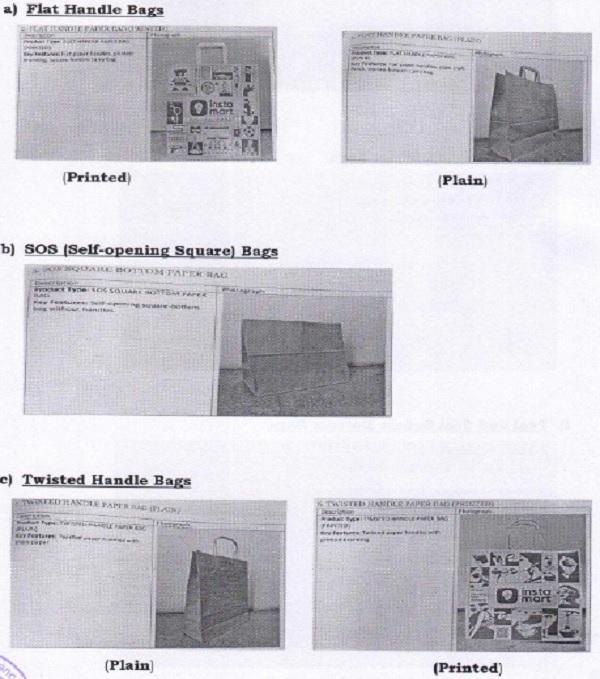
–
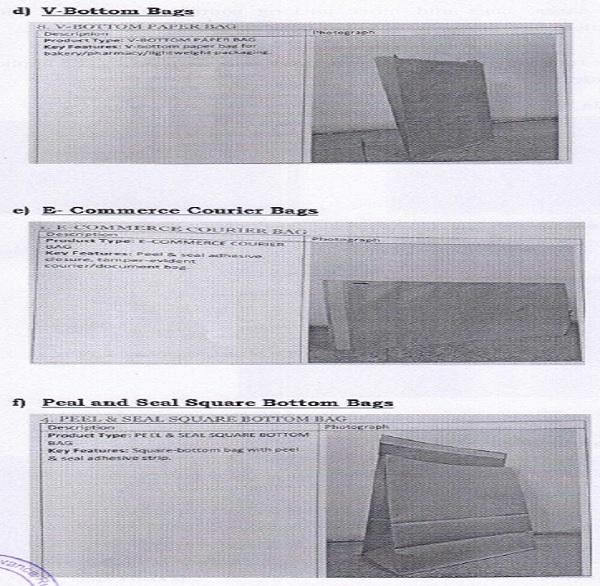
5.3 The Applicant submits that they use paper, kraft paper or paperboard having a GSM range of 50–140 as raw materials, which are procured on payment of the applicable GST. No plastic lamination or coating constituting more than half of the total thickness is applied to the products. Accordingly, the products retain the character of articles of paper and fall under Chapter 48 of the First Schedule to the Customs Tariff Act, 1975.
6.1 Applicant’s Interpretation of Law: – The Applicant submits that, in terms of the First Schedule to the Customs Tariff Act, 1975, the subject goods are classifiable under Heading 4819, covering “Cartons, boxes, cases, bags, and other packing containers, of paper, paperboard, cellulose wadding or webs of cellulose fibres” and, more specifically, under Tariff Item 4819 4000, covering “Sacks and bags, including cones, of paper, paperboard, cellulose wadding or webs of cellulose fibres”. Accordingly, the subject goods are classifiable under Heading 4819 and, more specifically, under Tariff Item 4819 4000.
6.2 The Applicant further submits that, with effect from 22.09.2025, Notification No. 09/2025-Central Tax (Rate) dated 17.09.2025 (“the rate Notification”) superseded Notification No. 01/2017-Central Tax (Rate) dated 28.06.2017. Under the said rate Notification, the following entries are relevant to the products of the Applicant:
(i) Entry No. 185 of Schedule II (18%) – Heading 4819 (except 4819 10 and 4819 20) – “All goods, other than cartons, boxes and cases of— (a) corrugated paper or paper board; or (b) non-corrugated paper or paper board”; and
(ii) Entry No. 319 of Schedule I (5%) – HSN 39, 48 – “Paper Sacks/Bags and bio-degradable bags”, inserted with effect from 17.09.2025.
6.3 The Applicant also places reliance on the Advance Ruling pronounced by the Gujarat Authority for Advance Ruling in the case of M/s Canpac Trends Private Limited, wherein it was held that paper bags classifiable under Sub-heading 4819 4000 are covered under Entry No. 319 of Schedule I to Notification No. 09/2025-Central Tax (Rate) and are liable to GST at the rate of 5%.
6.4 Accordingly, the Applicant contends that the subject goods, being paper sacks/bags classifiable under Tariff Item 4819 4000, are specifically covered under Entry No. 319 of Schedule I to Notification No. 09/2025-Central Tax (Rate) and are, therefore, liable to GST at the rate of 5%.
7. PERSONAL HEARING PROCEEDINGS HELD ON 15.10.2026:
CA Amit Surana, the authorised representative of the Applicant, appeared for the personal hearing held before this Authority on 15.10.2026 and reiterated the facts and submissions made in the original application for advance ruling. The authorised representative explained the Applicant’s position with reference to the issue raised in the application but did not present any new facts or advance any additional arguments during the course of the hearing.
FINDINGS & DISCUSSION
8. At the outset, we would like to make it clear that the provisions of the Central Goods and Services Tax Act, 2017 and the Karnataka Goods and Services Tax Act, 2017 are pari materia and contain identical provisions on all material aspects, differing only in respect of certain specific provisions. Accordingly, unless a particular reference is made to such dissimilar provisions, any reference to the CGST Act, 2017 shall also be construed as a reference to the corresponding provisions of the KGST Act, 2017.
9. We have considered the submissions made by the Applicant in the application for advance ruling and examined the issues on which the advance ruling has been sought, the relevant facts of the case, and the arguments advanced by the Applicant, including the submissions made by the authorised representative during the course of the personal hearing. The Applicant contends that the subject goods, being paper sacks/bags classifiable under Tariff Item 4819 4000, are specifically covered under Entry No. 319 of Schedule I to Notification No. 09/2025-Central Tax (Rate) and are, therefore, liable to GST at the rate of 5%.
10.1 At the outset, paragraph 1 of Notification No. 09/2025-Central Tax (Rate) dated 17.09.2025 provides that the expressions “tariff item”, “sub-heading”, “heading” and “Chapter” specified therein shall have the same meaning as assigned to them in the First Schedule to the Customs Tariff Act, 1975. Further, paragraph 2 of the Explanation to the said Notification provides that the Rules for Interpretation of the First Schedule, including the relevant Section Notes, Chapter Notes and General Explanatory Notes, shall apply, as far as may be, to the interpretation of the Notification. Accordingly, the classification of goods for the purpose of determining the applicable GST rate is required to be made with reference to the relevant tariff nomenclature and the applicable interpretative rules under the Customs Tariff Act, 1975.
10.2 Accordingly, the classification of the impugned goods, i.e., paper bags manufactured from paper or paperboard, is required to be determined in accordance with the provisions of the Customs Tariff Act, 1975, read with the applicable Rules for Interpretation.
11.1 On examination of the relevant Chapter Notes to Chapter 48, Heading 4819 of the First Schedule to the Customs Tariff Act, 1975 and the HSN Explanatory Notes to the said Heading, we find that Heading 4819 covers:
“Cartons, boxes, cases, bags, and other packing containers, of paper, paperboard, cellulose wadding or webs of cellulose fibres; box files, letter trays, and similar articles, of paper or paperboard of a kind used in offices, shops or the like.”
11.2 In the present case, the Applicant manufactures paper bags by undertaking the processes of:-
- cutting,
- printing,
- folding and pasting of paper, kraft paper or paperboard.
The finished products are intended for packing or carrying goods and retain the essential character of paper bags. The Applicant has further submitted that no plastic lamination or coating constituting more than half of the total thickness is applied to the products.
Further, Tariff Item 4819 4000 specifically covers “Other sacks and bags, including cones”. Considering the material used, manufacturing process and nature and intended use of the finished products, we find that the impugned goods are classifiable under Tariff Item 4819 4000 of the First Schedule to the Customs Tariff Act, 1975.
12.1 Having determined the classification of the impugned goods, we now proceed to examine the applicable rate of GST under Notification No. 09/2025-Central Tax (Rate) dated 17.09.2025, as amended. In this regard, Entry No. 319 of Schedule I and Entry No. 185 of Schedule II are relevant.
Entry No. 319 of Schedule I covers “Paper Sacks/Bags and bio-degradable bags” falling under Chapters 39 and 48 and prescribes a CGST rate of 2.5%. On the other hand, Entry No. 185 of Schedule II covers goods falling under Heading 4819, except Tariff Items 4819 10 and 4819 20, subject to the exclusions specified therein, and prescribes a CGST rate of 9%. The relevant entries are reproduced below for ease of reference:
Schedule I – 2.5 %
| S. No. | Chapter/Heading/Sub-heading/Tariff item | Description of goods | Rate |
|---|---|---|---|
| (1) | (2) | (3) | |
| 319 | 39, 48 | Paper Sacks/Bags and bio-degradable bags | 2.5% |
12.2 On examination of Entry No. 319 of Schedule I, we observe that the said entry specifically covers “Paper Sacks/Bags and bio-degradable bags” falling under Chapters 39 and 48. The description of goods is not restricted to any particular tariff item or sub-heading under Chapter 48. Thus, the entry covers paper sacks/bags falling under the said Chapter, provided that the goods satisfy the description specified therein.
12.2 On the other hand, Entry No. 185 of Schedule II covers goods falling under Heading 4819, except Tariff Items 4819 10 and 4819 20, subject to the exclusions specified therein. The exclusion under the said entry relates to cartons, boxes and cases made of (a) corrugated paper or paperboard, or (b) non-corrugated paper or paperboard. It is relevant to note that paper sacks/bags are not expressly mentioned among the exclusions specified under Entry No. 185.
Thus, the impugned paper bags, being classifiable under Heading 4819, may prima facie fall within the broader description of Entry No. 185. However, the applicability of the said entry is required to be examined in conjunction with the specific description of goods under Entry No. 319 of Schedule I.
13.1 In order to understand the background and objective behind the specific inclusion of paper sacks/bags under Schedule I, we consider it relevant to examine the deliberations of the GST Council concerning the rate of GST applicable to such goods.
The minutes of the 54th meeting of the GST Council held on 09.09.2024 record deliberations concerning the GST rate applicable to paper sacks falling under Tariff Items 4819 30 and 4819 40. During the deliberations, the Hon’ble Minister from Maharashtra proposed that the GST rate on paper sacks be reduced from 18% to 12%, in line with the proposed rate reduction for cartons, boxes and cases made of corrugated and non-corrugated paper or paperboard. The proposal was intended to encourage the use of paper sacks and bags as alternatives to plastic bags, particularly in view of the restrictions imposed on plastic bags in several States. However, at that stage, the Fitment Committee recommended maintaining the existing GST rate on paper sacks.
13.2 Subsequently, at its 56th meeting held on 03.09.2025, the GST Council recommended reducing the GST rate on paper sacks/bags and biodegradable bags from 18% to 5%. This recommendation was implemented through the relevant amendments to the GST rate notifications, with effect from 22.09.2025. Accordingly, Entry No. 319 was introduced in Schedule I specifically covering “Paper Sacks/Bags and bio-degradable bags” falling under Chapters 39 and 48.
13.3 From the foregoing deliberations, we find that the subsequent rate reduction specifically identified paper sacks/bags and biodegradable bags as a distinct category of goods for the purpose of extending the concessional rate of GST. The policy objective underlying the reduction was to provide tax relief on such goods and encourage their use as alternatives to conventional plastic bags. The said background also provides context for interpreting the specific description introduced under Entry No. 319 of Schedule I.
14.1 We now examine whether paper bags classifiable under Tariff Item 4819 4000 are covered under Entry No. 319 of Schedule I or Entry No. 185 of Schedule II. In this regard, it is relevant to consider the specific description of goods under both entries. While Entry No. 185 covers goods falling under Heading 4819 in general, Entry No. 319 specifically identifies “Paper Sacks/Bags and bio-degradable bags” and expressly includes goods falling under Chapter 48. The said entry is reproduced below for ease of reference:-
Schedule II – 9 %
| S. No. | Chapter/Heading/Sub-heading/Tariff item | Description of goods | Rate |
|---|---|---|---|
| (1) | (2) | (3) | |
| 185 | 4819 (except 4819 10, 4819 20) | All Goods (other than Cartons, boxes and cases of:- (a) corrugated paper or paper board; or (b) non-corrugated paper or paper board) |
9% |
14.2 In this regard, reference may also be made to the principle embodied in General Rule 3(a) of the General Rules for the Interpretation of the First Schedule to the Customs Tariff Act, 1975, which provides preference to a heading providing the most specific description over a heading providing a more general description, where goods are prima facie classifiable under two or more headings. Although the present issue concerns the interpretation of entries in a GST rate notification, and not competing tariff headings for classification, the said principle of specific description over general description is relevant as an interpretative aid, particularly in view of paragraph 2 of the Explanation to the Notification.
Applying the aforesaid principle, we find that Entry No. 319 of Schedule I specifically describes “Paper Sacks/Bags and bio-degradable bags” falling under Chapters 39 and 48, whereas Entry No. 185 of Schedule II covers goods under Heading 4819 generally, subject to the exclusions specified therein. Therefore, the specific description of paper sacks/bags under Entry No. 319 is required to be given due effect and cannot be rendered ineffective merely because such goods also fall within the broader tariff heading referred to in Entry No. 185.
15. Further, the specific inclusion of paper sacks/bags under Entry No. 319, along with the express reference to Chapter 48, must be given meaningful effect while interpreting the rate notification. If all paper bags falling under Heading 4819 were to be subjected to the general rate under Entry No. 185 merely on account of their tariff classification, the specific inclusion of paper sacks/bags under Entry No. 319 would be deprived of its intended operation. Such an interpretation would not give due effect to the specific description provided by the legislature in the rate notification.
16. Hence, we find that Entry No. 185, being a general entry covering goods under Heading 4819, is required to be read harmoniously with the specific coverage of paper sacks/bags under Entry No. 319 of Schedule I. Where goods satisfy the description of paper sacks/bags under Entry No. 319 and fall under the Chapters specified therein, the specific entry is applicable for determining the rate of GST.
17. Accordingly, the paper bags manufactured and supplied by the Applicant, classifiable under Tariff Item 4819 4000 of the First Schedule to the Customs Tariff Act, 1975, are covered under Entry No. 319 of Schedule I to Notification No. 09/2025-Central Tax (Rate) dated 17.09.2025, as amended, and are accordingly liable to GST at the rate of 5% (2.5% CGST + 2.5% KGST).
18. In view of the foregoing, we pass the following.
RULING
Question: – Whether the supply of paper bags made of paper or paperboard, classifiable under Heading 4819, is liable to GST at the rate of 18% under Entry No. 185 of Schedule II to Notification No. 01/2017-Central Tax (Rate), or at the rate of 5% under Entry No. 319 of Schedule I to Notification No. 09/2025-Central Tax (Rate)?
Answer: – The Applicant’s paper bags are classifiable under Tariff Item 4819 4000 and are liable to GST at 5% (2.5% CGST + 2.5% KGST) under Entry No. 319 of Schedule I to Notification No. 09/2025-Central Tax (Rate) dated 17.09.2025, as amended.