C.G. Sponge Manufacturers Consortium Coalfields Pvt. Ltd. Vs ITO (ITAT Raipur)
Section 148 Notice Issued by an Officer Lacking Pecuniary Jurisdiction Is Void and Invalidates the Reassessment
Summary: The Raipur ITAT held that a notice under section 148 of the Income-tax Act, 1961 is void ab initio if the officer issuing it lacks pecuniary jurisdiction under the applicable CBDT instructions. The assessee company had declared income above the monetary limit for cases assigned to an Income Tax Officer. The Tribunal held that the jurisdiction lay with the Assistant Commissioner or Deputy Commissioner and quashed the reassessment founded on the ITO’s notice.
The assessee produced its income-tax return and acknowledgement for AY 2014–15, showing gross total income of ₹30,75,723. It also pointed out that the original scrutiny assessment under section 143(3) had been completed on 13 December 2016 by the ACIT, Circle 3(1), Raipur. The notice reopening that assessment, however, was issued by the ITO, Ward 3(1), Raipur. After the CIT(A), National Faceless Appeal Centre, passed its order dated 31 March 2026, the company challenged the ITO’s authority before the Tribunal.
CBDT Instructions Allocate Jurisdiction by Returned Income
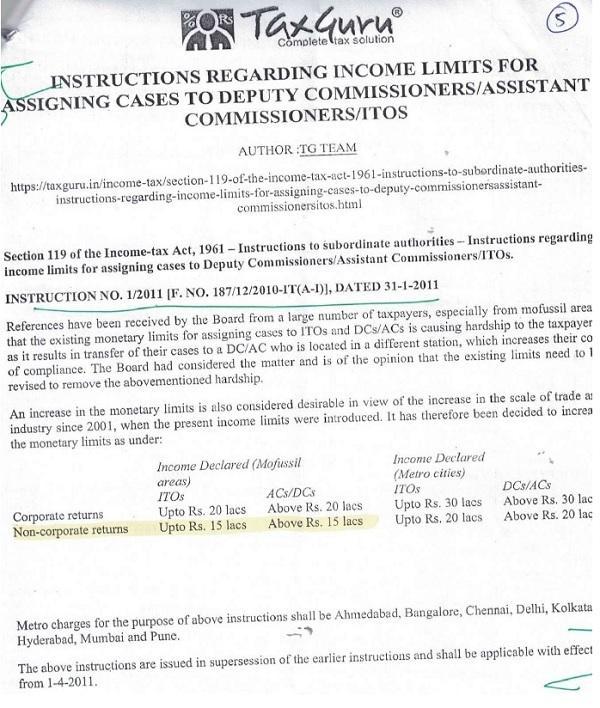
The assessee relied on CBDT Instruction No. 1/2011 dated 31 January 2011. Under the allocation referred to in the order, corporate returns in mufassil areas declaring income above ₹20 lakh fell within the jurisdiction of an ACIT or DCIT. Counsel also referred to a subsequent instruction dated 30 May 2011 prescribing a threshold of ₹15 lakh, and a departmental instruction dated 18 December 2015 referring to ₹20 lakh for corporate returns.
The company’s declared income exceeded both figures discussed before the Tribunal. Its objection therefore concerned the authority of the officer who initiated the proceedings. The original scrutiny order showed that an ACIT had handled the company’s assessment, while the return and acknowledgement supplied the income figure on which the jurisdictional objection rested. The Tribunal examined the instructions and the record and concluded that the ITO lacked the inherent jurisdiction necessary to issue the notice.
A Higher-Ranking Officer Can Also Lack Pecuniary Jurisdiction
The Raipur Bench relied on Vikas Jhuntra and Sons HUF v. ACIT, 2026 (5) TMI 1251 (ITAT Delhi). In that case, the HUF had declared income of ₹7,34,500, below the applicable ₹20 lakh limit. The Delhi Bench held that the ITO was the competent officer and that the notice issued by the ACIT was void from inception. It also referred to Aashiyana Infrastructure Development Pvt. Ltd. v. DCIT, ITA No. 8472/Del/2019, decided on 4 July 2025.
The cases illustrate how the monetary allocation works in both directions. In Vikas Jhuntra, the returned income placed the case in the ITO’s charge. In C.G. Sponge Manufacturers, it placed the case in the ACIT or DCIT’s charge. In either situation, the validity of the notice depended on whether the officer who signed it had jurisdiction over that assessee under the applicable allocation.
PAN Remaining With the ITO Cannot Cure the Defect
The Tribunal also relied on Ashok Devichand Jain v. Union of India (2023) 452 ITR 43 (Bom.). There, a non-corporate assessee had returned income of approximately ₹64.34 lakh, but the ITO issued the section 148 notice. The Department explained that the PAN was still mapped to the ITO’s ward and that there had been insufficient time to migrate it to the competent officer’s charge.
The Bombay High Court treated the section 148 notice as a jurisdictional notice and held that an inherent defect in it was incurable. The PAN mapping explained how the ITO came to issue the notice. The applicable jurisdictional allocation determined whether the ITO had authority to issue it.
Reassessment Quashed and Other Grounds Became Academic
The Raipur Bench followed these authorities and also referred to Union of India v. Rajeev Bansal, Civil Appeal No. 8629 of 2024, decided on 3 October 2024. It held that the ITO’s notice was void ab initio and could not support a valid reassessment. It accordingly quashed the reassessment and allowed the appeal. The remaining grounds became academic.
Author’s Comments
The point worth checking in a reassessment file is who issued the initiating notice. The relevant documents are the return acknowledgement, the applicable jurisdictional instructions and the signed notice. Here, the original scrutiny order provided a further reference point because it showed that the case had previously been assessed by an ACIT.
The ₹20 lakh threshold should be read in the context of the instructions discussed in this case. The applicable allocation depends on the category of assessee, the location and the instructions governing the case. The principle that carries beyond these facts is that the officer must possess jurisdiction when the section 148 notice is issued. A reassessment founded on a notice issued without that authority cannot stand.
Cases Discussed:
- Vikas Jhuntra and Sons HUF Vs ACIT (ITAT Delhi); 2026 (5) TMI 1251; AY: 2019-20.
- Aashiyana Infrastructure Development Pvt. Ltd. Vs DCIT (ITAT Delhi); ITA No. 8472/Del/2019; 04/07/2025.
- Union of India & Ors. Vs Rajeev Bansal (Supreme Court of India); Civil Appeal No. 8629 of 2024; 03/10/2024.
- Ashok Devichand Jain Vs Union of India & Ors. (Bombay High Court); Writ Petition No. 3489 of 2019; 08/03/2022; (2023) 452 ITR 43 (Bom.).
FULL TEXT OF THE ORIGINAL JUDGMENT/ORDER
The present appeal preferred by the assessee emanates from the order of the Ld.CIT(Appeals)/NFAC, Delhi dated 31.03.2026 for the assessment year 2014-15 as per the grounds of appeal on record.
2. The contention in law assailed by the Ld. Counsel for the assessee in this case is that notice u/s.148 of the Income Tax Act, 1961 (for short ‘the Act’) issued by the ITO, Ward-3(1), Raipur is without pecuniary jurisdiction, hence, such notice is void ab initio which cannot give rise a valid reassessment order, therefore, is liable to be quashed. The relevant notice u/s. 148 of the Act which is issued by the ITO, Ward-3(1), Raipur is extracted as follows:
GOVERNMENT OF INDIA
MINISTRY OF FINANCE
INCOME TAX DEPARTMENT
OFFICE OF THE INCOME TAX OFFICER
WARD 3(1) RAIPUR/
| To,
C G SPONGE MANUFACTURERS CONSORTIUM |
–
| PAN: AACCC6516E |
AY: 2014-15 |
Dated: 30/03/2021 |
DIN & Notice No : ITBA/AST/S/148/2020-21/1031909160(1) |
Notice Under Section 148 Of The Income Tax Act, 1961
Sir/ Madam/ M/s,
Whereas I have reasons to believe that your Income chargeable to Tax for the Assessment Year 2014-15 has escaped Assessment within the meaning of section 147 of the Income Tax Act, 1961.
I, therefore, propose to assess/ re-assess the income/ loss for the said Assessment Year and I hereby require you to deliver to me within 30 days from the service of this notice, a return in the prescribed form for the said Assessment Year.
This notice is being issued after obtaining the necessary satisfaction of the PCIT, Raipur-1
CHALAMJI V G
WARD 3(1) RAIPUR/
(In case the document is digitally signed please
refer Digital Signature at the bottom of the page)
Note: If digitally signed, the date of digital signature may be taken as date of document.
CENTRAL REVENUE BUILDING, RAI02, RAI03, RAI04, RAIPUR, Chhattisgarh, 492001
Email: [email protected].
* DIN-Document identification No.
“Certified True Copy”
3. The Ld. Counsel demonstrates by filing copy of ITR and acknowledgement for A.Y.2014-15 that gross total income of the assessee is Rs.30,75,723/-. Similarly, he demonstrates that original assessment u/s. 143(3) of the Act has been completed by the ACIT, Circle-3(1), Raipur, dated 13.12.2016. The Ld. Counsel for the assessee first referred to CBDT Instruction No.1/2011 [F.No.187/12/2010-IT(A-I)], dated 31.01.2011 wherein for mufassil areas for corporate returns income declared in the return if it is above Rs.20 lacs, the competent authority for carrying out assessment is AC/DC. The said instruction is extracted as follows:
4. That in subsequent CBDT Instruction dated 30.05.2011 for corporate returns, income declared above Rs.15 lacs, the competent authority for assessment is AC/DC. Further, the Ld. Counsel referred to Departmental Instruction dated 18.12.2015 wherein for corporate return, income declared above Rs.20 lacs is ACIT/DCIT. The Ld. Counsel for the assessee vehemently contended that as demonstrated, the total return of income is Rs.30,75,723/- for A.Y.2014-15, therefore, the competent authority for issuing notice u/s. 148 of the Act was ACIT/DCIT and not ITO, Ward-3(1), Raipur.
5. We find that in the identical facts and circumstances and issue the Coordinate Bench Delhi in the case of Vikas Jhuntra and Sons HUF vs. ACIT, Circle-49(1), Delhi 2026 (5) TMI 1251 – ITAT Delhi held that having regard to CBDT Instruction governing monetary limits for jurisdiction, the ACIT lacked authority to issue the notice under section 148 in the assessee’s case and therefore, the entire reassessment proceedings was void. The relevant observation are extracted as follows:
“5. Undisputedly, the assessee had filed return of income u/s. 139(1) of the Act on 21.06.2019 declaring total income of Rs. 7,34,500/-, i.e., less than the monetary limit of Rs. 20,00,000/- specified under CBDT Instruction No. 1/2011 dated 31.01.2011 (supra). Even in the return of income filed by the assessee in response to notice u/s. 148 of the Act, the assessee had declared total income of Rs. 7,34,500/-. The said return of income is at page 95 of the paper book. Thus, in light of aforesaid CBDT Instruction, the notice u/s. 148 of the Act ought to have been issued by the ITO. Since, in the present case the notice has been issued by the ACIT, the same is without jurisdiction, hence, void ab Initio. I find that the Division Bench of the Arbunal in the case of Aashiyana Infrastructure Development Pvt. Ltd. vs. DCIT in ITA No.8472/Del/2019, decided on 04.07. 2025 in similar facts had held notice issued u/s. 148 of the Act to 20 defective and void ab initio. Thus, in light of the above undisputed facts, I hold that the notice issued u/s. 148 of the Act by the ACIT is without Jurisdiction. Consequently, the proceedings arising from such defective notice are vitiated and hence, quashed.
6. In the result, appeal of the assessee is allowed.”
6. Further, the Hon’ble High Court of Bombay in the case of Ashok Devichand Jain vs. Union of India & Ors. (2023) 452 ITR 00 43 (Bom.) observed and held as follows:
“2. The primary ground that has been raised is that the Income Tax Officer who issued the notice under section 148 of the Act, had no jurisdiction to issue such notice. According to Petitioner as per instruction No. 1/2011 dated 31st January, 2011 issued by the Central Board of Direct Taxes, where income declared/returned by any Non-Corporate assessee is up to Rs. 20 lakhs, then the jurisdiction will be of ITO and where the income declared returned by a Non Corporate assessee is above Rs. 20 lakhs, the jurisdiction will be of DC/AG.
3. Petitioner has filed return of income of about Rs. 64,34,663/- and therefore, the jurisdiction will be that of DC/AC and not ITO. Mr. Jain submitted that since notice under section 148 of the Act has been issued by ITO, and not by DC/AC that is by a person who did not have any jurisdiction over Petitioner, such notice was bad on the count of having been issued by an officer who had no authority in law to issue such notice.
4. We have considered the affidavit in reply of one Mr. Suresh G. Kamble, ITO who had issued the notice under section 148 of the Act. Said Mr. Kamble, ITO, Ward 12(3)(1), Mumbai admits that such a defective notice has been issued but according to him, PAN of Petitioner was lying with ITO Ward (12)(3)(1), Mumbai and it was not feasible to migrate the PAN having returned of income exceeding Rs. 30 lakhs to the charge of DCIT, Circle 12(3)(1). Mumbai, as the time available with the ITO 12(3)(1) was too short to migrate the PAN after obtaining administrative approval from the higher authorities by 31st March, 2019.
5. The notice under section 148 of the Act is jurisdictional notice and any inherent defect therein is not curable. In the facts of the case, notice having been issued by an officer who had no jurisdiction over the Petitioner, such notice in our view, has not been issued validly and is issued without authority in law.”
7. Respectfully following the aforesaid judicial pronouncements and on examination of the facts on record and also applying the “ratio decidendi” of the Hon’ble Supreme Court in the case of Union of India & Ors. vs. Rajeev Bansal, in Civil Appeal No. 8629 of 2024, dated 03.10.2024, the ITO, Ward-3(1), Raipur did not possess valid inherent jurisdiction as per the CBDT instructions (supra) to issue notice u/s. 148 of the Act to the assessee, therefore, notice issued u/s.148 of the Act is invalid, void ab initio. That once the very notice u/s.148 of the Act is held void-ab-initio it cannot enable framing of valid reassessment order which is, therefore, quashed. Subsequent proceedings becomes non-est as per law. Rest other grounds stand academic only.
8. As per above terms, the appeal of the assessee is allowed.
Order pronounced in the open court on 20th November, 2026.