Suman Lata Vs ITO (ITAT Raipur)
Section 148 Notice Is Void Where the Returned Capital Loss Exceeds the ITO’s Pecuniary Jurisdiction
Capital Loss of ₹27.99 Lakh Determined Jurisdiction
The Raipur ITAT quashed a reassessment because the Income Tax Officer who issued the notice under section 148 lacked pecuniary jurisdiction. The assessee’s original return disclosed a capital loss of ₹27,98,930, carried forward to the subsequent year. For applying the monetary limits in the CBDT instructions, the Tribunal took the amount of the loss into account. Since it exceeded the ₹15 lakh ceiling applicable to the ITO for the category in question, jurisdiction lay with the ACIT or DCIT.
The decision addresses a practical question in allocating assessment jurisdiction. Where the return discloses a loss, does the negative sign place the case within the ITO’s monetary limit? On the facts before it, the Tribunal treated the magnitude of the returned loss as the relevant figure.
Reassessment Notice Issued by the ITO
The assessee had filed her original return under section 139(1) of the Income-tax Act, 1961 for AY 2020–21. The computation under the head Capital Gains showed a loss of ₹27,98,930, which was carried forward. On 30 March 2024, the ITO, Ward-1(1), Raipur issued a notice under section 148. The proceedings culminated in a reassessment order under section 147 read with section 144B.
In the appeal against the order of the CIT(A), National Faceless Appeal Centre, the assessee produced the original return and computation before the Tribunal. Her contention was that the relevant monetary limit had already been crossed on the face of the return and that the ITO therefore lacked authority to initiate reassessment.
CBDT Instructions Allocated Cases by Monetary Limit
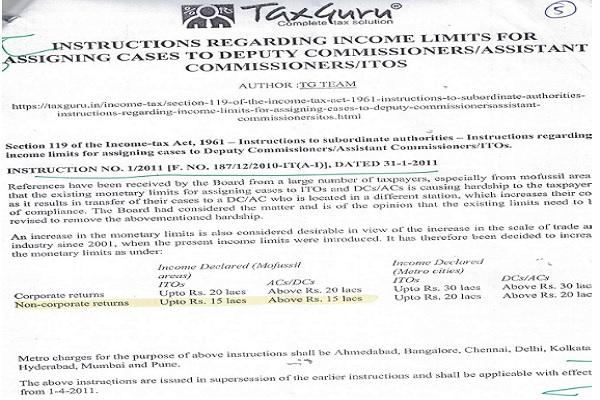
The assessee relied on CBDT Instruction No. 1/2011 dated 31 January 2011. For non-corporate returns in mofussil areas, the instruction allocated cases up to ₹15 lakh to ITOs and cases above that amount to ACITs or DCITs.
At the Bench’s request, the assessee also placed the subsequent instructions on record. The Tribunal noted that Instruction No. 6/2011 dated 8 April 2011 permitted the CCIT or DGIT to adjust the limits by ₹5 lakh in either direction for workload distribution. It recorded that the instruction dated 30 May 2011 reduced the relevant ITO limit to ₹10 lakh, while the notification dated 18 December 2015 restored it to ₹15 lakh. The returned loss in this case exceeded the ITO’s limit under either figure.
Earlier Rulings Confirmed That the Correct Officer Must Issue Notice
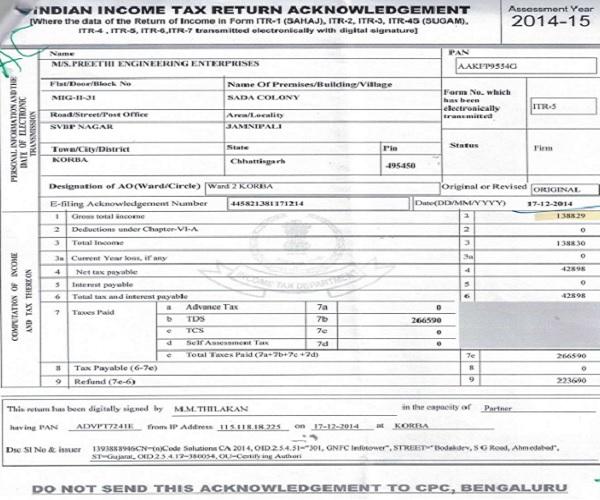
The Tribunal followed its earlier decision in Preethi Engineering Enterprises v. DCIT, ITA No. 313/RPR/2026, dated 24 June 2026. There, the returned gross total income was ₹1,38,829, and the applicable allocation placed the case with the ITO. The notice had been issued by the ACIT and was held void. Read together, the two decisions show that validity depends on which officer has been assigned jurisdiction under the applicable monetary limits.
The Tribunal also referred, through its earlier order, to Vikas Jhuntra and Sons HUF v. ACIT, 2026 (5) TMI 1251 (Delhi ITAT). The Delhi Bench had quashed reassessment where the ACIT issued notice despite the returned income being below the applicable ₹20 lakh threshold. The difference between the monetary limits in the two cases reflects the importance of identifying the allocation applicable to the assessee concerned.
Inherent Defect in Section 148 Notice Vitiated Reassessment
The Tribunal relied on Ashok Devichand Jain v. Union of India (2023) 452 ITR 43 (Bom.), where the Bombay High Court treated a section 148 notice as a jurisdictional notice and held that an inherent defect in the issuing officer’s authority was incurable. The Tribunal also referred to Union of India v. Rajeev Bansal, Civil Appeal No. 8629 of 2024, decided on 3 October 2024, in reaching its conclusion.
The ITO’s notice was held void ab initio, and the reassessment founded on it was quashed. The remaining grounds became academic, and the assessee’s appeal was allowed.
Author’s Comments
The notable feature is the use of the capital loss disclosed and carried forward in the original return to test the issuing officer’s authority. A review confined to the taxable income figure can miss a loss shown in the computation. In this case, that loss determined whether the ITO had jurisdiction to issue the notice.
The relevant comparison is between the figure disclosed in the return and the monetary allocation applicable to the assessee’s category and location. The amount of any proposed addition serves a different purpose in reassessment proceedings. Suman Lata is particularly relevant where the return carries forward a substantial loss and the notice has been issued by an officer whose monetary jurisdiction is confined to a lower amount.
Cases Discussed
- Preethi Engineering Enterprises Vs DCIT (ITAT Raipur), ITA No. 313/RPR/2026, 24 June 2026;
- Vikas Jhuntra and Sons HUF Vs ACIT (ITAT Delhi), 2026 (5) TMI 1251;
- Aashiyana Infrastructure Development Pvt. Ltd. Vs DCIT (ITAT Delhi), ITA No. 8472/Del/2019, 4 July 2025;
- Ashok Devichand Jain Vs Union of India (Bombay High Court), (2023) 452 ITR 43;
- Union of India Vs Rajeev Bansal (Supreme Court), Civil Appeal No. 8629 of 2024, 3 October 2024.
FULL TEXT OF THE ORDER OF ITAT RAIPUR
The present appeal preferred by the assessee emanates from the order of the Ld.CIT(Appeals)/NFAC, Delhi dated 02.09.2026 for the assessment year 2020-21 as per the grounds of appeal on record.
2. The contention in law assailed by the Ld. Counsel for the assessee is that the notice u/s.148 of the Income Tax Act, 1961 (for short ‘the Act’) issued to the assessee dated 30.03.2024 by the ITO, Ward-1(1), Raipur which resulted in passing of the assessment order u/s. 147 r.w.s 144B of the Act was without pecuniary jurisdiction. It was contended by the Ld. Counsel for the assessee that pecuniary jurisdiction over the assessee was with the ACIT/DCIT and not with ITO. Demonstrating the same, the Ld. Counsel has placed on record copy of the returned filed by the assessee for A.Y.2020-21 u/s.139(1) of the Act wherein in the computation sheet at Column income from capital gain of the assessee had shown loss of Rs.(-) 27,98,930/- which is carried forward to the subsequent year. Therefore, in effect return income filed disclosing loss of Rs. (-) 27,98,930/-.
3. Further, the Ld. Counsel for the assessee referring to the CBDT Instruction No.1/2011 [F.No.187/12/2010-IT(A-I)], dated 31.01.2011 stated that for the non-corporate returns above Rs.15 lacs, the competent Income Tax Authority for the mofussil areas is AC/DC and since in the return filed, the assessee had declared loss of Rs.(-) 27,98,930/-, therefore, ITO does not have the pecuniary jurisdiction to issue notice u/s. 148 of the Act since pecuniary jurisdiction of the ITO for non- corporate returns in the mofussil areas is only upto Rs.15 lacs. The said copy of the instruction is extracted as follows:
4. That on query from the Bench regarding subsequent development in the Departmental circular/Instruction, the Ld. Counsel placed on record Instruction No.6/2011[F.NO.187/12/2010-ITA-I], dated 08.04.2011, wherein CCIT /DGIT may adjust the above limits +/- Rs.5 lacs for proper distribution of work load as provided in Para 2 of the said circular. Thereafter, in the CBDT Instruction, dated 30.05.2011, the monetary limit was revised for non-corporate returns wherein the ITO had jurisdiction upto Rs.10 lacs and ACs/DCs had jurisdiction above Rs.10 lacs and therefore, there was downward adjustment of Rs.5 lacs regarding both the authorities as compared to the Instruction No.1/2011 [F.No.187/12/2010-IT(A-I)], dated 31.01.2011. That again in the Notification dated 18.12.2015 for non- corporate returns for ITO, the jurisdiction was again raised upto Rs.15 lacs and above Rs.15 lacs the jurisdiction was vested with ACIT/DCIT. In effect, the power of the ITO as competent authority for assessment was never for any returns filed above Rs.15 lacs at any given point of time. That any return filed which is having value above Rs.15 lacs, the competent authority is ACIT/DCIT. In the present case, as it has been examined in foregoing paras, return filed by the assessee declaring loss of Rs.(-) 27,98,930/-, hence, it is clear that the notice u/s.148 of the Act that was issued by the ITO, Ward-1(1), Raipur was without pecuniary jurisdiction of the ITO, hence, the said notice is invalid, bad in law, arbitrary and void ab initio sans inherent pecuniary jurisdiction of the issuing authority.
5. I find that on identical facts and circumstances and similar issue, this Bench of the Tribunal in the case of Preethi Engineering Enterprises Vs. DCIT, Circle-1(1), Bilaspur (C.G.) ITA No.313/RPR/2026, dated 24.06.2026 had held and observed as follows:
“2. The contention in law assailed by the Ld. Counsel for the assessee is that as per the return filed under section 139(1) of the Act for A.Y. 2014-15 the assessee had shown gross total income of Rs.1,38,829/-. The said copy of the return is extracted as follows:
3. The Ld. Counsel further submitted that as per CBDT Instruction No. 1/2011 [F. No. 187/12/2010-IT(A-I)], Dated 31-01-2011 for non- corporate return up to Rs. 15,00,000/- the assessment has to be done by the ITO. The said copy of the instruction as extracted as follows:
4. It is the grievance of the assessee that in such scenario the notice under section 148 of the Act for reassessment proceedings under section 147/148 of the Act dated 31.03.2021 for A.Y. 2014- 15 had been issued to the assessee not by ITO but by the ACIT, Circle-1(1), Bilaspur who is, therefore, not having the valid jurisdiction to issue such notice. It was further contended by the Ld. Counsel that being a non-corporate assessee and as demonstrated as per the return filed was below Rs. 15,00,000/-, therefore, the valid jurisdiction as per CBDT instruction (supra), it was with the A.O. who had to issue notice under section 148 of the Act. The ACIT, Circle-1(1), Bilaspur issuing notice to the assessee suffers from invalid jurisdiction.
5. I find that in the identical facts and circumstances and issue the Coordinate Bench Delhi in the case of Vikas Jhuntra and Sons HUF vs. ACIT, Circle-49(1), Delhi 2026 (5) TMI 1251 – ITAT Delhi held that having regard to CBDT Instruction governing monetary limits for jurisdiction, the ACIT lacked authority to issue the notice under section 148 in the assessee’s case and therefore, the entire reassessment proceedings was void. The relevant observation are extracted as follows:
“5. Undisputedly, the assessee had filed return of income u/s. 139(1) of the Act on 21.06.2019 declaring total income of Rs. 7,34,500/-, i.e., less than the monetary limit of Rs. 20,00,000/- specified under CBDT Instruction No. 1/2011 dated 31.01.2011 (supra). Even in the return of income filed by the assessee in response to notice u/s. 148 of the Act, the assessee had declared total income of Rs. 7,34,500/-. The said return of income is at page 95 of the paper book. Thus, in light of aforesaid CBDT Instruction, the notice u/s. 148 of the Act ought to have been issued by the ITO. Since, in the present case the notice has been issued by the ACIT, the same is without jurisdiction, hence, void ab Initio. I find that the Division Bench of the Arbunal in the case of Aashiyana Infrastructure Development Pvt. Ltd. vs. DCIT in ITA No.8472/Del/2019, decided on 04.07. 2025 in similar facts had held notice issued u/s. 148 of the Act to 20 defective and void ab initio. Thus, in light of the above undisputed facts, I hold that the notice issued u/s. 148 of the Act by the ACIT is without Jurisdiction. Consequently, the proceedings arising from such defective notice are vitiated and hence, quashed.
6. In the result, appeal of the assessee is allowed.”
6. Further, the Hon’ble High Court of Mumbai in the case of Ashok Devichand Jain vs. Union of India & Ors. (2023) 452 ITR 00 43 (Bom.) observed and held as follows:
“2. The primary ground that has been raised is that the Income Tax Officer who issued the notice under section 148 of the Act, had no jurisdiction to issue such notice. According to Petitioner as per instruction No. 1/2011 dated 31st January, 2011 issued by the Central Board of Direct Taxes, where income declared/returned by any Non-Corporate assessee is up to Rs. 20 lakhs, then the jurisdiction will be of ITO and where the income declared returned by a Non Corporate assessee is above Rs. 20 lakhs, the jurisdiction will be of DC/AG.
3. Petitioner has filed return of income of about Rs. 64,34,663/- and therefore, the jurisdiction will be that of DC/AC and not ITO. Mr. Jain submitted that since notice under section 148 of the Act has been issued by ITO, and not by DC/AC that is by a person who did not have any jurisdiction over Petitioner, such notice was bad on the count of having been issued by an officer who had no authority in law to issue such notice.
4. We have considered the affidavit in reply of one Mr. Suresh G. Kamble, ITO who had issued the notice under section 148 of the Act. Said Mr. Kamble, ITO, Ward 12(3)(1), Mumbai admits that such a defective notice has been issued but according to him, PAN of Petitioner was lying with ITO Ward (12)(3)(1), Mumbai and it was not feasible to migrate the PAN having retumed of income exceeding Rs. 30 lakhs to the charge of DCIT, Circle 12(3)(1). Mumbai, as the time available with the ITO 12(3)(1) was too short to migrate the PAN after obtaining administrative approval from the higher authorities by 31st March, 2019.
5. The notice under section 148 of the Act is jurisdictional notice and any inherent defect therein is not curable. In the facts of the case, notice having been issued by an officer who had no jurisdiction over the Petitioner, such notice in our view, has not been issued validly and is issued without authority in law.”
7. Respectfully following the aforestated judicial pronouncements and even applying the ratio of Hon’ble Supreme Court in the case of Union of India & Ors. vs. Rajeev Bansal, in Civil Appeal No. 8629 of 2024, dated 03.10.2024 the ACIT, Circle1(1), Bilaspur did not posses valid inherent jurisdiction as per the CBDT instruction (supra) to issue notice under section 148 of the Act to the assessee. Therefore, the notice under section 148 of the Act is void-ab-initio. That once the very notice under section 148 is held void-ab-initio it cannot enable framing of valid reassessment order which is, therefore, quashed. Subsequent proceedings becomes non-est as per law. Rest other grounds stand academic only.
8. As per the above terms the appeal of the assessee is allowed.”
6. Respectfully following the aforesaid judicial pronouncements and on examination of the facts on record and also applying the “ratio decidendi” of the Hon’ble Supreme Court in the case of Union of India & Ors. vs. Rajeev Bansal, in Civil Appeal No. 8629 of 2024, dated 03.10.2024, the ITO, Ward-1(1), Raipur did not possess valid inherent jurisdiction as per the CBDT instructions (supra) to issue notice u/s. 148 of the Act to the assessee, therefore, notice issued u/s.148 of the Act is invalid, void ab initio. That once the very notice u/s.148 of the Act is held void-ab-initio it cannot enable framing of valid reassessment order which is, therefore, quashed. Subsequent proceedings becomes non-est as per law. Rest other grounds stand academic only.
7. As per above terms, the appeal of the assessee is allowed.
Order pronounced in open court on 18th day of November, 2026.