Inder Jaggi Vs ITO (ITAT Raipur)
Summary: The ITAT Raipur allowed the assessee’s appeal for Assessment Year 2013-14 and quashed the reassessment proceedings on the ground that the notice issued under Section 148 of the Income Tax Act, 1961, on 27 July 2022 was barred by limitation. The appeal arose from the order of the CIT(A)/NFAC dated 4 December 2025. The assessee challenged the validity of the reassessment notice, contending that the surviving limitation period had expired before its issuance and that the consequential reassessment order dated 28 February 2023 was therefore unsustainable.
The assessee relied on the Supreme Court’s decision in Union of India v. Rajeev Bansal, 469 ITR 46 (SC), concerning computation of the surviving limitation period under the reassessment provisions read with the Taxation and Other Laws (Relaxation and Amendment of Certain Provisions) Act. Reliance was also placed on Kachrulal Jitendra Kumar v. ITO, Ram Balram Buildhome Pvt. Ltd. v. ITO and KLM Steel Pipe Pvt. Ltd. v. ITO. The Tribunal particularly considered the Delhi ITAT ruling in KLM Steel Pipe Pvt. Ltd., involving the same assessment year and a Section 148 notice dated 27 July 2022. The Departmental Representative could not produce evidence refuting the material facts.
Following the coordinate bench’s reasoning and the Supreme Court’s limitation principles, the Tribunal held that the reassessment notice was time-barred. Consequently, the reopening was quashed, subsequent proceedings became non-est in law, the remaining grounds were rendered academic, and the assessee’s appeal was allowed.
Cases Discussed
- KLM Steel Pipe Pvt. Ltd. v. ITO, Ward-14(1), ITA Nos. 9145 to 9147/Del/2025, order dated 29 April 2026 (ITAT Delhi) — Followed on materially similar facts involving AY 2013-14 and a reassessment notice dated 27 July 2022.
- Ram Balram Buildhome Pvt. Ltd. v. Income Tax Officer & Anr., 445 ITR 1 (Delhi High Court), decision dated 30 January 2025 — Considered for the requirement that Section 148A proceedings and the reassessment notice be completed within the surviving limitation period.
- Union of India & Ors. v. Rajeev Bansal, 469 ITR 46 (Supreme Court) — Relied upon for the computation of surviving limitation and the invalidity of reassessment notices issued beyond that period.
- Kachrulal Jitendra Kumar v. ITO, Ward-1(2), Raipur, ITA No. 307/RPR/2024 (ITAT Raipur) — Cited by the assessee in support of quashing reassessment where the Section 148 notice was time-barred.
- Union of India v. Ashish Agarwal, 444 ITR 1 (Supreme Court), decision dated 4 May 2022 — Discussed in the reproduced precedent concerning deemed show-cause notices and limitation exclusions.
- State of A.P. v. A.P. Pensioners Association, (2005) 13 SCC 161 (Supreme Court) — Appears in the reproduced Supreme Court reasoning concerning
- the consequences of a statutory legal fiction.
FULL TEXT OF THE ORDER OF ITAT RAIPUR
The present appeal preferred by the assessee emanates from the order of the Ld.CIT(Appeals)/NFAC, Delhi dated 04.12.2025 for the assessment year 2013-14 as per the grounds of appeal on record.
2. The assessee has raised both the grounds on merits as well as legal grounds. The contention in law raised by the Ld. Counsel for the assessee as per Ground of appeal No.2 reads as follows:
“2. On the facts and in law, notice u/s. 148 dt. 27/07/2022 issued by the ld. ITO, Ward-3(1), Raipur is illegal and bad in law, as such it is invalid since notice u/s. 148 was being issued after elapse of surviving period and therefore, consequent reassessment order passed u/s. 147 r.w.s. 144 r.w.s 144B dt. 28.02.2023 is also invalid, unsustainable and liable to be quashed.”
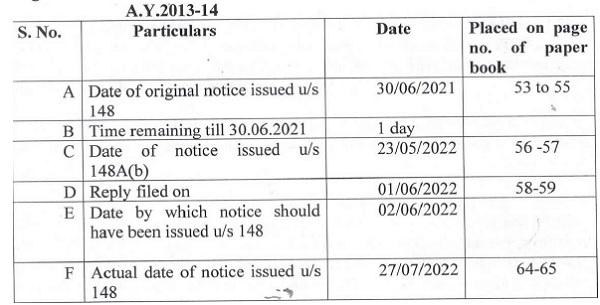
3. That in order to substantiate the aforesaid legal ground, the assessee had filed facts in tabulated form which is extracted as follows:
4. Further, the Ld. Counsel for the assessee submitted as follows:
“To support the above legal ground, in addition to facts as stated above, we further submits before your honour the following:-
-The observation of the Hon’ble Apex Court in the case of Union of India & Ors. Vs. Rajeev Bansal (supra) are culled out as under:
“114. In view of the above discussion, we conclude that: a. After 1 April 2021, the Income Tax Act has to be read along with the substituted provisions;
b. TOLA will continue to apply to the Income Tax Act after 1 April 2021 if any action or proceeding specified under the substituted provisions of the Income Tax Act falls for completion between 20 March 2020 and 31 March 2021;
c. Section 3(1) of TOLA overrides Section 149 of the Income Tax Act only to the extent of relaxing the time limit for issuance of a reassessment notice under Section 148; d. TOLA will extend the time limit for the grant of sanction by the authority specified under Section 151. The test to determine whether TOLA will apply to Section 151 of the new regime is this: if the time limit of three years from the end of an assessment year falls between 20 March 2020 and 31 March 2021, then the specified authority under Section 151(i) has extended time till 30 June 2021 to grant approval;
e. In the case of Section 151 of the old regime, the test is: if the time limit of four years from the end of an assessment year falls between 20 March 2020 and 31 March 2021, then the specified authority under Section 151(2) has extended time till 31 March 2021 to grant approval;
f. The directions in Ashish Agarwal (supra) will extend to all the ninety thousand reassessment notices issued under the old regime during the period 1 April 2021 and 30 June 2021;
g. The time during which the show cause notices were deemed to be stayed is from the date of issuance of the deemed notice between 1 April 2021 and 30 June 2021 till the supply of relevant information and material by the assessing officers to the assesses in terms of the directions issued by this Court in Ashish Agarwal (supra), and the period of two weeks allowed to the assesses to respond to the show cause notices; and
h. The assessing officers were required to issue the reassessment notice under Section 148 of the new regime within the time limit surviving under the Income Tax Act read with TOLA. All notices issued beyond the surviving period are time barred and liable to be set aside;”
– That the honorable jurisdictional bench of Raipur ITAT in case of M/s Kachrulal Jitendra Kumar Vs ITO, Ward- 1(2),Raipur, ITA No.307/RPR/2024 held by following the decision of honorable Supreme Court in Union of India & others Vs Rajeev Bansal that notice u/s 148 issued after the lapse of period of limitation barred by limitation, accordingly, assessment order passed by the AO u/s 147 r.w.s 144B of IT Act in absence of ‘a valid notice issued u/s 148 of the cat cannot be sustained and is quashed.
– Similarly in case of Assessee also, the notice u/s 148 dtd. 27/07/20222 was being issued after the lapse of period of limitation i.e after 02/06/2022 and consequently assessment order passed u/s 147 r.w.s. 144B of the Act dtd.28/02/2023 is not sustainable and liable to be quashed.
– That Delhi HC in case of Ram Balram Buildhome Pvt. Ltd. Vs. Income Tax Officer & Anr. by its decision dtd.30/01/2025 also held the similar view that assessment order passed pursuant to notice u/s 148 issued after the lapse of period of limitation, is liable to be set aside.
– Also, Delhi ITAT, in case of KLM Steel Pipe Pvt. Ltd. v. ITO (AY 2013-14) dtd.09/05/2026 quashed the reassessment as notice dated 27.07.2022 was beyond limitation, applying Rajeev Bansal SC ruling.
– Honorable jurisdictional CG high court also decided by following the decision of Honorable Supreme Court in case of Rajiv Bansal held that the order u/s 148A(d) need to be issued within the surviving period.
Thus, in view of above, the order u/s 148A(d) dtd.21/0702022 and notice u/s 148 dated 27.07.2022 is time-barred and therefore the reassessment order dated 28.02.2023 is consequently invalid.
5. We find that on similar and identical facts and circumstances and issues, the Co-ordinate Bench of the Tribunal, Delhi in the case of KLM Steel Pipe Pvt. Ltd. Vs. ITO, Ward-14(1), ITA Nos.9145 to 9147/Del/2025, dated 29.04.2026 had quashed reassessment as notice dated 27.07.2022 being barred by limitation relying on the judgment of the Hon’ble Apex Court in the case of Union of India Vs. Rajeev Bansal 469 ITR 46 (SC). In the case of the assessee also, the actual date of notice was 27.07.2022 matching with the said notice as referred in the decision of the Co-ordinate Bench of the Tribunal, Delhi and that it also pertains to same A.Y. i.e. A.Y.2013-14. The relevant observation of the Tribunal are extracted as follows:
“3. We have heard the rival submissions and perused the material available on record. Notice u/s 148 of the Act stood issued to the assessee for the assessment year 2013-14 on 28.06.2021. The ld AR pleaded that the said notice issued was as per old provisions of Section 148 of the Act prior to the substitution by Finance Act, 2021. It was submitted that Section 148 of the Act has been substituted by Finance Act, 2021 w.e.f 01.04.2021 wherein notice u/s 148 of the Act as per the old provisions of Section 148 of the Act applicable upto 31.03.2021 could not have been issued after 31.03.2021. This issue per se was subject matter of various writ petitions filed in various High Courts and ultimately got settled by the Hon’ble Supreme Court in the case of Union of India Vs. Ashish Agarwal reported in 444 ITR 1 (SC) dated 04.05.2022. Thereafter, the ld AO issued letter u/s 148A(b) of the Act on 21.05.2022. The assessee filed its reply on 27.06.2022. The ld AO passed an order u/s 148A(d) of the Act on 27.07.2022 rejecting the objections of the assessee and proceeded to issue notice u/s 148 of the Act on 27.07.2022. All these facts are not in dispute before us with regard to dates. Now the short question that arises for our consideration is as to whether the subsequent notice issued u/s 148 of the Act on 27.07.2022 is to be treated as time barred or not in the light of decision of Hon’ble Supreme Court in the case of Union of India Vs. Rajeev Bansal reported in 469 ITR 46 (SC). In this regard, it would be appropriate to reproduce the relevant portion of the decision of the Hon’ble Supreme Court in the case of Rajeev Bansal referred (supra) as under:-
“110. The effect of the creation of the legal fiction in Ashish Agarwal (supra) was that it stopped the clock of limitation with effect from the date of issuance of Section 148 notices under the old regime [which is also the date of issuance of the deemed notices]. As discussed in the preceding segments of this judgment, the period from the date of the issuance of the deemed notices till the supply of relevant information and material by the assessing officers to the assesses in terms of the directions issued by this Court in Ashish Agarwal (supra) has to be excluded from the computation of the period of limitation. Moreover, the period of two weeks granted to the assesses to reply to the show cause notices must also be excluded in terms of the third proviso to Section 149.
111. The clock started ticking for the Revenue only after it received the response of the assesses to the show causes notices. After the receipt of the reply, the assessing officer had to perform the following responsibilities: (i) consider the reply of the assessee under Section 149A(c); (ii) take a decision under Section 149A(d) based on the available material and the reply of the assessee; and (iii) issue a notice under Section 148 if it was a fit case for reassessment. Once the clock started ticking, the assessing officer was See State of A P v. A P Pensioners Association, (2005) 13 SCC 161 [28]. [This Court observed that the “legal fiction undoubtedly is to be construed in such a manner so as to enable a person, for whose benefit such legal fiction has been created, to obtain all consequences flowing therefrom.”] PART F required to complete these procedures within the surviving time limit. The surviving time limit, as prescribed under the Income Tax Act read with TOLA, was available to the assessing officers to issue the reassessment notices under Section 148 of the new regime.
112. Let us take the instance of a notice issued on 1 May 2021 under the old regime for a relevant assessment year. Because of the legal fiction, the deemed show cause notices will also come into effect from 1 May 2021. After accounting for all the exclusions, the assessing officer will have sixty-one days [days between 1 May 2021 and 30 June 2021] to issue a notice under Section 148 of the new regime. This time starts ticking for the assessing officer after receiving the response of the assessee. In this instance, if the assessee submits the response on 18 June 2022, the assessing officer will have sixty-one days from 18 June 2022 to issue a reassessment notice under Section 148 of the new regime. Thus, in this illustration, the time limit for issuance of a notice under Section 148 of the new regime will end on 18 August 2022.”
4. Now let us see whether the notice issued u/s 148 of the Act on 27.07.2022 is within the time in the light of the aforesaid observation of the Hon’ble Supreme Court. For this purpose, the following table would be relevant which is reproduced as under:
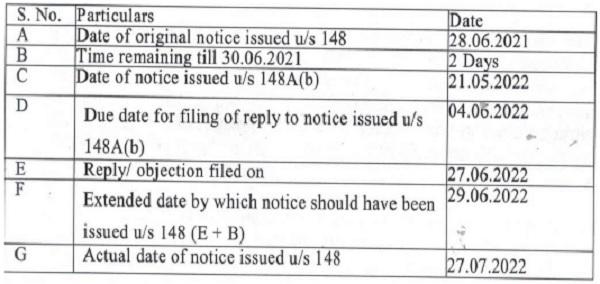
5. Hence, in view of the observation of the Hon’ble Supreme Court in the case of Rajeev Bansal (supra), the extended due date for issuance of notice u/s 148 of the Act expired on 29.06.2022 and since, the notice u/s 148 of the Act is issued on 27.07.2022, the said notice is to be treated as barred by limitation and consequentially reassessment proceedings would be liable to be quashed as void ab initio. This issue was also subject matter of consideration by the Hon’ble Jurisdictional Delhi High Court in the case of Ram Balram Buildhome Vs. ITO & Anr reported in 445 ITR 1 (Del) dated 30.01.2025. Relevant operative portion of the said order is reproduced herein below:-
“65. Thus, in the facts of the present case, the last date for issuance of notice under Section 148 of the Act for AY 2013- 14 under the statutory framework, as was existing prior to 01.04.2021 was 31.03.2020, that is, six years from the end of the relevant assessment year.
66. By virtue of Section 3 (1) of TOLA time for completion of specified acts, which fell during the period 20.03.2020 to 31 12.2020 were extended till 30.06.2021 [Notification No.38/21 dated 27.04.2021]. Thus, the notice dated 01.06.2021 was issued twenty-nine days prior to the expiry of period of limitation for issuing a notice under Section 148 of the Act as was extended by TOLA. As noted above, the period from 01.06.2021, the date of issuance of notice, and 04.05.2022, being the date of decision of the Supreme Court in Union of India & Ors. v. Ashish Agarwal is required to be excluded by virtue of the third proviso to Section 149 (1) of the Act. 67 Additionally, the period from the date of decision in Union of India & Ors. v. Ashish Agarwal2 till the date of providing material, as required to the accompanied with a notice under Section 148A (b) of the Act. is required to be excluded. Thus, the period between 04.05.2022 to 30.05.2022, the date on which the AO had issued the notice under Section 148A (b) of the Act in furtherance of his earlier notice dated 01.06.2021, is also required to be excluded by virtue of the third proviso to Section 149 (1) of the Act as held by the Supreme Court in Union of India & Ors. v. Rajeev Bansal4.
68. In addition to the above, the time granted to the petitioner to respond to the notice dated 30.05.2022-the period of two weeks-is also required to be excluded by virtue of the third proviso to Section 149 (1) of the Act. The petitioner had furnished its response to the notice under Section 148A (b) of the Act on 13.06.2022. Thus, the period of limitation began running from that date.
69. As noted above, by virtue of TOLA, the AO had period of twenty-nine days limitation left on the date of commencement of the reassessment proceedings, which began on 01.06.2021, to issue a notice under Section 148 of the Act. The said notice was required to be accompanied by an order under Section 148A (d) of the Act. Thus, the AO was required to pass an order under Section 148A (d) of the Act within the said twenty-nine days notwithstanding the time stipulated under Section 148A (d) of the Act. This period expired on 12.07.2022.
70. Since the period of limitation, as provided under Section 149 (1) of the Act, had expired prior to issuance of the impugned notice on 30.07.2022. The said is squarely beyond the period of limitation.
71. It is contended on behalf of the Revenue that the AO is required to pass an order under Section 148A (d) of the Act by the end of the month following the month on which the reply to the notice under Section 148A (b) of the Act was received. Thus, the order under Section 148A (d) of the Act as well as the notice under Section 148 of the Act (both dated 30.07.2022) are within the prescribed period. This contention is without merit as it does not take into account that proceedings under Section 148A of the Act necessarily required to be completed within the period available for issuing notice under Section 148 of the Act, as prescribed under Section 149 of the Act. Thus, the time available to the AO to pass an order under Section 148A (d) of the Act was necessarily truncated and the same was required to be passed on or before 12.07.2022. The fourth proviso to Section 149 of the Act did not come into play as the time period available for the AO to pass an order under Section 148A (d) of the Act was in excess of the seven days.
72. In view of the above, we find merit in Mr. Sehgal’s contention that the impugned notice dated 30.07.2022 has been issued beyond the period of limitation.
73. The petition is accordingly allowed and the impugned order dated 30.07.2022 passed under Section 148A (d) of the Act; the impugned notice dated 30.07.2022 issued under Section 148 of the Act; and the assessment order dated 30.05.2023 framed under Section 147 of the Act pursuant to the notice dated 30.07.2022 for AY 2013-14, are set aside. Pending application is also disposed of.”
6. Respectfully following the said decision, we hold that the notice issued u/s 148 of the Act on 27.07.2022 for the assessment year 2013-14 is barred by limitation and accordingly the reopening of assessment is hereby quashed.”
6. The Ld. Sr. DR could not furnish any evidence to refute these facts on record.
7. Respectfully following the aforesaid decision, on the same parity of reasoning, we hold that the notice issued u/s. 148 of the Act dated 27.07.2022 for A.Y.2013-14 is barred by limitation and accordingly, reopening of assessment is quashed.
8. That once reassessment itself is quashed, subsequent proceedings becomes non-est as per law. This contention in law raised by the assessee is answered in favour of the assessee against the Revenue. Rest other grounds stand academic only.
9. That as per above terms, the appeal of the assessee is allowed. Order pronounced in the open court on 14th May, 2026.