National Stock Exchange of India Limited Vs DCIT Circle-7(1)(1) (ITAT Mumbai)
Summary: ITAT Mumbai allowed the appeal of National Stock Exchange of India Limited concerning a CPC adjustment of Rs. 35,23,99,063 towards “Abandoned Project Expenses written off and claimed as deductible expenditure.” The assessee had filed its return for AY 2020-21 declaring total income of Rs. 2049,74,12,520, which was processed under Section 143(1) at Rs. 2084,98,11,580 after adjustments. The Tribunal noted that the Revenue never doubted the expenditure itself; the dispute concerned whether it was allowable as business expenditure under Section 37 or was capital expenditure. The assessee had filed its objection to the proposed Section 143(1) adjustment on 29.09.2021, but CPC did not respond to it and apparently passed the final intimation without considering the objection.
The assessee also filed a rectification application under Section 154, but no order was passed on it. Meanwhile, the case was selected for complete scrutiny and an assessment order under Section 143(3) read with Section 144B was passed on 28.09.2022 without making the disputed addition. The Tribunal held that non-consideration of the assessee’s response and non-disposal of its rectification application violated the requirements referred to in Section 143(1), rendering the CPC action unsustainable. It further applied the doctrine of merger, holding that once scrutiny assessment under Section 143(3) had been completed, the CPC adjustment merged into that assessment and only the Section 143(3) order survived.
The Tribunal also observed that although the proposed adjustment was based on the tax auditor’s opinion, the tax auditor’s independent legal opinion was not binding either on the assessee or the Revenue. Since the final scrutiny assessment contained no such addition, the dispute concerning the earlier CPC adjustment became academic, including the appellate order passed under Section 250. Accordingly, the assessee’s grounds and appeal were allowed. This National Stock Exchange decision was subsequently cited by ITAT Mumbai in Innovsource Services Pvt. Ltd. while considering the doctrine of merger in the context of Section 143(1) and Section 143(3) proceedings.
FULL TEXT OF THE ORDER OF ITAT MUMBAI
This appeal by assessee is directed against the order of National Faceless Appeal Centre (for short “NFAC”) dated 12.01.2023 u/s. 250 of the Income Tax Act, 1961 (in short ‘the Act’) for A.Y. 2020-21. The assessee has raised the following grounds of appeal:-
1.(a) The learned Commissioner of Income Tax (Appeals), National Faceless Appeal Centre (the ld. CIT(A), NFAC) erred in not deleting the adjustments made by learned Asst. Director of Income Tax, CPC (the ld. ADIT-CPC) u/s. 143(1) (a)(iv) while processing the return of income u/s. 143(1) of the Act being contrary to provisions as laid down in second proviso of Section 143(1)(a) of the Act.
1.(b) The ld. CIT(A) NFAC ought to have deleted the adjustment u/s. 143(1) (a)(iv) as the ld. ADIT-CPC failed to consider and deal with the response filed by the appellant in reply to the receipt of intimation of adjustments u/s. 143(1)(a) of the Act as required in terms of second proviso to the said section and as such the adjustment made in the Intimation u/s. 143(1) of the Act is invalid and requires to be deleted.
1.(c) The ld. lower authorities failed to appreciate that process of making adjustments under section 143(1) is an interactive and cerebral process and objections of the appellant has to be disposed of before proceeding further in the matter and such disposal of objections is a quasi-judicial function.
2. The Id. lower authorities erred in making the adjustments u/s. 143(1)(a)(iv) of Rs. 35,23,99,063/- without appreciating that issues-
(i) Where the question involved requires further verifications; or (ii) where mere question of law is involved and which is debatable; are beyond the scope of Section 143(1)(a)
3. The ld. CIT(A), NFAC ought to have deleted the adjustment u/s. 143(1)(a)(iv) as the ld. Assessing Officer (Assessment Unit) (the ld. AO (AU)) in the assessment order passed u/s. 143(3) r.w.s. 144B of the Act has accepted and allowed the appellant’s claim of deduction of abandoned project expenses of Rs. 35,23,99,063/- and as such not doing so is wrong and contrary to the facts and circumstances of the case, provisions of Income Tax Act, 1961 and Rules made there under..
4.(a) The Id. lower authorities erred in making the disallowance of Rs. 35,23,99,063/- being “Abandoned Project Expenses written off and claimed as deductible expenditure” u/s. 143(1)(a)(iv) and doing so, is wrong and contrary to the facts and circumstances of the case, provisions of Income Tax Act, 1961 and Rules made there under.
4. (b). The ld. lower Authorities erred in not appreciating that mere indication in a tax audit report, by themselves, cannot be justifications enough for any disallowance of expenditure u/s. 143(1) (a) (iv) and more so in case where appellant company was not in agreement with view of Tax Auditor as mentioned in Tax Audit Report of treating the same as capital expenditure and as such the view of the tax auditor in tax audit report cannot bind the appellant.
4. (c) The ld. CIT (A), NFAC ought to have deleted addition of Rs. 35, 23, 99,063/- made u/s. 143(1)(a)(iv) as:
(i) Opinion of Tax Auditor was not in harmony with the law laid down by the Hon’ble High Courts;
(ii) while preparing the tax audit report, the auditor is expected to report the information as per the provisions of the Act, but that information ceases to be relevant when the terms of the law laid down by Hon’ble High Courts being binding judicial precedent and as such the inputs in the tax audit report cannot be reason enough to make the disallowance.
5. (a) The ld. CIT (A) NFAC erred in conforming the addition of Rs. 35, 23, 99,063/- made u/s. 143(1) (a) (iv) by holding that appellant has failed to lead any evidence substantiating with details, the nature of expenditure and justification of the write off, so as to consider whether the treatment given by the appellant in the books of accounts is correct.
5. (b) The ld. CIT (A) NFAC failed to appreciate that the ld. ADIT-CPC has not doubted the genuineness of the expenditure incurred but made the adjustments on basis of particulars indicated in Tax Audit Report and as such question of producing evidence for incurrence of expenditure for further verification while processing return of income u/s. 143(1) is unwarranted and also beyond the scope of 143(1).
The appellant craves leave to add, alter, amend and/or modify all or any of the above ground of appeal on or before the date of hearing.
2. The Brief Facts of the case are thatassessee company filed its return of income on 12.02.2021 declaring total income at Rs. 2049,74,12,520/-. Return of the assessee was processed u/s. 143(1) of the Act vide intimation dated: 24.12.2021, determining total income at Rs. 2084, 98, 11,580/-after making certain adjustments. Aggrieved with this intimation, assessee preferred an appeal before the Ld. CIT (A), who in turn confirmed the processing done u/s. 143(1) of the Act. Assessee being further aggrieved preferred this present appeal before us.
3. We have gone through the intimation/order passed u/s. 143(1) of the Act, Order u/s. 143(3) r.w.s. 144B of the Act, Order of the Ld. CIT (A) u/s. 250 and submissions of the assessee alongwith grounds of appeal taken before us. Our observation after going through these documents can be summarised as under:
- Revenue never doubted over the expenditure incurred by the assessee, the only issue was treatment of the same from tax point of view, i.e., whether to allow the same as business expenditure u/s. 37 of the Actor to be treated the same as capital expenditure;
- Assessee filed its objection/reply on 29.09.2021 over proposed adjustment to be made u/s. 143(1), but no response over the same was there from ADIT (CPC), Bangalore and it seems that final intimation u/s. 143(1) of the Act of the Act was passed ignoring the response of the assessee;
- Thereafter assessee filed an application u/s. 154 of the Act also to rectify the mistake apparent from record, as per assessee proposed adjustments do not fall in the purview of section 143(1) of the act, being legal issue/debatable issue requires thorough verification and it is observed that case of the assessee was selected for scrutiny assessment also in which this transaction could have been considered by the revenue. No order u/s. 154 of the Act was passed by ADIT (CPC), Bangalore;
- It is observed that notice issued u/s. 143(2) vide dated: 29.06.2021 vide Page No. 88 of the factual Paper Book it was clearly mentioned that “Since it is a complete scrutiny, further queries may arise during the course of assessment proceedings”. Still, no query on this issue was ever raised during the assessment proceedings;
- Order u/s. 143(3) r.w.s. 144B of the Act was passed on 28.09.2022 and appeal u/s. 250 of the Act was disposed by the Ld. CIT (A) was disposed on 12.01.2023, wherein Ld. CIT (A) has all options/authority to instruct Assessment Unit for verification of disputed expenses and thereafter appeal could have been disposed accordingly;
- The proposed action was based on opinion of the Tax Auditor appointed by the assessee, as there was the difference between tax auditor’s report and what assessee claimed in its return.
4. For sake of ready reference and better clarity over the issue we need to analyse the powers/scope given to CPC, Bangalore through section 143(1) as under:
143. [(1) where a return has been made under section 139, or in response to a notice under sub-section (1) of section 142, such return shall be processed in the following manner, namely: —
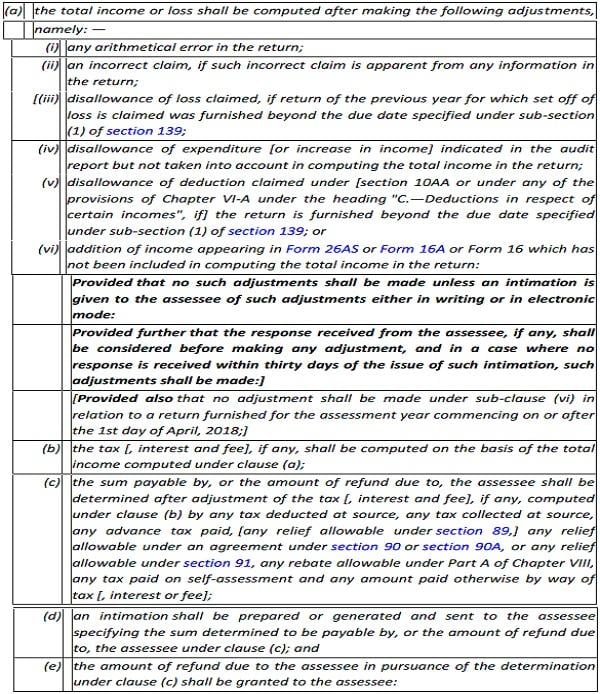
Provided that an intimation shall also be sent to the assessee in a case where the loss declared in the return by the assessee is adjusted but no tax [, interest or fee] is payable by, or no refund is due to, him:
Provided further that no intimation under this sub-section shall be sent after the expiry of [nine months] from the end of the financial year in which the return is made.
Explanation —for the purposes of this sub-section, —
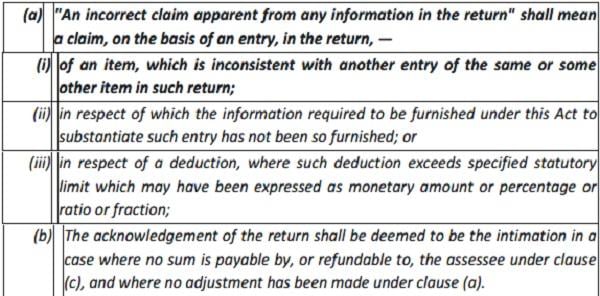
(1A) For the purposes of processing of returns under sub-section (1), the Board may make a scheme for centralised processing of returns with a view to expeditiously determining the tax payable by, or the refund due to, the assessee as required under the said sub-section.
(1B) Save as otherwise expressly provided, for the purpose of giving effect to the scheme made under sub-section (1A), the Central Government may, by notification in the Official Gazette, direct that any of the provisions of this Act relating to processing of returns shall not apply or shall apply with such exceptions, modifications and adaptations as may be specified in that notification; so, however, that no direction shall be issued after the 31st day of March, [2012].
(1C) every notification issued under sub-section (1B), along with the scheme made under sub-section (1A), shall, as soon as may be after the notification is issued, be laid before each House of Parliament.] [(1D) Notwithstanding anything contained in sub-section (1), the processing of a return shall not be necessary, where a notice has been issued to the assessee under sub- section (2): Provided that the provisions of this sub-section shall not apply to any return furnished for the assessment year commencing on or after the 1st day of April, 2017.]
5. As noted above, neither assessee’s response to proposed adjustment was considered, nor application u/s. 154 of the Act was disposed of, these falls in the violation of proviso 1 and 2 of the section 143(1) and makes whole action null and void. Further, as the case of assessee was scrutinized u/s. 143(2) and assessment order u/s. 143(3) was passed, technically the doctrine of merger comes into picture, therefore the impugned adjustment by CPC gets merged into order passed u/s. 143(3) of the Act and order passed u/s. 143(3) only survives. As far as reporting by Tax Auditor is concerned, maybe he has been appointed by the assessee, still his independence is always assumed and he is always free to give his own legal opinion, but the same is not binding on assessee or revenue.
6. In view of above legal and factual discussion it can be reasonably hold that final order in this case is assessment order passed by AO u/s. 143(3) r.w.s. 144B of the Act and not the intimation/order passed by CPC, Bangalore u/s. 143(1) of the Act. Effectively, when order passed by AO u/s. 143(3) r.w.s. 144B of the Act is final and therein no such addition is there, whole issue becomes academic including the appeal order passed by the Ld. CIT (A) U/s. 250 of the Act. In the result grounds of appeal raised by the assessee is allowed.
7. In the result, appeal of the assessee is allowed.
Order pronounced in the open court on 22nd day of September, 2023.