
Amitabh Tayal Vs ITO (ITAT Delhi)
Summary: ITAT Delhi allowed two appeals of the assessee concerning AY 2017-18—ITA No. 636/Del/2026 relating to the quantum assessment and ITA No. 637/Del/2026 relating to penalty under Section 271AAC(1) of the Income-tax Act, 1961. In the quantum proceedings, an investigation concerning Shri Joginder Pal Gupta, described as an entry operator, led to an allegation that the assessee had benefited from bogus entries provided through a shell company controlled by him. The Assessing Officer treated an unsecured loan of Rs.2.25 crore as income under Section 69D. The assessee’s first appeal was dismissed in limine by the CIT(A)-NFAC because a six-month delay in filing the appeal was not condoned. Before the Tribunal, apart from challenging the orders below, the assessee raised a jurisdictional objection that approval under Section 151 had been obtained from the PCIT rather than the statutorily designated higher authority.
The assessee relied upon the Supreme Court decision in Union of India v. Rajeev Bansal, reported in 469 ITR 46 (SC), and contended that for AY 2017-18 the PCIT could grant sanction, even after taking the benefit of TOLA, only up to 30.06.2021. The notice under Section 148 was, however, issued on 18.07.2022 after approval from PCIT-12, Delhi. The Tribunal noted that paragraphs 77-78 of Rajeev Bansal specifically illustrate the position for AY 2017-18: even after the extended TOLA period, the authority specified under Section 151(i), namely the PCIT, could grant sanction only up to 30.06.2021. As a logical corollary, a notice issued thereafter beyond three years required prior approval of the PCCIT under Section 151(ii).
Since the statutory approval had been obtained from the PCIT rather than PCCIT, the Tribunal held that assumption of jurisdiction was illegal and the consequential assessment order invalid in law. The quantum assessment was therefore quashed. Since the penalty under Section 271AAC(1) in ITA No. 637/Del/2026 emanated from the quashed quantum assessment, the Tribunal held that the penalty could not survive and directed its deletion. Both appeals were accordingly allowed. The order was pronounced on 06.05.2026. ([TaxGuru][1])
Cases Discussed
- Union of India Vs Rajeev Bansal (Supreme Court); (2024) 469 ITR 46 (SC).
FULL TEXT OF THE ORDER OF ITAT DELHI
1. This is a batch of two appeals pertaining to the same assessee. ITA No.636/Del/2026 pertains to the quantum for AY 2017-18, while ITA No.637/Del/2026 pertains to a penalty levied u/s 271AAC(1) of the Income Tax Act, 1961 (hereafter as “the Act”). ITA 636 arises from order dated 12.11.2025, passed u/s 250 of the Act, by Ld. CIT(A)-NFAC. ITA 637 arises from order dated 13.11.2025, passed u/s 250 of the Act, by Ld. CIT(A)-NFAC.
1.1 In the quantum matter apparently there was an investigation carried out on one Shri Joginder Pal Gupta, an entry operator. It was alleged that the assessee had benefitted from bogus entries provided by one of the shell companies controlled by said Shri Joginder Pal Gupta. Admittedly during the course of assessment proceedings no worthwhile compliance was made and the Ld. AO held that the unsecured loan amounting to Rs.2,25,00,000/- was added u/s 69D of the Act.
1.2 The assessee approached the Ld. CIT(A) where he could not succeed on the ground that the delay of six months in the filing of first appeal was not condoned and the appeal was dismissed in limine.
1.3 Thereafter the assessee has approached the ITAT with grounds challenging the action of authorities below and more importantly, has challenged the assumption of jurisdiction in the matter by stating that the approval u/s 151 of the Act was not obtained from the designated officer, but from a lower ranked officer.
2. Before us the Ld. AR filed a brief written submission in which a table of dates was filed. The Ld. AR used this table of dates to demonstrate that following the case of Rajeev Bansal reported in 469 ITR 46 (SC), the approval was required from the Pr. CCIT and not the PCIT as has been done in the case. For the sake of reference, this particular table deserves to be extracted as under: –
The Ld. AR argued that the notice dated 18.07.2022 was issued u/s 148 of the Act, after seeking approval from PCIT-12, Delhi. It was the submission that following the Rajeev Bansal case (supra) the competent authority for granting such approval for a notice issued beyond three years from the end of AY 2017-18 was the PCCIT as per section 151(ii) of the Act. It was the further submission that even with the benefit of TOLA the maximum extended time for the PCIT to grant approval for AY 2017- 18 was 30.06.2021 [section 151(i) of the Act]. It was pointed out that the
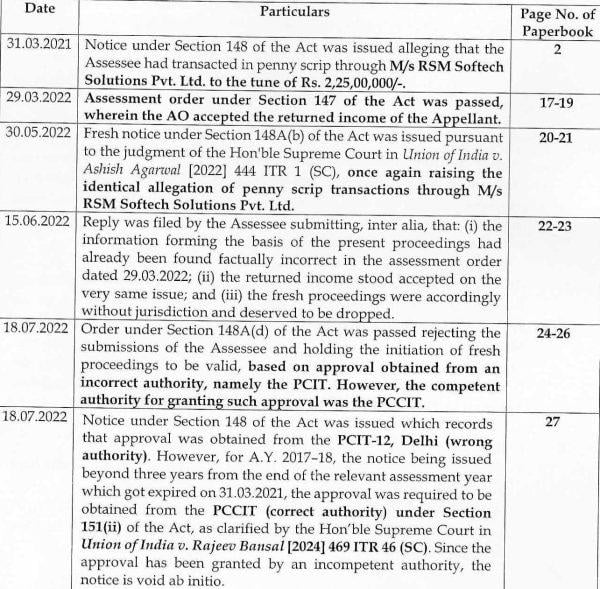
The Ld. AR argued that the notice dated 18.07.2022 was issued u/s 148 of the Act, after seeking approval from PCIT-12, Delhi. It was the submission that following the Rajeev Bansal case (supra) the competent authority for granting such approval for a notice issued beyond three years from the end of AY 2017-18 was the PCCIT as per section 151(ii) of the Act. It was the further submission that even with the benefit of TOLA the maximum extended time for the PCIT to grant approval for AY 2017- 18 was 30.06.2021 [section 151(i) of the Act]. It was pointed out that the necessary approval was granted on 18.07.2022, nearly 12 months after the extended deadline.
2.1 The Ld. DR relied on the orders of the authorities below and stated that none of the facts had been examined at lower levels and therefore it was not possible to comment with any degree of accuracy about the dates mentioned.
3. We have carefully considered the submissions of Ld. AR/DR and have gone through the records and documents before us. While it deserves to be noted with a sense of concern that the assessee has been very casual in terms of complying before the authorities below and thus, we are faced with a situation where the issue of assumption of jurisdiction is coming up for the first time before the ITAT only. However, the Ld. AR has been able to demonstrate that the notice dated 18.07.2022 issued u/s 148 of the Act should have been issued only after obtaining the prior approval of the PCCIT u/s 151(ii) of the Act. In paras 77 to 78 of the Rajeev Bansal case (supra), it is clearly mentioned as an illustration for AY 2017-18 that even after the extended period under TOLA the specified authority u/s 151(i) of the Act, being the PCIT, could grant sanction till 30.06.2021 only. Thus, as a logical corollary to this illustration any notice beyond three years would need to be approved by the PCCIT u/s 151(ii) of the Act. Considering this position of law it is held that the assumption of jurisdiction was illegal and thereafter the consequential assessment order is invalid in the eyes of law.
3.1 Regarding ITA 637, which is a penalty emanating from the quantum order, it deserves to be held that since the quantum order has been quashed hence, this penalty also cannot survive. The same is directed to be deleted.
4. In the result, both the appeals of the assessee are allowed.
Order pronounced in the open court on 06.05.2026.







