Mohanlal Premraj Shah Vs ITO (ITAT Surat)
Unaccounted Purchase Cannot Be Taxed Along With Estimated Profit: ITAT Treats Cash Purchase as Additional Turnover and Restricts Addition to Embedded Profit
Summary: The Surat Bench of the Income Tax Appellate Tribunal has held that where an undisclosed purchase is connected with the assessee’s existing business, the entire purchase amount cannot ordinarily be assessed as unexplained expenditure in addition to the profit arising from the corresponding sales. What can reasonably be brought to tax is the profit embedded in the undisclosed business transaction.
Accordingly, against additions aggregating to ₹8,53,177, the Tribunal sustained only ₹51,760 as additional presumptive business income. It also categorically held that Section 115BBE was not applicable, as the amount sustained was assessed as business income under Section 44AD and not as unexplained expenditure under Section 69C.
Facts of the case
The assessee was an individual engaged in the small-scale retail trading of firecrackers. For Assessment Year 2020-21, he filed his return declaring total income of ₹17,25,580, which included presumptive business income of ₹3,70,337 under Section 44AD on a disclosed turnover of ₹14,30,837. Thus, the assessee had declared profit at an effective rate of 25.88% of turnover.
Subsequently, the Assessing Officer received information from the Investigation Wing concerning a search conducted under Section 132 on the Ambica Fireworks Group and a connected survey under Section 133A on M/s Ambica Ashish Trade Link LLP.
During those proceedings, the Department found certain documents, including:
- a Rojmel or slip containing the assessee’s name;
- an invoice issued by Ambica Ashish Trade Link LLP in the name of M/s Jay Ambe Fataka Bhandar; and
- the statement of the logistics manager of Ambica Ashish Trade Link LLP.
Based on this material, the Assessing Officer reopened the assessment under Sections 147 and 148, alleging that the assessee had made unaccounted cash purchases.
The assessee denied having made any such cash purchases. He also produced the ledger account and confirmation of Ambica Ashish Trade Link LLP. Nevertheless, the Assessing Officer made an addition of ₹6,77,770 under Section 69C towards alleged unaccounted purchases. A further addition of ₹1,75,407, calculated at 25.88% of ₹6,77,770, was made towards the estimated profit on the alleged corresponding sales.
The Commissioner (Appeals) confirmed both additions.
Assessee’s contentions
The assessee contended that he was carrying on a small retail business and had already offered income under the presumptive taxation scheme contained in Section 44AD. Consequently, he was not required to maintain detailed books of account.
It was further argued that the invoice relied upon by the Assessing Officer was issued in the name of M/s Jay Ambe Fataka Bhandar and did not contain the assessee’s name. Therefore, neither that invoice nor the logistics manager’s statement established that the assessee had made unaccounted purchases.
The Rojmel containing the assessee’s name had been found at a third party’s premises and not from the assessee. Hence, the assessee argued that no addition could be made solely on that basis.
Tribunal’s findings
The Tribunal noticed that the Rojmel dated 12 September 2019 contained the assessee’s name and an amount of ₹2,00,000 against it. Since the date fell within the relevant previous year, the slip constituted tangible evidence of a cash transaction connected with the assessee.
The ledger and account confirmation furnished by the assessee did not record this transaction. All the recorded payments had been made through NEFT or RTGS, and no cash payment of ₹2,00,000 appeared in the disclosed records. On a cumulative consideration of the evidence, the Tribunal concluded that the transaction of ₹2,00,000 remained outside the assessee’s disclosed accounts.
However, the Tribunal found no basis for the Assessing Officer’s determination of unaccounted purchases at ₹6,77,770. When specifically questioned, the Departmental Representative was unable to explain how that figure had been arrived at.
More importantly, the Tribunal held that once the purchase was connected with the assessee’s existing firecracker business, the corresponding goods would ordinarily have been sold and would have generated cash. Therefore, it would be unreasonable to assess the entire purchase as unexplained expenditure and then make a separate addition for profit on the presumed sales.
Addition restricted to ₹51,760
The Tribunal treated the undisclosed purchase of ₹2,00,000 as additional business turnover. Applying the assessee’s own declared profit rate of 25.88%, it computed the taxable income at ₹51,760.
The balance additions were directed to be deleted.
The Tribunal further clarified that the amount was being assessed as presumptive business income under Section 44AD, and not as income falling under Sections 68, 69, 69A, 69B, 69C or 69D. Consequently, the higher rate of taxation prescribed under Section 115BBE had no application. The income of ₹51,760 was liable to tax at the normal slab rates applicable to an individual.
The appeal was, therefore, partly allowed.
Author’s comments
The decision correctly addresses the element of duplication in the assessment. Taxing the entire alleged purchase under Section 69C and then separately taxing profit on the corresponding sales may result in bringing both the business outlay and the income generated from that outlay to tax.
At the same time, the ruling should not be understood as laying down an absolute proposition that unaccounted purchases can never be assessed under Section 69C. The treatment would depend upon whether the assessee demonstrates that the purchase formed part of an identifiable business cycle and that the corresponding sales generated funds available for circulation.
Interestingly, the Tribunal applied the assessee’s actual declared margin of 25.88%, rather than the statutory presumptive rate of 8% or 6%. This substantially higher margin appears to have been adopted as a fact-specific measure to bring finality to the litigation.
The Tribunal itself expressly clarified that its decision was rendered on the peculiar facts of the case and should not be quoted or treated as a precedent. Nevertheless, its reasoning on the impropriety of taxing both the alleged purchase and the estimated profit, as well as its distinction between business income and deemed income taxable under Section 115BBE, remains practically significant.
FULL TEXT OF THE JUDGMENT/ORDER OF ITAT, SURAT BENCH
Feeling aggrieved by order of first appeal dated 05.12.2025 passed by learned Commissioner of Income-Tax (Appeals)-NFAC, Delhi [“CIT(A)”], which in turn arises out of assessment-order dated 30.03.2025 passed by learned ITO, Ward-5, Vapi [“AO”] u/s 147 of Income-tax Act, 1961 [“the Act”] for Assessment-Year [“AY”] 2020-21, the assessee has filed this appeal.
2. Precisely stated, the facts of the case are as under:
(i) The assessee-individual is engaged in trading business of fire crackers, etc. For AY 2020-21, the assessee filed return u/s 139 declaring a total income of Rs. 17,25,580/- (inclusive of business income of Rs. 3,70,337/- u/s 44AD) which was duly accepted. Subsequently, the AO received information from DDIT, Unit-2(1), Ahmedabad stating that during the course of search u/s 132 conducted on “M/s Ambica Fireworks Group” and a survey u/s 133A conducted on “M/s Ambica Ashish Trade Link LLP”, certain incriminating documents were found and seized/impounded. In Paras 5.2 to 5.4 of assessment-order, the AO has re-produced (i) a Rojmel (slip) containing the name of assessee, (ii) one Invoice No. B10935 dated 11.11.2023 issued by “M/s Ambica Ashish Trade Link LLP” in the name of “M/s Jay Ambe Fataka Bhandar”, and (iii) statement of Shri Tejas Vikrambhai Modi, Logistics Manager of “M/s Ambica Ashish Trade Link LLP”. Based on this information, the Ld. AO formed a belief that the assessee had made unaccounted purchases in cash during the previous year 2019-20 relevant to AY 2020-21 under consideration from “M/s Ambica Ashish Trade Link LLP”, which had given rise to income chargeable to tax but the same had escaped assessment. Accordingly, the AO issued notice dated 31.03.2024 u/s 148 to re-open assessee’s case u/s 147. In response, the assessee re-filed return on repeating the original income of Rs. 17,25,580/-.
(ii) Thereafter, the AO issued notices u/s 143(2)/142(1) which were complied with by the assessee. During proceedings, the assessee filed details of purchases and A/c confirmation of “M/s Ambica Ashish Trade Link LLP”. The assessee also submitted that he had declared profit of business under presumptive taxation scheme u/s 44AD. The assessee also denied having made any cash purchase as alleged by AO. However, the Ld. AO rejected assessee’s submissions and completed assessment by making (i) an addition of Rs. 6,77,770/- u/s 69C on account of unaccounted purchases, and (ii) a further addition of Rs. 1,75,407/- [25.88% of Rs. 6,77,770/-] on account of estimated profit on alleged sales made out of such unaccounted purchases.
(iii) Aggrieved, the assessee carried matter in first-appeal but the Ld. CIT(A) did not grant any relief.
(iv) Now, the assessee has come before us in present appeal.
3. The assessee has raised following grounds:
“1. The Ld.CIT(Appeals) confirmed additions of Rs.6,77,770/- based onloose papers found at the presmis of third party and without considering th submissions made by the assessee.
2. The Ld.CIT(Appels) confirmed additions of Rs.174507 as GP addition on correspondign sales based on loose papers found at the premises of third party and withotu considerign the submissions made by the assessee.”
4. During hearing before us, the Ld. AR for assessee made following submission:
(i) That the assessee is engaged in a very small-scale retail business.
(ii) That the assessee has no other source of income except the aforesaid business.
(iii) That the assessee is covered under presumptive provision of section 44AD. Accordingly, the assessee declared a business turnover of Rs. 14,30,837/- and business income @ 25.88% of turnover amounting to Rs. 3,70,337/- u/s 44AD in the return originally filed u/s 139 as well as re-filed u/s 148.
(iv) That, having opted for presumptive taxation u/s 44AD, the assessee was not required to maintain books of account.
(v) That, the Invoice No. B10935 dated 11.11.2023 issued by “M/s Ambica Ashish Trade Link LLP” re-produced by Ld. AO in Para 5.3 of assessment-order, which is the basis for alleging unaccounted purchase by assessee, is in the name of “M/s Jay Ambe Fataka Bhandar” and it nowhere contains the name of assessee. Therefore, the said Invoice does not pertain to present assessee. Consequently, the statement of Shri Tejas Vikrambhai Modi, Manager of “M/s Ambica Ashish Trade Link LLP”, relied by Ld. AO in Para 5.4 of assessment-order, also has no relevant to assessee.
(vi) That, the impounded Rojmel (slip) containing the name of assessee, as re-produced in Para 5.2 of assessment-order, had been found at the premise of third party and not at the premise of assessee. Therefore, the Ld. AO is wrong in making addition on the basis of such document which is not found at assessee’s premise.
(vii) That, the assessee did not make any unaccounted purchase as alleged by the Ld. AO. Hence, no addition is warranted.
5. Per contra, Ld. DR supported the order of AO. He submitted that the AO has acted on the basis of information received from Investigation Wing. He submitted that the AO has re-produced the Rojmel (slip) found during the search/survey proceeding undertaken by authorities, which clearly contains the name of assessee. Therefore, the impugned additions made by Ld. AO are based on documentary evidences. He requested to uphold the additions made by Ld. AO.
6. We have carefully considered the rival submissions of both sides and have perused the orders of lower authorities as well as the material placed on record to which our attention was drawn during the course of hearing. The core issue arising for adjudication in the present appeal is whether the AO was justified in making the impugned addition of Rs. 6,77,770/- u/s 69C on account of unexplained purchase transactions and a further addition of estimated profit of Rs. 1,75,407/- thereon.
7. Having carefully examined the material on record, we find that there was a Search u/s 132 on “M/s Ambica Fireworks Group” and connected Survey u/s 133A on “M/s Ambica Ashish Trade Link LLP” by tax authorities during which a Rojmel (slip) had been found. The said Rojmel (Slip), produced by Ld. AO in Para 5.2 of assessment-order, is re-produced below for an immediate reference: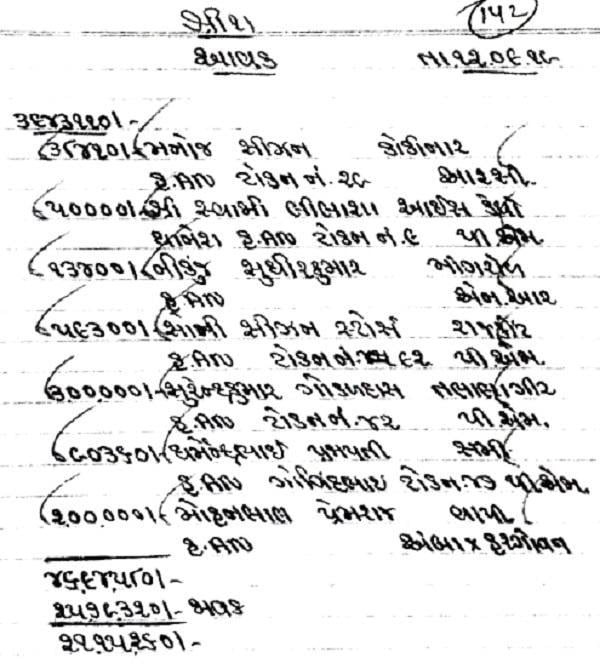
8. The above Rojmel (slip) is dated 12.09.2019 falling within financial year 2019-20 relevant to AY 2020-21 under consideration. Further, it contains the name of the assessee along with a sum of Rs. 2,00,000/- against his name. Thus, the seized document constitutes tangible evidence indicating a cash transaction of Rs. 2,00,000/- relating to the assessee. The fact that “M/s Ambica Ashish Trade Link LLP” was undertaking cash transactions is also borne out from the invoice and the statement of its Logistics Manager recorded by the tax authorities. Further, the assessee has filed the Ledger and Account Confirmation of “M/s Ambica Ashish Trade Link LLP” at Pages 12-14 of the Paper-Book. On perusal of same, we do not find the aforesaid purchase of Rs. 2,00,000/- recorded therein. Further, we find that the assessee has made all payments through NEFT/RTGS and no cash payment is found recorded. Therefore, on a cumulative consideration of these evidences, we find that the transaction of Rs. 2,00,000/- stands outside the disclosed records of assessee.
9. However, during hearing, we raised a pointed query to learned Representatives of both sides as to the basis on which the Ld. AO had quantified the unaccounted purchases at Rs. 6,77,770/-. In response, the Ld. AR submitted that there is no basis reflected in assessment-order, while the Ld. DR was unable to demonstrate the basis of said figure.
10. Nevertheless, having regard to the totality of facts and circumstances, including the fact that the assessee is engaged in a small-scale business and has declared business income under the presumptive taxation scheme u/s 44AD, we are of the view that the entire amount of Rs. 2,00,000/- representing the undisclosed purchase cannot be brought to tax as unexplained expenditure u/s 69C. Once the purchase is found to be related to the assessee’s existing business, the corresponding business activity would necessarily involve sale of the goods and generation of cash. Therefore, what can reasonably be brought to tax in respect of such undisclosed business transaction is the profit embedded therein and not the entire amount of purchase expenditure (+) profit thereon. Accordingly, and with a view to bringing finality to the litigation between the assessee and the Revenue, we consider it appropriate to treat the amount of Rs. 2,00,000/- as additional business turnover and bring to tax presumptive business income thereon @ 25.88% which works out to Rs. 51,760/- [25.88% of Rs. 2,00,000/-]. Consequently, the addition is sustained only to the extent of Rs. 51,760/-, and the Ld. AO is directed to modify the assessment-order accordingly and delete the excessive additions. Here, we would also like to make it clear that since the amount is being assessed as presumptive income from business u/s 44AD and not as income falling within the ambit of section 68, 69, 69A, 69B, 69C or 69D of the Act, the provisions of section 115BBE shall have no application to the addition sustained by us. Therefore, the Ld. AO would charge tax as per slab rates of taxation as applicable to an individual assessee and not u/s 115BBE. With this, the grounds raised by assessee are partly allowed.
11. Before parting, we clarify that the present decision is rendered on the peculiar facts of case and shall not be quoted or treated as a precedent.
12. Resultantly, this appeal is partly allowed.
Order pronounced in open court on 10/09/2026