Sudesh Synthetic Mills Private Limited Vs DCIT (ITAT Surat)
Composite Sale Consideration for Factory Land and Building Must Be Reasonably Bifurcated: ITAT Surat
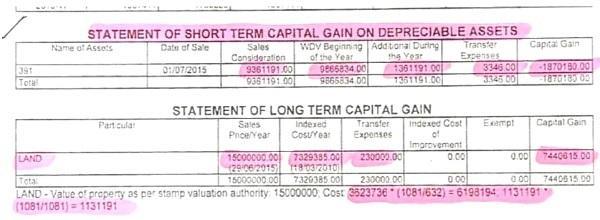
Summary: The assessee sold factory land together with a shed structure for a consolidated consideration of ₹2.30 crore. It apportioned ₹1.50 crore towards land and ₹80 lakh towards the depreciable factory building. Accordingly, it computed long-term capital gain of ₹74.40 lakh on land and short-term capital loss of ₹18.70 lakh under Section 50 on the building, offering net capital gain of ₹55.70 lakh.
The Assessing Officer rejected the bifurcation and treated the entire ₹2.30 crore as consideration for land, mainly because the purchaser had allegedly accounted for the property as land and had not claimed depreciation on the shed. He recomputed long-term capital gain at ₹1.60 crore and made an addition of ₹1.04 crore.
The Tribunal observed that the registered Deed of Assignment expressly described the transferred property as land “along with 179 sq. metres shed structure.” The assessee’s audited financial statements also consistently classified land as a non-depreciable asset and the factory building as a depreciable asset. Therefore, merely because both assets were transferred through one document for a composite price, the entire consideration could not be attributed only to land.
The allocation also had a reasonable basis. The Jantri value of the land was approximately ₹1.82 crore, whereas the assessee attributed only ₹1.50 crore to it because the land was leasehold. The Tribunal accordingly accepted the bifurcation of ₹1.50 crore towards land and ₹80 lakh towards the building. It further held that the accounting treatment adopted by the purchaser could not determine the nature of the assets in the seller’s hands.
The Tribunal also allowed deduction of the building block’s opening WDV of ₹98,66,834 under Section 50. The WDV was traceable through the returns and audited accounts of earlier years and had been accepted in a scrutiny assessment. This WDV included GEB arrears of ₹13.61 lakh capitalised in an earlier year. Since the accepted WDV had never been lawfully disturbed, the Assessing Officer could not exclude any component while computing capital gains in the year of transfer.
The additional acquisition expenditure of ₹2,20,126 claimed for transfer fees and other expenses was disallowed because the assessee failed to produce supporting material. However, brokerage of ₹2.30 lakh was allowed under Section 48 since TDS had been deducted under Section 194H, the balance was paid through banking channels and the payment was supported by the broker’s ledger account.
The appeal was consequently partly allowed.
Key principle: Where land and a depreciable building are sold together for a composite consideration, the consideration must be reasonably apportioned between the two assets. The land and building retain their separate tax identities, and their respective capital gains must be computed under the applicable provisions.
Cases Discussed
- CIT Vs. Vimal Chand Golecha (1993) 201 ITR 442 – Hon’ble Rajasthan High Court
- Commissioner of Income-tax Vs. C.R. Subramanian (2000) 242 ITR 342 (Karnataka) – Hon’ble Karnataka High Court
- Assistant Commissioner of Income-tax Vs. Shekhar Gupta (2001) 79 ITD 192 (Cal) – ITAT, Calcutta
- Assistant Commissioner of Income-tax Vs. Yamuna Syndicate Ltd. (2007) 162 Taxman 167 (CHD) (Mag.) – ITAT, Chandigarh
FULL TEXT OF THE JUDGMENT/ORDER OF ITAT, SURAT BENCH
Feeling aggrieved by the order of first appeal dated 30.05.2024 passed by learned Commissioner of Income-Tax (Appeals)-NFAC, Delhi [“Ld. CIT(A)”], which in turn arises out of the assessment-order dated 24.12.2018 passed by learned Deputy Commissioner of Income-tax, Circle – 2(1)(2), Surat [“Ld. AO”] u/s 143(3) of Income-tax Act, 1961 [“the Act”] for Assessment-Year [“AY”] 2016-17, the assessee has filed this appeal.
2. The background facts leading to present appeal are as under:
(i) The assessee is a company engaged in textiles business.
(ii) For AY 2016-17 under consideration, the assessee filed its return of income u/s 139 declaring a total income of Rs. 80,29,660/-. The case of assessee was selected for scrutiny assessment and the Ld. AO issued notices u/s.143(2)/142(1) from time to time which were complied with by the assessee. During relevant year, the assessee sold an immovable property (factory land and building) situated at Type A-1, Plot No. 498, Revenue Block No. 142 Palki & 143 Palki, Village – Vadod, District – Surat, on 02.07.2015 to M/s Diwan Silk Mills Pvt. Ltd. [“Purchaser”] for a consideration of Rs. 2,30,00,000/-. In the return of income filed to department, the assessee had bifurcated the total sale consideration of Rs. 2,30,00,000/- in two parts, namely (i) Rs. 1,50,00,000/- for land and (ii) Rs. 80,00,000/- for building. Further, the assessee treated the “land” as a long-term capital asset and “building” as a short-term depreciable asset. Accordingly, the assessee computed respective components of taxable capital gains, namely (i) long-term capital gain of Rs.74,40,615/- from land portion and (ii) short-term capital loss of Rs.18,70,180/- from building portion and offered net taxable long-term capital gain of Rs. 55,70,435/- (after setting off the short-term loss of building against long-term gain of land). The working made by assessee is re-produced below for an immediate reference (Page No. 3 and 4 of Paper-Book):
As the building component was part of depreciable fixed assets, the assessee gave effect to the block of fixed assets as under:
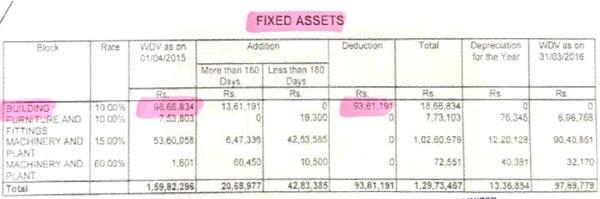
[Note: In response to a query raised by the Bench as to why the assessee had shown sale consideration of Rs. 93,61,191/- instead of Rs. 80,00,000/- against ‘Building’ in these statements, the Ld. AR for assessee clarified that the statements also contain a figure of Rs. 13,61,191/- under the column heading “Addition during the year”. Correspondingly, the “Sale consideration” had been stepped up from Rs. 80,00,000/- to Rs. 93,61,191/- . Ld. AR explained that the amount of Rs. 13,61,191/- is the amount of cost incurred by purchaser (and not by assessee), therefore in order to factorize such amount, the same was shown as an “addition during the year” and correspondingly the stepped-up sale consideration of Rs. 93,61,191/- was shown in the column of “sale consideration”. However, Ld. AR submitted, the two figures have a neutralizing effect and the effective sale consideration remains Rs. 80,00,000/- only. In nutshell, Ld. AR submitted that while computing the capital gain, the assessee had correctly taken “sale consideration” at Rs. 80,00,000/- and deducted cost of building at Rs. 98,66,834/- [equivalent to the Opening W.D.V.], which do not have the element of Rs. 13,61,191/-].
(iii) The Ld. AO, however, did not accept the aforesaid bifurcation of sale consideration done by assessee towards land and building and consequently rejected the long-term capital gain and short-term capital gain offered by assessee in the return of income. The Ld. AO treated the entire sale consideration of Rs. 2,30,00,000/- as relatable to land only and, accordingly, computed taxable long-term capital gain from land at Rs. 1,60,47,128/- and thereby made an addition of Rs. 1,04,76,693/-. The relevant portion of Ld. AO’s order is re-produced below for an immediate reference:
“4.5 The reply of the assessee is perused and placed on record. The contention of the assessee is not acceptable. The assessee is required to furnish the supporting documents for claiming the cost of acquisition on capital gains. The assessee submitted that it had incurred the expenses and furnished the ledger copies of expenses. Furnishing of ledger copies is not sufficient to claim any expenses. The assessee should furnish the documentary evidence in support of its claim otherwise, the genuineness of the claim cannot be proved.
The assessee also submitted that it has paid the GEB dues which were not for the consumption of the electricity by the company but for the consumption of the previous owner and added the same to the cost of the property which is not acceptable.
To verify the claim of Assessee, a notice u/s 133(6) of the Income Tax Act, 1961 was issued to the purchaser of the property i.e. M/s Diwan Silk Mills Pvt. Ltd. whose PAN is AAKFD9575B. On verification of the Audit reports and Balance sheet of the Assessee, it was found that the purchaser has treated the purchased property as Land and has not claimed any depreciation and treated it as non-depreciable asset both for the land and the shed in subsequent years clearly establishing the intent of the Assessee is to evade taxes and to build up losses for set off against income in subsequent years. Clearly when the purchaser of the property is also not treating the land and the shed structure separately, then the intent of the assessee(seller) is to evade taxes.
The assessee further submitted that WDV of the property as per books of account comes to Rs. 1,10,94,774/- but the company has very-very conservatively taken the value even from the revenue point of view at Rs. 80,00,000/- and offered the long-term capital gains accordingly. It is to be noted that any prudent business concern having WDV at Rs. 1,10,94,774l- in its books of account and taking the value only at Rs. 80,00,000/- for computing capital gains with a loss of Rs. 30,94,774/- is out of understanding. As such, the claim of the assessee is not acceptable.
After going through all the material available on record and the submission filed by the assessee from time to time. The sale consideration received by the Assessee of Rs. 2.30,00,000/- should be treated as LTCG and the shed structure for which depreciation has been claimed and short-term capital gain/loss working has been done separately is disallowed.
Therefore, the capital gains on the sale of property is re-worked as under:
| Sale consideration of the property | Rs.2,30,00,000/- |
| Less: cost of acquisition – 34,03,610 x 1081/632 | – Rs.58,21,681/- |
| Less: Transfer fee to GIDC in F.Y. 2015-16 | – Rs.11,31,191/- Rs. 69,52,872/- |
| Taxable long term capital gains | Rs.1,60,47,128/- |
| Less: assessee already offered for taxation | Rs. 55,70,435/- |
| Difference in LTCG | Rs.1,04,76,693/- |
As discussed above, the long-term capital gains on sale of property is re-computed at Rs. 1,60,47,128/-. As the assessee has already shown LTCG of Rs. 55,70,435/-, therefore, the difference of Rs. 1,04,76,693/- is added to the total income of the assessee on account of long-term capital gains.
(addition: Rs.1,04,76,693/-)”
(iv) Aggrieved by Ld. AO’s order, the assessee carried matter in first-appeal. However, the Ld. CIT(A) did not grant any relief and dismissed assessee’s appeal.
(v) Still aggrieved, the assessee has come in next appeal before us.
3. The assessee has raised following effective grounds:
“1. That on the facts and in the circumstances of the case as well as in law, the Id. CIT(A), NFAC, DELHI [CIT(A)] has erred in upholding the action of ld. AO in re-working and assessing the long-term capital gain (LTCG) on sale of the Factory Land and Building at Rs. 1,60,47,128/- as against the correct working of LTCG of Rs. 74,40,615/- on sale of land and short-term capital loss (STCL) of Rs. 18,70,180/- on sale of factory building (Net LTCG after set off = Rs. 55,70,435/-) worked out and declared by the appellant in return of income (ROI) and thereby erred in upholding the addition of Rs. 1,04,76,693/- made by the AO to the correct LTCG declared by appellant. Appellant prays for deleting this wrong, unjustified and erroneous addition.
2. That on the facts and in the circumstances of the case as well as in law, the Id. CIT(A) has erred in denying the bifurcation of sale consideration between land and building merely for the reason that annexure containing such bifurcation for stamp duty purpose was not found attached with the sale deed and thereby erred in upholding the apparently wrong and erroneous action of Id. AO in assuming whole of the sale consideration of Rs. 2,30,00,000/- as for land, whereas it was evident that this sale consideration was received for both land and building. If the bifurcation done by appellant was found to be not acceptable, then the Id. AO or CIT(A) must have got the fair and justifiable bifurcation ascertained by exercising powers vested in them. Not doing that and treating entire sale consideration as for land is apparently wrong, unjustified and erroneous.
3. That on the facts and in the circumstances of the case as well as in law, the Id. CIT (A) has erred in upholding the action of Id. AO in not granting deduction W.D.V. of the factory building from the combined sale consideration received for sale of land and building both and thereby erred in upholding the computation of LTCG at huge figure of Rs. 1,60,47,128/- as against the correct LTCG (net after set off) of Rs. 55,70,435/- declared by appellant. This action of Id. AO and CIT (A) of not allowing the deduction of W.D.V. of factory building is clearly contrary to the provisions of S. 50 r.w.s. 48 of the Act, as the sales consideration received was combined sales consideration for both land and building.
4. Without prejudice of generality of ground no. ‘3’ above, that the Id. AO has erred in not accepting the arrears of electricity bills of old owner of old factory building on the said land paid by the appellant to protect the said property from legal action and to make the same usable by getting power connection, as part of cost of the factory building or land and Id. CIT (A) has erred in not considering and allowing the appeal of the appellant on this issue.
5. Without prejudice of generality of ground no. ‘3’ above, that the Id. AO has erred in denying to grant lawful deduction of WDV of factory building for the reason that documentary evidence in support of this claim has not been furnished, whereas the WDV of the factory building is very much evident from the ROl of appellant for preceding years and has been b/f from last year. Appellant is lawfully entitled for deduction of same as per S. 50 of the Act. Ld. CIT (A) has erred in not allowing appeal of appellant on this issue.
6. That on the facts and in the circumstances of the case as well as in law, the Id. CIT (A) has erred in upholding the action of Id. AO in not deducting the indexed cost of improvement incurred by appellant by way of payment of transfer fee and other expenses of Rs. 2,20,126/- in relation to purchase of said land and for getting the same transferred in the name of appellant.
7. That on the facts and in the circumstances of the case as well as in law, the Id. CIT (A) has erred in upholding the action of ld. AO in not granting deduction of expenses of Rs. 2,30,000/- incurred by appellant in relation to sale of said land and building.”
Ground No. 1:
4. In this ground, the assessee is challenging the overall action of Ld. AO in rejecting the long-term capital gain and short-term capital gain declared by assessee in the return and instead assessing the taxable capital gain at Rs.1,60,47,128/- and thereby making an addition of Rs. 1,04,76,693/-.
5. This is an overall/general ground and the issues involved therein are covered by specific Grounds No. 2 to 7 which we shall be adjudicating in subsequent discussions. Hence, this ground is not required to be adjudicated separately.
Ground No. 2:
6. In this ground, the assessee is claiming that the Ld. AO has erred in rejecting assessee’s bifurcation/appropriation of composite sale consideration in two parts relatable to “Land” and “Building”.
7. Ld. AR for assessee at first drew us to Pages 37-50 of Paper-Book where the registered document titled “Deed of Assignment” executed by and between the assessee and the purchaser of impugned property is placed. The Ld. AR referred following covenants mentioned in this document:
Page 1 of document / Page 37 of Paper-Book:
“Detail of the property:-
All That piece and parcel of land bearing Type A-1 Plot No. 498 admeasuring about 2702.00 Sq. Mtr. Land alongwith 179 Sq. Mtr. Shed Structure situated at or in Pandesara Industrial Area, Revenue Block No. 142 Paiki & 143 Paiki within the Village Limits of Vadod, of Sub District : Choryasi of District : Surat.”
Page 5 of document / Page 42 of Paper-Book:
“NOW THEREFORE, it is agreed
……THAT IN CONSIDERATION of the amount of Rs. 2,30,00,000/- (Rupees Two Crore Thirty Lacs Only), with 1% TDS Tax including for which amount, the party of the First Part hereby acknowledge the receipt of the payment as mentioned below, for an against the said Plot No. A-1 type 498 alongwith Shed Structure thereon.”
Page 9 of document / Page 46 of Paper-Book:
“SCHEDULE:
All That piece and parcel of land bearing Type A-1 Plot No. 498 admeasuring about 2702.00 Sq. Mtr. Land alongwith 179 Sq. Mtr. Shed Structure situated at or in Pandesara Industrial Area, Revenue Block No. 142 Paiki & 143 Paiki within the Village Limits of Vadod, of Sub District : Choryasi of District : Surat ….”
8. Thus, Ld. AR demonstrated, the description of impugned property in the registered document itself is not just “land”, rather the subject-matter of transfer is expressly described as “land” alongwith the “shed structure”. According to Ld. AR, the “shed structure” mentioned in the registered document represents the “factory building”. Ld. AR also referred the Audited Financial Statements of assessee-company under Companies Act, 1956, placed in Paper-Book, to show that the assessee had separately shown the “land” as non-depreciable asset and “shed structure” as “Pandesara factory building” in the category of depreciable assets in its Schedule of Fixed Assets appended to the Audited Balance-Sheet. Further, the assessee has given proper treatment to the respective portions of sale consideration against the respective assets i.e. the “Land” and “Pandesara factory building” (Page 17 of Paper-Book).
9. Ld. AR thereafter relied upon following decisions wherein the identical controversy has been decided. It has been held that where the assessee has sold two assets by a composite agreement for a composite consideration, the assessee would be well within his right to segregate consideration amongst two assets and compute respective capital gains accordingly:
(i) Hon’ble Rajasthan High Court – CIT Vs. Vimal Chand Golecha (1993) 201 ITR 442
(ii) Hon’ble Karnataka High Court – Commissioner of Income-tax Vs. C.R. Subramanian (2000) 242 ITR 342 (Karnataka)
(iii) ITAT, Calcutta – Assistant Commissioner of Income-tax Vs. Shekhar Gupta (2001) 79 ITD 192 (Cal)
(iv) ITAT, Chandigarh – Assistant Commissioner of Income-tax Vs. Yamuna Syndicate Ltd. (2007) 162 Taxman 167 (CHD) (Mag.)
10. Ld. AR thereafter referred Para 6, more particularly sub-paras 6.2 & 6.3, of the impugned order of first-appeal. He submitted that the Ld. CIT(A) has neither objected to the assessee’s claim of transferred asset being land and building nor the splitting up of the capital gain into long-term and short-term in principle. The Ld. CIT(A) has, however, rejected assessee’s claim only on the footing that there is a single composite deed of transfer and there is no Annexure to such deed specifying the appropriation of consideration and that the assessee has also failed to produce the document/evidence substantiating the bifurcation/appropriation. In this regard, Ld. AR submitted, the assessee has obtained a statement of ‘Jantri’ rates for stamps duty purposes downloaded from the website of Gujrat Govt. for the area in which the impugned property sold by assessee was situated, the same is placed at Page 52 of Paper-Book. As per this statement, the prevailing ‘Jantri’ rate of land was Rs. 6,750/- per square meter. The assessee sold land admeasuring 2,702 square meters, therefore the ‘Jantri’ value would be Rs. 6750/- X 2,702 square meters = Rs. 1,82,00,000/-. Ld. AR submitted that the assessee’s land was leasehold and not freehold, therefore the assessee adopted a consideration of Rs. 1,50,00,000/- towards land which is rational and fair.
11. With these submissions, Ld. AR requested to allow the assessee’s claim of bifurcation of sale consideration towards land and building and consequent break-up into long-term capital gain from land and short-term capital gain from building offered by assessee.
12. Per contra, Ld. DR for revenue supported the orders of lower-authorities. He particularly emphasized the observations made by Ld. AO in Para 4.5 of assessment-order (re-produced above). He submitted that the Ld. AO has clearly observed that a notice u/s 133(6) was given to the purchaser and the purchaser has treated the property purchased from assessee as a single asset i.e. ‘land’ only and has not claimed any depreciation on “shed structure”. He submitted that the Ld. CIT(A) has, after due consideration, rejected assessee’s claim of bifurcation/appropriation of sale consideration and upheld the view taken by Ld. AO. He submitted that there is no error or fallacy in the orders of lower authorities, therefore the same must be upheld.
13. In rejoinder, Ld. AR drew our attention to the following submission made by assessee during the course of first-appellate proceeding as reproduced on Page No. 14 of the impugned order passed by Ld. CIT(A):
“3. However, the Facts stated are half-truth. We have discussed the matter with the purchaser (M/s Diwan Silk Mills Pvt. Ltd.) of the said property and CA of purchaser has informed us that they have classified the property as Land and Building and purchaser has not claimed any depreciation on the said asset because purchaser has commenced production later. We therefore regretfully deny the doubt of afterthought to escape taxation….”
Referring to above, Ld. AR submitted very strongly that the purchaser had classified the property purchased from assessee as ‘Land and Building’ and not ‘Land’ alone. Further, the purchaser had not claimed depreciation because the production was not commenced and hence as per provisions of Income-tax Act, the depreciation was not permissible. Without prejudice, Ld. AR submitted that the treatment given by purchaser has no bearing on the correct legal treatment to be accorded in assessee’s hands.
14. We have considered rival submissions of both sides and perused the material held on record. The short controversy arising in Ground No. 2 is whether the assessee was justified in bifurcating the composite sale consideration of Rs. 2,30,00,000/- towards “land” and the “shed structure” situated thereon?
15. On perusal of the registered Deed of Assignment placed on record, we find that the subject-matter of transfer has been described not merely as a piece of land but specifically as land “alongwith 179 Sq. Mtr. Shed Structure” situated thereon. The same description has been reiterated in the Schedule to the said document. Thus, the registered document itself evidences that the property transferred by assessee comprised of the land as well as the shed structure standing thereon. This factual position is further corroborated by assessee’s audited financial statements wherein the “land” has been separately shown as a “non-depreciable asset” and the “Pandesara factory building” has been separately reflected as a “depreciable asset”. Therefore, there can hardly be any doubt with respect to the claim of assessee that the sold property was having two assets, viz. land and building. Consequently, in our considered view, the mere fact that the transfer was effected through a single composite deed and for a consolidated consideration cannot, by itself, justify treating the entire consideration as attributable only to the “land”.
16. We further find a considerable force in the submission of the Ld. AR that the assessee’s allocation of Rs. 1,50,00,000/- towards “land” and Rs. 80,00,000/- towards the “shed structure” is not without any supporting basis. The assessee has placed on record the statement of Jantri rates applicable to the area in which the subject property was situated, according to which the prevailing Jantri rate of the land was Rs. 6,750/- per square meter, therefore the Jantri Value for 2,702 square meters of land sold by assessee works out to approximately Rs. 1.82 crore. The assessee has attributed Rs. 1.50 crore, out of the total sale consideration of Rs. 2.30 crore, towards land considering the fact that the impugned land sold by assessee was leasehold and not freehold. Thus, the amount allocated by assessee towards “land” cannot be said to be without any reasonable basis.
17. In so far as the objection of Ld. AO that the purchaser had subsequently treated the entire property as “land”, in our considered view the same does not constitute a valid basis for disregarding assessee’s claim. The nature and tax treatment of the assets transferred by the assessee have to be examined with reference to the actual property transferred and the evidence available in the hands of the assessee. In present case, as discussed earlier, the registered document itself records transfer of the “land” along with the “shed structure”. Further, the assessee had separately accounted for the “land” and “factory building” in its books and had consistently treated the “land” as a non-depreciable asset and “factory building” as a depreciable asset. Therefore, the subsequent accounting treatment adopted by purchaser cannot determine the character of asset in the hands of assessee.
18. We have carefully gone through the judicial decisions relied upon by the Ld. AR as narrated in earlier para of this order. The common principle emerging from those decisions is such that the mere fact that the land and building are transferred through a composite document for a consolidated consideration does not, by itself, justify treating the entire consideration as relatable to only land; rather the consideration is required to be reasonably apportioned between land and building. In those cases, the proportionate consideration attributable to the “land” and “building” and resultant computation of long-term and short-term capital gains from respective assets, was accepted. Therefore, the principle laid down in those cases supports the assessee’s claim in present case.
19. In view of above discussion and considering the totality of the facts and evidence available on record and respectfully following the aforesaid judicial decisions, we accept the assessee’s bifurcation of the composite sale consideration of Rs. 2,30,00,000/- into Rs. 1,50,00,000/- attributable to “land” and Rs. 80,00,000/- attributable to “shed structure/building”. Accordingly, this ground is allowed.
Ground No. 3 to 5:
20. In these grounds, the assessee is claiming that the Ld. AO has erred in not granting deduction of opening W.D.V. of block of assets as on 01.04.2015 as cost of acquisition in computing the taxable capital gain arising from transfer of building.
21. Ld. AR for assessee, at the outset, drew our attention to following documents:
(i) AY 2014-15 – The assessment-order dated 30.06.2016 passed by assessing officer u/s 143(3), is placed before us. Referring to same, Ld. AR submitted that the assessment for the year was completed by way of scrutiny and no variation was made by assessing officer in the fixed/depreciable assets. Thus, the closing W.D.V. of the building block as on 31.03.2014 at Rs. 1,09,63,149/- declared in assessee’s documents, stood accepted by the assessing officer.
(ii) AY 2015-16 – Pages 18-36 of Paper-Book where the copies of Income-tax return, Form No. 3CD forming part of audit report u/s 44AB and Audited Balance-Sheet filed by assessee to Income-tax Department, are placed. Referring to same, Ld. AR demonstrated that the opening W.D.V. as on 01.04.2014 was Rs. 1,09,63,149/-; there was no addition or deduction in the year; the assessee only charged depreciation of Rs.10,96,315/-; and hence the closing W.D.V. as on 31.03.2015 was Rs. 98,66,834/-.
(iii) AY 2016-17 – Pages 2-17 of Paper-Book where the copies of Income-tax return, Form No. 3CD forming part of audit report u/s 44AB and Audited Balance-Sheet filed by assessee to Income-tax Department, are placed. Ld. AR drew our attention to the Statement of Short-Term Capital Gain, Statement of Long-term Capital Gain and the Table showing block of “Fixed Assets” [already re-produced in earlier para 2(ii) of this order]. Referring to same, Ld. AR demonstrated that there was an opening W.D.V. of Rs. 98,66,834/- as on 01.04.2015 in “Building” block which was the same as the closing W.D.V. as on 31.03.2015.
22. Thus, on the basis of above documents, Ld. AR demonstrated that the assessee had taken the opening W.D.V. of block at Rs. 98,66,834/- as on 01.04.2015 into consideration while computing the taxable amount of short-term capital gain arising from transfer of building. According to Ld. AR, such computation is very much in accordance with the provision of section 50 of the Act and therefore, there is no justification for the Ld. AO to deny the benefit of opening W.D.V.
23. In so far as the element of GEB dues of Rs. 13,61,191/- paid by assessee and treated as part of impugned cost/opening W.D.V., Ld. AR submitted that the said amount was paid and capitalized in AY 2014-15 itself, the assessment of which had been completed by department u/s 143(3). Therefore, the treatment of same amount had already been accepted in scrutiny assessment and could not be disturbed in present year without any contrary material being brought on record. Without prejudice, Ld. AR submitted that the said amount represented arrears of electricity charges payable to Gujarat Electricity Board (GEB) which were the liability of the seller from whom the assessee had originally purchased the factory building. According to Ld. AR, the assessee was required to discharge the said liability in order to protect its interest/title in the property. As the payment was related to pre-acquisition period and was incurred in connection with the acquisition of the factory, the assessee did not claim the same as revenue expenditure but capitalized it as part of the cost of asset. Ld. AR thus submitted that the treatment given by assessee was justified and, in any event, the same had already been accepted in the scrutiny assessment of AY 2014-15. Hence, Ld. AR contended, the adverse observation made by Ld. AO is not sustainable.
24. With these submissions, Ld. AR requested to allow the opening W.B.V. as claimed by assessee.
25. Per contra, Ld. DR for revenue supported the orders of lower authorities. He iterated the Para 4.5 of assessment-order (re-produced above). He emphasized Ld. AO’s observation that the assessee had not furnished documentary evidence in support of claim.
26. We have considered rival submissions of both sides and carefully perused the orders of lower authorities as also the documents placed before us. In present case, we are concerned with AY 2016-17. The Ld. AR has placed on record the income-tax records of assessee for three successive years from AY 2014-15 to 2016-17. From those records, it is clearly discernible that in AY 2014-15 which is the first year in sequence, the assessment was completed by way of scrutiny u/s 143(3) and no variation was made by assessing authority in the depreciation claimed by assessee or the fixed assets/depreciable block of assets. Needless to mention that the depreciation and depreciable assets are an important part of scrutiny assessment and since the assessing authority has not made any variation therein, the closing W.D.V. of the building block as on 31.03.2014 declared in assessee’s records at Rs. 1,09,63,149/- stood accepted by Ld. AO. In next year i.e. AY 2015-16, there was no addition to or deduction in building block and only depreciation of Rs. 10,96,315/- was charged and therefore the closing W.D.V. reduced to Rs. 98,66,834/- as on 31.03.2015. Finally, in the year under consideration i.e. AY 2016-17, the opening W.D.V. of the said block is taken at Rs. 98,66,834/-. Thus, the opening W.D.V. of Rs. 98,66,834/- claimed by assessee is duly supported by the record available with income-tax department itself. There is no material to suggest that the said W.D.V. had been disturbed or varied by the authorities. Therefore, while computing the capital gain arising from transfer of the building component in AY 2016-17 year under consideration, the said opening W.D.V. as on 01.04.2015 at Rs. 98,66,834/- is rightly claimed by assessee in terms of the provision of section 50 of the Act. As regards the GEB dues of Rs. 13,61,191/-, we find that the assessee had capitalized the said amount in AY 2014-15 and the same formed part of the W.D.V. accepted in the scrutiny assessment for that year. The Ld. AO has not brought any material on record to demonstrate that the W.D.V. accepted in that year was subsequently revised by tax authorities. In these circumstances, the same could not be excluded from the opening W.D.V. as on 01.04.2015 while computing the capital gain. Thus, in the final conclusion, we are of the view that the Ld. AO cannot deny the deduction of opening W.D.V. of building block of Rs. 98,66,834/- claimed by assessee as per provision of section 50 of the Act. Accordingly, these grounds are allowed.
Ground No. 6:
27. In this ground, the assessee is claiming that the Ld. AO has erred in not giving deduction of cost of Rs. 2,20,126/- incurred by way of payment of transfer fee and other expenses in relation to purchase of land.
28. The facts apropos to this issue are such that the assessee claimed the cost at Rs. 36,23,736/- (indexed to Rs. 61,98,194/-) in computing long-term capital gain from land, as against which the Ld. AO allowed cost at Rs. 34,03,610/- (indexed to Rs. 58,21,681/-). Thus, the Ld. AO did not allow balance cost of Rs. 2,20,126/- [Rs. 36,23,736 (-) Rs. 34,03,610], subject to indexation.
29. We find that the Ld. AO has allowed cost of Rs. 34,03,610/- by observing as under in assessment-order:
“4.1 The assessee submitted that the land was purchased by the company on 18.03.2010 for a consideration of Rs. 29,11,000/-. The assessee submitted the purchase document of the said land. The assessee submitted that total cost of the land comes to Rs. 34,03,610/- which includes stamp duty of Rs.4,63,500/- and fee of Rs. 29,110/-. This working of assessee is found acceptable.”
30. Thus, the Ld. AO has accepted the cost of acquisition to the extent of Rs. 34,03,610/- on the basis of the purchase document and the stamp duty and fee. During hearing before us, the Ld. AR has not made any submission or placed any material on record to substantiate the additional expenditure of Rs. 2,20,126/- claimed by the assessee as part of the cost of acquisition. In absence of any supporting material to establish the nature, incurrence and nexus of the said expenditure with the acquisition of land, the claim remains unsubstantiated. We, therefore, find no infirmity in the action of Ld. AO in giving deduction of Rs. 34,03,610/- only and thereby not allowing the expenditure of Rs. 2,20,126/-. Accordingly, this ground is dismissed.
Ground No. 7:
31. In this ground, the assessee is claiming that the Ld. AO has erred in not giving deduction of expenditure of Rs. 2,30,000/- incurred by assessee by way of brokerage for sale of impugned property.
32. Ld. AR for assessee submitted that the assessee paid a brokerage of Rs. 2,30,000/- to Shri Rajnikant Jayantilal Liliwal in connection with the sale of property. The assessee deducted TDS of Rs. 23,000/- u/s 194H @ 10% and the remaining payment of Rs. 2,07,000/- was made through banking channel. The Ledger A/c of Shri Rajnikant Jayantilal Liliwal is placed on Page No. 51 of Paper-Book. Thus, Ld. AR submitted that the assessee has claimed rightful deduction of brokerage expenditure as allowable u/s 48 in computing taxable long-term capital gain. The Ld. DR for revenue though supported the orders of lower-authorities yet could not show any infirmity in the claim of assessee. After a careful consideration, we find merit in the claim of assessee and therefore we direct the Ld. AO to allow deduction of Rs. 2,30,000/- as claimed by assessee u/s 48. Accordingly, this ground is allowed.
33. In result, this appeal is partly allowed.
Order pronounced in open court on 10/09/2026