ITO Vs Varda Energy and Engineering Private Limited (ITAT Raipur)
The Revenue appealed against the order dated 24.11.2023 passed by the CIT(A), NFAC, Delhi, which arose from the assessment order dated 10.03.2023 passed under Section 147 read with Section 144B of the Income Tax Act, 1961, for AY 2016-17.
The assessee had filed its return on 05.10.2016 declaring total income of Rs.10,01,510/-. Reassessment proceedings were initiated after survey proceedings involving M/s Pratyush Steels and M/s Abhishek Enterprises, during which their proprietors reportedly admitted providing bogus bills without physical delivery of goods. The AO concluded that the assessee had made bogus sales to these entities and made additions under Section 68 of Rs.1,47,64,966/- and Rs.16,89,353/- relating respectively to alleged bogus sale credits and agricultural income.
The CIT(A) deleted both additions. Regarding the first addition, the CIT(A) noted that the assessee had furnished financial statements, VAT returns, ledgers, confirmations, invoices and vehicle details. The transactions were stated to have been conducted through banking channels, VAT had been paid, records and stock registers were maintained, and accounts were audited. The CIT(A) also observed that the AO had not disproved the transactions through independent inquiry or rejected the books.
Regarding agricultural income, the assessee produced land ownership documents, sales records and expense vouchers and explained the cultivation and irrigation arrangements. The CIT(A) held that the AO had not produced documentary evidence supporting the conclusion that the agricultural income was excessive and directed deletion of the Rs.16,89,353/- addition.
Challenge to Reassessment Jurisdiction Under Section 151
Before the ITAT, the assessee raised a legal ground under Rule 27 of the Income Tax (Appellate Tribunal) Rules, 1963, challenging the validity of the approval granted under Section 151.
The assessee contended that AY 2016-17 ended on 31.03.2017 and the notice under Section 148 was issued on 27.07.2022, more than three years after the end of the assessment year. Under the amended Section 151 applicable to the new reassessment regime, where more than three years had elapsed, approval was required from the Principal Chief Commissioner, Principal Director General, Chief Commissioner or Director General, as specified in Section 151(ii).
The assessee submitted that the approval in the present case had instead been granted by the Principal Commissioner of Income Tax-1, Raipur, on 22.07.2022.
The assessee relied upon the Supreme Court’s decisions in Union of India vs Ashish Agrawal and Rajeev Bansal, as well as other judicial decisions concerning the specified authority under amended Section 151.
ITAT’s Finding on Section 151 Approval
The ITAT noted that the first notice under the old regime had been issued on 30.06.2021. Following the directions of the Supreme Court in Ashish Agrawal, the reassessment proceedings were reinstated under the new regime through an order under Section 148A(d) dated 26.07.2022 and a notice under Section 148 dated 27.07.2022.
The Tribunal observed that the notice under Section 148 was issued beyond three years from the end of AY 2016-17. Therefore, Section 151(ii) of the amended regime applied. Under that provision, the specified authority was the Principal Chief Commissioner or Principal Director General, or, where there was no such authority, the Chief Commissioner or Director General.
The Tribunal found that the approval had been granted by the PCIT-1, Raipur, who was not vested with jurisdiction to grant the approval in such circumstances. It further noted that the relevant factual position was not disputed by the Revenue.
The Tribunal rejected the Revenue’s reliance on Ashish Agrawal and the CBDT office memorandum, observing that the amended Section 151 provisions applied where the extended time under TOLA had been utilised and reassessment proceedings were undertaken under the new regime.
Assessment Quashed and Revenue Appeal Dismissed
The ITAT held that the assessment order dated 10.03.2023 under Section 147 read with Sections 144 and 144B was invalid for want of valid assumption of jurisdiction because the approval under Section 151 had been granted by an authority other than the specified authority under Section 151(ii).
Accordingly, the assessment was quashed. Since the assessment itself had been quashed for lack of valid jurisdiction, the Revenue’s appeal challenging deletion of the additions became infructuous and was dismissed.
The Revenue’s appeal in ITA No.10/RPR/2024 was accordingly dismissed. The order was pronounced in the open court on 27.12.2024.
Cases Discussed
- Rajeev Bansal (Supreme Court), (2024) 167 taxmann.com 70 (SC)
- ACIT vs Manish Financial (ITAT Mumbai), ITA No. 5055 & 5050/Mum/2024, vide order dated 02.12.2024
- Manoj Rajput vs DCIT-1(1) (ITAT Raipur), ITA No. 360/RPR/2023, vide order dated 22.10.2024
- Gigantic Mercantile (P) Ltd vs Assistant Commissioner of Income Tax (Bom HC), Writ Petition No. 1498 of 2023, dated 26.07.2024 (Bom HC)
- Cipla Pharma and Life Sciences Ltd. Vs DCIT (Bom HC), Writ Petition No. 149 of 2023 dated 02.07.2024, (Bom HC)
- Union of India vs Ashish Agrawal (Supreme Court), (2022) 138 com 64/280 taxman 183/444 ITR 1
- Commissioner of Income Tax-7, New Delhi Vs. Odeon Builder Pvt. Limited (Supreme Court), (2019) 418 ITR 315 (SC)
- Pr. CIT vs NRA Iron and Steel (P) Ltd. (Supreme Court), (2019) 103 taxmann.com 48 (SC)
- Principal Commissioner of Income Tax Vs. Sanjay Dhokad (Bombay High Court), (2023) 456 ITR 77 (Bombay)
- CIT vs. Nikunj Exim Enterprises (P) Ltd. (Bombay High Court), (2013) 35 taxmann.com 384 (Bom)
- State of A P v. A P Pensioners Association, 13 SCC 161
- East End Dwellings Co. Ltd. v. Finsbury’ Borough Council, [1952] AC 109
FULL TEXT OF THE ORDER OF ITAT RAIPUR
The captioned appeal is filed by the department against the order of Commissioner of Income Tax (Appeal), NFAC, Delhi [(in short “Ld. CIT(A)”], u/s 250 of the Income Tax Act, 1961 (in short “the Act”), dated 24.11.2023, for the Assessment Year 2016-17, which in turn arises from the order of Assessment Unit, Income Tax Department, NFAC, (in short “Ld. AO”), u/s 147 read with section 144B of the Act, dated 10.03.2023.
2. The grounds of appeal raised by the department are as under:
1. “Whether on the facts and in the circumstances of the case the ld. CIT(A) was justified in deleting the addition of Rs.1,47,64,966/- made by the AO as unexplained credit in the books of the assessee u/s 68 of the I. T. Act, 1961?”.
2. “Whether on the facts and in the circumstances of the case the ld. CIT(A) was justified in deleting the addition of Rs.16,89,353/- made by the AO as unexplained credit in the books of the assessee u/s 68 of the I. T. Act, 1961?”
3. Any other ground which may be adduced at the time of hearing.
3. The brief facts of the case are that, the assessee has filed its Return of Income for the AY 2016-17 on 05.10.2016, declaring total income at Rs.10,01,510/-. Subsequently, survey proceedings have been conducted on the premises of few other assessee’s, namely M/s Abhishek Enterprise, Pratyush Steels etc, wherein statement of Shri Abhishek Agrawal (Proprietor of M/s Pratyush Steels) and Shri Gitesh Agrawal (Prop. M/s Abhishek Enterprises) were recorded on 24.01.2019, both these persons have admitted that they are in business of providing bogus bills without physically delivered of goods. Accordingly, it was concluded that these entities were involved in providing of bogus accommodation entries to their clients on commission. Reportedly, the assessee company has made bogus sales to M/s Pratyush Steel and Abhishek Enterprises to the tune of Rs. 76,14,323/- and Rs.77,41,242/-, respectively. Therefore, reopening assessment on the basis of aforesaid information was initiated against the assessee. Subsequently, an order u/s 148A(d) was passed on 26.07.2022 and notice u/s 148 of the Act was issued on 27.07.2022. In response, notice u/s 148, assessee furnished ITR declaring the same income as was declared by the assessee in the original return u/s 139 of the Act.
4. After deliberations, certain additions were made by the Ld. AO, drawing conclusions, as under:
(3.8) Conclusion drawn: –
(a) The assessee has received credit in its books from Bogus sale bills without any actual sale to the tune of Rs. 1,47,64,966/-. Therefore, same is treated as unexplained credits in the books of the assessee u/s 68 of the Act. Tax on same has to be levied as per the provisions of section 115BBE of the Act. Penalty proceedings u/s 271 (l)(c) of the Act is initiated separately for concealment of income.
(b) The assessee has credited exempt agricultural income in its books, which remain unexplained to the extent of Rs. 16,89,353/-. Same is treated as unexplained credits u/s 68 of the Act. Tax on same has to be levied as per the provisions of section 115BBE of the Act. Penalty proceedings u/s 271(1)(c) of the Act is initiated separately for concealment of income.
4. In view of above facts, variation is made in the total income of the assessee: –
| Sl. No. | Description | Amount (in INR) |
| 1 | Income as per return of income filed u/s 148 | 10,01,510/- |
| 2 | Income as computed u/s 143(1)(a) | – |
| 3 | Variation in respect of issues: – | |
| i. | Addition u/s 68 of the Act | 1,64,54,319/- |
| 4. | Total income determined | 1,74,55,829/- |
| R/o | 1,74,55,830/- |
Subject to the above, the total income of the assessee is assessed u/s 147 r.w.s. 143(3) read with section 144B of I. T. Act, 1961 at Rs. 1,74,55,830/- Penalty proceeding u/s 271 (l)(c) of the Act has been initiated through notice issued separately. Computation of income and demand notice u/s 156 of the l. T. Act, are attached.
5. Aggrieved with the aforesaid additions made by the Ld. AO, assessee preferred an appeal before the Ld. CIT(A), wherein contentions of the assessee are partly allowed, however the entire quantum of the additions have been deleted, in favour of the assessee. The observations of Ld. CIT(A), while deleting the additions are culled out, as under:
Ground No. 2:- This ground pertains to addition of Rs.1,47,64,966/- on account of unexplained credits u/s 68 of the Income Tax Act. The appellant has submitted that the provision of section 68 of the Act will not apply to facts of the case since all the transactions have been duly recorded in the books of the accounts. The appellant has also relied on various case laws to substantiate his contentions.
The Ld. AO in his order as stated that the appellant has made bogus sales to M/s Pratyush Steels and M/s Abhishek Enterprises to the tune of Rs.76,14,323/- and Rs. 77,41,242/- respectively. The same was based on survey conducted on these two entities wherein it was admitted that they were business of providing bogus bills without physical delivery of goods, The Ld. AO being not satisfied with reply of the appellant made the said addition of Rs.1,47,64,966/- u/s 68 of the Act.
During the assessment and appellate proceedings, the appellant has furnished his financial statements, VAT returns, copy of ledger of M/S Abhishek Enterprises and M/S Pratyush Steels, confirmation from buyers, copy of invoices with details of vehicles. It can be seen that the VAT has been duly paid and has been debited as an expense P&L account TDS has also been duly deducted. During appellate stage, sample of invoices purchase/sales as well as shipping of goods were submitted which were examined to the extent of being reflected in the bank statements.
From the above, the following points seek to established identity of the party and genuineness of the transactions: –
1. Purchases from M/s Pratyush Steels and M/S Abhishek Enterprises have been made through banking channels. There is no evidence that any transaction has been done in cash.
2. VAT has been duly paid.
3. Proper record of purchases, sales etc. have been maintained by the appellant.
4. Stock register has been maintained by the appellant.
5. The accounts have been duly audited by the Auditor.
In respect of facts of the case reliance is placed on the judgment of Hon’ble Supreme Court in the case of Commissioner of Income Tax-7, New Delhi Vs. Odeon Builder Pvt. Limited as reported in (2019) 418 ITR 315 (SC) wherein it has been opined by the Apex Court that: –
“Where assessee had submitted purchase bills, transportation bills, confirmed copy of accounts and VAT registration of sellers as also their Income Tax Return and payment was made through cheques, impugned purchases could not be disallowed.
Further, in the case of Principal Commissioner of Income Tax Vs. Sanjay Dhokad, as reported in (2023) 456 ITR 77 (Bombay), Hon’ble High Court of Bombay has ruled that: –
“Where assessee, engaged in business of civil construction, made certain purchases in course of its business, since assessee had discharged initial burden of proving genuineness of transactions by providing details of parties, and, further, payments for purchases were made through proper banking channels, no addition under section 69C was to be made on account of such purchases”
In this case, the Hon’ble High Court Bombay had the occasion to follow its own decision in CIT vs. Nikunj Exim Enterprises (P) Ltd. (2013) 35 taxmann.com 384 (Bom) and distinguish the facts from the judgment of Hon’ble Supreme Court in Pr. CIT vs. NRA Iron and Steel (P) Ltd. (2019) 103 taxmann.com 48 (SC). The entire facts and discussion centred around the discharge of onus by the Assessing Officer/s in these cases.
In the facts which pertain to the matter at hand, it is evident that Ld. AO had not discharged is onus of disproving the transactions between the M/S Pratyush Steels and M/S Abhishek Enterprises as a sham arrangement from the documentary evidence at hand. The entire case of the Ld. A.O. rests on the information received from the Investigation Wing without any inquiries. Hence, the addition made by the AO cannot be sustained.
Further, the Ld. AO although made the impugned addition on bogus purchases, no comments have been made on the nature of sales made by the appellant. Neither has the AO rejected the books of the accounts of the appellant nor has he recast the trading results based on gross profit. The additions cannot be sustained on these grounds as well.
In view of the above addition of Rs. l,47,64,966/- made u/s 68 by the Ld. AO is hereby deleted. The ground no. 2 is allowed.
Ground no.3:- pertains to addition of agricultural income of Rs.16,89,353/- as unexplained credits u/s 68 of the Act. The appellant has put forth the argument that the basis of findings of the Ld. AO are incorrect and contrary to the material and facts on record.
During the course of assessment proceedings, the Ld. AO observed that the assessee has 12 acres of land on which net agricultural income is Rs.13,23,480/-that the assessee claimed yield per hector at Rs.47,20 quintal per hector and sale price of Rs.8592/- per quintal which were extremely high when compared with rates of Krishi Vigyan Kandra, Raipur. Further, as per Ld. AO the assessee company claimed that it was converting Maize into Maize seeds and selling it at higher rate to farmers and that the land owns by assessee as per records was not irrigated.
During the course of appellate proceedings, the appellant has produced the details of his land holdings (12 Acres) with ownership documents, the sales register has been produced wherein total production stands at 22890 kilograms and the total sales has been shown at Rs.19,66,850/-. The appellant has also attached the vouchers of expenses including labour charges, tractor rent, seed cost and pesticides & fertilizers. The appellant has explained that irrigation is done by them through public water canals in which no electricity is involved. Further, electricity is free from farmer in the state of Chhattisgarh.
It is pertinent to mention that the total produce of agriculture and expenses are commensurate to the land holding of the appellant. The Ld. AO has not brought on record any documentary evidence to substantiate his findings that agricultural income is quite high except for quoting the price from Krishi Vigyan Kandra. His findings are purely based on assumptions and surmises. The price of all the farm lands are different and cannot be taken at average rates. Here it is pertinent to mentioned that the agricultural land of the appellant is near the river. Hence, the production as well as the cost advantage lies with him.
Further the appellant has produced evidences to indicate that, he is setting up a starch manufacturing project. In starch manufacturing process, maize is one of the raw materials. Before the manufacturing has to start, the assessee came out with a seed growing centre. The appellant has submitted necessary documentary evidence including environmental clearances, technical advisory and consultancy invoices as well as evidences construction of the said plant. The assessing officer has omitted/forgotten to take into account that the assessee has not grown or sold maize but rather he has grown and sold ‘maize seed’. According to the submissions of the appellant, the seed of any fruit, vegetable or other agricultural produce is much costlier than the crop. The Ld. AO has not got the rates of maize seeds correct.
Further, the accounts of the appellant are audited and the auditor has not found any discrepancy in respect of agriculture income. In view of the above discussion, the addition made by the AO is not sustainable and the same is being directed to be deleted. The ground no.3 is allowed.
6. Aggrieved with aforesaid decision of the Ld. CIT(A), wherein the additions made by the Ld. AO are entirely deleted, the revenue have carried the matter by way of filing an appeal before this tribunal, which is under consideration in the present case.
7. At the outset, it is noticed that an application under Rule 27 of the Income Tax (Appellate Tribunal) Rules, 1963 has been filed by the assessee, raising certain legal grounds, stating that the same goes to the root of the matter, placing reliance on certain judgments of the Hon’ble High Courts and Hon’ble Apex Courts. The application u/r 27 filed before us on 6th June 2024, is culled out as under:
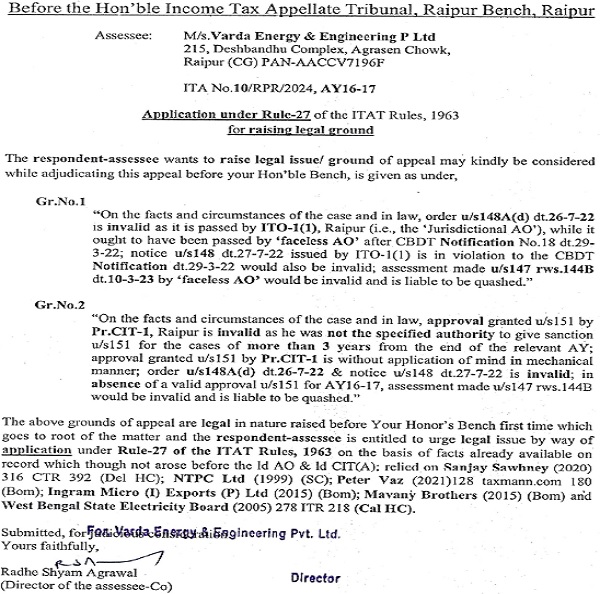
8. Based on legal ground no. 2 of the aforesaid application, Ld. AR raised the legal contention that the mandatory approval in the present case u/s 151 of the Act, was granted by the Principal Commissioner of Income Tax-1, Raipur (Pr. CIT-1), whereas, he was not the specified authority under the prescribed provisions of section 151 of the Act. To substantiate the contention so raised, Ld. AR further submitted that the reopening assessment in the present case was initiated after 3 years from the end of the relevant assessment year and the present case is covered by the amended provisions brought into the statute by Finance Act, 2021, accordingly, the specified authority for present case happened to be the Ld. Chief Commissioner of Income Tax and other authorities specified in the Act, but not the Ld. Pr. CIT, who eventually had granted approval u/s 151 in the present case. To substantiate about this factual aspect, Ld. AR drew our attention to page no. 1 & 2 of Assessee’s Paper Book (APB) comprising of notice u/s 148 dated 27.07.2022, the same is extracted as under:
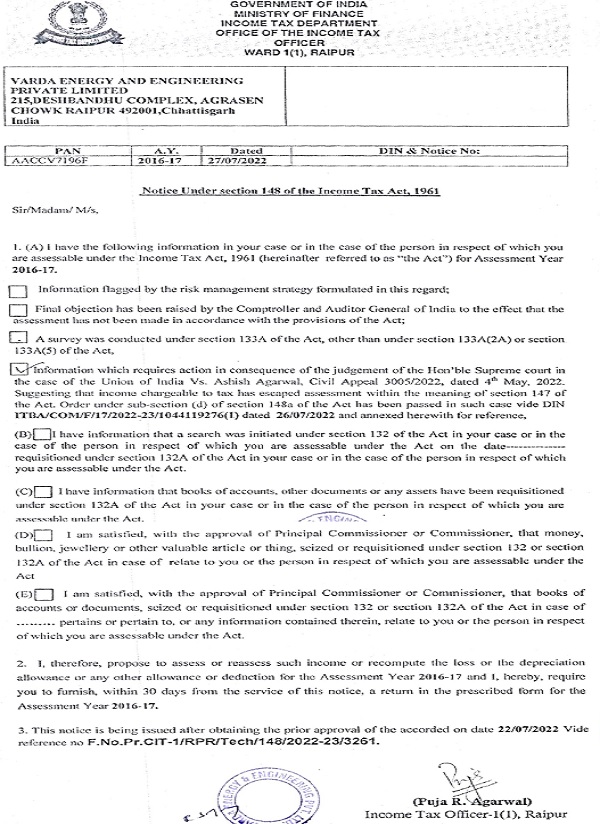
9. Based on aforesaid document, Ld. AR argued that as per para 3 of the aforesaid notice u/s 148 dated 27.07.2022, an approval was granted by Pr. CIT on 22.07.2024, vide reference no. F. No.:Pr. CIT-1/RPR/Tech/148/2022-23/3261. It is further clarified that the assessment year involved in the present case, i.e., AY 2016-17 was ended on 31.03.2017 and 3 years from 31.03.2017 were completed on 31.03.2020, therefore, the notice issued on 27.07.2022 falls in the category wherein the reopening is initiated after 3 years from the end of the AY. Accordingly, the prior approval for reopening u/s 151 granted on 22.07.2022 by the Ld. PCIT, cannot be construed as an approval granted by the specified Authority as per the mandate of section 151 of the Act. Consequently, the approval granted u/s 151 in the present case, become invalid and non-est, therefore in absence of approval by the specified authority prescribed u/s 151 of the Act, the assessment completed u/s 147 r.w.s. 144B dated 10.03.2023, is at nullity, would be invalid and is liable to be quashed.
110. Ld. AR drew our attention to the relevant provisions of section 151 under new regime effective from 01.04.2021, specifying the specified authority for the purpose of section 148 / 148A. For the sake of better interpretation, the relevant provisions are extracted as under:
[Sanction for issue of notice.
151. Specified authority for the purposes of section 148 and section 148A shall be,—
(i) Principal Commissioner or Principal Director or Commissioner or Director, if three years or less than three years have elapsed from the end of the relevant assessment year;
(ii) Principal Chief Commissioner or Principal Director General or where there is no Principal Chief Commissioner or Principal Director General, Chief Commissioner or Director General, if more than three years have elapsed from the end of the relevant assessment year.]
11. It is further submitted by the Ld. AR that by virtue of direction by the Hon’ble Apex Court in the case of Union of India vs Ashish Agrawal (2022) 138 com 64/280 taxman 183/444 ITR 1, which is further analyzed by the Apex Court in the case of Rajeev Bansal (2024) 167 taxmann.com 70 (SC) dated 03.10.2024, wherein the Hon’ble Apex Court had explain the analogy drawn in the case of Ashish Agrawal (supra), extending the limitation under TOLA read with provisions of section 151 under new regime, the same is extracted as under:
b. Interplay of Ashish Agarwal with TOLA
108. The Income-tax Act read with TOLA extended the time limit for issuing reassessment notices under section 148, which fell for completion from 20 March 2020 to 31 March 2021, till 30 June 2021. All the reassessment notices under challenge in the present appeals were issued from J April 2021 to 30 June 2021 under the old regime. Ashish Agarwal (supra) deemed these reassessment notices under the old regime as show cause notices under the new regime with effect from the date of issuance of the reassessment notices. The effect of creating the legal fiction is that this Court has to imagine as real all the consequences and incidents that will inevitably flow from the fiction. East End Dwellings Co. Ltd. v. Finsbury’ Borough Council [1952] AC 109. [Lord Asquith, in his concurring opinion, observed: “If you are bidden to treat an imaginary state of affairs as real, you must surely, unless prohibited from doing so, also imagine as real the consequences and incidents which, if the putative state of affairs had in fact existed, must inevitably have flowed from or accompanied it.”] Therefore, the logical effect of the creation of the legal fiction by Ashish Agarwal (supra) is that the time surviving under the Income-tax Act read with TOLA will be available to the Revenue to complete the remaining proceedings in furtherance of the deemed notices, including issuance of reassessment notices under section 148 of the new regime. The surviving or balance time limit can be calculated by computing the number of days between the date of issuance of the deemed notice and 30 June 2021.
109. If this Court had not created the legal fiction and the original reassessment notices were validly issued according to the provisions of the new regime, the notices under section 148 of the new regime would have to be issued within the time limits extended by TOLA. As a corollary, the reassessment notices to be issued in pursuance of the deemed notices must also be within the time limit surviving under the Income-tax Act read with TOLA. This construction gives full effect to the legal fiction created in Ashish Agarwal (supra) and enables both the assesses and the Revenue to obtain the benefit of all consequences flowing from the fiction. See State of A P v. A P Pensioners Association 13 SCC 161. [This Court observed that the “legal fiction undoubtedly is to be construed in such a manner so as to enable a person, for whose benefit such legal fiction has been created, to obtain all consequences flowing therefrom.”]
110. The effect of the creation of the legal fiction in Ashish Agarwal (supra) was that it stopped the clock of limitation with effect from the date of issuance of Section 148 notices under the old regime I which is also the date of issuance of the deemed notices]. As discussed in the preceding segments of this judgment, the period from the date of the issuance of the deemed notices till the supply of relevant information and material by the assessing officers to the assesses in terms of the directions issued by this Court in Ashish Agarwal (supra) has to be excluded from the computation of the period of limitation. Moreover, the period of two weeks granted to the assesses to reply to the show cause notices must also be excluded in terms of the third proviso to Section 149.
111. The clock started ticking for the Revenue only after it received the response of the assesses to the show causes notices. After the receipt of the reply, the assessing officer had to perform the following responsibilities: (i) consider the reply of the assessee under section 149A(c), (ii) take a decision under section 149A(d) based on the available material and the reply of the assessee, and (iii) issue a notice under section 148 if it was a fit case for reassessment. Once the clock started ticking, the assessing officer was required to complete these procedures within the surviving time limit. The surviving time limit, as prescribed under the Income-tax Act read with TOLA, was available to the assessing officers to issue the reassessment notices under section 148 of the new regime.
112. Let us take the instance of a notice issued on I May 2021 under the old regime for a relevant assessment year. Because of the legal fiction, the deemed show cause notices will also come into effect from 1 May 2021. After accounting for all the exclusions, the assessing officer will have sixty-one days [days between I May 2021 and 30 June 2021] to issue a notice under section 148 of the new regime. This time starts ticking for the assessing officer after receiving the response of the assessee. In this instance, if the assessee submits the response on 18 June 2022, the assessing officer will have sixty-one days from 18 June 2022 to issue a reassessment notice under section 148 of the new regime. Thus, in this illustration, the time limit for issuance of a notice under section 148 of the new regime will end on 1 8 August 2022.
113. In Ashish Agarwal (supra), this Court allowed the assesses to avail all the defenses, including the defence of expiry of the time limit specified under section 149(1). In the instant appeals, the reassessment notices pertain to the assessment years 2013-2014, 2014-2015, 2015-2()16, 2016-2017, and 2017-2018. To assume jurisdiction to issue notices section 148 with respect to the relevant assessment years, an assessing officer has to: (i) issue the notices within the period prescribed under section 149(1) of the new regime read with TOLA; and (ii) obtain the previous approval of the authority specified under section 151. A notice issued without complying with the preconditions is invalid as it affects the jurisdiction of the assessing officer. Therefore, the reassessment notices issued under section 148 of the new regime, which are in pursuance of the deemed notices, ought to be issued within the time limit surviving under the Income-tax Act read with TOLA. A reassessment notice issued beyond the surviving time limit will be time-barred.
G. Conclusions
114. In view of the above discussion, we conclude that:
a) After I April 2021, the Income-tax Act has to be read along with the substituted provisions;
b) TOLA will continue to apply to the Income-tax Act after I April 2021 if any action or proceeding specified under the substituted provisions of the Income-tax Act falls for completion between 20 March 2020 and 31 March 2021;
c) Section 3(1) of TOLA overrides Section 149 of the Income-tax Act only to the extent of relaxing the time limit for issuance of a reassessment notice under section 148;
d) TOLA will extend the time limit for the grant of sanction by the authority specified under section 151. The test to determine whether TOLA will apply to Section 151 of the new regime is this: if the time limit of three years from the end of an assessment year falls between 20 March 2020 and 31 March 2021, then the specified authority under section 151(i) has extended time till 30 June 2021 to grant approval:
e) In the case of Section 151 of the old regime, the test is: if the time limit of four years from the end of an assessment year falls between 20 March 2020 and 31 March 2021, then the specified authority under section 151(2) has extended time till 31 March 2021 to grant approval;
f) The directions in Ashish Agarwal (supra) will extend to all the ninety thousand reassessment notices issued under the old regime during the period I April 2021 and 30 June 2021;
g) The time during which the show cause notices were deemed to be stayed is from the date of issuance of the deemed notice between 1 April 2021 and 30 June 2021 till the supply of relevant information and material by the assessing officers to the assesses in terms of the directions issued by this Court in Ashish Agarwal (supra), and the period of two weeks allowed to the assesses to respond to the show cause notices; and
h) The assessing officers were required to issue the reassessment notice under section 148 of the new regime within the time limit surviving under the Income-tax Act read with ‘TOLA. All notices issued beyond the surviving period are time barred and liable to be set aside;
12. Based on aforesaid submission, Ld. AR submitted that since the order u/s 148A(d) along with notice u/s 148 was issued to the assessee dated 02.07.2022 i.e., after 3 years from the last date of assessment year 2016-17 i.e., 31.03.2017. In such case, an approval u/s 151(ii) granted by the Ld. PCIT stands invalid, as the specified authority in the case of assessee is Principal Chief Commissioner or Principal Director General or Where there is no Principal Chief Commissioner or Principal Director General, Chief Commissioner or Director General will be the specified authority.
13. To fortify the aforesaid contentions, Ld. AR further placed his reliance on the following case laws:
(i) ACIT vs Manish Financial in ITA No. 5055 & 5050/Mum/2024, vide order dated 02.12.2024
14. We heard the parties and perused the material on record. In assessee’s case for AY 2016-17 pursuant to the directions of the Hon’ble Supreme Court in the case of Ashish Agrawal, the AO passed an order under section 148(d) of the Act and issued a notice under section 148 on 30.07.2022. From the above observations of the Hon’ble Supreme Court it is clear that the though the prior approval under section 148A(b) and 148(d) were waived in terms of the decision of Ashish Agarwal (supra), for issue of notice under section 148A(a) and under section 148 on or after 1 April 2021, the prior approval should be obtained from the appropriate authorities specified under Section 151 of the new regime. The provisions of section 151 of the Act under the new regime read as under:
Sanction for issue of notice.
151. Specified authority for the purposes of section 148 and section 148A shall be,—
I. Principal Commissioner or Principal Director or Commissioner or Director, if three years or less than three years have elapsed from the end of the relevant assessment year;
II. Principal Chief Commissioner or Principal Director General or where there is no Principal Chief Commissioner or Principal Director General, Chief Commissioner or Director General, if more than three years have elapsed from the end of the relevant assessment year.
15. In assessee’s case from the perusal of para 3 of the notice issued under section 148 for AY 2016-17 we notice that the same is issued with the prior approval of Pr. CIT-19 Mumbai accorded on 29.07.2022 vide reference No. Pr. Cit and this fact is not contravened by the ld DR. For AY 2016-17, the period of three years have elapsed as of 31.03.2020 and the notice is issued beyond three years on 30.07.2022. Therefore as per the decision of the Hon’ble Supreme Court, the approval should have been obtained under the amended provisions of section 151(ii) of the Act i.e. the approval should have been obtained from the Principal Chief Commissioner whereas the approval has been obtained from Pr.CIT as stated in the notice under section 148 itself. Therefore we see merit in the contention of the assessee that the notice under section 148 for AY 2016-17 isissued without obtaining the prior approval from the appropriate authority. Accordingly, we hold that the notice under section 148 is invalid and the consequent assessment under section 147 is liable to be quashed.
(ii) Manoj Rajput vs DCIT-1(1) in ITA No. 360/RPR/2023, vide order dated 22.10.2024.
15. We, thus, in terms of our aforesaid observation concur with the Ld. AR that in the present case before us for A.Y.2017-18, wherein notice u/s.148 of the Act was issued on 30.06.2022, i.e. beyond a period of three years from the end of the assessment year, the A.O. was statutorily obligated to have obtained the approval from either of the authorities specified u/s. 151(ii) of the extant law, viz. Principal Chief Commissioner or Principal Director General or where there is no Principal Chief Commissioner or Principal Director General, Chief Commissioner or Director General. However, as the A.O. had obtained the approval from the Pr. Commissioner of Income Tax, i.e. an authority who was not vested with any jurisdiction as per the mandate of Section 151 of the Act (as made available on the statute w.e.f 01.04.2021), therefore, the assessment so framed by him u/s.147 r.w.s. 144 r.w.s. 144B of the Act, dated 11.05.2023 being devoid and bereft of valid assumption of jurisdiction is liable to be quashed. Accordingly, we quash the assessment framed by the A.O u/s.147 r.w.s. 144 r.w.s. 144B of the Act, dated 11.05.2023 in terms of our aforesaid observations.
(iii) Gigantic Mercantile (P) Ltd vs Assistant Commissioner of Income Tax in Writ Petition No. 1498 of 2023, dated 26.07.2024 (Bom HC).
8. It is apparent that the sanction accorded in the instant case was required to be granted under Section 151(ii) of the Act since more than three years had lapsed from the end of the relevant Assessment Year. The period of three years would expire on 3 1 st March, 2020 while the first notice (which now was purported to be a notice under Section 148A), came to be issued on 30t June, 2021 i.e. one year and three months after the lapse of three years. The sanction in the instant case has been granted by the Principal Commissioner of Income-tax-3. For cases where the reassessment is sought to be undertaken more than three years after the end of the relevant Assessment Year, the specified authorities who may sanction the reassessment are of a more senior and higher rank. Section 151 of the Act contains an inherent check and balance – when the reopening is sought to be initiated after a longer period, application of mind by the specific authorities who are even more senior (as compared with the authorities who are relatively subordinate, who are listed in Section 15 1 (i) to sanction reassessments initiated within three years) would have to be involved.
9. It is an admitted position that the sanction in the instant case had not been granted by any authority empowered under Section 15 1 (ii). Consequently, indeed, the matter at hand would be covered by the decision in Cipla, which inherently deals with the findings in Siemens. The following extracts would be relevant: –
9. The record clearly indicates that the sanction in the present case was issued by the Principal Commissioner which can only be in respect of cases if three years or less than three years have elapsed from the end of the relevant assessment year, as would fall under the provisions of clause (i) of Section 151 of the Act. As in the present case the assessment year in question is 20 16-17 and the impugned notice itself has been issued on 30 July. 2022, it is issued after a period more than 3 years having elapsed from the end of the said assessment year. hence, clause (ii) of Section 151 of the Act was applicable, which required the sanction to be issued by either Principal Chief Commissioner or Principal Director General or where there is no Principal Chief Commissioner or Principal Director General. Chief Commissioner or Director General for issuance of notice under Section 148 of the Act.
10. As rightly pointed out at the bar, such issue fell for consideration of the Division Bench of this Court in Siemens Financial Services Pvt. Ltd. (supra), wherein the Division Bench considered the provisions of Section 151 of the Act read with the provisions of Section 148A(b), the latter provision clearly providing that prior to issuance of any notice under Section 148 of the Act, the assessing officer shall provide an opportunity of being heard to the assessee only after considering the cumulative effect of Section 148A(b) read with Section 151 of the Act and as provided under sub-clause (d), the assessing officer shall decide on the basis of material available on record including reply of the assessee, whether or not it is a fit case to issue a notice under Section 148 by passing an order, with the prior approval of specified authority within one month from the end of the month in which the reply is received, It is held that the sanction of the specified authority has to be obtained in accordance with the law existing when the sanction is obtained and, therefore, the sanction is required to be obtained by applying the amended section 151(H) of the Act and since the sanction has been obtained in terms of section 15 1 (i) of the Act, the impugned order and impugned notice are bad in law and should be quashed and set aside.
[Emphasis Supplied]
10. In this view of the matter the Petition deserves to be allowed since the decision in Cipla indistinguishably a plies to the facts of the case involved in the matter at hand. In the instant case too, Assessment Year 2016 17 is involved and the sanction is accorded by the Principal Commissioner of Income-tax. Consequently, the Writ Petition deserves to be allows, which we hereby do in terms of prayer clause (a) which reads thus:-
a. that this Hon’ble Court be pleased to issue a Writ of Certiorari or any other writ order or clirection under Article 226 of the Constitution of India calling for the records of the case leading to the issue of the ilnpugned initial notice (Exhibit J) dated May 24, 2022, passing of the impugned order (Exhibit M) dated July 29, 2022 and the issue of the impugned notice (Exhibit N) dated July 29, 2022 and after going through the same and examining the question of legality thereof quash, cancel and set aside the impugned initial notice (Exhibit J) dated May 24, 2022, passing of the impugned order (Exhibit M) dated July 29, 2022 and the issue of the impugned notice (Exhibit N) dated July 29,2022;
(iv) Cipla Pharma and Life Sciences Ltd. Vs DCIT in Writ Petition No. 149 of 2023 dated 02.07.2024, (Bom HC) .
8. On a plain reading of Section 148A it is clear that the Assessing officer beföre issuing any notice under section 148 is required to follow the procedure as set out in clauses (a) to (d) of Section 148A. One of the pre-conditions as ordained by clause (d) of Section 148A is that an order under such provision can be passed by the Assessing ()fficer only with the approval of “Specified Authority”. Thus, necessarily when clause (d) of Section 148A provides for prior approval specified authority, it relates to the provisions of Section 151 of the Act providing for ‘Specified authority for the purposes of Section 148 and Section 148A of the Act’. In the present case, Section 151 as amended by the Finance Act, 2021 and Section 148A as also introduced by Finance Act, 2021 have become applicable, as although the assessment year in question is 2016-17 in respect of which the assessrnent is sought to be reopened by issuance of notice under section 148, which is dated 30 July, 2()22. Such amended provision would squarely become applicable the date of notice under section 148 itself being 30 July, 2()22.
9. The record clearly indicates that the sanction in the present case was issued by the Principal Commissioner which can only be in respect of cases if three years or less than three years have elapsecl from the end of the relevant assessment year, as would fill] under the provisions of clause (i) of Section 151 of the Act. As in the present case the assessment year in question is 2016-17 and the impugned notice itself has been issued on 30 July, 2022, it is issued after a period more than 3 years having elapsed from the end of the said assessment year, hence, clause (ii) of Section ‘1 5 1 of the Act was applicable, which required the sanction to be issued by either Principal Chief Commissioner or Principal Director General or where there is no Principal Chief Commissioner or Principal Director General, Chief Commissioner or Director General for issuance of notice under Section 148 of the Act.
10. As rightly pointed out at the bar, such issue fell for consideration of the Division Bench of this Court in Siemens Financial Services Pvt. Ltd. (supra), wherein the Division Bench considered the provisions of Section 151 of the Act read with the provisions of Section 148A(b), the latter provision clearly providing that prior to issuance of any notice under Section 148 of the Act, the assessing officer shall provide an opportunity of being heard to the assessee only after considering the cumulative effect of Section 148A(b) read with Section 151 of the Act and as provided under sub-clause (d), the assessing officer shall decide on the basis of material available on record including reply of the assessee, whether or not it is a fit case to issue a notice under Section 148 by passing an order, with the prior approval of specified authority within one month from the end of the month in which the reply is received. It is held that the sanction of the specified authority has to be obtained in accordance with the law existing when the sanction is obtained and, therefore, the sanction is required to be obtained by applying the amended section 15 1(ii) of the Act and since the sanction has been obtained in terms of section 15 1(i) of the Act, the impugned order and impugned notice are bad in law and should be quashed and set aside.
11. Insofar as the respondent’s case based on the notification dated 31 March, 202() issued under the Taxation and other Laws (Relaxation and Amendment of Certain Provisions) Act, 202() (for short, ‘TOLA’) was concerned, the Court held that such notification was a subordinate legislation and it could not override the statute enacted by the Parliarnent and in that regard, the position in law was discussed by the Division Bench in paragraph 27 of the said decision.
12. In the present ease, it is not in dispute that an appropriate sanction of the specified authority as per the provisions of Section 151(ii) of the Act was not obtained and {Or such reason, certainly, as held by this Court in Siemens Financial Services Pvt. Ltd. (supra), the impugned notices would be rendered bad and illegal. The petition accordingly needs to succeed on such ground of the Court requiring to delve on such issues of challenge as raised by the petitioner as also prior procedure adopted in that regard.
14. On this issue, Ld. Sr. DR, Dr. Priyanka Patel, placed her reliance on the orders of revenue authorities. She further referred to the report submitted by the concerned Assessing Officer dated 24.05.2023 along with copy of CBDT Circular dated 28.02.2023, extending clarifications on the issues of jurisdiction and approval u/s 151, the report so submitted by the Ld. JAO is culled out hereunder for the sake of completeness of facts:
15. Based on aforesaid submission, it was the prayer by Ld. Sr. DR that the approval is rightly granted by Ld. Pr. CIT, therefore, the additional ground raised by the Ld. AR on behalf of the assessee under Rule 27 of the ITAT Rules, 1963, raising the issue of validity of jurisdiction and sanction granted by the competent authority are not maintainable and liable to be rejected.
16. We have considered the rival submissions, perused the material available on record and the judicial pronouncements placed before us in support of the contentions. As per facts of the present case, the first notice u/s 148 (under old regime) was issued on the assessee on 30.06.2021. Subsequently, following the directions of Hon’ble Apex Court in the case of Ashish Agrawal (supra), the proceedings of reopening are reinstated under new regime by issuing a notice u/s 148A(d) along with order was issued on 26.07.2022 and notice u/s 148 (under new regime) was issued on 27.07.2022, after taking pre approval u/s 151 on 22.07.2022 vide reference no. F. No.:Pr. CIT-1/RPR/Tech/148/2022-23/3261, as evident from the copy of notice u/s 151 dated 27.07.2022. Admittedly, the present case pertains to AY 2016-17 and the notice u/s 148 for initiation of reopening assessment proceedings was issued on 27.07.2022, beyond the period of 3 years from the end of impugned AY, which got elapsed on 31.03.2020. Accordingly, as per provisions of section 151(ii) (extracted supra), the sanctioning authority under the new regime brought in the statute by Finance Act, 2021, are Principal Chief Commissioner or Principal Director General or Where there is no Principal Chief Commissioner or Principal Director General, Chief Commissioner or Director General, whereas in present case, the approval was granted by Ld. PCIT-1, Raipur, who is not vested with the jurisdiction to grant such approval. The aforesaid facts are on record and are not disputed by the revenue. Since, the issue of sanctioning authority is no more res integra, as has been specifically deliberated upon and guided by the Hon’ble Apex Court in the case of Rajeev Bansal (supra), analysing the order of Hon’ble Apex Court in the case of Ashish Agrawal (supra), wherein it is categorically held that, as per the provisions of new regime the sanctioning authority shall be decided, as prescribed amended section 151(new regime). In the present case because the reopening has been initiated after 3 years, therefore, clause(ii) of section 151 shall apply. We, thus, find substance in the contention of the Ld. AR that the approval granted u/s 151(ii) (new regime) was untenably granted by the Ld. PCIT, who do not have jurisdiction to do so, in a case wherein the process of reopening has been triggered beyond 3 years from the end of the relevant assessment year. The contention of the revenue, placing reliance on the judgment in the case of Ashish Agrawal (supra) along with CBDT’s office memorandum dated 20.02.2023, that in present case the prescribed authority is Principal CIT-1, Raipur and the approval was validly granted by the specified authority, found to be misplaced or misconstrued, as the directions by the Hon’ble Apex Court are clear, which are further clarified, that the provisions of amended section 151 shall be applied in the cases in which the revenue has availed the benefit of extended time limit under TOLA and had proceeded for reopening assessment under the provisions of new regime. We, thus, are unable to persuade and concur with the response of the Ld. AO, as per their report dated 24.05.2024.
17. Under such facts and circumstances, we are of the considered view that the impugned assessment order framed u/s 147 r.w.s. 144 r.w.s. 144B of the Act dated 10.03.2023 passed by the Ld. AO is liable to be struck down, being invalid for the want of valid assumption of jurisdiction on account of approval u/s 151 by an authority, who is not vested with jurisdiction to grant such approval or other than the specified authority under clause (ii) of section 151(new regime). Consequently, the assessment u/s 147 r.w.s. 144B of the Act dated 10.03.2023, stands quashed.
18. Since the impugned assessment u/s 147 r.w.s. 144B dated 10.03.2023 has been quashed by us, as the Ld. AO was lacking valid assumption of jurisdiction to issue notice u/s 148 of the Act, dehors valid sanction u/s 151(ii)(new regime), as elaborated and discussed hereinabove, therefore, the appeal of the revenue in support of the orders of revenue authorities has become infructuous, consequently, the same has been rendered as dismissed.
19. In result, the appeal of the revenue in ITA No.10/RPR/2024, stands dismissed, in terms of our observation.
Order pronounced in the open court on 27/12/2024.